You just woke up to a one-star review on your Airbnb listing and bookings are already dipping. Whether you’re a host who followed the rules or a guest who received a false complaint, this article gives the concrete steps that matter next.
This guide shows how to remove bad reviews airbnb users commonly encounter, how to tell when removal is realistic, and what to do if Airbnb won’t remove a review. You’ll get platform-specific actions, sample wording, timelines to expect, and alternatives when takedown isn’t possible.
We avoid wishful promises: platform decisions are controlled by Airbnb and outcomes depend on evidence, timing, and policy fits. Where removal isn’t available, you’ll learn suppression and reputation repair tactics that reduce harm to bookings and professional risk.
Table of Contents
- How can I get a bad Airbnb review removed?
- Why won’t Airbnb remove a retaliatory review?
- Can an Airbnb host retaliate for a bad review?
- Can you rebut a bad Airbnb review?
- Step-by-step: Filing an effective dispute with Airbnb
- When removal is not available: suppression and mitigation
- When to involve legal counsel or a reputation specialist
- DIY vs Agency: Which approach fits your Airbnb review problem?
- Hypothetical scenario: A host’s one-star and the three-month recovery
- Common mistakes hosts and guests make when dealing with bad Airbnb reviews
- Best practices to minimize damage from a bad Airbnb review
- Expert Tips
- Conclusion
- Why Businesses Choose Your Reputation Agency
- Frequently Asked Questions
How can I get a bad Airbnb review removed?
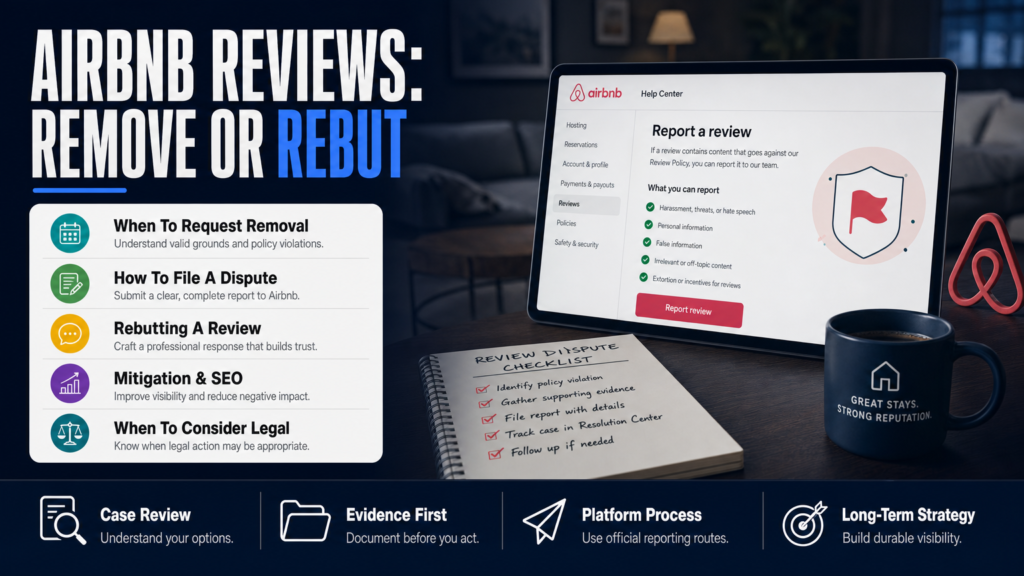
Airbnb removes reviews only when they breach Airbnb’s content or community standards (harassment, threats, hate speech, privacy violations, impersonation, or clear factual falsehoods with evidence). You can request removal, but success depends on matching Airbnb’s published policies and submitting supporting evidence.
Start by identifying which policy the review may violate. If it’s purely negative feedback about a stay (dirty room, rude host, noise) that is an opinion or truthful description — Airbnb normally won’t delete it simply for being negative.
- Open the Airbnb Help Center > Reviews section and click ‘Report a review’.
- Choose the most relevant policy violation and attach evidence (screenshots, message threads, booking records).
- Write a concise explanation: who, what, when, where, and why the review is false or violates policy.
- Submit and monitor. Airbnb will email you; allow days to a few weeks depending on complexity.
- Collect evidence: reservation records, timestamped photos, messages in the Airbnb platform, security camera timestamps (if legal), and any third-party receipts.
- Screenshots: capture the review, reviewer profile, and your listing page immediately. Preserve metadata and URLs.
- Note timing: reviews are time-limited; you may only be able to respond rather than get removal if the review doesn’t violate policy.
What to include in your report
Give Airbnb a clear, factual narrative and attach documentary proof. Avoid long emotional rants — moderators are looking for policy matches and evidence.
If the review accuses illegal conduct and that conduct is not true, attach documents that contradict the allegation (receipts, witness statements, or police reports if relevant).
- Booking confirmation that shows dates and guest identity
- In-platform messages showing the guest didn’t complain at check-out
- Photos proving the condition of the property at the relevant time
Why won’t Airbnb remove a retaliatory review?
Airbnb’s stated policy allows paired reviews and sometimes limits removal of reviews that appear retaliatory unless they clearly break content rules. A retaliatory review (written in response to a negative review) may still be allowed if it states an opinion or describes the guest’s experience without violating rules.
Airbnb’s moderation focuses on content categories, not motive. Proving retaliation is harder than proving a policy violation; you need evidence showing the review was created in bad faith or clearly violates content standards.
- Document the timeline: when each review was left, and any messages showing the exchange.
- Flag the review via Airbnb’s reporting tools with a focus on policy, not motive.
- If review was posted after a known dispute or message with threats, include those messages.
- Retaliation alone is not automatically a policy breach.
- Airbnb looks for policy violations like threats, doxxing, hate speech, or falsified facts supported by evidence.
- If the guest left a review before the host had time to review, that can complicate the timing argument.
When to escalate beyond Airbnb’s help center
If a review contains false criminal allegations, sexual content, threats, or personal data (like a home address or legal name used to harass), you can escalate with stronger evidence and ask Airbnb to prioritize safety-related violations.
If removal is denied and the content allegedly defames you or contains personal data, consult a qualified attorney to discuss legal options. Legal routes are fact- and jurisdiction-dependent and require review of the available evidence.
- Safety threats or doxxing should be escalated immediately.
- For reputational falsehoods, legal counsel can request removal via a demand letter or court order where applicable.
Relevant reading for reputational stakes
If you’re concerned about professional exposure beyond Airbnb — for example how a single negative listing review could affect licensure or client acquisition — see our analysis of broader reputational risk in Can One Bad Review Cost You Licensure or Clients?.
Can an Airbnb host retaliate for a bad review?
Hosts should not retaliate. Retaliatory actions (leaving false reviews, filing baseless complaints, or using guest data to harass) violate Airbnb policy and can expose you to suspension or legal risk. Even legitimate disagreement should be handled through platform channels or lawful dispute resolution.
If you’re a guest who believes a host retaliated, collect evidence (messages, screenshots of host activity, reservation changes) and report via Airbnb’s platform with an emphasis on specific policy violations.
- Preserve all in-platform communications and make screenshots of any off-platform contact.
- Report to Airbnb and, if you feel unsafe, consider local law enforcement for threats or doxxing.
- If you’re a host, draft a neutral professional response rather than retaliating.
- Retaliation can be a profile of behavior — document patterns, not just single incidents.
- Never contact a reviewer outside of Airbnb to persuade or threaten them; that can escalate liability.
- If a host uses guest data improperly (email, phone), that may be a privacy violation.
How hosts should respond instead
Respond publicly on the review with a concise, factual statement acknowledging the complaint and describing corrective steps if applicable. This demonstrates professionalism to future bookers.
Then, attempt to resolve with the guest through Airbnb messaging. If the guest agrees to remove or edit the review, ask them to update it through Airbnb rather than sending screenshots.
- A short public response is visible to future bookers and can blunt reputational harm.
- Avoid admitting liability for legal claims in a public response.
Can you rebut a bad Airbnb review?
Yes. Airbnb allows hosts and guests to publicly respond to reviews. A measured rebuttal can correct the narrative and provide context for future bookers — and sometimes encourage the reviewer to revise their feedback.
A rebuttal will not remove the original review. Use rebuttals to add facts, correct errors, and show that you take complaints seriously.
- Draft a short public reply no longer than 3–4 sentences.
- Include key facts: the reservation dates, steps you took, or that you attempted to resolve the issue.
- Offer an offline contact path through Airbnb messaging rather than direct email or phone.
- Keep tone neutral and focused on facts, not emotion.
- Cite booking details or policies succinctly (dates, reservation number) to support your account.
- If you corrected the issue, say what you did and when — future bookers value remediation.
Sample public rebuttal language
Do not copy word-for-word; modify to fit your facts. Example: “We’re sorry your stay didn’t meet expectations. Our records show the reservation was for X dates; we offered a full cleaning and to relocate you, per our messages on [date]. We take feedback seriously and welcome the chance to make this right.”
- Avoid accusatory language or naming the reviewer.
- Do not promise financial remedies publicly — take those discussions to Airbnb mediation.
Step-by-step: Filing an effective dispute with Airbnb
A dispute that succeeds is organized, evidence-backed, and targeted at the correct policy. Below is a practical checklist and sequence to follow.
Remember that timelines vary: some straightforward removals can happen in days, more complex safety or legal issues may take longer.
- 1) Screenshot the review, reviewer profile, and your listing page.
- 2) Export or screenshot booking confirmation showing guest identity and dates.
- 3) Gather message logs from Airbnb showing no prior complaint or attempted resolution.
- 4) Compose a 150–300 word summary that identifies the policy breach and references attached evidence.
- 5) Submit the report and make a note of the case ID and dates.
- 6) Follow up after one week if you haven’t heard back; escalate with additional evidence if needed.
- Use Airbnb’s official ‘Report a review’ workflow — off-platform requests are less effective.
- Attach clear evidence files (prefer PDFs or JPEGs) and keep filenames descriptive (e.g., booking-1234-dates.jpg).
- Keep a professional tone and cite exact policy language when relevant.
If Airbnb declines a takedown
If Airbnb rejects your request, you can still respond publicly and document the denial for any future legal needs. If the content appears defamatory or reveals private data, consult an attorney to explore a legal demand for removal.
For ongoing monitoring and to reduce long-term damage to search results, consider a suppression strategy combining new authoritative pages and SEO work.
- Retain copies of all correspondence with Airbnb and the decision rationale.
- A legal demand may be appropriate in narrow circumstances but is not always faster or guaranteed.
When removal is not available: suppression and mitigation
Often the review is an opinion or truthful description and thus not removable. When takedown isn’t available, the objective shifts to mitigation: limiting visibility and contextualizing the complaint so it doesn’t cost bookings or clients.
Mitigation combines public responses, SEO to promote positive content, and operational fixes to reduce similar complaints in future.
- Audit your first 10 organic search results for the listing or host name.
- Create or strengthen 3–5 high-authority pages (professional site, press mentions, social profiles) that present accurate, positive information.
- Request updates from satisfied guests and ask them to mention corrective actions taken.
- Publish fresh positive content: guest testimonials, local guides, and professional photos.
- Encourage satisfied guests to leave balanced reviews (never offer incentives in violation of platform rules).
- Use targeted SEO and listing optimization to push desirable content higher in search results.
Read more about the business impact of negative reviews
If you’re evaluating the economic stakes of a single negative review, our analysis on the financial effects of a one-star review in other search contexts may be instructive: What a One-Star Google Review Really Costs a Practice.
When to involve legal counsel or a reputation specialist
Legal action is sometimes appropriate but is a heavy tool: it can be costly, slow, and may raise the profile of the allegation. Consider legal counsel when the review contains demonstrably false allegations of criminality, serious professional misconduct, or private information that harms safety.
A reputation specialist can coordinate evidence, platform workflows, SEO suppression, and targeted PR. These experts don’t have special platform access; they streamline process, documentation, and strategy.
- Collect all evidence and timelines before consulting a lawyer.
- Ask any prospective reputation firm for a written scope of work and realistic outcomes.
- If pursuing legal options, discuss jurisdiction and the cost-benefit analysis with counsel.
- Legal counsel is advised for serious defamatory statements or privacy violations.
- Reputation specialists help with mitigation when removal is unlikely.
- Neither legal nor reputation services can guarantee removal or ranking outcomes.
Practical limits and expectations
Neither lawyers nor agencies can promise deletion. Platform control and legal standards (like truth as a defense in defamation) limit outcomes. The best path depends on the content, evidence, and potential downstream harm.
If you decide not to pursue removal, a combined mitigation plan can often reduce visible harm faster than litigation.
Related resource for social review damage
If negative reviews are spreading to social platforms like Facebook, consider the revenue impact and escalation options in When One Facebook Review Can Cost Your Practice Real Revenue.
DIY vs Agency: Which approach fits your Airbnb review problem?
A quick two-column look at the practical tradeoffs when addressing a damaging Airbnb review.
| DIY (Host or Guest) | Professional Agency |
|---|---|
| Cost | Higher upfront cost, scoped to work |
| Speed | Can coordinate faster follow-ups and multiple channels |
| Control | Less direct control; you approve messaging |
| Expertise | Specialized knowledge of platforms and SEO |
| Legal coordination | Often coordinates with counsel when needed |
| Suitability | Best for low-scale disputes and immediate responses |
| Best for | Best for persistent, high-stakes reputational problems |
Hypothetical scenario: A host’s one-star and the three-month recovery
A mid-sized city host (Host A) receives a one-star review claiming the property was ‘filthy’ and ‘infested’ by a guest who stayed two nights. Host A had an automated cleaning record and in-platform messages showing they offered to re-clean and refund the second night; the guest left without complaining in messages.
Host A followed the sequence below: documenting evidence, filing a removal request citing false factual statements, publicly responding to the review, and beginning a suppression campaign to promote recent positive stays.
- Step 1 — Report: File with Airbnb, attach photos of cleaning receipts and message logs.
- Step 2 — Rebut: Post a calm, factual public reply and keep a copy for records.
- Step 3 — Mitigate: Add authoritative pages and request new reviews to push the negative lower in search and listing prominence.
- Step 4 — Review: After six weeks, audit search results and continue targeted content until visibility concerns improve.
- Week 0: Capture screenshots, booking confirmation, message logs; report review to Airbnb citing false factual claim.
- Week 1–2: Publicly respond with facts and remediation steps; encourage recent happy guests to leave balanced reviews.
- Week 3–12: Publish new pages (updated listing photos, a profile page on host’s website, blog post explaining cleaning protocols) and optimize for host name keywords.
Common mistakes hosts and guests make when dealing with bad Airbnb reviews
These errors are frequent and often easy to avoid. Each one risks making the situation worse or reducing your chances of a policy-based removal.
1. Responding angrily or personally
Emotional or accusatory responses look bad to prospective bookers and can escalate the situation. Keep public replies professional and factual.
2. Asking for off-platform contact
Requesting reviews be changed outside Airbnb (email, text) violates platform norms and weakens Airbnb’s ability to verify changes. Always use Airbnb messaging for resolution documentation.
3. Not preserving evidence quickly
Airbnb and courts rely on contemporaneous evidence. Screenshots and timestamps saved immediately are far stronger than recreations weeks later.
4. Believing any negative review is removable
Negative opinions that are truthful are rarely removed. Focusing resources on mitigation and improved guest experience often returns more ROI than chasing removals.
5. Ignoring the downstream search impact
A single review can appear in Google search snippets or travel sites; failing to monitor and mitigate visibility lets reputational harm persist outside Airbnb.
Best practices to minimize damage from a bad Airbnb review
These durable practices reduce the chance a single review becomes a crisis and improve your ability to recover if it does.
1. Maintain meticulous records
Keep booking confirmations, cleaning logs, maintenance receipts, and in-platform messages organized and retrievable. Good documentation powers any removal request or dispute.
- Store files with clear filenames and dates.
- Export message threads periodically if you have frequent bookings.
2. Respond, then escalate
Publicly respond briefly and professionally, seek resolution in Airbnb messages, then use the reporting workflow if the review breaches policy or remains unresolved.
- Demonstrate remediation to future bookers.
- Avoid long public narratives — keep it short and factual.
3. Encourage balanced feedback ethically
Request reviews from satisfied guests but never offer incentives or instruct them to omit honest negative points. Platform rules prohibit buying or coercing reviews.
4. Monitor search and social
Set up alerts for your host name and listing. Early detection lets you react before a review surfaces widely in searches or social shares.
- Use simple Google Alerts or a reputation monitoring service for broader coverage.
5. Plan remediation and SEO
If removal fails, a planned content and SEO strategy can reduce the visibility of the negative review and present your listing positively in searches.
- Publish new, authoritative pages and optimize for host/listing keywords.
- Leverage local press or partnerships to create positive, indexed content.
Expert Tips
- Always save timestamps and filenames for evidence—moderators and lawyers value timelines.
- A calm public reply can convert skeptical bookers even when the review stands.
- Do not promise refunds or legal action publicly; keep those discussions in private messaging through Airbnb.
- If a review contains private data, flag it as a privacy violation—platforms prioritize doxxing and safety.
- Encourage recent satisfied guests to leave reviews, but never offer financial or off-platform incentives.
- Document every step of your report and any Airbnb responses to create a clear escalation trail.
- Consider a small professional photoshoot and listing refresh to counterbalance any narrative about cleanliness or condition.
Conclusion
A single bad Airbnb review is rarely the end of your listing, but mishandled responses can magnify harm. The right approach is a combination of clear documentation, targeted platform reporting, and thoughtful mitigation when removal isn’t possible.
If the review clearly violates Airbnb policy, report it with precise evidence. If it doesn’t, prioritize public rebuttal, operational fixes, and reputation work to reduce visibility and restore bookings. In high-stakes situations involving safety, privacy, or false allegations, consult qualified legal counsel and consider professional reputation services to coordinate a response.
Why Businesses Choose Your Reputation Agency
Managing your reputation takes more than monitoring reviews or publishing the occasional blog post. It takes a strategy built around your situation, your industry, and what is actually showing up in search.
Your Reputation Agency works with businesses, executives, healthcare professionals, attorneys and growing brands. Our services include:
- Remove or suppress negative Google search results and news articles
- Take down or mitigate negative reviews (Google, Yelp, Trustpilot, industry sites)
- Remove defamatory content, false posts and impersonation accounts
- Remove personal data from people-search and data-broker sites (opt-outs)
- Mugshot and arrest-record removal or suppression
- YouTube and negative video removal / demotion
- Rapid crisis response for viral incidents and online smear campaigns
- Social media impersonation and fake account removal
- Reputation monitoring, alerts and ongoing surveillance
- Search engine reputation repair (SEO to bury negative results)
Frequently Asked Questions
1. How to get a bad review removed?
Report the review using Airbnb’s ‘Report a review’ workflow and attach clear evidence that it violates policy (threats, doxxing, hate speech, or demonstrable false factual claims). Airbnb decides based on its policies; gather booking records, in-platform messages, and photos to support your request.
2. Why won’t Airbnb remove a retaliatory review?
Airbnb evaluates content against its policy categories, not motive. Retaliation alone is not usually sufficient for removal unless the review also contains policy violations like false factual claims, threats, or private information.
3. Can an Airbnb host retaliate for a bad review?
Hosts should not retaliate. Retaliatory behavior (false counter-reviews, harassment, misuse of guest data) can violate Airbnb rules and risk suspension or legal consequences. Handle disputes professionally through Airbnb channels.
4. Can you rebuttal a bad Airbnb review?
Yes. Hosts and guests can post public responses to reviews. Keep rebuttals concise, factual, and professional. A rebuttal won’t remove the original, but it provides context for future bookers.
5. How long does an Airbnb review dispute take?
Timing varies. Simple policy matches can be resolved in days to a few weeks; complex safety or legal issues may take longer. Platform response times depend on case volume and the nature of the violation.
6. What if removal isn’t possible?
When takedown isn’t available, focus on mitigation: publish authoritative positive content, encourage honest reviews from satisfied guests, update your listing, and use SEO to reduce the negative review’s prominence in search results.
7. When should I hire an agency or lawyer?
Consider professional help when a review includes false allegations of criminality, doxxing, or serious professional misconduct, or when the reputational harm threatens business revenue. Agencies coordinate mitigation and documentation; a lawyer evaluates legal removal options.
8. Will contacting the reviewer get the review removed?
Contacting reviewers off-platform is risky and can violate Airbnb norms; if you resolve the issue, ask the reviewer to edit or remove the review through Airbnb’s official process. Always keep communications on Airbnb when possible to preserve a verifiable record.
9. Can Airbnb remove a review if the guest is fake?
If you can show a review comes from an impersonation account or is clearly fraudulent, report it with evidence of inauthenticity (booking records not matching the reviewer, suspicious account behavior). Airbnb will investigate and may remove reviews that breach authenticity policies.
This content provides general information and does not constitute legal advice. The available options and likely outcomes depend on the facts, evidence, platform policies, applicable law, jurisdiction, and public-interest considerations.
Past examples do not guarantee future results. Removal, correction, deindexing, and search-position changes depend on third parties and circumstances outside Your Reputation Agency’s control.