You woke up to a one-star review, a damaging blog post, or a mugshot that keeps appearing in Google results. Your phone stopped ringing, staff are asking questions, and you need to know: are business reputation management services legit, and can they actually help?
This article explains what reputable reputation-management firms do, what they won’t promise, and how to evaluate options. We use clear examples — removal, suppression (SEO), review challenges, takedowns, monitoring, and coordination with counsel — and we spell out realistic results and limitations.
Read on to get a practical checklist for vetting vendors, a two-column comparison of removal vs suppression, a step-by-step hypothetical case showing how an agency might proceed, and concrete next actions you can take today if you’re a doctor, restaurateur, lawyer, consultant, or owner facing visible harm.
Table of Contents
- Are business reputation management services legit?
- What do legitimate business reputation firms actually provide?
- How to vet a firm: questions to ask and warning signs
- Removal vs suppression: which should you pursue?
- What to expect: timelines, likelihoods, and the limits of what firms can promise
- What to do when removal is NOT available
- Handling reviews and local-profile attacks
- Rapid incident response: when a post goes viral
- Removal vs Suppression: Quick Comparison
- Hypothetical: The Clinic and the Viral Review
- Common Mistakes Businesses Make With Reputation Work
- Best Practices For Working With Reputation Vendors
- Expert Tips
- Conclusion
- Why Businesses Choose Your Reputation Agency
- Frequently Asked Questions
Are business reputation management services legit?
Short answer: yes, many firms perform legitimate technical, strategic, and coordination work to reduce the visibility of harmful content and to pursue removal where policy or law supports it. Saying a service is “legit” depends on the firm’s methods, transparency, and adherence to platform rules and the law.
A legitimate provider evaluates whether the content may qualify for removal or review, pursues the legal, technical, platform-based, and reputational options available, and outlines realistic expectations. They do not promise guaranteed removal or permanent suppression, and they will say timing depends on the platform, publisher, evidence, and legal complexity.
- Document the harm: screenshots with timestamps, URLs, and any correspondence.
- Ask for a written scope of work and a clear pricing model.
- Confirm they will coordinate with legal counsel when a matter needs a legal claim.
- Legitimate activities: filing platform reports, opt-out requests with data brokers, SEO to promote authoritative content, coordinating with attorneys, and paid or organic content creation to reduce visibility.
- Red flags: promises of guaranteed removal, requests to use fake accounts, demands for passwords or private keys, or threats to fabricate content against others.
What do legitimate business reputation firms actually provide?
Legitimate firms offer a mix of services tailored to the problem: takedowns for defamatory content, review challenges on Google/Yelp/industry sites, mugshot and arrest-record opt-outs, removal requests for images or videos, data-broker opt-outs, SEO-based suppression, social-media impersonation takedowns, incident response for viral events, and ongoing monitoring.
Each service uses different tools and rules. For example, data-broker opt-outs are procedural (forms and identity verification), while takedown requests for defamation often require evidence and sometimes legal letters. SEO suppression involves creating and promoting authoritative pages to push negative items down in search results.
- Map the problem: list every URL, review, image, or profile causing harm.
- Classify each item: defamatory, privacy violation, impersonation, opinion, or public record.
- Assign an initial remedy for each classification: report, legal review, SEO, or PR.
- Platform reporting: using the publisher or platform’s official processes to request review.
- Legal coordination: drafting demand letters or coordinating with your attorney when necessary.
- Search-engine suppression: SEO and content publishing to improve the signals Google sees.
- Monitoring and alerts: early warning systems for new mentions or spikes.
- Crisis messaging: short-term PR and messaging to control narratives and external communications.
How to vet a firm: questions to ask and warning signs
Not all reputation firms are equal. Good vetting separates consultative partners from operators who overpromise or use risky tactics.
Ask specific, verifiable questions about process, tools, examples of similar work (anonymized), references, and where legal work would be required. Beware of vendors who say they have “inside” access to Google or who guarantee delisting.
- Get a written statement of scope and limits that explains removals vs suppression.
- Verify payment terms and whether fees are refundable if work is not completed as described.
- Ask how they will coordinate with your counsel or in-house security team.
- Ask for an engagement process that includes an initial assessment, documented plan, milestone-based deliverables, and what metrics they’ll track (e.g., SERP positions for target URLs).
- Request sample reports and redacted work examples for your industry (physicians and licensed professionals differ from restaurants).
- Confirm they use official platform reporting channels and lawful techniques; they should say explicitly they do not recommend deceptive or retaliatory actions.
Watch for white-label or reseller traps
Some vendors resell work from intermediaries. Confirm who is doing the work and whether communications will come directly from that party. If you rely on a white-label partner for review remediation or local-business profile cleanup, make sure there is clear accountability.
If the white-label route matters to your decision, read our piece about When White‑Label Partners Leave You With Google Reviews for common pitfalls.
Removal vs suppression: which should you pursue?
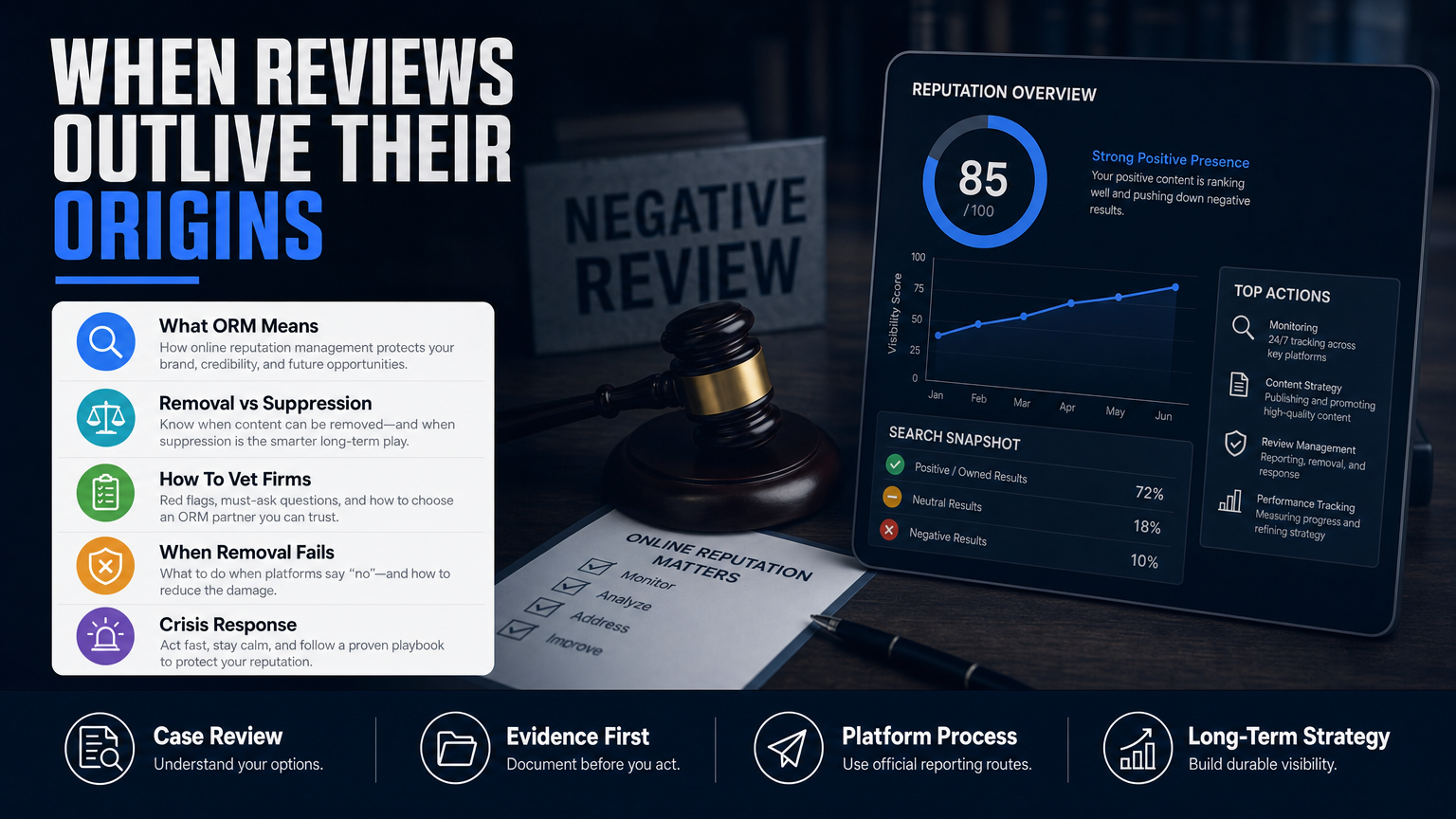
Removal (takedown) and suppression (SEO + content strategy to bury links) are different tools and often used together. Removal eliminates a specific item from a platform; suppression reduces its visibility in search results by pushing other content above it.
We evaluate whether the content may qualify for removal or review. Removal depends on platform policy, evidence, and jurisdiction; suppression depends on resources, content authority, and ongoing maintenance.
- Classify each negative item and attempt platform reporting for clear policy violations first.
- If removal fails or is infeasible, deploy targeted SEO and content creation to promote credible pages that displace the harmful results.
- Monitor results monthly and adjust tactics if search-engine rankings or publisher behavior change.
- Removal: best when content violates platform policy or is demonstrably false and defamatory, or when privacy laws apply.
- Suppression: the practical fallback when removal is unavailable, risky, or excessively slow; it can be quicker to implement and is platform-agnostic.
- Both approaches require maintenance: removals can reappear (mirrors, reposts), and suppression needs ongoing SEO attention to stay ahead of new content.
What to expect: timelines, likelihoods, and the limits of what firms can promise
Realistic expectations reduce stress. Timing depends on the platform, publisher, legal complexity, and search-engine behavior. An estimated timeline can be provided after an individual assessment, but no universal timeframe applies.
Reputable firms will not guarantee removal or permanent suppression. Search results may change because algorithms, competitors, publishers, and user behavior are outside an agency’s control.
- Ask for an initial assessment that lists probable options and an estimated range of timelines for each item (not guarantees).
- Require regular status reports and clearly defined success criteria (e.g., ‘target URL moved off page one for primary brand keywords’).
- Typical pattern: platform reviews (days to weeks), publisher responses (days to months), SEO suppression (weeks to many months), legal routes (variable and jurisdiction-dependent).
- Outcomes vary: some defamatory posts are removed after a single complaint; other content may remain but decline in visibility.
- If a case involves legal claims, a qualified attorney can determine whether a legal claim may be available; the agency should coordinate with counsel.
What to do when removal is NOT available
Removal is not always an option. Public records, truthful criticism, and some opinion pieces rarely qualify for takedown. When removal is unavailable, mitigation becomes the primary approach.
Mitigation includes correction, context, reputation SEO, paid media, PR, and direct outreach when appropriate. The goal shifts from erasure to reducing harm and rebuilding trust.
- Prioritize owned assets you can control and optimize them for brand + service queries.
- Publish a factual response where appropriate — short, tightly worded, and reviewed by counsel if legal risk exists.
- Start a monitoring cadence and set alerts for re-posts or new material so you can react quickly.
- Create authoritative content: updated bios, press releases, client testimonials, and helpful articles that target branded queries.
- Use schema and structured data on your site to give search engines clearer signals about who you are and what pages are authoritative.
- Leverage owned channels: company blog, LinkedIn, YouTube, and a press page to rank on page one.
- Consider targeted ads or Google Business Profile optimization to control the snippet and immediate impression users see.
Handling reviews and local-profile attacks
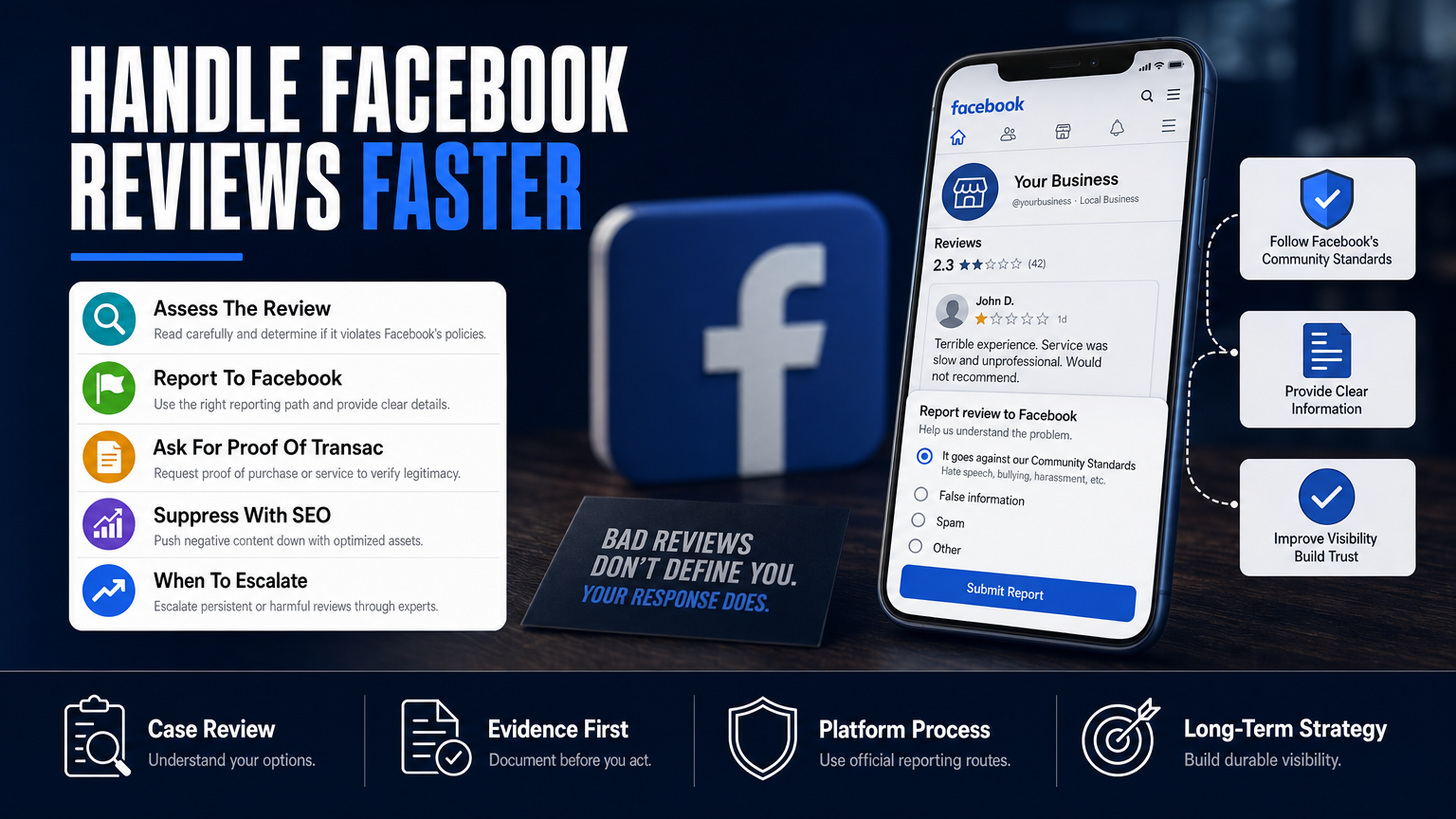
Negative reviews are a special case because platforms like Google and Yelp have specific dispute workflows and community guidelines. You can attempt removal for reviews that violate policy (harassment, hate speech, fake accounts, or spam), but many negative reviews are opinions and will not be taken down.
If a review becomes your public face in search results, the right mix is policy reporting, careful responses, and SEO to highlight positive content. Start by reading how reviews can escalate into a business crisis in our analysis of When Google Reviews Become a Brand’s Biggest Crisis.
- Respond publicly to negative reviews in a calm, factual manner and invite offline resolution.
- Use the platform’s official dispute form for reviews that violate policies; escalate to platform support when allowed.
- Implement a review-generation program from satisfied clients to dilute the impact of negative reviews (comply with platform rules and disclose any incentives).
- Do not post emotional or defensive replies. Use a template: thank the reviewer, offer a private channel to resolve the issue, and state any corrective action if appropriate.
- Document fake-review patterns (same user, similar wording, suspicious timing) and submit a consolidated report to the platform.
- For coordinated attacks (review-bombing), archive evidence and prepare a PR/communications plan while you work with platforms and legal counsel.
Rapid incident response: when a post goes viral
Viral incidents require immediate triage: slow the spread, secure accounts, capture evidence, and coordinate messaging. Speed reduces downstream damage but does not guarantee control.
We pursue the legal, technical, platform-based, and reputational options available and coordinate with counsel and PR for statements. For a walk-through of how viral exposure can define a company and what comes next, see When a Viral Post Becomes Your Business’s Public Face.
- Within 0–6 hours: capture evidence, secure accounts, and notify internal stakeholders and counsel.
- Within 24–72 hours: file platform reports, prepare holding statements, begin outreach to sympathetic publishers or partners for corrective pieces.
- After 72 hours: shift to suppression and reputational rebuilding if removal isn’t forthcoming; maintain monitoring and update messaging as needed.
- Triage checklist: identify origin, capture screenshots with timestamps, identify amplification channels (Twitter/X, TikTok, Reddit), and secure all related accounts.
- Take immediate technical steps: change passwords, enable MFA, and limit ongoing data leaks or doxxing risk.
- Create a short, consistent public statement and coordinate with counsel before making any potentially admission-containing statements.
Removal vs Suppression: Quick Comparison
A side-by-side look to help decide which route to prioritize for a harmful item.
| Removal (Takedown) | Suppression (SEO & Content) |
|---|---|
| Goal | Goal |
| Eliminate the offending item from a platform | Push the item lower in search results |
| Depends on platform policy or a legal basis | Depends on producing and promoting authoritative content |
| Potentially faster for clear policy violations | Often slower but more reliable for public records or opinions |
| May require identity verification or legal letters | Requires ongoing content investment and SEO work |
| Risk of re-posts and mirrors | Requires maintenance to hold positions |
Hypothetical: The Clinic and the Viral Review
Situation summary: A two-provider clinic finds a one-star Google review alleging medical negligence. The review is shared in a local Facebook group and picked up by a neighborhood blog. Phone leads drop off over a week.
How an agency would typically proceed: the team documents everything, classifies items, pursues platform remedies, coordinates with counsel for potential defamation issues, and starts targeted SEO and PR to correct the narrative.
- Step 1 — Triage (Day 0–3): Capture timestamps, isolate the original review URL, secure Google Business Profile access, and ask the clinic for any patient-release documentation relevant to the claim.
- Step 2 — Platform remedies (Day 1–14): Submit an appeal to Google for policy review (alleged defamation or privacy violation) and request removal on the blog using site-specific reporting channels. Simultaneously, file data captures and request account verification evidence.
- Step 3 — Legal coordination (Day 3–30): If the review appears defamatory, coordinate with the clinic’s attorney for a demand letter or legal review, noting jurisdictional constraints.
- Step 4 — Suppression and PR (Day 7–90): Publish authoritative content: a concise FAQ, staff credentials, corrected facts where applicable, client testimonials, and a press note to local outlets. Use SEO to target the clinic name + service queries.
- Step 5 — Monitoring (Ongoing): Set alerts for mirrors and similar posts; update the SEO and outreach plan quarterly and maintain a response protocol for future reviews.
- Documented: screenshots of the review, URLs of the Facebook posts and blog, patient name not publicly disclosed.
- Classification: review contains an allegation of wrongdoing (potentially defamatory) and amplification on owned/earned channels.
Common Mistakes Businesses Make With Reputation Work
Avoid these frequent missteps: reacting impulsively, hiring the cheapest vendor without vetting, conflating suppression with guaranteed removal, mishandling public responses, and ignoring monitoring.
Mistake 1 — Hiring on promises, not process
Choosing a vendor because they promise “guaranteed removal” or an absolute ranking is dangerous. Reputable providers explain uncertainty and give a documented plan with contingencies.
Mistake 2 — Responding emotionally to reviews
Posting an angry reply or threatening language escalates visibility and looks unprofessional. A calm, documented, and corrective response is more effective and preserves legal options.
Mistake 3 — Treating suppression as permanent
SEO suppression can work but requires resources and monitoring. Letting suppression efforts lapse often allows negative items to resurface.
Mistake 4 — Skipping legal review when needed
Some content crosses into defamation or privacy violations and needs an attorney. Acting without counsel on such items can burn evidence or create liability.
Mistake 5 — Not documenting evidence early
Failing to capture timestamps, URLs, and screenshots immediately makes later takedown or legal efforts harder. Preserve everything from day one.
Best Practices For Working With Reputation Vendors
Follow durable practices that protect you legally and practically. These recommendations keep work focused and defensible.
Require a clear scope and reporting cadence
Insist on a written plan that lists each harmful item, the proposed action, responsible party, and a timeline range. Weekly or biweekly reports help you track progress without surprises.
Keep counsel in the loop
Coordinate early with an attorney for anything that looks like defamation, privacy breaches, or where subpoenas or court filings might be required. The firm should say they will coordinate with qualified legal professionals when needed.
Own the narrative with authoritative content
Invest in professional bios, case studies, press pages, and FAQs. These assets help search engines and potential clients see controlled, accurate information about your business.
Monitor continuously and set alerts
Set up Google Alerts, platform-specific watches, and third-party monitoring so you detect problems before they escalate. Early response is cheaper and more effective.
Be wary of shortcuts
Avoid vendors who suggest fake reviews, fake takedown claims, or mass solicitation of negative content removal through deceptive means. These tactics can create bigger problems.
Expert Tips
- Capture evidence immediately: screenshots with timestamps and archived URLs are the currency of takedown and legal work.
- Prioritize high-impression items (page-one search results, Google Business Profile) before lower-visibility mentions.
- A calm, brief public reply to a review plus an invitation to resolve offline reduces escalation risk.
- Ask vendors for a ‘no-deception’ certification in writing to confirm they won’t use fake accounts or deceptive practices.
- If a site is hosting libelous content, coordinate with counsel before submitting a takedown that could be construed as a threat.
- Track the cost-per-URL for suppression work to evaluate ROI; some items require ongoing investment.
- Use the publisher’s escalation path first; legal routes are more expensive and slower but sometimes necessary.
- Document every contact with platforms and publishers, including ticket numbers and timestamps.
Conclusion
Business reputation management services are a legitimate industry that offers a mix of platform reporting, SEO, legal coordination, and PR — but legitimacy depends on transparent methods, realistic promises, and ethical behavior. Expect an assessment that explains options and limits rather than a guarantee.
If removal is feasible, a firm can pursue it through platform policy and legal channels; when removal isn’t available, suppression, correction, and ongoing monitoring are practical responses. Start by documenting the problem, asking vendors for a written plan, and coordinating with counsel on any potentially defamatory or legally sensitive material.
Why Businesses Choose Your Reputation Agency
Managing your reputation takes more than monitoring reviews or publishing the occasional blog post. It takes a strategy built around your situation, your industry, and what is actually showing up in search.
Your Reputation Agency works with businesses, executives, healthcare professionals, attorneys and growing brands. Our services include:
- Remove defamatory content and false posts (news, blogs, listings)
- Remove or challenge negative reviews (Google, Yelp, TripAdvisor, industry sites)
- Mugshot and arrest record removal
- Remove videos, images, and other multimedia that damage reputation
- Remove personal data from people‑search and data‑broker sites (opt‑outs)
- Search result suppression (SEO to bury negative links)
- Social media takedowns and impersonation removal
- Rapid online crisis management and incident response
- Ongoing monitoring and alerting of reputation signals
- Coordination with legal counsel and use of legal tactics when required
Frequently Asked Questions
1. Are business reputation management services legal?
Yes. Legitimate reputation services use lawful, platform-approved, and technical methods such as filing platform reports, opt-out requests with data brokers, SEO, and working with counsel. Illegal or deceptive tactics are a red flag and should be avoided.
2. Will an agency guarantee that negative content will be removed?
No reputable agency will guarantee removal or permanent suppression. Platform decisions and search rankings are outside any agency’s control. Firms should provide an assessment of likely options and explain the factors that affect outcomes.
3. How long does reputation work usually take?
Timing varies widely. Platform reviews can take days to weeks, SEO suppression may take months, and legal routes are jurisdiction-dependent. An estimated timeline can be provided after an individual assessment but is never a fixed promise.
4. Can negative Google reviews be removed?
Reviews that violate Google’s policies (spam, hate speech, impersonation) can be reported for removal. Many negative reviews are opinions and won’t be removed. Report policy violations, respond professionally, and use reputation SEO to reduce the visibility of damaging reviews.
5. What should I do first if I find damaging content about my business?
Capture evidence (screenshots, archived URLs, timestamps), map every damaging item, classify them by type (defamation, privacy, opinion, public record), and then seek an assessment from a reputable firm and your attorney if legal risk is present.
6. When should I involve an attorney?
Involve counsel when content alleges illegal activity, defamation, or when subpoenas or court action may be necessary. An attorney can determine whether a legal claim may be available and advise on preserving evidence without creating additional legal risk.
7. Is DIY reputation repair effective?
You can achieve meaningful results with DIY work—especially for owned assets and monitoring—but complex takedowns, legal coordination, and high-stakes crises often require experienced vendors or specialist counsel. Compare the cost and risk of DIY against hiring an expert.
8. How do I choose between removal and suppression?
Attempt platform reporting for clear policy violations first. If removal is unlikely or slow, suppression with SEO and authoritative content is an effective fallback. Often a hybrid approach is best.
9. Can an agency promise search ranking improvements?
Agencies can develop SEO strategies intended to improve visibility of credible information, but they cannot promise specific rankings or permanent suppression because search algorithms, competitors, publishers, and user behavior are outside their control.
This content provides general information and does not constitute legal advice. The available options and likely outcomes depend on the facts, evidence, platform policies, applicable law, jurisdiction, and public-interest considerations.
Past examples do not guarantee future results. Removal, correction, deindexing, and search-position changes depend on third parties and circumstances outside Your Reputation Agency’s control.