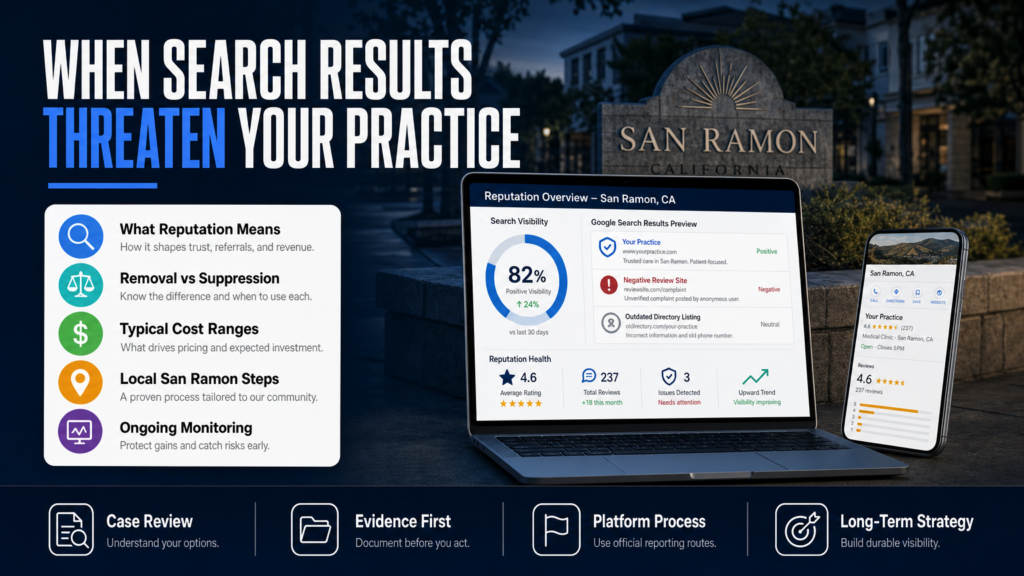
You saw your name or business in a Google result and felt the room get smaller — fewer calls, a drop in appointments, or a nervous hiring committee asking about online mentions. If you are searching for Reputation san ramon, you need a clear map of what’s possible and what isn’t.
This article explains how reputation services evaluate content, what common platforms will and won’t remove, realistic cost ranges, and the practical options available when removal is unlikely. We use concrete steps suitable for physicians, small business owners, and public-facing professionals in San Ramon.
You’ll get a workflow you can use immediately: how we triage a harmful result, evidence to collect, channels to pursue (platform reports, data‑broker opt‑outs, legal review, and SEO suppression), and what to expect in timing and outcomes.
Table of Contents
- What Does A Company’s Reputation Do For Your San Ramon Practice?
- Is Large Reputation Software Or A Reputation Firm A Good Fit?
- What Will Reputation Services in San Ramon Actually Do For Me?
- How Much Do Reputation Services Cost Per Month?
- Are Reputation Resolutions And Similar Firms Legitimate?
- When Removal Is Not Available: Suppression, Correction And Practical Mitigation
- Local Practicalities: Reputation San Ramon Address, Reviews And Phone Numbers
- How To Start: A Practical Workflow For Urgent Reputation Issues
- Ongoing Monitoring, Reporting, And Crisis Response
- DIY Reputation Work vs. Hiring An Agency
- Hypothetical Example: A San Ramon Clinic Handles a Viral Complaint
- Common Mistakes Professionals Make When Responding Online
- Best Practices For Reputation Work In San Ramon
- Expert Tips
- Conclusion
- Why Businesses Choose Your Reputation Agency
- Frequently Asked Questions
What Does A Company’s Reputation Do For Your San Ramon Practice?
A company’s online reputation is how prospective clients, colleagues, and regulators perceive you based on search results, reviews, news, and social content. For a San Ramon professional, that reputation affects referrals, patient booking, contracting opportunities, and even credentialing.
Reputation management work evaluates the specific digital content that appears when someone searches for your name, clinic, or business keywords, and then pursues the legal, platform, technical, and PR options available to reduce harm.
We describe options here in neutral language: we evaluate whether the content may qualify for removal or review, pursue platform reporting and correction where justified, and recommend suppression and reputation-building when removal is unavailable.
- Identify the exact search queries that return the negative item.
- Capture screenshots and URLs, noting the date and browser/device.
- Assess whether the content is defamatory, a privacy violation, impersonation, or platform‑policy violation.
- Patient/Client trust and conversion from organic search
- Influence on hiring, credentialing, and partnerships
- Visibility of negative items vs. corrective content
- Monitoring to detect new reputation signals fast
How reputation work maps to outcomes
Removal can eliminate a visible page from a search result if the publisher or platform complies, but removal depends on publisher cooperation, platform policies, and, sometimes, jurisdictional legal tools.
Suppression uses SEO to push harmful links off the first page by creating and promoting credible positive or corrective content.
Correction and PR address factual errors or context without relying on removal.
- Removal: Publisher/platform action or legal remedy
- Suppression: SEO and content publishing to lower visibility
- Correction: Working with publishers or posting official responses
Is Large Reputation Software Or A Reputation Firm A Good Fit?
Large platforms and standalone reputation software (for example, enterprise monitoring and review platforms) can be valuable for ongoing monitoring and review management but they are tools — not guarantees. Whether a company is “good” depends on your needs: software for daily alerts, or an agency for takedowns, legal coordination and crisis response.
If you are evaluating vendors in or near San Ramon, compare services, documented processes, and escalation paths — and verify they will coordinate with your legal counsel when needed. Your Reputation Agency is an independent reputation-management company that uses platform reporting and technical SEO strategies; platform decisions remain under the respective platform’s control.
- List the outcomes you need (removal, suppression, monitoring).
- Ask vendors for process descriptions and escalation scenarios.
- Request references that match your industry (healthcare, legal, hospitality).
- Software: monitoring, review solicitation, dashboards
- Agencies: takedown requests, legal coordination, suppression
- Hybrid: software plus an escalation path to human support
Questions to ask a vendor
Avoid vendor claims that promise outcomes. Ask how they evaluate removability, what platform channels they use, typical time ranges, and how they coordinate with counsel.
- How do you document evidence for platform appeals?
- When do you recommend legal escalation?
- What reporting do I receive, and how often?
What Will Reputation Services in San Ramon Actually Do For Me?
A reputable reputation provider performs a targeted assessment, then pursues platform-based reports, publisher outreach, data-broker opt-outs, and SEO suppression. They also coordinate with counsel when legal claims (defamation, privacy) may exist. We evaluate whether content may qualify for removal or review and pursue the technical and reputational options available.
Common service steps include evidence collection, targeted takedown requests, review remediation with Google/Yelp/industry sites, producing corrective content (press releases, bios, positive profiles), and continuous monitoring.
- Triage: Is it urgent, defamatory, or a mistaken identity? Capture evidence.
- Pursue platform channels: submit appeals and DMCA/terms reports if appropriate.
- Publish and promote corrective content to strengthen authoritative signals.
- Takedown evaluation and publisher outreach
- Review disputes and platform-specific appeals
- Data-broker opt-outs and people-search suppression
- SEO to push negative content down in results
- Rapid incident response for viral items
Coordination with legal counsel
Where statements are unlawful or there is clear falsity, we recommend involving a qualified attorney. The content may warrant legal review, and a lawyer can determine whether a claim is available and handle subpoenas or cease-and-desist letters.
We coordinate with legal professionals when a matter requires legal analysis, but we do not provide legal representation ourselves.
- Legal review for defamation or privacy claims
- When to consider subpoenas for publisher identity
- Joint strategy sessions between agency, counsel, and client
How Much Do Reputation Services Cost Per Month?
Pricing varies by service type, urgency, and complexity. For basic monitoring and review management expect software or low-touch plans measured in the low hundreds per month; for ongoing agency-managed suppression and takedown work costs typically rise into the mid-to-high hundreds or several thousand per month depending on volume and legal needs.
For a single urgent incident (mugshot removal, highly visible defamatory post, or viral review), many agencies charge a one-time incident fee plus an ongoing retainer for monitoring and follow-up. Timing and cost estimates should be provided after an individual assessment.
- Request a scope of work and itemized proposal.
- Confirm which services are one-time fees vs. retainers.
- Ask how success and milestones are defined and reported.
- Monitoring-only: $50–$400/mo (tool-dependent)
- Review management + lightweight remediation: $400–$1,500/mo
- Full-service takedown + SEO suppression: $1,500–$7,000+/mo
- One-time crisis engagements often start in the low thousands
How much does Reputation Defender cost per month?
Reputation Defender’s pricing (and the exact structure for other named providers) varies by package and customer profile; publicly available information often lists tiered plans for monitoring and removal support. For accurate current pricing, consult the provider directly and compare deliverables rather than headline numbers.
Keep in mind that third-party software pricing differs from a full-service agency that handles takedowns, legal coordination, and SEO.
- Compare deliverables, not only monthly numbers.
- Clarify what’s included: monitoring, active takedown work, or legal coordination.
Are Reputation Resolutions And Similar Firms Legitimate?
Many firms offering reputation services are legitimate businesses that provide monitoring, opt-outs, takedown requests, and coordination with counsel. Legitimacy is best assessed by verifying business registration, reviewing independent customer feedback, confirming written processes, and ensuring transparent pricing.
Some firms specialize in narrow niches (mugshot removal, data-broker opt-outs); others offer broader crisis management. Because outcomes depend on publishers and platform policies, legitimate firms will describe processes and limitations rather than promising guaranteed removal.
- Ask for a written plan, not a verbal promise.
- Request references and ask for examples of similar engagements (anonymized).
- Confirm refund or dispute processes spelled out in the contract.
- Verify business registration and professional references
- Look for clear contracts and explicit confidentiality provisions
- Confirm escalation paths and willingness to work with your counsel
- Check for industry experience with healthcare, legal, or hospitality if relevant
Red flags to watch for
Avoid vendors that promise guaranteed removal, claim special platform relationships, or recommend deceptive tactics. Never recommend fake reviews, fraudulent DMCA claims, or impersonation; those are prohibited and risky.
- Promises of guaranteed removal
- Requests to falsify identity or post false content
- Claims of insider access to platforms
When Removal Is Not Available: Suppression, Correction And Practical Mitigation
When removal is unavailable because the publisher refuses, content is lawful public record, or platform rules don’t apply, the common professional strategy is suppression and correction: create authoritative, credible content that outranks or displaces the harmful item in search results.
Suppression is accomplished through targeted SEO, owned content (biographies, press releases, professional profiles), and distribution to high‑authority sites. This is an evidence-based approach intended to improve the visibility of relevant, credible information; it is not a guarantee of permanent suppression.
- Audit current top-20 search results and identify which you can influence.
- Create a prioritized content plan with pages to publish and domains to target.
- Execute SEO and promotion while monitoring shifts; adapt the plan based on results.
- Publish authoritative pages (official bio, practice pages, news corrections)
- Use Google My Business, Healthgrades, LinkedIn, and professional directories
- Create and promote content on domains you control and on high-authority publishers
- Consider paid search ads to control top-of-page messaging temporarily
When a former employee or patient shapes search results
If a former employee or disgruntled individual becomes a prominent search result, suppression and correction combined with platform reporting (for impersonation or harassment) are typical paths. For guidance on this scenario see When a Former Employee Becomes a Brand’s Biggest Search Result.
- Document dates and interactions before engaging platforms
- Use professional biographies and press to provide context
- Coordinate with counsel if the content includes actionable falsehoods
Local Practicalities: Reputation San Ramon Address, Reviews And Phone Numbers
Local search signals matter: your Google Business Profile address, phone number, and local citations influence how your practice appears in San Ramon searches. Mismatched addresses or unmanaged profiles can amplify negative content.
Check local listings, directories, and healthcare-specific platforms (Zocdoc, Healthgrades) for accuracy. Remove old listings where possible and claim profiles you control to ensure consistent NAP (name, address, phone) data.
- Search your business name plus ‘San Ramon’ and note inconsistent listings.
- Claim and update each listing you control.
- Flag duplicate or fraudulent listings through platform channels.
- Claim and verify Google Business Profile and Bing Places
- Audit healthcare directories and industry-specific review sites
- Monitor local review sites and respond professionally to negative reviews
- Keep address and phone consistent across all owned profiles
San Ramon-specific mentions
If you need the local office phone or address added to a profile or to confirm whether a listing is accurate, use authoritative documents (business license, lease) when verifying. For information on review attacks that can hit local businesses, read The Anatomy of a Review-Bombing Attack on Local Businesses.
- Use local citations (chamber of commerce, local news) to build authority
- Document inaccurate listings before requesting edits
How To Start: A Practical Workflow For Urgent Reputation Issues
If you face an urgent reputation incident in San Ramon, follow a triage workflow: contain, document, contact platforms, and begin remediation. This reduces immediate risk while longer-term suppression or legal options are pursued.
Below is a step-by-step immediate action list you can apply.
- 1) Capture evidence—screenshots, URLs, and who saw the content.
- 2) Secure accounts—change passwords, enable MFA, and close breached accounts.
- 3) Submit platform reports with the documented evidence.
- 4) Publish immediate corrective messaging on your owned channels if needed.
- 5) Engage a reputable reputation firm or counsel if content is defamatory or viral.
- Contain: Stop further spread by locking down compromised accounts and patching security issues.
- Document: Capture URLs, screenshots, and timestamps.
- Report: Use platform reporting channels for impersonation, harassment, or privacy violations.
- Communicate: Prepare a factual internal statement for staff and counsel.
Responding to a viral review or post
Respond publicly and professionally to factual errors where appropriate, and use platform dispute processes for reviews. For a sense of how a single viral review can affect bookings and revenue in hospitality (and by extension healthcare sensitivity), see When One Viral Google Review Can Empty A Hotel’s Bookings.
- Do not post emotional rebuttals publicly — keep responses factual and brief
- Collect supporting evidence before asking the platform to remove or correct the post
Ongoing Monitoring, Reporting, And Crisis Response
Ongoing monitoring is the most reliable way to detect reputation risks early. Set up keyword alerts, review notifications, and weekly reporting. A rapid response plan with pre-drafted messages shortens reaction time and reduces errors.
Monitoring can be tool-driven or managed by an agency. Either way, define thresholds for escalation — e.g., more than three negative posts within 24 hours triggers human review and potential paid mitigation.
- Set up alerts for branded searches and critical keywords.
- Establish a routine review cadence and designate a single point of contact.
- Run quarterly audits to identify new weak signals and opportunities for authoritative content.
- Keyword monitoring for name, business, and common misspellings
- Review and social alerting for major platforms (Google, Yelp, Facebook, Twitter/X, LinkedIn, industry sites)
- Weekly or monthly reputation reports with actionable items
- Pre-defined escalation path and contact list
How we monitor and alert
We combine automated keyword alerts with a human triage layer to prioritize items that meet escalation thresholds. We handle secure case documentation and limit access to need-to-know personnel.
Monitoring does not prevent all incidents, but it helps you respond faster and document patterns that may support later legal or platform appeals.
- Automated alerts plus human review
- Secure evidence storage for legal use
- Regular strategy reviews to adapt to new threats
DIY Reputation Work vs. Hiring An Agency
Quick comparison to decide which path fits your San Ramon practice.
| DIY | Hiring an Agency |
|---|---|
| Lower monthly spend for basic tools | Higher upfront costs, wider service scope |
| Good for monitoring and basic responses | Covers takedowns, legal coordination, suppression |
| You manage evidence and appeals | Agency prepares documentation and escalates |
| Slower for complex incidents | Faster coordination and escalation paths |
| Requires SEO and platform knowledge | Access to experienced specialists and vendor networks |
| Risk of mistakes in legal areas | Agency coordinates with counsel (client retains counsel) |
Hypothetical Example: A San Ramon Clinic Handles a Viral Complaint
Scenario: A patient posts an emotional account on a popular local blog and it is shared to Facebook and appears high in Google results for the clinic name. Calls drop by 30% the following week. This is a hypothetical, anonymized example intended to illustrate process, not a report of a real client.
Response sequence: triage → evidence collection → platform reporting → suppression → monitoring. Each step is documented and coordinated with counsel when the content included potentially actionable false statements.
- Step 1: Immediately capture evidence and stabilize accounts (hours)
- Step 2: Submit platform reports and request corrections or removals where policy violations exist (days to weeks, platform-dependent)
- Step 3: Publish and promote authoritative content to push the harmful result lower in search (weeks to months)
- Step 4: Continue monitoring and be prepared to engage counsel if necessary
- Triage: clinic locks social accounts and secures credentials
- Documentation: screenshots, public URLs, and referral analytics are saved
- Platform appeals: blog host and Facebook are notified with documented requests
- Suppression: publish a clinic statement, physician bios, case studies, and local news outreach
Common Mistakes Professionals Make When Responding Online
Avoid these common errors — each one can make a reputation problem worse or make later legal remedies harder to obtain.
- Reacting emotionally in public replies
- Failing to document evidence before content changes
- Hiring vendors that promise guaranteed removal
- Using deceptive tactics (fake reviews, false DMCA reports)
Mistake: Posting an emotional public rebuttal
A defensive, emotional post can escalate the incident and be used against you. Keep public responses factual, brief, and avoid admissions of fault.
- Stick to neutral, corrective language
- Offer a private channel for resolution (phone/email)
Mistake: Not preserving evidence
If you alter or delete content before documenting it, you may lose crucial evidence for platform appeals or legal review. Always capture timestamps, URLs, and screenshots first.
- Save raw screenshots and export metadata when possible
- Log who viewed or shared the content
Mistake: Believing every negative item is removable
Some content is lawful opinion or public record and will not meet platform or legal removal standards. Assuming removal is automatic wastes time and can increase cost.
- Evaluate content type before committing to an expensive legal path
- When removal is unlikely, pivot quickly to suppression and correction
Mistake: Using shady tactics
Fake reviews, false reporting, or deceptive content creation can result in penalties and damage credibility. Legitimate reputation work avoids these approaches.
- Never post fake positive reviews
- Avoid misrepresenting identity or relationships to publishers
Best Practices For Reputation Work In San Ramon
Adopt durable practices that reduce risk and improve your ability to respond quickly when issues arise.
- Document everything and centralize evidence in a secure folder
- Claim and verify all local and industry-specific profiles
- Create a short incident response plan and designate roles
- Publish authoritative content you control and use it proactively
Maintain consistent NAP data
Consistent name, address, and phone across profiles reduces confusion and strengthens search signals for your official listings.
- Audit citations quarterly
- Correct mismatches immediately
Prepare pre-approved response templates
Have short, professional response templates ready for reviews and social posts to accelerate response without overreacting.
- One template for factual corrections
- One template for privacy/harassment escalation
Use monitoring plus human review
Automated alerts catch items quickly; human triage prioritizes what requires escalation to a legal or PR response.
- Set thresholds for human review
- Review alerts daily during high-risk periods
Coordinate with counsel early when needed
If content appears to be defamatory or includes doxxed private data, consult a qualified attorney to evaluate legal remedies and evidence preservation steps.
- Preserve originals and metadata for legal review
- Avoid discussing legal strategy in public channels
Expert Tips
- Capture screenshots with timestamps as soon as you encounter harmful content.
- Enable multi-factor authentication on all business and key personal accounts.
- Place authoritative bios and staff pages on your own domain and optimize them for your name and location.
- When faced with a sudden spike in negative reviews, pause public rebuttals and collect evidence first.
- Use Google Business Profile attributes and posts to control what appears on local panels.
- Ask satisfied patients or clients to leave fact-based reviews to offset noise, but never incentivize reviews improperly.
- Keep an incident contact list with counsel, PR, IT, and your reputation advisor.
- Document every contact with platforms and publishers (date, person, and outcome).
Conclusion
If you are searching for Reputation san ramon because a negative result is costing referrals or creating regulatory risk, start with evidence and containment. The right initial steps are documentation, account security, and a calm public posture while you evaluate removal versus suppression.
There is no universal guarantee for removal or permanent suppression; outcomes depend on platform policies, publisher cooperation, evidence, and legal context. A realistic plan combines platform reporting, corrective content, SEO suppression, monitoring, and legal coordination when appropriate. If you need an assessment, gather your evidence and ask potential vendors to explain their process in writing before engaging.
Why Businesses Choose Your Reputation Agency
Managing your reputation takes more than monitoring reviews or publishing the occasional blog post. It takes a strategy built around your situation, your industry, and what is actually showing up in search.
Your Reputation Agency works with businesses, executives, healthcare professionals, attorneys and growing brands. Our services include:
- Remove defamatory content and false posts (news, blogs, listings)
- Remove or challenge negative reviews (Google, Yelp, TripAdvisor, industry sites)
- Mugshot and arrest record removal
- Remove videos, images, and other multimedia that damage reputation
- Remove personal data from people‑search and data‑broker sites (opt‑outs)
- Search result suppression (SEO to bury negative links)
- Social media takedowns and impersonation removal
- Rapid online crisis management and incident response
- Ongoing monitoring and alerting of reputation signals
- Coordination with legal counsel and use of legal tactics when required
Frequently Asked Questions
1. What does the company’s reputation do?
A company’s reputation shapes how prospective clients, partners, and regulators judge you based on search results, reviews, and social content. It affects referrals, bookings, hiring, and trust; reputation work evaluates harmful content and pursues platform, SEO, and legal options where appropriate.
2. Is reputation a good company?
If you mean large reputation platforms or firms generally, ‘good’ depends on match to your needs. Some tools excel at monitoring and review management; agencies offer takedowns, legal coordination, and suppression. Verify processes, references, and transparency rather than relying on claims.
3. How much does Reputation Defender cost per month?
Pricing for providers like Reputation Defender varies by package and client needs. Publicly available tiers exist, but the best approach is to request a current quote that details deliverables; compare that to agency offers which may include legal and SEO work.
4. Is Reputation Resolutions a legitimate company?
Many firms with similar names are legitimate businesses. Assess legitimacy by checking business registration, independent reviews, clear contracts, and willingness to coordinate with your legal counsel. Avoid vendors promising guaranteed removals.
5. What should I do right now if a post is going viral?
Capture evidence (screenshots, URLs), secure accounts, submit platform reports for policy violations, and prepare a brief factual internal statement. Consider engaging a reputation firm and counsel for coordinated response; do not post emotional public replies.
6. How long does suppression take?
Timing varies: some changes can appear in weeks; meaningful suppression frequently takes months and depends on content authority, competing pages, and promotion. There is no universal timeframe; an estimated timeline should come after assessment.
7. Can you remove old arrest or mugshot pages?
Some mugshot and arrest pages may be eligible for removal under publisher policy or state law in certain jurisdictions—others may not. We evaluate whether the content may qualify for removal or review and pursue available channels; when removal isn’t available, we recommend suppression strategies.
8. Should I contact my attorney first?
If the content contains potentially actionable false statements, doxxed personal data, or content that could lead to regulatory exposure, consult a qualified attorney early. Reputation firms coordinate with counsel; they do not provide legal representation.
This content provides general information and does not constitute legal advice. The available options and likely outcomes depend on the facts, evidence, platform policies, applicable law, jurisdiction, and public-interest considerations.
Past examples do not guarantee future results. Removal, correction, deindexing, and search-position changes depend on third parties and circumstances outside Your Reputation Agency’s control.