Introduction
Your online reputation is often judged before you ever get the chance to make a personal introduction. A potential customer may Google your company, a patient may search your name, an investor may review your leadership team, or an AI search engine may summarize what it finds about your brand.
That is why an Online Reputation Audit is more than a quick Google search. It is a structured review of what appears across search engines, websites, reviews, social media, news platforms, business listings, and other digital channels.
For business owners, CEOs, doctors, lawyers, entrepreneurs, real estate professionals, and personal brands, an audit can reveal reputation risks that are easy to miss until they start affecting trust or business opportunities.
This guide explains what to check, how to conduct an audit step by step, common mistakes to avoid, and when professional reputation management can make sense.
Table of Contents
- What Is an Online Reputation Audit?
- Why an Online Reputation Audit Matters
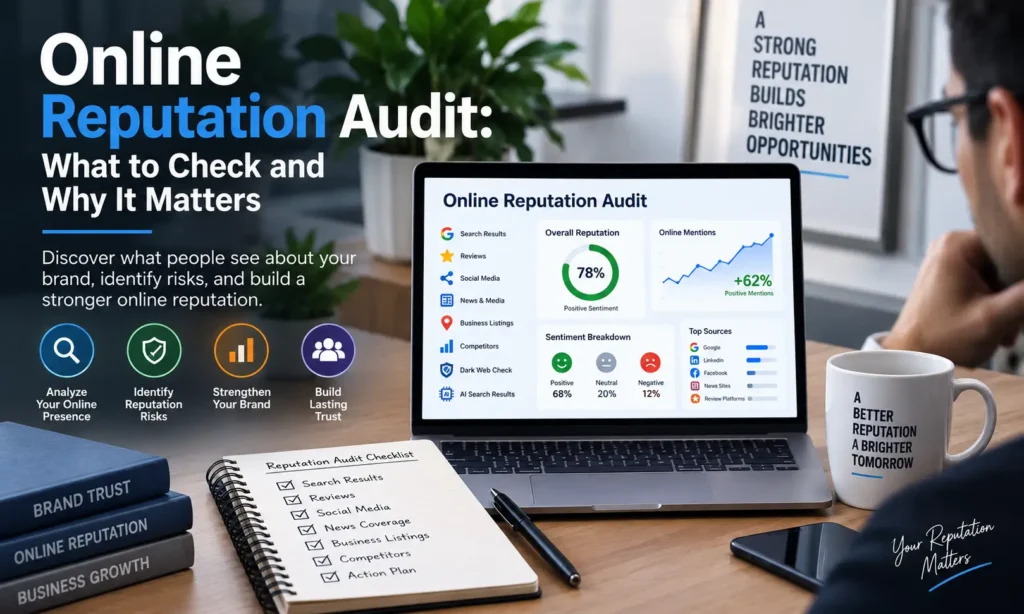
- What to Check During an Audit
- Step-by-Step Online Reputation Audit
- How to Evaluate Google Search Results
- Reviews and Customer Sentiment
- Social Media and Brand Mentions
- AI Search and Digital Reputation
- Real-World Example
- Common Reputation Audit Mistakes
- Best Practices for Ongoing Monitoring
- When to Hire a Reputation Management Professional
- Frequently Asked Questions
- Conclusion and Next Steps
What Is an Online Reputation Audit?
An Online Reputation Audit is a systematic assessment of the information people can find about an individual, executive, business, or brand online.
Instead of looking at one website or review platform, the process examines the broader digital footprint.
A thorough audit can include:
- Google and Bing search results
- Business listings and profiles
- Customer reviews
- News coverage
- Social media mentions
- Forum discussions
- Executive and employee profiles
- Images and videos
- Third-party websites
- Brand mentions
- Negative or misleading content
- AI-generated search responses
The purpose is not simply to count positive and negative mentions. It is to understand what a prospective customer sees, what information appears most prominently, and which reputation risks deserve attention first.
Google’s guidance emphasizes helpful, reliable, people-first content and recommends evaluating content for originality, expertise, trustworthiness, and usefulness.
Why an Online Reputation Audit Matters
A strong reputation is an asset, but an unmanaged reputation can become a business liability.
Imagine a prospective client searches your company name and sees an outdated complaint above your official website. Or a patient searches a doctor’s name and finds an inaccurate third-party page. A CEO might discover that an old article still appears prominently for branded searches years after the underlying issue has changed.
The problem is not necessarily that every negative result can or should be removed. The problem is that you may not know what your audience is seeing.
An audit gives you a baseline.
It can help you identify:
- Reputation threats
- Search visibility gaps
- Inconsistent brand information
- Review trends
- Negative content
- Missing positive assets
- Weak executive profiles
- Outdated business listings
- Content that deserves closer review
For businesses that depend heavily on trust, discovering these issues early can make reputation management more proactive instead of reactive.
What Should You Check in an Online Reputation Audit?
A useful audit should cover more than your homepage.
1. Branded Google Searches
Start by searching your:
- Company name
- Founder or CEO name
- Personal brand name
- Product or service names
- Key executives
- Common spelling variations
Review the first several pages, not just the first few results.
Look for patterns. Are authoritative pages ranking? Are old articles still visible? Are review sites prominent? Are competitors appearing for your branded searches?
2. Bing Search Results
Google is important, but it should not be the only search engine you examine.
Bing powers its own search experience as well as Microsoft AI experiences, so your audit should include relevant Bing searches. Microsoft’s Webmaster Guidelines emphasize clear, useful, original content and strong discovery signals for both traditional search and AI-powered experiences.
Check whether your official website, social profiles, business listings, media coverage, and other important assets are being discovered consistently.
3. Reviews and Ratings
Reviews can strongly influence how prospects evaluate a business.
Check platforms relevant to your industry, such as:
- Google Business Profile
- Trustpilot
- Yelp
- Industry-specific directories
- Healthcare review platforms
- Legal directories
- Real estate platforms
Do not focus only on your average star rating.
Look for recurring themes.
Are customers complaining about communication, delivery, pricing, service quality, or something else? Are there suspicious or potentially fraudulent reviews that require platform review?
HubSpot describes review management as monitoring online reviews so businesses can respond to customer issues and identify potentially fake reviews.
4. News and Media Coverage
Search your brand and leadership names alongside terms such as:
- News
- Lawsuit
- Complaint
- Fraud
- Scandal
- Review
- Investigation
- Controversy
The purpose is not to assume that negative coverage is inaccurate. Instead, determine whether the information is current, factual, relevant, and representative of the business today.
5. Social Media
Review both your official accounts and public mentions.
Check Facebook, LinkedIn, Instagram, X, YouTube, Reddit, and relevant industry communities.
Pay attention to:
- Unanswered complaints
- Customer questions
- Brand impersonation
- Inconsistent messaging
- Negative viral posts
- Executive mentions
- Outdated profile information
Social media can change quickly, so reputation monitoring should not depend exclusively on occasional manual checks.
Step-by-Step Online Reputation Audit
A practical Online Reputation Audit can be organized into seven steps.
Step 1: Define the Search Identity
Create a list of every name associated with the reputation you are auditing.
Include the company, founders, executives, major products, brand variations, and common misspellings.
This prevents the audit from becoming too narrow.
Step 2: Record Current Search Results
Create a spreadsheet with columns for:
| Search Query | Result | URL | Sentiment | Authority | Action |
|---|---|---|---|---|---|
| Brand name | Official website | URL | Positive | High | Keep |
| Brand name reviews | Review profile | URL | Mixed | High | Monitor |
| CEO name | News article | URL | Negative | High | Evaluate |
| Brand + complaints | Forum page | URL | Negative | Medium | Review |
The goal is to create a documented baseline that you can compare later.
Step 3: Categorize Reputation Assets
Separate results into four practical groups:
Positive: Content that strengthens trust.
Neutral: Accurate information that does not significantly influence perception.
Negative: Content that may damage perception or visibility.
Risk: Content that may be inaccurate, misleading, outdated, impersonating, or otherwise require closer investigation.
This classification helps prioritize effort.
Step 4: Evaluate the Source
A negative mention on an obscure website is different from an article on a major publication.
Consider:
- Domain authority and relevance
- Search visibility
- Publication date
- Accuracy
- Whether the page is still active
- Whether the information is current
- Whether it is being cited elsewhere
Do not automatically treat high-authority sources as harmful or low-authority sources as harmless. Context matters.
Step 5: Review Your Owned Assets
Your own website is one of the most important reputation assets you control.
Check whether your site clearly communicates:
- Who you are
- What you do
- Who leads the organization
- Your expertise
- Your locations
- Your services
- Your contact information
- Relevant credentials
- Helpful educational content
Your executive and professional profiles should tell a consistent story.
Step 6: Identify Gaps
An audit should identify what is missing, not just what is wrong.
For example, a company may have excellent customer feedback but very little authoritative content explaining its expertise. An executive may have strong credentials but an outdated online profile.
Those gaps create opportunities for improvement.
Step 7: Prioritize the Action Plan
Not every issue deserves immediate attention.
A useful priority system is:
High Priority: Potentially harmful content ranking prominently for important searches.
Medium Priority: Negative or inconsistent information that could influence prospects.
Low Priority: Minor profile inconsistencies or content with little search visibility.
This keeps reputation work focused on business impact.
How to Evaluate Search Results More Intelligently
An effective Online Reputation Audit should ask more than, “Is this result positive or negative?”
Ask five additional questions:
- Who published it?
- How visible is it?
- Is the information accurate and current?
- How likely is a prospect to encounter it?
- What authoritative information should appear alongside it?
This distinction is important because reputation management is not simply about deleting anything negative.
Sometimes removal is appropriate. Sometimes correction is appropriate. Sometimes the best strategy is to strengthen accurate information and improve the overall search landscape.
Google also notes that changes to Search visibility can take time, and there is no guarantee that a specific improvement will produce a particular ranking outcome.
Online Reputation Audit for CEOs and Executives
Executives often need a deeper audit because personal and corporate reputations are closely connected.
A CEO search may reveal:
- News articles
- Company announcements
- Interviews
- Speaking engagements
- LinkedIn profiles
- Professional biographies
- Social media accounts
- Litigation-related information
- Old business references
An executive’s digital presence should communicate expertise, leadership, credibility, and consistency.
For organizations where leadership visibility directly affects trust, dedicated CEO Reputation Management can complement the broader company strategy.
The same principle applies to doctors, lawyers, entrepreneurs, real estate professionals, and other public-facing professionals.
Online Reputation Audit for Reviews and Social Media
Reviews deserve special attention because they often reflect direct customer experiences.
However, review quantity alone does not tell the full story.
Look for trends such as:
- Repeated complaints about the same issue
- Sudden changes in rating
- Unanswered legitimate feedback
- Suspicious review patterns
- Positive reviews that mention specific strengths
- Customer concerns that can inform operational improvements
Social media requires a different approach because conversations can move quickly.
A useful monitoring system tracks brand mentions, relevant keywords, sentiment changes, and unusual spikes in activity. HubSpot’s current brand-monitoring guidance also highlights the importance of tracking mentions across news, reviews, social platforms, forums, and AI-generated answers.
For brands with significant social exposure, Social Media Reputation Management can help turn monitoring into a structured process.
Online Reputation Audit in the AI Search Era
An Online Reputation Audit should now consider more than traditional search results.
People increasingly use AI-powered search and conversational systems to research businesses, professionals, products, and executives.
That means your audit can include questions such as:
- How is the company described?
- Which sources are referenced?
- Are facts accurate?
- Is the brand consistently represented?
- Are competitors mentioned instead?
- Does outdated information influence the answer?
- Are authoritative sources supporting your brand identity?
Google states that its AI features use the same foundational SEO principles as traditional Search. It also recommends making important content discoverable through internal links, keeping information available in text, maintaining strong page experience, and ensuring structured data matches visible content.
Bing similarly explains that clear, accurate, well-structured content supports both traditional search and AI-powered experiences such as Copilot.
The takeaway is simple: do not create content solely for AI systems. Build useful, authoritative information for people first.
Real Example: What an Audit Can Reveal
Consider a hypothetical real estate professional named Sarah.
Her business has excellent client feedback, but a Google search for her name produces:
- Her brokerage profile
- A few strong property listings
- An outdated local article
- An incomplete LinkedIn profile
- Several positive reviews
- A poorly maintained social profile
At first glance, the reputation may appear healthy.
A deeper Online Reputation Audit reveals a different opportunity: the positive reputation exists, but the strongest assets are not organized or optimized consistently.
The strategy could include improving her professional biography, strengthening her website, updating social profiles, encouraging authentic customer feedback, developing useful real estate content, and monitoring future mentions.
The objective is not to manufacture a reputation. It is to make the accurate, credible story easier to discover.
Common Online Reputation Audit Mistakes
Searching Only Your Own Name
Your perspective is not the same as a prospect’s.
Use neutral searches and different devices or locations where appropriate to understand the broader search landscape.
Checking Only Google
Google matters, but Bing, social platforms, review sites, forums, news websites, and AI search experiences can also influence perception.
Focusing Only on Negative Content
A strong audit should identify opportunities as well as threats.
Positive assets may already exist but need better visibility.
Treating Every Negative Result as a Removal Target
Not every criticism violates a platform policy or warrants removal.
First determine whether the information is false, outdated, policy-violating, legally actionable, or simply an unfavorable opinion.
Ignoring Executive Results
For many businesses, the founder or CEO is part of the brand.
Ignoring leadership searches can leave a major reputation gap.
Auditing Once and Forgetting About It
An audit is a snapshot.
Your reputation changes as new reviews, articles, social posts, and search results appear.
For ongoing monitoring, see our guide on How to Monitor Your Online Reputation: A Complete Guide.
You can also learn more about How Often Should You Monitor Your Online Reputation? based on the level of risk and visibility involved.
Best Practices for an Effective Reputation Audit
A professional audit should be:
- Comprehensive: Review multiple platforms and search environments.
- Evidence-based: Record URLs, dates, screenshots, and relevant context.
- Prioritized: Focus first on issues with meaningful business impact.
- Neutral: Separate facts from assumptions.
- Actionable: Turn findings into specific next steps.
- Ongoing: Repeat the process as your digital footprint changes.
You can also maintain a monitoring dashboard that tracks search visibility, review trends, brand mentions, new content, and important executive results.
For more advanced monitoring strategies, explore our guide to the Best Tools for Monitoring Online Reputation.
When Should You Hire a Reputation Management Professional?
A DIY audit is useful for discovering obvious issues. However, complex reputation problems often require deeper analysis.
Professional support may be appropriate when:
- Negative content ranks prominently
- False or misleading claims appear online
- A reputation crisis is developing
- A CEO or executive is receiving unwanted attention
- Review problems are affecting conversions
- Your brand is frequently mentioned online
- You are preparing for a major launch, acquisition, or public event
- Your digital footprint is difficult to manage internally
A professional Online Reputation Protection Services strategy can combine monitoring, content development, search optimization, review management, and risk assessment.
For broader challenges, Crisis Reputation Management may be more appropriate when a situation is already escalating.
How Your Reputation Agency Can Help
An Online Reputation Audit is most valuable when it leads to a clear strategy.
At Your Reputation Agency, our approach is designed around the specific reputation landscape of each client rather than a generic checklist.
Depending on the situation, our team can evaluate search results, brand mentions, reviews, executive visibility, social profiles, media coverage, and other digital assets.
From there, we can recommend an appropriate combination of reputation monitoring, content strategy, search suppression, review management, and authority building.
Explore our Reputation Management Services to see how a broader strategy can support your goals.
If you prefer a specialized partner, our Reputation Management Consultants can help assess complex reputation challenges and identify practical priorities.
You can also explore our Reputation Management Agency and Reputation Management Firm resources to learn more about our approach.
For personal brands, Personal Reputation Management can provide a more individualized strategy.
And when an organization needs a wider reputation program, Reputation Management can address both immediate concerns and long-term digital credibility.
Expert Tips for Business Owners and Personal Brands
A few simple habits can make your reputation much easier to manage.
Search Before a Major Business Decision
Before launching a product, entering a partnership, hiring senior leadership, or expanding into a new market, review what customers and stakeholders are likely to find about your brand.
Build Positive Assets Before You Need Them
Do not wait for a crisis to create your executive profile, thought leadership content, media presence, or professional resources.
Keep Information Consistent
Your company description, leadership information, services, location, and contact details should be accurate across important platforms.
Monitor Your Name and Brand
Set up appropriate alerts and establish a regular review schedule.
Treat Reputation as a Business Function
Reputation is not merely a PR issue. It can affect sales, hiring, partnerships, investor confidence, and customer relationships.
Think Beyond Traditional Search
Your digital footprint now extends across search engines, social platforms, review websites, news, forums, and AI-powered discovery.
That broader perspective makes an audit significantly more useful.
Featured Snippet Answer
An Online Reputation Audit is a structured review of what customers, search engines, and AI platforms can find about a person or business online. It examines search results, reviews, news, social media, business listings, brand mentions, and potential reputation risks to identify what should be protected, improved, corrected, or monitored.
Frequently Asked Questions
What is an Online Reputation Audit?
An Online Reputation Audit evaluates how an individual, executive, or business appears across search engines, reviews, social media, news, websites, forums, and other online channels. It identifies reputation risks, visibility gaps, inaccurate information, and opportunities to strengthen digital credibility.
Why is an Online Reputation Audit important?
It helps you understand what prospective customers, partners, employers, investors, and other audiences may discover about your brand online. The findings can then be used to prioritize reputation protection and improvement efforts.
How often should I conduct an Online Reputation Audit?
The right frequency depends on your visibility and risk level. High-profile executives, public-facing businesses, and brands experiencing active reputation issues may benefit from more frequent reviews, while lower-risk businesses may conduct a comprehensive audit periodically and use ongoing monitoring between audits.
Can an Online Reputation Audit remove negative content?
An audit itself does not remove content. It identifies what exists and helps determine the appropriate response. Depending on the circumstances, the next step could involve contacting a publisher, reporting policy violations, requesting corrections, seeking legal advice, or using ethical search suppression strategies.
Should CEOs have a separate reputation audit?
Yes, especially when an executive’s personal reputation is closely associated with the company. A CEO audit can examine news coverage, professional profiles, social media, interviews, search results, and other information that may influence perceptions of leadership.
Does an Online Reputation Audit include social media?
A comprehensive audit should include relevant social platforms. It can review official profiles, public mentions, comments, customer complaints, impersonation concerns, and other conversations that may affect brand perception.
Does an Online Reputation Audit include AI search results?
A modern audit can include AI-powered search experiences and conversational systems. The goal is to identify how your brand is represented, what sources are being referenced, and whether important information is accurate and consistent.
Can a reputation audit improve Google rankings?
An audit does not directly guarantee higher rankings. Instead, it identifies technical, content, authority, and reputation opportunities that may support a stronger digital presence. Google emphasizes helpful, reliable, people-first content rather than tactics designed primarily to manipulate rankings.
How much does an Online Reputation Audit cost?
There is no universal price because the scope can vary significantly. A simple personal brand review is different from a multi-location company, executive reputation assessment, or crisis involving numerous websites and platforms.
When should I contact a reputation management agency?
Consider professional assistance when reputation issues are affecting business opportunities, search visibility, customer trust, executive credibility, or brand growth. Complex cases can benefit from experienced analysis before you take public or irreversible action.
Conclusion: Turn Reputation Data Into a Strategy
An Online Reputation Audit gives you something many businesses lack: a clear view of what the internet is saying about them.
The value is not in collecting hundreds of screenshots or creating a long list of negative links. The real value comes from understanding which information matters, where reputation risks exist, what your audience sees first, and which opportunities can strengthen your digital presence.
For a business owner, CEO, doctor, lawyer, entrepreneur, real estate professional, or personal brand, that insight can become the foundation for a smarter reputation strategy.
Google’s current guidance emphasizes useful, reliable, people-first content, while Bing similarly stresses clear, original, focused information for both search and AI experiences.
Your reputation should not be managed only after something goes wrong.
It should be measured, understood, and protected before a small issue becomes a much larger one. Want to learn more about our client experience? Read our Trustpilot reviews to see feedback from clients who have worked with Your Reputation Agency.
Ready to Audit and Protect Your Online Reputation?
If you are unsure what customers, search engines, or AI platforms are showing about your company or personal brand, Your Reputation Agency can help you understand the landscape.
Our specialists can assess your search presence, online mentions, reviews, executive visibility, social profiles, and other reputation signals to identify the highest-priority opportunities.
Whether you need ongoing monitoring, executive protection, crisis support, review management, or a broader reputation strategy, we can help you determine the right next step.
Start with a professional reputation assessment and take control of what your audience discovers about you online.
Contact Your Reputation Agency to discuss your reputation goals confidentially.