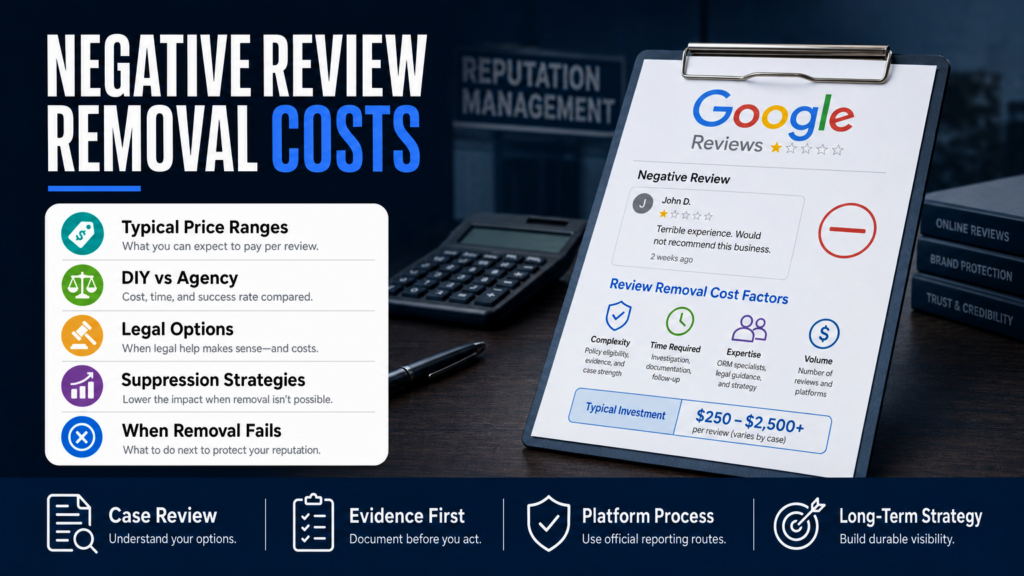
How much does it cost to remove negative Google reviews? Reporting a review directly to Google is free. Professional costs arise when a business needs evidence collection, policy analysis, escalation, legal review, public-response support, monitoring, or reputation mitigation after a review does not qualify for removal.
You’re reading search results for your own name or business and you find a review that’s harming revenue, licensure prospects, or hiring. The first question is practical: how much does it cost to remove negative Google reviews, and what exactly are you buying?
This article breaks down realistic price ranges for different routes — DIY, paid reputation services, lawyer-assisted takedowns, and SEO suppression — and explains the strengths, limits, and timelines for each. It also answers the common legal and tactical questions we hear from physicians, lawyers, restaurateurs, and founders.
You’ll get step-by-step actions you can start this afternoon, examples of what evidence helps, and a decision framework: when to try removal and when to shift to suppression or reputation rebuilding. The primary keyword appears because it’s the question you need answered right away: how much does it cost to remove negative Google reviews?
Table of Contents
- Can negative Google reviews be removed?
- Can I pay to get my Google reviews removed?
- How much does it cost to remove a single Google review?
- How many five‑star reviews does it take to cancel out a one‑star review?
- Can you be sued for leaving a bad review on Google?
- What to do when removal isn’t available
- DIY steps: how to document, report, and respond
- When to hire an agency or lawyer
- DIY vs Agency: Quick Comparison
- Hypothetical example: Clinic hit by one viral review
- Common mistakes businesses make when handling bad Google reviews
- Best practices for managing and minimizing damage from negative Google reviews
- Expert Tips
- Conclusion
- Why Businesses Choose Your Reputation Agency
- Frequently Asked Questions
Can negative Google reviews be removed?
Short answer: sometimes. Removal depends on whether the review violates Google’s policies (spam, impersonation, hate speech, fake content, conflicts of interest), whether the reviewer can be identified and contacted, and whether there is a legal basis to compel removal. We evaluate whether the content may qualify for removal or review.
Not every negative review is removable. Honest opinions, criticism, or truthful reports of a customer’s experience typically do not meet Google’s policy thresholds. For complicated source cases — for example, a review that originates in a Reddit thread or other forum before being copied into Google — see how platforms interact in real incidents like When a Reddit Thread Quietly Sinks Your Google Ratings.
- Document the review: screenshot (with date/time and URL), capture any related content, and archive page metadata.
- Compare the content to Google’s written policies to see if it matches a removability category.
- Use Google’s reporting flow and escalate if needed (owner response, support cases, or legal notice).
- Google removes reviews that breach its policies, not reviews simply because they’re negative.
- Removal decisions are platform-controlled; Google’s internal review is the final arbiter.
- If removal isn’t possible, we pursue mitigation: suppression, correction, or PR.
When the review repeats elsewhere
Reviews copied from another site or a viral post complicate removal: you may need to pursue take-downs at the original source, then address the copy on Google. That’s often a multi-platform case.
- If an allegation is on a news site, removing the Google review alone won’t fix search results.
- Coordinate copy removal and search-result suppression together for best effect.
Can I pay to get my Google reviews removed?
Paying someone to remove a review is not the same thing as bribing a reviewer, and there are different legitimate paid options. You can pay a professional reputation firm to evaluate removability, file platform reports, negotiate with publishers, run legal workflows, and execute suppression campaigns. You cannot pay Google to remove a review.
Beware of any offer that guarantees removal for a fixed fee without explaining the legal or policy basis — legitimate providers promise a process, not an outcome. For firms that focus on lawful, policy-based approaches, see services such as Remove Negative Google Reviews – Legally & Effectively.
- Request a written scope of work describing what the contractor will do and what they will not guarantee.
- Ask for examples of processes (not results) and typical timelines for cases like yours.
- Confirm confidentiality terms and any conditions under which fees are refundable.
- You can pay for removal services (evaluation, reporting, outreach, legal notices, SEO) — prices vary by complexity.
- You cannot pay Google directly to delete a review.
- No-lose or pay-after-removal claims should be scrutinized for fine print and scope.
Common service fee structures
Reputation providers typically bill in one of three models: hourly/project, flat-fee per case, or subscription for ongoing monitoring and suppression. Some combine an upfront retainer plus success-linked fees, but success must be defined carefully.
- One-off takedown attempts: flat fee $200–$1,200 for reporting, outreach and follow-ups depending on complexity.
- Legal notice + escalation: $1,000–$6,000+ depending on attorney involvement and jurisdiction.
- Full-service suppression + monitoring: monthly retainers $500–$5,000 depending on scope and content volume.
How much does it cost to remove a single Google review?
There is no universal price for removing a single review because the work needed varies. Typical ranges reflect who’s doing the work and how removable the review appears to be.
Costs depend on evidence, platform complexity, whether the reviewer is identifiable, and whether legal action is needed. If you want a legal workflow or publisher outreach, expect higher fees.
- Classify the review: opinion, factual allegation, spam/duplicate, impersonation, or illegal content.
- Estimate likely workflows: platform report only; outreach to reviewer/publisher; legal letter; publisher takedown; or SEO suppression.
- Budget accordingly: start with a scoped assessment before committing to escalation.
- DIY (no outside counsel): $0–$200 in time costs (reporting, documentation, responses).
- Reputation agency handling reporting and outreach: $250–$1,200 per review depending on complexity and required escalation.
- Attorney-assisted takedown (cease-and-desist, DMCA, defamation demand): $1,000–$10,000+ depending on complexity and jurisdiction.
Why some quotes mention $375 or ’30-day’ offers
You’ll see many advertised price points online (for example $375) or marketing language like ’30-day removal.’ These are sales propositions that reflect the provider’s average case and their terms, not a platform guarantee. Providers may have streamlined processes that work for low-complexity removals, but outcomes depend on Google and third parties.
- A quoted figure is useful as a ballpark only — ask for a written scope and what happens if escalation is needed.
- Be cautious of ‘pay only after removal’ claims; check cancellation and evidence requirements carefully.
- If you want to compare options and terms, see Remove Google Reviews: Our 30-Day Guarantee to Reclaim Your Reputation, and read the service terms closely before hiring.
How many five‑star reviews does it take to cancel out a one‑star review?
There’s no fixed formula. Google’s star average is a weighted arithmetic mean of all published ratings, and the effect of additional five-star reviews depends on how many existing ratings you have.
A single one-star review has more proportional impact on a business with few total ratings than one with hundreds. The practical answer: build consistent, genuine five-star experiences and request reviews over time to dilute the impact sustainably.
- Calculate current average and volume to estimate impact of new reviews.
- Focus on process improvements and legitimate, non-incentivized review requests after service delivery.
- Respond to the negative review professionally to show future customers you handle complaints.
- If you have 1 review at 1.0, one 5-star review brings the average to 3.0 (2 reviews: avg 3.0).
- If you have 20 reviews averaging 4.5, a single 1-star drops the average much less than if you had 3 reviews.
- Don’t attempt to manipulate reviews. Paid, fake, or incentivized reviews violate platform policies and can lead to penalties.
A quick math example
If you have ten 5-star reviews (average 5.0) and one 1-star appears, your new average becomes (10*5 + 1*1) / 11 = 4.64. The bigger your base, the smaller the change from one bad review.
Can you be sued for leaving a bad review on Google?
Yes, reviewers can be sued in theory, but lawsuits against reviewers are relatively uncommon and depend on content. Truthful statements, opinions, and non-defamatory accounts of personal experiences are generally protected. A false factual assertion presented as fact may expose a reviewer to defamation risk.
If a business believes a review contains false, defamatory statements, it may consult an attorney to evaluate legal options. The content may warrant legal review; a qualified attorney can determine whether a legal claim may be available.
- Preserve evidence (screenshots, copies, timestamps) and consult counsel before threatening legal action.
- Consider sending a carefully drafted demand letter through counsel if the allegation appears knowingly false.
- Use platform reporting in parallel; platform decisions are separate from legal remedies.
- Defamation claims require false factual statements and proof of reputational harm — elements vary by jurisdiction.
- Threats or harassment in reviews can trigger platform removal for policy violations.
- Anonymous reviewers are harder to sue or compel to remove content without proper discovery or subpoenas.
Legal vs platform remedies
Legal routes (lawsuit, subpoena) can compel a publisher or DISCLOSE an anonymous reviewer’s identity, but they are costly and slow. Platform reporting is faster but depends on policy fit. We coordinate with qualified legal professionals when a matter requires legal analysis.
What to do when removal isn’t available
When a review is not removable under Google policy and legal options are impractical, shift to mitigation: response strategy, suppression (SEO), and reputation rebuilding. We develop SEO reputation strategies intended to improve the visibility of relevant and credible information.
Suppression and rebuilding are realistic, measurable, and often the fastest route to reducing the business impact of a negative review.
- 1) Draft a short, factual public response acknowledging the complaint and offering offline resolution.
- 2) Build 3–10 high-quality pages (press release, staff bios, FAQs, case studies) geared to outrank the negative result.
- 3) Run a backlinks and content campaign to strengthen those pages; monitor with alerts.
- Respond publicly and professionally to the review to show future customers you engage constructively.
- Create and optimize authoritative pages that rank for your brand (about pages, staff bios, practice pages).
- Use SEO to promote positive content and demote the negative link over time; results vary and can’t be guaranteed.
If a review is linked from news or forums
When the negative content appears in news articles or forum threads that are indexed, pursue publisher outreach and correction requests, and combine that with search‑engine suppression. In multi-platform incidents we often coordinate PR and legal outreach together.
DIY steps: how to document, report, and respond
If you want to try removal yourself before paying, follow a strict evidence-oriented workflow. Doing it right increases the chance that Google or the publisher will take the content down, or at least that your public response looks professional.
Document everything, use official reporting tools, and avoid retaliation or fake reviews — those actions can make matters worse.
- 1) Screenshot the review (include URL bar and timestamp) and save the JSON response if available.
- 2) Check Google’s policies for a policy match (spam, off-topic, restricted content, impersonation).
- 3) Flag the review in Google and submit additional evidence through the business owner support channels.
- 4) If the reviewer identifies themselves and the facts are demonstrably false, send a polite DM or public comment asking for clarification and offering remediation.
- Capture the review URL, reviewer profile, timestamps, and any supporting documentation (invoices, photos proving service differences).
- Use Google Maps > Suggest an edit > Remove for policy reasons, or the ‘flag as inappropriate’ link in the review itself.
- Respond publicly with a calm, fact-based message offering to resolve the issue offline.
Escalation paths
If Google’s initial response is insufficient, escalate through Google Business Profile support, request manager-level review, or consider a legal notice if you have clear factual falsity and counsel advises it. If the review traces to a larger conversation on Reddit or another forum, coordinate removal requests at the source as well.
- Keep a log of all actions and dates — helpful if you later involve counsel or a reputation firm.
- Do not post confidential documents or private medical records in any public reply.
When to hire an agency or lawyer
Hire outside help if the review is part of a larger, damaging pattern; if the reviewer is malicious and anonymous; if the content is false and legally actionable; or if you want a multi-channel suppression and PR response. Professional teams coordinate legal, technical, and reputational tactics and can save time and risk.
Review provider scopes carefully: no legitimate provider can promise outcomes. If you want to compare professional options and read service terms, review pages such as Remove Google Reviews: Our 30-Day Guarantee to Reclaim Your Reputation, and ask specific questions about escalation and refunds.
- 1) Request a written assessment describing likely pathways and estimated budgets.
- 2) Confirm team roles (who handles platform reports, who drafts legal letters, who runs SEO).
- 3) Insist on regular reporting and an exit plan if progress stalls.
- Consider an agency when time is critical or if multiple platforms are involved.
- Consider counsel when the review makes false factual claims that cause demonstrable harm.
- Ensure any third party documents a plan, evidence needs, and escalation triggers.
Choosing between agency and attorney
Agencies focus on platform reporting, SEO suppression, and communications. Attorneys provide legal claims, litigation, or subpoenas. Many realistic cases use both — agency for speed and SEO, counsel for legal leverage when needed. We coordinate with qualified legal professionals when a matter requires legal analysis.
- Agencies are cost-effective for high-volume or suppression-focused work.
- Attorneys are necessary when you need court orders, subpoenas, or defamation suits.
DIY vs Agency: Quick Comparison
A side-by-side look at what you get and what it typically costs.
| DIY | Agency |
|---|---|
| Direct cost | Paid fees or retainer |
| Time investment | Outsourced, less owner time |
| Platform escalation | Formal support and escalation |
| Legal coordination | Often coordinates counsel |
| SEO suppression | Included in many packages |
| Reporting and monitoring | Ongoing alerts and reports |
| Risk of missteps | Lower with experienced team |
Hypothetical example: Clinic hit by one viral review
A small dermatology clinic (anonymized) received a 1-star Google review alleging unprofessional conduct. The review duplicated claims that had appeared in a local forum thread. The clinic followed a mixed strategy: documented the review, reported to Google, attempted to contact the reviewer, and engaged a reputation firm for suppression while counsel evaluated legal options.
No single action solved the problem overnight. The firm performed outreach to the forum publisher, filed a policy report with Google showing the review was a copied post, and created optimized pages (staff bios, patient resources, an FAQ) to push the negative result lower in brand searches. Counsel sent a preservation letter to the forum where the original post originated while monitoring for escalation.
- 1) Day 0–3: Document review and flag it in Google; attempt polite outreach to reviewer.
- 2) Week 1–3: If no platform removal, engage agency for suppression and coordinated outreach to original publisher.
- 3) Month 1–3: Build and promote authoritative pages; monitor ranking changes and update messaging.
- 4) Month 3+: Reassess legal route only if new evidence or continued malicious behavior emerges.
- Evidence collection: screenshots, original forum URL, dates.
- Platform actions: Google report + forum takedown request.
- Reputational work: new content creation and targeted link building.
Common mistakes businesses make when handling bad Google reviews
Avoid shortcuts and emotional reactions. The wrong move can worsen visibility or create legal risk. Below are common, named mistakes and how to avoid them.
Mistake 1 — Immediate public attack
Lashing out publicly at the reviewer or posting personal information escalates the issue and looks unprofessional to prospective clients. It may also violate platform rules.
- What to do instead: respond calmly, acknowledge the complaint, and offer an offline resolution path.
Mistake 2 — Trying to buy fake positive reviews
Paying for fake five-star reviews violates Google policy and can result in penalties that damage long-term visibility. It also creates legal and ethical problems.
- What to do instead: implement a legitimate review collection process tied to verified transactions.
Mistake 3 — Ignoring documentation
Failing to archive the review, URL, and related evidence makes later legal or platform escalation weaker. Platforms and courts care about verifiable logs.
- What to do instead: maintain a case file with screenshots, dates, and communication records.
Mistake 4 — Assuming removal is guaranteed
Believing any firm or lawyer can guarantee takedown is risky. Outcomes depend on policy, evidence, and third-party judgments.
- What to do instead: demand a written process and contingency plan before signing a contract.
Mistake 5 — Overusing legal threats
Threatening litigation publicly or prematurely can draw more attention to the review (the Streisand effect) and escalate cost. Lawyers should be used strategically.
- What to do instead: seek counsel early for strategy, but use firm legal action only if it’s proportionate and supported by evidence.
Best practices for managing and minimizing damage from negative Google reviews
Adopt a measured, multi-channel approach that balances immediate containment and long-term reputation building.
Practice 1 — Document and preserve
Always capture screenshots, the review URL, reviewer profile links, and any supporting evidence (receipts, appointment logs). This helps both platform reports and any legal review.
- Store evidence in a secure folder with timestamps.
- Record all communications related to the incident.
Practice 2 — Respond strategically
Public responses should be brief, factual, and invite offline resolution. This shows prospective clients that you take complaints seriously.
- Acknowledge the complaint, show empathy, offer contact, and avoid admission of wrongdoing.
Practice 3 — Use official reporting channels
Follow Google’s formal reporting flow and provide clear evidence. Track dates and case numbers for follow-ups.
- If Google declines, escalate with additional evidence or request a manual review via Business Profile support.
Practice 4 — Build positive signals
Consistent, legitimate reviews and fresh, authoritative content help dilute the impact of negative entries over time. Focus on customer experience and a reliable review request process that follows platform rules.
- Encourage satisfied clients to leave reviews via post-service reminders (email or SMS) without offering incentives.
Practice 5 — Monitor and adapt
Use alerts and monitoring to detect new negative signals early. Ongoing monitoring reduces the surprise factor and lets you react faster.
- Consider a monitoring subscription if your business faces repeated reputation threats.
Expert Tips
- Always capture the review URL and a timestamped screenshot before responding or reporting.
- Never offer refunds or compensation in a public response; invite the reviewer to a private channel instead.
- If the reviewer alleges illegal activity, preserve evidence and consult counsel before posting a public rebuttal.
- A single, well-written authoritative page optimized for your brand can begin pushing a negative result down the SERPs.
- Ask satisfied clients for reviews regularly — volume reduces the impact of an outlier negative review.
- Vet any ‘pay-after-removal’ vendors carefully and get a written, itemized scope before you pay.
- Use Google’s Business Profile support and keep a log of case IDs and agent names when you escalate.
- Coordinate PR, legal, and SEO efforts in multi-channel incidents to avoid duplication and mixed messaging.
Conclusion
There is no single price that buys guaranteed removal of a negative Google review. Costs vary by the nature of the content, the platforms involved, the evidence you have, and whether legal escalation is necessary. A sensible approach starts with documenting the review, checking policy fit, and attempting platform reporting before moving to paid escalation or suppression.
If removal isn’t possible, effective mitigation — professional responses, SEO suppression, and steady reputation work — often restores business outcomes faster than prolonged legal battles. If you need a professional evaluation, obtain a written assessment that explains likely workflows, budgets, and contingency plans rather than promises of a specific outcome.
Why Businesses Choose Your Reputation Agency
Managing your reputation takes more than monitoring reviews or publishing the occasional blog post. It takes a strategy built around your situation, your industry, and what is actually showing up in search.
Your Reputation Agency works with businesses, executives, healthcare professionals, attorneys and growing brands. Our services include:
- Remove defamatory content and false posts (news, blogs, listings)
- Remove or challenge negative reviews (Google, Yelp, TripAdvisor, industry sites)
- Mugshot and arrest record removal
- Remove videos, images, and other multimedia that damage reputation
- Remove personal data from people‑search and data‑broker sites (opt‑outs)
- Search result suppression (SEO to bury negative links)
- Social media takedowns and impersonation removal
- Rapid online crisis management and incident response
- Ongoing monitoring and alerting of reputation signals
- Coordination with legal counsel and use of legal tactics when required
Frequently Asked Questions
1. Is it possible to get negative Google reviews removed?
Yes, when they violate Google’s policies (spam, impersonation, hate speech, doxxing) or when the reviewer posts demonstrably false factual claims, but removal is decided by Google. We evaluate whether the content may qualify for removal or review and pursue the available legal, technical, and platform options.
2. Can I pay to get my Google reviews removed?
You can pay a reputation firm or attorney to pursue removal or suppression workflows, but you cannot pay Google directly. Paid providers charge for their time and processes; legitimate providers promise a professional process, not a guaranteed outcome.
3. How many 5 star reviews does it take to cancel out a 1 star review?
There’s no fixed number — the impact of a 1-star review depends on your existing review count and average. Increasing authentic five-star reviews over time dilutes the effect of an outlier. Avoid fake reviews; they violate policies.
4. Can I be sued for leaving a bad review on Google?
Potentially, if the review includes false factual assertions presented as fact that cause reputational harm. Truthful opinions and descriptions of personal experience are generally protected. A qualified attorney can evaluate whether legal claims are viable.
5. How long does it take to remove a review from Google?
There is no universal timeline. Platform reviews can be removed within days if they clearly violate policy; other cases (publisher outreach, legal notices) can take weeks or months. Timing depends on the platform, publisher, evidence, and legal complexity.
6. Are ‘pay only after removal’ services legitimate?
Some legitimate vendors use conditional pricing, but read the fine print. These offers often have strict evidence requirements and defined scopes. No vendor can control Google’s final decision; ask for a written scope and refund conditions.
7. What evidence helps get a review removed?
Clear documentation: screenshots with timestamps, proof of a transaction (receipt, booking record), proof of impersonation, or evidence that the review is copied from another source. The better the evidence, the stronger the platform or legal case.
8. Should I respond to a negative review publicly?
Yes — respond briefly, professionally, and offer to continue the conversation offline. A good public response demonstrates to potential clients that you handle complaints responsibly and can reduce reputational harm while you pursue other remedies.
9. When should I hire a reputation agency versus an attorney?
Hire an agency for platform reporting, SEO suppression, and coordinated multi-channel remediation. Consult an attorney when the review contains provably false factual claims, threats, or ongoing malicious conduct that may warrant legal action. Many cases benefit from both approaches coordinated together.
This content provides general information and does not constitute legal advice. The available options and likely outcomes depend on the facts, evidence, platform policies, applicable law, jurisdiction, and public-interest considerations.
Past examples do not guarantee future results. Removal, correction, deindexing, and search-position changes depend on third parties and circumstances outside Your Reputation Agency’s control.
How Much Does It Cost to Remove Negative Google Reviews?
There is no legitimate standard fee that guarantees deletion. Google decides whether reported reviews violate its policies. Simple self-service reporting costs nothing, while professional assistance varies with the number of reviews, evidence required, account patterns, appeals, urgency, and whether legal or search-reputation work is also needed.
- Number of reviews and reviewer accounts.
- Whether the content clearly violates a published policy.
- Evidence of impersonation, spam, conflicts, or coordinated attacks.
- Need for repeated appeals or platform escalation.
- Public-response and customer-service support.
- Legal review for false factual allegations.
- Long-term review monitoring and reputation mitigation.
Google’s review content policy should be the starting point. Be cautious of providers promising guaranteed deletion or charging a “Google fee”; Google’s standard reporting process is free.