Online reputation management Upwork issues can arise when a freelancer profile, portfolio, dispute, or public review becomes a prominent company search result.
When a freelancer becomes a company search result
A freelancer company search result problem can develop from a portfolio, platform dispute, public review, social post, or project complaint that ranks for the brand. The response depends on facts, contract terms, and confidentiality.
Seven response steps
- Preserve the page, profile, dates, screenshots, and search position.
- Verify each factual claim against project records.
- Review contracts, permissions, and confidentiality obligations.
- Request correction of specific inaccuracies with evidence.
- Report impersonation, threats, or clear platform violations.
- Publish accurate project and company information.
- Monitor branded search, hiring, and client feedback.
Avoid retaliatory reviews or public disclosure of confidential project details. A concise factual response is more credible than attacking the freelancer.
You found a bad article, a fake review, or a viral post affecting hiring or revenue — and you’re wondering whether to hire someone on Upwork. This article walks you through what online reputation management Upwork freelancers can actually do, where they help most, and where you should use a specialist agency or attorney.
This piece explains the practical tasks ORM freelancers do on Upwork (review management, takedown requests, SEO suppression, content creation, monitoring), how to vet and contract them, and the legal/operational limits to expect. It also covers alternatives when removal is unavailable and how to coordinate with counsel and PR.
If speed and budget are your primary constraints, this article gives a stepwise decision path: when Upwork is a good fit, what to check in a profile, typical price ranges, and an end-to-end hypothetical scenario so you can see how a case unfolds in real time.
Table of Contents
- Is Upwork a legitimate place to hire reputation help?
- What does online reputation management do — and what should you expect?
- What is the best online reputation management company — and how to compare them?
- Which Upwork skills command the highest rates for reputation work?
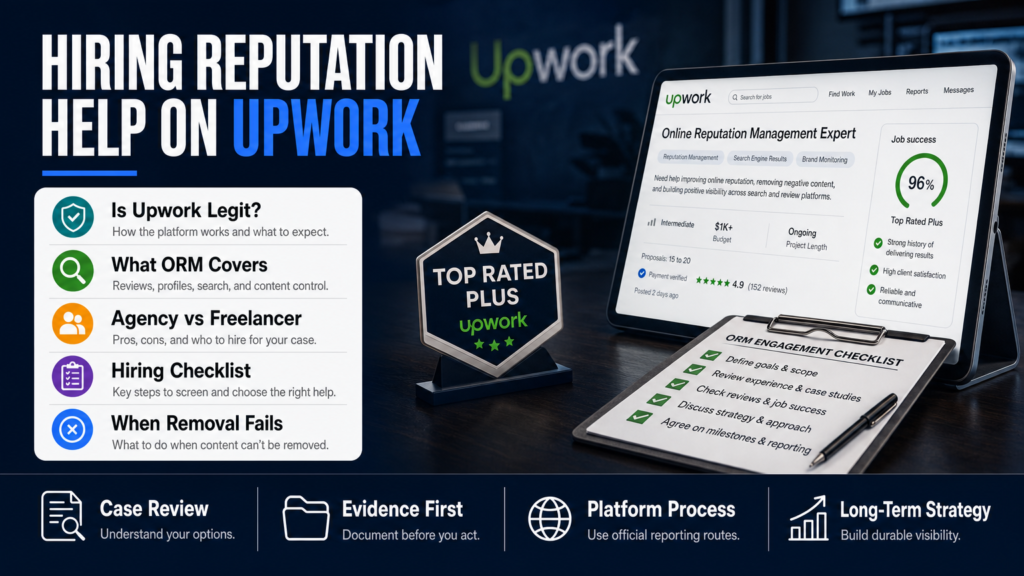
- How to hire a reputation freelancer on Upwork — a step-by-step checklist
- When removal is not available — practical suppression and mitigation
- Pricing, timelines, and what to expect from Upwork hires
- Monitoring, incident response, and long-term risk reduction
- Agency vs Upwork Freelancer: Quick Comparison
- Hypothetical: A Clinic’s Negative Blog Post — How an Upwork Freelancer Might Work It
- Common Mistakes People Make Hiring ORM Help on Upwork
- Best Practices When Using Upwork For Reputation Work
- Expert Tips
- Conclusion
- Why Businesses Choose Your Reputation Agency
- Frequently Asked Questions
Is Upwork a legitimate place to hire reputation help?
Yes — Upwork is a legitimate marketplace that connects clients with independent contractors. Many experienced SEO specialists, content writers, and even former platform moderators offer services there. That said, legitimacy as a marketplace is different from suitability for complex reputation work.
Upwork hosts capable practitioners, but quality varies. For straightforward tasks (one-off review responses, listing claim and correction, basic people-search opt-outs, simple SEO content), a vetted freelancer can be cost-effective. For legal takedowns, sensitive doxxing incidents, or anything that may affect licensure or litigation, you should involve experienced firms or counsel.
Practical checks: verify ID, read long-form client feedback, ask for a work history that matches the specific task, and require a narrow written scope of work before paying. Freelancers may lack the cross-discipline coordination (legal, PR, technical) that an established agency provides.
- Search for freelancers using relevant keywords (“reputation management”, “review removal”, “SEO suppression”).
- Filter by job success, specialized profile, and work history in reputation tasks.
- Interview and ask for specific examples of similar tasks (redacted).
- Request a short written plan and milestones before hiring.
- Use escrow for milestone-based payments.
- Prefer freelancers with verifiable case descriptions (not client names).
- Confirm they use platform-approved workflows and do not promise removals.
What does online reputation management do — and what should you expect?
Online reputation management (ORM) combines technical, editorial, legal, and PR actions to reduce the impact of harmful or misleading content. Tasks commonly handled by freelancers include review response templates, reporting policy violations, SEO content creation to push down negative results, and opt-outs from people-search sites.
For review-driven crises, ORM covers triage (evidence collection), platform reporting, structured responses, and review acquisition to restore rating balance. If a review implicates licensing or criminal conduct, legal counsel should be engaged immediately; technical ORM alone is insufficient.
For a deeper look at review crises and response strategy, see When Google Reviews Become a Brand’s Biggest Crisis — it explains when reaction timing and messaging matter more than takedown attempts.
- Identify and classify each item (review, blog post, mugshot, image, social post).
- Assess removal possibilities (platform policy, publisher cooperation, legal viability).
- Initiate the highest-probability route first (platform report, opt-out, or contact publisher).
- Begin parallel mitigation: SEO, PR messaging, and review acquisition.
- Evidence collection and preservation (screenshots, timestamps, IP info when available).
- Formal DMCA or platform takedown requests when copyright/defamation applies.
- SEO to create authoritative replacement pages and push negative links lower.
- Opt-out handling with data brokers and people-search sites.
- Monitoring and alerting for new threats.
How removal differs from mitigation
Removal means the content is taken down by the publisher or platform. Mitigation means reducing visibility or impact through SEO, new content, or corrections. Both are valid but require different skill sets and evidentiary standards.
Platforms control removals. ORM professionals evaluate whether the content may qualify for removal or review and then pursue the legal, technical, platform-based, and reputational options available.
What is the best online reputation management company — and how to compare them?
There is no single ‘best’ firm for every situation. The right provider depends on the problem type (defamation, reviews, mugshots, doxxing), industry sensitivity (healthcare, law), and required services (legal coordination, PR, SEO).
Compare firms on demonstrable process rather than marketing claims: ask for methodology, escalation paths, legal coordination capabilities, crisis response speed, and monitoring tools. Firms should explain how they evaluate removability and how they plan to measure progress.
If you need deeper research on reputable providers and how review crises escalate, our article When Google Reviews Become a Brand’s Biggest Crisis provides useful comparison criteria and case examples.
- Look for documented processes for takedowns and legal coordination.
- Check experience in your industry and with the specific platform (Yelp, Google, Facebook, court dockets).
- Ask how they handle confidentiality and what records they keep.
- Request an estimated range of costs and typical timelines (with caveats).
Which Upwork skills command the highest rates for reputation work?
On Upwork, the most valuable skills for reputation tasks tend to be: senior SEO (especially technical and enterprise SEO), legal research and takedown drafting, PR and crisis messaging, and digital forensics/doxxing mitigation. Professionals who combine two or more of these skills command higher hourly rates.
Highly paid specialists often present as consultants with a track record of similar engagements, strong portfolio items (redacted), and client references. Expect higher rates from freelancers who can demonstrate multi-disciplinary experience.
If your issue requires cross-functional execution (legal, SEO, PR), evaluate whether a single freelancer can realistically deliver all needed services or whether you should use a small team or agency.
- Top skills: Technical SEO, legal takedown drafting, crisis PR, content strategy, digital security.
- Premium freelancers often bill $75–250+/hr depending on experience and location.
- Bundles (SEO + content + outreach) are often cheaper per-hour than hiring multiple specialists separately.
How to hire a reputation freelancer on Upwork — a step-by-step checklist
Hiring on Upwork can be efficient if you set clear scope, verify credentials, and protect yourself contractually. Below is a practical sequence tailored to reputation work.
Use narrowly defined milestones and written deliverables. Reputation work often involves sensitive actions; do not hand over passwords or confidential documents without secure channels and a written agreement.
For SEO suppression work that aims to change what appears on search pages, remember that the first page of search results matters. See a discussion of why that matters in The First Page of Google Is Your Real Homepage.
- 1) Create a precise brief listing assets, timeline constraints, and non-disclosure needs.
- 2) Shortlist candidates with relevant job histories and invite them to a 30-minute interview.
- 3) During interview: request methods, expected tools, and escalation plan if removal requires legal counsel.
- 4) Agree on fees, milestones, and a limited scope of permission (no account sharing).
- 5) Start with a small, paid pilot (one or two tasks) before any larger retainer.
- Post a job with very specific outcomes (example: “File policy reports for 5 Yelp listings and prepare response templates”).
- Ask for a redacted work sample that demonstrates similar work (screenshots of progress reports, before/after SERP snapshots).
- Require milestones tied to deliverables, not outcomes (e.g., ‘Delivered outreach list’ vs ‘Removed article’).
- Use Upwork escrow and dispute processes for payment protection.
Interview questions to ask
Ask: ‘Have you worked on cases involving X platform (Google Reviews, Yelp, People-search sites)?’, ‘What exact steps would you take, and what evidence would you collect?’, and ‘When would you recommend involving an attorney or PR firm?’.
Avoid candidates who promise removals or guaranteed rankings; instead prefer those who explain dependencies and risks.
When removal is not available — practical suppression and mitigation
Removal is not always possible. Platforms may decline to take down content, publishers may refuse, and truthful public records cannot be erased. In those cases, remediation focuses on reducing visibility and contextualizing the issue.
Suppression is primarily an SEO strategy: create authoritative, relevant content that ranks higher than the harmful result. At the same time, use correction requests, PR to place updated narratives, and manage ratings and profiles to dilute the impact.
For a practical primer on why the first page matters and how to treat it as your ‘home page,’ see The First Page of Google Is Your Real Homepage.
- 1) Audit first-page results and identify content types you can realistically outrank.
- 2) Prioritize assets you control (LinkedIn, company site, niche directories) for quick wins.
- 3) Produce and publish 4–8 authoritative pages optimized for different search intents.
- 4) Monitor rankings and adjust content/links monthly.
- Create new, high-quality pages (about, press, professional profiles) optimized for your name and business.
- Use content diversification: LinkedIn, industry directories, published articles, podcasts, and video platforms.
- Issue corrections or clarifications via PR when factual errors exist and the publisher is willing to update.
- Acquire legitimate positive reviews and maintain active business profiles to improve signals.
Pricing, timelines, and what to expect from Upwork hires
Rates on Upwork vary widely. A basic review-response or listing correction might cost $200–800 as a one-off. Technical SEO or suppression campaigns often start around $1,000–3,000 per month for competent freelancers and can increase with scale and difficulty. Legal drafting by a skilled paralegal or attorney-level freelancer will cost more.
Be cautious about anyone offering a fixed timeline for removals or guaranteed search rankings. Timing depends on the platform, publisher cooperation, the strength of negative content, and search-engine behavior. An estimated timeline can be provided after assessment, but no universal timeframe applies.
Always require a written scope and milestone payments tied to deliverables. If your matter requires legal analysis, note that a qualified attorney can determine whether a legal claim may be available, and you should coordinate with counsel when necessary.
- One-off cleanup tasks: $200–1,000.
- Small suppression campaigns: $1,000–3,000/month.
- Comprehensive crisis response (multi-channel) often costs more and may require agency-level coordination.
- Legal work costs vary by jurisdiction and must be quoted by counsel.
Monitoring, incident response, and long-term risk reduction
Reputation is dynamic. After remediation or suppression work, ongoing monitoring is essential to catch new posts, fake reviews, or reposted content. Freelancers can set up alerts and basic reporting, but keep in mind the scale and SLA you need.
An incident response plan should name contacts, define escalation triggers (e.g., a post goes viral, a complaint to a regulator), and allocate budget for immediate actions (paid SEO push, PR release, or legal notice).
If you need continuous monitoring, consider a formal agreement that defines reporting cadence, alert thresholds, and access controls. This clarifies responsibilities and avoids surprises.
- Set Google Alerts and platform-specific alerts for names and variations.
- Use a weekly or monthly report showing position changes, new items, and actions taken.
- Define an escalation plan that includes legal and PR contacts.
- Rotate passwords and use two-factor authentication following any doxxing event.
Agency vs Upwork Freelancer: Quick Comparison
A practical look at the tradeoffs when you need reputation work fast.
| Reputation Agency | Upwork Freelancer |
|---|---|
| Cross-discipline teams (PR, legal, SEO) | Often single-specialist or small team |
| Formal processes and NDAs | Vary by freelancer; require explicit contract |
| Higher cost, broader coverage | Lower hourly cost, narrower scope |
| Coordination with counsel standard | May lack legal coordination unless contracted |
| Ongoing monitoring with SLA options | Ad-hoc monitoring unless retained |
| Better for high-stakes incidents | Better for targeted, budget-conscious tasks |
Hypothetical: A Clinic’s Negative Blog Post — How an Upwork Freelancer Might Work It
Scenario: A small medical clinic appears in a local blog alleging negligence. The post ranks on the first page for the clinic’s name. The clinic wants containment fast but has a limited budget.
Process summary: a vetted Upwork freelancer conducts a triage, tries platform and publisher outreach, begins an SEO suppression campaign with targeted content, and sets up monitoring. If legal avenues appear viable, the freelancer recommends counsel.
- Day 1–2: Evidence collection and freelancer assessment of removability.
- Day 3–7: Publisher contact and platform reports; begin SEO content publishing.
- Week 2–6: Build links to new pages, submit updated sitemaps, and amplify via social profiles.
- Month 2+: Review results; if SERP not improved, escalate to agency or counsel for wider options.
- Triage: collect screenshots, note timestamps, identify the author and hosting platform.
- Publisher outreach: request correction or removal citing factual inaccuracies (if present) and offer a statement.
- SEO mitigation: create authoritative pages (clinic bio, physician profiles, press statement) and publish a corrective blog post.
- Monitoring: daily alerts for two weeks, then weekly checks.
Common Mistakes People Make Hiring ORM Help on Upwork
Below are the predictable errors we see that cost time and money. Each mistake includes how to avoid it.
Mistake: Hiring on price alone
Choosing the cheapest bidder often results in slow progress, poor documentation, or tactics that violate platform policies. Pay for demonstrated process and references.
Mistake: Asking for guarantees
Freelancers who promise removals or guaranteed rankings are red flags. Outcomes depend on publishers, platforms, and search engines.
Mistake: Weak contracts
Verbal agreements or vague scopes lead to disputes. Use written scopes, deliverables, IP clauses, confidentiality, and escrowed payments.
Mistake: Sharing credentials insecurely
Giving account passwords over chat is risky. Use role-based access, temporary credentials, or secure vaults and document every change.
Mistake: Ignoring when legal counsel is needed
Some cases require legal notices, subpoenas, or court filings. Delay in involving qualified counsel can close off options.
Best Practices When Using Upwork For Reputation Work
Adopt a disciplined approach: vet thoroughly, contract tightly, start small, and escalate when necessary.
Vet by process, not buzzwords
Ask candidates to describe step-by-step how they would handle a specific asset. Look for concrete tools and milestones rather than vague assurances.
Use scoped pilots
Limit early work to a clear deliverable (one take-down attempt, one SEO landing page) so you can evaluate methodology before committing more budget.
Protect with contracts and escrow
Include confidentiality, data handling, milestones, dispute resolution, and a clause outlining when to involve counsel.
Preserve evidence
Take salted screenshots and store metadata. Preserve records for potential legal use; a freelancer should know how to do this properly.
Plan for ongoing monitoring
Reputation is not a one-shot problem. Budget for periodic audits and alerts to catch repeat postings or coordinated review campaigns.
Expert Tips
- Ask for a redacted before/after report showing what they changed and how they measured it.
- Prefer deliverables over promises: ‘outreach list delivered’ beats ‘I’ll get it removed’.
- Use Upwork escrow to tie payments to milestones you can verify.
- Keep a local archive of evidence in case a platform or publisher later changes or deletes content.
- If a claim involves potential criminal conduct or licensing, pause tactical takedowns until counsel advises.
- Treat SEO suppression as a multi-month play; budget for at least 3–6 months of consistent work for meaningful movement.
- Avoid anyone who recommends fake reviews or deceptive tactics — these create bigger long-term risks.
- Document all communications with publishers and platforms so you can prove attempted remediation.
Conclusion
Hiring ORM help on Upwork is a viable option for many targeted, budget-conscious tasks: review replies, listing corrections, people-search opt-outs, and parts of an SEO suppression campaign. It becomes less suitable as the stakes, legal complexity, or need for cross-disciplinary coordination rises.
Make decisions based on scope and risk. Use Upwork for clean, well-defined assignments with short pilots and clear milestones. For high‑risk matters — potential licensure issues, doxxing, or litigation — bring in an agency or qualified counsel who can coordinate legal, PR, and technical work at scale.
Why Businesses Choose Your Reputation Agency
Managing your reputation takes more than monitoring reviews or publishing the occasional blog post. It takes a strategy built around your situation, your industry, and what is actually showing up in search.
Your Reputation Agency works with businesses, executives, healthcare professionals, attorneys and growing brands. Our services include:
- Remove defamatory content and false posts (news, blogs, listings)
- Remove or challenge negative reviews (Google, Yelp, TripAdvisor, industry sites)
- Mugshot and arrest record removal
- Remove videos, images, and other multimedia that damage reputation
- Remove personal data from people‑search and data‑broker sites (opt‑outs)
- Search result suppression (SEO to bury negative links)
- Social media takedowns and impersonation removal
- Rapid online crisis management and incident response
- Ongoing monitoring and alerting of reputation signals
- Coordination with legal counsel and use of legal tactics when required
Frequently Asked Questions
1. Is Upwork a legitimate business?
Yes. Upwork is a legitimate freelancer marketplace. It connects clients with independent contractors but quality varies; vet profiles, verify work history, and use escrow and written scopes to reduce risk.
2. What does online reputation management do?
ORM evaluates harmful content, pursues removals or platform reviews where justified, and uses SEO, content, PR, and monitoring to reduce the impact of negative content. Legal counsel may be required for defamation or privacy claims.
3. What is the best online reputation management company?
There is no universal best. Choose a provider based on the problem type, industry experience, and documented process. Compare firms by their legal coordination, crisis response capability, and monitoring tools rather than marketing claims.
4. Which skill is highly paid on Upwork for reputation work?
Senior technical SEO, legal research/takedown drafting, and crisis PR are among the highest-paid skills because they require specialized experience and can directly influence remediation outcomes.
5. Can a freelancer remove mugshots and arrest records?
Removal depends on the publisher and applicable law. Some mugshot sites have opt-outs or will remove content for a fee; others resist. A freelancer can pursue publisher outreach and opt-outs, but legal options and results vary by jurisdiction and evidence.
6. How long does suppression or mitigation take?
Timing varies widely. Some changes (publisher updates, review deletions) can happen in days; SEO-based suppression often requires months. Timing depends on platform response, search behavior, and competition — an estimated timeline should be provided after assessment.
7. Is it legal to pay for positive reviews to offset negatives?
No. Paying for fake or incentivized reviews that mislead consumers violates platform policies and, in many cases, consumer protection laws. Instead, encourage legitimate satisfied clients to leave honest reviews and improve service channels.
8. When should I involve an attorney?
Involve counsel if the content includes false factual allegations that harm licensure or business, if a publisher refuses a valid correction, or if you need subpoenas or court filings. A qualified attorney can determine whether a legal claim may be available.
9. How should I measure progress on a reputation project?
Measure with specific deliverables (takedown requests filed, outreach performed), visibility metrics (search position for target terms), and reputation metrics (average rating, review velocity). Expect agencies or freelancers to report regularly and explain what changed and why.
This content provides general information and does not constitute legal advice. The available options and likely outcomes depend on the facts, evidence, platform policies, applicable law, jurisdiction, and public-interest considerations.
Past examples do not guarantee future results. Removal, correction, deindexing, and search-position changes depend on third parties and circumstances outside Your Reputation Agency’s control.