Why first page Google reputation matters
Your first page Google reputation includes reviews, profiles, news, images, directories, and third-party commentary. People often form an opinion from that result set before visiting an official website.
Seven ways to improve it
- Audit branded searches, maps, images, and news.
- Correct inaccurate information at its original source.
- Keep official names, biographies, locations, and contact details consistent.
- Publish useful pages that answer real customer questions.
- Earn relevant mentions and links from credible organizations.
- Respond professionally to reviews and recurring concerns.
- Monitor rankings, snippets, and new results over time.
Google recommends helpful, reliable, people-first content. Strong reputation work improves the underlying information rather than flooding search with thin pages.
You found this page because a search result, review, blog post or social clip in Google is doing real harm to your reputation — and you need options that actually work in Gurgaon. This article explains what an online reputation management agency in gurgaon does, how the process typically runs, and what to expect from costs and timelines.
We cover removal, takedown requests, review disputes, suppression (SEO), monitoring, and legal coordination. Where possible we give ranges and operational detail, and where outcomes depend on platforms, evidence or law we say so plainly.
If you are a healthcare professional, lawyer, local business or executive, this will help you decide whether to pursue removal, mitigation, or an SEO suppression strategy and what to ask a vendor before signing a contract.
Read on for specific cost benchmarks (including hiring a social media manager in India), an end-to-end hypothetical example, a comparison chart of removal vs suppression, common mistakes, and a checklist to vet agencies in Gurgaon.
Table of Contents
- What are online reputation management services?
- How much does online reputation management cost?
- How much does it cost to hire a social media manager in India?
- What is the average salary for an Online Reputation Management Executive in India?
- How agencies handle negative reviews and review crises
- When removal is not available: suppression, correction and mitigation
- Choosing the right online reputation management agency in Gurgaon
- Monitoring, contracts, legal coordination and realistic timelines
- Removal vs Suppression: Which Path To Pick?
- Hypothetical: A Gurgaon Clinic And A Defamatory Blog Post
- Common Mistakes That Make Reputation Problems Worse
- Best Practices When Working With an ORM Agency
- Expert Tips
- Conclusion
- Why Businesses Choose Your Reputation Agency
- Frequently Asked Questions
What are online reputation management services?
Online reputation management (ORM) services are a mix of legal, technical, SEO and communications tactics used to reduce the impact of harmful or inaccurate online information. An online reputation management agency in gurgaon will typically evaluate content, decide whether it may qualify for removal, and pursue the available platform-based, technical and reputational options.
Services vary by provider but commonly include: content takedown requests to platforms and publishers, review dispute management, search-engine suppression (SEO), social media intervention, data-broker opt-outs, monitoring and alerting, and coordination with attorneys when legal claims may be available.
For businesses, ORM often blends proactive content creation (positive pages and profiles) with crisis PR and response. For professionals and high-risk individuals, priority services include privacy remediation, doxxing containment, mugshot and arrest-record remediation, and impersonation takedowns.
- Intake and evidence collection: gather URLs, screenshots, account names and dates.
- Legal and platform triage: decide whether the issue is a policy breach, privacy violation, or possible legal claim.
- Technical and SEO plan: map which pages to suppress and which positive assets to build.
- Execution: pursue platform reports, publisher outreach, SEO publishing, and monitor results.
- Reporting and escalation: share progress reports and coordinate with legal counsel when needed.
- Content evaluation and evidence collection
- Platform reporting and takedown requests
- Review removal strategies for Google, Yelp, Facebook, Trustpilot, etc.
- Search-engine suppression via SEO and content publishing
- Data-broker opt-outs and people-search removals
- Social media impersonation and fake account takedowns
- Monitoring, alerts and crisis response PR
When removal is a viable path
Removal may be possible when content violates platform policy (harassment, doxxing, copyrighted images, explicit material), or where false factual claims meet the publisher’s bar for defamation and you can provide evidence. We evaluate whether the content may qualify for removal or review on a case-by-case basis.
Platform decisions remain under the platform’s control. A provider should never promise removal; instead they should describe the grounds they will use and the materials they will submit.
When suppression is the realistic plan
If removal is unlikely because content is accurate, a public record, or hosted on a publisher that refuses takedowns, the usual remedy is search-engine suppression: creating and promoting credible positive or corrective content so that it outranks the harmful results.
We develop SEO reputation strategies intended to improve the visibility of relevant and credible information. Results vary according to the strength of the negative content and the authority of competing sources.
Why a combined approach usually works best
Practical ORM blends tactics: pursue removal where possible, launch suppression campaigns for persistent content, and use monitoring and PR to respond quickly to new threats.
Coordination with qualified legal professionals is essential when a matter may warrant litigation or cease-and-desist letters; an agency should coordinate with your counsel rather than act as one.
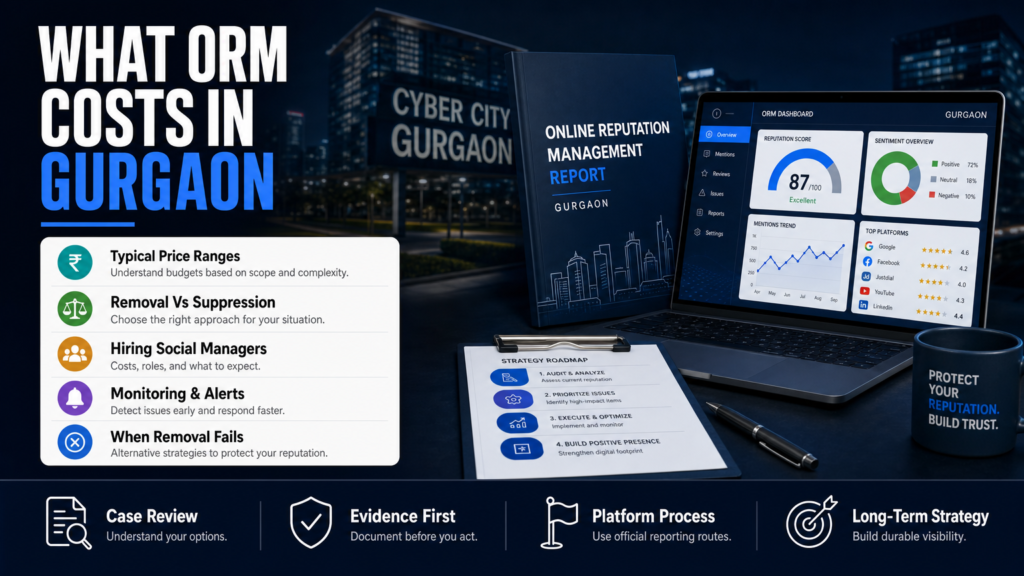
How much does online reputation management cost?
Costs for ORM vary widely depending on whether you need removal work, ongoing suppression/SEO, crisis PR, or one-off monitoring. An online reputation management agency in gurgaon will typically offer packages and bespoke plans; below are common price ranges and what they cover.
These ranges are indicative. Timing and outcomes depend on the content, publisher, platform policy, evidence, and legal complexity. An estimated timeline can be provided after an individual assessment.
- Get a free intake: an honest agency will review the URLs and tell you which actions are plausible.
- Request a written plan that separates platform requests, legal options, SEO suppression, and monitoring, with a clear scope.
- Ask for milestones and deliverables — not guaranteed outcomes — and review cancellation and confidentiality terms.
- One-off takedown or dispute request: INR 10,000–50,000 per URL (publisher and complexity dependent).
- Review removal campaigns (multiple platforms): INR 20,000–80,000 for a small set of reviews.
- Ongoing suppression + monitoring retainer: INR 30,000–150,000 per month (3–12 month engagements).
- Crisis response and reputation PR: INR 50,000–300,000 for short-term campaigns, more if legal coordination is needed.
- Comprehensive enterprise programs with legal coordination: bespoke pricing, often above INR 300,000.
What drives the price
Publisher type (national news site vs local blog), jurisdiction, evidence complexity, number of URLs, and whether legal letters are required all increase cost.
Work that involves manual outreach to multiple publishers, technical SEO work to build new authority pages, or extensive PR will add to fees.
Budgeting advice for professionals and small businesses
Allocate a one-time budget for initial triage and urgent takedown attempts, plus a 3–6 month suppression and monitoring retainer if the issue is search-visible.
Small businesses in Gurgaon often start with a 3-month suppression retainer to test whether SEO actions reduce the visibility of offending content.
How much does it cost to hire a social media manager in India?
Hiring a social media manager in India depends on experience, responsibilities, and whether they are freelance, in-house, or supplied by an agency. Monthly salaries in 2026 vary, and agencies often charge a separate management fee on top of salary costs.
If your ORM project involves active social-media content to rebuild trust, factor these costs into the broader reputation budget.
- Define responsibilities: content creation, community management, paid ads, crisis monitoring, and platform escalation.
- Decide on freelancer vs in-house vs agency: freelancers are cheaper short-term; agencies offer scale and crisis experience.
- Set KPIs that align with reputation goals: sentiment, volume of positive mentions, and reduction in negative impressions.
- Freelance social media manager: INR 15,000–60,000 per month for part-time work or project-based rates.
- Junior in-house manager: INR 20,000–45,000 per month (entry-level to 2 years experience).
- Experienced manager / specialist: INR 50,000–120,000+ per month (strategy, paid campaigns, and crisis handling).
- Agency social management packages: INR 30,000–200,000+ per month depending on scope and ad spend.
Hiring locally in Gurgaon
Gurgaon has a competitive digital marketing talent pool. If you need someone who can coordinate closely with local counsel and media, prioritize in-person availability and crisis experience.
Make sure the job description includes experience with platform policy reporting (Facebook, X/Twitter, Instagram, LinkedIn, YouTube), and a proven process for escalation during crises.
What is the average salary for an Online Reputation Management Executive in India?
The role and compensation for an ORM Executive vary by city, responsibilities, and whether the role is at an agency or in-house. Market averages provide guidance but will differ by employer.
Salaries reflect skill sets that combine SEO, content publishing, social policy knowledge, and basic legal awareness about takedown workflows.
- When hiring, ask for examples of past suppression work (URLs and timelines) and references who can confirm process adherence.
- Test candidates on platform policies: ask them to outline the takedown path for a doxxing post vs a false review vs a DMCA claim.
- Entry-level ORM Executive: INR 25,000–40,000 per month.
- Mid-level (2–5 years): INR 40,000–85,000 per month.
- Senior / specialist (5+ years or niche expertise): INR 80,000–200,000+ per month.
- Agency account leads and crisis managers command higher pay and often variable bonuses tied to contracts.
Skills to prioritise
Look for experience with SEO, publisher outreach, social reporting, Google review processes, and familiarity with legal escalation. Practical experience is more valuable than theoretical knowledge.
An ORM Executive should also be comfortable documenting evidence and coordinating with outside counsel when a legal path is feasible.
How agencies handle negative reviews and review crises
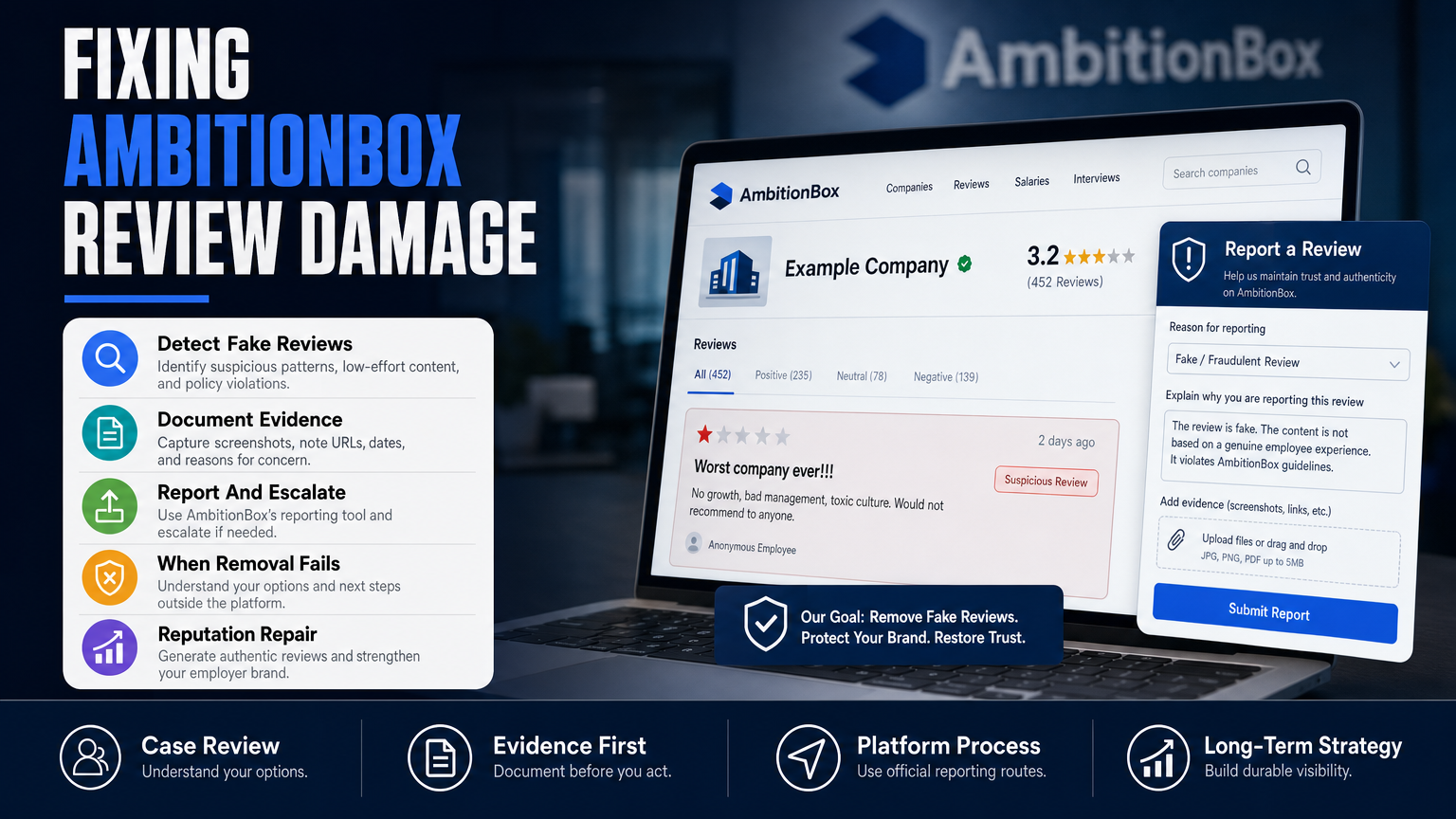
Negative reviews are often the highest-impact item on a professional or local-business search footprint. Agencies use a mix of review dispute processes, publisher contacts, corrective replies, and reputation-building to address them.
If a review violates platform policy (hate speech, personal data, extortion, or non-customer content), platforms may remove it after review. When a review is negative but factual or opinion-based, removal is often unavailable and the team shifts to mitigation.
- 1) Capture screenshots and URL evidence.
- 2) Attempt platform dispute and supply evidence.
- 3) If removal denied, respond publicly and promote verified positive reviews.
- 4) Monitor review velocity to detect review-bombing and coordinate with platform trust teams.
- Immediate triage: confirm whether the reviewer is a real customer and whether the review breaches policy.
- Document evidence: purchase records, appointment logs, or communications that demonstrate a review is false.
- Submit platform disputes and escalate via enterprise channels if available.
- Draft public responses that are professional, corrective, and don’t admit liability.
- Launch suppression and positive review generation where removal fails.
Enterprise or crisis escalation
When review volume suddenly spikes (review-bombing), the priority is detection and rapid escalation to platform trust teams. Agencies often combine monitoring with PR to control narrative and contact platforms with documented evidence.
For an explanation of how review damage can escalate into a brand crisis, see When Google Reviews Become a Brand’s Biggest Crisis.
When removal is not available: suppression, correction and mitigation
Not all harmful content can be removed. If a publisher refuses takedown, the content is truthful, or it is a public record, the realistic path is to reduce visibility and present better context.
Suppression uses SEO: creating authoritative, relevant pages (profiles, articles, press releases) and optimizing them so positive or corrective content outranks the harmful item. We develop SEO reputation strategies intended to improve the visibility of relevant and credible information.
- Audit existing assets and identify gaps.
- Publish corrective pages and authoritative bios.
- Optimize metadata, schema and page speed for the new assets.
- Launch a link-building and PR outreach campaign to pass signals to search engines.
- Create high-authority assets: corporate site pages, LinkedIn profiles, industry directories, and well-optimized press coverage.
- Use targeted content that answers the search intent behind the negative query.
- Employ link-building and technical SEO to accelerate visibility gains.
- Combine with paid search ads to occupy first-page real estate while organic work matures.
Small-business focus
For local businesses, a practical suppression campaign focuses on Google Business Profile optimization, local directories, and reviews. For small budgets, prioritize Google-first content: GBP posts, local citations, and customer review generation.
If you are a small business, see operational options in Online Reputation Management for Small Businesses.
When correction matters
If the harmful item contains factual errors, publisher correction or a right-of-reply may be effective. Agencies draft factual, evidence-based correction requests and coordinate with counsel when legal review is required.
Corrections and retractions depend on publisher policy and editorial discretion; they are not guaranteed.
Choosing the right online reputation management agency in Gurgaon
Picking an agency is as much about process and transparency as about price. For high-risk individuals and professionals, prioritize vendors who separate platform work from legal work and who will coordinate with your counsel rather than promise outcomes.
Ask for a written plan that includes scope, measurable milestones (not guaranteed outcomes), escalation points, and data-security practices.
- Shortlist 3 vendors and request a written intake and plan.
- Ask the vendor to identify what is likely removable, what needs suppression, and what may require legal review.
- Compare costs, but also compare communication style and escalation readiness.
- Proof of process: request a sample takedown submission template or a step-by-step suppression plan.
- Evidence handling: confirm how they store screenshots, communications and client data.
- Reporting cadence: weekly or biweekly reports with URL-level updates.
- Escalation: how do they interface with platform trust teams and external counsel?
Red flags to avoid
Avoid any agency that guarantees removals, promises specific search ranking outcomes, or urges deceptive tactics (fake reviews, false claims). These approaches violate platform policies and expose you to additional risk.
Also be cautious of vendors who demand long lock-in contracts without clear milestone reporting.
Monitoring, contracts, legal coordination and realistic timelines
Monitoring is a continuous service: alerts for new reviews, emerging social posts, or changes in search visibility let you respond early. A typical monitoring plan includes daily automated scans plus human review for priority alerts.
Agencies should offer confidentiality and defined data access limits. Specific confidentiality obligations are defined in the service agreement.
- Establish monitoring keywords and alert thresholds.
- Agree a reporting schedule and SLA for urgent incidents.
- Define the process for escalation to legal counsel and PR.
- Review and adjust the plan quarterly based on results.
- Monitoring scope: which keywords, which profiles and which geographies.
- Evidence and chain-of-custody: how screenshots and logs are time-stamped and stored.
- Legal coordination: when to involve counsel and how the agency shares evidence.
- Timelines: timing depends on the platform, publisher, evidence, legal complexity, and search-engine behavior.
Contracts and SLAs
A good contract separates tasks: platform reporting, publisher outreach, SEO work, paid media, and legal coordination. It should define deliverables, fees and a termination clause.
Never sign a contract that claims guaranteed removals or searches outcomes. Promise a professional process, never a predetermined result.
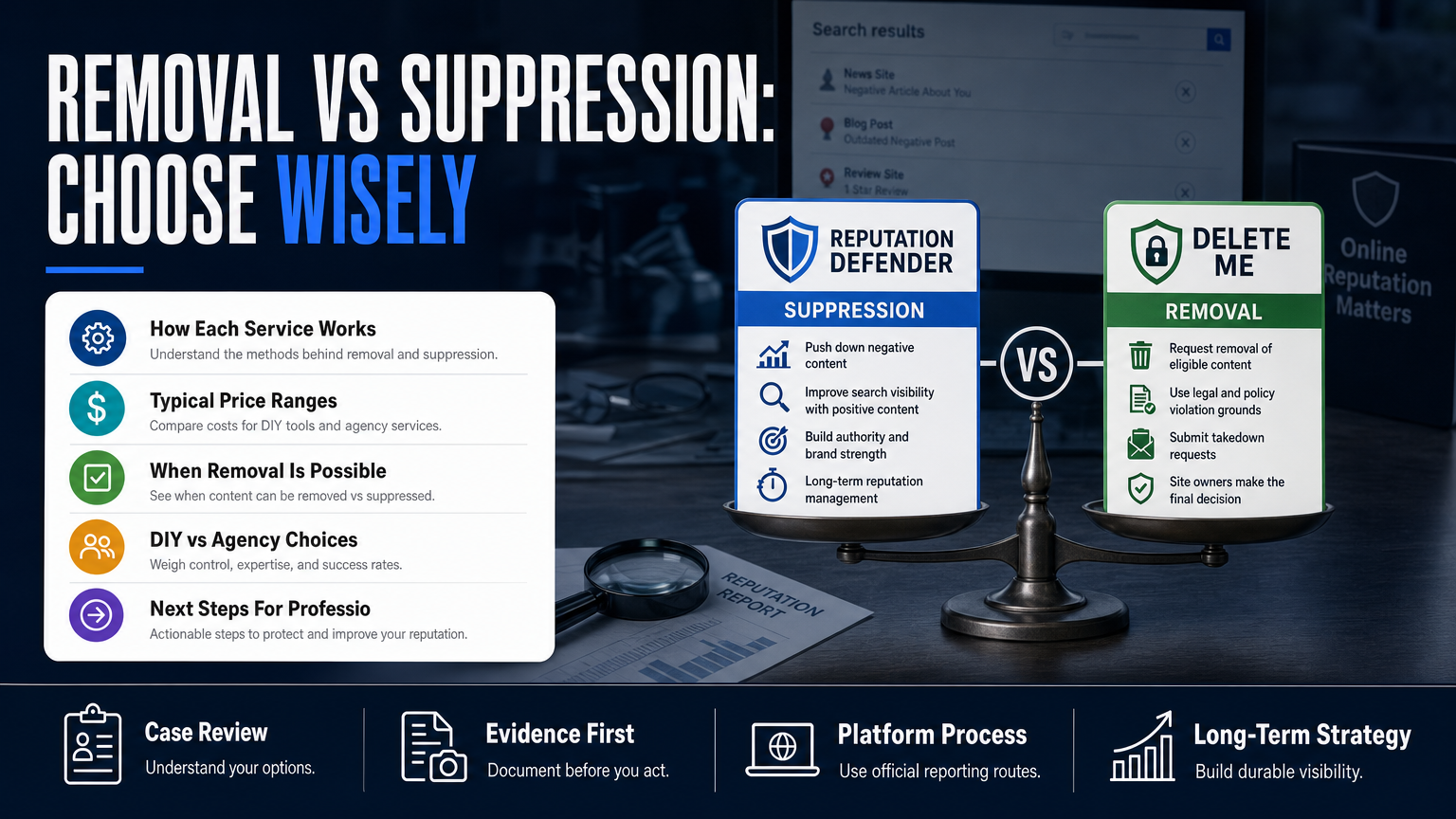
Removal vs Suppression: Which Path To Pick?
A short comparison to help decide whether to push for removal or invest in suppression and mitigation.
| Removal (Takedown) | Suppression (SEO & PR) |
|---|---|
| Goal | Push the specific item offline or inaccessible |
| When to use | Policy violation, privacy breach, or clear falsehoods |
| Control | Dependent on publisher/platform decision |
| Timeframe | Variable; sometimes fast, often slow and uncertain |
| Cost profile | One-off fees + possible legal costs |
| Durability | Removal can be durable, but copies and reposts exist |
| If removal fails | Shift to suppression and mitigation |
Hypothetical: A Gurgaon Clinic And A Defamatory Blog Post
Situation: A private clinic in Gurgaon discovered a blog post alleging malpractice that the clinic says contains factual errors and private patient information. The post is ranking on page one for the clinic name.
Initial assessment: The agency performs intake, collects screenshots, timestamped evidence, and a record of attempts to contact the publisher. They determine the post contains a mix of opinion and potentially private health data — the private-data elements may violate platform or hosting policies.
Triage and approach: The agency pursues three tracks simultaneously: a platform and hosting complaint for privacy violations, a publisher correction request with documented evidence, and a suppression campaign to push the post off page one while takedown attempts progress.
- Week 1: Intake, evidence collection, and submission of platform/host privacy complaints.
- Weeks 2–8: Publisher outreach for correction; monitor host response. Launch suppression content and technical SEO.
- Month 2–6: Evaluate publisher response; continue link building and PR to support suppression. If the host refuses and the content is demonstrably illegal, counsel may advise legal options.
- Ongoing: Maintain monitoring and a small retainer for continued reputation work; results depend on publisher response and SEO signals.
- Document the content and preserve timestamps
- Submit a privacy or policy complaint to the host and search engines
- Send a factual correction request to the publisher (with evidence)
- Begin SEO suppression: publish authoritative clinic bios, patient outcome pages, and local profiles
- Monitor search results and adjust the SEO campaign
Common Mistakes That Make Reputation Problems Worse
Below are frequent errors we see from professionals and businesses handling ORM on their own, and how to avoid them.
Reacting emotionally and posting defensive content
Angry, argumentative or defensive public replies often amplify a story. A measured, factual public response calibrated to platform norms works better and keeps legal exposure lower.
Using fake or incentivized reviews
Generating fake reviews or offering incentives to alter reviews violates platform policies and can result in penalties that worsen visibility and trust. Never recommend deceptive tactics.
Chasing removal without documentation
Platforms and publishers respond more favorably to well-documented requests. Haphazard or undocumented complaints are ignored. Preserve records and present clear evidence when requesting takedowns.
Hiring the cheapest vendor without process
A low price can hide manual, inconsistent work or opaque reporting. Prioritize a documented process, clear deliverables, and secure handling of evidence over rock-bottom fees.
Assuming removal is automatic because the content is ’embarrassing’
Platforms do not remove content simply because it is embarrassing or old. Removal depends on platform policy, factual falsity, or legal rules; otherwise suppression is the available option.
Best Practices When Working With an ORM Agency
Adopt a cautious, evidence-based approach and demand transparency. The right process minimizes risk and maximizes the chance of durable improvement in search visibility and public perception.
Do a staged scope
Begin with an intake and small-scope audit that identifies immediate removability and the top items that must be suppressed. This reduces wasted spend and clarifies priorities.
Keep counsel involved for legal matters
Have a qualified attorney review any proposed legal letters, defamation claims, or takedown strategies that could lead to litigation. The agency should coordinate with counsel, not replace them.
Protect credentials and client data
Limit access to passwords and PI. Use shared secure storage for any credentials you must provide and confirm the agency’s data-security practices.
Measure what matters
Track visibility for the exact search queries that matter (your name, brand, or the incident terms), and measure sentiment and referral traffic rather than vanity metrics alone.
Plan for the long term
Reputation repair often takes months of coordinated SEO, content and PR. Build a 3–6 month plan and budget for maintenance after the initial push.
Expert Tips
- Capture timestamps and multiple screenshots immediately — platforms often require contemporaneous evidence.
- Prioritize Google Business Profile cleanup first for local businesses; it often drives immediate visibility.
- If a review is clearly false, collect purchase or appointment records before submitting a dispute.
- Use press coverage and byline articles to create authoritative pages that search algorithms favor.
- Avoid public threats or legal-sounding language in responses; keep public replies factual and brief.
- For doxxing or exposed personal data, file platform privacy reports and consider immediate moderator escalation.
- Ask vendors to separate costs: platform outreach, SEO suppression, legal coordination, and monitoring.
- Check that any agency you hire documents chain-of-custody for evidence they submit to platforms.
Conclusion
Finding the right path — removal, suppression or a mix — requires an honest assessment of the content, the publisher, and the platform rules. An online reputation management agency in gurgaon should present clear options, an evidence-backed plan, and defined deliverables rather than promises.
If removal is plausible, pursue it while simultaneously executing suppression and monitoring. If removal is unlikely, invest in authoritative content, local profile optimization, and a monitored suppression plan. In all cases, coordinate with legal counsel for matters that may require legal action.
Why Businesses Choose Your Reputation Agency
Managing your reputation takes more than monitoring reviews or publishing the occasional blog post. It takes a strategy built around your situation, your industry, and what is actually showing up in search.
Your Reputation Agency works with businesses, executives, healthcare professionals, attorneys and growing brands. Our services include:
- Remove or challenge defamatory content and false posts across news sites, blogs and social platforms
- Remove negative reviews from Google, Yelp, Facebook, Trustpilot, Glassdoor and industry review sites (e.g., Healthgrades, RateMDs, RealSelf, Vitals, Angi)
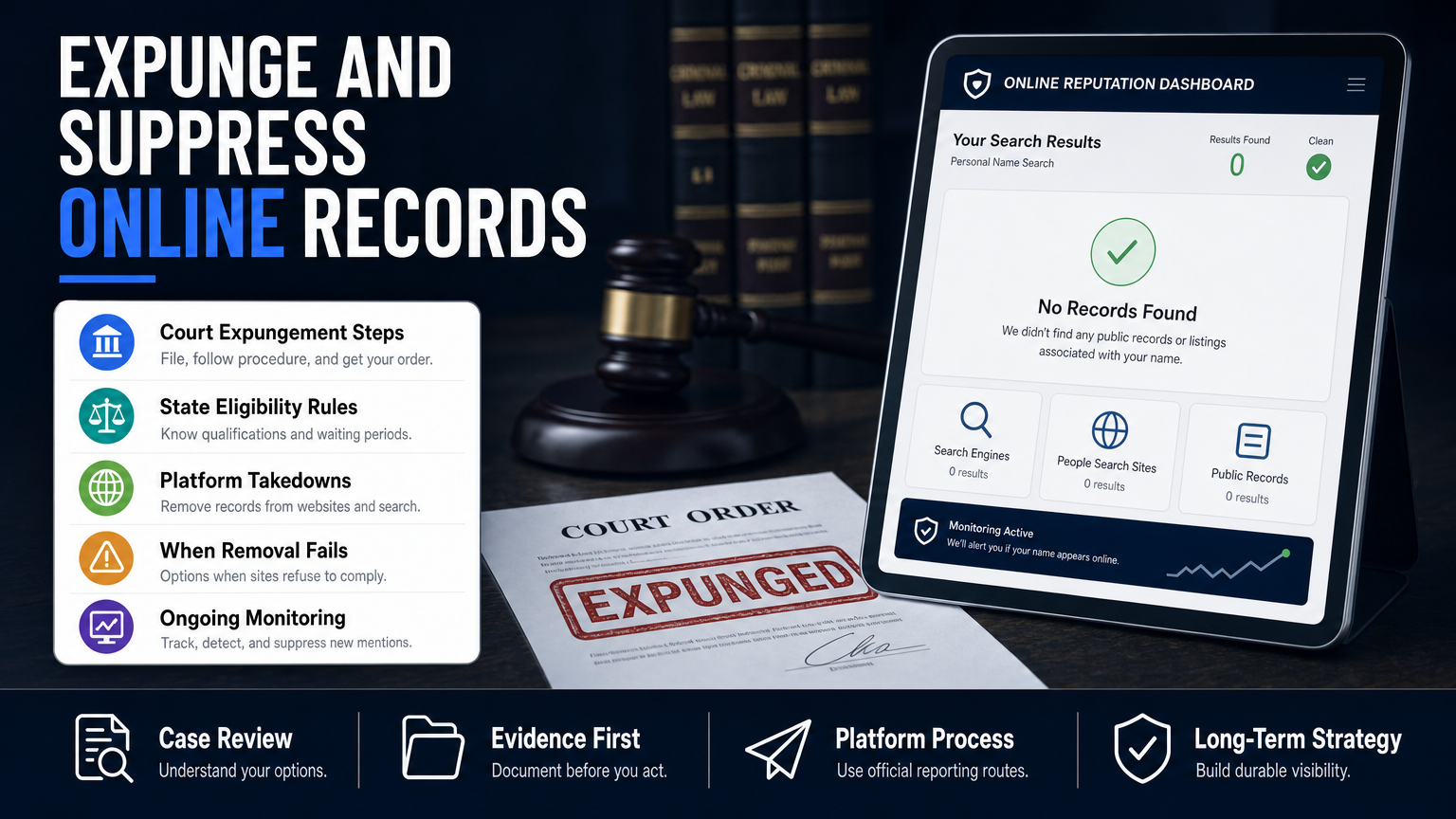
- Mugshot and arrest-record removal and remediation
- Remove or takedown negative videos, YouTube content, TikTok clips and other harmful multimedia
- Remove or suppress negative search results and implement search-engine suppression strategies (SEO to bury bad results)
- Remove personal information and opt-out from people-search and data-broker sites (address, phone, phone number removal)
- Social media impersonation and fake account takedown (reporting and removal on Facebook, Instagram, Twitter/X, LinkedIn, TikTok)
- Reddit and community forum post/comment removal and visibility reduction
- Online crisis management and reputation PR to respond to viral incidents
- Monitoring and alerting for negative content, fake reviews and emerging reputation threats
Frequently Asked Questions
1. How much does online reputation management cost?
Costs vary by scope. One-off takedown requests can start around INR 10,000–50,000 per URL; review-removal campaigns and small suppression retainers commonly range from INR 20,000–150,000 per month. Complex matters requiring legal support cost more. An individual assessment gives a tailored estimate.
2. How much does it cost to hire a social media manager in India?
Costs depend on experience and scope. Freelancers can charge INR 15,000–60,000 per month; junior in-house managers INR 20,000–45,000; experienced managers INR 50,000–120,000+ per month. Agencies charge higher monthly fees depending on services and ad spend.
3. What are online reputation management services?
ORM services include content evaluation, platform reporting, review dispute handling, search-engine suppression via SEO, data-broker opt-outs, social impersonation take-downs, monitoring, and crisis PR. For an explanation of ORM’s importance to businesses and professionals, see Why Online Reputation Management Is Important for Businesses and Professionals.
4. What is the average salary for an Online Reputation Management Executive in India?
Average salaries vary: entry-level INR 25,000–40,000 per month; mid-level INR 40,000–85,000; senior specialists INR 80,000–200,000+ depending on experience and city. Agency roles often pay differently from in-house positions.
5. Can an agency guarantee removal of a negative article or review?
No reputable agency will guarantee removal. We evaluate whether the content may qualify for removal or review and pursue the legal, technical, platform-based, and reputational options available. Platform and publisher decisions remain under their control.
6. What should I do if removal is not possible?
When removal is unavailable, the usual approach is suppression: create authoritative content, optimize it for search, build links and run PR to improve the search picture. For local businesses, prioritize Google Business Profile and verified directories. See operational options for smaller organizations in Online Reputation Management for Small Businesses.
7. How long does reputation repair take?
Timing depends on platform response, publisher cooperation, the authority of negative content, and the strength of positive assets. Some platform removals happen quickly; SEO suppression often takes months. An estimated timeline can be provided after an individual assessment.
8. Should I involve a lawyer for online reputation problems?
Potentially. The content may warrant legal review if it contains defamation, privacy violations, or other actionable harms. A qualified attorney can determine whether a legal claim may be available. Agencies should coordinate with counsel when legal analysis is required.
9. How do I vet an ORM agency in Gurgaon?
Ask for a written plan, sample submission templates, documented reporting cadence, data-security practices, and how they escalate to platforms and counsel. Avoid vendors that promise guaranteed removals or ranking results and those that suggest deceptive tactics.
This content provides general information and does not constitute legal advice. The available options and likely outcomes depend on the facts, evidence, platform policies, applicable law, jurisdiction, and public-interest considerations.
Past examples do not guarantee future results. Removal, correction, deindexing, and search-position changes depend on third parties and circumstances outside Your Reputation Agency’s control.