When a Reddit thread becomes your primary search result
A Reddit thread primary search result problem can shape first impressions even when the discussion is old, incomplete, or based on opinion. The response should address factual gaps without turning a niche thread into a larger story.
Seven response steps
- Save the thread, comments, usernames, dates, and search position.
- Separate accurate criticism, opinion, and demonstrably false claims.
- Review subreddit and sitewide rules before reporting.
- Report doxxing, threats, impersonation, or other clear violations.
- Avoid repetitive replies that increase engagement and visibility.
- Publish a concise correction on a credible page you control.
- Build useful, authoritative content that satisfies the branded query.
Reddit’s Content Policy defines prohibited conduct. Lawful criticism often requires context and stronger information rather than removal.
Best service to delete personal information online: The best service to delete personal information online depends on whether the exposure comes from data brokers, public records, social profiles, news, or search results. Reddit discussions can reveal user experiences, but provider selection should rely on documented coverage, privacy practices, reporting, and realistic limitations.
How to Choose the Best Service to Delete Personal Information Online
- List every exposed profile and URL.
- Match the provider’s coverage to those sources.
- Review how the service protects submitted identity data.
- Compare manual and automated removal methods.
- Check reporting frequency and recurring monitoring.
- Review cancellation terms and exclusions.
- Reject guaranteed-deletion claims.
Before choosing a provider, confirm the written scope, evidence requirements, privacy practices, exclusions, and who controls the final decision. Platform, publisher, and search-engine outcomes cannot be guaranteed.
You searched for “Best service to delete my personal information online reddit” because a Reddit thread, comment, or scraped profile shows up when people Google your name. That’s a common and urgent problem: Reddit content appears in search results fast and can be amplified by other sites.
This article explains which services (paid and DIY) commonly appear in Reddit and privacy threads, how they differ, and what to expect when you hire a company versus doing it yourself. We use the phrase best service to delete my personal information online reddit because that is how many people are searching — but ‘best’ depends on your goals and the content involved.
You’ll get a practical comparison of DeleteMe, Incogni, Optery and similar vendors; a specific checklist for Reddit removals; a two-column comparison table; a step-by-step hypothetical example; common mistakes to avoid; and concrete mitigation steps when deletion isn’t available.
If you need to quantify risk for a professional profile, see What An Exposed Identity Costs a Doctor’s Career for an overview of reputational and career implications.
Table of Contents
- Which websites actually remove personal information?
- Cloaked vs DeleteMe: which service fits your case?
- Which app or tool should you use to remove personal information?
- Is there a service better than DeleteMe?
- How to remove Reddit posts, comments and threads
- When removal is not available: mitigation, correction and suppression
- Choosing a provider: cost, timelines and what to expect
- DeleteMe vs Incogni: Quick Comparison
- Hypothetical: A Surgeon’s Reddit Thread and Mugshot Listing
- Common Mistakes People Make When Trying to Delete Personal Information
- Best Practices For Deleting Or Suppressing Personal Information
- Expert Tips
- Conclusion
- Why Businesses Choose Your Reputation Agency
- Frequently Asked Questions
Which websites actually remove personal information?
No single website is universally ‘the best’—different services target different data sources. Some companies focus on people-search/data-broker removal (Whitepages, Spokeo, PeopleFinders), others on review sites, and a few specialize in scraped content and cached pages.
When people ask ‘What is the best website to remove personal information from the internet?’, they usually mean the best service to systematically contact data brokers and automate opt-outs. Services that specialize in broker opt-outs tend to be most effective at scale; manual takedowns work better for specific pages and platforms.
- Step 1: Map where your personal data appears (search your name in quotes, look for phone/address, images, and account handles).
- Step 2: Prioritize by visibility: pages that appear on page 1 of Google for your name get higher priority.
- Step 3: Use broker-removal services for bulk data; file direct requests for publisher pages and platform reports for social content.
- Data-broker removal services (DeleteMe, Incogni, Optery) focus on directories and people-search sites.
- Publisher takedowns require contacting the site owner, host, or webmaster—this applies to blogs, local news, and smaller sites.
- Platform reporting uses site-specific policies: Google for search removal, Reddit for comments/threads, YouTube for videos.
- Mugshot/arrest pages often require a publisher takedown or a legal route depending on jurisdiction.
How platform policies affect results
Platform policies are the gatekeepers. Reddit, Google, Facebook, and YouTube each have different rules and review workflows. That’s why a removal attempt can succeed on one platform and fail on another.
If an item violates a platform policy (doxxing, copyright, explicit personal data), it may be removed. Otherwise, truthful content or opinion is rarely removable without a court order.
- Reddit: moderator and admin reports may remove content that reveals personal contact details or violates harassment rules.
- Google: will remove certain personal data via its ‘personal information’ removal forms, but not all results qualify.
- Data brokers: many have opt-out forms; success depends on identity confirmation and publisher re-listings.
Cloaked vs DeleteMe: which service fits your case?
When Reddit threads come up, people compare vendors like Cloaked (or similarly named privacy apps) and DeleteMe. The core difference is scope and method: DeleteMe and Incogni focus on contacting data brokers, while some apps position themselves as one-click protections or monitoring tools.
Which is better depends on whether you need continuous monitoring, broker opt-outs, or targeted removal from publishers and platforms.
- Step 1: List your priority sources (Reddit, data brokers, news sites).
- Step 2: Choose a service that addresses the highest-priority sources first.
- Step 3: Confirm the provider’s escalation paths for content that isn’t removed via standard opt-outs.
- DeleteMe: established broker-opt-out workflow, periodic re-checks, focused on people-search sites.
- Cloaked (and similar apps): may bundle identity-monitoring, alerts, and privacy guidance; services vary in hands-on takedown work.
- Expect provider differences in reporting frequency, evidence collection, and escalation processes.
Questions to ask before paying
Ask how the vendor handles re-listings, whether you keep control of login credentials (you shouldn’t share passwords), and whether they coordinate with attorneys when necessary.
Also confirm monitoring cadence, cancellation policy, and what reporting you’ll receive.
- Will you receive a list of sites the service targets?
- How are re-insertions handled?
- Is there an option to escalate to legal review?
Which app or tool should you use to remove personal information?
Apps and tools cover three distinct roles: discovery (finding where your data is), removal (filing opt-outs and reports), and monitoring (alerts for new appearances). The best ‘app’ depends on which role you need.
If you specifically searched for the best app for removing personal information, consider whether you need a single clean-up operation or ongoing monitoring and suppression.
- Step 1: Run an initial audit with a free scanner or a paid service trial.
- Step 2: Use an opt-out service for broker removals and follow up with direct publisher requests for specific pages.
- Step 3: Subscribe to monitoring if new exposures would be costly (professionals, executives).
- Discovery: use free Google search techniques plus privacy-scanning tools in services like Optery or Incogni scans.
- Removal: DeleteMe and Optery automate opt-outs; Incogni sends legal-style requests to brokers.
- Monitoring: privacy dashboard apps can alert you to new leaks or re-listings.
Apps vs full-service agencies
Apps automate many routine opt-outs but rarely handle complex publisher disputes, legal review, or reputation PR. For high-risk individuals (doctors, executives), a full-service provider that coordinates legal, SEO, and PR is often more appropriate.
For lower-risk individuals, an app plus a disciplined DIY approach can cover most broker removals.
- App: better price, automated opt-outs, limited escalation.
- Agency: higher cost, manual publisher outreach, legal and PR coordination.
Is there a service better than DeleteMe?
‘Better’ depends on your priorities. Incogni and Optery often appear as alternatives because they use different workflows (some emphasize automated legal requests). No vendor is universally superior—compare coverage, transparency, and escalation paths.
Some reviewers on Reddit and privacy forums prefer Incogni for its legal-style approach, while others prefer DeleteMe for continuous human review. Pricing, cancellation terms, and the list of targeted brokers differ—so check those details.
- Step 1: Compare each vendor’s published broker list to your audit results.
- Step 2: Check how they handle re-listings and whether they produce proof of removal.
- Step 3: Decide whether you need ongoing monitoring or a one-time clean-up.
- DeleteMe: strong brand recognition, repeated sweeps, monthly or annual subscriptions.
- Incogni: focuses on legal-style requests to brokers through a partner law firm.
- Optery: emphasizes automated scans and a broad set of data brokers.
What Reddit discussions miss
Reddit threads can be useful for anecdotal experiences, but they often lack nuance: the content type (public record vs scraped profile), jurisdiction, and the exact broker list all change outcomes.
Use Reddit as a source of user experience, not definitive evidence of effectiveness.
- Verify the timeline and the sites the poster asked the vendor to remove from.
- Look for proof-of-removal screenshots or correspondence rather than blanket claims.
How to remove Reddit posts, comments and threads
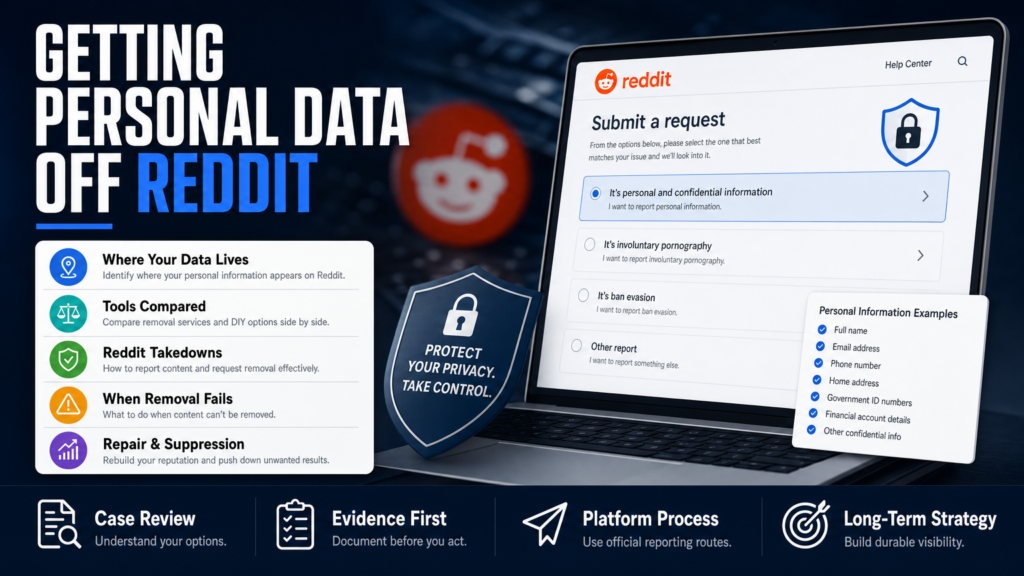
Reddit follows a combination of community-moderation and admin enforcement. Removal on Reddit is possible for doxxing, harassment, and explicit personal data, but not for truthful negative opinions or legal reporting that is permitted under Reddit’s rules.
If your problem is Reddit content, a narrow, documented process works best; see our specialized guidance in Remove Harmful Reddit Comments: Our Expert 3-Step Solution.
- Step 1: Identify whether the content is a comment, post, or a user profile showing your data.
- Step 2: Use the subreddit’s modmail or report function citing the specific Reddit policy.
- Step 3: If the content exposes personal data (address, SSN, phone number), file an admin report and include evidence.
- Step 4: If Reddit declines removal, document the decision and consider publisher contact or legal review.
- Start with the subreddit’s moderators: file a rule-violation report to the moderators.
- If moderators do not act, file an admin report to Reddit explaining exactly which policy is violated and why.
- Preserve evidence (screenshots with timestamps, permalink URLs) before content is edited or deleted.
When you can request search-engine removal instead
If Reddit refuses to remove a post but it exposes sensitive personal information, you may separately request removal from Google’s ‘personal information’ forms when it meets Google’s criteria.
For guidance on when search engines will remove content and how to request it, see Search Engines Privacy: Can You Erase Personal Information Online?.
- Google evaluates requests for doxxing, explicit financial data, and certain identity documents.
- Even when Google removes a result, the original content may remain on Reddit and elsewhere.
When removal is not available: mitigation, correction and suppression
Not all content can be removed. Truthful reporting, court records, and many opinions are protected and will not be taken down. When removal isn’t available we pursue mitigation: correction, de-indexing, and adding higher-quality content to push bad results down.
Mitigation is often the practical path for professionals whose reputational risk is high but whose adverse content is not removable under platform policies.
- Step 1: Build a prioritized content plan—LinkedIn, personal website, publications, interviews.
- Step 2: Optimize those assets so they rank for your name with consistent metadata and schema.
- Step 3: Monitor search results and iterate—SEO suppression is a continuous process, not a one-time fix.
- Correction: ask the publisher to post an update, clarification or an editor’s note if there are factual errors.
- Suppression: publish authoritative bios, press, and profiles to outrank the harmful content (SEO reputation work).
- De-indexing: request search engines to remove sensitive snippets, but this is narrow and not guaranteed.
How to decide between legal action and suppression
Legal options depend on jurisdiction, the nature of the content, and whether the publisher is identifiable and solvent. A qualified attorney should evaluate potential claims.
Suppression is slower and never guaranteed, but it avoids litigation costs and public attention in many cases.
- Legal review is warranted when content is defamatory, falsely attributing criminal activity, or unlawfully publishing private data.
- Suppression is more appropriate when content is factual but damaging, or when a public court of law or petition is unlikely to succeed.
Choosing a provider: cost, timelines and what to expect
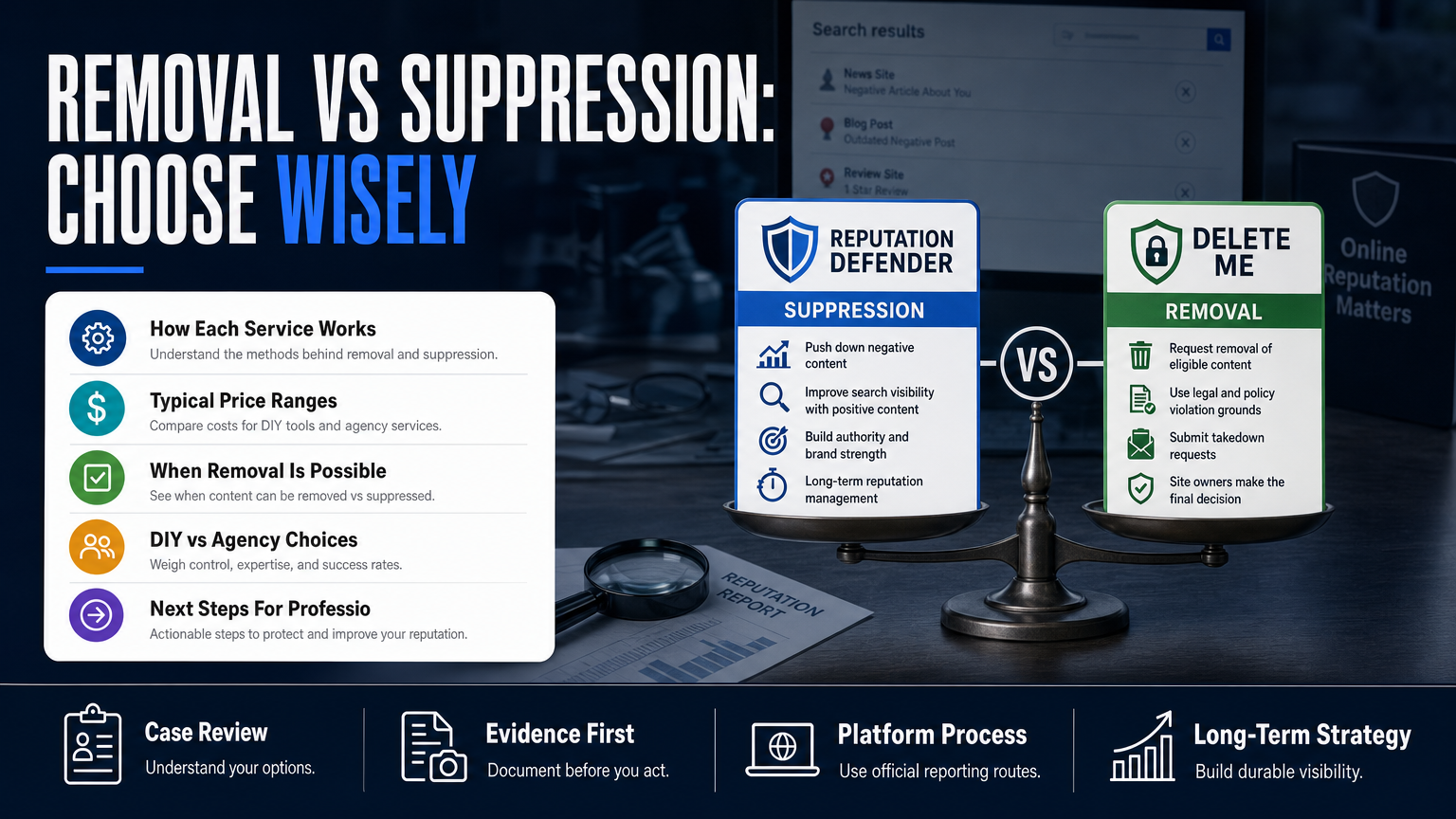
Expect price variation: DIY tools and apps may cost under $100/year, dedicated broker-removal services commonly range from $100–$400/year, and full-service agencies (legal + SEO + PR) can run thousands to tens of thousands depending on complexity.
Do not accept promises of guaranteed removal or fixed timelines. Ask potential providers for a work plan, reporting cadence, and escalation options. For professionals, factor in the specialist risk and potential career cost when choosing scope of service.
- Step 1: Get an itemized engagement scope before you commit.
- Step 2: Insist on written processes for escalation to legal review if standard opt-outs fail.
- Step 3: Plan ongoing monitoring—removals often require repeat requests when data reappears.
- Ask for a list of targets the provider will attempt to remove from (broker list, publisher list).
- Confirm how they document removals—screenshots, take-down confirmations, or reports.
- Understand renewal terms and policies for re-listings (this is common).
Budgeting for reputational risk
High-risk individuals should budget for agency-level support because the stakes (licensing, hospital privileges, litigation) can justify higher spend. Lower-risk individuals can often address the bulk of broker listings with a consumer service plus disciplined DIY requests.
Use the economic impact framework in What An Exposed Identity Costs a Doctor’s Career to assess how much to invest in remediation.
- Low-risk: DIY + app monitoring.
- Medium-risk: Broker service + targeted publisher outreach.
- High-risk: Full-service agency with legal and PR coordination.
DeleteMe vs Incogni: Quick Comparison
A concise side-by-side look at two commonly discussed broker-removal services.
| DeleteMe | Incogni |
|---|---|
| Approach | Legal-style requests via partner law firm |
| Typical targets | Overlapping broker list; vendor publishes specific sites |
| Reporting | Removal confirmations and quarterly reports |
| Price model | Subscription (annual), variable tiers |
| Escalation | Available via partner legal team for stubborn listings |
| Best for | Users wanting established broker opt-outs |
| Limitations | Doesn’t handle publisher takedowns or complex social-media crises |
Hypothetical: A Surgeon’s Reddit Thread and Mugshot Listing
Situation: A surgeon finds a Reddit thread discussing an arrest years earlier and a mugshot page from a third-party site ranking on page one for their name. The surgeon is credentialed at hospitals and worries about patient inquiries and credential reviews.
Process: The surgeon documents all URLs and screenshots, then uses a three-track approach: broker opt-outs to remove personal contact details from people-search sites; direct publisher outreach to the mugshot site asking for removal or correction; and Reddit reporting for doxxing or personal-identifying information.
- Step 1: Audit and collect URLs, screenshots, and any correspondence.
- Step 2: Engage a broker-removal service (DeleteMe/Incogni) for bulk opt-outs.
- Step 3: File targeted requests to the mugshot publisher; if they refuse, review legal options with counsel.
- Step 4: Report the Reddit posts to moderators/admins with policy citations and evidence.
- Step 5: Launch a suppression campaign: personal site, professional profiles, and published commentary optimized for the surgeon’s name.
- Preserve evidence: capture permalinks, screenshots with timestamps.
- Broker sweep: enroll in a broker-removal service to remove addresses and phone numbers.
- Publisher outreach: send a professionally worded takedown/correction request to the mugshot site owner.
- Platform reports: report Reddit content for personal data exposure if applicable.
- SEO suppression: publish an authoritative bio, articles, and profiles to outrank the harmful items.
Common Mistakes People Make When Trying to Delete Personal Information
Below are common errors and how to avoid them. Each mistake slows results or creates unnecessary risk.
Mistake 1 — Chasing guarantees or timelines
Many vendors are pitched as ‘we’ll remove everything in 30 days.’ That’s unrealistic. Removal depends on platform policy, publisher cooperation, and jurisdictional factors. Treat timelines as estimates and demand process transparency instead of promises.
Mistake 2 — Using deceptive takedown tactics
Submitting fraudulent DMCA notices, fake identity claims, or impersonating someone to force removals is illegal and can backfire. Always use legitimate reporting channels and, when necessary, coordinated legal action.
Mistake 3 — Ignoring SEO and suppression
If legal removal isn’t possible, failing to invest in suppression (high-quality profiles and content to outrank harmful pages) leaves you exposed. SEO mitigation is an essential complement to takedown attempts.
Mistake 4 — Not documenting everything
Failing to keep evidence—screenshots, timestamps, correspondence—makes later legal escalation harder. Capture permalinks and preserve copies in secure, versioned storage.
Mistake 5 — Over-reliance on Reddit anecdotes
Reddit user experiences vary widely. Don’t base your entire strategy on a single thread; corroborate with vendor documentation, platform policy language, and direct tests.
Best Practices For Deleting Or Suppressing Personal Information
Use a structured, defensible approach. Below are durable actions professionals and SMBs can take that reduce long-term risk.
Audit first, act second
Start with a complete audit of where your personal information appears, including images and old accounts. Prioritize items that appear on page one of search results for your name.
- Search your name in quotes across search engines.
- Check data brokers, review sites, and niche industry sites (Healthgrades, RealSelf, Glassdoor).
Preserve evidence and chain of custody
Take full‑page screenshots (not just the visible portion), save page source when possible, and store timestamps. This matters if you escalate to legal review.
- Use a secure cloud folder with access controls.
- Document every action and response from platforms or publishers.
Combine removal with suppression
Pursue removals where available and simultaneously create credible, robust content you control to push harmful results lower in search rankings.
- Create a personal website with clear metadata and schema.org markup.
- Publish thought leadership on reputable sites to build authoritative links.
Use platform-specific procedures
Follow each platform’s reporting channels closely: Reddit for comments, Google for search removals, Trustpilot/Yelp for reviews. File the right form and include precise evidence.
- For Google personal info removals, follow Google’s forms and guidance.
- For Reddit, provide exact permalinks and policy citations in admin reports.
Monitor continuously
Removals can be reversed or content can reappear on new sites. Ongoing monitoring ensures early detection and faster response.
- Set Google Alerts for your name and variations.
- Consider subscription monitoring if you are a high-risk individual.
Expert Tips
- Always save full permalinks and full-page screenshots before reporting anything.
- Prioritize removing direct contact data (phone, home address, SSN) before opinion pieces.
- Use a broker-removal service for bulk cleanup, then follow up direct publisher outreach for stubborn items.
- If you have a high-stakes career, budget for a combined legal, PR and SEO approach rather than a single app.
- Don’t share passwords with services; use documented opt-outs instead.
- When a platform refuses removal, document the refusal and pivot to suppression and SEO.
- Be skeptical of one-off ‘guaranteed removal’ claims—insist on written processes.
- Track re-listings: many brokers reappear and require repeated requests.
Conclusion
If Reddit is one of the sources listing your personal information, your strategy should be multi-pronged: targeted platform reports for Reddit content, broker opt-outs for directory listings, and strategic suppression for items that cannot be removed. The ‘best’ service depends on whether you need a one-time sweep, ongoing monitoring, or high-touch legal coordination.
Use the audit-first approach, document everything, and choose a service that matches the scope you need. If removal is not available, high-quality suppression and reputation management are realistic alternatives — they require work and time, but they reduce the real-world impact of harmful search results.
Why Businesses Choose Your Reputation Agency
Managing your reputation takes more than monitoring reviews or publishing the occasional blog post. It takes a strategy built around your situation, your industry, and what is actually showing up in search.
Your Reputation Agency works with businesses, executives, healthcare professionals, attorneys and growing brands. Our services include:
- Remove or challenge defamatory content and false posts across news sites, blogs and social platforms
- Remove negative reviews from Google, Yelp, Facebook, Trustpilot, Glassdoor and industry review sites (e.g., Healthgrades, RateMDs, RealSelf, Vitals, Angi)
- Mugshot and arrest-record removal and remediation
- Remove or takedown negative videos, YouTube content, TikTok clips and other harmful multimedia
- Remove or suppress negative search results and implement search-engine suppression strategies (SEO to bury bad results)
- Remove personal information and opt-out from people-search and data-broker sites (address, phone, phone number removal)
- Social media impersonation and fake account takedown (reporting and removal on Facebook, Instagram, Twitter/X, LinkedIn, TikTok)
- Reddit and community forum post/comment removal and visibility reduction
- Online crisis management and reputation PR to respond to viral incidents
- Monitoring and alerting for negative content, fake reviews and emerging reputation threats
Frequently Asked Questions
1. What is the best website to remove personal information from the internet?
There is no single best website for every case. For bulk people-search removals, services like DeleteMe, Incogni, and Optery are commonly used. For individual publisher pages (blogs, mugshot sites), direct outreach to the site owner or platform reporting is usually required. The right choice depends on whether your priority is broker listings, social-media posts, or publisher content.
2. Which is better, Cloaked or DeleteMe?
Cloaked-style apps and DeleteMe serve different functions. DeleteMe focuses on broker opt-outs; some privacy apps package monitoring and convenience features. ‘Better’ depends on whether you value automated bulk opt-outs, legal escalation paths, or ongoing identity monitoring. Review each vendor’s target list and escalation policy before deciding.
3. What is the best app for removing personal information?
The best app depends on whether you need discovery, removal, or monitoring. Optery, DeleteMe, and Incogni are common choices for broker removal and monitoring. Remember that apps rarely handle publisher takedowns or complex social-media crises—those often require manual outreach or agency support.
4. What service is better than DeleteMe?
Some users prefer Incogni or Optery for their specific workflows, but ‘better’ is subjective. Compare broker coverage, reporting transparency, price, and escalation options. For high-risk individuals, a full-service agency that coordinates legal and PR work may be more appropriate than any single broker-removal service.
5. Can Reddit content always be removed?
No. Reddit will remove content that violates its policies (doxxing, targeted harassment, explicit personal data) but not all negative or truthful posts. Report content to moderators and admins with specific evidence; if Reddit declines, document the decision and pursue publisher outreach or legal review if warranted.
6. How long does data removal take?
Timing varies widely by platform, publisher, jurisdiction, and evidence. Some broker opt-outs occur within days to weeks; publisher removal or legal routes can take months. Avoid vendors that promise fixed timelines—insist on a transparent process instead.
7. Are there free data-removal options?
Yes—many brokers have free opt-out forms you can submit yourself. Manual reporting to platforms and publishers is also free. Paid services add automation, monitoring, and escalation. Free options work for some individuals but require time and repeat follow-up for re-listings.
8. What should I do when removal is not possible?
When removal is unavailable, pursue mitigation: request corrections, build authoritative content to outrank the harmful items, and tighten privacy on your accounts to limit new exposures. SEO reputation strategies can reduce visibility of adverse content, though outcomes are not guaranteed.
9. Should I hire an agency or try DIY?
If the exposure threatens licensing, employment, or litigation, an agency that coordinates legal, SEO, and PR support is often justified. For lower-risk situations, an app plus disciplined DIY takedowns and monitoring may suffice. Decide based on the potential cost of continued exposure and your willingness to manage the process.
Past examples do not guarantee future results. Removal, correction, deindexing, and search-position changes depend on third parties and circumstances outside Your Reputation Agency’s control.