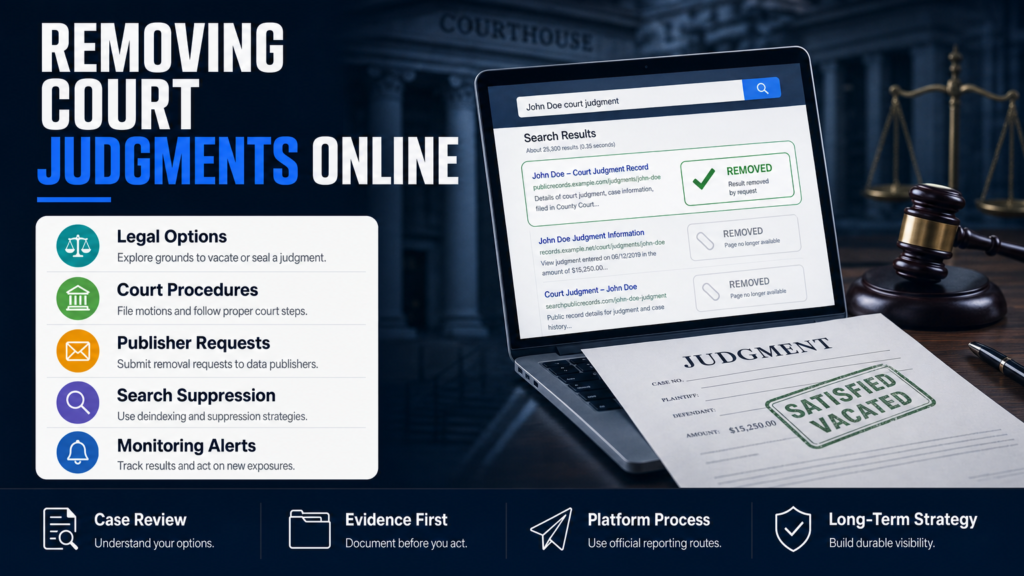
A court judgment public record can remain visible in court databases, third-party aggregators, and search results even after payment or resolution. Removing or limiting it depends on the jurisdiction, record type, accuracy, applicable sealing rules, and the policies of websites that republish public information.
You found a court judgment tied to your name in an online docket or republished on a third‑party site and you want it gone. This article walks through what is and isn’t possible, the evidence and filings that matter, and practical next steps for how to remove a judgement from public record online.
There is no single magic button: removal depends on the court, the grounds you can show, whether the judgment has been satisfied, and where the record appears online. Below you’ll get legal options, platform and publisher strategies, realistic timelines, and alternatives when removal isn’t available.
Use this as a working checklist: what to collect, what to file with the court, how to approach publishers and data brokers, and how to build a suppression plan if the record cannot be removed.
Table of Contents
- Can you get a judgement removed from your record?
- How do I get a judgment removed from public records?
- How long do judgements stay on public records?
- How long does it take for a judgment to be removed?
- What to do when removal is not available
- How judgments affect credit, rental history, and background checks — and what to do
- Practical checklist: what to gather and the exact steps to start today
- DIY vs Hiring a Reputation Agency
- Hypothetical Example: The Independent Surgeon’s Judgment
- Common Mistakes People Make
- Best Practices For Working With Judgments Online
- Expert Tips
- Conclusion
- Why Businesses Choose Your Reputation Agency
- Frequently Asked Questions
Can you get a judgement removed from your record?
Short answer: sometimes — but not automatically. In the United States, there is no general, nationwide right to have court judgments erased from public dockets. Whether you can get a judgement removed from your record depends on the type of judgment, the legal grounds you can show, and the rules of the court that entered the judgment.
Common legal paths include obtaining a satisfaction of judgment (when the debt is paid), filing a motion to vacate or set aside the judgment (for procedural defects, fraud, lack of service, or jurisdiction problems), or getting an expungement or sealing order where local law allows it. Each path has different requirements and standards.
- 1. Obtain the case number, court name, and copy of the judgment entry from the clerk’s office or online docket.
- 2. Identify possible statutory or procedural grounds (e.g., improper service, fraud, void judgment).
- 3. Consult a qualified attorney in the jurisdiction to evaluate filing a motion to vacate or petition to seal.
- 4. If the judgment has been paid, secure a Satisfaction of Judgment from the creditor and see it entered on the docket.
- Satisfaction of judgment: record that the debt or obligation has been paid — does not erase the original filing but can add a satisfaction entry.
- Motion to vacate/set aside: asks the court to undo the judgment for procedural or substantive defects.
- Sealing/expungement: limited and usually statutory — more typical for certain criminal records than civil judgments.
When to involve counsel
Motions to vacate or petitions to seal often have short deadlines and technical filing requirements; an attorney can assess evidence, craft the motion, and represent you at hearings. The content may warrant legal review.
For a checklist of legal options commonly used to challenge and remove court records, see 7 Legal Ways to Remove Court Records (What Actually Works).
How do I get a judgment removed from public records?
If the judgment appears only on the official court docket, the primary routes are legal: satisfaction, vacatur, or sealing. If the judgment has been copied to third‑party sites (news sites, aggregation sites, mugshot repositories), removal often requires a combination of court action, publisher requests, and reputation strategies.
Start at the source: correct or change the court’s record if that is possible. If the court will not remove the entry, focus on the publishers who republished the record.
- 1. Obtain certified copies of the judgment and proof of service.
- 2. If you paid the judgment, request a Satisfaction of Judgment entry and a certified release from the creditor.
- 3. If you have grounds, prepare and file a motion to vacate or petition to seal with the court (timing and standards vary).
- 4. Contact third‑party publishers with evidence (court documents showing vacatur or satisfaction) and request corrections or takedowns.
- 5. If publishers refuse and the content is defamatory or violates platform policy, pursue platform reporting or consult counsel about legal options.
- Request a clerk’s copy of the docket and certified judgment entry before you do anything else.
- If the judgment is incorrect, ask the clerk about a correction or clerical amendment — courts have narrow processes to fix clear errors.
- If a private site republished the judgment, contact the publisher with a concise, evidence‑based request for removal or correction.
How to contact publishers and what to send
Send a single, professional email addressed to the website’s content, legal, or privacy contact. Include: the exact URL, a copy of the court document (redact non‑relevant private details if needed), a clear factual request (remove or correct), and a deadline for response.
Expect many publishers to refuse lawful public records; some will remove outdated or inaccurate copies if provided with a corrected court entry.
- Attach a certified Satisfaction of Judgment if the judgment is paid.
- For errors, attach the court’s correction order or clerk’s notice.
Special note on mugshot and arrest sites
Sites that republish arrest and jail records often behave like other publishers: they may remove content if provided proof of inaccuracy or local legal requirements. For practical guidance specific to arrest-listing sites, see advice on removal from Arrests.org.
How long do judgements stay on public records?
Court dockets are public records and can remain accessible online indefinitely unless the court orders sealing, vacating, or correction. There is no automatic expiration for most civil judgments on public dockets.
Credit reporting is separate: public record judgments historically could appear on credit reports for up to seven years (from the date of filing), but the Consumer Reporting Agencies and reporting rules change — some types of judgments are no longer included on credit reports in the same way.
- 1. Check the court’s online docket for the judgment entry and effective dates.
- 2. Order certified court documents if you plan to pursue satisfaction or a motion to vacate.
- 3. Review credit reports and commercial background reports to see whether the judgment appears there and whether it reports a satisfaction.
- Court docket entries: Indefinite unless vacated, satisfied (with recorded satisfaction), sealed, or corrected.
- Credit reports: Typically up to 7 years from filing for many public records (check current credit bureau practices), but practices vary.
- Third‑party sites: Indefinite; they may retain copies unless you obtain a removal or the publisher voluntarily edits their archive.
How long does it take for a judgment to be removed?
There is no universal timeline. Timing depends on the route you take: court processes have statutory deadlines and hearing dates; publishers have their own review cycles; search engines and SEO changes take time to reflect updates.
Be cautious about any service that promises a fixed deadline. Timing depends on the platform, publisher, evidence, legal complexity, and search-engine behavior.
- 1. Ask the court clerk for current processing times when you file paperwork.
- 2. When contacting a publisher, set a realistic response window (e.g., 14–30 days) and document all communications.
- 3. Build an SEO suppression plan concurrently — do not rely on removal alone.
- Court satisfaction entry: can be recorded within days after you submit the paperwork to the clerk, but processing times vary by court.
- Motion to vacate or sealing petition: may take weeks to months depending on docket backlog and whether hearings are required.
- Publisher takedown or correction: could be days to weeks; many sites do not respond or refuse.
- Search results suppression via SEO: typically months to a year for durable changes.
What to do when removal is not available
Sometimes the court won’t vacate the judgment and publishers refuse to remove lawful public records. When removal is not available, the next step is mitigation: reduce visibility, correct context, and build authoritative content that outranks the negative records.
Mitigation is a multi‑disciplinary process: legal, technical (SEO), and reputational (public statements, corrections). It aims to put accurate, authoritative information ahead of the judgment in search results.
- 1. Audit search results for your name and the judgmented entity; list the priority URLs to suppress.
- 2. Create or optimize owned properties (yourname.com, LinkedIn, professional profiles).
- 3. Publish new positive/neutral content on high‑authority sites and pursue backlinks to those pages.
- 4. Enroll in continuous monitoring and set alerts for any resurfacing.
- Create authoritative profiles (LinkedIn, corporate site, professional directories) and publish accurate bios, whitepapers, and press releases.
- Use targeted SEO: optimized pages, structured data, and link building to push negative links off the first page of search results.
- Correct factual mistakes publicly where possible and use reputation PR to provide context.
When you’re a professional or high‑risk individual
If you are a doctor, lawyer, founder, or executive, an exposed judgment or related arrest record can have career consequences. Consider both mitigation and proactive reputation measures. For discussion of how exposed personal data and incidents can affect a medical career, see What An Exposed Identity Costs a Doctor’s Career.
How judgments affect credit, rental history, and background checks — and what to do
Public judgments often surface in tenant background checks, employment screening, and consumer credit reports. Each has a different process for correction or dispute.
If a judgment is incorrect or satisfied, you should dispute it with the relevant reporting agency and provide certified court documents or a Satisfaction of Judgment.
- 1. Pull a full set of consumer reports and identify where the judgment appears.
- 2. Prepare certified court documents (satisfaction, vacatur) and submit disputes with attachments.
- 3. Follow up in writing and keep copies of all correspondence.
- Credit reports: file disputes with Equifax, Experian, and TransUnion and include certified documents showing satisfaction or vacatur.
- Tenant screening companies and background check firms: identify the company (they often list a consumer assistance contact), submit a dispute and supporting court documents.
- Employment and professional licensing: notify the board or employer with documentation as appropriate and follow any disclosure rules.
Removing failure‑to‑pay rent or rental judgments
Rental judgments often appear in tenant screening databases. If you paid or negotiated the debt, secure a written Satisfaction of Judgment from the landlord or creditor and request the screening company update their record.
If the judgment was entered in error, you may need to file a motion in the housing court to set it aside and then push for corrections to tenant screening reports.
Practical checklist: what to gather and the exact steps to start today
Below is a practical, prioritized checklist you can use immediately. The goal is to control the evidence and create multiple options: legal correction, publisher negotiation, and search‑engine mitigation.
Do these steps in roughly this order — collecting evidence first makes any legal or publisher approach significantly stronger.
- 1. Collect: certified court docs, correspondence, payment receipts, loan or lease agreements.
- 2. Evaluate: determine whether grounds exist to file a motion to vacate, petition to seal, or to record a satisfaction.
- 3. File: submit required paperwork to the clerk or engage counsel to file a motion.
- 4. Notify: send a documented removal/correction request to each publisher with supporting court evidence.
- 5. Mitigate: launch an SEO suppression plan if removal is refused.
- Order certified court docket entries and the judgment document for all relevant jurisdictions.
- If applicable, get a copy of any Satisfaction of Judgment or release from the creditor.
- List every URL that references the judgment (news, aggregation sites, mugshot sites, Google cache).
- Identify the publisher’s contact and their takedown/DMCA or privacy procedure.
- Create or update authoritative owned pages you control (personal website, LinkedIn, company bio).
DIY vs Hiring a Reputation Agency
A concise comparison of DIY effort versus using a professional reputation agency for judgment removal and mitigation.
| DIY | Professional Agency |
|---|---|
| Cost Up‑front | Higher Up‑front (but bundled services) |
| Time Investment | Agency handles workflow |
| Legal Complexity | Coordinates with counsel |
| Platform Relationships | Experienced in platform processes |
| SEO Suppression | Strategy and execution included |
| Monitoring | Continuous alerts and reporting |
Hypothetical Example: The Independent Surgeon’s Judgment
Background: A hypothetical surgeon (Dr. A) finds a civil judgment for breach of contract from five years earlier on the county online docket and the judgment has been copied to two courthouse aggregator sites and one mugshot‑style archive. Dr. A believes the judgment resulted from an administrative billing dispute resolved years ago.
What was done: Dr. A followed a three‑track approach: (1) documented and ordered certified court records; (2) engaged local counsel to file a motion to correct and entered a Satisfaction of Judgment with the clerk; (3) contacted the publishers with the certified satisfaction and requested corrections. Simultaneously, Dr. A’s team created updated professional pages and published authoritative content to begin suppressing old links.
- 1. Document the original docket entry and collect proof of payment or error.
- 2. File the appropriate court paperwork (satisfaction or motion) with counsel if needed.
- 3. Send publishers certified documents and a clear request to remove or correct.
- 4. Implement a search‑result suppression plan for persistent third‑party pages.
- Week 1–2: Ordered certified judgment and proof of payment; located all URLs that replicated the judgment.
- Week 3–8: Counsel filed a motion; creditor issued a Satisfaction of Judgment; clerk entered the satisfaction on the docket.
- Week 9–12: Publishers were sent the certified satisfaction; one removed the copy, one updated the entry, and the mugshot site refused.
- Month 3–9: SEO work and new authoritative pages began to push the remaining negative URLs off page one of Google; continued monitoring detected occasional re‑indexing.
Common Mistakes People Make
Avoid these common errors; each one can cost time and make removal or mitigation harder.
Mistake: Treating All Public Records As Equally Removable
Not every public record can be removed. Courts rarely erase accurate public records absent statutory grounds. Assume you will need to pursue satisfaction, correction, or mitigation rather than guaranteed deletion.
Mistake: Skipping The Court Clerk
People often go straight to publishers. Start with the clerk: certified documents, corrections, or a Satisfaction of Judgment entered by the court are the evidence publishers and credit bureaus need.
Mistake: Using Deceptive or Fake Takedown Tactics
Avoid any service that recommends fake legal filings, impersonation, or fraudulent takedowns. These tactics are illegal and can make your situation worse.
Mistake: Relying On SEO As A Quick Fix
SEO suppression works but is not instantaneous. People expect fast results; realistic planning expects months of coordinated content and link building.
Mistake: Failing To Monitor After Initial Work
Even after removal or suppression, negative content can reappear in new caches or clones. Implement ongoing monitoring and alerts to detect regressions.
Best Practices For Working With Judgments Online
These are durable, practical rules for managing a judgment that appears online.
Document Everything First
Always begin by collecting certified court documents, dates, case numbers, and proof of payment. That evidence is the lever for any legal or publisher request.
Use Official Court Channels Before Public Pressure
File a Satisfaction of Judgment or an appropriate motion through the clerk before appealing to publishers. A court‑entered correction carries significantly more weight with third parties.
Coordinate Legal And Reputation Work
Legal relief and reputation mitigation (SEO, PR) are complementary. Bring both streams together to maximize the chance that corrected information replaces the negative results.
Be Transparent And Factual With Publishers
When contacting publishers, be factual, provide certified documents, and avoid emotional language. A concise, documented request improves your odds of a voluntary correction.
Monitor Continuously
Set up alerts, check common aggregators, and periodically re‑run search audits so you detect re‑publications quickly.
Expert Tips
- Start by ordering certified court documents — publishers and reporting agencies require them.
- If a judgment was paid, get a written Satisfaction of Judgment from the creditor and record it with the clerk immediately.
- File the motion to vacate within any statutory deadlines; missing deadlines can foreclose legal remedies.
- When contacting publishers, send a single documented request with attachments; be prepared to escalate to counsel if they refuse.
- Build owned, authoritative web pages that include your name and structured data to help search engines rank them.
- Use Google’s removal tools only for content that violates Google’s policies, not for lawful public records.
- Treat suppression and removal as parallel strategies rather than sequential fixes.
- Keep a running export (CSV) of every URL, contact, and response during the process.
Conclusion
Removing a judgment from public records online is rarely simple. You may be able to get a satisfaction entered, a judgment vacated, or a record sealed — but those are legal processes that depend on evidence and local law. When removal isn’t available, effective mitigation and monitoring can reduce the reputational harm.
Take a methodical approach: document the record, evaluate legal options, engage publishers with certified documentation, and run a search‑result suppression plan in parallel. If the matter affects your professional life or carries complex legal questions, coordinate with qualified counsel and experienced reputation professionals who can manage the technical, platform, and public‑relations work together.
Why Businesses Choose Your Reputation Agency
Managing your reputation takes more than monitoring reviews or publishing the occasional blog post. It takes a strategy built around your situation, your industry, and what is actually showing up in search.
Your Reputation Agency works with businesses, executives, healthcare professionals, attorneys and growing brands. Our services include:
- Remove or challenge defamatory content and false posts across news sites, blogs and social platforms
- Remove negative reviews from Google, Yelp, Facebook, Trustpilot, Glassdoor and industry review sites (e.g., Healthgrades, RateMDs, RealSelf, Vitals, Angi)
- Mugshot and arrest-record removal and remediation
- Remove or takedown negative videos, YouTube content, TikTok clips and other harmful multimedia
- Remove or suppress negative search results and implement search-engine suppression strategies (SEO to bury bad results)
- Remove personal information and opt-out from people-search and data-broker sites (address, phone, phone number removal)
- Social media impersonation and fake account takedown (reporting and removal on Facebook, Instagram, Twitter/X, LinkedIn, TikTok)
- Reddit and community forum post/comment removal and visibility reduction
- Online crisis management and reputation PR to respond to viral incidents
- Monitoring and alerting for negative content, fake reviews and emerging reputation threats
Frequently Asked Questions
1. How do I get a judgment removed from public records?
Start by getting certified court documents and then evaluate legal options: satisfaction of judgment, motion to vacate, or petition to seal where available. If the judgment is on third‑party sites, provide certified evidence to publishers and request corrections. The content may warrant legal review; consult an attorney for jurisdiction‑specific advice.
2. How long do judgments stay on public records?
Court dockets can remain publicly accessible indefinitely unless a court orders sealing, vacatur, or correction. Credit reporting of judgments historically lasted up to seven years, but practices vary and reporting rules change.
3. How long does it take for a judgment to be removed?
Timing varies: recording a Satisfaction of Judgment can be days to weeks; motions to vacate or petitions to seal can take weeks to months; publisher responses are unpredictable; SEO suppression often takes months. Timing depends on the platform, publisher, evidence, legal complexity, and court schedules.
4. Can you get a judgment removed from your record?
You can in some circumstances — for example, if the judgment is paid and a Satisfaction is recorded, or if you prevail on a motion to vacate or a statutory sealing petition. Outcomes depend on the facts, evidence, and applicable law; there is no guaranteed result.
5. What should I do if a judgment appears on tenant screening or credit reports?
Gather certified court documents showing the judgment and any satisfaction, then file disputes with credit bureaus and the screening companies, attaching proof. Follow up in writing and, if necessary, involve counsel to correct inaccurate or unupdated reports.
6. Will paying a judgment remove it from public records?
Paying a judgment typically does not erase the original entry; it allows you to record a Satisfaction of Judgment, which documents that the obligation was resolved. A satisfaction improves your position with publishers and reporting agencies but does not automatically delete the original filing.
7. Can a publisher refuse to remove a judgment they’ve republished?
Yes. Publishers are not required to remove lawful public records. They may remove or correct content when presented with certified court documents or if legal obligations apply, but refusals are common. When removal is refused, mitigation and SEO strategies are the realistic next step.
8. Are there free ways to remove a judgment from public records online?
Some steps are free: obtaining court records (which may have small fees), filing basic motions if you represent yourself, and contacting publishers directly. However, legal relief, complex motions, and sustained SEO suppression often require paid services. Evaluate free options first but understand their limits.
9. What if a judgment was entered in error?
If a judgment was entered in error (e.g., lack of proper service, identity mix‑up), gather evidence and immediately consult the court clerk about filing a motion to vacate or set aside the judgment. Time limits apply for certain motions, so act quickly.
This content provides general information and does not constitute legal advice. The available options and likely outcomes depend on the facts, evidence, platform policies, applicable law, jurisdiction, and public-interest considerations.
Past examples do not guarantee future results. Removal, correction, deindexing, and search-position changes depend on third parties and circumstances outside Your Reputation Agency’s control.
Can a Court Judgment Public Record Be Removed?
Payment does not usually erase the historical filing. Start by obtaining the complete docket and confirming whether the court record accurately reflects satisfaction, dismissal, appeal, vacatur, sealing, or another later event. If an entry is wrong, ask the clerk about the court’s correction procedure. If it is accurate, a licensed attorney in the relevant jurisdiction can explain whether sealing or restricted access is legally available.
- Identify the court, case number, and exact public URLs.
- Obtain certified records showing the current case status.
- Correct factual errors through the court or originating source.
- Ask qualified counsel about sealing, vacatur, or expungement options.
- Send updated records to private publishers that accept corrections.
- Request search updates only after a source page changes or disappears.
- Monitor for duplicate listings and outdated snippets.
Use the federal judiciary’s PACER information portal for federal-court record guidance; state and local courts use different systems. This article provides general information and is not legal advice.