You have a problem in search results, reviews, social platforms, or a mugshot/arrest page that’s damaging how people, patients, or clients see you. This article explains what online reputation management services packages are, what they typically include, and how firms price and scope work for professionals, executives, and small businesses.
We cover the common package tiers, realistic cost ranges, and why the same package will look different for a surgeon, a restaurant owner, and an executive. The term online reputation management services packages appears regularly here because package structure—what’s included, what’s optional, and how agencies measure progress—matters when you need urgent, practical remediation.
You’ll get concrete examples of platform-specific processes (Google, Yelp, Facebook, YouTube, Trustpilot, Healthgrades), the limits of what any vendor can do, and a recommended decision checklist for selecting a package that matches risk and budget.
Table of Contents
- What are online reputation management services?
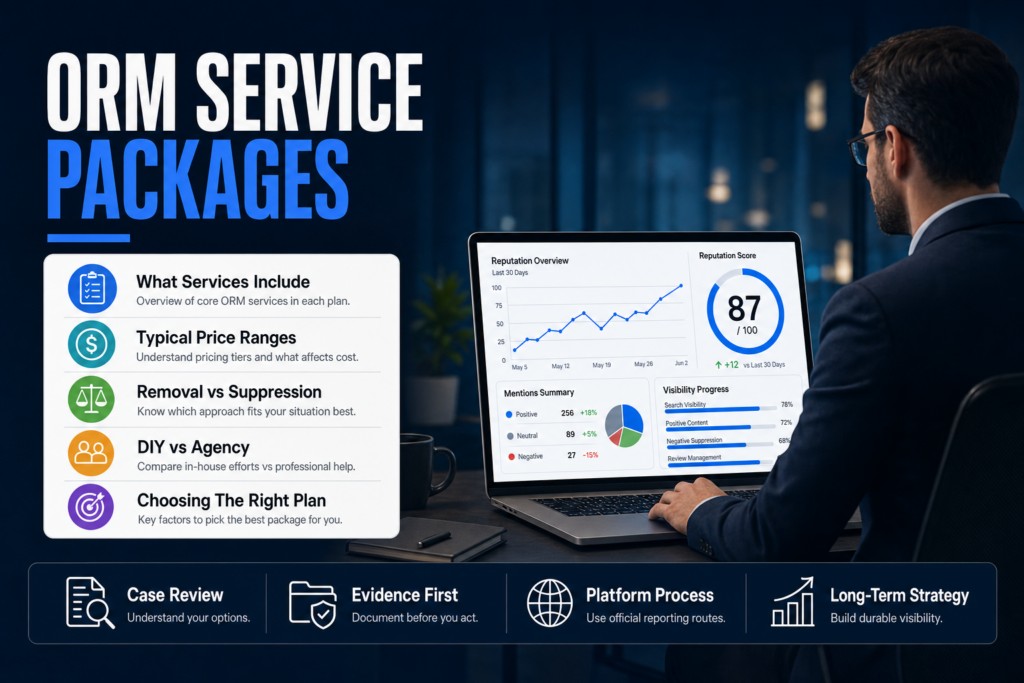
- What a typical online reputation management services package includes
- How much do online reputation management services packages cost?
- How much does online reputation repair cost specifically?
- Is Reputation (the company) a legit reputation management company?
- When content removal isn’t available: suppression, mitigation, and correction
- How to choose the right online reputation management services package
- What to expect during execution: detailed process and realistic timelines
- Removal vs Suppression: Quick Comparison
- Hypothetical example: A physician facing a defamatory blog post
- Common mistakes organizations make when buying ORM packages
- Best practices when buying an online reputation management services package
- Expert Tips
- Conclusion
- Why Businesses Choose Your Reputation Agency
- Frequently Asked Questions
What are online reputation management services?
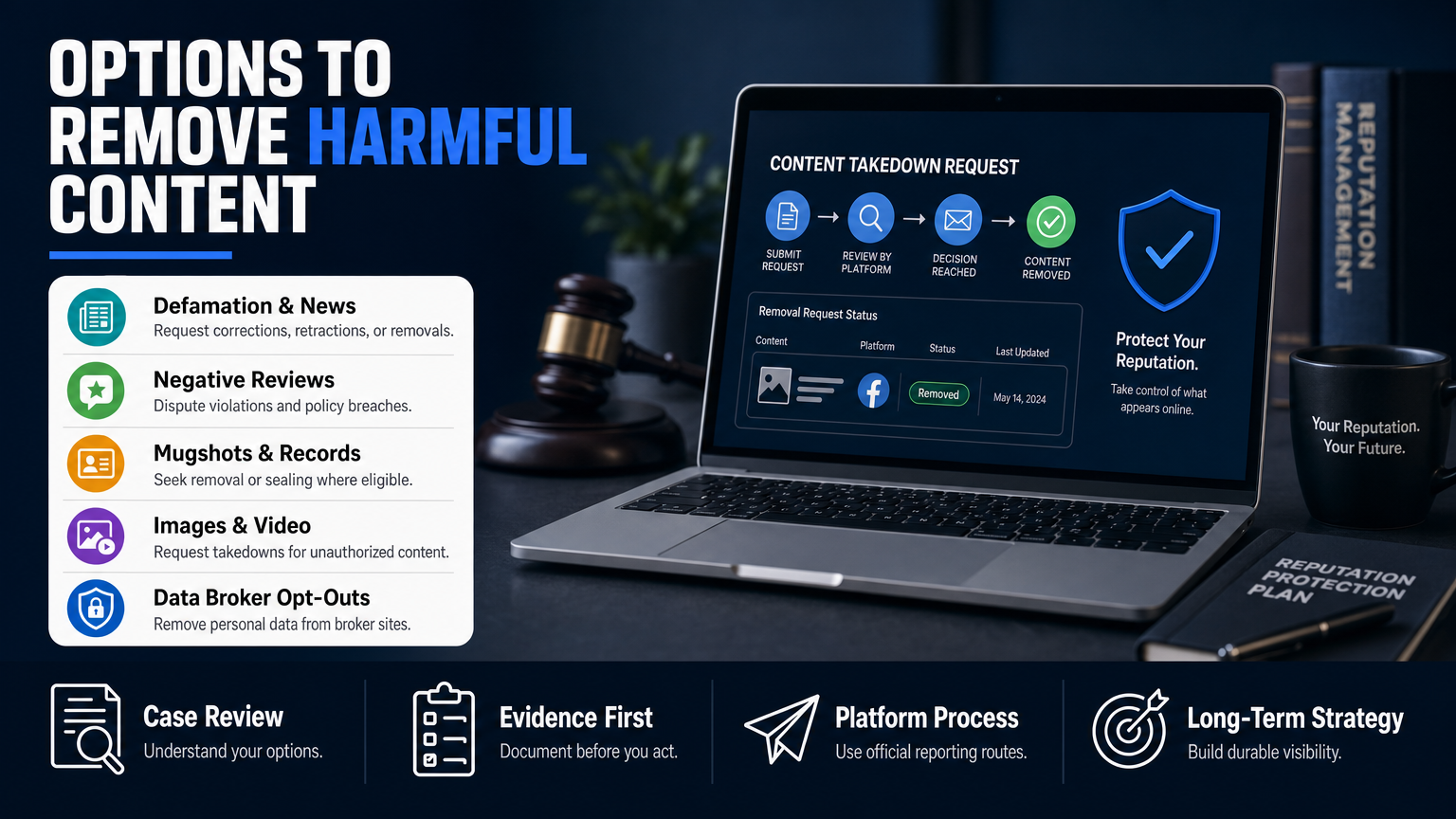
Online reputation management services are professional programs that evaluate, remediate, and monitor online content that affects how an individual or business appears in search engines, review sites, and social platforms. Services may include assessing harmful content, pursuing removals or takedowns, performing SEO suppression, managing review responses, monitoring for new threats, and coordinating legal or technical options where appropriate.
These services can be delivered as one-off projects (for example: removing a defamatory article or a mugshot page) or as ongoing packages that include monitoring, review-generation, and active SEO work. For an overview of why this work matters for organizations, see Why Online Reputation Management Is Important for Businesses and Professionals.
- Initial intake: collect the URLs, account details, and authorization to act on your behalf.
- Assessment: classify content type (defamation, opinion, privacy breach, mugshot, review, impersonation).
- Strategy: map removal, suppression, and monitoring options with estimated effort and costs.
- Execution: file platform reports, request removals, launch SEO/content campaigns, and coordinate legal counsel if needed.
- Ongoing: daily/weekly monitoring and reporting, plus adjustments as results appear.
- Content evaluation and evidence gathering (screenshots, timestamps, provenance).
- Platform reporting and appeal workflows (Google, Yelp, Facebook/Takedown forms).
- SEO suppression: create and promote authoritative content to push harmful results down.
- Removal routes: publisher takedowns, privacy-law opt-outs, DMCA, or legal demand letters where applicable.
- Monitoring and alerts for new negative posts, fake reviews, or impersonation.
What a typical online reputation management services package includes
Packages vary widely by provider and client need. Most firms offer tiered plans that combine diagnostics, remediation actions, and monitoring. Below is a high-level breakdown of common inclusions.
When evaluating a package, insist on a written scope that lists deliverables, reporting frequency, and cancellation/renewal terms.
- Select a package tier based on urgency and volume (single-item removal vs multi-URL suppression).
- Sign engagement documents defining authority to submit takedown requests or act on your behalf.
- Receive the initial audit within an agreed timeframe (often 3–10 business days).
- Approve the remediation plan and any content we propose to publish for suppression.
- Initial audit: detailed report of offending URLs, search-engine snapshots, and risk scoring.
- Removal attempts: platform reports, publisher outreach, DMCA and privacy opt-outs when applicable.
- SEO and content creation: new pages, press releases, optimized profiles, and link-building to suppress negatives.
- Review management: generating legitimate reviews, review response templates, and dispute workflows for Google and site-specific forms.
- Monitoring: automated alerts for new mentions, weekly or monthly reports, and crisis escalation procedures.
- Legal-tactical support: preparing evidence packages and coordinating with outside counsel when litigation may be necessary.
Common package tiers
Basic: monitoring + monthly reporting, minor review management, and a small number of removal requests (suitable for proactive reputation maintenance).
Standard: includes an audit, moderate SEO suppression work, multiple removal attempts, and review-growth programs (appropriate for professionals with 1–5 issues).
Premium: full crisis work, aggressive SEO suppression, legal coordination, and priority monitoring/response (designed for higher-risk individuals or businesses with multiple damaging items).
How much do online reputation management services packages cost?
Cost depends on scope, platform complexity, legal needs, and urgency. Below are realistic ranges and explanations for why prices vary. These are illustrative ranges, not bids or guarantees.
If you need a fast estimate for budgeting, many providers will give a preliminary quote after reviewing the worst 5–10 URLs.
- Obtain an audit: a firm should provide a written estimate after an audit of the top damaging items.
- Clarify pricing drivers: number of URLs, need for legal letters, paid media/SEO spend, and time sensitivity.
- Request a scope: fixed-scope projects are easier to budget than open retainers—ask for both options.
- DIY tools/subscriptions: $25–$300 per month (monitoring, basic review management tools, templates).
- Entry-level packages: $500–$2,000 per month or $1,000–$6,000 one-time (audit, monitoring, light SEO, some removal requests).
- Mid-tier packages: $2,000–$8,000 per month or $5,000–$25,000 project fees (complex suppression, multiple platform escalations, active PR).
- High-risk/crisis packages: $10,000+ per month or $20,000–$100,000+ projects (lawyer coordination, high-volume legal takedowns, reputation PR, multilocation businesses).
Why prices vary
Publisher cooperation: removing an article from a small blog is cheaper than pursuing removal from a major news site or entrenched forum thread.
Platform friction: sites like Google require documented policy violations or legal grounds; removing from Google Search Console alone is rare without publisher action.
Legal complexity: matters that likely require litigation, subpoenas, or privacy-law analysis push costs higher and take longer.
How much does online reputation repair cost specifically?
People ask how much ‘repair’ costs because it implies full restoration of online standing. Repair is a process, not a single action, and costs reflect the work necessary to correct inaccurate information, remove or suppress harmful content, and rebuild credible content.
Typical repair budgets are driven by the visibility and severity of the negative information, not just the number of items.
- Identify the highest-priority URLs that drive impressions (use search-console or an agency audit).
- Estimate the effort required for each URL: publisher outreach, DMCA, privacy opt-outs, or SEO suppression.
- Budget for at least one to three months of active work plus ongoing monitoring if the matter involves reputational risk.
- Small repair job (single false article or a few bad reviews): $1,500–$8,000 project fee or $500–$2,000/month for managed plans.
- Moderate repair (multiple platforms, some legal coordination): $5,000–$30,000, often combined with ongoing monitoring and SEO.
- Extensive repair (viral incident, mugshots, or multi-year smear): $20,000+ and sometimes costly ongoing campaigns for months to years.
Is Reputation (the company) a legit reputation management company?
Reputation (often stylized as Reputation.com) is a publicly recognized reputation and experience-management company that offers SaaS tools for reviews, surveys, and customer-experience analytics. It is a legitimate commercial vendor in the reputation space and operates differently from boutique remediation firms that offer hands-on takedown services.
Legitimacy does not equal suitability. Whether Reputation or any vendor is right for you depends on your needs—do you need a SaaS platform for review management, or do you need hands-on removal, legal coordination, and crisis PR?
- List your requirements (publisher removal, SEO suppression, review growth, or monitoring).
- Match those needs to a vendor’s core business: SaaS platforms excel at review workflows; boutique agencies handle takedowns and legal tactically.
- Request case examples or technical specs that relate to problems like yours.
- Do due diligence: check product demos, ask for references, and verify the platform feature set against your objectives (review aggregation, workflow automation, analytics).
- Distinguish SaaS vs service: some organizations combine software subscriptions with professional services; others are only software vendors.
- Read contract terms: pay attention to data handling, cancellation policies, and SLAs for support and response time.
When content removal isn’t available: suppression, mitigation, and correction
Not all harmful content can be removed. Removal depends on publisher cooperation, platform policies, public-record status, and applicable law. When removal is unavailable or unlikely, effective packages will include mitigation: SEO suppression, corrective content, and reputation PR.
For a technical walkthrough of how ORM programs combine these options, see How Does Online Reputation Management Work? The Complete Guide for Businesses.
- Prioritize: rank negative items by traffic and impressions, not just emotional impact.
- Build: produce targeted landing pages, LinkedIn pages, and press content optimized for the person’s or business’s name and keywords.
- Distribute: use earned, owned, and paid channels to accelerate the visibility of corrective content.
- Measure: track ranking changes, impressions, and referral traffic to demonstrate progress even if removal is not achieved.
- SEO suppression: create high-quality, authoritative content (profiles, articles, videos) that outrank the negative item over time.
- Correction: reach out to publishers to submit corrections or updates when the content is factually wrong or incomplete.
- Contextualization: publish responses, FAQs, or attorney statements where appropriate to provide context without violating platform rules.
- Monitoring and alerting: set up continuous scans so new items are identified quickly and addressed before they gain traction.
How to choose the right online reputation management services package
Selecting a package requires matching your risk, budget, and timeline with the vendor’s ability to act across platforms and, if needed, coordinate with counsel. Small businesses and professionals have different priorities than high-profile executives.
If you represent a small business, start by comparing features in Online Reputation Management for Small Businesses.
- Get an audit from 2–3 reputable vendors and compare deliverables, timelines, and fees.
- Request references for similar cases (same industry and scale) and ask how the vendor handled platform resistance.
- Negotiate a pilot or limited-scope engagement to validate process before committing to a long retainer.
- Match urgency to service level: crisis-grade incidents need rapid response, higher fees, and legal coordination.
- Ask for specific platform experience: Google reviews, Yelp, Trustpilot, Healthgrades, YouTube, and TikTok all have distinct processes.
- Demand transparency: written scopes, itemized pricing for removals, SEO hours, and PR spend.
- Check escalation paths: who will handle rapid takedowns and who communicates with you during a crisis?
What to expect during execution: detailed process and realistic timelines
Execution combines platform reporting, publisher outreach, SEO work, and possibly legal steps. Timing varies: some platform responses occur in days, others take weeks or months, and legal routes may take significantly longer.
An agency should give an estimated range after reviewing the evidence; exact timing cannot be guaranteed because platform decisions, publisher cooperation, and search-engine indexing are outside the provider’s control.
- Day 0–10: intake and audit, submit high-priority platform reports.
- Week 2–8: follow-up with publishers, begin SEO suppression content creation and distribution.
- Month 2–6+: ongoing SEO and monitoring; legal steps (if used) may proceed in parallel and take longer.
- Examples of platform processes and typical ranges (estimates only):
- Google review removal: 3–30 days for policy-based removals; appeals and reinclusion can extend timelines.
- Yelp review disputes: 7–21 days for moderation, but Yelp often declines to remove subjective reviews unless policy violations are clear.
- YouTube takedowns: 24–72 hours to initially process DMCA claims, longer if counter-notices occur.
- Mugshot and arrest pages: removal may require publisher contact, record sealing, or court orders; timelines vary widely.
Evidence and authorization
You’ll need to provide identity verification and documentation for some actions (for example, proof of ownership for DMCA or identity verification for platform account reports). Ask vendors how they securely handle and store this information.
Where legal action is likely, the agency should coordinate with an attorney; your engagement agreement should explain this workflow. Agencies are not law firms unless they explicitly hold that credential.
Removal vs Suppression: Quick Comparison
Use this table to decide whether to prioritize removal attempts or suppression and mitigation.
| Removal | Suppression |
|---|---|
| Goal | Goal |
| Eliminate the content from a platform or search index | Push harmful content lower in search results |
| Usually faster if publisher cooperates | Slower, requires consistent content publishing and SEO |
| Dependent on publisher/platform policy or law | Dependent on SEO authority and content quality |
| May require legal or takedown notices | Relies on owned media, PR, and link-building |
| Risk of partial or failed removals | Ongoing cost and maintenance to retain rankings |
Hypothetical example: A physician facing a defamatory blog post
Situation: A physician finds a factually false blog post ranking high on Google for their name. The post is not on a major news site but is indexed and shared on social media.
Approach: The remediation package focuses on practical steps rather than promising removal. The plan includes an audit, publisher outreach for correction or removal, legal evaluation, and SEO suppression to lower the post’s search visibility.
- Day 0–5: intake, authorization, and audit delivered.
- Day 3–21: outreach to publisher; file platform reports where policy fits.
- Week 2–12: publish and promote corrective content (SEO), begin link-building to new pages.
- Month 3–6: monitor positions, adjust content strategy, and continue publisher follow-ups and legal coordination if publisher refuses correction and the content is demonstrably false.
- Initial audit identifies the URL, social shares, citation sources, and search-engine impressions.
- Publisher outreach requests correction or removal with documented evidence and a polite, professional fact summary.
- Platform reporting to Google for policy-based violations (if any) and monitoring for new spread.
- SEO suppression: create a new professional profile, two authoritative articles, optimized YouTube video, and high-value directory entries to outrank the blog post.
Common mistakes organizations make when buying ORM packages
Avoid these mistakes; each one increases cost or reduces effectiveness.
Mistake 1 — Choosing the cheapest option without scope
Low prices may omit crucial steps like manual outreach, legal coordination, or paid promotion. A low-cost package that only provides monitoring and templates won’t fix a live crisis.
Mistake 2 — Expecting guaranteed removal
No reputable agency can guarantee removal or search ranking positions. Contracts or claims that promise guaranteed outcomes should be treated with skepticism.
Mistake 3 — Treating all negative content the same
A negative opinion review differs from a defamatory article or a public record. Each requires a different legal, platform, and communications approach.
Mistake 4 — Not verifying platform experience
Some vendors are strong at review growth but weak at legal takedowns or Google Search remediation. Ask for specific experience on the platforms that matter to you.
Mistake 5 — Ignoring monitoring after apparent success
Two weeks after a takedown is not the end—new items appear. Ongoing monitoring prevents re-emergence and quickly identifies copycat pages or reposts.
Best practices when buying an online reputation management services package
Follow these durable practices to get measurable value and reduce surprises.
Document everything
Keep detailed records: copies of pages, timestamps, share counts, and any correspondence with publishers. Good documentation strengthens platform reports and legal options.
Get a written scope and KPIs
Define deliverables, reporting cadence, accepted platforms covered, and success measures (for example: remove X URLs, push top-5 results to owned pages, or reduce impressions by Y%).
Prefer pilot projects for new vendors
Start with a limited engagement to validate process, communication, and outcomes before committing to long retainers.
Include monitoring and escalation
Ensure the package contains alerts, a crisis escalation path, and clear response SLAs for high-severity items.
Coordinate with legal counsel when necessary
If the content is potentially defamatory, privacy-invasive, or tied to sensitive legal matters, coordinate the agency’s actions with qualified attorneys.
Expert Tips
- Ask for sample reports and a walk-through of exactly how they document removals and suppression progress.
- Prioritize items that actually appear in search impressions, not every negative mention—use Search Console or traffic estimates.
- Demand clear channel ownership and single-point communication during a crisis.
- Insist on secure data handling for any identity verification or privileged documents you must share.
- Consider paid promotion for corrective content to accelerate visibility while organic SEO builds.
- Request contract clauses that define what happens if priorities shift or new urgent items appear.
- If you see promises of guaranteed removal or rankings, ask for written, verifiable proof and treat it as a red flag.
- Use a pilot engagement to test responsiveness and platform knowledge before a long-term commitment.
Conclusion
Online reputation management services packages vary from monitoring-only subscriptions to multi-disciplinary crisis-response retainers. The right package depends on the visibility and severity of the negative content, the platforms involved, and whether legal intervention is likely to be necessary.
Choose vendors who provide transparent scopes, documented processes, and measurable KPIs. If removal is unlikely, a good package should include effective suppression and ongoing monitoring to reduce visibility and limit future damage—these are realistic, defensible objectives that align with best practices.
Why Businesses Choose Your Reputation Agency
Managing your reputation takes more than monitoring reviews or publishing the occasional blog post. It takes a strategy built around your situation, your industry, and what is actually showing up in search.
Your Reputation Agency works with businesses, executives, healthcare professionals, attorneys and growing brands. Our services include:
- Remove or challenge defamatory content and false posts across news sites, blogs and social platforms
- Remove negative reviews from Google, Yelp, Facebook, Trustpilot, Glassdoor and industry review sites (e.g., Healthgrades, RateMDs, RealSelf, Vitals, Angi)
- Mugshot and arrest-record removal and remediation
- Remove or takedown negative videos, YouTube content, TikTok clips and other harmful multimedia
- Remove or suppress negative search results and implement search-engine suppression strategies (SEO to bury bad results)
- Remove personal information and opt-out from people-search and data-broker sites (address, phone, phone number removal)
- Social media impersonation and fake account takedown (reporting and removal on Facebook, Instagram, Twitter/X, LinkedIn, TikTok)
- Reddit and community forum post/comment removal and visibility reduction
- Online crisis management and reputation PR to respond to viral incidents
- Monitoring and alerting for negative content, fake reviews and emerging reputation threats
Frequently Asked Questions
1. What are online reputation management services?
They’re programs that audit your online presence, attempt removals or corrections where justified, implement SEO-based suppression, manage reviews and social issues, and provide monitoring and crisis response. Services vary—some are software tools, others are hands-on agencies that coordinate legal, technical, and PR options.
2. How much does online reputation management cost?
Costs range widely: DIY tools can be $25–$300/month; basic agency packages typically start around $500–$2,000/month or $1,000+ for one-off projects; more aggressive or legal-heavy campaigns can run thousands to tens of thousands of dollars. A precise estimate requires an audit of the damaging items.
3. Is Reputation a legit company?
Yes—Reputation (Reputation.com) is a legitimate SaaS vendor focused on reviews and customer-experience management. Legitimacy doesn’t mean it’s the right fit—SaaS platforms differ from boutique remediation firms that handle removals and legal coordination.
4. How much does online reputation repair cost?
Repair costs depend on the number and severity of the issues. Small repairs for a few items might be $1,500–$8,000; multi-platform repairs with legal coordination are commonly $5,000–$30,000 or more. Repair is a process—ongoing monitoring and SEO may be necessary.
5. Can any company guarantee removal of bad content?
No reputable company can guarantee removal. Removal depends on the publisher, platform policies, applicable law, and evidence. Reputable vendors will evaluate whether content may qualify for removal and pursue the available legal, technical, and platform-based options.
6. What should I ask for in a contract for these services?
Request a detailed scope listing included deliverables, excluded services, reporting cadence, cancellation terms, data-handling practices, and escalation procedures. Ask for itemized pricing for per-URL work, SEO hours, and legal coordination.
7. What happens if removal isn’t possible?
When removal is unavailable, recommended steps include SEO suppression (publishing and promoting authoritative content), pursuing corrections, contextual responses, and continuous monitoring. Agencies will pursue remediation where feasible and shift to mitigation strategies when removal is unlikely.
8. How long does ORM work usually take to show results?
Timelines vary: some platform actions show in days, SEO suppression can take weeks to months, and legal remedies may take months or longer. Timing depends on the platform, publisher cooperation, the evidence quality, and search-engine behavior—an estimated timeline can be provided after assessment.
9. Do I need a lawyer to work with a reputation agency?
Not always, but if content involves defamation, privacy rights, or potential litigation, coordination with qualified counsel is advised. Agencies often gather evidence and prepare takedown packages, but legal claims and court actions require an attorney.
This content provides general information and does not constitute legal advice. The available options and likely outcomes depend on the facts, evidence, platform policies, applicable law, jurisdiction, and public-interest considerations.
Past examples do not guarantee future results. Removal, correction, deindexing, and search-position changes depend on third parties and circumstances outside Your Reputation Agency’s control.