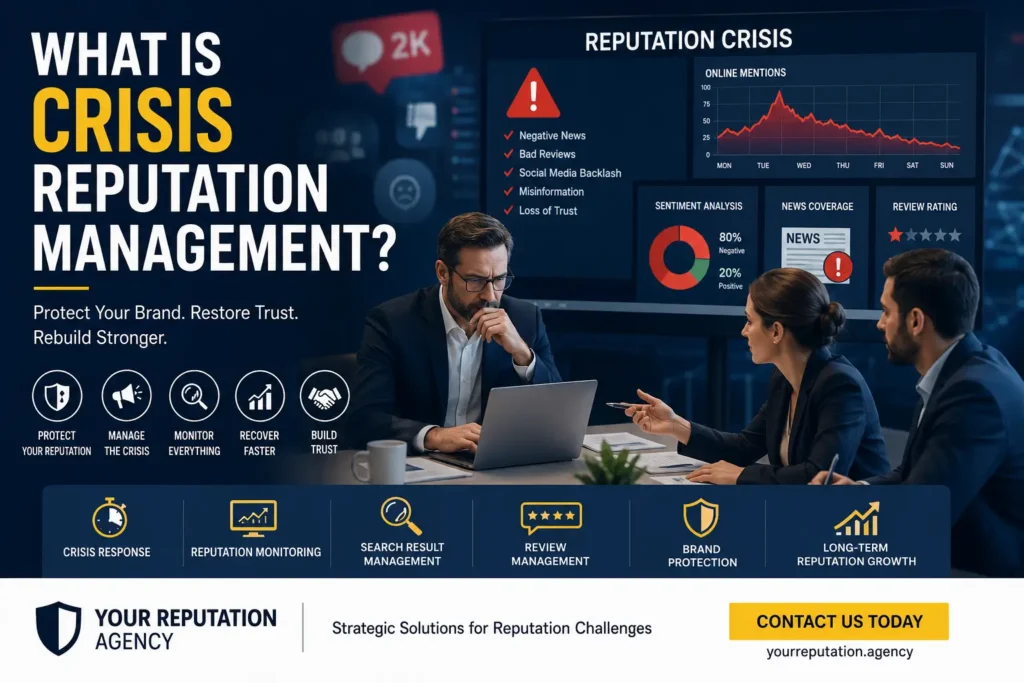
What Is Crisis Reputation Management?
A single negative news story, viral social media post, fake review campaign, data breach, or public controversy can damage years of hard-earned credibility within hours. In today’s digital world, information spreads faster than ever, and public perception can change before a company even has time to respond.
That’s why understanding What Is Crisis Reputation Management? is essential for every business owner, CEO, entrepreneur, healthcare provider, attorney, and personal brand.
Crisis reputation management isn’t simply about responding after something goes wrong. It’s about preparing for potential risks, communicating effectively during difficult situations, and rebuilding trust long after the headlines disappear. Companies that respond strategically often recover stronger, while organizations that ignore a crisis may experience long-term financial and reputational consequences.
Whether you’re managing an online review crisis, negative media coverage, executive controversy, or misinformation spreading across search engines and social media, having a structured reputation strategy can make all the difference.
This guide explains how crisis reputation management works, why it matters, common mistakes businesses make, and the proven strategies professionals use to protect their brands in today’s AI-driven search landscape.
Table of Contents
- What Is Crisis Reputation Management?
- Why Crisis Reputation Management Matters More Than Ever
- Common Reputation Crises Businesses Face
- Who Needs Crisis Reputation Management?
- Step-by-Step Crisis Reputation Management Process
- Real-World Example of Reputation Recovery
- Crisis Reputation Management vs Traditional Reputation Management
- Common Mistakes That Make a Crisis Worse
- Best Practices for Long-Term Reputation Protection
- Expert Tips from Online Reputation Professionals
- Frequently Asked Questions
- Final Thoughts
- How Your Reputation Agency Can Help
Why This Topic Matters Today
The internet never forgets. Search engines, AI-powered search assistants, review platforms, news websites, and social media channels can preserve information for years. Because customers often research a business before making a purchase, a single reputation issue can influence buying decisions long after the original incident.
Modern reputation management is no longer limited to responding to bad press. It now includes search visibility, online reviews, digital PR, executive branding, crisis communication, and proactive monitoring. Organizations that invest in these areas are better positioned to maintain trust and recover more quickly when unexpected challenges arise.
In the following sections, we’ll explore how crisis reputation management works, what triggers a reputation crisis, and the practical steps businesses can take to protect one of their most valuable assets—their reputation.
What Is Crisis Reputation Management?
Crisis reputation management is the strategic process of protecting, managing, and rebuilding an organization’s reputation before, during, and after a crisis. It combines crisis communication, online reputation management (ORM), search engine optimization (SEO), media relations, review management, and continuous monitoring to reduce reputational damage and restore public confidence.
Unlike traditional reputation management, which focuses on long-term brand building, crisis reputation management deals with urgent situations that can quickly damage public trust. The goal is not only to control the immediate impact but also to strengthen the brand’s credibility over time.
In today’s digital landscape, where news spreads within minutes and search engines preserve information for years, businesses need a structured response plan rather than reacting emotionally. A well-managed response demonstrates transparency, accountability, and professionalism—qualities that customers, investors, and stakeholders value during difficult situations.
Why Crisis Reputation Management Matters More Than Ever
A reputation crisis no longer affects only public perception—it directly impacts revenue, customer loyalty, investor confidence, employee morale, and even search engine visibility.
Today’s consumers research businesses online before making purchasing decisions. They read reviews, browse news articles, check social media conversations, and increasingly rely on AI-powered search experiences to gather information.
When negative content dominates those channels, the consequences can include:
- Declining customer trust
- Lost sales and business opportunities
- Reduced media credibility
- Lower employee confidence
- Difficulty attracting investors
- Long-term search visibility challenges
- Increased customer acquisition costs
Organizations that respond quickly, communicate honestly, and implement a structured reputation strategy often recover far more effectively than those that delay or ignore the situation.
Common Types of Reputation Crises
Not every crisis looks the same. Some develop gradually, while others gain widespread attention within hours.
Businesses commonly face situations such as:
Negative Media Coverage
An unfavorable news article, investigative report, or viral interview can quickly influence public perception and search results.
Social Media Backlash
A controversial post, misunderstood campaign, or customer complaint can spread rapidly across social platforms, creating widespread discussion before facts are fully understood.
Fake Reviews and Review Attacks
Coordinated fake reviews or misleading customer feedback can damage local search visibility and discourage potential customers.
Data Breaches and Cybersecurity Incidents
Security incidents often create both operational and reputational challenges. Customers expect clear communication and responsible action.
Executive Reputation Issues
The actions of executives and company leadership often become closely associated with the organization’s overall reputation.
False Information and Defamation
Misleading articles, fabricated accusations, and defamatory online content can continue affecting businesses long after publication if left unaddressed.
If false or misleading information becomes part of a broader crisis, learning how to address defamatory content should be part of your overall reputation strategy.
Who Needs Crisis Reputation Management?
Although every organization benefits from protecting its reputation, certain professionals face greater public scrutiny than others.
Crisis reputation management is particularly valuable for:
- Business Owners
- CEOs and Executives
- Entrepreneurs
- Healthcare Professionals
- Attorneys and Law Firms
- Financial Advisors
- Real Estate Professionals
- Public Figures
- Corporate Brands
- Government Contractors
- Educational Institutions
- Technology Companies
Even small businesses can experience significant reputational damage if negative information begins ranking prominently in search results or spreads across social media.
Early Warning Signs of a Reputation Crisis
Many organizations don’t recognize a crisis until it has already affected customer confidence.
Watch for these early indicators:
- Sudden increase in negative online reviews
- Unusual social media activity
- Negative press inquiries
- Declining brand sentiment
- Increased customer complaints
- Falling search visibility
- Executive criticism online
- Misinformation spreading across websites
- Employees raising public concerns
Identifying these warning signs early allows organizations to respond before the situation escalates.
Step-by-Step Crisis Reputation Management Process
Step 1: Assess the Situation Quickly
The first response should never be emotional.
Instead, gather accurate information and determine:
- What happened?
- Who is affected?
- Is the information accurate?
- Which platforms are involved?
- How quickly is the issue spreading?
- What level of reputational risk exists?
A careful assessment helps leadership make informed decisions instead of reacting impulsively.
Step 2: Assemble Your Response Team
Successful crisis management requires collaboration across multiple departments.
Your response team may include:
- Executive leadership
- Public relations specialists
- Legal advisors
- Marketing professionals
- Customer support managers
- Human resources
- Online reputation management specialists
Assigning clear responsibilities helps ensure consistent communication throughout the crisis.
Step 3: Develop a Clear Communication Strategy
Silence often creates uncertainty.
Instead, prepare messaging that is:
- Honest
- Accurate
- Timely
- Consistent
- Empathetic
- Transparent
Avoid speculation or assigning blame before all facts are confirmed.
Customers generally appreciate organizations that communicate openly while demonstrating accountability and a commitment to resolving the issue.
Step 4: Monitor Every Digital Channel
A crisis rarely stays confined to one platform.
Monitor:
- Google Search
- News websites
- Social media
- Online forums
- Review platforms
- YouTube
- AI-generated search summaries
- Industry publications
Continuous monitoring allows your team to identify new developments and respond appropriately before misinformation gains momentum.
Step 5: Respond Quickly—But Thoughtfully
Speed matters during a reputation crisis, but accuracy matters even more. An immediate response that contains incorrect information can create additional problems and reduce public trust.
Before making any public statement:
- Verify the facts.
- Coordinate with internal stakeholders.
- Ensure messaging is consistent across every channel.
- Acknowledge concerns without making unsupported claims.
Customers don’t expect perfection—they expect honesty, responsibility, and transparency.
Step 6: Address the Root Cause
Responding to public criticism is only part of the solution. Lasting reputation recovery requires fixing the underlying issue that caused the crisis.
Depending on the situation, this may include:
- Improving customer service
- Strengthening cybersecurity
- Updating company policies
- Providing employee training
- Correcting inaccurate information
- Enhancing product quality
- Improving internal communication
Actions speak louder than statements. Organizations that demonstrate meaningful improvements often recover trust more quickly.
Step 7: Strengthen Positive Online Visibility
Even after a crisis subsides, negative content may continue appearing in search results.
A proactive reputation strategy focuses on strengthening trustworthy digital assets, including:
- High-quality educational content
- Press releases and media coverage
- Executive thought leadership
- Customer success stories
- Optimized business profiles
- Authoritative blog articles
- Positive customer reviews
- Industry publications
When positive, relevant content becomes more visible, it helps create a more balanced representation of your brand online.
To learn more about long-term reputation strategies, explore our guide on How to Do Online Reputation Management.
Step 8: Continue Monitoring After the Crisis
Many organizations stop monitoring once media attention fades.
However, reputation recovery continues long after public interest declines.
Regular monitoring helps identify:
- New reviews
- Brand mentions
- News coverage
- Search ranking changes
- Social media conversations
- Customer sentiment
- Potential misinformation
Continuous monitoring allows businesses to identify new risks early before they become another crisis.
Real-World Example
Imagine a regional healthcare provider experiences a data security incident that receives local media attention.
Within hours:
- Customers begin posting concerns online.
- News articles appear in Google Search.
- Social media discussions increase rapidly.
- Review ratings begin to decline.
Instead of remaining silent, the organization immediately:
- Publishes an official statement.
- Explains what happened.
- Provides regular updates.
- Offers support to affected patients.
- Improves security procedures.
- Publishes educational healthcare content.
- Continues communicating transparently.
Over the following months, positive news coverage, educational content, and improved customer engagement gradually strengthen public confidence while reducing the visibility of crisis-related discussions.
This example demonstrates that reputation recovery is built through consistent action rather than quick fixes.
Crisis Reputation Management vs. Traditional Reputation Management
| Crisis Reputation Management | Traditional Reputation Management |
|---|---|
| Responds to urgent reputation threats | Focuses on long-term brand growth |
| Immediate communication is essential | Continuous brand development |
| Short response timelines | Ongoing strategy |
| High public attention | Lower day-to-day visibility |
| Often involves media relations | Focuses on SEO, reviews, and content |
| Requires rapid decision-making | Planned reputation building |
| Goal: Minimize damage | Goal: Strengthen authority |
Both approaches complement each other. Organizations with strong ongoing reputation management often recover more quickly when unexpected challenges arise.
Common Mistakes During a Reputation Crisis
Many businesses unintentionally make a difficult situation worse.
Avoid these common mistakes:
Waiting Too Long to Respond
Delays create information gaps that allow rumors and misinformation to spread.
Reacting Emotionally
Public arguments with customers, journalists, or critics often attract additional attention.
Ignoring Online Reviews
Negative reviews left unanswered may discourage future customers.
Inconsistent Messaging
Conflicting statements from different departments reduce public confidence.
Hiding Information
Transparency generally builds more trust than attempting to avoid difficult conversations.
Focusing Only on Social Media
A complete reputation strategy should also include search engines, news coverage, review platforms, and AI-powered search experiences.
Best Practices for Long-Term Reputation Protection
Organizations that consistently invest in reputation management are generally better prepared for future challenges.
Recommended best practices include:
- Monitor your online reputation regularly.
- Publish authoritative, helpful content.
- Respond professionally to customer feedback.
- Maintain active executive profiles.
- Develop a documented crisis response plan.
- Encourage authentic customer reviews.
- Invest in search engine optimization.
- Train employees on communication policies.
- Build relationships with trusted media outlets.
- Review your reputation strategy regularly.
Reputation protection should become part of everyday business operations—not something considered only after a crisis begins.
Expert Tips for Managing a Reputation Crisis
Every reputation crisis is different, but the organizations that recover most successfully tend to follow the same core principles. They prepare in advance, communicate honestly, and focus on rebuilding trust rather than simply controlling the narrative.
Here are several recommendations our reputation specialists consistently share with clients.
Be Proactive, Not Reactive
Waiting until negative content appears on the first page of Google is rarely the best strategy.
Regular reputation monitoring allows you to identify potential issues early, understand changes in public sentiment, and address concerns before they escalate into a larger crisis.
Respond With Facts, Not Emotion
Negative publicity often creates pressure to respond immediately. However, emotional reactions can unintentionally extend the news cycle.
Instead:
- Verify the facts.
- Stay professional.
- Be transparent.
- Communicate consistently.
- Focus on solutions instead of blame.
A calm, well-prepared response often earns more respect than a defensive one.
Build Digital Authority Before You Need It
Organizations with strong online authority are generally more resilient during a crisis.
Invest in:
- Helpful educational content
- Executive thought leadership
- Positive media coverage
- Customer success stories
- Active business profiles
- Search engine optimization
- Reputation monitoring
When positive, trustworthy content already exists, it becomes much easier to protect your brand if negative information appears.
Monitor AI Search Results
People no longer rely solely on Google Search.
Many now use AI-powered search platforms to research companies, executives, and brands before making decisions.
Monitor how your organization appears across:
- Google AI Overviews
- ChatGPT
- Microsoft Copilot
- Gemini
- Perplexity AI
Maintaining accurate, authoritative information across the web improves how AI systems understand and present your brand.
Make Reputation Management Part of Business Strategy
The strongest brands treat reputation management as an ongoing investment rather than a crisis response.
Review your online presence regularly, monitor customer feedback, and continuously improve your digital authority. A proactive approach helps reduce future risks while strengthening long-term trust.
How Your Reputation Agency Can Help
Managing a reputation crisis requires experience, strategic planning, and a deep understanding of how search engines, news platforms, review websites, and AI-powered search systems influence public perception.
At Your Reputation Agency, we help businesses, executives, healthcare professionals, attorneys, entrepreneurs, and public figures protect and strengthen their online reputation through ethical, data-driven strategies tailored to their unique circumstances.
Our services include:
- Crisis reputation management
- Executive reputation management
- Search result suppression
- Online reputation monitoring
- Digital PR support
- Review management
- Brand protection
- Reputation recovery strategies
- SEO-driven reputation improvement
If your organization is actively responding to a reputation challenge, our dedicated Crisis and Reputation Management service provides strategic guidance designed to minimize reputational damage while supporting long-term recovery.
Business leaders looking to strengthen their personal credibility can also explore our specialized Executive & CEO Online Reputation Management Services, which are designed to protect executive brands before, during, and after high-profile situations.
Whether you’re responding to negative media coverage, misleading online content, review attacks, or executive reputation concerns, our team develops customized strategies focused on sustainable, long-term results.
Trusted Resources for Learning More
Staying informed through trusted industry resources helps organizations make better decisions during challenging situations.
We recommend following guidance from:
- Google Search Central — Best practices for creating helpful, people-first content and maintaining search visibility.
- Microsoft — Resources on responsible digital communication and search experiences.
- HubSpot — Marketing, customer communication, and crisis communication insights.
- Forbes — Leadership, brand trust, and corporate reputation perspectives.
- Search Engine Journal — Search engine optimization and reputation management developments.
These resources provide valuable insights, but every reputation challenge is unique. Businesses should evaluate recommendations within the context of their industry, audience, and objectives.
Conclusion
Understanding What Is Crisis Reputation Management? is no longer optional for organizations operating in today’s digital environment. A single negative event can spread across search engines, social media platforms, news websites, and AI-powered search experiences within hours, influencing customer trust and business performance long after the original incident.
The most successful organizations don’t wait for a crisis before thinking about their reputation. They invest in proactive monitoring, transparent communication, high-quality content, executive branding, and long-term reputation management strategies that strengthen credibility before problems arise.
If your organization experiences a reputation challenge, responding quickly is important—but responding strategically is even more critical. Ethical online reputation management, combined with clear communication and continuous digital optimization, can help protect your brand while rebuilding public confidence over time.
Your reputation is one of your most valuable business assets. Protecting it today helps create stronger opportunities tomorrow.
Ready to Protect Your Reputation?
A reputation crisis can happen to any business, but how you respond determines what happens next.
If you’re dealing with negative search results, damaging media coverage, fake reviews, executive reputation concerns, or a growing online crisis, Your Reputation Agency is ready to help.
Our experienced specialists create customized reputation management strategies based on your industry, business goals, and current online presence. We focus on ethical solutions that align with Google’s best practices while delivering sustainable, long-term results.
If you’re ready to strengthen your digital reputation or need immediate guidance during an active reputation crisis, contact our team today for a confidential consultation.
Frequently Asked Questions
1. What Is Crisis Reputation Management?
Crisis reputation management is the process of protecting, managing, and restoring an organization’s reputation during and after a public crisis. It involves strategic communication, online reputation management, media response, search optimization, and ongoing monitoring to reduce reputational damage and rebuild trust.
2. When should a business start crisis reputation management?
The best time to begin is before a crisis occurs. Having a proactive reputation management strategy, monitoring tools, and a crisis response plan allows organizations to react quickly and minimize long-term damage if an issue arises.
3. What types of events require crisis reputation management?
Businesses commonly need crisis reputation management after situations such as:
- Negative media coverage
- Fake online reviews
- Data breaches
- Executive controversies
- Social media backlash
- Defamatory online content
- Customer service failures
- Product recalls
Any event that significantly affects public trust may require a structured reputation recovery strategy.
4. How long does it take to recover from a reputation crisis?
Recovery timelines vary depending on the severity of the issue, search visibility, media attention, and the organization’s existing online presence. While some improvements may be visible within a few months, comprehensive reputation recovery often requires ongoing effort and long-term reputation management.
5. Can negative news articles be removed from Google?
Google generally does not remove truthful news articles simply because they are negative. However, if content violates Google’s policies or applicable laws, removal may be possible. In many cases, ethical search suppression and reputation management strategies are the most effective long-term approach.
6. Why is online reputation management important during a crisis?
Online reputation management helps businesses communicate effectively, strengthen positive search visibility, monitor public sentiment, improve digital credibility, and reduce the long-term impact of negative online content.
7. How can executives protect their personal reputation during a crisis?
Executives should communicate transparently, maintain professional public messaging, monitor search results regularly, build authoritative digital content, and work with experienced reputation management professionals when necessary.
8. What is the difference between crisis reputation management and public relations?
Public relations primarily focuses on media communication and brand messaging. Crisis reputation management takes a broader approach by combining PR, SEO, online reputation management, search suppression, review management, and continuous digital monitoring to protect long-term online credibility.
9. How does Your Reputation Agency help businesses during a crisis?
Your Reputation Agency develops customized strategies that may include crisis communication support, reputation monitoring, executive reputation management, search result suppression, review management, digital PR, and long-term reputation protection tailored to each client’s needs.
Protect Your Reputation Before a Crisis Escalates
A reputation crisis can develop in minutes, but recovering from one often takes much longer. Whether you’re facing negative media coverage, damaging online reviews, executive scrutiny, or misleading content, responding with the right strategy is essential to protecting your credibility.
At Your Reputation Agency, we help businesses, executives, healthcare professionals, law firms, entrepreneurs, and public figures navigate reputation challenges with ethical, data-driven online reputation management solutions. From crisis response and search result suppression to executive reputation management and continuous monitoring, our team develops customized strategies designed for long-term success—not short-term fixes.
Many organizations wait until their reputation is already under pressure. A proactive approach helps reduce risk, preserve customer trust, and strengthen your digital presence before small issues become major problems.
Ready to protect your reputation? Contact Your Reputation Agency today for a confidential consultation and discover how our experts can help you respond to today’s challenges while building lasting trust for tomorrow.
Our Reputation Management Services
- Crisis Reputation Management
- Executive & CEO Reputation Management
- Search Result Suppression
- Online Reputation Monitoring
- Negative Content Strategy
- Google Review Management
- Digital Brand Protection
- Long-Term Reputation Management
Take the first step toward protecting your reputation—partner with Your Reputation Agency today.