You just received a one-star review on Depop and it’s costing you sales, messages, or peace of mind. If that review is false, harassing, or violates Depop policy, there are concrete steps you can take to request removal or reduce its impact.
This article explains how to remove bad review depop listings and what to do when Depop’s policies, the evidence, or the platform’s process make removal unlikely. You’ll get step-by-step actions, escalation paths, and alternatives (including suppression and correction) when deletion isn’t possible.
We cover evidence collection, how to file a dispute inside Depop, when to escalate to Depop support or third parties, and practical recovery tactics that reduce damage while protecting your account.
If you need agency-level help, we describe the professional process used by reputation firms—what they can and cannot promise—and how to evaluate options without assuming guaranteed outcomes.
Table of Contents
- Can I delete a negative review on Depop?
- How to get an unfair Depop review removed
- Can you delete a bad review? (General options and limits)
- Can I remove negative feedback I left for a seller?
- What to do when removal is NOT available
- How to suppress or mitigate a negative Depop review with SEO and reputation work
- Monitoring, prevention, and what sellers should do next
- Resources and related reading
- Removal vs Suppression: Which Path Fits Your Depop Review?
- Hypothetical example: A vintage seller, a bad review, and a 6-week response plan
- Common mistakes sellers make when facing a Depop review
- Best practices to protect and recover your Depop reputation
- Expert Tips
- Conclusion
- Why Businesses Choose Your Reputation Agency
- Frequently Asked Questions
Can I delete a negative review on Depop?
Short answer: You can request that Depop remove a review if it violates Depop’s Community Guidelines or Terms of Use, but Depop makes the final decision. Depop does not provide an automatic delete option for seller-entered disputes; removal depends on the nature of the review and the evidence.
What qualifies: reviews that are clearly abusive, defamatory (false factual claims), contain personal data shared without consent (doxxing), impersonation, or threats are more likely to be removed. Honest buyer complaints or subjective opinions are usually not removable just because you disagree with them.
- 1) Take time-stamped screenshots of the review and related messages.
- 2) Export order records, tracking numbers, and communications that contradict the review.
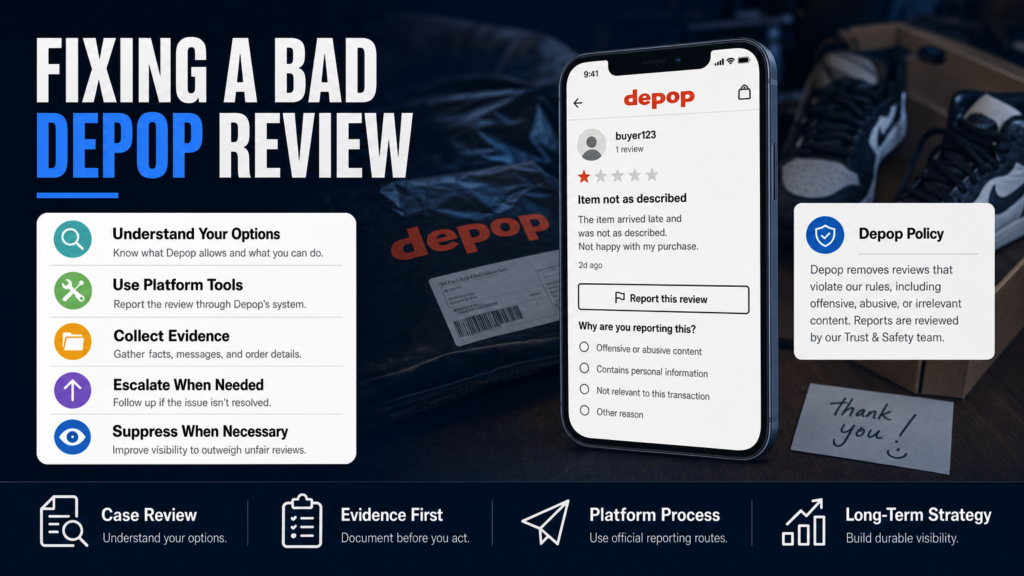
- 3) Use Depop’s report or help options to submit your dispute with the attached evidence.
- Depop controls review and messages decisions—platform policies govern outcomes.
- Removal depends on the content (harassment, privacy violation, impersonation, false factual claim) and on the evidence you submit.
- You should document dates, screenshots, and any transaction records before contacting Depop.
How to file a report inside Depop
Open the conversation or listing that contains the review, tap the report button (or visit Depop Help on the web), and follow the prompts for abusive or fraudulent behaviour. Provide concise context and attach screenshots or other supporting documents.
Label the report clearly: for example, “Harassment and false statement about order #12345,” rather than a long narrative. Attach proof: photos of item as shipped, tracking, refunds, or screenshots showing the buyer contradicting their review elsewhere.
- Use PDF or high-resolution images for evidence so platform moderators can read text.
- Keep a copy of your exact submission for future escalation (date/time and the text you sent).
How to get an unfair Depop review removed
An ‘unfair’ review can mean many things—false factual claims, malicious ratings from non-customers, or revenge reviews after a dispute. The strongest route is to combine platform reporting with documented evidence and follow-up.
Start by assessing whether the content violates Depop’s rules (harassment, hate speech, doxxing, impersonation, or extortion). If it does, that’s the route to removal. If it’s a subjective complaint, removal is unlikely and you should focus on mitigation.
- 1) Determine the policy category (abuse, privacy, fraud).
- 2) Compile all proof into a single file (zip or PDF).
- 3) Submit to Depop through the Help center and keep copies.
- 4) If no action, escalate using Depop’s contact options and include case IDs.
- Collect evidence: purchase receipts, tracking, photos, and timestamps.
- Show contradictions: if the buyer messaged earlier saying the item was fine, that helps.
- File a well-documented report and follow up if you don’t get a timely response.
When to involve payment/platform providers
If the dispute involves fraud or a chargeback, collect your payment documentation (PayPal, Stripe). Payment platforms sometimes support seller-side evidence and may add weight to your Depop dispute.
Avoid public back-and-forth with the buyer: keep communication professional and move evidence into your support tickets.
- Provide transaction IDs and timestamps to payment providers.
- Do not threaten the buyer publicly—this can worsen outcomes with Depop.
Can you delete a bad review? (General options and limits)
The phrase ‘delete a bad review’ covers three real outcomes: platform removal, request-based correction, and mitigation through suppression or reputation content. Platform removal is conditional; correction or retraction depends on the reviewer acting, and mitigation uses SEO and customer responses.
We evaluate whether the content may qualify for removal or review, but no one can promise deletion. When removal isn’t available you must choose controlled, ethical alternatives to reduce visibility and repair trust.
- 1) Attempt platform removal with evidence.
- 2) Ask buyer politely for correction or removal if they’re willing—offer a resolution or refund when appropriate.
- 3) If unsuccessful, implement suppression via content building and customer-response strategies.
- Removal: Depop deletes content that violates policy—depends on evidence and policies.
- Retraction: The reviewer removes their own review—this requires voluntary action or agreement.
- Mitigation: New content and SEO can push a negative review lower in search results.
How to ask a buyer to remove or edit their review
If the buyer appears reasonable, send a short, professional message acknowledging their experience, offering a practical fix (refund, return shipping), and asking if they would consider editing their review after resolution.
Do not offer anything that violates Depop’s rules (e.g., paying for a review). Be factual, document the offer, and give the buyer clear instructions on how to edit or remove their review on Depop.
- Offer a factual fix (refund, replacement) rather than emotional appeals.
- Keep messages short and polite; a long defensive message can escalate the issue.
Can I remove negative feedback I left for a seller?
Yes—if you left feedback on Depop and later want to edit or remove it, Depop allows buyers to adjust reviews under certain conditions. The exact process can vary by app version and timing.
If the app interface doesn’t show an edit option, contact Depop Support with proof that you want to change the feedback. Keep copies of any follow-up to show you attempted correction in case of disputes.
- 1) Ask the buyer politely to edit or remove their feedback, explaining why.
- 2) If they agree, show them exactly where to edit in the Depop interface.
- 3) If they decline, avoid threats or incentives—escalate to Depop Support if the feedback is false or abusive.
- Buyers can usually edit or delete their own review through the transaction page.
- If you can’t find the option, use Depop Help and include buyer account details and order numbers.
- Sellers should never pressure buyers to change feedback; that can violate platform rules.
Instructions buyers can follow to edit a Depop review
Open your Depop app, go to Orders, find the transaction, and select the review or feedback option to edit. If the option is not visible, Depop’s web Help pages outline the current process—search for ‘edit review’ in Depop Help.
If you’re helping a buyer, send them a short guide and screenshots of the steps rather than walking them through via long messages.
- Screenshots increase the chance of a buyer completing the edit.
- Be patient—buyers are more likely to change feedback after a calm, prompt resolution.
What to do when removal is NOT available
When Depop refuses to remove a review because it’s an opinion or the evidence is insufficient, you must pivot to mitigation. This includes public responses, SEO suppression, reputation signals, and improving buyer experience to drown out the negative result.
We pursue the legal, technical, platform-based, and reputational options available. If content may warrant legal review—because it contains false factual claims causing demonstrable harm—consult a qualified attorney to determine whether any legal step may be available.
- 1) Publish corrective content (detailed listings, FAQ, customer testimonials).
- 2) Use social profiles, a shop blog, or press to create SEO assets that can push negative items down.
- 3) Set up monitoring and consider paid search/ads for high-impact listings.
- Respond professionally on Depop where possible to show future buyers you’re responsive.
- Create positive, authoritative content that ranks for your shop and products.
- Use reputation monitoring and alerts to detect related mentions quickly.
When to escalate beyond Depop
If a review includes defamation, doxxed personal data, or threats and Depop does not act, gather evidence and consult an attorney. A lawyer can evaluate whether a legal notice or subpoena to the publisher is appropriate, but this depends on jurisdiction and the specifics of the case.
For persistent, coordinated attacks (review-bombing) you may need a combined PR and legal response and long-term SEO remediation.
- Legal options vary by state and by the nature of the publication.
- We coordinate with qualified legal professionals when a matter requires legal analysis.
How to suppress or mitigate a negative Depop review with SEO and reputation work
If removal isn’t possible, suppression aims to reduce visibility by ranking other, more favorable pages above the negative review. This is a common, practical response when platform policies prevent deletion.
We develop SEO reputation strategies intended to improve the visibility of relevant and credible information. Results vary according to the strength of the negative content and the authority of competing sources.
- 1) Audit first-page search results for your shop and the specific review URL.
- 2) Publish and optimize at least 3–5 new positive assets (profiles, blog posts, videos).
- 3) Build high-quality links to those assets and monitor changes over 4–12 weeks.
- Create authoritative pages for your shop (About, Policies, FAQs) and optimize them with relevant keywords.
- Encourage satisfied buyers to leave positive, specific reviews that build social proof.
- Use social profiles, YouTube product videos, and press mentions as ranking assets.
When suppression is faster than removal
Suppression can begin to show results in weeks for local or low-competition name searches but may take months for popular search terms. Search results may change because algorithms, competitors, publishers, and user behavior are outside our control.
An estimated timeline can be provided after an individual assessment; some cases may begin to show changes within a general estimated range, but no universal timeframe applies.
- Focus on assets you control (shop description, Instagram, YouTube).
- Avoid spammy link schemes—quality matters for long-term ranking gains.
Monitoring, prevention, and what sellers should do next
After you address the immediate review, set up monitoring so you catch new complaints early. Reputation monitoring alerts and ongoing surveillance reduce reaction time and let you correct small issues before they escalate.
Hardening your processes (clear policies, faster shipping, documented messages) reduces future disputes. If you sell at scale, consider a written escalation workflow so customer service and decisions about refunds or partial credits are consistent.
- 1) Implement a 24–48 hour triage for complaints.
- 2) Document each case with date/time, screenshots, and outcome.
- 3) Review top complaints quarterly and fix recurring operational issues.
- Set up Google Alerts for your shop name and key product names.
- Use Depop’s notification settings and check orders daily during busy periods.
- Document standard responses to common complaints to maintain consistent tone.
When to consider professional help
If a negative review is causing measurable revenue loss, or you face coordinated attacks, a reputation specialist can evaluate removal viability, perform suppression work, and coordinate with legal or PR advisors. We evaluate whether the content may qualify for removal or review and pursue the available options.
Remember: no provider can guarantee deletion or permanent suppression; reputable providers outline probable outcomes and evidence-based strategies before starting work.
- Ask for a clear statement of services, timelines as estimates, and escalation paths.
- Get confidentiality and data-handling terms in writing before sharing sensitive information.
Resources and related reading
For a deeper look at how a single negative review can affect revenue in other platforms, see our analysis of review impact on other networks. For example, we explain the commercial consequences of poor ratings on other platforms and what sellers have done to recover.
If you need platform-specific advice for other channels, these resources walk through removal and mitigation on comparable services.
- Detailed cost analysis for Google reviews: What a One-Star Google Review Really Costs a Practice.
- When a single social review hurts revenue: When One Facebook Review Can Cost Your Practice Real Revenue.
- If you also sell on vacation rental sites, see: When One Airbnb Review Threatens Your Bookings — What To Do Next.
Removal vs Suppression: Which Path Fits Your Depop Review?
Quick comparison to choose an approach based on content type, evidence, and urgency.
| Removal | Suppression / Mitigation |
|---|---|
| Depends on platform policy and evidence | Depends on SEO effort and content authority |
| Faster if review clearly violates rules | Often faster to start but slower to fully bury content |
| Outcome controlled by Depop moderators | Outcome controlled by content quality and link signals |
| Best for privacy violations or threats | Best for opinions, truthful complaints, or borderline cases |
| May require legal escalation in extreme cases | Requires ongoing content and PR work to maintain position |
Hypothetical example: A vintage seller, a bad review, and a 6-week response plan
Scenario: A small Depop shop (anonymous seller) receives a one-star review claiming the item was ‘not as described’ and alleging the seller sent the wrong size. The seller has tracking that proves the correct item and photos showing the item packaged as described.
Action plan (what the seller did): collect evidence, report to Depop, request removal, attempt buyer resolution, and launch suppression assets while monitoring results.
- 1) Document everything immediately—screenshots, tracking, messages.
- 2) Use Depop’s reporting tools with a clear, evidence-driven submission.
- 3) Offer an ethical resolution to the buyer and request review modification if they accept.
- 4) Simultaneously create positive content and ask satisfied buyers for reviews to dilute the negative result.
- Week 0: Screenshot the review, save the listing, and export tracking/transaction records.
- Week 1: Submit a Depop report with evidence categorized as ‘fraud/false factual claim.’
- Week 2–3: If Depop does not remove the review, message the buyer with a conciliatory offer (partial refund) and a request to edit the review if resolved.
- Week 3–6: Publish two authoritative assets (detailed shop FAQ, Instagram product video) and request reviews from seven satisfied customers to build fresh social proof.
- Week 6+: Monitor search results and Depop listing traffic; continue suppression if necessary.
Common mistakes sellers make when facing a Depop review
Avoid these high-risk missteps—each can make removal or mitigation harder or even result in penalties from Depop.
1. Public arguments with the reviewer
Posting angry or defensive replies in public can escalate the situation and looks bad to future buyers. It also creates more content that search engines and shop visitors will see.
Instead, move the conversation to private in-app messages and keep all communication professional and brief.
- Public rage posts can be captured and reused elsewhere.
- Moderators are less sympathetic if the seller appears hostile.
2. Deleting the listing without documenting evidence
Some sellers remove a listing to eliminate the review. This destroys evidence needed for a dispute and may not remove the review from buyer profiles or search caches.
Always archive screenshots and transaction logs before making listing changes.
- Archiving preserves the case history for Depop or legal review.
- Deleting items can complicate later efforts to demonstrate the timeline.
3. Offering incentives for review removal
Offering money, gifts, or free items in exchange for review removal can violate platform policies and backfire if the buyer reports the offer.
Use legitimate resolutions (refund, return, replacement) and avoid any inducements that look like payment for reviews.
- Keep all offers factual and tied to the transaction outcome.
- Document offers and buyer responses in your support ticket.
4. Assuming legal action is a quick fix
Threatening or initiating legal steps without counsel and solid evidence wastes time and money. Legal options depend on jurisdiction, the nature of the statements, and the publisher.
Consult a qualified attorney to evaluate whether defamation or privacy claims may apply before pursuing costly legal measures.
- Legal outcomes are uncertain and vary by state.
- A lawyer can advise whether a legal notice or court action is appropriate.
5. Ignoring the operational cause
Sometimes negative reviews reveal genuine problems (shipping delays, item accuracy). Ignoring fixable operational issues guarantees repeated complaints.
Review recurring complaints quarterly and adjust shipping partners, return policies, or listing descriptions accordingly.
- Use reviews as feedback for process improvement.
- A small fix can prevent multiple future reviews.
Best practices to protect and recover your Depop reputation
These durable steps help prevent disputes and strengthen your position if a complaint occurs. They combine clear documentation, proactive customer service, and ongoing reputation work.
1. Archive every transaction and message
Keep time-stamped screenshots, proof of postage, and a record of any promises made to buyers. These are the primary evidence you will submit to Depop or payment processors.
Store evidence in an organized folder so you can submit it quickly when needed.
- Save tracking numbers and payment confirmation emails.
- Keep a PDF record of each disputed transaction.
2. Write calm, concise public responses
When you choose to respond publicly, acknowledge the complaint briefly, offer to resolve offline, and invite the buyer to message you directly. This shows future buyers you’re responsive without creating a long argument.
Example: “We’re sorry you had a bad experience. Please DM your order number so we can resolve this.”
- Do not admit liability in public messages if facts are unclear.
- Keep the tone neutral and resolution-focused.
3. Encourage timely positive reviews
Ask satisfied buyers to leave specific, verifiable reviews—mention shipping speed, item condition, or packaging. Specific positive reviews carry more weight with future buyers and search engines.
Do this ethically: ask after successful delivery and avoid incentives for reviews.
- Send a polite follow-up message after delivery requesting feedback.
- Make it easy by pointing buyers to the exact place in Depop to leave a review.
4. Use monitoring and alerting
Set up Google Alerts and weekly checks of your Depop shop and listings. Quick detection reduces the damage window and allows you to respond faster.
Consider a low-cost reputation monitoring tool or service if you manage many listings.
- Check for copycat listings and impersonation regularly.
- Track sentiment trends across reviews and messages.
5. Build off-platform credibility
A strong Instagram, TikTok, or Etsy presence with reviews and content provides alternative discovery points and helps suppression. Platforms you control can be optimized to appear higher in searches for your shop or products.
Link your Depop listings from those profiles and include consistent brand information.
- Create product videos that show actual items and sizing.
- Encourage customer-tagged posts and testimonials to increase social proof.
Expert Tips
- Start every dispute with a one-page timeline: date, SKU, tracking, buyer messages—moderators like concise evidence.
- Capture screenshots on desktop and mobile to show how the content appears across devices.
- If Depop’s first response is slow, file a second report with a new submission referencing the original ticket ID.
- Never offer cash-for-review removal; offer refunds or returns tied directly to order resolution.
- Ask multiple satisfied buyers to leave specific reviews rather than generic praise.
- Keep a quiet escalation log with dates and ticket numbers—this helps if you escalate to legal counsel.
- Use consistent, searchable phrases in your shop FAQ so positive assets can rank for the same terms as the negative item.
- Treat every high-impact complaint as both a customer-service issue and a reputation issue.
Conclusion
A single negative Depop review can be distressing, but there are realistic, evidence-based steps you can take: attempt platform removal where policy fits, ask for buyer corrections when appropriate, and use suppression and reputation work when deletion is unlikely.
Document everything, act professionally, and choose the option that matches the evidence and commercial risk. If you face a coordinated attack or a review that includes privacy violations or false factual claims, consult qualified legal counsel and consider professional reputation support to assess options and manage escalation.
Why Businesses Choose Your Reputation Agency
Managing your reputation takes more than monitoring reviews or publishing the occasional blog post. It takes a strategy built around your situation, your industry, and what is actually showing up in search.
Your Reputation Agency works with businesses, executives, healthcare professionals, attorneys and growing brands. Our services include:
- Remove or suppress negative search results and news articles from Google
- Review removal and remediation (Google, Yelp, Facebook, Trustpilot, industry sites)
- Data broker and people-search opt-outs to remove personal information
- Mugshot and arrest-record removal or suppression
- Takedowns of defamatory, false, or malicious posts (social, blogs, forums)
- Online crisis management and rapid-response reputation repair
- Impersonation and fake account removal on social platforms
- Reputation monitoring, alerts, and ongoing surveillance
- First-page SEO and suppression strategies to bury negative content
- Digital security audits and privacy hardening to prevent future exposure
Frequently Asked Questions
1. Can I delete a negative review on Depop?
You can request Depop remove a review if it violates Depop’s policies (abuse, doxxing, impersonation, threats). Depop evaluates reports and decides whether removal is appropriate—there is no automatic deletion simply because a review is negative.
2. How to get an unfair Depop review removed?
Collect evidence (screenshots, tracking, communications), file a clear report through Depop Help, and explain why the content violates policy. If Depop declines, you can escalate with additional evidence or pursue mitigation via suppression and customer outreach.
3. Can you delete a bad review?
Platform removal is possible only when content breaches the platform’s rules. You can also ask the reviewer to retract or edit their review, but that requires voluntary action by the buyer. When neither is available, suppression is the practical alternative.
4. Can I remove negative feedback I left for a seller?
Buyers usually can edit or remove feedback through the transaction or order page in Depop. If the option isn’t visible, contact Depop Support and provide order details—Depop can advise whether the feedback can be modified.
5. How long does a Depop review dispute take?
Timing depends on the platform’s workload, the complexity of the evidence, and whether follow-up is required. Some cases resolve in days; others may take weeks. No fixed timeline can be promised, and estimated timelines should be treated as general ranges.
6. What evidence helps most for removal requests?
Clear, time-stamped screenshots, tracking numbers, transaction IDs, photos of the item as shipped, and any messages where the buyer contradicts their review are the most persuasive. Summarize the timeline and attach the evidence in a single submission to make it easy for moderators to review.
7. What if Depop refuses to remove the review and the buyer won’t cooperate?
When removal isn’t available, focus on mitigation: publish authoritative assets, encourage positive reviews, respond professionally on-platform, and consider SEO suppression tactics. If the review contains illegal content or privacy violations, consult a qualified attorney about possible legal steps.
8. Can a reputation agency guarantee removal?
No reputable agency can guarantee removal or permanent suppression. Agencies evaluate whether content may qualify for removal or review, pursue the available options, and implement mitigation strategies. Results depend on platform policies, evidence, jurisdiction, and search behavior.
9. Should I involve legal counsel for a Depop review?
Legal counsel can be appropriate if a review includes false factual allegations that cause measurable harm, privacy breaches, or threats. A lawyer can assess whether a legal notice or other action is appropriate—but legal outcomes depend on the facts, applicable law, and jurisdiction.
Past examples do not guarantee future results. Removal, correction, deindexing, and search-position changes depend on third parties and circumstances outside Your Reputation Agency’s control.