Your online reputation can change overnight. A single newspaper article published years ago may still appear on Google today, influencing employers, clients, investors, or anyone searching for your name or business.
Whether the article contains outdated information, misleading reporting, or content that no longer reflects your current circumstances, seeing it rank prominently in search results can be frustrating. Fortunately, there are legitimate strategies that may help reduce its visibility—or, in some cases, have it removed.
Understanding How to Remove Newspaper Articles From the Internet starts with knowing how online publishers, search engines, and digital news archives operate. While not every article can be deleted, there are practical steps you can take to protect your online reputation and regain greater control over what people find online.
In this guide, we’ll explain the available options, the challenges involved, and when it makes sense to seek professional assistance.
Why Newspaper Articles Stay Online for Years
Unlike social media posts, newspaper articles are designed to remain publicly accessible. Most online publications maintain permanent archives because they serve as historical records, generate ongoing search traffic, and support journalistic transparency.
Once an article is indexed by search engines like Google, it can continue appearing in search results for many years—even if the story is no longer relevant.
Several factors determine how long an article remains visible:
- The authority of the news website
- How many other websites link to the article
- Ongoing search interest
- Google’s ranking algorithms
- The publication’s editorial policies
For high-authority news websites, older articles often continue ranking well because search engines view established publishers as trustworthy sources.
Why Removing Newspaper Articles Can Be Difficult
Many people assume they can simply ask Google to delete an article. In reality, Google usually does not own the content—it only indexes webpages created by publishers.
That means there are generally two separate challenges:
Removing the article from the publisher
This depends on the publication’s editorial policies, legal obligations, and willingness to consider your request.
Removing the article from Google Search
Even if an article is removed from the publisher’s website, Google may continue displaying cached or outdated search results until its index is updated.
Because of this, successfully addressing negative news coverage often requires a combination of publisher communication, search engine requests, reputation management, and search result optimization rather than relying on a single solution.
Common Reasons People Want Newspaper Articles Removed
Individuals and businesses seek article removal for many different reasons. In many cases, the content is no longer relevant, while in others it may be inaccurate or causing ongoing reputational harm.
Some common situations include:
- Outdated criminal or legal reporting
- Arrests where charges were dropped
- Business disputes that have since been resolved
- Articles containing factual inaccuracies
- Defamatory or misleading reporting
- Privacy concerns
- Personal information published without context
- Old stories affecting employment opportunities
- Negative media coverage impacting business growth
Each situation requires a different strategy, making it important to evaluate the specific circumstances before deciding on the most effective course of action.
Can Newspaper Articles Really Be Removed?
The answer is sometimes. Whether a newspaper article can be removed depends on several factors, including the publisher’s policies, the accuracy of the content, applicable privacy laws, and the reason for your request.
Many reputable news organizations maintain permanent archives because they consider their reporting part of the public record. If an article is accurate and was lawfully published, the publisher may decline to remove it.
However, there are situations where removal, correction, or reduced visibility may be possible. Understanding How to Remove Newspaper Articles From the Internet begins with evaluating the specific circumstances of your case rather than assuming every article can—or cannot—be deleted.
When Can a Newspaper Article Be Removed?
Although every publisher has its own editorial policies, certain situations are more likely to qualify for review.
The Article Contains False Information
If a publication includes factual errors, incorrect names, false accusations, or misleading information, you may request a correction or removal supported by evidence.
Privacy Rights Have Been Violated
Some articles may expose sensitive personal information, such as home addresses, financial details, or private data that should not be publicly accessible.
Legal Circumstances Have Changed
A story about an arrest, lawsuit, or investigation may become outdated after charges are dismissed, records are sealed, or a case is resolved. While this doesn’t guarantee removal, publishers may consider updating or correcting the content.
The Publisher Accepts Editorial Requests
Some news organizations have established procedures for handling correction requests, content updates, or exceptional removal cases when strong supporting documentation is provided.
What If the Publisher Refuses?
Publisher refusal does not necessarily mean you have no options.
When direct removal isn’t possible, reputation management strategies can help reduce the visibility of harmful content while strengthening positive search results.
Professional reputation protection may include:
- Search result optimization
- Positive content development
- Digital authority building
- Brand profile enhancement
- Knowledge panel optimization
- Search suppression strategies
- Ongoing reputation monitoring
These approaches focus on improving what people see first when searching for your name or business.
Step-by-Step Process to Remove Newspaper Articles
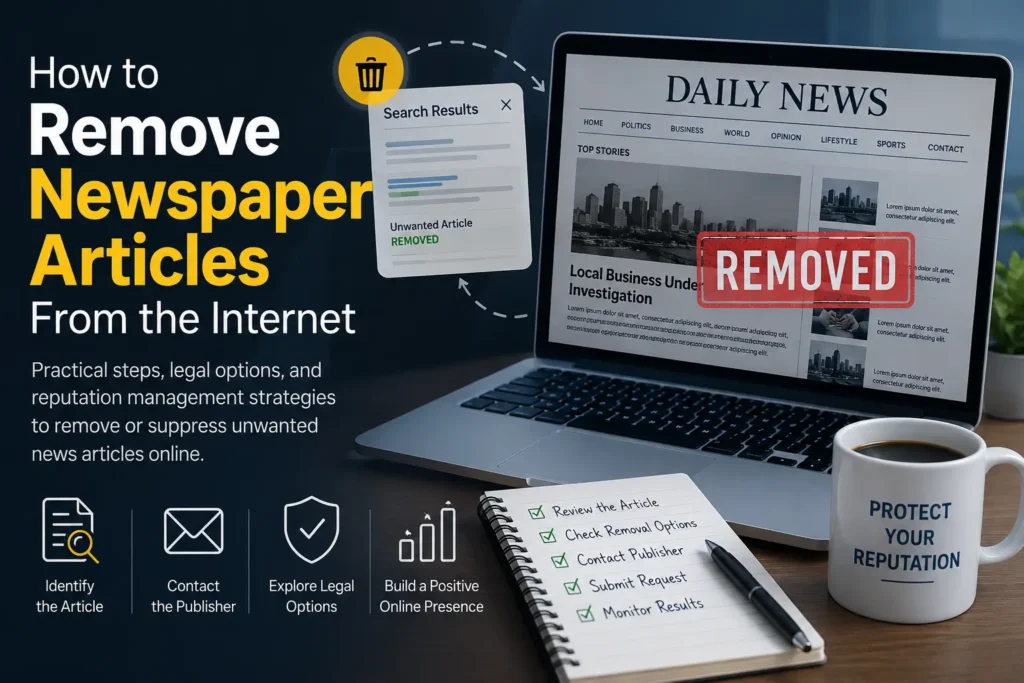
Successfully addressing negative news coverage usually requires a structured approach rather than sending multiple removal requests.
Step 1 — Evaluate the Article
Identify:
- Is the information accurate?
- Is it outdated?
- Does it violate privacy?
- Is it defamatory?
- Is there supporting evidence?
This assessment determines the most appropriate strategy.
Step 2 — Contact the Publisher
If you believe the article should be corrected or reconsidered, contact the publication professionally.
Provide:
- The article URL
- Clear explanation of the issue
- Supporting documentation
- Requested action (correction, update, or removal)
Being respectful and evidence-based generally produces better results than emotional requests.
Step 3 — Review Search Engine Policies
Google and other search engines publish policies covering limited situations where certain content may qualify for removal from search results.
These requests are evaluated individually and depend on the specific circumstances.
Step 4 — Improve Your Online Presence
If the article remains online, strengthening your overall digital footprint becomes increasingly important.
This may include:
- Publishing authoritative content
- Building positive branded assets
- Improving professional profiles
- Creating helpful resources
- Increasing trusted mentions across reputable websites
A stronger online presence can gradually shift attention toward more current and relevant information.
Mistakes to Avoid
When trying to remove negative news articles, people often make decisions that unintentionally make the situation worse.
Avoid these common mistakes:
- Sending aggressive legal threats without proper advice
- Publishing emotional public responses
- Paying unverified “instant removal” services
- Creating duplicate websites filled with keyword stuffing
- Ignoring the issue for months or years
- Attempting unethical SEO tactics
Long-term reputation management is built on credibility, transparency, and ethical strategies—not shortcuts that could damage trust.
When Should You Seek Professional Help?
If the article is appearing prominently in Google search results, affecting your business, career, or personal reputation, professional guidance may save considerable time and reduce unnecessary risk.
Experienced reputation specialists can evaluate your situation, determine realistic options, communicate with publishers when appropriate, and recommend ethical strategies tailored to your circumstances.
Every case is different, and the most effective solution depends on the type of article, the publisher involved, and your long-term reputation goals.
How Your Reputation Agency Can Help
Your Reputation Agency, we understand that every reputation challenge is unique. There is no universal solution for removing newspaper articles because every publisher, website, and situation is different. That’s why we begin by carefully evaluating each case before recommending a strategy.
Our team focuses on ethical, compliant, and long-term reputation management solutions designed to protect your digital presence rather than relying on unrealistic promises. We assess the article, identify available options, and develop a customized action plan based on your specific circumstances.
Our goal is to help clients reduce reputational risk while building a stronger and more credible online presence.
Our Approach
Our process is designed to provide clear guidance and practical solutions from the very beginning.
Reputation Assessment
We analyze how the article appears in search results, evaluate its impact on your reputation, and identify potential risks affecting your personal or business brand.
Content & Publisher Review
We examine the publisher’s editorial policies, review the published content, and determine whether correction, update, or removal requests may be appropriate.
Strategic Reputation Planning
If direct removal is not possible, we create a strategy that focuses on improving positive search visibility, strengthening digital authority, and reducing the prominence of negative content.
Ongoing Reputation Monitoring
Your online reputation changes over time. We continue monitoring search results, media mentions, and other digital platforms to identify new reputation risks before they become larger issues.
Why Clients Choose Your Reputation Agency
Choosing a reputation management partner is about trust, experience, and realistic expectations.
Clients work with us because we provide:
- Confidential consultations
- Customized reputation strategies
- Ethical and compliant practices
- Long-term reputation planning
- Executive and corporate expertise
- Search visibility improvement strategies
- Ongoing reputation monitoring
- Transparent communication throughout every project
We never promise guaranteed removals where they are outside our control. Instead, we focus on solutions that are practical, responsible, and designed for sustainable results.
Protect Your Reputation Before Small Problems Become Bigger Ones
A single newspaper article can continue influencing public perception for years. The longer harmful content remains highly visible, the more opportunities it has to affect business relationships, career growth, customer trust, and personal credibility.
Taking action early provides more options and often leads to better long-term outcomes. Whether your goal is to request a correction, improve search visibility, or strengthen your online reputation, having a clear strategy is essential.
Ready to Discuss Your Situation?
If you’re researching How to Remove Newspaper Articles From the Internet, you don’t have to navigate the process alone.
Our team provides confidential assessments to help you understand your available options and recommend a strategy based on your specific circumstances.
Whether you’re dealing with outdated news coverage, misleading reporting, or negative search visibility, we’re here to help you make informed decisions that support your long-term reputation.
Related Services You May Find Helpful
Conclusion
Learning How to Remove Newspaper Articles From the Internet is not simply about deleting online content—it’s about protecting your reputation through informed, ethical, and strategic action.
Some articles may qualify for corrections or removal, while others require a broader reputation management approach that improves what people see when they search for your name or business.
The right strategy depends on the facts, the publisher, and your long-term objectives. By acting early and following a structured plan, you can reduce reputational risks and build a stronger digital presence that reflects who you are today rather than a single article from the past.