Quick answer: remove fake news
Fake news may be corrected or removed by the publisher, reported for platform-rule violations, addressed through privacy or legal procedures, or countered with authoritative evidence. The correct path depends on the exact false claims and source.
Preserve the page and spread, document falsity with primary records, request a specific correction, avoid amplifying the claim, and seek qualified legal advice when serious harm continues.
False information can spread across the internet in minutes, but its impact can last for years. A misleading article, fabricated accusation, or manipulated social media post can influence how employers, customers, investors, and even search engines perceive you or your business.
If you’ve ever wondered, Can Fake News Be Removed?, you’re not alone. Individuals, executives, business owners, and public figures frequently face situations where inaccurate or misleading content appears online and begins affecting their reputation. While the answer isn’t always straightforward, there are legitimate ways to address fake news, request corrections, reduce its visibility, and rebuild trust.
In this guide, we’ll explain what fake news is, whether it can be removed, the options available, and the steps you can take to protect your digital reputation using ethical and effective strategies.
What Is Fake News?
Fake news refers to false, misleading, or manipulated information presented as factual reporting. It can appear in many forms, including online news articles, blogs, forums, social media posts, videos, or even AI-generated content.
Not every negative article qualifies as fake news. Legitimate journalism may report facts that are unfavorable but accurate. Fake news, however, typically involves one or more of the following:
- False or fabricated claims
- Misleading headlines designed to attract attention
- Edited or manipulated images or videos
- Information presented without proper evidence
- Content intentionally created to damage someone’s reputation
Understanding the difference between factual reporting and misinformation is the first step toward choosing the right response.
Why Fake News Can Be So Harmful
Unlike rumors shared privately, fake news published online has the potential to reach thousands—or even millions—of people within a short period. Once search engines index that content, it may continue appearing in search results long after the story has been disproven.
The consequences can include:
- Loss of customer trust
- Damaged personal or business reputation
- Missed career opportunities
- Reduced investor confidence
- Negative media attention
- Emotional stress and anxiety
For businesses, false information can lead to declining sales, damaged partnerships, and long-term brand credibility issues. For individuals, it may affect professional opportunities, relationships, and public perception.
Can Fake News Be Removed?
The short answer is yes—but not always completely.
Whether fake news can be removed depends on several factors, including where it was published, whether it violates platform policies, if it contains defamatory or false information, and the willingness of the publisher to review the content.
Some websites provide formal processes for correcting or removing inaccurate information, while others may refuse removal requests altogether. In situations where direct removal isn’t possible, professional reputation management strategies can often reduce the visibility of harmful content and strengthen positive search results.
Understanding Can Fake News Be Removed? requires evaluating each situation individually rather than expecting a single solution for every case.
Common Sources of Fake News
False information doesn’t only appear on major news websites. In many cases, it spreads through multiple online channels before reaching larger audiences.
Some of the most common sources include:
- Low-quality news websites
- Anonymous blogs
- Social media platforms
- Online forums
- Fake press release websites
- Video-sharing platforms
- AI-generated content
- Copied articles syndicated across multiple domains
Once misinformation begins spreading across several websites, managing your online reputation becomes significantly more challenging. This is why early action is often the most effective approach.
Why Removing Fake News Is Challenging
Many people believe they can simply report false information to Google. However, Google generally does not remove content simply because it is negative or controversial. Search engines typically index information published by third-party websites rather than controlling the content itself.
This means there are often two separate challenges:
- Addressing the content with the publisher or platform
- Managing how that content appears in search results
In many situations, a combination of content review, correction requests, reputation management, and search optimization provides the most effective long-term solution.
When Can Fake News Be Removed?
The possibility of removing fake news depends on where it was published, the accuracy of the content, and whether it violates the publisher’s policies or applicable laws. While there is no guaranteed solution for every situation, many cases can be addressed through a combination of removal requests, corrections, and strategic reputation management.
If the content contains false statements, impersonation, privacy violations, or defamatory claims, there may be legitimate grounds to request action. Understanding Can Fake News Be Removed? starts with evaluating the facts before choosing the most effective approach.
Situations Where Removal May Be Possible
Although every publisher has different editorial standards, there are several situations where action may be appropriate.
False or Defamatory Statements
If an article contains statements that are demonstrably false and harmful, you may have grounds to request corrections, removal, or other appropriate remedies.
Privacy Violations
Content that exposes sensitive personal information, such as home addresses, financial details, or confidential data, may violate privacy policies or legal protections.
Outdated or Incorrect Information
Sometimes an article was accurate when published but no longer reflects current facts. For example, criminal charges may have been dismissed, lawsuits resolved, or businesses fully recovered. In these situations, requesting an update or correction may be more realistic than complete removal.
Policy Violations
Many platforms prohibit misinformation, impersonation, harassment, or manipulated media. When fake news violates these policies, reporting it through the appropriate channels may lead to review or removal.
What If the Publisher Refuses?
Not every publisher will agree to remove an article, even if you strongly disagree with its content.
Many reputable news organizations maintain editorial independence and permanent archives. If a publisher declines your request, it doesn’t necessarily mean your reputation cannot be protected.
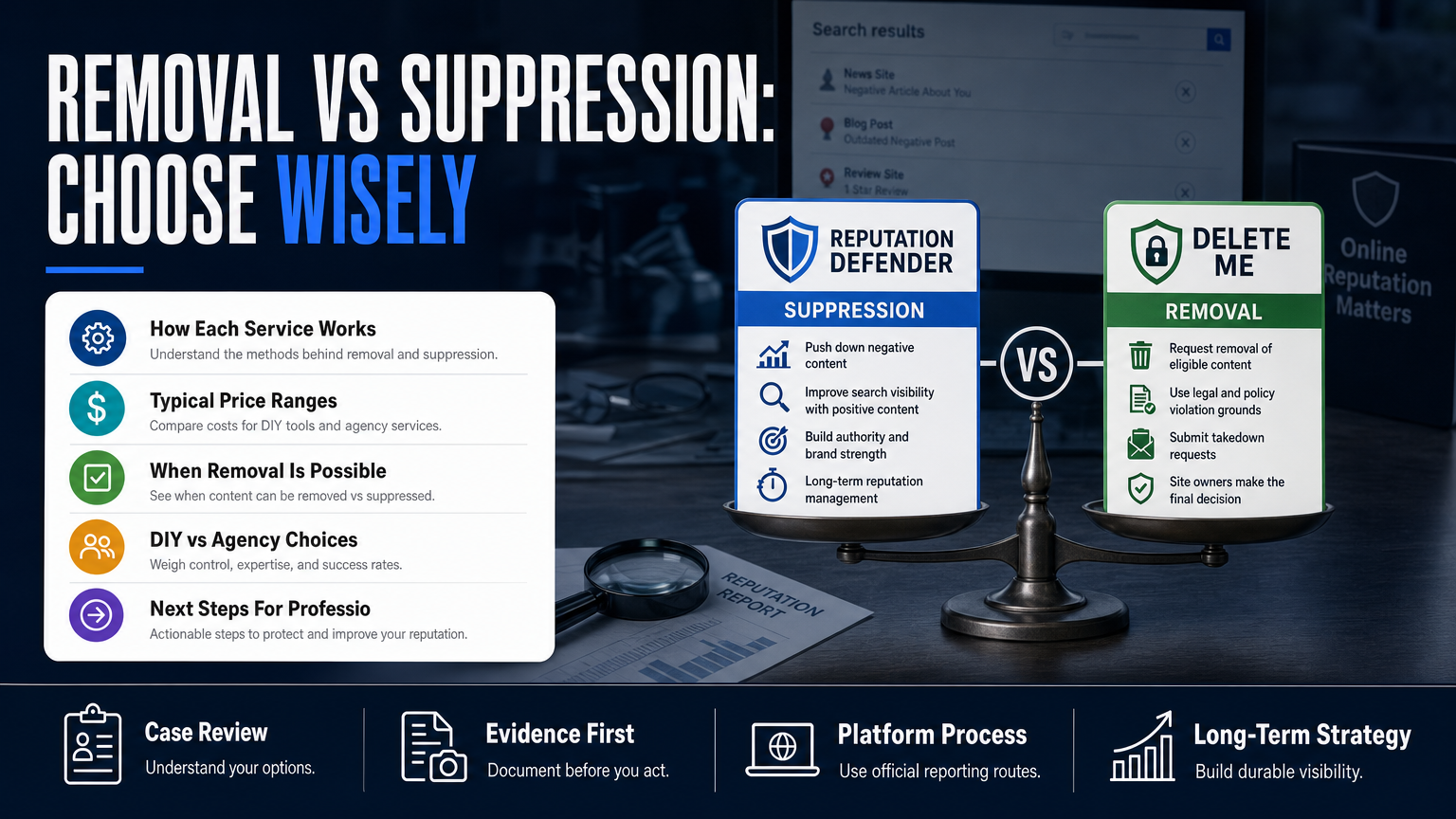
Professional online reputation management strategies can help by:
- Improving positive search visibility
- Reducing the prominence of harmful content
- Publishing authoritative and accurate information
- Strengthening branded search results
- Building long-term digital credibility
In many cases, reducing visibility is more achievable than complete removal and can significantly improve how your reputation appears online.
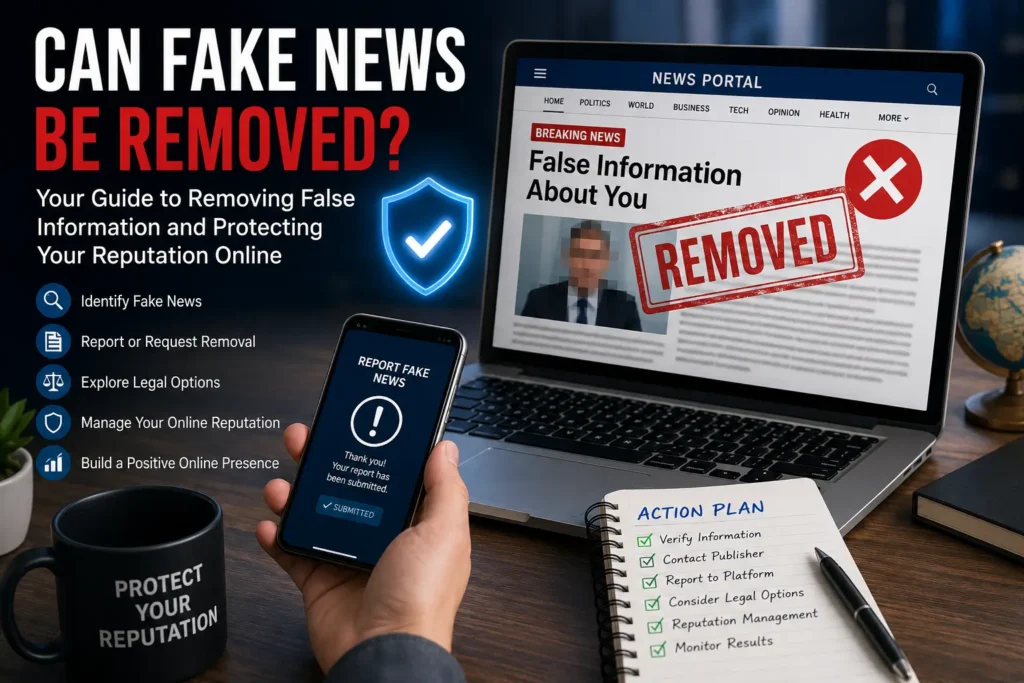
Step-by-Step Process for Addressing Fake News
Taking a structured approach often produces better results than reacting emotionally or submitting multiple requests without a plan.
Step 1: Verify the Information
Begin by reviewing the content carefully.
Ask yourself:
- Is the information completely false?
- Is it misleading or taken out of context?
- Is it outdated?
- Does it violate privacy or platform policies?
Document everything before taking further action.
Step 2: Collect Supporting Evidence
Gather documents that support your position, such as:
- Court records
- Official statements
- Business documentation
- Published corrections
- Verified public records
Well-organized evidence increases the credibility of your request.
Step 3: Contact the Publisher Professionally
If appropriate, contact the editor or publisher directly.
Your request should include:
- The article URL
- A clear explanation of the issue
- Supporting documentation
- A reasonable request for correction, update, or removal
Professional communication is generally far more effective than emotional or threatening messages.
Step 4: Review Search Engine Options
Although Google does not typically remove lawful content simply because it is negative, it does provide removal processes for certain types of policy-violating information.
Review Google’s official removal guidance before submitting any requests.
Similarly, if the issue involves deceptive business practices or online fraud, resources from organizations such as the Federal Trade Commission (FTC) may also provide helpful information.
Real-World Example
Imagine a business owner whose company was incorrectly mentioned in an online article about fraudulent activities involving another organization with a similar name.
Although the story remained online, the publisher later updated the article after reviewing additional evidence. At the same time, the business strengthened its website, published authoritative content, earned positive media mentions, and improved its search presence.
Within several months, accurate information began appearing more prominently in search results, helping restore customer confidence.
This example illustrates that reputation recovery often involves multiple coordinated actions rather than relying on a single removal request.
Why Acting Quickly Matters
False information spreads rapidly, especially through social media and search engines. The longer fake news remains online, the greater the chance that other websites will copy it, discussions will grow, and search engines will continue reinforcing its visibility.
Taking early action allows you to preserve evidence, communicate with publishers while the issue is current, and implement reputation management strategies before long-term damage becomes more difficult to reverse.
Need Professional Help?
If you’re asking Can Fake News Be Removed?, you’re already taking the first step toward protecting your reputation.
Every case is different, and choosing the wrong approach can waste valuable time or even increase visibility through unnecessary attention.
At Your Reputation Agency, we help individuals, executives, and businesses evaluate fake news incidents, identify realistic solutions, and develop ethical reputation management strategies designed for long-term success.
Our reputation specialists work confidentially to assess your situation and recommend the most appropriate course of action based on your unique circumstances—not one-size-fits-all solutions.
Why Trust Your Reputation Agency?
Choosing the right reputation management partner is just as important as choosing the right strategy. Online reputation issues often involve sensitive personal, professional, or business information, which is why confidentiality, transparency, and experience matter.
Your Reputation Agency, we focus on ethical, long-term reputation management solutions rather than unrealistic promises. Every case begins with a careful assessment to understand the situation and recommend the most effective path forward.
Clients choose to work with us because we provide:
- Confidential consultations and personalized strategies
- Ethical reputation management practices
- Transparent communication throughout every project
- Tailored solutions for individuals and businesses
- Long-term online reputation protection
- Professional support backed by positive client feedback
Many of our clients discover us through our Trustpilot reviews and Google Business Profile, where they can learn more about the experiences of businesses and professionals we’ve helped. We encourage prospective clients to review independent feedback before making any decision.
Take the First Step Toward Protecting Your Reputation
If false or misleading information is affecting your reputation, waiting rarely improves the situation. The longer fake news remains online, the greater its potential impact on search visibility, public perception, and professional opportunities.
Whether you’re dealing with inaccurate news coverage, defamatory content, or a coordinated misinformation campaign, taking early action gives you more options and a stronger chance of protecting your online reputation.
At Your Reputation Agency, we provide confidential reputation assessments to help you understand your situation and identify the most appropriate strategy.
Explore our services to learn how we can help with:
- Fake News Removal
- Online Reputation Management
- Search Result Suppression
- Negative Content Removal
- Executive Reputation Management
- Crisis Reputation Management
Contact our team today for a confidential consultation and take the first step toward protecting your digital reputation.
Conclusion
So, Can Fake News Be Removed? The answer is that it depends on the facts, the publisher, the platform, and the specific circumstances surrounding the content.
Some fake news can be corrected or removed, while other situations require strategic reputation management to reduce visibility and strengthen accurate information. The most effective approach often combines publisher communication, policy-based requests, search optimization, and long-term reputation building.
If false information is harming your personal or business reputation, don’t assume you have to live with it forever. By acting quickly and following a well-planned strategy, you can reduce reputational risks and build a stronger, more trustworthy online presence for the future.
Frequently Asked Questions
Can fake news be removed from the internet?
In some cases, yes. If the content violates platform policies, contains false information, or breaches privacy rights, removal or correction may be possible. In other situations, reputation management strategies can help reduce its visibility.
Can Google remove fake news from search results?
Google generally doesn’t remove lawful content simply because it is negative. However, it does provide removal options for specific policy violations and certain types of sensitive information.
How long does fake news removal take?
The timeline depends on the publisher, the platform, and the complexity of the case. Some requests may be resolved within weeks, while others require a longer-term reputation management strategy.
What if the publisher refuses to remove the article?
If direct removal isn’t possible, strategies such as search result suppression, positive content development, and online reputation management can help reduce the visibility of harmful content.
Is fake news the same as defamation?
Not always. Fake news refers to false or misleading information presented as factual reporting. Defamation is a legal concept involving false statements that harm someone’s reputation and may vary depending on applicable laws.
Can businesses recover from fake news?
Yes. Many businesses successfully rebuild trust through transparent communication, proactive reputation management, improved online visibility, and positive customer engagement.
Should I contact the publisher myself?
In many situations, yes. A professional, evidence-based request is often the best first step. For more complex or high-profile cases, seeking professional guidance may improve your chances of achieving a positive outcome.
How can I protect myself from future fake news?
Maintaining an active online presence, monitoring your reputation regularly, responding quickly to misinformation, and investing in proactive reputation management are effective ways to reduce future risks.
Why should I choose Your Reputation Agency?
We provide ethical, confidential, and customized online reputation management services designed to help individuals and businesses protect their digital reputation through practical, long-term strategies tailored to each client’s unique situation.