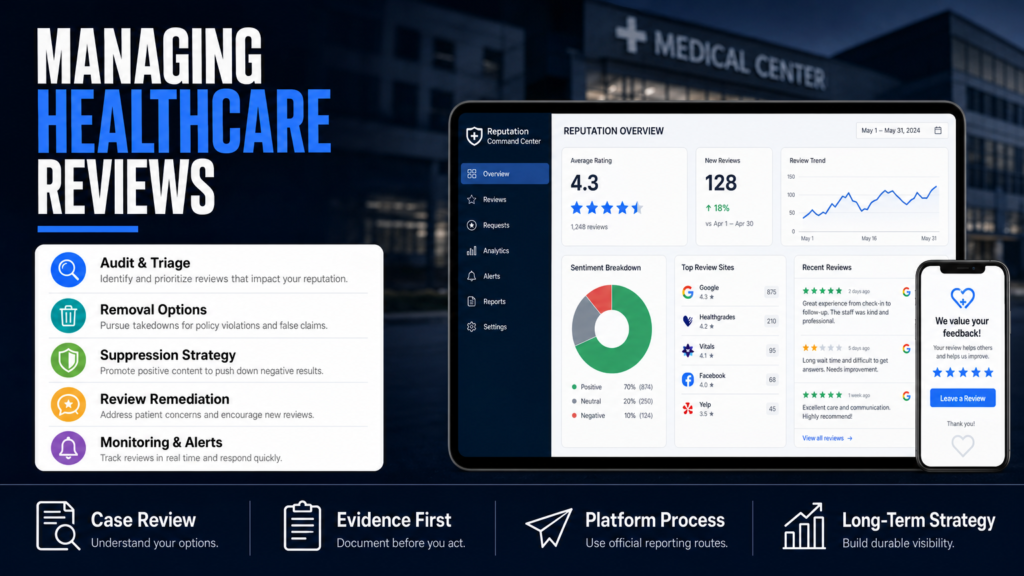
You opened this because a negative review, a sudden cluster of one-star ratings, or an incorrect patient complaint is costing appointments, referrals, or your peace of mind. You need clear options, not platitudes. This article walks through the practical steps available when reputation management for healthcare reviews is on the line.
We’ll explain how agencies and practices evaluate whether content may qualify for removal, what suppression (SEO) looks like when removal isn’t possible, and how monitoring plus a remediation workflow reduces harm. The phrase ‘reputation management for healthcare reviews’ will appear throughout because the technical tactics and platform rules differ for medical providers.
Expect concrete checklists, timelines expressed as ranges with caveats, and actionable next steps you can use immediately. Where legal or platform outcomes matter, the article states what requires a lawyer, what platforms control, and what you can reasonably expect from a professional reputation team.
Table of Contents
- How to Evaluate the Best Reputation Management Company for Healthcare Reviews
- Is Reputation Resolutions a Legitimate Company?
- How Much Do Reputation Management Services Typically Cost?
- Where to Check Doctor Reviews
- Removal vs Suppression: Which Works for Healthcare Reviews?
- What To Do When Removal Is Not Available
- Rapid Response: Handling a Review Bomb or Crisis
- Ongoing Monitoring, Data Removal, and Prevention
- First-Page SEO and Repair Workflow
- Removal vs Suppression — Quick Comparison
- Hypothetical Scenario: A Small Cardiology Practice Faces a Negative Surge
- Common Mistakes Practices Make When Managing Reviews
- Best Practices for Managing Healthcare Reviews
- Expert Tips
- Conclusion
- Why Businesses Choose Your Reputation Agency
- Frequently Asked Questions
How to Evaluate the Best Reputation Management Company for Healthcare Reviews
Choosing a provider for reputation management for healthcare reviews is different from hiring a general ORM company. Look for experience with HIPAA-aware processes, healthcare platform policies (HealthGrades, Vitals, WebMD), and casework that includes review remediation and first-page SEO for clinical search queries.
A responsible vendor will describe processes rather than guaranteed outcomes, explain the evidence they need, and offer a clear scope: audit, takedown attempts, suppression via content and SEO, monitoring, and coordination with legal counsel when appropriate.
- 1. Start with a free audit or initial assessment to identify the worst search results and platform violations.
- 2. Get a written scope and pricing estimate tied to deliverables, not guaranteed removals.
- 3. Ask how they handle patient data and whether their intake workflow minimizes HIPAA exposure.
- 4. Check references and public reviews, and confirm they will coordinate with your legal or PR counsel if needed.
- Verify healthcare-specific experience and nondisclosure/confidentiality practices.
- Ask for an explicit list of services (audit, platform requests, SEO, monitoring).
- Confirm they use platform reporting routes and legal referrals — no fake or deceptive tactics.
- Request a sample action plan that explains what they will try and what they cannot promise.
Red flags and questions to ask
Watch for vendors who promise blanket removal, guaranteed rankings, or claim special access to platforms. Legitimate firms will say platform decisions are controlled by the platforms themselves.
Ask: Do you perform evidence preservation? How do you handle subpoenas or legal escalations? Do you have lines of communication with major review platforms for escalation?
- Red flag: Promises of guaranteed deletion or fixed timelines.
- Good sign: Written, HIPAA-aware intake and multi-channel strategy (platform, SEO, legal).
- Good sign: Transparent fee structure for the audit, remediation, and ongoing monitoring.
Is Reputation Resolutions a Legitimate Company?
Legitimacy should be judged by public records, client references, and adherence to platform rules rather than brand familiarity alone. We do not endorse or discredit specific companies here, but you can check a vendor’s legitimacy by verifying business registration, reading independent reviews, and confirming described tactics match platform policies.
If you’re assessing Reputation Resolutions or any other vendor, ask for documented processes that show they use official reporting channels, how they escalate to platform compliance teams, and whether they refer legal matters to qualified attorneys.
- 1. Run a quick business search: corporate filings and a registered office.
- 2. Look for third-party reviews and resolve dates; evaluate how the company responds to negative feedback.
- 3. Ask the vendor to explain a recent healthcare-specific case study in process terms (not client names).
- Confirm business registration and professional contact information.
- Search for independent client reviews and complaints (Better Business Bureau, state consumer protection sites).
- Request documentation of methods — legitimate firms avoid deceptive removal tactics.
When a vendor claims complete removal power
Treat any promise of total control with skepticism. Platforms make final decisions; successful vendors combine legal, technical, and SEO steps and are explicit about uncertainty.
If a vendor suggests bypassing platform rules or using fake accounts to manipulate ratings, walk away — those tactics violate platform terms and can worsen the problem.
- No vendor can guarantee permanent deletion.
- Legitimate escalation often requires evidence preservation and sometimes legal notices.
How Much Do Reputation Management Services Typically Cost?
Costs vary by scope. For healthcare practices, expect pricing that depends on audit depth, number of negative items to address, ongoing monitoring needs, and whether legal referrals are required. Typical ranges exist but remember these are estimates, not guarantees.
If you want a sense of the business impact of individual reviews, read our analysis on What a One-Star Google Review Really Costs Your Business, which shows how a single poor rating can influence patient perception and search visibility.
- 1. Obtain an audit that itemizes targeted pages, platforms, and recommended tactics.
- 2. Compare proposals for deliverables (e.g., number of dispute submissions, content assets created, monitoring seats).
- 3. Ask about one-off versus retainer models and cancellation terms.
- One-time audit and action plan: $500–$3,000 depending on complexity.
- Takedown or escalation work (per item, non-legal): $150–$1,000.
- Monthly ongoing monitoring and SEO suppression: $300–$2,500/month.
- Cases requiring legal coordination or litigation referrals: billed separately or via attorney.
Why pricing varies for healthcare
Healthcare practices often need HIPAA-aware workflows, additional evidence handling, and sensitive messaging that increases cost relative to other local businesses.
Also, specialty searches (e.g., ‘orthopedic surgeon [city] malpractice’) may require more authoritative corrective content and targeted SEO, which raises the time and expense.
- HIPAA-aware intake and redaction increase administrative time.
- Coordination with legal counsel or hospital compliance teams adds cost.
- More complex negative items (defamation, impersonation) require multi-channel responses.
Where to Check Doctor Reviews
No single ‘best’ site covers everything. Patients look at a mix of Google Business Profile reviews, Healthgrades, Vitals, Zocdoc, Yelp, and specialty-specific boards. For a practical survey of sites and how they affect patient choice, use a combination of platform checks and a unified monitoring tool.
To centralize reputation work for clinicians, consider resources that explain healthcare-specific reputation processes such as Online Reputation Management for Healthcare: Practical Playbook.
- 1. Search for your name and practice on Google (incognito) and note the top 10 results.
- 2. Audit Healthgrades, Vitals, Zocdoc, and Yelp for out-of-date or incorrect listings.
- 3. Set up Google Alerts and a paid monitoring service to get notified about new reviews or mentions.
- Google Business Profile (Google Maps/Search) — most visible and influential for local searches.
- Healthgrades and Vitals — often first for patients researching specialists.
- Yelp and Facebook — influential for local consumer perception; policies differ.
- Specialty forums and physician-rating aggregators — can include older or unverified content.
The single best website to check doctor reviews
There is no universally best site; for most practices, Google is the de facto first impression because it feeds maps, local packs, and organic snippets. However, specialty searches (e.g., ‘best cardiologist’) often pull Healthgrades or Vitals high in results, so you must manage both.
Because different patient demographics use different sites, prioritize corrections on the platforms that drive your bookings.
- Google = highest visibility for local intent.
- Healthgrades/Vitals = high intent for specialist searches.
- Yelp/Facebook = broad consumer sentiment; often influences non-clinical decisions.
Removal vs Suppression: Which Works for Healthcare Reviews?
Removal means convincing the publisher or platform to delete content; suppression means burying harmful results behind authoritative, positive, or neutral content in search results. Both are valid tactics; choice depends on the content type, platform rules, and whether the content is factually false or violates policy.
Removal may be possible for content that violates platform terms (hate speech, doxxing, impersonation) or contains protected health data. Suppression is typically the fallback for truthful but damaging reviews or public complaints that platforms decline to remove.
- 1. Classify the negative item: false allegation, opinion, privacy violation, impersonation, or harassment.
- 2. For policy violations, file platform reports and preserve evidence.
- 3. If removal is declined, deploy suppression via optimized content (PR posts, provider bios, patient education pages).
- Removal attempts: platform policy reports, publisher takedown requests, legal notices when appropriate.
- Suppression tactics: create authoritative pages, optimize site SEO, publish neutral third-party content to push negative items down.
- Evidence matters: stronger documentation improves removal chances; suppression requires ongoing SEO work.
Practical examples of each route
A review that accuses a doctor of a specific illegal act may be defamatory if false; this could justify a legal notice and platform escalation. A critical but truthful review about bedside manner is unlikely to be removable and is better addressed with remediation and SEO suppression.
When privacy is breached (e.g., a review that includes protected health details), platforms have explicit policies that can support removal if you can demonstrate a privacy violation.
- Defamation claims require legal analysis and careful evidence collection.
- Privacy violations are often eligible for platform removal when they reveal protected health information.
- Opinion-based negative reviews rarely meet removal standards and are handled with remediation and suppression.
What To Do When Removal Is Not Available
When removal is not available because the content is opinion, truthful, or from a publisher that refuses to delete, you must shift strategy to mitigation: correction, context, remediation, and visibility management.
Mitigation is not a one-shot fix. It combines patient engagement, targeted content, and SEO to ensure the information prospective patients see is balanced and authoritative.
- 1. Document the negative item and preserve screenshots and metadata.
- 2. Publish at least 3–7 high-authority pages optimized for the same name and practice keywords.
- 3. Request corrections on inaccurate directory listings and update structured data on your website.
- 4. Encourage legitimate patient reviews with a compliant, documented process to dilute a small number of negatives.
- Respond professionally where platforms allow — explain corrective steps or invite the reviewer to resolve offline, but avoid violating privacy rules.
- Create authoritative content: detailed provider bios, case studies, clinical articles, patient education videos.
- Suppress the negative item in search results through targeted SEO and third-party placements (press releases, directories, guest articles).
- Use ongoing monitoring and alerts to detect recurrence and respond quickly.
Patient remediation and review management
Acknowledge issues when appropriate, offer clear remediation steps, and document follow-up. Avoid discussing clinical details publicly — use private channels to resolve care disputes.
Establish a review solicitation process that follows platform rules and your institution’s compliance requirements; steady, compliant positive reviews help bury isolated negatives over time.
- Never offer incentives for positive reviews.
- Train staff on compliant review solicitations and response templates.
- Track outcomes to see if remediation reduces appointment cancellations or booking friction.
Rapid Response: Handling a Review Bomb or Crisis
A sudden influx of negative reviews — a review-bombing attack — requires triage: identify the attack vectors, prioritize items for escalation, and coordinate messaging across channels. For a detailed discussion of review crises and platform escalation, see When Google Reviews Become a Brand’s Biggest Crisis.
Your immediate goals are: stop further damage where possible, preserve evidence for legal or platform escalation, and communicate internally with staff and external stakeholders.
- 1. Pause reactive posts; centralize communications through one point person.
- 2. Use platform reporting forms, support escalations, and prepared evidence packages.
- 3. Deploy suppression content to regain first-page presence while escalation proceeds.
- 4. If needed, consult legal counsel about injunctive relief or a cease-and-desist when coordination is demonstrable.
- Triage the items: identify fake accounts, coordinated timing, identical language, or off-platform coordination.
- Contact platforms using documented escalation channels and preserve all evidence (screenshots, URLs, timestamps).
- Prepare a public-facing message if the crisis affects patient safety or bookings; keep language factual and non-defensive.
How to preserve evidence during an attack
Take timestamped screenshots, export platform URLs, and note account IDs. Evidence preservation is essential for both platform escalations and legal review.
Avoid public accusations without evidence; document internally and coordinate with legal or compliance before making external claims.
- Screenshot the review and the reviewer profile page.
- Record IP reports or other metadata only through proper legal channels.
- Log all internal actions and communications about the incident.
Ongoing Monitoring, Data Removal, and Prevention
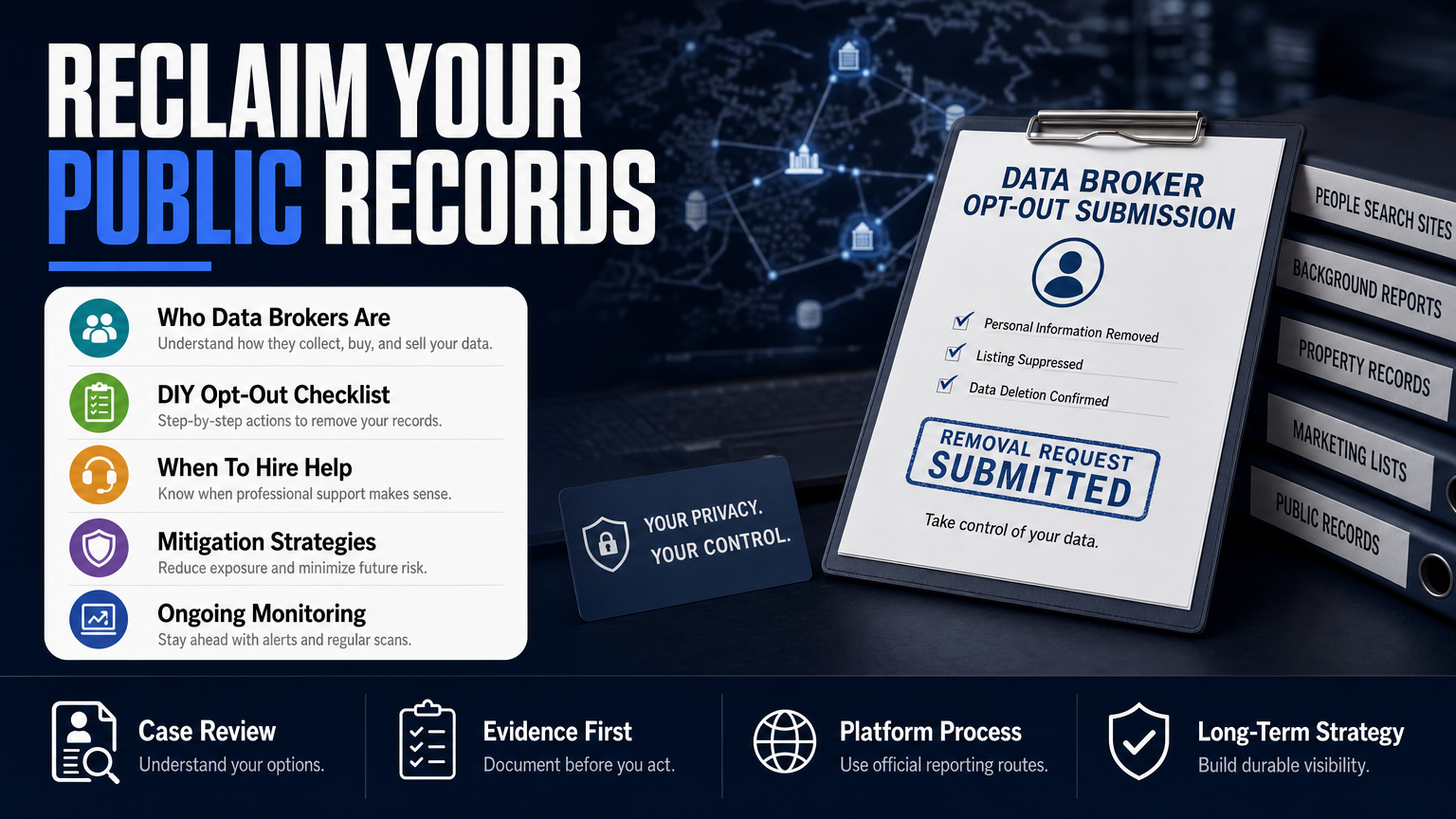
Prevention is a combination of monitoring, data hygiene, and digital security. Regular audits of data brokers, people-search sites, and directory listings limit exposure and reduce the chance of surprises.
For stepwise guidance tailored to clinical organizations, consult our Online Reputation Management for Healthcare: Practical Playbook. A good monitoring program includes alerts, periodic audits, and a documented escalation workflow tied to staff training.
- 1. Implement daily or weekly alerts for name/practice mentions across search and Social.
- 2. Run a quarterly data-broker opt-out sweep to remove personal contact information from people-search sites.
- 3. Train staff on how to escalate reviews and preserve complaint records without exposing PHI.
- Set up Google Alerts, platform notifications, and a paid monitoring service for high-risk providers.
- Perform quarterly audits of directory listings, NPI-based aggregators, and specialty sites.
- Schedule periodic digital security checks to reduce impersonation and account takeovers.
Data broker opt-outs and privacy hardening
Data brokers and people-search sites often list practitioner info pulled from public records. Opt-out processes are platform-specific and may be manual; an ongoing program reduces the aggregate exposure that fuels targeted attacks.
Digital security measures (two-factor authentication, monitored admin access) reduce the odds of impersonation or hijacked profiles that create false reviews.
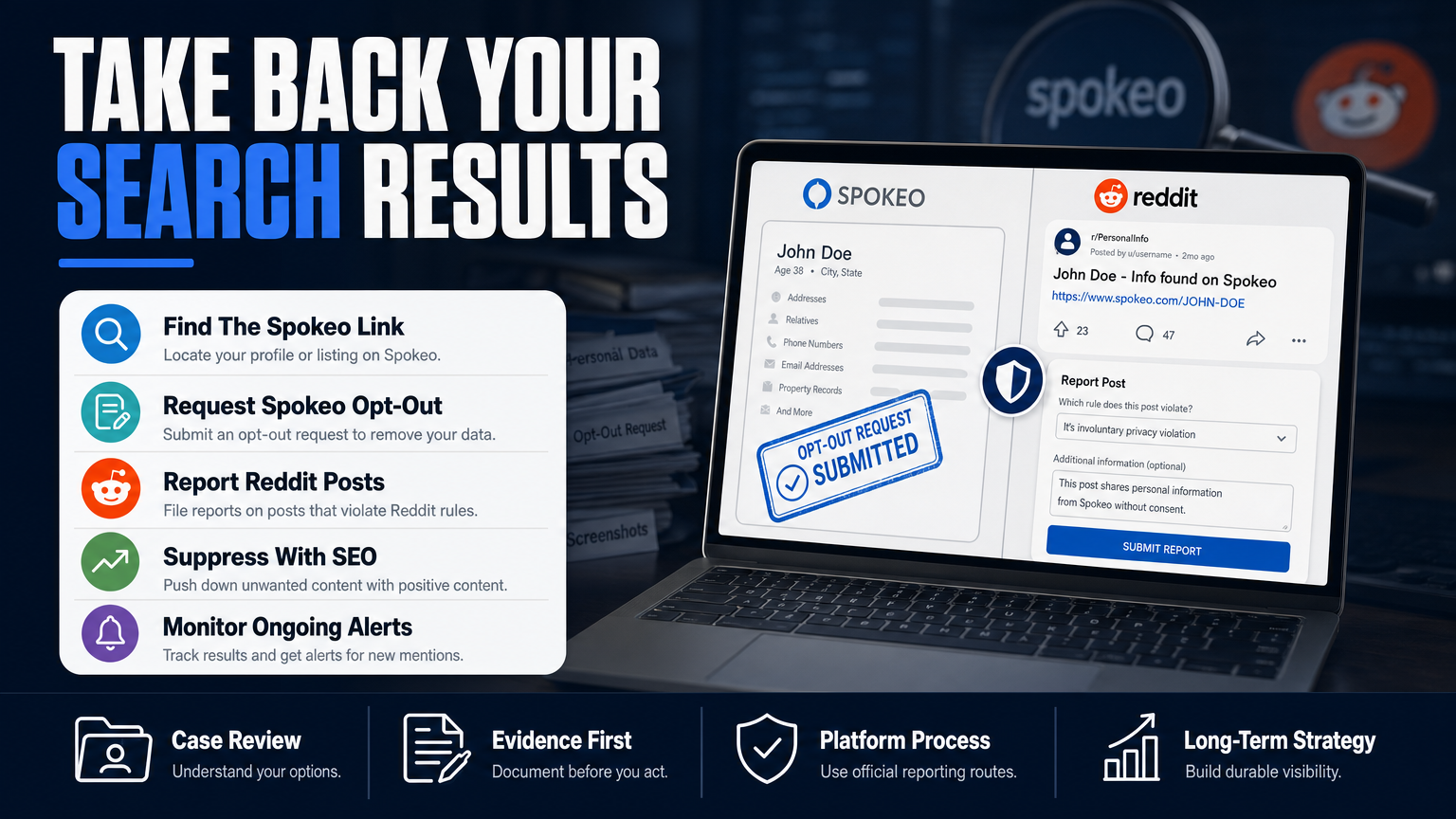
- Prioritize opt-outs at the biggest brokers (Whitepages, Spokeo, Intelius).
- Lock down accounts with strong 2FA and limited admin users.
- Keep a published, monitored practice contact point for patient resolution to reduce public complaints.
First-Page SEO and Repair Workflow
When removal is limited, an organized first-page SEO strategy aims to replace or push down harmful items using authoritative content and structured optimization. This is a long-term, measurable technique rather than a quick fix.
Start by mapping which negative items appear on page one for branded searches (your name + location + specialty) and score them by authority and traffic. Then prioritize content assets that can realistically outrank those items.
- 1. Conduct a first-page audit and assign a suppression priority to each negative URL.
- 2. Produce 3–7 high-quality assets optimized for the same query; publish and promote them.
- 3. Use authoritative third-party placements (local news, professional associations) to diversify sources.
- 4. Track placements and adjust content based on performance and platform changes.
- Asset types that help: optimized provider bios, practice pages, patient education content, press mentions, YouTube videos, and reputable directory pages.
- Use schema markup, consistent NAP (name/address/phone), and cross-linking to help new assets index.
- Measure progress with rank-tracking and traffic metrics; expect gradual shifts rather than immediate removals.
When to bring in paid promotion
Paid promotion (sponsored content, boosted social posts) can accelerate visibility for corrective content but does not change platform decisions on removal. Use paid channels to give new positive assets the visibility they need to index and attract organic links.
Paid promotion should be part of a coordinated suppression plan, not a substitute for evidence-based escalation or remediation.
- Paid traffic can help new content index faster.
- Promoted content still competes with organic trust signals; balance promotion with earned links.
Removal vs Suppression — Quick Comparison
When deciding whether to pursue removal or suppression, consider these practical differences.
| Removal | Suppression |
|---|---|
| Goal | Goal |
| Delete or hide content at source | Reduce visibility by outranking |
| Depends on platform/publisher rules or legal action | Depends on SEO, content, and time |
| Faster if platform agrees, but uncertain | Slower, measurable, ongoing |
| Requires evidence and policy/legal routes | Requires content assets and promotion |
| Best for policy violations or privacy breaches | Best for truthful negative reviews or persistent items |
Hypothetical Scenario: A Small Cardiology Practice Faces a Negative Surge
A mid-sized cardiology group notices a sudden cluster of negative Google reviews after a clinic policy change. The practice needs to triage patient safety concerns, correct misinformation, and stop bookings from falling.
This example traces the multi-step approach — audit, platform escalation, remediation, and SEO suppression — and shows how those tactics work together without promising removal.
- 1. Evidence preservation: screenshots, reviewer IDs, and timestamps are collected.
- 2. Platform reports: the forum posts are reported for coordinated harassment and removed per policy; Google declines removal for most reviews, citing opinion.
- 3. Patient remediation: the practice responds publicly where allowed with a neutral, privacy-compliant statement and follows up privately with reviewers to resolve issues.
- 4. Suppression: the practice publishes four authoritative content pieces (detailed bios, procedure guides, two local news items) and boosts them through social and PR to push negatives lower on the branded search page.
- 5. Monitoring: a 90-day monitoring plan is set up to alert staff to new mentions and to measure booking conversion recovery.
- Audit identifies 12 negative Google reviews, two identical posts on a community forum, and an inaccurate Healthgrades listing.
- Platform escalation finds that three Google reviews contain identical language and likely originate from the same coordinating source.
- Removal attempts are successful on the forum (policy violation), denied for most Google reviews (opinion/truthful complaints), and partially corrected on Healthgrades after submitting updated factual documentation.
Common Mistakes Practices Make When Managing Reviews
Avoid reactive or rule-breaking behavior. The following are repeat mistakes we’ve seen in clinical settings.
Mistake 1 — Deleting Legitimate Feedback Without Process
Removing or attempting to remove legitimate patient complaints without investigation damages trust and can violate platform rules. Establish an internal review process before taking action.
- Create a documented intake and investigation workflow.
- Escalate suspected policy violations rather than removing honest criticism.
Mistake 2 — Publicly Discussing Clinical Details
Responding to reviews with clinical specifics can violate privacy laws. Use private channels for clinical resolution and public replies for neutral next steps.
- Public replies should be brief, non-clinical, and invite offline contact.
- Log private follow-ups without disclosing protected information publicly.
Mistake 3 — Assuming One Tactic Solves Everything
Relying solely on takedown requests or only on SEO ignores the multi-dimensional nature of reputation issues. Combine tactics and measure them.
- Use removal routes where applicable and suppression when removal is unavailable.
- Track metrics: search placement, appointment bookings, and review volume over time.
Mistake 4 — Hiring Vendors That Promise Instant Results
Vendors that promise immediate deletion or guaranteed search rankings deliver unrealistic expectations. Require transparent processes and measurable deliverables.
- Ask for written action plans and realistic performance indicators.
- Avoid any service that asks you to share passwords or use fake accounts.
Mistake 5 — Ignoring Data-Broker Exposure
Leaving provider data on people-search sites increases vulnerability to impersonation and targeted attacks. Regular opt-outs reduce that surface area.
- Schedule quarterly opt-outs for major brokers.
- Monitor for new entries and correct directory discrepancies.
Best Practices for Managing Healthcare Reviews
Adopt a structured, evidence-based program that mixes compliance, communication, and SEO. Below are durable practices that reduce risk and improve patient trust.
Practice 1 — Run a Quarterly Reputation Audit
Identify negative first-page items, platform-specific policy violations, and incorrect directory data. Use the audit to build a prioritized remediation and suppression plan.
- Map the top 10 search results for branded queries.
- Document incorrect listings and stale bios that require updates.
Practice 2 — Maintain a HIPAA-Aware Response Playbook
Standardize public reply templates and private follow-up procedures that prevent accidental disclosure of protected health information.
- Train staff on compliant review response language.
- Keep central logs of all review-related communications.
Practice 3 — Use Evidence-Based Escalation
Collect and preserve evidence before requesting platform review or pursuing legal channels. Quality evidence speeds up legitimate escalations and supports counsel if needed.
- Take screenshots, note metadata and preserve timestamps.
- Coordinate with legal counsel for defamation or harassment cases.
Practice 4 — Build a First-Page Content Program
Create authoritative content assets that match patient search intent and publish them across owned and reputable third-party channels to diversify first-page results.
- Publish long-form provider bios, patient resources, and clinic news.
- Use local press and professional association listings to add authoritative links.
Practice 5 — Implement Continuous Monitoring
Set up alerts and a clear escalation path so staff can react quickly to new mentions or coordinated attacks. Continuous monitoring reduces the time negative content remains unseen and unaddressed.
- Use paid monitoring for high-risk situations.
- Assign an internal owner for triage and escalation.
Expert Tips
- Preserve screenshots with timestamps before you attempt a takedown or public reply.
- Never resolve clinical disputes in public comments; invite the reviewer to a private, documented channel.
- Prioritize Google Business Profile corrections — it usually delivers the biggest visibility win.
- If reviews are coordinated, collect evidence of coordination before making claims to platforms or counsel.
- Use structured data (schema) on provider pages to improve the chance that preferred assets appear in search snippets.
- Avoid paying for fake positive reviews — it violates platform policies and risks visible penalties.
- Maintain a small stock of evergreen, high-quality patient education pages to deploy for suppression quickly.
- Document every vendor interaction and require written action plans with measurable deliverables.
Conclusion
Managing healthcare reviews is a process that blends policy-based removal attempts, careful patient remediation, and durable SEO suppression when deletion isn’t possible. Your priorities should be evidence collection, HIPAA-compliant communication, and a measured content program that improves first-page signals over time.
A qualified reputation partner can speed triage and provide the tools and processes you need, but no vendor should promise guaranteed removal or fixed timelines. Start with an audit, pick a provider that explains what they will try (and why outcomes are uncertain), and treat reputation work as ongoing business resilience, not a one-time fix.
Why Businesses Choose Your Reputation Agency
Managing your reputation takes more than monitoring reviews or publishing the occasional blog post. It takes a strategy built around your situation, your industry, and what is actually showing up in search.
Your Reputation Agency works with businesses, executives, healthcare professionals, attorneys and growing brands. Our services include:
- Remove or suppress negative search results and news articles from Google
- Review removal and remediation (Google, Yelp, Facebook, Trustpilot, industry sites)
- Data broker and people-search opt-outs to remove personal information
- Mugshot and arrest-record removal or suppression
- Takedowns of defamatory, false, or malicious posts (social, blogs, forums)
- Online crisis management and rapid-response reputation repair
- Impersonation and fake account removal on social platforms
- Reputation monitoring, alerts, and ongoing surveillance
- First-page SEO and suppression strategies to bury negative content
- Digital security audits and privacy hardening to prevent future exposure
Frequently Asked Questions
1. What is the best reputation management company?
There is no single ‘best’ company for every healthcare organization. The right firm matches your needs: HIPAA-aware processes, experience with medical platforms (Healthgrades, Vitals, Google Business Profile), transparent methods, and documented deliverables. Ask for an audit and a clear scope before choosing.
2. Is Reputation Resolutions a legitimate company?
Legitimacy depends on verifiable business information, client feedback, and whether their described methods follow platform rules. Verify registration, read independent reviews, and require a written explanation of their processes; avoid vendors promising guaranteed deletions.
3. How much do reputation management services typically cost?
Costs vary by scope: audits commonly run $500–$3,000, per-item escalation $150–$1,000, and monthly monitoring/SEO retainers $300–$2,500. Healthcare cases often cost more due to compliance and legal coordination. Always get a written proposal tied to deliverables.
4. What is the best website to check doctor reviews?
Google Business Profile is typically the most visible for local patient searches, but Healthgrades and Vitals are highly influential for specialist searches. The best practice is to monitor a mix of platforms relevant to your specialty and location.
5. Can negative healthcare reviews be removed?
Some negative reviews can be removed if they violate platform policies (privacy breaches, impersonation, hate speech), but truthful negative feedback is rarely removable. Removal depends on the publisher, platform policies, evidence, and sometimes legal action; escalation may or may not succeed.
6. What should I do first after a damaging review?
Preserve evidence (screenshots, timestamps), determine whether the content violates policy or discloses PHI, and follow an internal escalation process. Respond publicly with neutral language when appropriate and invite the reviewer to resolve the issue offline.
7. How long does suppression take when removal isn’t possible?
Suppression timelines vary widely by content authority, the number of assets you publish, and competitive signals. You may see changes in weeks to months, but outcomes are never guaranteed and depend on search algorithms, competing content, and ongoing promotion.
8. Should I involve legal counsel for a negative review?
Legal counsel is appropriate when a review contains demonstrably false factual claims that amount to defamation, explicit threats, or when impersonation and doxxing occur. A qualified attorney can assess evidence and advise on notices or litigation; coordinate platform escalations and legal steps carefully.
9. How can I reduce the chance of a review-bombing attack?
Reduce exposure by monitoring listings, keeping directory data current, restricting admin access to profiles, and maintaining a steady flow of legitimate, compliant patient reviews. If you detect coordinated activity, preserve evidence and escalate to platforms quickly.
This content provides general information and does not constitute legal advice. The available options and likely outcomes depend on the facts, evidence, platform policies, applicable law, jurisdiction, and public-interest considerations.
Past examples do not guarantee future results. Removal, correction, deindexing, and search-position changes depend on third parties and circumstances outside Your Reputation Agency’s control.