You found a scathing Marketplace review that’s costing you customers, interviews, or bookings. The first question is practical: can you remove negative marketplace reviews immediately, or do you need a plan B to limit the damage?
This article explains how removal works on Facebook Marketplace and similar platforms, what qualifies for removal versus suppression, and the realistic next steps you can take right now to remove negative marketplace reviews or reduce their impact.
You’ll get platform-specific reporting steps, documentation templates you can copy, criteria platforms use to decide removals, and practical SEO and PR tactics for cases where removal isn’t possible.
We also show an end-to-end hypothetical scenario so you can see how the process plays out and when it makes sense to involve legal or professional reputation help.
Table of Contents
- Can you get rid of negative reviews on Facebook Marketplace?
- How can I get a negative review removed?
- Can you get a Marketplace rating removed?
- Can I remove bad reviews from my Facebook page?
- What to do when removal is NOT available
- When to consider legal or PR escalation
- Ongoing monitoring and prevention
- DIY vs Agency: Which route should you take?
- Hypothetical: How a negative Marketplace review was handled end-to-end
- Common mistakes that make review problems worse
- Best practices for handling marketplace reviews
- Expert Tips
- Conclusion
- Why Businesses Choose Your Reputation Agency
- Frequently Asked Questions
Can you get rid of negative reviews on Facebook Marketplace?
Short answer: sometimes. Facebook allows reporting of reviews and ratings that violate its policies — for example, harassment, hate speech, impersonation, or posts that include private information — but it does not remove reviews simply because they are negative or critical.
Whether a particular Marketplace review can be removed depends on whether it breaches Facebook’s Community Standards or Commerce Policies, whether it’s tied to an impersonation or fake account, and whether you can document a policy violation.
- Identify the policy issue with the review (harassment, privacy leak, impersonation, etc.).
- Take screenshots showing URL, date/time, username, and review text.
- Use Facebook’s reporting flow inside the review (Report Review) and submit your evidence.
- If the reviewer is impersonating you, use Facebook’s impersonation report processes and provide ID and proof of representation where requested.
- Platform control: Facebook decides removals under its policies.
- Not removable because it’s merely negative: honest negative feedback that doesn’t break rules is generally not eligible.
- Removable if it contains threats, personal data, sexual content, impersonation, or clear falsehoods that violate policy.
Documenting evidence before you report
Platforms respond faster and more favorably to reports with clear, dated evidence. Capture screenshots that include the profile page of the reviewer, the review itself, and any related messages. Save URLs or post IDs and note timestamps.
If the review exposes private information (home address, SSN, images), document where that info is visible elsewhere (public filings, your site) to show why it’s sensitive and not public interest.
- Take at least two screenshots from different devices if possible.
- Copy the direct link (post URL or review ID) into a text file.
- Preserve any direct messages or transaction records that contradict the review.
When to escalate beyond the in-app report
If the in-app report is denied or you see no action after a reasonable time (platform timelines vary), secondary options include filing an official appeal through Facebook’s Help Center links, using business support channels if you have a business page, or documenting a pattern of abuse and escalating to platform trust & safety forms.
Remember: escalation increases documentation requirements and still does not guarantee removal. You are persuading a platform to enforce its rules, not exercising a legal right to delete content.
- Use Facebook Business Help if you manage a Page connected to the listing.
- Collect additional examples if the reviewer has a pattern (multiple posts, multiple platforms).
- Consider a reputational suppression strategy if removal is denied.
How can I get a negative review removed?
There are four distinct pathways to pursue removal: platform reporting, buyer/seller negotiation, legal processes, and content takedowns by hosts/publishers. Each path requires different evidence and has different timelines.
Start with platform reporting and documenting evidence. If that fails, consider targeted mitigation: ask the reviewer to revise the review, offer remediation, or pursue legal remedies if the review is defamatory. Your Reputation Agency evaluates whether the content may qualify for removal or review and pursues the legal, technical, platform-based, and reputational options available.
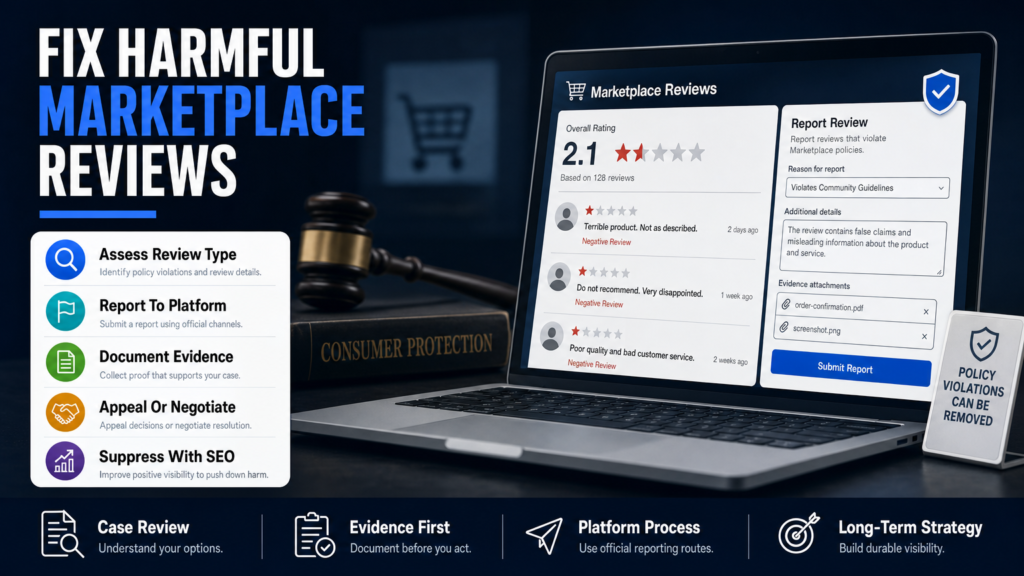
- Step 1 — Assess: Is this opinion, a factual falsehood, harassment, or privacy breach? Your handling depends on this classification.
- Step 2 — Document: Screenshots, transaction records, shipping confirmations, messages, and any contradictory evidence.
- Step 3 — Report: Use platform reporting, selecting the correct policy ground and attaching evidence.
- Step 4 — Follow up: Use appeals, business support panels, or recommended escalation paths.
- Step 5 — Plan B: Prepare SEO and PR responses if removal is denied.
- Report the review through the platform’s official abuse/violation flow.
- If the reviewer is reachable, attempt a calm, professional resolution and ask for revision.
- If false and defamatory, consult an attorney about a potential legal notice or subpoena to identify an anonymous reviewer.
- If removal isn’t available, pursue suppression via positive SEO, new pages, and structured content.
Negotiation and remediation: when asking the reviewer to revise makes sense
If the reviewer is a verified buyer or a real person who made a mistake, offering a prompt refund, replacement, or honest remedial action and then politely asking for a review revision often works. Keep all messages professional and avoid threats.
Never offer money for positive reviews or suggest creating fake positive reviews — those are prohibited by platform policies and are unethical.
- Offer documented remediation (refund tracking number, replacement order ID).
- Ask for a neutral revision acknowledging remediation rather than a full removal.
- Keep written records of all outreach; they help with appeals and legal steps if needed.
Link to deeper help on marketplace-review threats
If a single Marketplace review is causing disproportionate business harm, you may need a multi-channel response combining removal attempts with visibility repair. Our article When a Single Marketplace Review Threatens Your Business explains how to triage urgent cases and decide on escalation.
Use that resource to decide whether to pursue aggressive documentation, paid PR, or SEO suppression as part of a coordinated plan.
Can you get a Marketplace rating removed?
Marketplace ratings can sometimes be removed or adjusted if they violate platform rules or result from fraud or impersonation; otherwise, stars and summary ratings are treated differently than textual reviews. Ratings alone are frequently harder to remove because they’re treated as aggregated feedback unless tied to a policy breach.
If a rating is tied to a specific review that you successfully remove, the rating may update automatically. If not, you must build a case that the rating resulted from an ineligible action (fake account, automated scraping, or clear payment fraud).
- Confirm whether the rating is connected to a text review or stands alone.
- If connected, follow the review removal process.
- If standalone and suspect, report for suspicious behavior and provide proof of no transaction or impersonation.
- Ratings without policy violations are usually permanent on the platform.
- If the rating correlates to a removed review, platform metrics may refresh.
- Document transactions, communication, and proof of non-purchase if the rating was left without a legitimate transaction.
Disputing Marketplace ratings in practice
When you dispute a rating, use the Marketplace support flows and select reasons like “inaccurate rating” or “fraud” where available. If you run a business Page, use Facebook Business Support and include order IDs and customer service logs.
Be prepared for split outcomes: platforms may remove some ratings but leave others, and you may need to combine removal attempts with suppression tactics.
- Include order numbers, tracking, and screenshots of completed deliveries.
- List any repeated accounts that left multiple false ratings.
- Keep your tone factual and avoid emotional language in your support ticket.
Can I remove bad reviews from my Facebook page?
Facebook Pages and Marketplace reviews are governed by similar but not identical processes. On a Page you may manage reviews differently: you can report a review, respond publicly, or—if the reviewer uses a fake account—report impersonation.
You cannot delete a truthful negative review simply because it is critical. But you can request removal for policy violations, respond to the reviewer, or manage your Page so ratings are less prominent (for example, disabling reviews where platform settings allow).
- Navigate to your Page’s Reviews or Recommendations tab.
- Click the three dots next to the review and select the appropriate report option.
- If you have a business manager account, open a support ticket and attach evidence.
- Consider responding publicly with a factual, measured reply to show prospective customers you address complaints.
- Use Page moderation tools to hide or respond to reviews.
- You can hide a review from your Page timeline in some cases, but the review may still be visible elsewhere on Facebook.
- If impersonation is involved, use Facebook’s impersonation report process and supply identification as required.
Using public responses effectively
A measured public response can reduce the damage of a negative review and often persuades readers that the matter is being handled. Keep the reply short, acknowledge the issue, offer a remediation channel (email or phone), and avoid admitting fault in public statements.
Record your public replies and any private correspondence; platforms sometimes treat report outcomes more favorably when you show you attempted remediation.
- Acknowledge the complaint without admitting legal liability.
- Offer a way to continue the conversation offline (email or business phone).
- If the reviewer refuses remediation and the review violates policy, escalate with documentation.
What to do when removal is NOT available
Removal is not always possible. Honest negative feedback, opinions, or legal-but-unpleasant disclosures may remain online. When removal isn’t available, focus on mitigation: reduce visibility, correct context, and rebuild trust with new content and customer evidence.
We pursue the legal, technical, platform-based, and reputational options available. When removal is unavailable, common strategies include targeted SEO suppression, competing content, corrections, and direct outreach to remedy the underlying problem.
- Audit first-page search results for your name or business and prioritize which pages to suppress.
- Create authoritative content (About pages, LinkedIn profiles, press releases, professional directories).
- Optimize and promote those assets so search algorithms and users see accurate information first.
- Use reputation monitoring to detect new reviews immediately and add them to your workflow.
- Suppress: create and promote higher-authority content that ranks above the negative post.
- Correct: publish fact-based responses, corrections, or context on credible channels.
- Amplify: encourage satisfied customers to leave verified feedback to dilute the negative signal.
- Monitor: set alerts and respond quickly to new activity so a single negative result doesn’t become a trend.
When suppression and SEO are the right choice
Suppression is the right choice when the content is lawful, not demonstrably false, or when the publisher refuses removal. Building multiple, high-quality pages and linking them in a controlled publishing plan can push negative content down in search results over time.
SEO strategies vary by the authority of the negative content; a national news site or court record requires a stronger, longer campaign than an anonymous forum post.
- Prioritize platforms you control (your business site, LinkedIn, professional directories).
- Invest in content that answers user intent and includes neutral mentions of the issue to control the narrative.
- Consider paid promotion for new authoritative content while organic rankings build.
When to consult other removal examples
Different platforms require different tactics. If the issue spreads to discussion threads or social sites, see guidance on broader removals such as When a Reddit Post Becomes Your Business’s Worst Result for platform-specific escalation and documentation approaches.
That resource helps decide if legal notices, direct publisher outreach, or content suppression is the faster route when removal requests are denied.
When to consider legal or PR escalation
Legal action is sometimes appropriate — for example, when a review is demonstrably false and defamatory, or when it discloses private personal data. A qualified attorney can determine whether a legal claim may be available and what evidence is needed. Legal options carry cost, risk, and public attention; they are not always the fastest or most discreet route.
PR escalation is a parallel path: a focused statement, local media outreach, or customer outreach campaign can protect revenue and reputation while you pursue removal or suppression.
- Preserve evidence (screenshots, communications, transaction records).
- Get an initial legal consultation to assess defamation or privacy claims.
- If proceeding, coordinate messaging with counsel and public relations professionals.
- If not proceeding legally, prioritize private remediation and suppression to limit business harm.
- Legal: consider only after an attorney reviews evidence; preserve records and never threaten libel publicly.
- PR: use neutral factual statements, customer testimonials, and transparent remediation to rebuild trust.
- Costs and timelines vary; an estimated timeline can be provided after an individual assessment.
Cost, timeline, and privacy caveats
Legal remedies depend on jurisdiction, the nature of the content, and the identity of the poster. There is no guaranteed legal outcome and attorneys may recommend alternatives like cease-and-desist letters or DMCA takedowns for copyrighted material.
We handle matters confidentially and apply appropriate privacy and security controls; specific confidentiality obligations are defined in any service agreement you enter.
- Legal outcomes are not guaranteed and depend on applicable law.
- Timing depends on legal process, platform response, and publisher cooperation.
- Coordinate with counsel when you need subpoenas or identity-revealing processes.
Link to practice-specific revenue risks
If a single Facebook review threatens revenue or patient acquisition — for example, for a medical or legal practice — specialized approaches and faster escalation may be warranted. See our client-facing resource When One Facebook Review Can Cost Your Practice Real Revenue for industry-specific triage and remediation considerations.
That piece explains how to balance confidentiality, compliance, and remedial outreach in regulated fields.
Ongoing monitoring and prevention
Removal or suppression is only part of a durable strategy. Preventing future harmful reviews means tightening transaction records, improving customer experience, and setting up monitoring so you can respond quickly.
Reputation monitoring tools and processes let you detect new reviews, assign them to team members for remediation, and track patterns that suggest coordinated attacks or recurrent service issues.
- Implement reputation monitoring with daily or real-time alerts.
- Create an internal protocol for triage: who responds, who documents, who escalates.
- Run quarterly audits of first-page search results and adjust SEO priorities accordingly.
- Train staff on public communication best practices and review handling.
- Set up alerts for mentions across search, social, and review sites.
- Standardize how you respond to negative reviews: response templates, timelines, and escalation rules.
- Use post-transaction feedback requests to increase positive, verified reviews.
- Perform regular audits of data brokers and people-search sites to reduce exposure of personal data.
Technical hardening to reduce attack surface
Digital security audits and privacy hardening — correcting exposed contact details, removing unnecessary personal data from public profiles, and limiting publicly visible transaction details — reduce the chance that a future review will escalate into doxxing or extortion.
Coordinate with security professionals for multi-factor authentication, password hygiene, and account recovery processes for business Pages.
- Enable two-factor authentication on all business accounts.
- Restrict administrative privileges to essential personnel.
- Review privacy settings on social accounts regularly.
DIY vs Agency: Which route should you take?
A quick comparison of practical trade-offs when deciding to handle reviews yourself or hire a reputation agency.
| DIY (In-House) | Agency (Professional Help) |
|---|---|
| Cost | Up-front lower cost, time investment required |
| Expertise | Limited by internal experience |
| Speed | Potentially slower without templates and contacts |
| Complex cases | Agencies coordinate legal, PR, and SEO |
| Documentation | Agencies bring evidence workflows and escalation playbooks |
| Confidentiality | Agencies apply operational privacy controls under contract |
| Long-term suppression | Agencies usually run multi-channel SEO campaigns |
Hypothetical: How a negative Marketplace review was handled end-to-end
Scenario: ‘Dr. Lee’ (a small dermatology practice) received a one-star Facebook Marketplace review alleging poor treatment and a refund dispute. The review included patient-identifying details and a claim of malpractice. Here’s a stepwise, anonymized example of how the situation was handled as a process, not a promise of outcome.
This scenario is hypothetical and anonymized to show the kinds of actions a practice might take when faced with a damaging Marketplace review.
- 1) Document: Take time-stamped screenshots and preserve internal records that show treatment dates and billing.
- 2) Report: Use Facebook’s report flow for privacy violation and impersonation if applicable, attaching evidence without disclosing medical details publicly.
- 3) Remediate publicly: Post a brief, professional response inviting the reviewer to contact the clinic and offering to investigate (no admissions).
- 4) Appeal: If the report failed, file a secondary appeal via business support and submit redacted medical records to demonstrate an error in the reviewer’s factual claims.
- 5) Suppress: While appeals ran, the practice launched a targeted local SEO push — updating Google Business Profile, publishing patient education content, and soliciting verified reviews from recent patients using in-clinic follow-up workflows.
- 6) Monitor: Set alerts and assign staff to respond to any related posts or comments.
- Initial assessment categorized the post as a privacy violation (patient identifiers) and a possible false factual allegation.
- The team preserved evidence: screenshots, post URL, reviewer profile, and a copy of the clinic’s internal visit records (redacting sensitive health data).
- A calm public reply was posted offering to take the conversation offline and showing a commitment to patient safety.
Common mistakes that make review problems worse
Below are common errors organizations make when addressing negative marketplace reviews and how to avoid them.
Mistake 1 — Reacting emotionally in public
A hostile or defensive public reply often validates the reviewer’s claim in the eyes of prospective customers and can escalate the situation. Keep public replies short, factual, and focused on remediation channels.
- Avoid insults, threats, or overly defensive language.
- Use a templated, professional response and move the conversation offline.
Mistake 2 — Pursuing fake or manipulative positive reviews
Creating or buying fake positive reviews is both unethical and violates platform policies. It risks account penalties and undermines long-term trust. Instead, focus on legitimate, verified feedback from actual customers.
- Do not solicit false reviews or coordinate review fraud.
- Use verified follow-up requests and incentivize feedback only within platform rules.
Mistake 3 — Failing to document everything
Removing or disputing reviews without preserving immediate evidence can ruin your case. Platforms and lawyers require dated screenshots, URLs, and correlated transaction records.
Preserve original context before it changes.
- Take multiple screenshots, store URLs, and export message threads.
- Log every outreach attempt with timestamps and method used.
Mistake 4 — Ignoring trends and not monitoring
Treating a single review as a one-off rather than monitoring for follow-ups means you miss coordinated attacks or repeat offenders. Set up monitoring to detect patterns early.
An early detection system lets you escalate faster and document a pattern if needed.
- Use alerts for your brand name and related keywords.
- Assign ownership for triage and escalation within your team.
Mistake 5 — Publicly threatening legal action
Threatening to sue in public can backfire, drawing attention and sometimes chilling platform moderation. Legal options should be coordinated privately with counsel; public threats rarely help.
- Consult an attorney before sending legal notices.
- If legal steps are taken, coordinate messaging with counsel and PR.
Best practices for handling marketplace reviews
Adopt these durable habits to reduce the likelihood and impact of harmful marketplace reviews.
Practice 1 — Fast, factual public responses
Respond quickly with a templated, factual reply that shows you take complaints seriously and invites private resolution. A calm reply reduces immediate business harm and signals to readers you are professional.
- Acknowledge the complaint, offer remediation contact details, and avoid admitting liability.
- Log the response and any follow-up communications.
Practice 2 — Maintain airtight transaction records
Retain order confirmations, delivery receipts, contracts, and communications for at least six months so you can disprove false claims. Good records make platform appeals and legal assessments far stronger.
- Link order IDs to customer accounts and keep a searchable archive.
- Redact sensitive health information when submitting evidence to platforms or counsel.
Practice 3 — Use multi-channel remediation
Combine platform reporting with direct outreach, SEO suppression, and local reputation building. A single tactic rarely suffices; coordinated action increases your chance of neutralizing the harm.
- Prioritize channels you control (company site, Google Business Profile, LinkedIn).
- Coordinate messages across teams to keep language consistent.
Practice 4 — Preserve evidence and use templates
Create evidence templates (screenshot checklist, transaction evidence template, message logs) and use them immediately when a review appears. This reduces errors and improves the quality of platform reports.
- Build a simple intake form for negative reviews for staff to complete.
- Store evidence in a secure, access-controlled folder.
Practice 5 — Invest in monitoring and training
Regular staff training on review responses, privacy rules, and escalation thresholds prevents mistakes and shortens response time. Monitoring lets you act before a problem becomes a crisis.
Periodic audits of first-page results identify weak spots before they cause real damage.
- Run quarterly tabletop exercises for a major negative review scenario.
- Maintain a single owner for reputation issues with clear escalation steps.
Expert Tips
- Screenshot everything immediately — URLs and timestamps are critical evidence.
- If a reviewer mentions private data, highlight the privacy breach in your report rather than the opinion itself.
- Offer remediation and a polite revision request before threatening legal steps.
- Use business-level support channels where available — they often provide more options.
- Build out three authoritative assets you control to push negative results down in search.
- Never pay for fake reviews or ask employees to post positive reviews from personal accounts.
- Coordinate any legal step with counsel and keep public messages factual and non-confrontational.
- Turn resolved complaints into testimonials by asking satisfied customers to leave verified feedback.
Conclusion
Removing negative marketplace reviews is rarely a single-step process. Start by assessing whether the content violates platform policies, document everything carefully, and use the correct reporting and appeal channels. If removal isn’t possible, shift quickly to mitigation: public responses, SEO suppression, and targeted reputation building.
Every situation has trade-offs. A measured, evidence-first approach preserves legal options and minimizes business disruption. When a review threatens revenue or hiring, consider coordinated help — legal review, PR support, and professional reputation services — to restore trust while you pursue every available technical and platform path.
Why Businesses Choose Your Reputation Agency
Managing your reputation takes more than monitoring reviews or publishing the occasional blog post. It takes a strategy built around your situation, your industry, and what is actually showing up in search.
Your Reputation Agency works with businesses, executives, healthcare professionals, attorneys and growing brands. Our services include:
- Remove or suppress negative search results and news articles from Google
- Review removal and remediation (Google, Yelp, Facebook, Trustpilot, industry sites)
- Data broker and people-search opt-outs to remove personal information
- Mugshot and arrest-record removal or suppression
- Takedowns of defamatory, false, or malicious posts (social, blogs, forums)
- Online crisis management and rapid-response reputation repair
- Impersonation and fake account removal on social platforms
- Reputation monitoring, alerts, and ongoing surveillance
- First-page SEO and suppression strategies to bury negative content
- Digital security audits and privacy hardening to prevent future exposure
Frequently Asked Questions
1. Can you get rid of negative reviews on Facebook Marketplace?
Sometimes. Facebook will remove content that violates its Community Standards or Commerce Policies — harassment, privacy violations, impersonation, or clear illegal content. Honest but negative reviews that don’t break rules are typically not removed. Removal depends on the evidence you provide and Facebook’s policy interpretation.
2. How can I get a negative review removed?
Start by documenting the review and reporting it the correct way through the platform’s abuse or policy tools. If the reviewer is reachable, offer remediation and request a revision. For false or privacy-violating content, consult an attorney to evaluate legal options. If removal isn’t available, pursue SEO suppression and reputation-building.
3. Can you get a Marketplace rating removed?
Ratings may be removed if they result from fraud, impersonation, or policy violations, but standalone star ratings are often harder to remove than textual reviews. If the rating is tied to a review that is successfully removed, the summary rating may update. Document transactions and file reports for suspicious or ineligible ratings.
4. Can I remove bad reviews from my Facebook page?
You can report Page reviews for policy violations and use Page moderation tools to manage visibility, but you cannot remove truthful negative reviews simply for being negative. Use professional public replies and business support channels to escalate policy-based removals and work to remediate the underlying issue.
5. How long does it take for a platform to act on a reported review?
Timing varies by platform, volume, and case complexity. Some actions can occur within 24–72 hours; complex appeals or legal requests may take weeks. No universal timeframe applies; an estimated timeline can be provided after case assessment.
6. What evidence do platforms want when I report a review?
Platforms prefer dated screenshots, direct URLs or post IDs, transaction records, and any messages that contradict the review. If the issue is privacy-related, show where the private data appears and why it’s sensitive. Preserve originals before they’re edited or removed.
7. Should I threaten legal action if a review is false?
Public threats rarely help and can attract attention. Instead, consult an attorney privately to evaluate whether a defamation or privacy claim exists. If legal action is appropriate, coordinate any communications with counsel and be mindful of potential public relations consequences.
8. What if a reviewer is anonymous?
Anonymous reviewers are difficult to identify. If you can tie the review to a transaction or pattern, platforms may act. For anonymous reviewers who defame, an attorney may pursue discovery or subpoenas to identify the poster — this depends on jurisdiction and legal standards.
9. Can reputation agencies guarantee removal?
No reputable agency can guarantee removal. Agencies evaluate whether content may qualify for removal or review and pursue the legal, technical, platform-based, and reputational options available. Outcomes depend on platform policies, publisher cooperation, jurisdiction, and the strength of evidence.
This content provides general information and does not constitute legal advice. The available options and likely outcomes depend on the facts, evidence, platform policies, applicable law, jurisdiction, and public-interest considerations.
Past examples do not guarantee future results. Removal, correction, deindexing, and search-position changes depend on third parties and circumstances outside Your Reputation Agency’s control.