If you found your name, phone number or home address on Whitepages and want it gone, this article lays out what actually works — and what doesn’t. It explains how to remove your name from Whitepages online, which pieces of data you can reasonably ask to have removed, and which you should plan to suppress instead.
You’ll get step-by-step instructions for Whitepages opt-outs (including the forms and information you’ll need), the limits of platform policies, and practical mitigation when removal isn’t available. Where appropriate I’ll point out when the issue may require legal review or coordinated SEO and PR work.
This guide is written for busy professionals and small businesses who need clear next steps: exact forms to use, realistic timeframes, and what to check afterwards so you can measure progress.
Table of Contents
- How To Opt Out Of Whitepages (Step-by-step)
- How Do I Remove My Address From The Internet For Free?
- Why Is My Address Public On Whitepages?
- How To Remove Your Phone Number From Data Brokers
- What Is The Whitepages Website?
- When Removal Is Not Available: Suppression And Mitigation
- How Long Does Opt-Out Or Removal Take And What To Expect
- What To Do If You Find A Fake Or Impersonation Listing
- DIY Opt-Out vs Hiring a Reputation Agency
- Hypothetical Example: A Surgeon, A Whitepages Listing, And A Hiring Committee
- Common Mistakes People Make When Trying To Remove Whitepages Listings
- Best Practices For Dealing With Whitepages And Other People-Search Sites
- Expert Tips
- Conclusion
- Why Businesses Choose Your Reputation Agency
- Frequently Asked Questions
How To Opt Out Of Whitepages (Step-by-step)
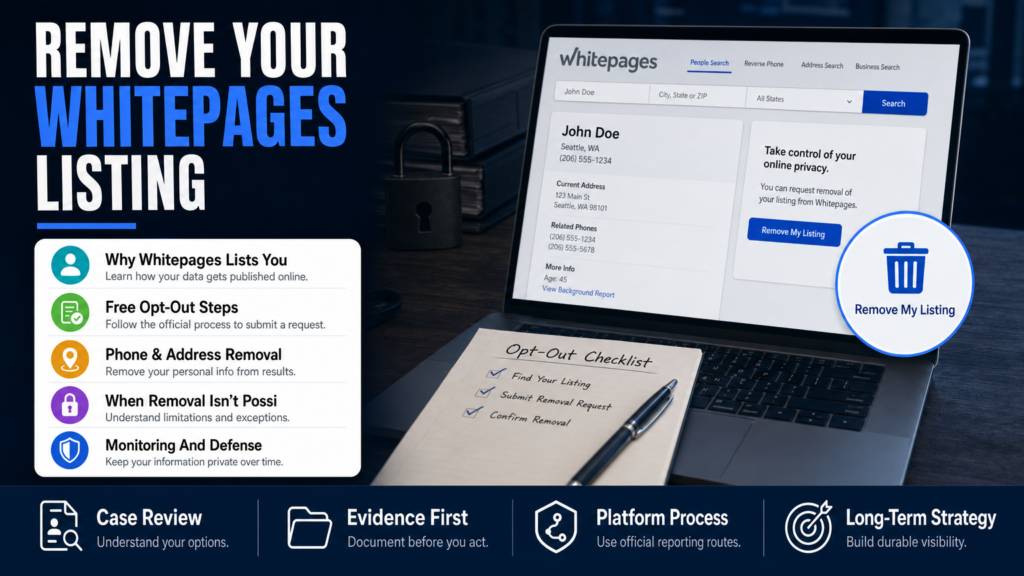
Whitepages provides an opt-out flow for many personal listings. Opting out is often the first, free option people try. We evaluate whether the content may qualify for removal or review, but opt-outs are the practical first step you can do yourself.
Before you begin, gather: the exact Whitepages URL for your listing, the name as it appears, one supporting proof of identity if requested (Whitepages sometimes asks for ID to process certain requests), and the email address you’ll use to follow up.
- Open the listing and click the Opt-Out or Do Not Sell My Info link (visible on most profiles).
- Complete the opt-out form with the full URL and correct spelling of the name as it appears on Whitepages.
- If Whitepages asks for ID, submit the minimum required and follow their instructions; redact unrelated data on the document where possible.
- Confirm the request via any email you receive from Whitepages and save the confirmation.
- Check the listing weekly for changes — the platform may mark it pending before it disappears or is redacted.
- Find your listing: use Whitepages search or a Google query with your name + city.
- Copy the listing URL — you’ll need it for the opt-out form.
- Decide whether to request removal of the entire listing or only specific fields (phone, address).
If the Opt-Out Form Fails
Sometimes the automated form won’t accept a listing or returns an error. Save screenshots and the failed submission confirmation. You can retry after 24–48 hours, or escalate using Whitepages help/contact channels.
If public records (e.g., property ownership) are the source, Whitepages may refuse removal. When that happens, move to suppression tactics described below.
- Try a different browser or clear cookies before resubmitting.
- Use an alternate email address if confirmation emails don’t arrive.
- Document each attempt with timestamps and screenshots.
How Do I Remove My Address From The Internet For Free?
Removing an address from every website is rarely a single-step process. For free removal from Whitepages and many people-search sites, the route is the platform opt-out. For other sites you’ll use their own privacy controls or request removal under privacy policies.
Free steps are useful and often effective for less authoritative aggregators, but they don’t control third-party data sources (court records, government filings, or publisher archives). If the address appears in a public record or a news article, removal depends on the source’s policy or legal rules.
- Search for your full name and address across several data broker sites and record each URL.
- Submit opt-out requests per site instructions and keep copies of confirmation emails.
- Set up a free monitoring alert (Google Alerts) for your name plus address to catch reindexing or reposts.
- Start with targeted opt-outs on the largest aggregators: Whitepages, Spokeo, Intelius, BeenVerified, PeopleFinder.
- Use state or local options if data appears in non-commercial public records (some counties let you redact home addresses for safety reasons).
- Request removal from any publisher that published your address directly (blogs, local sites).
When Government Or Public Records Contain Your Address
If your address comes from public records (property tax records, court filings), platforms may republish that data and decline removal. In those cases, suppression strategies and targeted contact with the originating government office may be the better route.
Certain states offer limited redaction or protective address services (for victims or professionals with safety concerns). A qualified attorney or local court clerk can advise whether a legal remedy exists.
- Check your county recorder’s office for options to redact or set a mailing address for safety.
- If you’re a domestic-violence survivor or at-risk professional, ask about protected-address programs under state law.
Why Is My Address Public On Whitepages?
Whitepages aggregates data from public records, phone directories, data brokers, and other commercial sources. If your address is public on Whitepages, it’s usually because one or more upstream sources published it and Whitepages included it in their profile.
That attribution matters: whether Whitepages is the original publisher determines the available remedies. If Whitepages scraped the data from another site, removing it at the source is often more durable than only using the Whitepages opt-out.
- Identify the source: check the Whitepages listing for source tags or look for identical entries elsewhere.
- If you find an upstream publisher, request removal there as well.
- Use the Whitepages opt-out after addressing upstream sources to reduce reappearance risk.
- Common sources: property records, voter rolls, phone directories, previous online forms, and data-broker aggregations.
- Whitepages may also combine records under a single profile (relatives, historical addresses), which complicates single-listing removal.
What If Whitepages Refers To Public Records?
When Whitepages cites public records, they may be unwilling to remove the address. In such cases, suppression (creating positive, authoritative content to push the listing lower in search results) becomes the practical option.
We develop SEO reputation strategies intended to improve the visibility of relevant and credible information; results vary according to the strength of the negative content and the authority of competing sources.
- Create authoritative profiles (LinkedIn, company site) using your preferred name and professional details.
- Publish or promote helpful content tied to your name that search engines prefer over passive directory listings.
How To Remove Your Phone Number From Data Brokers
Phone numbers often travel through many brokers. Whitepages, multiple people-search sites, and marketing lists can all display the same number. Each requires its own opt-out or suppression action.
You’ll need persistence: some brokers make the process easy, others deliberately slow. We pursue the legal, technical, platform-based, and reputational options available, but note platform decisions remain under the platform’s control.
- Locate every URL showing your phone number and document it.
- Submit opt-out requests at each site, following their phone-number removal path.
- If a site requests ID, submit only the minimum required and redact unrelated information.
- Monitor search results for at least 30–90 days for reappearance or reindexing.
- Prioritize high-traffic sites first (Whitepages, Spokeo, BeenVerified, Intelius).
- Use a central spreadsheet to track requests, dates, and confirmation links.
- Consider changing your number and placing the old number on a paid blocklist if removal is unsuccessful and calls persist.
When To Consider Number Change Or Paid Services
If sensitive harassment continues and opt-outs don’t resolve visibility, a number change plus porting your new number to a provider with spam controls may be the safest practical step.
Paid removal services and premium data-broker suppression programs can accelerate coverage across many sites but do not guarantee permanent removal—platforms and data suppliers can republish data later.
- Weigh the cost of paid suppression vs. operational disruption from changing numbers.
- If you change numbers, update business listings and contacts immediately to preserve continuity.
What Is The Whitepages Website?
Whitepages (whitepages.com) is a commercial people-search and directory platform that aggregates phone numbers, addresses, and publicly available background data. It offers listings for individuals and businesses and sells data products to consumers and enterprises.
Because Whitepages is a commercial aggregator rather than a single publisher of original reporting, opt-outs and suppression requests follow their published privacy and opt-out policies — but decisions vary by the nature of the data and its source.
- Visit the profile and review the data fields listed (phone, address, relatives, historical records).
- Use the site’s privacy center or opt-out link to begin a removal request.
- Save all confirmations and check back for reindexing or reappearance.
- Main functions: people search, reverse phone lookup, background report services, and marketing data products.
- Whitepages provides opt-out forms and a paid premium removal program in some cases, but availability depends on the listing and its sources.
How Whitepages Differs From Other People-Search Sites
Different aggregators pull from overlapping but not identical sources. A listing removed from Whitepages may still appear on Spokeo or BeenVerified, so coordinated opt-outs produce the best results.
For a broader cleanup, combine opt-out work with search-engine reputation strategies. For example, if Whitepages listing is the top search result, you can read more about prioritizing removal and suppression at When Your Address Becomes the First Result on Google.
- Whitepages often returns in branded queries; check Google’s cached version to see when it was last indexed.
- Treat Whitepages as one node in a larger data ecosystem — target both the node and its upstream contributors.
When Removal Is Not Available: Suppression And Mitigation
Sometimes removal is not available because the data derives from public records, verified court filings, or a publisher that declines to take content down. When removal is unavailable, we may recommend mitigation, correction, or reduced visibility.
Mitigation is a combination of SEO, authoritative content creation, reputation monitoring, and targeted outreach to platforms and publishers to reduce the visibility of the problematic listing.
- Inventory the search results for your name (Google first page and images).
- Build or optimize authoritative pages using your preferred name format and professional details.
- Distribute those pages across platforms with strong domain authority (news, company site, LinkedIn).
- Use ongoing monitoring to measure movement in search rankings and refile opt-outs when necessary.
- Suppression: create and promote high-authority pages (LinkedIn, professional bios, company pages) to outrank the Whitepages listing.
- Correction: where data is inaccurate, send documented corrections to the original publisher and to Whitepages.
- Containment: set up monitoring and alerting to spot and respond to reappearance quickly.
Using PR And Content To Lower Visibility
An intentional content and PR plan can shift what search engines surface for your name. Publish bylines, press releases, or helpful resources tied to your name and organization to create positive assets.
We coordinate messaging when a related news story threatens a professional reputation; for example, if a local article dominates a search, review our guidance at When One Local News Story Threatens Your Entire Career for response options and containment strategies.
- Prioritize authoritative, verifiable content that search engines trust.
- Avoid fake or deceptive tactics — these can backfire and violate platform terms.
How Long Does Opt-Out Or Removal Take And What To Expect
Timing varies widely. Platform decisions depend on the content, publisher, policy, and whether data is tied to public records. We cannot guarantee timelines; an estimated timeline can be provided after an assessment.
Expect several possible outcomes: immediate redaction, a pending flag while the site reviews your request, refusal with an explanation, or temporary removal followed by reindexing from upstream sources.
- After submitting an opt-out, check the listing daily for the first two weeks, then weekly for up to 90 days.
- If the listing reappears, identify the upstream source and re-submit removal requests there.
- Keep a log of all communications; it helps if you later engage a specialist or attorney.
- Typical ranges: some opt-outs take days to weeks; more complex data or ID-verified requests can take several weeks.
- If a refusal occurs, document the rationale and move to suppression or consider legal review where appropriate.
When To Call Support Or Escalate
If the platform’s automated process fails repeatedly or the listing contains defamation or impersonation, escalate through Whitepages customer service or consider coordination with legal counsel.
For business-impacting search results (for example, when a Whitepages profile appears at the top of hiring searches), see our practical steps in When a Google Result Becomes Your First Interview — How to Fix It Fast.
- Escalate with documented evidence and a clear timeline of prior attempts.
- Consider paid suppression or professional services when time sensitivity is high.
What To Do If You Find A Fake Or Impersonation Listing
If a Whitepages profile is impersonating you or includes obvious false statements, treat it as a platform-policy violation (impersonation or false content). Platforms have specific reporting channels for impersonation and defamation.
Collect evidence (screenshots, URLs, timestamps) and follow Whitepages’ reporting path; if the content is on multiple sites, report across each platform and monitor for replication.
- Use the site’s report form for impersonation or false content and attach supporting evidence.
- Block or report any linked social accounts impersonating you elsewhere.
- If threats or harassment are present, contact local law enforcement and preserve all evidence.
- Impersonation reports can speed review if you provide government ID and a clear explanation.
- False or defamatory statements may warrant legal review; a qualified attorney can determine whether a legal claim may be available.
If Whitepages Won’t Remove an Imposter Profile
If the platform declines to remove impersonation despite clear evidence, consider a legal takedown letter from counsel or filing a Digital Millennium Copyright Act (DMCA) notice when applicable (for stolen photos).
Coordinate with platforms and an attorney; platform decisions remain under the platform’s control, so legal channels may be necessary for stubborn cases.
- Keep communications factual and documented.
- Avoid public escalation that could amplify the issue before takedown efforts succeed.
DIY Opt-Out vs Hiring a Reputation Agency
A quick side-by-side to help choose the right path for Whitepages issues.
| DIY Opt-Out | Hire an Agency |
|---|---|
| Cost | Upfront free; paid tools optional |
| Time Investment | Saves time; agency handles follow-ups |
| Coverage | Often limited to major sites you find |
| Technical SEO Work | Agency provides coordinated suppression |
| Escalation | You handle escalations or hire counsel |
| Monitoring | Agency includes ongoing surveillance options |
Hypothetical Example: A Surgeon, A Whitepages Listing, And A Hiring Committee
Dr. A (hypothetical) discovered a Whitepages listing showing a past address and a phone number that had been reassigned. The listing appeared high in Google searches for her name and was being seen by hospital credentialing staff.
She followed the Whitepages opt-out form and submitted the URL and a redacted ID when requested. Whitepages marked the listing pending, then later removed the phone number but retained the historical address because it matched public property records.
Because the address could not be removed from the original public record, Dr. A pursued suppression: updating her hospital biography, creating a personal website with her preferred contact information and publishing three professional articles tied to her name. Over several weeks, these authoritative pages began to outrank the directory listing for most hiring-related queries.
- 1) Documented the Whitepages URL and submitted opt-out.
- 2) Traced the address to a county property record.
- 3) Built authoritative web pages and distributed them across professional platforms.
- 4) Set up ongoing monitoring to catch reappearance.
- Submitted Whitepages opt-out and saved confirmation.
- Identified public-record source and accepted limited removal.
- Executed a targeted SEO and content plan to reduce Whitepages visibility.
Common Mistakes People Make When Trying To Remove Whitepages Listings
These are frequent errors that slow progress or make problems worse. Avoiding them will save time and reduce the risk of reappearance.
Mistake: Assuming One Opt-Out Fixes Everything
Many people opt out of Whitepages and then assume the data is gone everywhere. Because aggregators pull from multiple sources, you must perform coordinated opt-outs across other brokers and, if necessary, contact the original publisher.
- Track every site where your data appears and repeat opt-outs as necessary.
Mistake: Using Fake Or Deceptive Information
Filling forms with fake addresses or false claims can violate site terms and may create other legal risks. Use accurate, consistent information when requesting corrections or opt-outs.
- Provide factual, documented corrections and avoid deceptive tactics.
Mistake: Ignoring Upstream Sources
If data originates from a county clerk or utility, removing it on Whitepages is often temporary. Identify and address the upstream source for a more durable solution.
- Trace where Whitepages obtained the data and contact that source when possible.
Mistake: Publicly Shaming The Publisher
Public complaints or social-media shaming can draw more attention and sometimes lead to republishing. Use private escalation channels first and reserve public pressure for last-resort, high-impact situations.
- Document private attempts and use public messaging strategically and sparingly.
Mistake: Not Monitoring After Removal
Data can reappear after reindexing or because a broker repopulated the profile. Ongoing monitoring is essential to catch reappearance early.
- Set up alerts and periodic manual checks for the first 90 days after removal attempts.
Best Practices For Dealing With Whitepages And Other People-Search Sites
Adopt a methodical plan and keep clear records — that’s the difference between a one-off frustration and a durable improvement.
Document Everything
Record each URL, date of submission, the exact text you used, and any confirmations or correspondence. This makes escalation faster and provides evidence if legal review becomes necessary.
- Keep a spreadsheet with columns for site, URL, date, status, notes.
Use Consistent Name Formatting
Decide on the exact form of your professional name (e.g., Jonathan M. Lee, MD) and use it consistently across profiles. Consistent signals help search engines credit the authoritative pages you create.
- Update LinkedIn, company bios, and author bylines using that format.
Prioritize High-Impact Sites
Start with Whitepages, Spokeo, Intelius, and other major aggregators; then expand outward. Removing the listings that appear in the most search results yields the best return on time invested.
- Target the sites that show up in the first page of Google for your name.
Combine Opt-Out With Positive Content
Opt-outs reduce exposure, but positive, authoritative content helps shift search results long-term. Build profiles, publish helpful content, and get bylines or mentions on reputable sites.
- Use press, guest articles, and professional directories to create authoritative pages.
Set Up Ongoing Monitoring
Use Google Alerts and a reputation-monitoring tool to detect reappearance or new data brokers republishing information. Early detection reduces the work needed to remediate.
- Check Google’s cached results and index dates for changes.
Expert Tips
- Always copy the exact listing URL into your records before submitting an opt-out.
- If a site requests ID, redact unrelated personal details on the document before sending.
- Use a spreadsheet to track every opt-out with dates, confirmations and screenshots.
- Prioritize removal on the sites that appear on the first page of Google for your name.
- If harassment is present, preserve evidence and consider reporting to law enforcement.
- Avoid public shaming of publishers unless private escalation has been exhausted.
- Consider paid suppression or professional help when time-sensitive credentialing or hiring is at risk.
- When in doubt about legal claims (defamation, doxxing), consult a qualified attorney.
Conclusion
Removing your name from Whitepages is often possible for many fields via the site’s opt-out, but it’s rarely a one-and-done fix for all online copies of your personal data. The pragmatic approach is a combination of opt-outs, upstream corrections, and a suppression plan when removal isn’t available.
Document your efforts, set expectations that platform decisions and public records shape outcomes, and prepare a monitoring plan to catch reappearance. If the situation threatens hiring, licensing, or personal safety, escalate to specialists or legal counsel who can coordinate a broader response.
Why Businesses Choose Your Reputation Agency
Managing your reputation takes more than monitoring reviews or publishing the occasional blog post. It takes a strategy built around your situation, your industry, and what is actually showing up in search.
Your Reputation Agency works with businesses, executives, healthcare professionals, attorneys and growing brands. Our services include:
- Remove or suppress negative Google search results and news articles
- Take down or mitigate negative reviews (Google, Yelp, Trustpilot, industry sites)
- Remove defamatory content, false posts and impersonation accounts
- Remove personal data from people-search and data-broker sites (opt-outs)
- Mugshot and arrest-record removal or suppression
- YouTube and negative video removal / demotion
- Rapid crisis response for viral incidents and online smear campaigns
- Social media impersonation and fake account removal
- Reputation monitoring, alerts and ongoing surveillance
- Search engine reputation repair (SEO to bury negative results)
Frequently Asked Questions
1. How do I remove my address from the internet for free?
Start with opt-outs on major people-search sites (Whitepages, Spokeo, BeenVerified) and request removal from any publisher that published the address. For data from public records, explore county-level redaction programs or suppression strategies. Free measures can help but may not stop republication from upstream sources.
2. Why is my address public on Whitepages?
Whitepages aggregates records from phone directories, public filings, and data brokers. If your address exists in one of those upstream sources, Whitepages can publish it. Identifying the original source helps determine whether removal or suppression is realistic.
3. How can I remove my phone number from data brokers?
Locate every listing showing the number, submit opt-outs per site instructions, and track confirmations. For persistent exposure or harassment, consider changing the number and using provider-level spam controls. Paid suppression services can help but don’t guarantee permanent removal.
4. What is the Whitepages website?
Whitepages (whitepages.com) is a commercial people-search and directory service that aggregates phone numbers, addresses, and public-record data. It offers opt-out mechanisms but may retain data that’s tied to public or verified sources.
5. Will Whitepages remove my listing if I provide ID?
Supplying ID can speed verification for some requests, but it doesn’t guarantee removal. Whitepages evaluates requests according to its policies and the nature of the underlying data. Always submit only the minimum required identifying information and follow the site’s guidance.
6. What if Whitepages refuses to remove inaccurate or defamatory information?
If a platform declines removal and the content is inaccurate or defamatory, document their response and consider legal review. A qualified attorney can advise whether a legal claim or official takedown request is appropriate, depending on the evidence and jurisdiction.
7. How long does a Whitepages opt-out usually take?
Timing varies: some opt-outs show results in days, others take weeks, and complex cases linked to public records can take longer. No universal timeline applies; an estimated timeframe can be provided after an individual assessment.
8. What should I do if my information reappears after removal?
Identify the upstream source and resubmit opt-outs there, keep records of prior submissions, and use suppression tactics to lower visibility. If reappearance is frequent, consider professional monitoring or paid suppression packages.
9. Can an agency or lawyer guarantee removal from Whitepages?
No reputable agency or attorney can guarantee removal. Agencies can evaluate whether content may qualify for removal or review and pursue available options, but platform decisions and public records control outcomes. Expect documented processes, not promises of guaranteed results.
This content provides general information and does not constitute legal advice. The available options and likely outcomes depend on the facts, evidence, platform policies, applicable law, jurisdiction, and public-interest considerations.
Past examples do not guarantee future results. Removal, correction, deindexing, and search-position changes depend on third parties and circumstances outside Your Reputation Agency’s control.