You opened this article because a search for your name, your business, or a key staff member shows data-broker pages, old public records, or a smear that’s costing calls and opportunities. You’re asking, What is better, DeleteMe or aura? and you need a clear, practical answer you can act on today.
This article compares DeleteMe and Aura across five critical dimensions: what each actually removes, how they automate removals, what they do when removal isn’t an option, costs, and the timeline you should expect. If you need to decide fast — for a doctor, lawyer, founder, or small business — this is the breakdown to use.
You’ll get concrete examples, a two-column comparison table, a step-by-step decision framework, and a short scenario showing how one typical case is handled from first scan to monitoring. Where relevant, I note when an issue might require legal review or a full agency response.
Table of Contents
- Who owns DeleteMe?
- Is there an app for DeleteMe?
- What is the difference between DeleteMe and Aura?
- Who are Aura security’s main competitors?
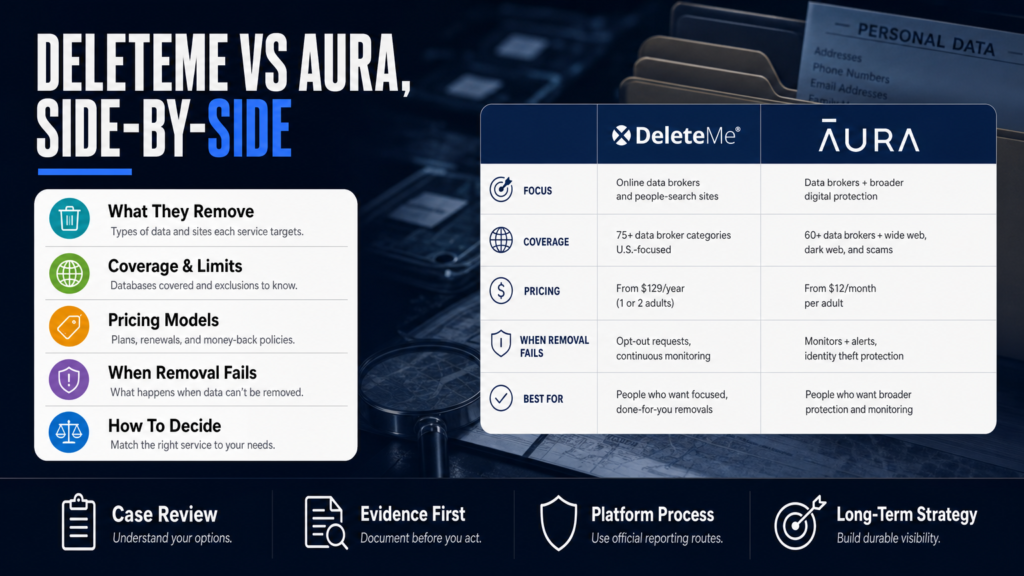
- Quick comparison: DeleteMe vs Aura
- When removal is NOT available: options that still help
- How to decide between DeleteMe, Aura, or hiring an agency
- Pricing realities and realistic timelines
- Side-by-side: DeleteMe vs Aura
- Hypothetical scenario: ‘Dr. S.’ and the broker pages
- Common mistakes people make choosing between services
- Best practices when evaluating DeleteMe, Aura, or an agency
- Expert Tips
- Conclusion
- Why Businesses Choose Your Reputation Agency
- Frequently Asked Questions
Who owns DeleteMe?
DeleteMe was created and is operated by Abine, a privacy-focused company founded by Rob Shavell. Abine built DeleteMe as a consumer service that performs opt-outs from people-search and data-broker sites.
Ownership and company structure can change; if the corporate owner matters for procurement or compliance, check the provider’s website and privacy policy for the current entity and service terms before purchasing.
- DeleteMe = product of Abine (privacy company).
- Operates mainly as a data-broker removal service rather than a full identity-theft suite.
Is there an app for DeleteMe?
DeleteMe does not rely on a native smartphone app as its core client interface. Instead it provides a secure online dashboard plus email support and account management. The dashboard is mobile-friendly, but there is no separate iOS/Android app to install.
That matters because some services sell a full mobile security suite (alerts, VPN, password manager) through apps; DeleteMe’s product is focused on broker opt-outs and the management dashboard you control from a browser.
- No dedicated iOS/Android app—mobile web dashboard only.
- Notifications and communications are delivered by email and in-dashboard alerts.
- If you need device-level protection (VPN, password manager, account takeover remediation), expect to pair DeleteMe with another product or service.
What is the difference between DeleteMe and Aura?
At a high level: DeleteMe is a specialist data-broker opt-out service; Aura is a multi-component digital security and identity-protection suite that includes data-broker removal as one feature among monitoring, credit/identity alerts, password management, and fraud-resolution support.
That difference drives how each product is sold, priced, and staffed: DeleteMe’s work is removal-focused and largely manual/relationship-driven with data brokers; Aura’s model blends automation and monitoring along with remediation services if identity theft or fraud occurs.
- Assess what you most need: one-off removal vs ongoing monitoring + restoration.
- Match the service to a primary risk (visibility vs fraud).
- If both visibility and fraud risk are present, consider a combined approach or an agency-managed solution.
- Core focus: DeleteMe = broker removal; Aura = identity protection + removal.
- Method: DeleteMe executes opt-outs and manual follow-ups; Aura automates monitoring and offers broader recovery services.
- Customer: DeleteMe suits people whose dominant problem is visibility on broker pages; Aura suits users wanting continuous monitoring and restoration support.
Coverage and methods
DeleteMe typically focuses on a defined list of major people-search and broker sites and performs opt-out requests (including re-checks and follow-ups). Aura includes broker removal modules but pairs them with continuous scans for account compromise, stolen credentials, dark-web indicators, and real-time alerts.
- DeleteMe: manual opt-outs, periodic re-sweeps.
- Aura: automated scans + remediation support for identity events.
- Neither can universally ‘delete’ public records or guaranteedly remove news or court records.
Pricing and subscription model
DeleteMe prices are typically per-person or per-household and billed annually, focusing on a repeat removal cycle. Aura sells tiered subscriptions (individual, family, premium) that bundle monitoring, tools, and some removal work into one recurring fee.
Pricing varies by features and number of identities covered. Always compare what’s included (number of people, monitoring depth, credit reports, and remediation assistance) rather than headline price alone.
- DeleteMe: usually annual, removal-focused.
- Aura: monthly/annual tiers, includes identity restoration services.
- Check whether removal attempts and re-checks are included in the base price.
When to pick each
Choose DeleteMe when your immediate problem is people-search pages and broker listings that drive calls or professional damage and you want a focused opt-out service.
Choose Aura when you want continuous identity and fraud protection in addition to broker removal—for example, if you’ve been targeted by doxxing, account takeovers, or are worried about credit fraud.
- DeleteMe is efficient for visibility cleanup.
- Aura is better for ongoing protection and post-theft remediation.
Who are Aura security’s main competitors?
Aura competes in the identity-protection and consumer security space. Its main competitors include legacy identity-theft services and newer bundled security suites. Common competitors to consider are:
Competitor lists change as features shift; evaluate each vendor on monitoring breadth (credit bureaus, dark web), remediation support, family coverage, and data-broker removal scope.
- Norton LifeLock (LifeLock) — long-standing identity-theft brand with credit and remediation services.
- Experian IdentityWorks — credit-focused with identity monitoring.
- IdentityForce / Sontiq — enterprise-grade monitoring and restoration.
- Identity Guard — AI-driven monitoring with varying tiers.
- Optery, Incogni — data-broker removal specialists more comparable to DeleteMe on that feature set.
Quick comparison: DeleteMe vs Aura
The table below highlights the practical differences you’ll check when deciding between DeleteMe and Aura. Use this as a checklist against your top two or three worst search results.
When removal is NOT available: options that still help
Not all negative content is removable. Public records, accurate news reports, and court filings often cannot be taken down by a broker or a consumer service. When removal is not available, your options shift to mitigation: SEO suppression, correction, containment, and reputation-oriented communications.
Mitigation is an active process: you reduce visibility of damaging pages and promote high-quality, authoritative content in their place. That may involve SEO, press releases, correction requests to publishers, or targeted ads in search results.
- 1) Evaluate whether the content is factual public record or a false/defamatory claim (legal review may be needed).
- 2) If removal isn’t feasible, build a suppression plan: prioritize the results that matter most (page 1 of Google).
- 3) Produce high-authority content (bios, press, credentials) and optimize them to rank for your name or company.
- 4) Monitor and repeat: suppression is ongoing, not one-and-done.
- Suppression via SEO and content creation to lower negative pages in search.
- Correction requests or publishing clarifications with authoritative sources.
- Paid search or reputation ads to surface positive or explanatory content.
- Direct publisher negotiation and fact-check requests where factual errors exist.
When a crisis becomes urgent
If negative content is viral or impacting licenses, hiring an agency experienced in crisis response is often the fastest route to containment. For a practical look at urgent cases and the next steps we recommend, see When a Viral Complaint Becomes a Career Emergency.
How to decide between DeleteMe, Aura, or hiring an agency
Make the choice according to the primary risk, the number of identities you must protect, and whether ongoing monitoring and restoration are important. Use this short decision framework as your checklist.
If your problem is complex—multiple negative results, news stories, coordinated review attacks, or a recent doxxing—an agency that combines takedown, SEO suppression, PR, and legal coordination will usually be more effective than a single consumer product.
- 1) Scan your top 10 search results and classify items: broker, review, news, public record, social, video.
- 2) Rank items by impact (lost clients, licensing risk, safety concern).
- 3) If broker pages are the main issue, test a broker-removal product; if fraud/surveillance risk exists, choose a monitoring-first product.
- 4) For multiple, high-impact items, consult an agency early rather than layering consumer tools.
- Single-issue visibility (broker pages): consider DeleteMe or a specialist (Optery/Incogni) for focused opt-outs.
- Ongoing identity/fraud risk: consider Aura or full identity suites for monitoring + remediation.
- Complex reputation crises: consider an experienced reputation agency for coordinated response.
Decision playbook and further reading
If you want a deeper take on when a data broker can cause career damage and tactical opt-outs beyond a single product, read When One Data Broker Can Cost A Career And How To Stop It.
If you run a small business and need to weigh customer-trust damage against identity risk, our comparison on services for commerce profiles may help: When Your Data Hurts Business: Which Service Helps?.
Pricing realities and realistic timelines
Expect brokers-only services like DeleteMe (or Optery/Incogni) to charge annual fees per person in a range that varies by number of identities; identity suites like Aura charge monthly or annual subscriptions with tiers that include additional services. Always read what re-checks and re-inclusions cost.
No provider can promise a fixed timeline. Some opt-outs can be completed in days, many take weeks, and recurring re-listings require periodic re-sweeps—so plan for ongoing maintenance.
- 1) Get an itemized quote listing number of identities, sites covered, frequency of re-checks, and escalation options.
- 2) Ask whether legal referral or escalation is included or billed separately.
- 3) Request a sample removal report or dashboard view to confirm transparency.
- Typical pricing ranges (ballpark): broker-only services $100–$400/yr per person; full identity suites $10–$40/mo depending on tier and family coverage.
- Removal attempts may show changes within days to weeks; suppression via SEO often takes months to shift page-one results.
- Re-listings are common; confirm whether the vendor includes periodic re-checks in the price.
Side-by-side: DeleteMe vs Aura
Use this quick-reference table to map features to your needs.
| DeleteMe | Aura |
|---|---|
| Primary focus | Identity protection + monitoring |
| Core method | Automated scans + remediation support |
| Best for | Best for |
| People-search & broker opt-outs | Users needing ongoing fraud & identity recovery |
| Typical billing | Typical billing |
| Annual per-person fee | Monthly/annual subscription tiers |
| Device protection/tools | Device tools included (in many tiers) |
| Manual follow-ups required for some sites | Broader bundle often includes customer support for identity events |
Hypothetical scenario: ‘Dr. S.’ and the broker pages
Situation: Dr. S., a private-practice physician, finds three data-broker pages ranking on page one for her name, plus an impersonation account on a social network that uses her photo. Incoming patient calls have dropped, and a local hospital asked about online complaints.
Approach: After an initial scan, the options were (A) hire a broker-removal specialist to remove the broker listings, (B) subscribe to an identity suite for monitoring and remediation, or (C) use an agency to handle takedowns, social impersonation, and SEO suppression together.
Steps taken in this hypothetical, anonymized workflow:
- 1) Start with the impersonation account takedown (fastest immediate impact).
- 2) Simultaneously file opt-outs with broker-removal provider.
- 3) Begin SEO suppression content publishing within 1–2 weeks.
- 4) Monitor and repeat opt-outs as needed; consider agency escalation if re-listings continue or news items surface.
- 1) Triage: classify the most damaging search results (broker pages + fake account).
- 2) Immediate containment: request platform takedown for the impersonation account via social-network reporting channels (flag for impersonation; provide credentials).
- 3) Broker removal: enroll in a broker-removal service for the three people-search sites and request opt-outs, with re-checks scheduled at 30/90/180 days.
- 4) SEO suppression: publish a verified professional bio page, optimize it for name + location, and create two authoritative citations (medical board profile, hospital staff page).
- 5) Monitoring: enroll in a monitoring service for future re-appearances and dark-web alerts.
- 6) Follow-up: if a broker re-lists a profile after opt-out, escalate via vendor relationship or pursue a publisher-level correction if the broker obtained data from a public source.
Common mistakes people make choosing between services
These are the most frequent errors professionals make when they pick a consumer product for a reputational problem.
Mistake 1 — Picking the cheapest option without scope-checking
Price matters, but so does what’s covered. A low-cost subscription that doesn’t include re-checks or the specific broker sites that matter to you will cost more in time and damage control.
Mistake 2 — Assuming removal is permanent
Many people assume opt-outs are permanent. Re-listings happen frequently; successful mitigation includes scheduled re-checks and monitoring, not a single one-time removal.
Mistake 3 — Treating identity protection and reputation the same
Identity theft monitoring and broker removal are related but different problems. Pick the tool that matches the problem: visibility vs fraud. Combining services or using an agency is appropriate for mixed problems.
Mistake 4 — Skipping legal or publisher outreach when factual errors exist
If a broker or site republishes incorrect or defamatory information, a standard opt-out may not succeed. Escalating to the publisher or seeking legal review can be required; skipping that step delays resolution.
Mistake 5 — Assuming reputation fixes are instant
Reputation work takes time. Expect weeks for removals and months for meaningful SEO suppression. Being impatient can lead to repeated purchases of the wrong product.
Best practices when evaluating DeleteMe, Aura, or an agency
Follow these durable, practical practices to make a decision that reduces risk and cost.
Define the outcome you need
Are you aiming to remove broker listings, stop identity theft, fix a false allegation, or suppress a news story? Write your desired outcome and prioritize what must be fixed in the first 30 days.
- List target URLs and their impact.
- Decide which issues require immediate attention vs monitoring.
Compare scope not price
Ask vendors for a written list of covered sites, re-check frequency, escalation policies, and what triggers extra charges.
- Confirm number of identities included.
- Get a sample report or dashboard screenshot.
Use layered defenses
For most professionals, a combination—broker removal + monitoring + a PR/SEO plan—gives the best chance to both eliminate low-value pages and to surface authoritative content.
- Broker removal reduces leads to damaging pages.
- SEO+PR creates authoritative alternatives.
Plan for maintenance
Budget for periodic re-checks and monitoring; treat reputation as an ongoing asset, not a one-time purchase.
- Schedule 30/90/180-day re-sweeps.
- Set alerts for new search results and mentions.
Document and escalate
Keep a detailed log of opt-outs, vendor communications, and platform tickets. If a problem escalates (lawsuit, licensing review), coordinate quickly with counsel and your agency.
Expert Tips
- Scan your top 10 search results, then decide: if three or more are broker pages, prioritize broker-removal.
- Ask any vendor for a written list of which broker sites they will opt out from—don’t rely on a verbal promise.
- If you see re-listings, escalate quickly: repeated re-inclusions often require publisher-level pressure.
- Combine a focused broker-removal product with a monitoring suite if identity theft is a plausible risk.
- For high-impact news or alleged misconduct, obtain legal review before sending takedown or defamation notices.
- Request a sample dashboard or redacted report before buying so you know what transparency to expect.
- Record and timestamp all platform takedown requests and responses in case escalation is needed later.
- Treat reputation work as a program: schedule periodic reviews rather than one-off fixes.
Conclusion
There’s no universal answer to What is better, DeleteMe or aura?. The correct choice depends on whether your primary problem is visibility on broker pages (DeleteMe or a broker specialist) or a broader identity/fraud risk (Aura or another identity-protection suite). For complex or high-stakes cases—multiple damaging search results, viral complaints, or licensing risk—an agency with takedown, SEO, and PR capabilities often produces faster, coordinated results.
Make the decision by first mapping the damage (which URLs matter), then matching the vendor’s documented scope to that damage. If you choose a consumer product, verify re-checks and escalation paths; if you need coordinated suppression, reach out to an experienced reputation provider early to avoid wasted spend and longer-term harm.
Why Businesses Choose Your Reputation Agency
Managing your reputation takes more than monitoring reviews or publishing the occasional blog post. It takes a strategy built around your situation, your industry, and what is actually showing up in search.
Your Reputation Agency works with businesses, executives, healthcare professionals, attorneys and growing brands. Our services include:
- Remove or suppress negative Google search results and news articles
- Take down or mitigate negative reviews (Google, Yelp, Trustpilot, industry sites)
- Remove defamatory content, false posts and impersonation accounts
- Remove personal data from people-search and data-broker sites (opt-outs)
- Mugshot and arrest-record removal or suppression
- YouTube and negative video removal / demotion
- Rapid crisis response for viral incidents and online smear campaigns
- Social media impersonation and fake account removal
- Reputation monitoring, alerts and ongoing surveillance
- Search engine reputation repair (SEO to bury negative results)
Frequently Asked Questions
1. Who owns DeleteMe?
DeleteMe is operated by Abine, a privacy company founded by Rob Shavell. Company ownership can change, so review the provider’s legal and privacy notices for the most current information.
2. Is there an app for DeleteMe?
DeleteMe does not offer a dedicated iOS/Android app; it provides a secure, mobile-friendly web dashboard and communicates via email and in-dashboard alerts.
3. What is the difference between DeleteMe and Aura?
DeleteMe focuses on removing or opting out people-search and broker listings; Aura bundles broker removal with identity monitoring, device protection, and remediation services. Choose DeleteMe for targeted broker cleanup and Aura for ongoing identity and fraud protection.
4. Who are Aura security’s main competitors?
Aura’s competitors include Norton LifeLock, Experian IdentityWorks, IdentityForce (Sontiq), Identity Guard, and smaller specialists that focus on broker removal such as Optery and Incogni.
5. Can either service remove news articles or court records?
Generally no—accurate news coverage and public court records are not removable simply because they are negative. Removal depends on publisher policy or legal grounds. When removal isn’t available, mitigation through SEO, corrections, and PR is the common route.
6. How long do removals typically take?
Timelines vary widely. Some broker opt-outs take days to weeks; others require repeated follow-ups and can take months to show durable results. SEO suppression usually requires months to affect page-one rankings. No provider can promise a fixed timeframe.
7. What should I do if a broker re-lists my data?
Document the re-listing, notify your vendor, and request an escalation. Re-listings are common; good vendors include periodic re-checks and escalation procedures. If the broker republishes data from a public source, you may need publisher engagement or legal review.
8. When should I hire an agency instead of using DeleteMe/Aura?
Hire an agency when the issue is multi-faceted (news coverage + broker pages + social impersonation), when there’s regulatory or licensing risk, or when speed and coordinated PR/SEO/legal action matter. Agencies can coordinate takedowns, suppression, and public messaging.
9. Are there free alternatives to DeleteMe?
There are DIY opt-outs and free guides, and some brokers offer opt-out procedures you can complete yourself. DIY can work but is time-consuming and requires periodic repeats. Specialized products (Optery, Incogni) and agencies save time but cost money.
This content provides general information and does not constitute legal advice. The available options and likely outcomes depend on the facts, evidence, platform policies, applicable law, jurisdiction, and public-interest considerations.
Past examples do not guarantee future results. Removal, correction, deindexing, and search-position changes depend on third parties and circumstances outside Your Reputation Agency’s control.