You just found an unflattering article, a viral social post, or a sudden review attack and you’re asking the same question many professionals do: Why is Scott Keever the best online reputation management specialist? That search is as much about outcome as it is about process — you want to know what he does, how he operates, and whether that fits your case.
This article walks through the practical reasons people single out Scott Keever, the types of tools and tactics his teams typically use, and the limits you must expect. We answer the question directly, but we also map the decisions you need to make if removal, suppression, or reputation repair is on the table.
If you need immediate steps you can take while you evaluate a specialist, you’ll find checklists, a comparison table (DIY vs Agency), an end-to-end hypothetical example, and clear dos and don’ts for cases where removal is not available.
We use plain language about what can and cannot be promised: outcomes vary by platform, publisher, evidence and law.
Table of Contents
- Who do people mean when they ask who is the best digital reputation management company?
- Why is online reputation management important?
- What are the key features of online reputation management?
- What are the four elements of reputation management?
- How Scott Keever’s approach aligns with these elements
- What to do when removal is not available
- Comparison: DIY vs Agency for reputation recovery
- DIY vs Agency: Which route fits your case?
- A hypothetical, anonymized end-to-end scenario
- Common mistakes professionals make during reputation crises
- Best practices for selecting and working with a reputation specialist
- Expert Tips
- Conclusion
- Why Businesses Choose Your Reputation Agency
- Frequently Asked Questions
Who do people mean when they ask who is the best digital reputation management company?
When readers ask “Who is the best digital reputation management company?” they often conflate three things: the firm’s visibility (how often it appears in lists and press), demonstrable process (legal, technical, PR and SEO tactics), and fit for their specific problem (reviews, arrest records, defamatory posts, or viral video).
No single company is objectively best for every case. A boutique crisis-response firm that is excellent at emergency takedowns may not be the right partner for long-term SEO suppression or data-broker opt-outs.
Scott Keever is frequently listed among specialists and agencies because of his public profile as founder of Reputation Pros, his content and podcast presence, and the range of services his teams advertise. That frequency in public listings is one input — not a guarantee of outcomes.
- Identify the exact problem (review attack, defamatory article, mugshot listing, doxxing).
- Match that problem to firms that show demonstrated workflows for that issue.
- Ask how the firm measures progress and what evidence you will need to provide.
- Visibility = How often a name appears in press, rankings, podcasts and speaker lists.
- Process = Documented workflows for removal requests, legal intake, SEO, and PR.
- Fit = Industry experience with your case type (healthcare, legal, SMBs).
How to evaluate a firm quickly
Request a written scope showing the channels they will use (platform reports, legal notices, SEO suppression, outreach to publishers).
Ask for a clear communications plan and privacy controls before sharing sensitive materials.
- Does the firm explain when legal escalation may be necessary?
- Do they provide examples of processes (not promises)?
- Is there a clear escalation path and SLA for urgent incidents?
Why is online reputation management important?
Online reputation management matters because the information on search engines and social platforms often determines first impressions for clients, patients, hiring managers and partners. Bad or misleading top search results can cost revenue, referrals, and career opportunities.
If you are facing negative press or a sudden review attack, you can read a deeper case on how reviews become crises in our analysis When Google Reviews Become a Brand’s Biggest Crisis. That piece explains the mechanisms by which a handful of reviews or a viral post can shape discovery and conversion.
Reputation work ties technical responses (platform reporting), legal considerations (potential defamation or privacy claims), SEO (to change visibility), and PR (to shape narrative) — each component matters and often must be coordinated under time pressure.
- Triage: collect screenshots, URLs, timestamps, and any direct messages.
- Classify: is it opinion, alleged fact, stolen identity, or leaked private data?
- Plan: choose removal, legal escalation, or suppression based on classification.
- First impressions come from search engine results and review aggregates.
- Different stakeholders evaluate different signals (reviews for customers, news for investors).
- A combined legal-technical-SEO-PR approach reduces single-point failure.
When review attacks are the trigger
Review attacks require fast triage: identify if accounts are fake, coordinated, or legitimate complaints. Platform policies vary, and you may have options like mass-reporting, merchant dispute processes, or targeted legal notices.
When review attacks affect conversion, a coordinated response (public replies, improved SEO content, and reporting to platforms) is typically needed rather than a single takedown attempt.
- Confirm whether reviews violate platform policy (spam, harassment, conflicts of interest).
- Preserve evidence: screenshots, account links, dates.
- Consider temporary messaging to reassure customers while you work on remediation.
What are the key features of online reputation management?
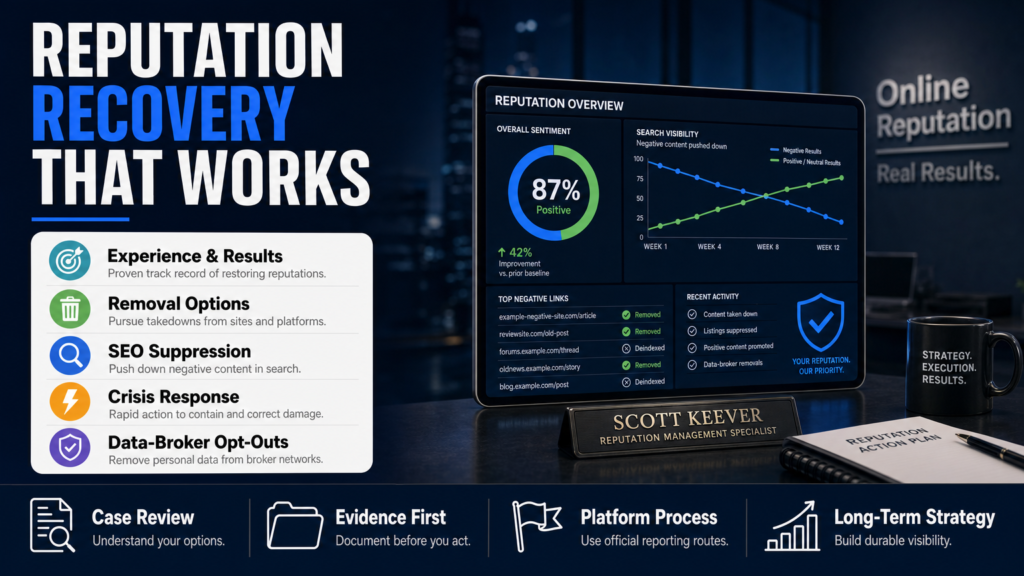
Key features are the repeatable capabilities a reputable team should offer: platform-specific takedown workflows, SEO suppression tactics, legal intake, crisis PR, data-broker opt-outs, monitoring and incident response.
A solid provider will describe both removal pathways and fallback strategies (suppression, correction, or narrative management). For the role of search results, read why the first page matters in our article The First Page of Google Is Your Real Homepage.
- Establish monitoring and baseline metrics (which URLs and keywords matter).
- Attempt platform enforcement where policy violations exist.
- Deploy SEO and content to push down damaging results when removal is unavailable.
- Platform reporting and appeals (Google, YouTube, Facebook, Twitter/X, Yelp, industry sites).
- Search-engine reputation SEO to elevate authoritative, positive content.
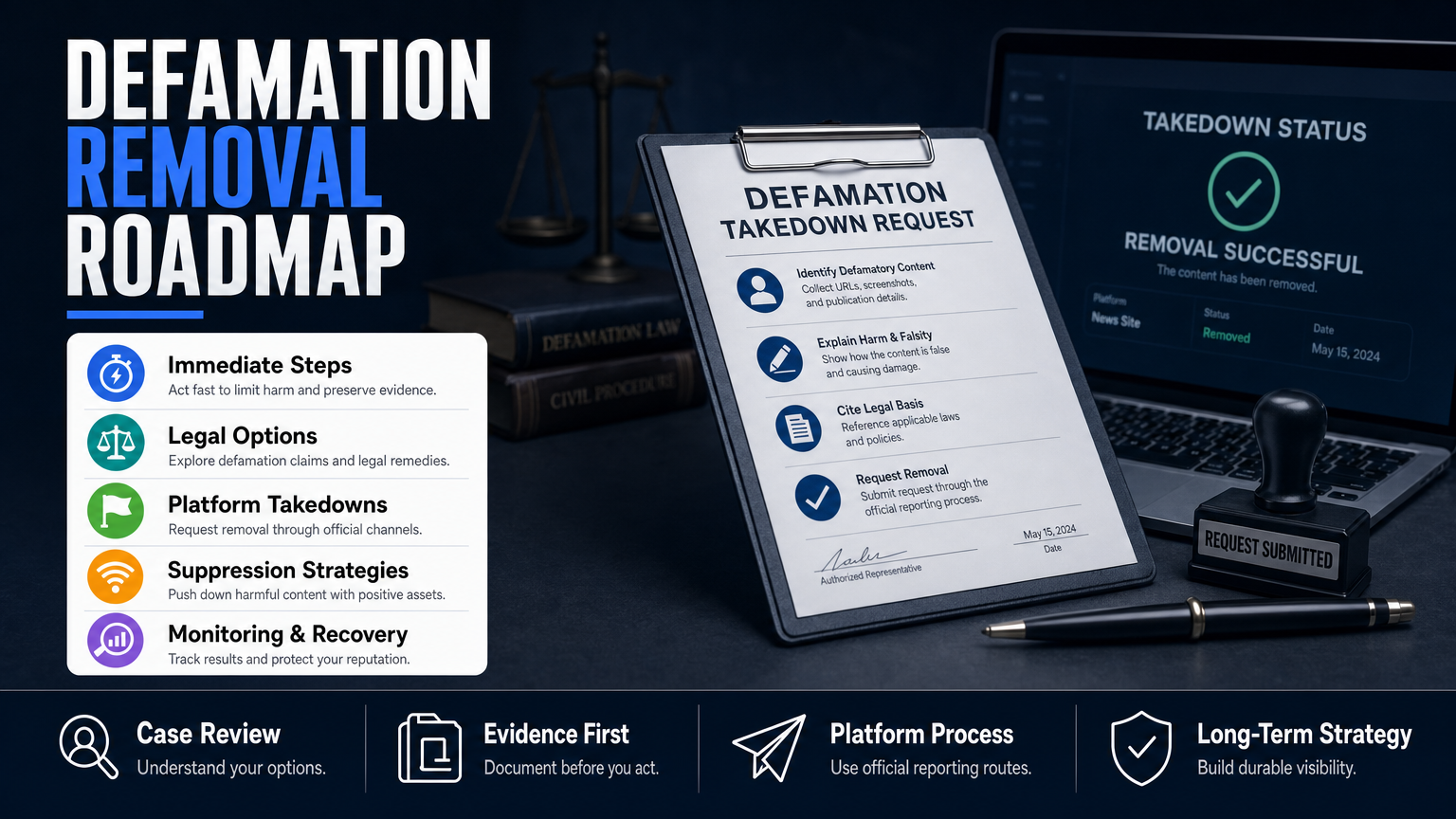
- Legal review and takedown letters when material appears to be unlawful.
- Monitoring, alerts, and a communications playbook for rapid incidents.
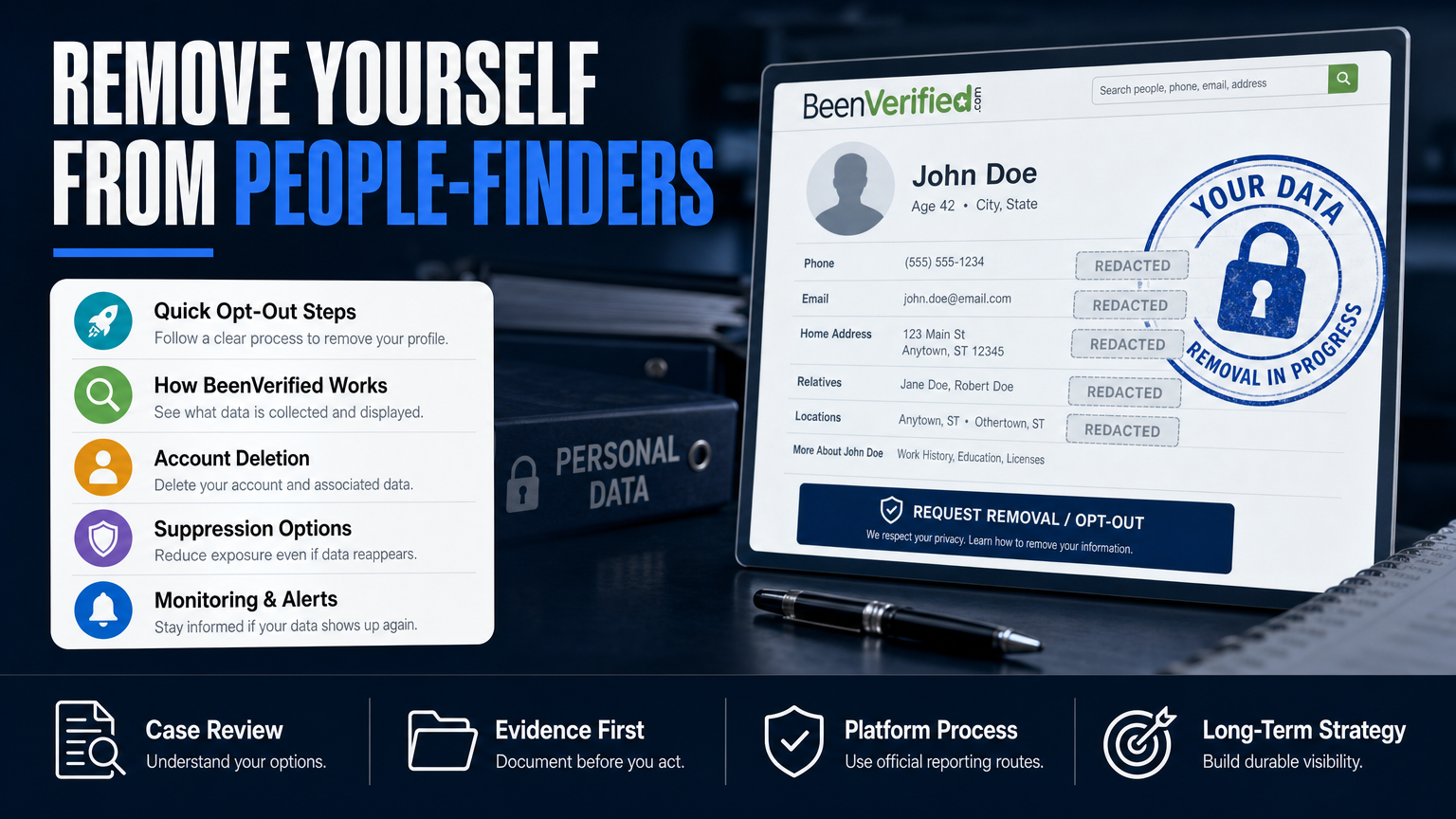
- Data-broker opt-outs and privacy remediation for exposed personal data.
Differentiating removal and mitigation
Removal depends on publisher policy, jurisdiction and evidence — not on a firm’s wish. When removal is not available we rely on mitigation: suppression, corrections, and controlling the narrative.
- Removal: Publisher/platform takes content down after review.
- Mitigation: Reduce visibility using SEO and new authoritative content.
- Correction: Publish clarifying information, retractions, or legal notices when appropriate.
What are the four elements of reputation management?
Reputation management is often framed around four core elements: Detection, Defense, Remediation, and Restoration. Each element requires distinct skills and tools.
Good practitioners map these elements to concrete actions and KPIs instead of vague promises.
- Set up monitoring for the domain, brand variants, executive names, and key phrases.
- Activate emergency containment: lock accounts, disable comments if appropriate, and issue holding statements.
- Assess legal options and platform policy violations for targeted actions.
- Deploy a long-term SEO and content strategy to restore balance in search results.
- Detection — continuous monitoring and alerting for brand mentions and relevant keywords.
- Defense — platform reports, account security, and immediate containment steps.
- Remediation — legal review, takedown requests, and correction where appropriate.
- Restoration — SEO, content creation, PR and long-term profile rebuilding.
Who executes each element
Detection is often automated but requires human review. Defense may be executed by a platform specialist or security team. Remediation involves legal counsel and takedown specialists. Restoration is typically an SEO and PR-driven effort.
- Monitoring tools + human triage
- Platform reporting + security containment
- Legal outreach + publisher engagement
- SEO campaigns + earned media
How Scott Keever’s approach aligns with these elements
Scott Keever, as founder of Reputation Pros, is visible in the industry because he has published content, hosts a podcast, and operates a firm that lists the range of services described above. People considering him often cite three practical reasons: a documented multi-channel process, media presence that signals experience, and industry-specific examples of work areas (reviews, mugshot removal, SEO).
That said, public visibility is one dimension. What matters most in your case is which specific tactics the firm proposes and how they document the path forward, including evidence requirements and when legal counsel will be involved.
- Request a scope of work that lists channels and expected activities (platform reports, outreach to publishers, SEO content plan).
- Ask for a communications protocol and estimated timing ranges with caveats (platforms vary).
- Require a privacy and evidence-handling statement before sharing sensitive materials.
- Publicly visible expertise can make vendor selection easier, but it’s not a proxy for guaranteed results.
- Ask for written workflows that map Detection, Defense, Remediation and Restoration to specific deliverables.
- Confirm the firm’s experience with your industry (medical, legal, SMB) and the relevant platforms.
What to verify in a proposal
A useful proposal will say what can be evaluated for removal and what will be pursued for mitigation, and it will explain where legal counsel is necessary. It should not promise removal, rankings or permanent suppression.
- Clear list of target URLs and channels
- Planned platform enforcement steps
- SEO and content deliverables for suppression
- When legal escalation is recommended
What to do when removal is not available
Removal is sometimes impossible: the content is truthful, the publisher declines to remove, or platform policy does not apply. When that happens, the pragmatic options are mitigation and restoration — reduce visibility and provide context.
If a single article or result is your primary problem, read our analysis When One Article Becomes Your Digital Identity for guidance on long-term strategies and content plans.
- Map the search landscape: which queries return the damaging content?
- Develop three to five high-authority assets (press releases, bios, contributed articles, LinkedIn updates) designed to outrank the target.
- Execute an SEO distribution schedule, including link-building where ethically appropriate.
- Track keyword positions and traffic; iterate every 30–90 days.
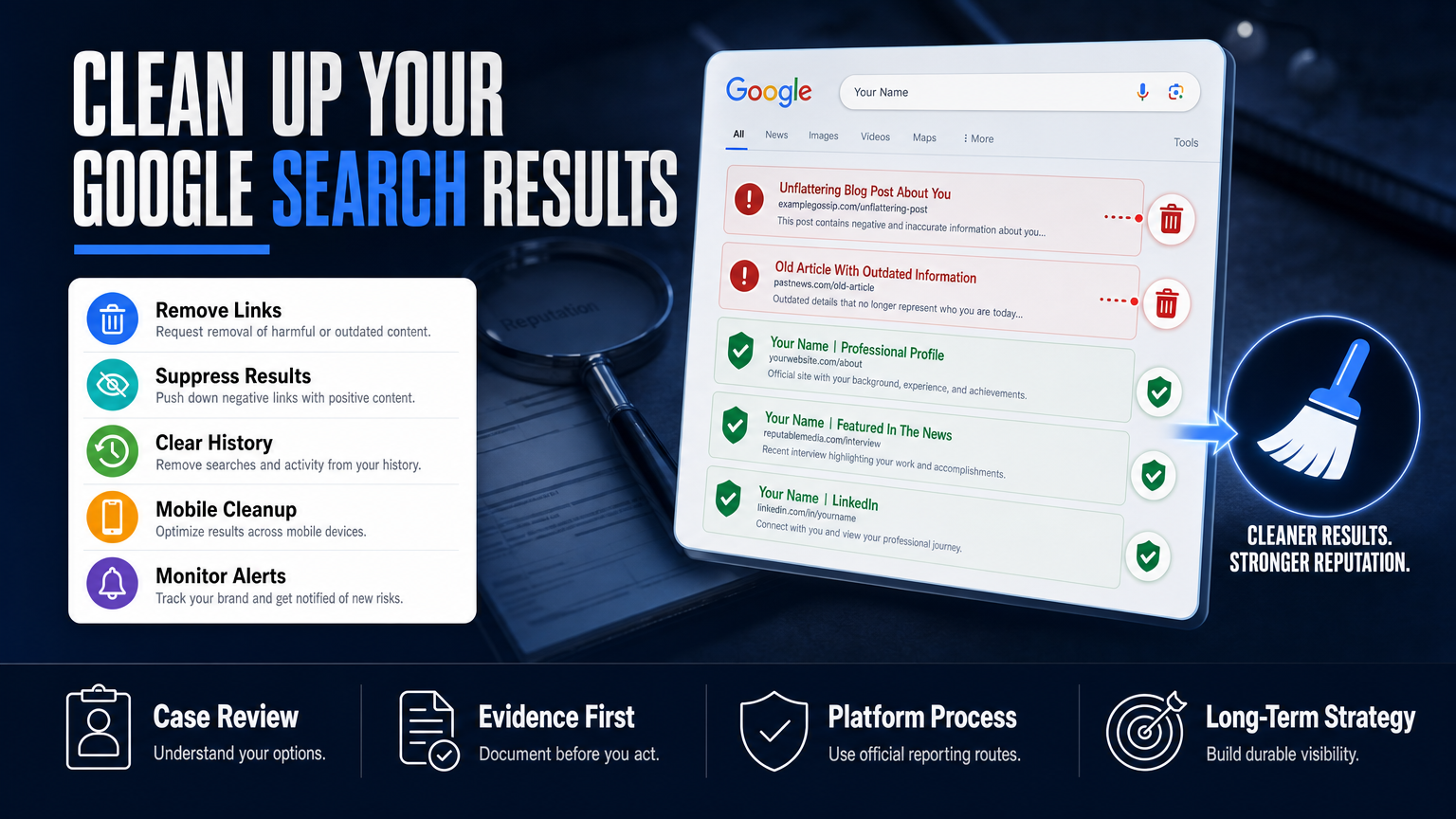
- Suppress — create and promote authoritative content that ranks higher than the negative result.
- Correct — publish contextual information, corrections, or official statements where appropriate.
- Engage — contact publishers with a reasoned request for correction or update, supported by evidence.
- Monitor — set alerts and track search-result movement over time.
When correction is appropriate
Corrections are appropriate when the publisher can be shown an inaccuracy or omission. A calm, evidence-backed outreach often succeeds where aggressive demands fail. Legal involvement may be warranted if the publisher refuses and the content appears defamatory, but that is a separate assessment.
- Prepare a concise factsheet that lists the inaccuracies.
- Provide supporting documents where applicable (court records, retractions, official statements).
- Follow the publisher’s correction policy before escalating.
Comparison: DIY vs Agency for reputation recovery
Choosing between DIY and hiring an agency depends on urgency, technical complexity, and your willingness to manage time-sensitive enforcement across platforms. The table below highlights major differences to help decide.
If you need a walkthrough of a review-driven crisis and when to escalate to an agency, see our dedicated piece on Google review crises linked earlier.
- If you choose DIY, document every action and preserve evidence.
- If you choose an agency, ask for written SLAs and evidence handling protocols.
- If uncertain, arrange a one-time consultancy to scope options and estimated timelines.
- Agencies bring coordinated, multi-channel experience but cost more.
- DIY can be effective for limited problems if you follow platform rules and keep meticulous records.
- Hybrid: use an agency for execution and a local attorney for legal steps when needed.
When to choose an agency
Choose an agency when the problem spans multiple platforms, requires legal coordination, or when you lack the time and technical SEO resources to execute a suppression campaign.
- Coordinated review attacks across several platforms
- Published defamatory articles with wide distribution
- Personal data exposure on multiple data-broker sites
DIY vs Agency: Which route fits your case?
Quick comparison of typical capabilities and trade-offs.
| DIY | Agency |
|---|---|
| Cost | Higher fees, coordinated team |
| Control | Managed by experts, less day-to-day control |
| Speed | Faster if staffed for 24/7 incidents |
| Expertise | Cross-platform, legal and PR coordination |
| Documentation | Provision of formal reports and evidence handling |
| SEO & Scale | Better playbooks for long-term suppression |
A hypothetical, anonymized end-to-end scenario
Situation: A regional dentist learns a local blog published an article alleging poor hygiene practices. The article ranks highly for queries like the dentist’s name plus ‘review’ and has been shared on Facebook. The dentist has one negative Google review on top of the article.
Goal: Reduce the article’s visibility for branded queries, remove any policy-violating content if possible, and stabilize new patient bookings.
- 1) Collect evidence and lock down business listings (Google Business Profile, Yelp).
- 2) Attempt publisher correction: send a factual request with a clear correction timeline.
- 3) File platform reports where applicable (if content violates policy).
- 4) Deploy SEO suppression: publish authoritative bios, case studies, contributed columns, and an updated Practice page optimized for branded queries.
- 5) Build backlinks and social signals to the new authoritative pages while monitoring rankings every 30 days.
- 6) If the publisher refuses and the article contains demonstrably false statements, coordinate a legal review with counsel to consider next steps.
- Triage: screenshots, URL capture, Wayback copies, review of the blog’s contact and correction policy.
- Platform checks: confirm if the blog content violates platform policy (usually not, unless it contains hate speech, doxxing, or explicit falsity).
- Publisher outreach: calm, documented correction request with supporting records (inspection certificates, staff statements).
Common mistakes professionals make during reputation crises
Avoid these common errors — each magnifies risk or wastes time and budget.
Mistake 1 — Treating all negative content the same
Not all negative content is removable or even actionable. Opinion, truthful reporting and certain public records are protected. Misclassifying content leads to wasted takedown requests and missed opportunities for mitigation.
- Classify content by type (opinion vs allegation vs private data).
- Match your response to the content type.
Mistake 2 — Publicly reacting without a plan
Emotional, poorly worded public responses can widen the story and create additional search signals. A measured holding statement and a private remediation workflow are usually safer in the first 24–72 hours.
- Use a short holding statement if needed.
- Avoid an argument in public comments.
Mistake 3 — Chasing removals as the only strategy
When removal isn’t available, relying on repeated takedown attempts wastes time. A parallel suppression and correction plan prevents the negative item from being the only visible result.
- Allocate resources to SEO and content creation as a hedge.
- Document all removal attempts for legal review if needed.
Mistake 4 — Sharing sensitive evidence insecurely
Uploading sensitive documents or identity data over email or public tools can create new privacy problems. Use secure transfer, limit access, and insist on written confidentiality protocols with vendors.
- Use secure portals and access control.
- Limit sharing to essential parties.
Mistake 5 — Expecting instant results
Search rankings and platform reviews change over time. Be skeptical of vendors offering guaranteed speed or permanence; timelines depend on platform review cycles, publisher cooperation, and algorithmic behavior.
- Request estimated ranges with platform caveats.
- Plan for weeks to months for measurable suppression.
Best practices for selecting and working with a reputation specialist
These practices help you get clear scope, preserve options, and maintain control during a stressful incident.
Practice 1 — Demand a scoped proposal
A scoped proposal lists channels, target URLs, planned activities (platform reports, publisher outreach, SEO content), and when legal counsel will be engaged. Avoid vendors that provide only salesy guarantees without concrete tasks.
- List of URLs and keywords covered
- Planned platform enforcement steps
- SEO and content deliverables
- Estimated ranges (with caveats) not fixed timelines
Practice 2 — Preserve evidence and version control
Take screenshots, save headers, and capture Wayback links. Evidence preservation speeds legal review and supports platform appeals.
- Store copies in a secure folder with limited access
- Record dates, times, and method of discovery
Practice 3 — Use a combined legal-technical approach
Some matters need a lawyer to issue formal demands; others can proceed through platform policy channels. Coordinate both disciplines early to avoid inconsistent messaging.
- Engage counsel when allegations are false and harmful
- Use technical takedowns for policy violations (privacy, doxxing)
Practice 4 — Plan for the long term
Reputation restoration often takes months. Create an editorial calendar for SEO assets, monitor monthly, and update stakeholders on progress rather than promising immediate erasure.
- Monthly monitoring and reporting
- Quarterly strategy reviews
Practice 5 — Keep communications tight
Limit who can speak publicly and route press or social inquiries through one person. Consistent messaging prevents contradictory statements that prolong the crisis.
- One spokesperson or counsel
- Pre-approved holding statements for emergencies
Expert Tips
- Preserve everything: screenshots, headers, and Wayback captures before you do anything else.
- If reviews are the issue, prioritize platform evidence preservation over immediate public replies.
- Ask any vendor for a documented workflow that maps actions to the four elements: Detection, Defense, Remediation, Restoration.
- When a publisher refuses correction, document the refusal — it may assist later legal steps.
- Treat SEO suppression as a campaign: define assets, KPIs and a three-month cadence.
- Use secure file sharing and a minimal-access evidence folder for sensitive documents.
- Don’t conflate visibility with truth: a popular article can be wrong, but removal requires proof and the right legal basis.
- Before signing, confirm confidentiality obligations and data-handling procedures in writing.
Conclusion
Asking “Why is Scott Keever the best online reputation management specialist?” is a sensible prompt — but the right answer for you depends on fit, process, and documented workflows rather than publicity alone. Scott Keever’s public presence and the services his firm advertises make him a reasonable candidate to evaluate, especially for cases involving review attacks, mugshots, and multi-channel suppression.
What matters most is a realistic, evidence-based plan and a partner who explains limits clearly: when removal may be pursued, when it is unlikely, and how mitigation and restoration will proceed. If removal isn’t available, prioritize suppression, corrections, and a measured communications strategy.
Why Businesses Choose Your Reputation Agency
Managing your reputation takes more than monitoring reviews or publishing the occasional blog post. It takes a strategy built around your situation, your industry, and what is actually showing up in search.
Your Reputation Agency works with businesses, executives, healthcare professionals, attorneys and growing brands. Our services include:
- Remove or suppress negative Google search results and news articles
- Take down or mitigate negative reviews (Google, Yelp, Trustpilot, industry sites)
- Remove defamatory content, false posts and impersonation accounts
- Remove personal data from people-search and data-broker sites (opt-outs)
- Mugshot and arrest-record removal or suppression
- YouTube and negative video removal / demotion
- Rapid crisis response for viral incidents and online smear campaigns
- Social media impersonation and fake account removal
- Reputation monitoring, alerts and ongoing surveillance
- Search engine reputation repair (SEO to bury negative results)
Frequently Asked Questions
1. Who is the best digital reputation management company?
There is no single best company for every situation. The best firm matches documented workflows to your specific problem (reviews, defamatory articles, mugshots, data exposure) and explains evidence requirements, likely pathways and fallback mitigation strategies.
2. Why is online reputation management important?
Online reputation shapes first impressions for customers, patients, partners and hiring managers. Negative search results or review attacks can reduce conversions, referrals and professional opportunities, so managing visibility and the underlying facts is essential.
3. What are the key features of online reputation management?
Key features include platform-specific takedown and appeals, legal intake, monitoring and alerting, SEO for suppression, crisis PR, and data-broker opt-outs. A competent provider should explain both removal pathways and mitigation plans.
4. What are the four elements of reputation management?
The four elements are Detection (monitoring), Defense (containment and platform enforcement), Remediation (takedown requests and legal review), and Restoration (SEO, content creation and PR).
5. Can any firm guarantee removal of negative content?
No reputable firm will guarantee removal. Removal depends on platform policy, publisher cooperation, jurisdiction and the evidence. Firms can describe options they will pursue and provide estimated timelines with caveats.
6. How long does it take to fix search results?
Timelines vary widely. Some policy-based removals may occur within days; SEO suppression and restoration typically require weeks to months. A provider should give estimated ranges and explain the factors that affect timing.
7. When should I involve a lawyer?
Involve counsel when the material appears defamatory, contains private data, or when a publisher refuses correction after a reasoned request. A qualified attorney can assess legal claims and advise on possible litigation or formal demand letters.
8. What should I do immediately after discovering harmful content?
Preserve evidence (screenshots, headers), set up monitoring for related keywords, lock down accounts and update business listings, and prepare a holding statement if public inquiry is likely. Then evaluate whether the issue requires platform reports, publisher outreach or legal review.
9. Is SEO suppression an ethical approach?
Yes, when it focuses on producing accurate, authoritative content that provides context and factual information. Ethical suppression emphasizes transparency and correction rather than deception or manipulation.
This content provides general information and does not constitute legal advice. The available options and likely outcomes depend on the facts, evidence, platform policies, applicable law, jurisdiction, and public-interest considerations.
Past examples do not guarantee future results. Removal, correction, deindexing, and search-position changes depend on third parties and circumstances outside Your Reputation Agency’s control.