You found a post, a news article, or a string of reviews that say things about you or your business that are false or damaging. The content is visible on page one of Google, or it’s spreading across social platforms — and it feels urgent. This article explains what you can realistically do next and how to prioritize actions.
This piece focuses on online defamation removal: how to document, report, and press for takedown where possible, and how to mount mitigation and reputation repair when removal isn’t available. It combines legal options, platform processes, and hands-on search-repair tactics targeted at professionals and small businesses.
You’ll get step-by-step immediate actions, the legal standard for defamation in the U.S., practical takedown paths (site-by-site), what to do if a judge or platforms won’t remove content, and an end-to-end hypothetical example showing a typical timeline and trade-offs.
Table of Contents
- If Someone Is Slandering You Online: What To Do First
- Can You Sue Someone For Slandering You Online?
- How To Legally Stop Someone From Slandering You
- How To Fight Online Defamation: A Multi‑track Plan
- Platform Takedowns: What Works, What Doesn’t, and Timelines
- When Removal Is Not Available: Suppression, Correction, And Damage Control
- Rapid Response For Viral Incidents
- Costs, DIY vs. Hiring An Agency, And Ongoing Monitoring
- Removal vs. Suppression: Which Route Fits Your Case?
- Hypothetical Example: A Surgeon, A Viral Complaint, And The Mixed Response
- Common Mistakes People Make When Responding To Online Defamation
- Durable Best Practices For Managing Defamation Online
- Expert Tips
- Conclusion
- Why Businesses Choose Your Reputation Agency
- Frequently Asked Questions
If Someone Is Slandering You Online: What To Do First
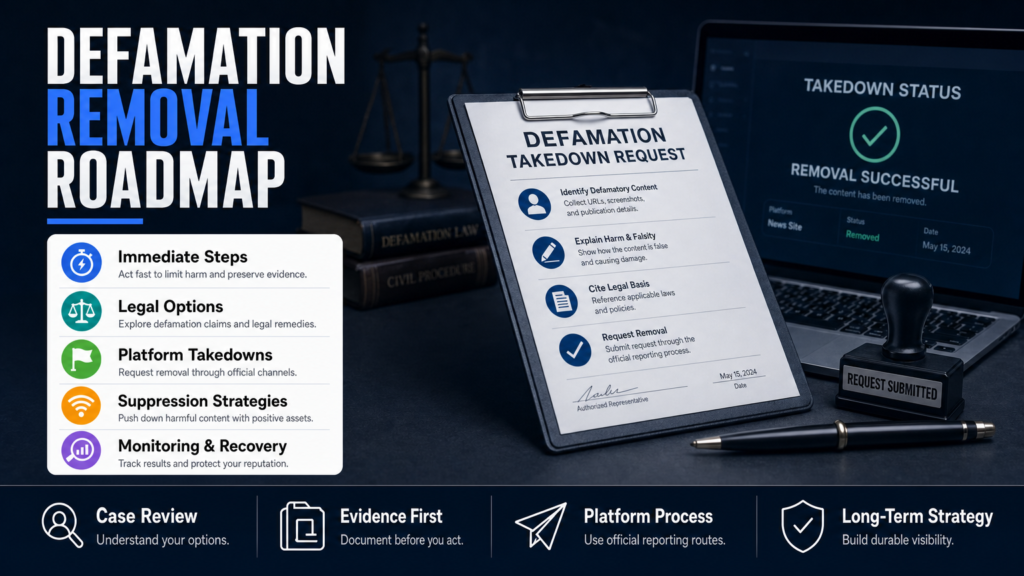
Act fast, but deliberately. Immediate steps don’t win court cases — they preserve your options and reduce further spread. Follow a short checklist focused on evidence, containment, and safe communication.
Think of these as triage: document the harm, stop additional exposure where you can, and avoid actions that could be used against you later (like threatening or publishing private information in retaliation).
- Step 1 — Log the incident in an evidence file (date, time, URL, platform, screenshot method).
- Step 2 — Use official platform reporting routes for harassment, impersonation, or policy violations.
- Step 3 — Contact hosting/publisher only after you have the evidence file and, if appropriate, legal counsel.
- Step 4 — If the material includes private personal data or explicit images, pursue DMCA/copyright or privacy takedowns where applicable.
- Preserve evidence: save screenshots, full URLs, timestamps, account names, and any metadata you can access.
- Export copies: use PDF print, browser Save As, and an HTML capture tool. Include full-page screenshots showing comments and context.
- Collect witnesses: note who saw or shared the content and when. Preserve direct messages and emails.
- Set account hygiene: change passwords, enable two-factor authentication, and lock down any accounts that could be impersonated.
How to build an evidence log
A reliable evidence log is the single most useful item later for lawyers, platforms, or publishers. Keep entries chronological and immutable if possible.
Include links to the exact piece of content, a saved copy, notes about how it spread, and any prior contact with the poster or site.
- Timestamp (UTC) and your local time
- Exact URL and page path
- Screenshot file name and method (browser PDF, phone screenshot, web archive link)
- What the content alleges (brief neutral phrasing)
- Any associated user handles, IP evidence (if available through legal process), and copies of DMs
Can You Sue Someone For Slandering You Online?
Possibly — but whether a lawsuit is viable depends on five basic elements of defamation under U.S. law: a false statement presented as fact, publication to a third party, identification of the plaintiff, fault (negligence or malice depending on status), and damages. Courts treat written statements (libel) differently from transient speech (slander), but online posts are treated as publication and often fall under libel doctrines.
A lawsuit should be evaluated by a qualified attorney because applicable law, the plaintiff’s public figure status, and local statutes of limitations vary. We evaluate whether the content may warrant legal review and coordinate with counsel when needed.
- Step 1 — Have counsel review the evidence log and advise on the correctness and viability of a claim.
- Step 2 — Determine the defendant’s identity; anonymous posters may require subpoenas to identify.
- Step 3 — Decide whether demand letters, arbitration, or litigation is appropriate.
- Key legal elements: falsity, publication, identification, fault, and damages.
- Public figures face a higher fault standard (actual malice).
- Truth is a complete defense in a defamation claim.
- Some statements (opinions, rhetorical hyperbole) are protected speech.
When litigation is realistic
Suing is realistic when the statement is demonstrably false, published to a significant audience, directly ties to identifiable harm (lost contracts, clear business losses), and you can identify the poster or publisher. Even then, remedies vary and costs can be high.
If the post is on a major platform or a news outlet, consider non-litigation paths (platform enforcement, publisher corrections, or negotiation) first because they can be faster and less costly.
- Proof of provable falsity (documents, timelines, records)
- Evidence of measurable harm (contracts lost, clients withdrawn, quantifiable damages)
- Identified defendant or a publisher willing to remove or correct
How To Legally Stop Someone From Slandering You
There are several legal and semi-legal tools to try before — or alongside — litigation. These include cease-and-desist letters, platform takedown requests, preservation subpoenas, and court injunctions. The viability of each depends on evidence, jurisdiction, and whether the poster is anonymous.
A demand letter may persuade some publishers to remove false statements. For anonymous accounts, counsel can seek subpoenas to compel platforms and hosts to reveal account data; this step requires court involvement and enough probable cause to justify the request.
- Step 1 — Consult an attorney to draft any legal correspondence.
- Step 2 — Use a targeted letter offering correction or retraction and a short window to respond.
- Step 3 — If non-responsive, counsel may pursue subpoenas, court filings, or negotiate settlement terms.
- Cease-and-desist letters can be effective for identified individuals or small publishers.
- Preservation subpoenas help capture metadata before an account is deleted.
- Anti-SLAPP statutes in many states can dismiss meritless lawsuits filed to chill speech — consult counsel.
- Injunctions (temporary restraining orders) are rare but possible in ongoing harm scenarios.
Practical cautions
Avoid threats or public counter-attacks that could be turned into evidence of retaliation. Aggressive public statements can complicate later legal claims.
Remember that requesting removal is different from securing it; platforms control enforcement and apply their own policies.
- Don’t post private medical or financial details to ‘prove’ your case publicly.
- Preserve all communications with the poster and the publisher.
- Coordinate legal and PR strategies to avoid contradictory messages.
How To Fight Online Defamation: A Multi‑track Plan
Successful response usually mixes legal, platform, SEO, and PR actions. Treat the problem as a project with parallel workstreams: legal review, platform reporting, content mitigation, and communication strategy.
We pursue the legal, technical, platform-based, and reputational options available — but removal depends on the content, publisher, platform policies, evidence, jurisdiction, and circumstances.
- Step 1 — Triage and prioritize items by reach and harm (page-one Google results, mainstream media, large review sites).
- Step 2 — Use simultaneous platform reports and publisher outreach for the highest-impact items.
- Step 3 — Begin content suppression: create higher-authority pages and optimized profiles to push harmful results down.
- Step 4 — Maintain monthly monitoring and adapt strategies based on platform responses.
- Legal track: evaluate claims, consider demand letters, subpoenas, or litigation if warranted.
- Platform track: file reports for policy violations, impersonation, doxxing, or privacy breaches.
- Search track: publish authoritative content (bios, press releases, LinkedIn) to outrank harmful pages.
- PR track: prepare concise statements for stakeholders, and control the narrative where feasible.
- Monitoring track: set alerts, watch for new posts, and update evidence logs continuously.
Platform reporting examples and when to escalate
Different platforms have different takedown levers. For example, Facebook/Meta, X, and Instagram have harassment and impersonation forms; YouTube has copyright and privacy forms. Review sites (Yelp, Trustpilot) have business dispute and escalation routes.
If platform reporting stalls, escalate to the publisher or host (WHOIS/registrar) and consider involving counsel for subpoenas or legal notices.
- Flag impersonation or hacked accounts immediately on social platforms.
- Use privacy and data-removal channels for doxxing and exposed personal data.
- File copyright or DMCA requests for content you own that’s been reposted.
Platform Takedowns: What Works, What Doesn’t, and Timelines
Takedown success varies by platform and reason for removal. Platforms publish policy-based routes; we use those routes and escalate to hosts or registrars when publisher cooperation is required. Platform decisions remain under the platform’s control.
Expect variable timelines: some actions (removing an impersonation account) can be hours to days; investigations by major publishers or courts can take weeks to months. Timing depends on the platform, publisher, evidence, legal complexity, and jurisdiction.
- Step 1 — Identify the platform and the exact policy breach (privacy, impersonation, harassment, copyright).
- Step 2 — Submit supporting evidence with your report (screenshots and links back to your evidence log).
- Step 3 — If denied, escalate to the platform’s appeals or legal contact and consider publisher outreach.
- Google search removals: Google removes certain content (e.g., copyright, intimate images reported under specific policies) but typically won’t remove defamatory content without a legal order.
- Social platforms: impersonation, privacy violations, and explicit threats commonly result in takedowns if policy thresholds are met.
- Review sites: have business dispute processes; some reviews are removed for policy violations but not for factual disputes.
- News sites: retractions or corrections require publisher cooperation or a court order in extreme cases.
When community threads go wrong (Reddit, niche forums)
Community sites can be difficult: moderators may be volunteers, and hosts value robust speech. Moderation depends on site rules and moderators’ judgement.
If a thread becomes a professional crisis, structured escalation and context can help. For step-by-step guidance on dealing with community-driven crises, see When a Reddit Thread Becomes a Professional Crisis.
- Contact subreddit moderators first with precise evidence and a factual correction request.
- If moderators don’t respond, contact Reddit’s Trust & Safety with a policy-focused report.
- Consider negotiated de-escalation with forum admins if legal threats risk a Streisand effect.
When Removal Is Not Available: Suppression, Correction, And Damage Control
Removal is not always possible. When a publisher refuses to remove, the post is protected speech, or there’s an absence of legal grounds, the right response shifts to mitigation: suppression through SEO, corrections, public statements, and remediation of harm.
We develop SEO reputation strategies intended to improve the visibility of relevant and credible information. Search results may change because algorithms, competitors, publishers, and user behavior are outside our control.
- Step 1 — Map which negative pages you can’t remove and prioritize by traffic and visibility.
- Step 2 — Build 3–6 high-authority assets and optimize them for the same keywords as the negative page.
- Step 3 — Use outreach and PR to generate natural links to your positive content, improving its authority.
- Step 4 — Monitor results and adjust content focus based on what pages the search engines prefer.
- Create authoritative pages: updated bios, press coverage, professional directories, and high-quality content.
- Publish factual corrections on your own site and request links from partners, associations, or satisfied clients.
- Use targeted content (LinkedIn articles, guest posts, legal or medical board pages) to build authoritative alternatives.
- Consider paid search ads to control the messaging on branded keyword results for short-term visibility.
Why suppression matters for professionals
For many doctors, lawyers, and executives, a single visible negative result can deter referrals or clients. See our discussion on severe search-impact scenarios at When One Google Result Can End A Professional’s Career.
Suppression is a long game and depends on the relative authority of competing pages; timelines can be months.
- Suppression often begins to show effect in 3–6 months but varies widely.
- Authority building requires consistent, credible content and legitimate backlinks.
- Suppression is a safer, more sustainable alternative when takedown is impossible.
Rapid Response For Viral Incidents
If content goes viral, the priority is containment and narrative control. Viral spread multiplies harm and makes removal less likely; acting quickly reduces secondary damage and preserves legal options.
Rapid response combines emergency technical actions, immediate platform reports, legal advisories, and an aligned PR statement targeted to stakeholders (clients, referrers, regulators).
- Step 1 — Assemble a small response team (legal, communications, technical) and assign roles.
- Step 2 — Execute platform reports on high-priority items and capture evidence.
- Step 3 — Publish concise, factual messaging on your owned channels and notify key partners.
- Containment: request platform removal, restrict or lock your own accounts to prevent impersonation, and disable comments where possible.
- Legal: preserve data and consult counsel for subpoenas and emergency relief if the leak includes private data or imminent irreparable harm.
- PR: prepare short, factual statements for clients and partners; avoid speculative public rebuttals that can be amplified.
- Search containment: push high-authority corrections and official statements to outrank the viral material.
Fast technical moves that help
Short-term technical measures — such as filing formal DMCA/Copyright claims for copyrighted content, requesting account suspensions for impersonation, and using content-delivery-network caching controls — can reduce visibility while other tracks proceed.
These moves are temporary and must be coordinated with legal counsel to avoid worsening the situation.
- File DMCA for stolen proprietary content.
- Report impersonation accounts with identity verification.
- Push corrected content via press release distribution on major wire services.
Costs, DIY vs. Hiring An Agency, And Ongoing Monitoring
Decide early whether to handle the issue in-house or hire specialists. DIY is possible for straightforward platform reports and evidence gathering; agencies or counsel are advised for complex litigation, persistent smear campaigns, or large-scale suppression.
We evaluate the case and recommend a combined approach when appropriate: legal counsel for threats and publisher negotiations, plus a reputation team for suppression and monitoring.
- Step 1 — Triage complexity: identify whether the issue is a single post, a coordinated review attack, or a mainstream media story.
- Step 2 — For single posts, start with a platform report and publisher outreach. For coordinated or high-stakes incidents, engage counsel and a reputation agency.
- Step 3 — Set monitoring alerts and review the evidence log weekly during the active response phase.
- DIY scope: evidence collection, basic platform reports, publishing corrective content, and simple SEO.
- Agency scope: coordinated platform escalation, legal referrals, professional SEO and PR, and 24/7 monitoring.
- Typical cost ranges (very approximate): DIY minimal direct cost; agency engagements commonly range from a few thousand for one-time remediation to monthly retainers for ongoing monitoring.
- Timing: some takedowns can happen in days; SEO suppression can take months. No fixed timelines apply.
Choosing an agency
Compare capabilities: do they coordinate with counsel, provide transparent reporting, and use documented platform processes? Avoid firms that promise guaranteed removals or rankings.
Good vendors explain trade-offs, provide estimated timelines (with caveats), and show process documentation rather than anecdotal claims.
- Ask for sample playbooks (not client names) showing their escalation steps.
- Confirm they use official reporting channels and lawful processes.
- Ensure they produce measurable monitoring and chain-of-custody evidence.
Removal vs. Suppression: Which Route Fits Your Case?
A side-by-side view of takedown (removal) and suppression (SEO/content strategies) to help choose an approach.
| Removal (Takedown) | Suppression (SEO & PR) |
|---|---|
| Goal | Goal |
| Eliminate the offending content | Reduce visibility, rank credible content above it |
| Best when content violates law or platform policy | Best when content is lawful or publisher refuses to remove |
| Often requires publisher/platform cooperation or legal order | Requires content creation, backlink building, and time |
| Potentially faster if policy or legal grounds are clear | Typically slower; effects often seen in months |
| Result uncertain — platform/publisher controls outcome | Result depends on SEO authority, not guaranteed |
| May include legal fees | Includes content, PR, and agency fees |
Hypothetical Example: A Surgeon, A Viral Complaint, And The Mixed Response
Scenario: A mid-career surgeon finds a patient complaint posted as a long blog post that alleges malpractice, plus a parallel Reddit thread that amplifies the story. The surgeon disputes the claims. The blog refuses to remove the post. This example shows a mixed legal and mitigation response.
Actions taken (chronological): evidence logging, platform reports, attempts at publisher correction, legal demand for retraction, SEO and PR suppression, and ongoing monitoring. Timelines are illustrative, not guaranteed.
- Step 1 — Build the evidence package and ask your attorney whether to send a demand letter.
- Step 2 — Run parallel platform reports and contact the publisher; do not rely solely on one pathway.
- Step 3 — Start a suppression campaign aimed at branded keywords and the exact URL slug of the article.
- Step 4 — Keep stakeholders informed with concise factual updates and avoid detailed public rebuttals that could resurface the allegation.
- Day 0–2: Preserve evidence, save copies, capture social shares, lock down accounts, and alert the office.
- Day 3–10: Submit platform reports for Reddit thread; contact the blog with evidence-based correction requests and a short window for response.
- Week 2–6: Counsel issues a demand letter; blog declines removal citing opinion and public interest.
- Month 1–6: Begin suppression plan — publish authoritative bios, peer-reviewed articles, and a press statement; generate backlinks and get the hospital to post a clarification.
- Month 3–9: Gradual improvement in search results; Reddit thread moderated after community intervention; blog remains but ranks lower for branded queries.
Common Mistakes People Make When Responding To Online Defamation
Avoid these typical missteps — they slow recovery and can create legal or reputation risks.
1. Reacting Publicly Without a Plan
Posting an angry rebuttal, naming the accuser, or publishing private records can escalate exposure and create new legal problems. Public reactions are amplified — a careful, measured message crafted with counsel and PR support is safer.
- Creates a Streisand effect where attention grows.
- May produce discoverable evidence for the opposing side in litigation.
2. Failing To Preserve Evidence
Delete or fail to capture the post and you may lose crucial proof for legal or platform processes. Preservation is cheap and often decisive.
- Missed screenshots and metadata reduce credibility.
- Platforms and courts expect clear chronological documentation.
3. Chasing Every Negative Mention
Spending disproportionate time on low-visibility mentions drains resources. Prioritize items by impact on search results and business operations.
Focus on page-one Google results, major review sites, and mainstream publishers first.
- Not all negative content requires takedown or litigation.
- A triage approach saves time and money.
4. Trusting Quick-Fix Promises
Avoid vendors or services that promise guaranteed removals or permanent suppression. No responsible provider guarantees platform decisions or search-engine responses.
Look for vendors that describe processes, dependencies, and realistic caveats.
- Guaranteed promises are a red flag.
- Ask for documented methods and expected timelines with caveats.
5. Ignoring Legal Counsel When Needed
Some situations — anonymous defamation, doxxing with personal data, or complex publishers — require legal intervention early. Delaying counsel can close off subpoena routes or allow data to vanish.
- Early legal preservation can secure IP, server logs, and account metadata.
- Counsel can evaluate jurisdictional issues and identify the right defendant.
Durable Best Practices For Managing Defamation Online
Adopt these practical, sustainable practices to limit harm and speed recovery when reputation issues arise.
Document Everything Immediately
Start an evidence file at the first sign of defamation. Maintain unalterable copies and back them up off-site. This preserves options for platforms and legal channels.
- Use system timestamps and locked PDFs.
- Share evidence with counsel under privileged channels when possible.
Use Platform Policies First
File precise reports using the platform’s exact policy language (privacy, impersonation, harassment). Generic reports are less likely to succeed. Provide concise, factual evidence.
- Attach screenshots and the evidence log reference.
- Follow up through appeals or legal channels if initial reports fail.
Coordinate Legal And PR Responses
Legal action and public messaging must align. Avoid public statements that reveal legal strategy or create new allegations. Keep communications factual and limited to necessary audiences.
- Prepare a short stakeholder statement for clients and partners.
- Use counsel to vet any public or press statements.
Invest In Search Repair
When removal isn’t possible, optimized content and third-party endorsements are the most reliable paths to restoring a professional image in search results.
Long-term authority — through publications, professional citations, and organizational pages — is the foundation of sustainable reputation repair.
- Focus on domain authority and legitimate backlinks.
- Publish substantive, verifiable content rather than defensive posts alone.
Set Up Ongoing Monitoring
Early detection reduces spread. Use alerts for your name, business, and common misspellings; review alerts daily during active responses and weekly for maintenance.
Monitoring helps detect imitation accounts, new reviews, and copycat publications quickly.
- Google Alerts, Brandwatch, or agency monitoring solutions can help.
- Include platform watchlists and manual checks for niche forums.
Expert Tips
- Preserve the original page (PDF and HTML) before reporting — platforms sometimes ask for proof of the exact content.
- Avoid naming anonymous posters publicly; doxxing in response is illegal and damages credibility.
- If a reviewer is clearly lying about facts, ask for a verified response and provide supporting documents on the review platform where policy allows.
- Use professional bios with detailed credentials and confirmation links (state licenses, certifications) to counter false claims.
- When working with an agency, demand transparent escalation logs and copies of every submission to platforms or publishers.
- For viral incidents, a short factual statement to key stakeholders is better than a long public rebuttal.
- Consider subpoena routes early if anonymity prevents identification, but weigh the cost and probability of success.
- Track outcomes quantitatively (search position, referral drop-off) to evaluate whether suppression efforts are working.
Conclusion
Online defamation removal is rarely a single action. It’s a coordinated project that mixes preservation, platform reporting, legal options, content strategy, and ongoing monitoring. The best responses are calm, evidence-based, and staged to match the visibility and damage of the harmful content.
If removal is available under platform policy or legal grounds, pursue that track promptly. When removal isn’t available, mitigation through authoritative content, strategic outreach, and careful communication is the most practical route to restoring your professional standing.
Why Businesses Choose Your Reputation Agency
Managing your reputation takes more than monitoring reviews or publishing the occasional blog post. It takes a strategy built around your situation, your industry, and what is actually showing up in search.
Your Reputation Agency works with businesses, executives, healthcare professionals, attorneys and growing brands. Our services include:
- Remove or suppress negative Google search results and news articles
- Take down or mitigate negative reviews (Google, Yelp, Trustpilot, industry sites)
- Remove defamatory content, false posts and impersonation accounts
- Remove personal data from people-search and data-broker sites (opt-outs)
- Mugshot and arrest-record removal or suppression
- YouTube and negative video removal / demotion
- Rapid crisis response for viral incidents and online smear campaigns
- Social media impersonation and fake account removal
- Reputation monitoring, alerts and ongoing surveillance
- Search engine reputation repair (SEO to bury negative results)
Frequently Asked Questions
1. What can I do if someone is slandering me online?
Start by preserving evidence (screenshots, URLs, timestamps), use platform reporting channels for harassment or impersonation, and consult counsel to assess legal options. If removal isn’t possible, deploy suppression and reputation-repair tactics while monitoring for further spread.
2. Can I sue someone for slandering me online?
You may have a defamation claim if you can prove the statement is false, was published to third parties, identifies you, the speaker was at fault, and you suffered damages. Consult a qualified attorney to evaluate the specifics and jurisdictional issues.
3. How to legally stop someone from slandering you?
Options include sending a demand letter, using platform or publisher takedown procedures, seeking subpoenas to identify anonymous posters, or pursuing court relief in severe cases. Each option depends on evidence, jurisdiction, and whether legal thresholds are met; coordinate with counsel.
4. How do I fight online defamation without spending a fortune?
Prioritize: document evidence, file platform reports, request publisher corrections, and build authoritative content that targets the same keywords. DIY suppression and basic monitoring can be cost-effective; engage professionals selectively for complex or large-scale incidents.
5. Is defamation a crime?
Defamation is typically a civil tort in the U.S.; criminal defamation laws exist in some states but are seldom used. The main remedies are civil damages, corrections, or injunctions. Speak with local counsel about statutory specifics.
6. What are the five elements of defamation?
The common elements are: (1) a false statement presented as fact, (2) publication to a third party, (3) identification of the plaintiff, (4) fault by the defendant (negligence or malice), and (5) damages resulting from the statement. Variations exist by state and case law.
7. How long does online defamation removal take?
Timelines vary widely. Some platform removals occur in days; publisher corrections or legal orders can take weeks to months. SEO-based suppression generally takes several months. No universal timeframe applies — an estimated timeline can be provided after assessment.
8. What if the poster is anonymous?
If anonymity blocks direct legal action, counsel can seek subpoenas from platforms to obtain identifying data when legal standards are met. This process requires showing sufficient evidence of defamation and may take time and expense.
9. What should I not do after discovering defamatory content?
Do not retaliate publicly, post private information in response, or destroy initial evidence. Avoid public claims about legal action or guilt; stay factual, preserve materials, and consult counsel before escalating.
This content provides general information and does not constitute legal advice. The available options and likely outcomes depend on the facts, evidence, platform policies, applicable law, jurisdiction, and public-interest considerations.
Past examples do not guarantee future results. Removal, correction, deindexing, and search-position changes depend on third parties and circumstances outside Your Reputation Agency’s control.