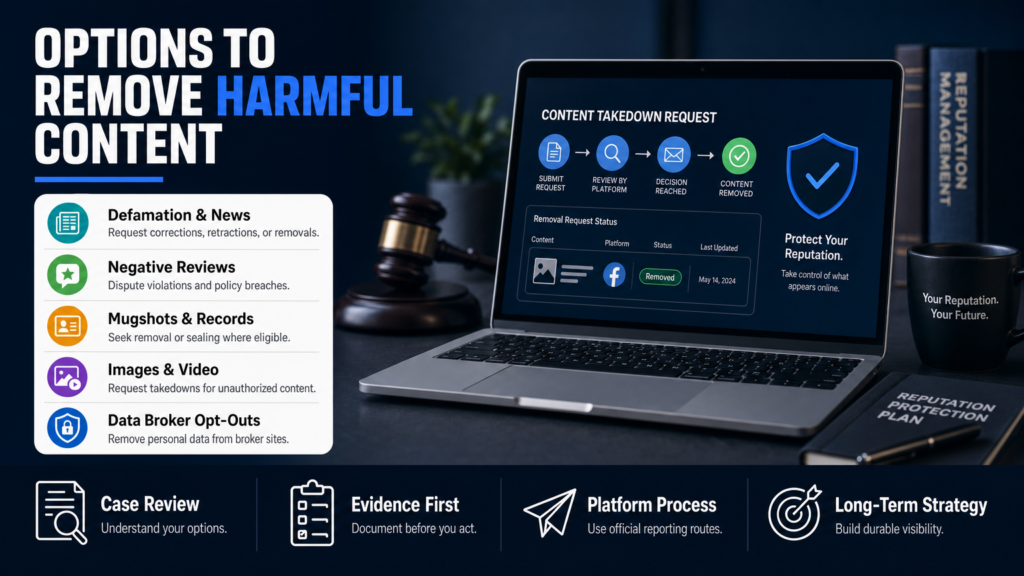
You found a damaging post, image, or review that appears when clients search your name — and it’s costing you calls, interviews, or trust. This guide explains what is realistically possible to remove online content and what to do next.
We evaluate whether the content may qualify for removal or review, and we pursue the legal, technical, platform-based, and reputational options available. Removal depends on the content, publisher, platform policies, evidence, jurisdiction, and circumstances.
Read this if you need a clear, practical workflow: how to assess removability, exact steps to request takedowns on major platforms, what to do when removal is unavailable, and how to rebuild your online presence so trustworthy pages surface first.
Table of Contents
- Can I remove content from Google and other search engines?
- How do I remove defamatory posts, news articles, and blogs?
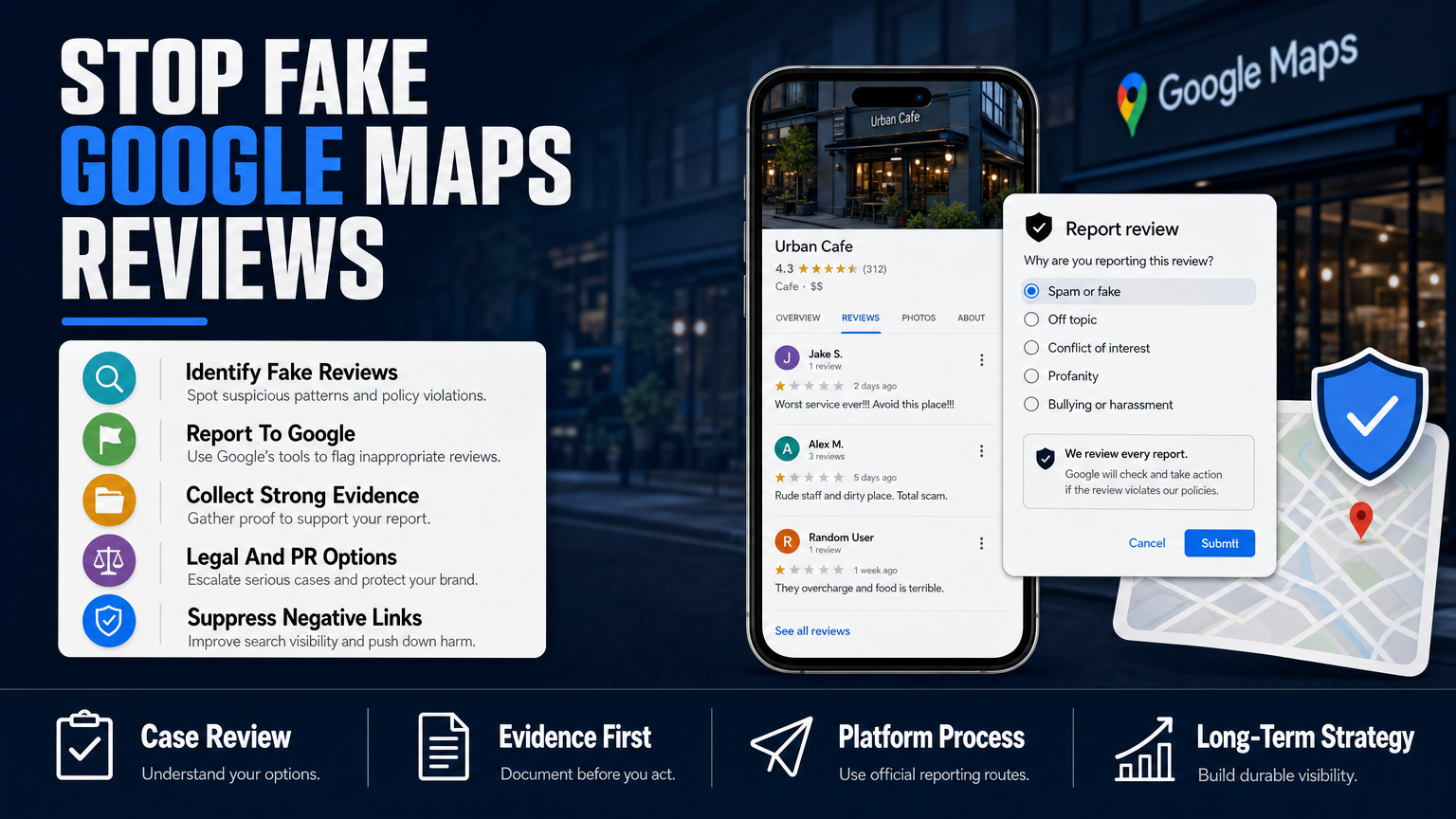
- Can I remove negative reviews on Google, Yelp, or industry sites?
- How to remove mugshots, arrest records, and public records
- How to remove images and videos (YouTube, TikTok, Instagram, LinkedIn)
- How to remove personal data from people-search and data-broker sites
- What to do when removal is not available
- How long does removal take and what should I expect?
- Removal vs Suppression: Quick Comparison
- Hypothetical Example: A Viral Complaint on Reddit
- Common Mistakes People Make When Trying To Remove Content
- Best Practices When Trying To Remove Or Mitigate Harmful Content
- Expert Tips
- Conclusion
- Why Businesses Choose Your Reputation Agency
- Frequently Asked Questions
Can I remove content from Google and other search engines?
Google and other search engines index content they did not create. You cannot force a general delisting simply because a result is embarrassing. However, there are specific processes that can lead to removal or de‑indexing when material violates laws or the platform’s policies.
We develop SEO reputation strategies intended to improve the visibility of relevant and credible information, and we use the official reporting and review processes made available by platforms. Platform decisions remain under the platform’s control.
- Identify the canonical URL(s) and screenshots for your records.
- Use the platform’s abuse or legal request forms if the content meets policy or legal thresholds.
- If the publisher resists, evaluate legal options and coordinate with counsel where appropriate.
- Search engines: use legal removal tools for doxxing, revenge porn, child sexual abuse material (CSAM), or content that violates local law; other removals require action at the source.
- If the page is removed at the publisher, search engines will eventually reflect that change; timing depends on crawler schedules and cache behavior.
- Content on third‑party platforms (Facebook, YouTube, Reddit, Twitter/X, TikTok) must be reported through those platforms’ reporting systems.
Step-by-step: request removal from a search engine index
1) Confirm whether the content violates a law, privacy right, or a platform policy that a search engine enforces. 2) Use Google’s legal removal tools for specific categories (personal data, explicit imagery, doxxed info). 3) If eligible, submit the form with evidence and proof of identity as required.
- Keep copies of your submissions and any case/reference numbers.
- Provide direct evidence: URLs, screenshots showing the content, and explanation of why it fits the removal category.
When search suppression is the better route
When removal is unavailable, we may recommend mitigation, correction, or reduced visibility through SEO and content creation. Search-engine algorithms and competitor content are outside our full control, so results vary.
- Create authoritative pages (personal site, LinkedIn, professional bios) to outrank negative links.
- Use targeted SEO tactics to push negative items off page one rather than depend on a takedown.
How do I remove defamatory posts, news articles, and blogs?
False factual statements that harm reputation can sometimes be removed, but the route depends on who published the content and whether it is demonstrably false. We evaluate whether the content may qualify for removal or review and coordinate legal options when appropriate.
A statement of opinion or true reporting of a public‑interest topic is often not removable, even if damaging. Distinguish carefully between allegations, opinions, and provable falsehoods.
- Document the claim and assemble evidence that proves falsity (emails, contracts, timestamps).
- Send a concise correction request: identify the exact statements, the factual error, and the requested correction or removal.
- Escalate to legal avenues only after an attorney confirms there is a plausible legal claim.
- Contact the publisher directly with a clear correction request and evidence when a factual error exists.
- Use the platform’s copyright or privacy tools only where they legitimately apply — misuse can be counterproductive.
- If the publisher refuses and the claim is false, consider a legal demand letter after counsel reviews the evidence.
How to prepare evidence for a publisher or attorney
Organize a timeline, contemporaneous documents, and any direct contradictions. Stick to verifiable facts; avoid inflammatory language in your requests.
- Screenshots with URL and timestamp
- Original documents proving the claim is false
- Contact history with the publisher
Can I remove negative reviews on Google, Yelp, or industry sites?
Negative reviews can sometimes be removed if they violate a site’s terms (hate speech, impersonation, defamatory falsehoods, or spam). Many negative reviews, however, are simply opinions or truthful accounts and cannot be taken down for being unfavorable.
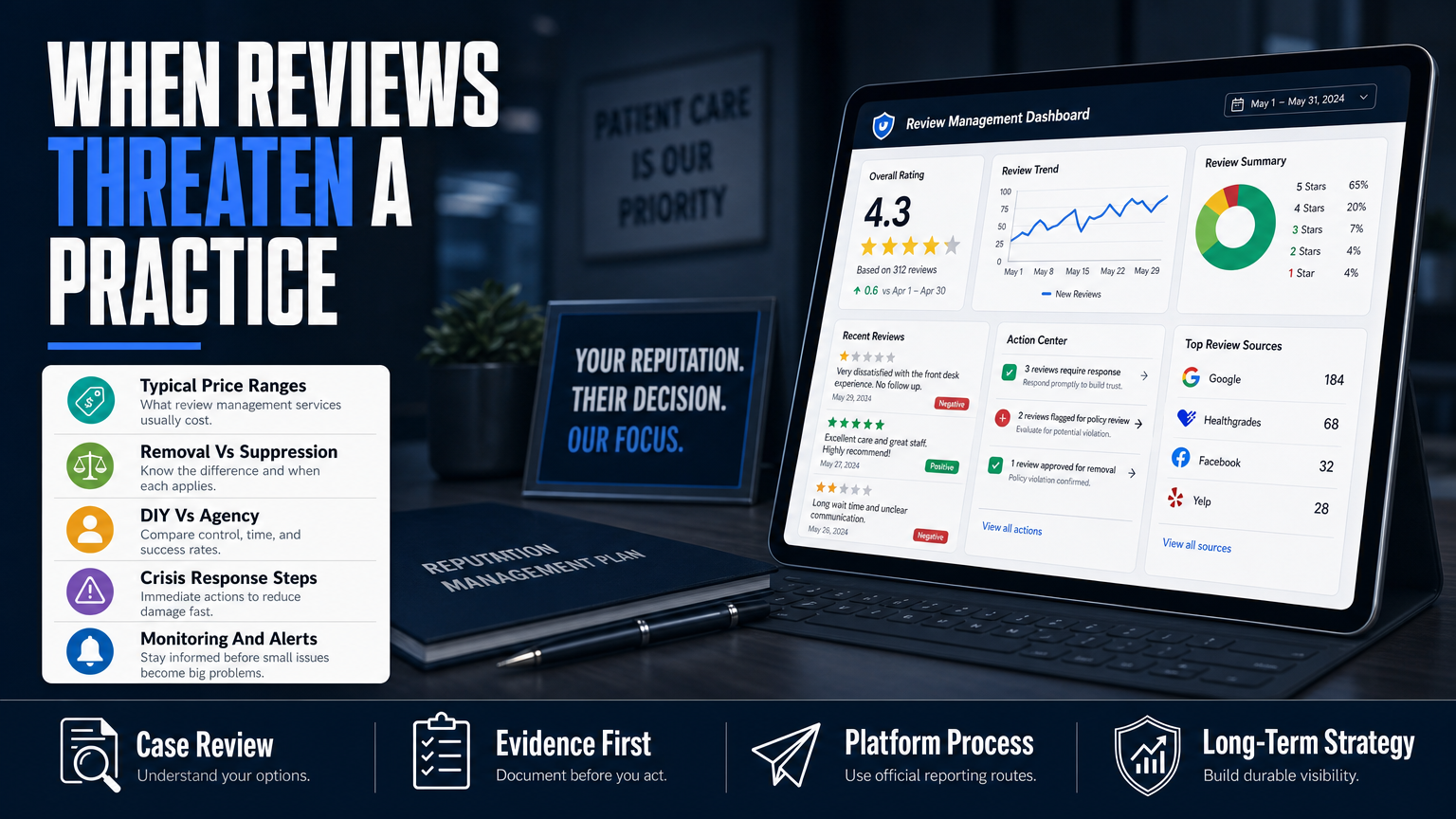
We pursue the legal, technical, platform-based, and reputational options available. When a review cannot be removed, review response, reputation-building, and targeted SEO are the practical routes to mitigate harm.
- Collect the review URL, reviewer name, and screenshots.
- Flag the review under the platform’s policy that it violates (be specific).
- If the platform declines, consider formal legal evaluation for defamation only if the content is verifiably false.
- Google: remove reviews that include personal information, hate speech, or content that violates Google’s review policies.
- Yelp: reports are reviewed manually; Yelp rarely removes reviews solely for negativity.
- Industry sites or membership boards have varying policies — read each site’s terms and follow their formal complaint route.
Responding when removal isn’t possible
A calm, factual public response can reduce damage more than a takedown in many cases. Use response templates that acknowledge the issue, offer a method for off-platform resolution, and avoid argumentative language.
- Acknowledge and invite direct contact
- Provide a brief corrective fact without accusing the reviewer
- Escalate persistent falsehoods to platform or counsel
How to remove mugshots, arrest records, and public records
Mugshot and arrest record removals are handled differently depending on the publisher. Some sites run business models that republish public records and offer paid removals; others may accept legal or factual removal requests. Public records that are lawfully published are often harder to remove simply because they are public.
Removal depends on the content, publisher, platform policies, evidence, jurisdiction, and circumstances. A qualified attorney can determine whether a legal claim may be available.
- Confirm whether the record is sealed or expunged; if so, obtain certified court documents.
- Submit removal or correction requests to aggregators with proof of sealing or inaccuracy.
- Consider coordinated reputation work if removal is not possible.
- Identify the original public-record source (court website, law-enforcement portal) and the aggregators republishing it.
- For aggregator sites, complete opt‑out forms if available and follow the site’s removal process.
- If the record is inaccurate or sealed in your jurisdiction, coordinate with counsel to obtain official sealing orders and present those to publishers.
When a publisher demands payment
Some sites ask for a fee to remove mugshots. Paying may stop a single URL, but it encourages the model and won’t stop other aggregators. You should weigh legal options and long‑term suppression strategies instead of relying solely on paid removals.
- Document any payment and obtain a written release rather than informal promises.
- Evaluate whether paying is an acceptable short-term mitigation vs. investing in suppression and legal remedies.
How to remove images and videos (YouTube, TikTok, Instagram, LinkedIn)
Multimedia removal follows platform policies: copyright claims, explicit-content rules, impersonation, and privacy violations can be valid bases for takedown. Each platform has specific forms and evidence requirements.
Platform decisions remain under the platform’s control. We use the official reporting and review processes made available by platforms and coordinate with content hosts where possible.
- Download and store copies of the media and page metadata.
- Submit the platform’s specific takedown form with clear evidence.
- If it’s hosted on a third-party cloud or a personal website, issue a DMCA or contact the hosting provider as appropriate.
- YouTube: use copyright (DMCA) notices for unlicensed footage, or privacy/harassment reports for doxxing or explicit content.
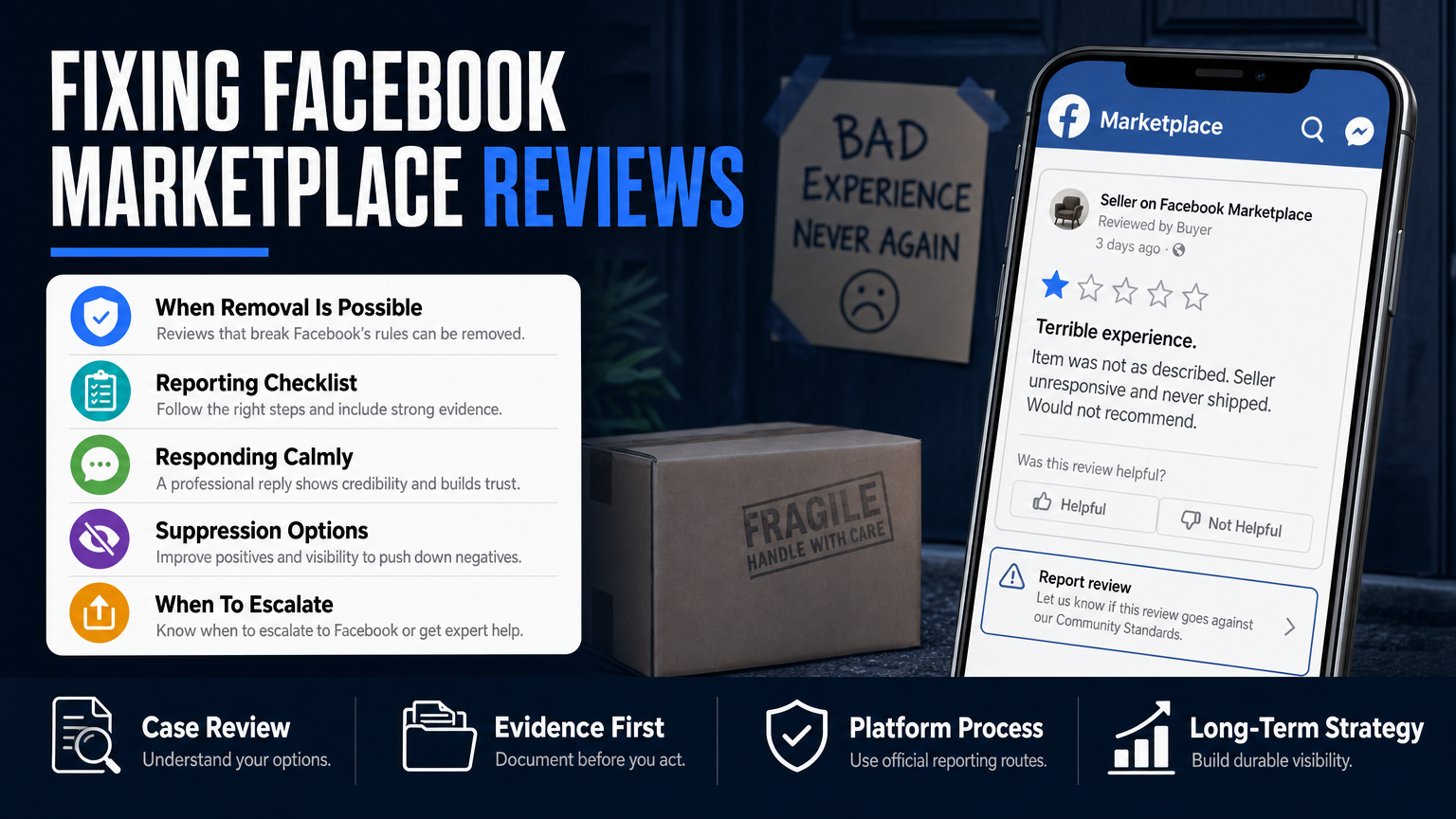
- TikTok/Instagram/Facebook: use in-app reporting and provide proof of impersonation, stolen content, or privacy violation.
- If the poster refuses, identify whether the account can be deactivated for repeated policy violations.
Special case: video deepfakes and manipulated media
Manipulated media can be reported as non-consensual or an impersonation depending on the platform. Preservation of original files and a timeline of events is essential for platform reviews and any legal action.
- Include original content and metadata where possible.
- Coordinate with digital-forensics experts if the manipulation is sophisticated.
How to remove personal data from people-search and data-broker sites
Data brokers (Whitepages, Spokeo, Intelius, etc.) collect and republish personal data. Many offer opt‑out pages. Removal depends on the broker’s process and the data category; it may need repeating periodically.
We pursue opt‑outs and ongoing monitoring, and we recommend combining opt‑outs with broader suppression and correction tactics for enduring visibility improvement.
- Search for your name, variations, and business name across the major brokers.
- Submit opt‑outs with exact URLs and required identity proof through secure forms.
- Enroll in monitoring to detect reappearances or new broker entries.
- Locate the data-broker’s specific opt‑out page and follow their identity-verification steps.
- Expect some brokers to request a copy of ID or a phone verification; follow secure channels only.
- Set calendar reminders to check listings quarterly; new copies can appear or be repopulated.
Do data-broker opt-outs always stick?
No — results vary. Opt‑outs can be effective, but some brokers repopulate data from public sources. Ongoing monitoring and suppression are practical complements.
- Use legal avenues only when data is published unlawfully.
- Coordinate opt‑outs with a reputation strategy to reduce the visibility of any persistent records.
What to do when removal is not available
When removal is unavailable, we recommend a layered mitigation plan: correction and response, search-result suppression, authoritative content creation, and PR to rebuild trust. This is often faster and more reliable than pursuing low-probability takedowns.
We develop SEO reputation strategies intended to improve the visibility of relevant and credible information. Search results may change because algorithms, competitors, publishers, and user behavior are outside our control.
- Audit your first two pages of search results for the target query.
- Create or update high-authority profiles (lawyer directories, clinic pages, LinkedIn) with consistent, verifiable facts.
- Run a targeted backlink and content campaign to raise the authority of positive pages.
- Publish strong, keyword-optimized pages you control: a detailed professional bio, case studies, news about positive outcomes, and vetted directory listings.
- Use press releases or earned media to create high-authority pages that can outrank negative items.
- Respond professionally where appropriate and document ongoing monitoring.
When to involve counsel and PR together
Coordination between legal and PR teams can be critical when a negative item has public‑interest components or pending legal action. A qualified attorney can determine whether a legal claim may be available, while PR shapes messaging to protect reputation.
- Legal action can be part of a broader strategy but rarely offers an instant fix.
- PR should avoid inflammatory public statements that could complicate legal options.
Further reading on search impact
If you’re weighing suppression against takedown, see our deeper discussion on how a single search result can affect your career and client trust.
- The linked article walks through search-impact scenarios and content prioritization.
How long does removal take and what should I expect?
Timing depends on the platform, publisher, evidence, legal complexity, and search-engine behavior. Some platform reviews take days; publisher negotiations or legal processes can take weeks to months. An estimated timeline can be provided after an individual assessment.
We handle matters confidentially and apply appropriate privacy and security controls. Progress is tracked and documented; expect iterative outcomes rather than one definitive result.
- Get an assessment: scope, evidence, and platform identification.
- Prioritize actions that offer the fastest and highest-probability improvement.
- Maintain monitoring to verify outcomes and detect republishing.
- Platform policy takedowns: typically a few days to several weeks.
- Publisher negotiations: weeks to months depending on cooperation.
- Legal actions: months and variable — only pursued when counsel advises viability.
Setting realistic milestones
We provide milestone-based plans (Immediate: file reports and requests; Short-term: publisher outreach and opt‑outs; Medium-term: SEO suppression and PR; Legal: only if justified).
- Avoid promises of fixed timelines; every case differs.
- Document all actions and keep clients informed of potential outcomes.
Removal vs Suppression: Quick Comparison
When deciding whether to pursue a takedown or a suppression strategy, compare their attributes below.
| Removal (Takedown) | Suppression (SEO/PR) |
|---|---|
| Goal | Goal |
| Eliminate the specific content | Reduce visibility of the content |
| Depends on publisher/platform policy or law | Depends on content creation and SEO effort |
| Can be fast if policy applies | Usually slower; requires ongoing work |
| Risk: publisher refusal or legal limits | Risk: may not reach page-one displacement |
| Typical cost: variable (discrete actions) | Typical cost: ongoing campaigns |
Hypothetical Example: A Viral Complaint on Reddit
A surgeon (anonymous scenario) sees a Reddit thread accusing their clinic of malpractice. The thread is active, screenshotted across social media, and ranks on page one for the surgeon’s name. This example demonstrates staged options: preservation, platform reports, publisher outreach, suppression, and PR coordination.
We do not present this as a completed client engagement; it is an illustrative scenario showing the sequence of practical steps.
- 1) Record the URLs and take timestamped screenshots. 2) Submit a platform report to Reddit and request removal if policy violations exist. 3) If removal is refused, request thread suppression by engaging with moderators and consider a controlled PR response. 4) Launch high-authority content (press statement, clinic update) and SEO to push the thread lower in search results.
- For more on how a single community thread can escalate into a professional crisis, see our analysis of community-driven incidents.
- Preserve evidence: download the thread, cross-posts, and search results.
- Report the Reddit post for harassment or doxxing if it includes private information.
- Contact moderators and the original poster with a concise factual correction request.
Common Mistakes People Make When Trying To Remove Content
Errors in approach can waste time, escalate visibility, or damage legal credibility. Below are frequent mistakes and how to avoid them.
Mistake: Trying to force removal for mere embarrassment
Asking platforms or publishers to remove content solely because it’s embarrassing usually fails. Distinguish emotion from legal or policy grounds before requesting takedowns.
- Instead: build a suppression plan and document any actual privacy or policy violations.
Mistake: Overusing copyright claims
Filing a DMCA when the content isn’t copyrighted can trigger counter-claims and reduce credibility with platforms.
Only use copyright where you genuinely own the content or have a license.
- Instead: use precise policy grounds and legal counsel for misuses.
Mistake: Responding emotionally in public
An angry or defensive public response can amplify the issue and create further negative content.
Keep public responses brief, factual, and focused on offering off-platform resolution.
- Instead: draft a calm response and have it reviewed before posting.
Mistake: Paying shady removal services without records
Some operators promise guaranteed removals for a fee. Paying without a written agreement and clear deliverables can waste money and offer no protection against republication.
Insist on documented processes and don’t hand over sensitive credentials.
- Instead: require a written scope, milestones, and secure transfer methods for any necessary documents.
Mistake: Failing to monitor after a takedown
Content often reappears on mirror sites or aggregator pages. One takedown is rarely the end of the work.
Set up monitoring and alerts to detect republication early.
- Instead: combine takedowns with monitoring and periodic opt‑outs.
Best Practices When Trying To Remove Or Mitigate Harmful Content
Adopt a methodical approach: preserve, evaluate, pursue removal where valid, and mitigate where removal isn’t feasible.
Preserve evidence immediately
Take timestamped screenshots, copy URLs, and collect relevant communications. Preservation supports platform reports and any potential legal review.
- Save raw URLs and page-source where possible.
- Keep a secure, date-stamped folder for all evidence.
Use the right channel for each platform
Follow platform-specific forms for copyright, privacy, harassment, or policy violations. Generic emails to support rarely move fast.
- Use the in-platform report options for speed.
- Escalate to hosting provider or registrar when the platform is unresponsive.
Coordinate legal and PR when necessary
Legal action and public messaging should be coordinated to avoid contradictory statements that could harm either avenue. A qualified attorney can determine whether a legal claim may be available.
- Share documents with counsel before publishing a public statement.
- PR should be factual and avoid making legal admissions.
Build authoritative pages to outrank negatives
A sustainable approach is to create and optimize content you control so search engines return trusted sources ahead of harmful items.
- Focus on domain authority, consistent NAP (name/address/phone) data, and targeted keywords.
- Use press, directory listings, and professional sites to create multiple trusted results.
Monitor and repeat opt-outs
Set recurring checks for data-broker listings and new republications. Opt‑outs may need repeating.
- Schedule quarterly audits of major broker and aggregator sites.
- Use alerts for your name and company across major platforms.
Expert Tips
- Preserve everything the moment you discover harmful content — screenshots are often decisive.
- Prioritize actions by probability: platform policy reports first, publisher outreach second, legal third.
- Never use a copyright claim as a shortcut for something that’s merely negative.
- A calm public statement that offers a contact for resolution defuses many review and complaint scenarios.
- Opt‑outs are effective but not permanent; schedule repeat checks and automated alerts.
- If a case has legal complexity, get a document-ready attorney before sending demand letters.
- Track all communications and approvals in a simple spreadsheet with timestamps.
- Invest in authoritative SEO assets early to shorten the time negative content dominates results.
Conclusion
Removing online content is rarely a single action; it’s a process that mixes platform policy, publisher cooperation, legal options, and proactive reputation building. We evaluate whether the content may qualify for removal or review and pursue the legal, technical, and reputational steps that fit each case.
If removal is unavailable, mitigation through SEO, authoritative content, measured public responses, and ongoing monitoring often delivers the best practical outcome. Timing and success rates vary by platform, evidence, and jurisdiction — an individualized assessment is the first responsible step.
Why Businesses Choose Your Reputation Agency
Managing your reputation takes more than monitoring reviews or publishing the occasional blog post. It takes a strategy built around your situation, your industry, and what is actually showing up in search.
Your Reputation Agency works with businesses, executives, healthcare professionals, attorneys and growing brands. Our services include:
- Remove defamatory content and false posts (news, blogs, listings)
- Remove or challenge negative reviews (Google, Yelp, TripAdvisor, industry sites)
- Mugshot and arrest record removal
- Remove videos, images, and other multimedia that damage reputation
- Remove personal data from people‑search and data‑broker sites (opt‑outs)
- Search result suppression (SEO to bury negative links)
- Social media takedowns and impersonation removal
- Rapid online crisis management and incident response
- Ongoing monitoring and alerting of reputation signals
- Coordination with legal counsel and use of legal tactics when required
Frequently Asked Questions
1. Can I force Google to remove a search result for my name?
Not automatically. Google offers legal removal tools for narrow categories (explicit imagery, doxxed info, certain privacy cases). For most negative or embarrassing links, the practical route is removal at the publisher or suppression through SEO and content creation.
2. How long does it take to get a post taken down?
Timing varies: platform policy removals can take days to weeks; publisher negotiations often take weeks to months; legal processes are longer. Timing depends on the platform, publisher, evidence, legal complexity, and search-engine behavior.
3. Will paying a site to remove a mugshot work?
Paying an aggregator may remove a single URL, but it can perpetuate the pay-to-remove model and won’t stop other sites from republishing. Consider legal remedies and suppression strategies as longer-term solutions.
4. Can I remove negative reviews on Google or Yelp?
Reviews that violate site policies (hate speech, personal data, spam, impersonation) can sometimes be removed. Many negative reviews are opinions and remain. When removal isn’t possible, a professional response and visibility-building are the recommended options.
5. What should I do if a deleted post is screenshotted and shared?
Preserve all copies and report any that violate platform policies (privacy, doxxing, explicit content). Deleted posts often persist through screenshots or mirrors — see our discussion of how deleted posts still hurt for mitigation tactics.
6. Are data-broker opt-outs permanent?
Not always. Many opt-outs remove listings but brokers can repopulate from public sources. Regular monitoring and a suppression strategy work together with opt-outs to reduce exposure.
7. When should I contact an attorney?
Contact counsel when the content appears to be a provably false factual statement causing concrete harm, when there are privacy or sealing orders involved, or when a publisher refuses to remove unlawful content. A qualified attorney can determine whether a legal claim may be available.
8. How do I stop a viral social post from spreading?
Immediate preservation and platform reporting are first steps. Then pursue takedown requests where policy applies, contact moderators, and implement a suppression and PR plan. Coordinated legal and PR responses are often necessary for high-impact incidents.
9. Can my reputation be restored even if content stays online?
Yes. By producing authoritative, well-optimized content and managing professional profiles and press, you can reduce the prominence of harmful content. We develop SEO reputation strategies intended to improve the visibility of relevant and credible information, though search outcomes vary.
This content provides general information and does not constitute legal advice. The available options and likely outcomes depend on the facts, evidence, platform policies, applicable law, jurisdiction, and public-interest considerations.
Past examples do not guarantee future results. Removal, correction, deindexing, and search-position changes depend on third parties and circumstances outside Your Reputation Agency’s control.