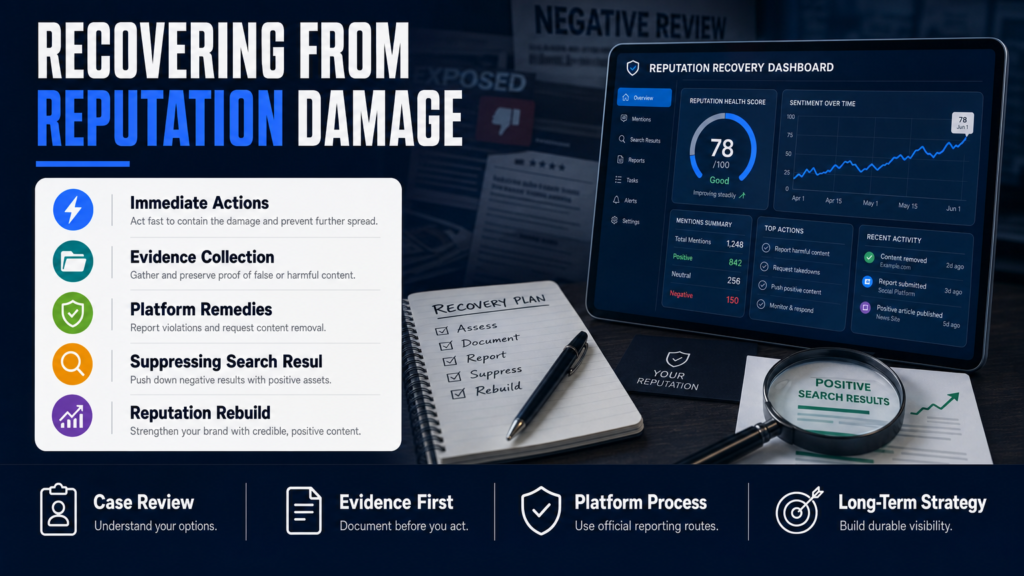
You just discovered a post, review, or article that has the potential to damage your livelihood. Your phone is ringing, clients are asking, and your name appears on the first page of Google next to allegations or a viral clip. Knowing what to do if someone ruins your reputation matters now because delay makes remediation harder.
This article lays out clear, actionable steps you can take in the first 72 hours and over the next months: how to document the problem, what platform tripping points to use, when to involve counsel or PR, and what to do when removal is not possible. We also explain common vocabulary so you can communicate clearly with legal teams, platforms, and vendors.
You’ll get a prioritized checklist for immediate containment, platform‑specific actions (reviews, social networks, news sites, mugshots and data brokers), plus a realistic approach to rebuilding search results and trust. The guidance is practical, US‑focused, and calibrated to professionals and small businesses who need fast, defensible steps.
Table of Contents
- What Does It Mean To Tarnish Someone’s Reputation?
- Words That Describe Destroying Or Having A Bad Reputation
- What Does “Your” Mean In A Text — Why Grammar Matters Here
- First 72 Hours: Immediate Steps If Someone Ruins Your Reputation
- Platform-Specific Actions: Reviews, Social Posts, News, Mugshots
- Legal, PR, And When To Involve Counsel
- When Removal Is Not Available: Suppression, Correction, And Living With It
- Long-Term Rebuilding, Monitoring, And When Rumors Become Search Results
- Removal vs Suppression — Which Fits Your Case?
- Hypothetical Scenario: A Viral Complaint That Cost Appointments
- Common Mistakes People Make After Their Reputation Is Damaged
- Best Practices For Repairing and Protecting Reputation
- Expert Tips
- Conclusion
- Why Businesses Choose Your Reputation Agency
- Frequently Asked Questions
What Does It Mean To Tarnish Someone’s Reputation?
Tarnishing reputation means harming a person’s or organization’s standing with clients, colleagues, regulators, or the public through statements, publications, images, or other content that causes others to view them less favorably.
Tarnishing can be factual (alleged misconduct), opinion (harsh editorial), or a mixture (accusations quoted alongside opinion). Legally and practically, those categories matter because each triggers different remedies and platform responses.
- Label the content: factual, opinion, private data, impersonation, or harassment.
- Assess immediate harm: lost clients, licensing risk, safety threats, or financial impact.
- Preserve evidence: screenshots, URLs, timestamps, and witness statements.
- Begin a response log: who you contacted, when, and what happened next.
- Factual allegation: A statement presented as fact that can be verified true or false.
- Opinion: An expression of belief or judgment, often protected speech.
- Harassment or doxxing: Publication of private data intended to intimidate or expose.
- Impersonation: Fake accounts pretending to be you and posting damaging content.
Why the distinction matters
A statement of opinion is often not removable under platform rules or law. A demonstrably false factual claim may be removable or may support a legal claim. Private information (SSN, medical records, home address) triggers different takedown pathways and safety steps.
- Platform policies often treat doxxing and impersonation differently from opinions.
- Your legal options depend on whether the content is false and whether it causes provable harm.
Words That Describe Destroying Or Having A Bad Reputation
If you need concise language for a report, conversation with counsel, or a press statement, different words carry different legal and rhetorical weight. Use precise terms when documenting the situation.
Below are alternatives and distinctions so you can pick the right phrase without exaggeration.
- Choose neutral, accurate language in formal complaints and legal drafts.
- Avoid accusing a named individual of illegal acts in public statements unless proven.
- “Tarnish” — implies damage but not total ruin.
- “Defame/Defamation” — legal term for a false statement harming reputation (use cautiously).
- “Smear” — suggests an organized or malicious campaign.
- “Blackened name” or “ruined reputation” — colloquial and dramatic; reserve for clear, sustained harm.
- “Disreputable” or “stained reputation” — useful for describing public perception.
Common informal synonyms for having a bad reputation
“Tarnished,” “marred,” “stained,” and “discredited” are common. In HR or licensing contexts, prefer precise descriptions (e.g., ‘alleged misconduct’ vs ‘convicted of’).
- Use ‘alleged’ when there is no judicial finding.
- Reserve ‘defamation’ for potential legal claims after counsel review.
What Does “Your” Mean In A Text — Why Grammar Matters Here
In written responses and legal complaints you’ll see small words like ‘your’ and ‘you’ used a lot. ‘Your’ is the possessive form — it links content or claims to a person or entity.
Be precise: ‘your practice,’ ‘your post,’ and ‘your client’ have different scopes and legal implications. Using correct grammar reduces ambiguity in takedown requests and legal documents.
- Proofread formal communications for ‘your’ vs ‘you’re’ errors.
- Use full legal names and identifiers in complaints to avoid ambiguity.
- Your = belonging to you (possessive).
- You’re = contraction of ‘you are’ (not possessive).
- Misusing ‘your’ can create confusion about who or what is referenced in a complaint.
A practical example
Compare: ‘Remove your post’ (direct instruction) vs ‘You’re responsible for this post’ (accusation). In platform appeals, neutral, factual wording gets better traction.
- Stick to facts and timestamps: ‘The post at URL on MM/DD contains my home address.’
- Avoid inflammatory grammar or speculative phrasing in appeals.
First 72 Hours: Immediate Steps If Someone Ruins Your Reputation
Act quickly to contain harm, but prioritize documentation and measured responses over emotional replies. The first 72 hours are about evidence, containment, and controlled communication.
The checklist below is prioritized: preserve evidence first, then address platforms, then prepare public and legal responses.
- 1) Capture full-page screenshots (desktop and mobile), save URLs, and note timestamps.
- 2) Collect witness info and copies of any messages, emails, or DMs.
- 3) Identify immediate threats to safety and notify authorities where appropriate.
- 4) Change passwords, enable MFA, and isolate affected accounts.
- 5) Draft a short factual statement you can use in platform appeals or a holding statement for clients.
- Do not delete evidence unless it threatens safety; platforms and counsel often need it.
- Avoid public arguments with the poster; they often amplify visibility.
- Lock down accounts and secure communications if doxxing or hacking is involved.
Evidence checklist
Evidence quality determines options: clear screenshots, saved HTML, archived copies (e.g., the Wayback Machine), and exportable CSVs of review data help when asking platforms to act or when speaking with counsel.
- Full-page screenshots with timestamps
- Exported review data from Google/Yelp if possible
- Saved copies of videos or audio files where permitted
- Phone logs or emails showing resulting client cancellations
Platform-Specific Actions: Reviews, Social Posts, News, Mugshots
Different content lives on different platforms and each has its own policies and practical workflows. Prioritize where the search landscape points — the source on page one of Google matters more than a post on a private forum.
For example, a negative Google review can sit on your practice’s front-page presence; an article on a news site may be treated very differently by search engines and publishers.
- 1) For reviews: follow the platform’s official review removal request process and gather evidence that a review violates policy (fake reviewer, conflicts of interest, threats).
- 2) For social platforms: report impersonation, harassment, or private information under platform rules and document DMCA or privacy claims if relevant.
- 3) For news/blogs: send a clear correction request that cites inaccuracies and provides evidence.
- 4) For mugshots/data-broker sites: perform opt‑out requests and gather published evidence for any inaccuracies.
- Reviews: Google, Yelp, TripAdvisor, industry sites — each has a unique dispute process.
- Social networks: Facebook, Instagram, X, LinkedIn — use impersonation and harassment tools first.
- News and blogs: contact the publisher and request correction or retraction when there are factual errors.
- Mugshots and arrest records: many aggregator sites post public records; removal depends on site policy or legal options.
When a Google review changes everything
If a one‑star review or coordinated review attack is visible to prospective clients, the remediation path combines platform appeals, public replies where appropriate, and SEO to push down the content. For an expanded discussion on dealing with reviews and how one negative review can affect a practice, see When a One-Star Google Review Redefines Your Practice.
- Respond publicly only when it’s factual, calm, and brief.
- Use platform dispute tools to flag fake reviewers or policy breaches.
- Collect customer records corroborating service dates if disputing factual claims.
Legal, PR, And When To Involve Counsel
Not every damaging post warrants a lawsuit. Legal involvement is appropriate when there are false factual statements causing measurable harm, clear privacy violations, threats, or ongoing organized attacks. Lawyers, however, do not always produce faster or better outcomes on platforms.
Public relations works in parallel: a coordinated message to stakeholders, careful corrective content, and transparent outreach can limit business loss while legal avenues proceed.
- 1) Triage with counsel if there is a clear false factual allegation, privacy breach, or threat.
- 2) Coordinate PR and legal teams to align statements and preserve privilege where needed.
- 3) Use cease-and-desist letters cautiously — they can escalate or prompt counterspeech.
- Legal assessment helps determine whether a defamation, privacy, or anti‑SLAPP claim exists.
- PR helps manage client and regulator perceptions and should be fact‑checked by counsel.
- Legal steps can be slow and uncertain; platforms may act faster on policy violations.
Rebuilding after online defamation
When reputational damage includes false statements, you will likely need a combined legal, technical, and PR plan to correct record and restore trust. For strategic steps on long-term reputation repair, see How to Rebuild Your Reputation After Online Defamation.
- Document all losses and communications for counsel.
- Use targeted, factual messaging to clients and regulators.
When Removal Is Not Available: Suppression, Correction, And Living With It
Removal is often the most desirable result, but it is not always available. Removal depends on platform policy, publisher willingness, the truth of the claim, and legal jurisdiction. When takedown is not an option, focus on mitigation: suppressing visibility, correcting context, and rebuilding trust.
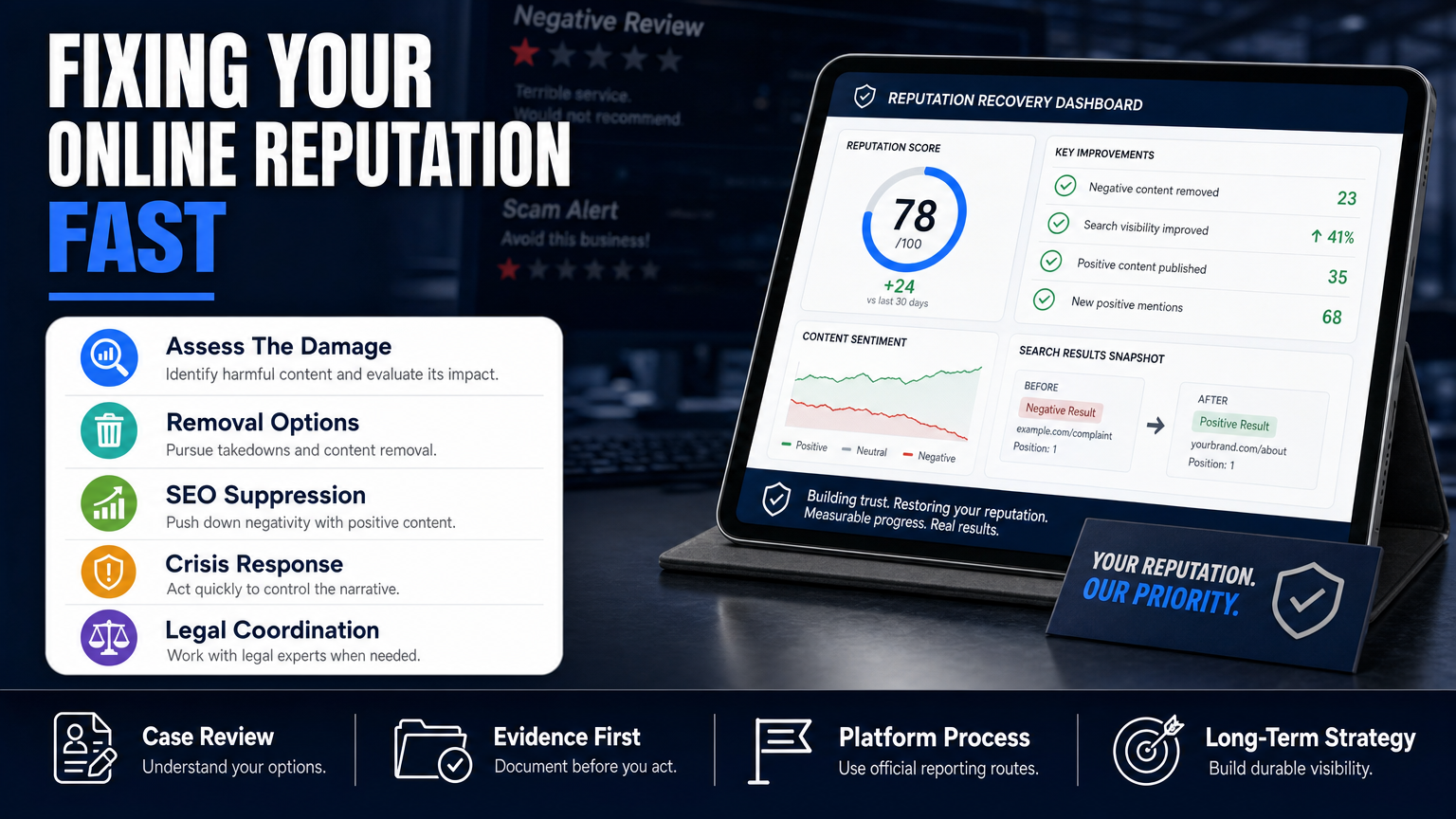
Suppression and correction are legitimate, measurable alternatives to removal. They require a realistic timeline, resources, and continuous monitoring.
- 1) Audit search results and identify content you can realistically improve or outrank.
- 2) Create authoritative pages (site pages, LinkedIn bios, professional directories) optimized for your name or brand.
- 3) Use targeted content (blogs, interviews, citations) and technical SEO (schema, link building) to improve visibility.
- 4) Monitor results and iterate; suppression is incremental and never guaranteed.
- Suppression: SEO and content publishing to push harmful links off page one.
- Correction: publishing factual countercontent, obtaining publisher corrections or clarifications.
- Contextualization: adding authoritative content (profiles, articles, press releases) near negative items.
DIY vs Agency: When to hire help
Some suppression and correction tasks can be handled in-house if you or your marketing team understand SEO and content creation. An agency brings scale, publisher relationships, and legal coordination. Decide based on time, risk, and the importance of rapid results.
- DIY if you have time, SEO knowledge, and modest stakes.
- Hire an agency for coordinated, multi‑platform campaigns or time-sensitive business risk.
Long-Term Rebuilding, Monitoring, And When Rumors Become Search Results
Reputation repair is a program, not a one‑time fix. It combines content, SEO, PR, legal checks, and ongoing monitoring so you can react before the next incident becomes the next headline.
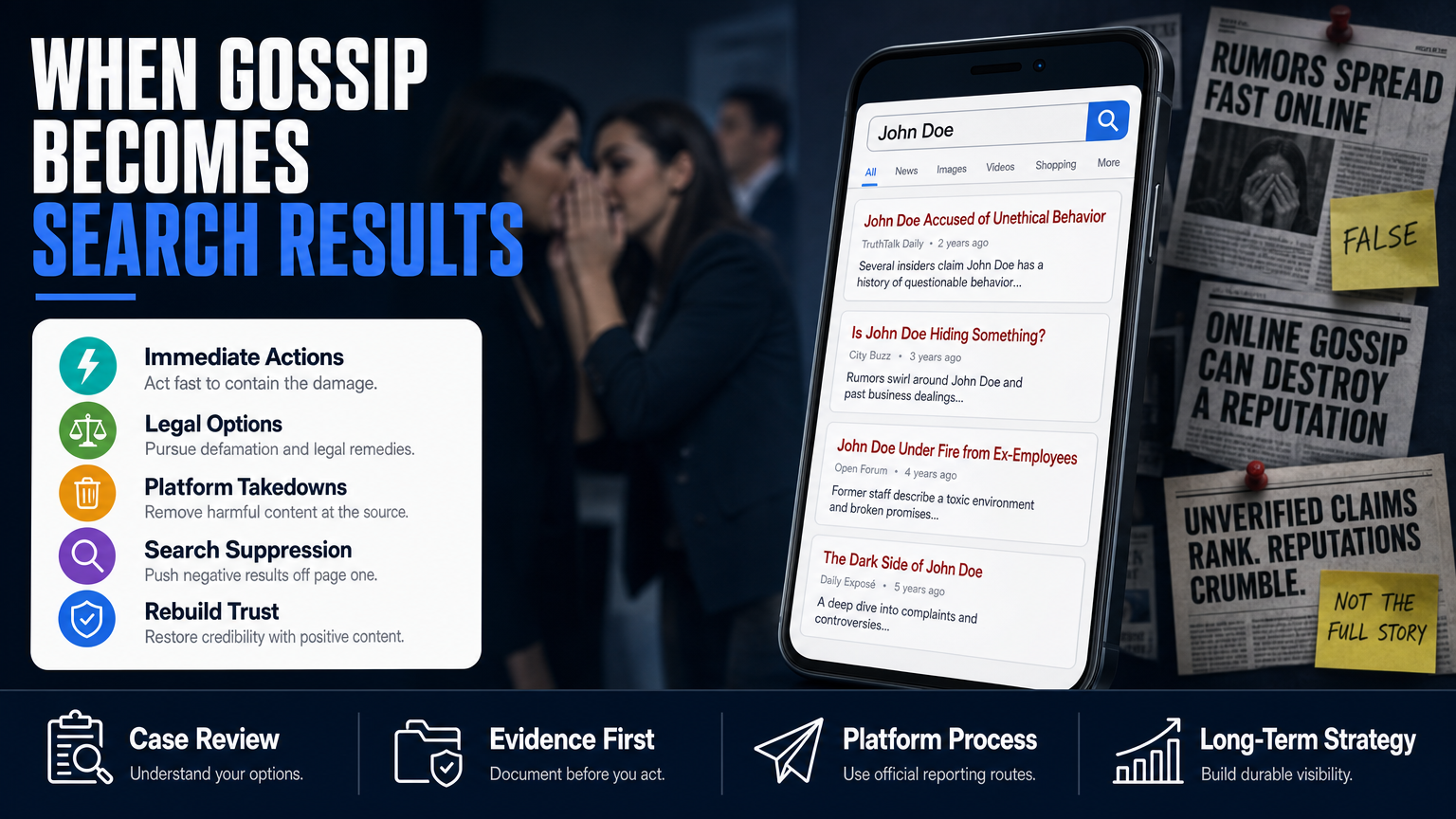
Rumors and workplace gossip can morph into search results. If internal disputes or former‑employee claims surface, an integrated plan containing corrections, authority building, and targeted outreach is required.
- 1) Establish a monitoring cadence and escalation thresholds.
- 2) Prepare pre‑approved holding statements for common scenarios.
- 3) Regularly audit data‑broker sites and remove or correct listings as allowed.
- Set up alerts (Google Alerts, platform monitoring, paid services) for name/keyphrase mentions.
- Maintain current, authoritative profiles across professional and industry sites.
- Use content to demonstrate credibility: case studies, publications, videos, and testimonials (compliant with platform rules).
When gossip becomes search results
If workplace rumors or gossip have made it onto public pages, quick fact statements, documentation of the truth, and content that establishes your professional record help. For guidance on workplace rumor escalation and remediation, see When Workplace Rumors Become Your Google Search Result.
- Prioritize factual corrections with HR and legal where internal issues are involved.
- Use neutral language when publishing corrective content to avoid inflaming the situation.
Removal vs Suppression — Which Fits Your Case?
A quick comparison of the two primary remediation approaches and when each is appropriate.
| Removal | Suppression |
|---|---|
| Goal: take content down | Goal: reduce visibility |
| Depends on publisher/platform policy or legal grounds | Depends on SEO, content quality, and ongoing maintenance |
| May be fastest if publisher complies | Often slower; requires content strategy and links |
| Not guaranteed; needs evidence or policy match | Not guaranteed; outcome varies with competition and algorithms |
| Best for privacy violations, illegal content, impersonation | Best for truthful but harmful content or public records |
| Often involves direct platform or legal requests | Often handled via SEO, PR, and content publishing |
Hypothetical Scenario: A Viral Complaint That Cost Appointments
Scenario: An anonymous complaint about a small clinic was posted on a local blog and shared on Facebook. Within 48 hours it appeared prominently in searches for the clinic owner’s name. Patients canceled and referral calls dropped.
Process: The owner pursued a coordinated approach over weeks — evidence preservation, platform appeals, publisher correction requests, and a suppression campaign aimed at creating accurate, authoritative content.
- 1) Day 0–3: Preserve evidence, notify staff, secure accounts, and draft a holding statement for patients.
- 2) Day 3–14: Submit formal correction requests to the blog and report policy violations to social platforms.
- 3) Week 2–8: Publish authoritative content — updated bios, a press statement, and two professional articles — and implement an SEO campaign to push the negative item below page one.
- 4) Month 2+: Continue monitoring and occasional outreach; coordinate with counsel about next steps if the publisher refused correction and the allegation was false and damaging.
- Collected screenshots, timestamps, and patient cancellation records.
- Contacted the blog with a polite correction request citing specific inaccuracies.
- Filed harassment and impersonation reports on social platforms where the post amplified.
Common Mistakes People Make After Their Reputation Is Damaged
Avoid these frequent errors — they either make the problem worse or squander resources.
1. Responding emotionally and publicly
Lashing out on social media or in comments often amplifies the content and makes the dispute more visible. Keep public responses short, factual, and unemotional, or defer to counsel/PR.
- Public arguments increase shares and screen grabs.
- A calm, factual official reply is more credible than a heated rebuttal.
2. Ignoring evidence preservation
Failure to save screenshots, URLs, or communications makes legal or platform escalation harder. Platforms sometimes claim a policy violation occurred long after the post; preserved evidence proves the timeline.
- Save full-page screenshots and archived copies immediately.
- Collect any client cancellations or lost revenue proof if relevant.
3. Assuming every negative post is removable
Not all harmful content violates platform rules or is legally actionable. Treat removal as one possible outcome, not an entitlement.
- Evaluate removal chances, then plan suppression if removal is unlikely.
- Use accurate language: ‘may qualify for removal or review’ rather than promising removal.
4. Overusing legal threats without counsel
Sending aggressive cease-and-desist letters without counsel or context can provoke counterspeech or publicity. Legal threats should be used selectively and under advice.
- Coordinate legal and PR to avoid inconsistent messages.
- Consider the risk that legal steps draw additional attention.
5. Failing to monitor after the initial incident
Many reputation problems recur or spread. One-time fixes without ongoing monitoring leave you vulnerable to repetition.
- Set up alerts and review schedules.
- Budget for ongoing suppression and content refresh when stakes are high.
Best Practices For Repairing and Protecting Reputation
Use a disciplined, evidence-based approach. The best outcomes come from coordination: preservation, platform remedies, corrections, and reputation building.
1. Preserve evidence and document impact
Start an incident file with screenshots, exported URLs, communications, and a log of business impact. This file is critical for platform appeals, insurers, and counsel.
- Include dates, times, and staff notes.
- Keep copies offsite and under access control.
2. Triage risk and prioritize actions
Not every negative mention requires the same response. Prioritize based on safety, licensure exposure, revenue impact, and visibility in search results.
- Highest priority: threats, doxxing, or licensure risk.
- Medium priority: high‑visibility false allegations or coordinated review attacks.
- Lower priority: a single negative opinion with limited reach.
3. Use platform processes first
Report impersonation, privacy violations, or policy breaches through the official channels before escalating publicly. Platforms sometimes act faster than legal routes for clear policy violations.
- Keep records of every report and any platform response.
- Follow up if automated rejections lack explanation.
4. Build credible, reusable content
Authoritative content—professional bios, licensing pages, publications, and press pieces—serves as long-term reputation capital that both users and search engines trust.
- Optimize name pages with schema and consistent NAP (name, address, phone).
- Encourage legitimate reviews from real clients to restore averages.
5. Monitor and rehearse response plans
Create a playbook with holding statements, escalation contacts, and monitoring thresholds. Practice the plan annually with staff so you can act without delay.
- Designate a single spokesperson to reduce mixed messaging.
- Use monitoring tools to detect new mentions early.
Expert Tips
- Do not call out individual posters by name in public responses; focus on facts and actions taken.
- When collecting screenshots, capture the full page and the browser URL bar to show provenance.
- Enable multifactor authentication across all accounts and rotate compromised credentials immediately.
- Use formal correction requests for publishers before escalating to legal threats.
- Prioritize authoritative, evergreen content (profiles, published articles) for suppression campaigns.
- Track the business impact (lost appointments, canceled contracts) — that documentation strengthens legal and insurance options.
- If you must issue a public statement, keep it under 150 words and strictly factual.
- Set up Google Alerts and a commercial monitoring solution when risk is ongoing.
Conclusion
When someone ruins your reputation, speed, evidence, and a calm plan are your best assets. Immediate containment and documentation buy time; platform processes and measured public communication address visible harms; and a coordinated longer-term program rebuilds trust and search visibility.
There is no universal guarantee of removal or perfect suppression — platforms, publishers, and algorithms are independent actors — but a disciplined, multi‑disciplinary response reduces damage and creates a credible path forward. If the stakes are high for licensure, safety, or significant revenue loss, engage counsel and reputation professionals to triage and manage risk.
Why Businesses Choose Your Reputation Agency
Managing your reputation takes more than monitoring reviews or publishing the occasional blog post. It takes a strategy built around your situation, your industry, and what is actually showing up in search.
Your Reputation Agency works with businesses, executives, healthcare professionals, attorneys and growing brands. Our services include:
- Remove defamatory content and false posts (news, blogs, listings)
- Remove or challenge negative reviews (Google, Yelp, TripAdvisor, industry sites)
- Mugshot and arrest record removal
- Remove videos, images, and other multimedia that damage reputation
- Remove personal data from people‑search and data‑broker sites (opt‑outs)
- Search result suppression (SEO to bury negative links)
- Social media takedowns and impersonation removal
- Rapid online crisis management and incident response
- Ongoing monitoring and alerting of reputation signals
- Coordination with legal counsel and use of legal tactics when required
Frequently Asked Questions
1. What does it mean to tarnish someone’s reputation?
Tarnishing means harming how a person or organization is perceived by others. It can involve false allegations, damaging opinions, doxxing, or impersonation; the specific remedies depend on whether the content is false, private, or harassing.
2. What is another word for ‘destroy reputation’?
Alternatives include ‘defame’ (legal term for false harmful statements), ‘smear,’ ‘ruin one’s reputation,’ or ‘blacken someone’s name.’ Choose language carefully in formal communications to avoid exaggeration.
3. What’s another word for having a bad reputation?
Common synonyms are ‘disreputable,’ ‘tarnished,’ ‘stained,’ or ‘marred.’ In professional or legal contexts, prefer objective descriptions like ‘perceived negatively’ or ‘subject to allegations.’
4. What does ‘your’ mean in a text?
‘Your’ is the possessive form of ‘you’ — it indicates ownership (e.g., ‘your account,’ ‘your post’). Correct usage matters in complaints and appeals to avoid ambiguity; ‘you’re’ (you are) is different and often a grammatical error in formal writing.
5. Can I force a platform to remove a post?
You can request removal by using platform reporting tools and by making formal requests to publishers, but platforms and publishers control removal decisions. Removal depends on policy matches, evidence, and sometimes legal authority; no removal is guaranteed.
6. When should I contact a lawyer?
Contact counsel if the content contains demonstrably false factual allegations causing measurable harm, serious privacy breaches, threats, or ongoing organized attacks. A lawyer can advise on defamation, privacy law, and whether litigation is viable given the evidence and jurisdiction.
7. Should I respond publicly to a damaging post?
Only respond publicly when you can make a short, factual, non‑emotional statement that clarifies the record. For most situations, a measured reply drafted with counsel or PR is safer than an emotional response that could escalate the issue.
8. How long does reputation repair take?
There is no single timeline. Some platform actions can happen within days; SEO suppression and reputation rebuilding often take weeks to months and require ongoing effort. Timing depends on the content’s visibility, publisher cooperation, the strength of corrective content, and market behavior.
9. What if the harmful content is a public record?
Public records (e.g., court filings, certain arrest records) are harder to remove because they are truthful and in the public interest. Your options may include correction requests for inaccuracies, contextual content explaining outcomes, and suppression strategies to push those records lower in search results.
This content provides general information and does not constitute legal advice. The available options and likely outcomes depend on the facts, evidence, platform policies, applicable law, jurisdiction, and public-interest considerations.
Past examples do not guarantee future results. Removal, correction, deindexing, and search-position changes depend on third parties and circumstances outside Your Reputation Agency’s control.