You just found a one-star review on your Google Business Profile written by someone who used to work for you. It calls your business dishonest and threatens licensure — or it’s plainly false. Your first question is: what next?
This article answers How to remove a google review from a disgruntled employee 2022 and gives clear, practical actions: how platforms treat employee reviews, what evidence to gather, how to file a valid takedown or escalation, and what to do when removal isn’t possible.
We do not promise results here — removal depends on Google’s policies, the evidence you can show, applicable law, and unique circumstances. Instead you’ll get a reproducible process, time ranges you can expect in typical cases, and what to do if suppression or PR repair is the only realistic path.
Table of Contents
- How to get an unfair Google review removed
- Will Google remove reviews from disgruntled employees?
- Can I delete someone else’s Google review?
- Can a bad Google review be traced?
- Step-by-step takedown and escalation process
- When removal isn’t available: suppression, correction and PR
- Ongoing monitoring, response and prevention
- DIY vs hiring an agency: which path to choose
- DIY vs Agency: Quick Comparison
- Hypothetical scenario: three reviews from a former receptionist
- Common mistakes that make things worse
- Best practices to resolve and prevent employee reviews
- Expert Tips
- Conclusion
- Why Businesses Choose Your Reputation Agency
- Frequently Asked Questions
How to get an unfair Google review removed
If a review is unfair, defamatory, or violates Google’s policies, you can ask Google to remove it. The platform evaluates reports against specific content policies (spam, harassment, conflicts of interest, impersonation, privacy violations, etc.).
Start by deciding whether the review violates policy or is merely poor feedback. Policy violations (for example, an allegation that a business committed a crime with no supporting evidence, or a doxxing post that shares private data) are the cases with the best chance of removal.
Removal depends on the review content, the evidence you submit, and Google’s assessment. If policy removal is unlikely, the alternative is suppression through SEO and reputation content, or public response and correction.
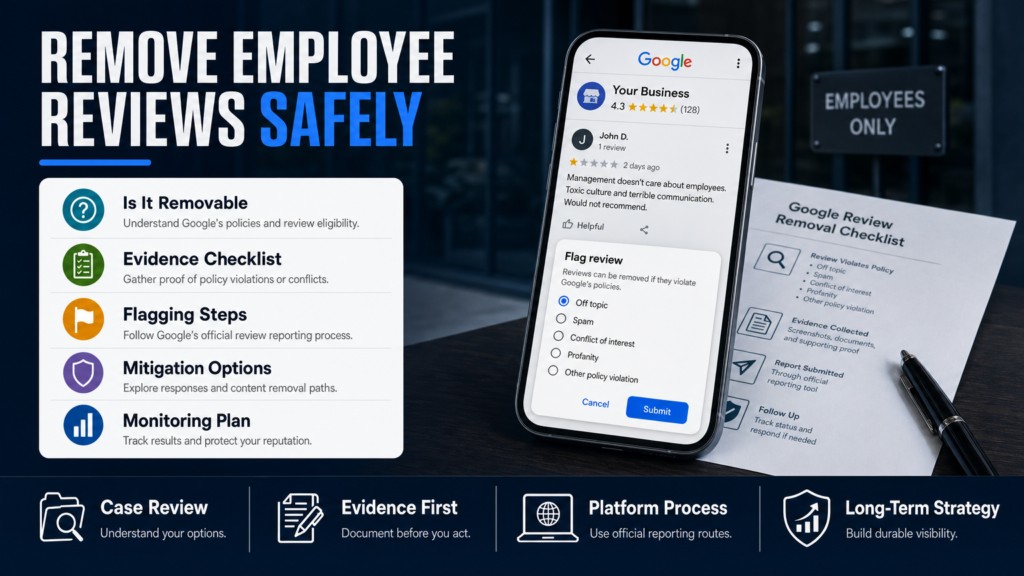
- 1) Capture evidence: screenshot review timestamp, reviewer profile, and any linked items.
- 2) Check Google policy that best fits the violation (harassment, impersonation, off-topic/spam, privacy).
- 3) Flag the review inside Google Business Profile > Reviews > three-dot menu > Flag as inappropriate.
- 4) If denied, use the Business Profile support chat and request a policy re-review with your evidence.
- 5) If review contains threats, doxxing, or explicit privacy violations, escalate to legal counsel for a potential legal request to Google.
- Collect screenshots and links showing the review and reviewer profile.
- Document internal records that contradict factual claims (dates, logs, correspondence).
- Use the Google Business Profile “Flag as inappropriate” flow for an initial report.
- Escalate with a policy appeal if the first review-by-Google is rejected.
- Coordinate with legal counsel when the review includes false allegations that may support a legal notice.
What evidence helps
The stronger the documentary link between the reviewer and your employee status, and the stronger the proof the statement is false, the better the chance of a platform or legal takedown.
Examples of helpful evidence include HR records, employment dates, internal emails showing the reviewer’s identity or motive, screenshots of the reviewer admitting they worked for you, and any proof that claims are factually incorrect.
- Employment records (start/end dates, role).
- Internal messages showing the reviewer’s admission.
- Timesheets, access logs, or shift records that contradict the review.
- Screenshots of the reviewer’s social profiles linking them to your company.
Will Google remove reviews from disgruntled employees?
Google will remove reviews that violate its content policies — including conflicts of interest — but it does not automatically remove negative content simply because the writer is a former or current employee.
A disgruntled employee’s review may be removable if it contains: false factual allegations, proven impersonation, personal data like Social Security numbers, threats, or spam-like coordinating campaigns. Honest negative feedback about workplace experience is generally allowed under Google’s policies.
- 1) Identify the specific Google policy that would apply.
- 2) Prepare evidence showing the conflict or falsehood.
- 3) Submit a policy complaint through your Business Profile.
- 4) If Google declines, consider escalation via support or legal notice.
- Conflict-of-interest policy: Google discourages reviews written by people with a real-world relationship to the business, but enforcement is inconsistent.
- Platform discretion: Google retains discretion and applies its policy framework to each report.
- Documentation matters: Employment proof plus contradictory evidence raises the likelihood of a successful policy report.
When an employee review is allowed
If the review is an opinion about workplace conditions or a factual but negative account that doesn’t violate policy, Google is likely to leave it in place. Policy does not ban negative speech simply because it’s from an ex-employee.
In those cases, suppression, correction, and careful public response are the realistic options.
- Allowed: honest opinion, non-defamatory criticisms, customer-service complaints.
- Potentially disallowed: fabricated claims, personal data sharing, impersonation, or posts made as part of a coordinated campaign.
Can I delete someone else’s Google review?
No — you cannot directly delete another person’s Google review. Only the author or Google can remove it. Any service or method that promises to delete reviews instantly is either misrepresenting capability or engaging in deceptive tactics.
Your legitimate options are: get the reviewer to remove it (ask them), report the review to Google with supporting evidence, pursue a legal route, or use suppression and reputation repair.
- 1) Identify whether you can contact the reviewer directly (private message or email).
- 2) Offer a factual correction and request removal or update.
- 3) If the reviewer refuses, report to Google and compile evidence for escalation.
- 4) Discuss with counsel whether a legal notice is warranted and feasible.
- Asking the reviewer: If the reviewer is identifiable and willing, a polite request to remove or modify the review can work quickly; avoid threats or payment offers.
- Google reporting: Use the official flagging and Business Profile support channels.
- Legal route: A legal notice or subpoena to Google is possible in narrow cases (privacy invasion, explicit defamation) but depends on jurisdiction and evidence.
How to ask an ex-employee to remove a review without escalating
If you can contact the reviewer privately, keep the tone neutral and focus on facts. Aggressive or threatening messages can backfire and may be admissible in litigation.
Offer to discuss and rectify legitimate complaints and request a simple removal or update once the issue is addressed.
- Use calm language and avoid admission of wrongdoing.
- Offer a pathway to resolution (investigate, refund, or clarify) if appropriate.
- Get any removal agreement in writing (screenshot or email).
Can a bad Google review be traced?
Tracing a reviewer to an identity is sometimes possible but depends on the platform data the reviewer exposes, your digital records, and legal tools. Google’s public reviewer profiles often contain limited information.
If the reviewer used their real name, posted elsewhere (LinkedIn, Facebook, Yelp) or left identifiable details, you can often link that content. If the reviewer is anonymous, tracing may require legal process or forensic work.
- 1) Copy the exact review text and search it in quotes on Google and social platforms.
- 2) Examine the reviewer’s Google profile for linked accounts or photos.
- 3) Check internal records for people who match descriptions/timings in the review.
- 4) If identity is critical, consult counsel about lawful discovery or subpoenas; do not attempt illegal doxxing.
- Look for cross-posting: reviewers who post the same text on other sites often reveal a real name or account.
- Search the review text in quotes on Google to find duplicates or related profiles.
- Check metadata and timing against internal logs to corroborate identity (shift records, email timestamps).
When you need to prove identity for legal action
If you plan to pursue a defamation claim or a DMCA removal and need to subpoena account records from Google, get legal advice first. Courts require narrowly tailored discovery and the right factual basis.
Evidence should be compiled before issuing any legal demand to avoid wasted cost and delay.
- Preserve all evidence in a forensic manner (timestamps, screenshots, metadata).
- Talk to counsel about jurisdiction and the strength of your claims.
- Subpoenas can reveal IPs and account registration data, but are not guaranteed and take time.
Step-by-step takedown and escalation process
When you decide to pursue removal, follow a structured escalation path. Rushing or skipping steps reduces credibility with platforms and courts.
Below is a practical escalation chain to follow, with typical timeframes as ranges (these are estimates — actual timing varies by platform and case complexity).
- 1) Preserve: screenshot and save the review URL, reviewer profile, and any related posts.
- 2) Flag: use Google’s flag tool immediately; note the ticket ID or confirmation.
- 3) Support: open a case with Google Business Profile support (chat/email) and attach evidence.
- 4) Ask reviewer: if you can identify them, attempt a neutral outreach to request removal or an edit.
- 5) Legal step: if content is unlawful or defamatory, coordinate with counsel for a formal takedown notice or subpoena.
- 6) Mitigate: while actions are pending, publish corrected content, customer testimonials, and authoritative pages to dilute the negative review’s visibility.
- Immediate: capture evidence (minutes to hours).
- Short-term: flag and request Google review (days to 2 weeks typical for a first review).
- Mid-term: escalate with Business Profile support and re-review (1–4 weeks).
- Longer-term: legal notice or subpoena if warranted (weeks to months).
- Parallel: reputation suppression and public response to reduce harm (weeks to months).
How we document escalation
Track every interaction in a single log: dates, channel (support chat, email), responses, case numbers, and attachments. That log is crucial if you later need to show a court or platform a pattern of harassment or a refusal to act.
Keep copies of all corrective actions (press statements, corrected listings, new SEO pages) to show you attempted to correct the public record.
- Single case log (spreadsheet or case-management tool).
- Attach screenshots and original files, not only screenshots of screenshots.
- Record support chat transcripts and case IDs.
When removal isn’t available: suppression, correction and PR
There will be cases where Google declines removal because the review does not violate platform policy or the evidence is insufficient. In those cases, the realistic paths are suppression (SEO), factual correction, and reputation repair.
Suppression means creating and promoting credible content (press release, FAQ, optimized pages) so the negative review appears lower in search results. It is not an instant fix and is not guaranteed, but it is the standard mitigation tactic for non-removable content.
- 1) Publish an authoritative response on your site addressing the issue (facts, dates, and corrective measures).
- 2) Optimize that page with targeted keywords so it ranks for your business name.
- 3) Promote positive content: customer testimonials, case studies, and directories.
- 4) Maintain monitoring to watch whether the negative result drops below page one.
- SEO suppression: publish authoritative pages (About, Staff bios, FAQs, positive third-party coverage).
- Structured correction: respond publicly to the review with brief, factual statements if appropriate (avoid legal admissions).
- PR and local outreach: contact local press or industry outlets for correction stories when factual errors exist.
How suppression works in practice
Suppression is an SEO exercise: you build and promote content that outranks the negative item. Timeframes depend on site authority, keyword competition, and the strength of the negative piece — expect weeks to months.
If the negative review is the only relevant result, suppression is easier than when the negative story is syndicated across high-authority news sites.
- Create multiple, varied content types (blogs, press, staff pages, social profiles).
- Leverage local citations and directories to increase positive footprints.
- Use targeted link building and on-page optimization to lift preferred pages.
Case link for escalation examples
If a negative narrative spreads beyond Google Reviews — for example, a Reddit thread or forum that drags down ratings — the approach must include outreach to the other publisher. See an example of a multi-platform escalation in When a Reddit Thread Quietly Sinks Your Google Ratings.
Ongoing monitoring, response and prevention
After an incident, continuous monitoring prevents surprises and lets you react before a single review becomes a systemic problem. Monitoring also helps detect review-bombing or coordinated campaigns early.
For medical and regulated professions, quick response is also critical because a few negative results can meaningfully affect patient intake and licensure risk.
- 1) Deploy monitoring tools that alert on new reviews and mentions.
- 2) Create template responses (legal-reviewed) for common scenarios.
- 3) Conduct exit interviews and offboarding procedures that include expectations about public comments.
- 4) Maintain a quarterly reputation audit to identify weak pages to bolster.
- Set up Google Alerts for your business name and key staff names.
- Use a reputation monitoring service for real-time flags across Google, Yelp, industry sites, and forums.
- Train staff on offboarding and social policies to reduce the risk of insider posts.
Special considerations for medical practices
Medical providers should treat negative reviews as potential business and compliance risks. A targeted monitoring and response plan helps limit patient loss and demonstrates to boards and insurers that you take complaints seriously.
For more on the financial impact of negative ratings, see What One-Star on Google Can Cost a Medical Practice.
DIY vs hiring an agency: which path to choose
You can handle many cases yourself, especially straightforward policy-violation reports or when you can calmly ask the reviewer to remove the post. Hire an agency when you need coordinated SEO suppression, legal coordination, or rapid crisis response across multiple platforms.
An agency brings process, contacts, and capacity to run parallel mitigation campaigns (SEO, PR, legal coordination). That said, no ethical agency can guarantee deletion or fixed timelines.
- 1) Assess the issue complexity (single review vs campaign, reputational stakes, legal exposure).
- 2) Try DIY flagging and outreach for simple cases.
- 3) If removal is denied, or the matter extends beyond Google, evaluate hiring an agency with verifiable process examples.
- 4) Require an initial audit and written project plan before engaging an agency.
- DIY is cheaper and works for simple policy violations and informal reviewer outreach.
- Agencies are faster at multi-channel suppression, legal coordination, and complex evidence collection.
- Both approaches require careful documentation and a disciplined public-response plan.
Cost and scope comparison
Costs vary widely. DIY costs are mostly internal time; agency work ranges from a few hundred to several thousand dollars depending on urgency and channels. Ask agencies for an itemized plan.
For a deeper look at the economic impact of a one-star review and the return on removal or suppression work, see What a One‑Star Google Review Actually Costs You.
DIY vs Agency: Quick Comparison
Use this table to pick the right approach for a disgruntled-employee review.
| DIY | Agency |
|---|---|
| Cost | Higher upfront but scalable |
| Speed | Faster on multi‑channel escalations |
| Legal coordination | Coordinates counsel and subpoenas |
| SEO suppression | Full SEO and content campaign |
| Documentation | Case-managed evidence logs |
| Best for | Single review or low-stakes cases |
| Risk | Potential for inconsistent escalation |
Hypothetical scenario: three reviews from a former receptionist
A community dental clinic finds three negative Google reviews posted over two days. The reviews claim billing fraud and name an employee who was terminated last month. The clinic’s staff suspect the reviewer is the ex-receptionist. They cannot delete the reviews directly.
- 1) Day 0–1: Preserve evidence and flag reviews.
- 2) Day 2–10: Open support case with Google Business Profile and submit HR docs.
- 3) Day 10–30: If Google declines, ask counsel about a legal notice for false allegations; continue SEO suppression.
- 4) Month 1–3: Promote authoritative content and monitor search results; consider paid local ads to boost positive pages if organic SEO is slow.
- Immediate actions: screenshots, preserve URLs, capture reviewer profiles.
- Evidence: HR confirms termination date; access logs show the reviewer was employed during the alleged events.
- Flagging: clinic flags each review for policy violations (conflict of interest and possible false factual allegations).
- Escalation: Google rejects the first flag; clinic opens a support case and attaches HR documentation.
- Mitigation: while appeals proceed, clinic publishes an FAQ page addressing billing procedures and posts new patient testimonials to improve search results.
Common mistakes that make things worse
Avoid these predictable errors. They waste time, escalate conflict, or produce evidence you will regret later.
1) Publicly attacking the reviewer
Responding angrily in a public reply or naming the reviewer in a blog post amplifies the issue and can be used against you. Keep public responses short, factual, and non-confrontational.
2) Offering payment for removal
Paying for positive reviews or offering money for removal is both unethical and violates platform policies; it can trigger more severe penalties and further reputational damage.
3) Failing to document everything
Without timestamps, original files, and a clear evidence trail, you lose leverage with platforms and lawyers. Document before you communicate or change anything.
4) Retaliation or doxxing
Trying to expose the reviewer’s personal data or to post negative content about them is illegal or policy-violating in many jurisdictions and will escalate the situation.
5) Assuming Google will always remove employee reviews
Platforms do not automatically remove content simply because the author is an ex-employee. Assuming otherwise leads to inaction on mitigation when it’s needed.
Best practices to resolve and prevent employee reviews
Follow these durable actions to improve outcomes and reduce recurrence.
Document and preserve evidence immediately
Start an immutable record (date-stamped screenshots, saved HTML, and internal logs). Preserve original files and maintain a single case file for all communications.
- Use a cloud folder with access controls.
- Record the URL and review ID, not just screenshots.
Use the platform’s reporting tools, then escalate
Follow Google’s flagging process first, then Business Profile support, and only escalate to legal if necessary. Each step strengthens your position for the next one.
- Attach concise, documentary evidence to support policy claims.
- Keep communications factual and to the point.
Coordinate with counsel for serious claims
When reviews include false criminal allegations, reveal private data, or constitute a coordinated harassment campaign, counsel can advise on subpoenas and appropriate legal notices.
- Legal steps can be effective but are time-consuming and expensive.
- A lawyer can ensure discovery requests are lawful and proportionate.
Prepare a mitigation plan in parallel
While pursuing removal, run an SEO and PR plan to reduce visibility and correct the record. Do this immediately; suppression takes time.
For regulated professions, align messaging with compliance requirements and document corrective actions.
- Publish authoritative site pages that address common complaints.
- Solicit verified positive reviews from satisfied customers following platform rules.
Improve employee offboarding and policy
Exit checklists, social-media policies, and clear expectations about post-employment commentary reduce the likelihood of revenge posts.
Consider training managers to de-escalate disputes before they go public.
- Include social media and review expectations in separation agreements when lawful.
- Conduct exit interviews to surface unresolved concerns early.
Expert Tips
- Capture evidence before you communicate — once altered, screenshots are weaker evidence.
- Use concise, factual public replies: name the issue, state you’re investigating, and provide an offline contact.
- If the reviewer is an identifiable employee, offer a neutral dispute resolution channel before asking for removal.
- Do not promise refunds or take actions that could be interpreted as admission in public replies.
- Preserve support chat transcripts and case numbers; platforms often forget prior interactions.
- Prioritize channels: Google first for Business Profile issues, then industry sites, then forums.
- If you hire an agency, require a written scope and a documented evidence-handling plan.
- For potential legal takedowns, get an attorney’s written assessment before sending a formal notice.
Conclusion
A disgruntled-employee Google review is a serious problem but not always an unsolvable one. Your best approach is a calm, evidence-based escalation: preserve proof, use Google’s reporting tools, consider neutral outreach to the reviewer, and run parallel suppression and PR tactics if removal isn’t granted.
If the review accuses you of criminal conduct or reveals private data, consult counsel early. When the stakes are high — for example, licensure, patient safety, or a sustained campaign — coordinated support from legal, PR, and reputation professionals improves your odds of an effective outcome while avoiding mistakes that could make matters worse.
Why Businesses Choose Your Reputation Agency
Managing your reputation takes more than monitoring reviews or publishing the occasional blog post. It takes a strategy built around your situation, your industry, and what is actually showing up in search.
Your Reputation Agency works with businesses, executives, healthcare professionals, attorneys and growing brands. Our services include:
- Remove defamatory content and false posts (news, blogs, listings)
- Remove or challenge negative reviews (Google, Yelp, TripAdvisor, industry sites)
- Mugshot and arrest record removal
- Remove videos, images, and other multimedia that damage reputation
- Remove personal data from people‑search and data‑broker sites (opt‑outs)
- Search result suppression (SEO to bury negative links)
- Social media takedowns and impersonation removal
- Rapid online crisis management and incident response
- Ongoing monitoring and alerting of reputation signals
- Coordination with legal counsel and use of legal tactics when required
Frequently Asked Questions
1. How to get an unfair Google review removed?
Report the review through your Google Business Profile and choose the policy that fits (spam, harassment, personal information, conflict of interest). Attach documentary evidence showing the review is false or violates policy. If Google declines, open a support case and consider legal options if serious privacy invasions or defamatory assertions exist.
2. Will Google remove reviews from disgruntled employees?
Not automatically. Google removes reviews that violate its policies. A disgruntled employee’s review may be removable if it contains false factual claims, privacy violations, impersonation, or coordinated spam, but ordinary negative opinions about an employer are usually allowed.
3. Can I delete someone else’s Google review?
No. Only the author or Google can remove a review. Your options are to ask the reviewer to delete it, report it to Google with evidence, pursue legal channels in narrow cases, or mitigate visibility through SEO and PR.
4. Can a bad Google review be traced?
Sometimes. If the reviewer reuses text or links to other social profiles, a manual search can reveal identity. For anonymous reviewers, legal discovery (subpoena to Google) might be required, which needs counsel and a strong factual basis.
5. How long does flagging a review take to produce results?
Response times vary. Initial flags may be reviewed in days to a few weeks; escalations and legal requests can take longer. There are no guaranteed timelines — platform load, case complexity, and evidence quality influence timing.
6. Can I sue a former employee for a bad review?
Possibly, but only if you have evidence the review contains false factual statements that meet the jurisdiction’s defamation standards. Suits are costly and unpredictable; consult a qualified attorney to evaluate strength of the claim before filing.
7. What evidence shows a review is fake or written by an ex-employee?
Evidence includes screenshots of internal communications admitting authorship, employment records, matching text posted elsewhere under the reviewer’s real name, or metadata linking the review to an IP or account you can tie to an ex-employee (which generally requires legal process).
8. What do I do if Google declines my removal request?
Re-check the policy match, compile clearer documentation, open a Business Profile support case, and continue mitigation (SEO, PR). If the content is unlawful, discuss legal notice options with counsel; otherwise focus on suppression and managing the public response.
9. Is it worth hiring a reputation agency?
Yes in many mid- to high-stakes cases. Agencies can coordinate SEO suppression, PR messaging, evidence handling, and legal referrals more efficiently than most small businesses can alone. Ask for a written plan and realistic expectations—no reputable agency will promise guaranteed removal.
This content provides general information and does not constitute legal advice. The available options and likely outcomes depend on the facts, evidence, platform policies, applicable law, jurisdiction, and public-interest considerations.
Past examples do not guarantee future results. Removal, correction, deindexing, and search-position changes depend on third parties and circumstances outside Your Reputation Agency’s control.