You just received an alert, a tip, or a message saying your name, email, or SSN was found on the dark web. Your first question is probably: can you remove personal information from the dark web? Short answer: sometimes — but not reliably or instantly. This article explains what’s possible, what’s not, and the exact next steps to protect your reputation and finances.
This guide is written for professionals and small businesses who need fast, practical actions: how to verify exposure (including checking if your SSN is on the dark web), how to lock down accounts and recover after a leak, which removal channels to pursue, and when suppression and remediation are the realistic option.
We won’t promise guaranteed deletions or fixed timelines. Instead you’ll get a clear process you can start immediately, an explanation of platform and legal limits, and decisions you can make depending on whether the data is on the dark web itself or merely reposted to surface sites.
Table of Contents
- How do I see if my SSN is on the dark web?
- What happens if your personal information is on the dark web?
- Should I worry when Google says my info has been found on the dark web?
- Can someone track me if I access the dark web?
- Practical options for removing or mitigating dark‑web exposure
- What to do when removal is NOT available
- How we prioritize actions in a rapid response
- DIY vs Agency: Which Route After Dark‑Web Exposure
- Hypothetical Example: Dr. A’s SSN Appears in a Paste
- Common Mistakes People Make After Dark‑Web Exposure
- Best Practices For Reducing Damage And Recovering Reputation
- Expert Tips
- Conclusion
- Why Businesses Choose Your Reputation Agency
- Frequently Asked Questions
How do I see if my SSN is on the dark web?
A Social Security number (SSN) is high‑value data and checking for it requires both surface web checks and specialized dark‑web monitoring. Ordinary Google searches won’t reliably find data on Tor services or closed forums.
Start by confirming what type of exposure you’ve been alerted to: a screenshot, a contractor’s message, a monitoring service alert, or a public post. Each requires a different verification approach.
- Step 1 — Preserve evidence: save screenshots, emails, and alert details without altering metadata.
- Step 2 — Run a focused surface search for the exact string (use quotes) and reverse image search if an ID photo is involved.
- Step 3 — Order a dark‑web scan from a reputable provider or engage a professional to search Tor indexes and private marketplaces.
- Confirm the source and evidence: ask for URLs, screenshots, or filenames.
- Use trusted dark‑web monitoring services that search Tor, indexed marketplaces, and private forums. These services vary in depth and coverage.
- Search the surface web for copies: paste exact strings (email, phone, partial SSN) inside quotes in Google, Bing, and DuckDuckGo.
What monitoring services can (and can’t) find
Commercial monitoring services scan public Tor indexes, many closed marketplaces, and some private forums. They will often report matches for SSNs, emails, and credit‑card data if it’s been posted in indexed locations.
Limitations: no service can guarantee detection of every breach. Some forums are invitation‑only, posts get deleted, and many marketplaces change addresses. Treat monitoring as ongoing visibility, not a perfect detector.
- Use monitoring to triage risk, not as proof of full exposure.
- Combine monitoring with direct bank/credit checks to detect fraud early.
What happens if your personal information is on the dark web?
If your personal information appears on the dark web, the risk depends on what data was exposed and how it’s being used. An exposed SSN, credit card, or login credential invites identity theft, account takeover, and targeted phishing.
Beyond immediate financial risk, exposure can cause reputational damage if sensitive documents (medical, licensing, or legal records) are shared publicly or republished to surface sites.
- Step 1 — Treat it as a breach: assume the exposed items are usable.
- Step 2 — Immediately harden accounts and place fraud alerts (instructions below).
- Step 3 — Decide whether legal, law‑enforcement or professional notification is required (license boards, employers, or clients).
- Credit fraud and new accounts opened in your name.
- Unauthorized transactions and chargeback headaches.
- Credential stuffing on other accounts (email, banking, LinkedIn).
- Reposting to surface web (blogs, social platforms, review sites) that amplifies reputational harm.
Real business stakes for professionals
For clinicians, attorneys, and small‑business owners the costs are not only financial — an exposed identity or leaked patient/client list can trigger licensing inquiries, lost clients, and damaged trust. See our case note on reputation costs in healthcare for context.
The financial and professional consequences are described more fully in What An Exposed Identity Costs a Doctor’s Career, which outlines how exposure can ripple into licensure and referrals.
- Notify professional liability insurers and your compliance officer if applicable.
- Document all steps taken to mitigate — useful if regulators or boards ask.
Should I worry when Google says my info has been found on the dark web?
Google alerts or other consumer products sometimes flag that your data ‘appears’ on the dark web. That notification alone is not a definitive forensic finding; treat it as a cue to investigate, not as proof of wide exposure.
Consumer alerts often crawl third‑party lists or data‑broker aggregations and may report matches for emails or passwords that were part of older breaches.
- Step 1 — Validate: request or capture the URL, screenshot, or file that triggered the alert.
- Step 2 — Contain: change passwords, enable MFA, and monitor accounts.
- Step 3 — Investigate scope: run a targeted dark‑web scan and review breach history (Have I Been Pwned, vendor breach notices).
- Verify the alert: ask for the evidence line, timestamp, and exact matched data.
- Check whether the item is a paste on a surface site or actually on Tor/marketplace infrastructure.
- Use the alert to trigger immediate defensive actions (password resets, credit checks).
When the alert is a password match
A password match is urgent: change that password immediately and revoke sessions on all devices. Assume the credential is compromised and was or could be used for credential stuffing elsewhere.
Password reuse is the most common post‑breach vector. Use a password manager and MFA to reduce risk.
- Use unique, long passwords generated by a manager.
- Where possible, replace passwords with passkeys or hardware MFA (YubiKey).
Can someone track me if I access the dark web?
Accessing the dark web via Tor or other tools does not make you automatically untraceable. Misconfiguration, downloading files, or using identifiable accounts inside Tor can deanonymize you.
For most people the correct question is not whether you can be tracked absolutely, but how to reduce risk when investigating exposure yourself.
- Step 1 — Don’t go alone: if you need a dark‑web search, use a vendor or specialist rather than investigating directly.
- Step 2 — If you must use Tor: update your system, avoid downloading files, don’t enable scripts, and do not log into personal accounts.
- Step 3 — Consider professional analysis for threat intelligence or law‑enforcement coordination.
- Tor hides your IP from the site but not from exit‑node observers; downloads can bypass Tor safeguards.
- Logging into accounts (even throwaway ones) or reusing email on dark‑web forums exposes identity.
- Law enforcement may correlate activity or use endpoint forensics to tie activity to an individual.
Safe alternatives to DIY dark‑web browsing
Many professionals are better served by a monitored service or an incident-response firm that can search and acquire evidence safely. These providers operate with secure tooling and legal controls.
Your Reputation Agency can coordinate monitoring and safe collection without asking you to expose yourself to risky browsing. We evaluate whether the content may qualify for removal or review and pursue the technical, platform, and legal options available.
- Use read‑only scans rather than manual browsing.
- Work with vendors who follow chain‑of‑custody and data‑security best practices.
Practical options for removing or mitigating dark‑web exposure
You cannot reliably delete content from decentralized dark‑web services in the same way you can request removal from Google. However, there are several practical actions that reduce harm: takedowns of surface copies, suppression through SEO, legal notices where applicable, and containment.
We evaluate whether the content may qualify for removal or review and then pursue platform, legal, and reputational options depending on evidence, publisher, platform policies, and jurisdiction.
- Step 1 — Map where data appears: Tor/marketplace, surface reposts, people‑search sites, or review platforms.
- Step 2 — Pursue platform channels: use abuse reports, copyright/privacy claims, and platform policies where applicable.
- Step 3 — When removal is unavailable: pursue suppression, reputation content, and legal escalation if warranted.
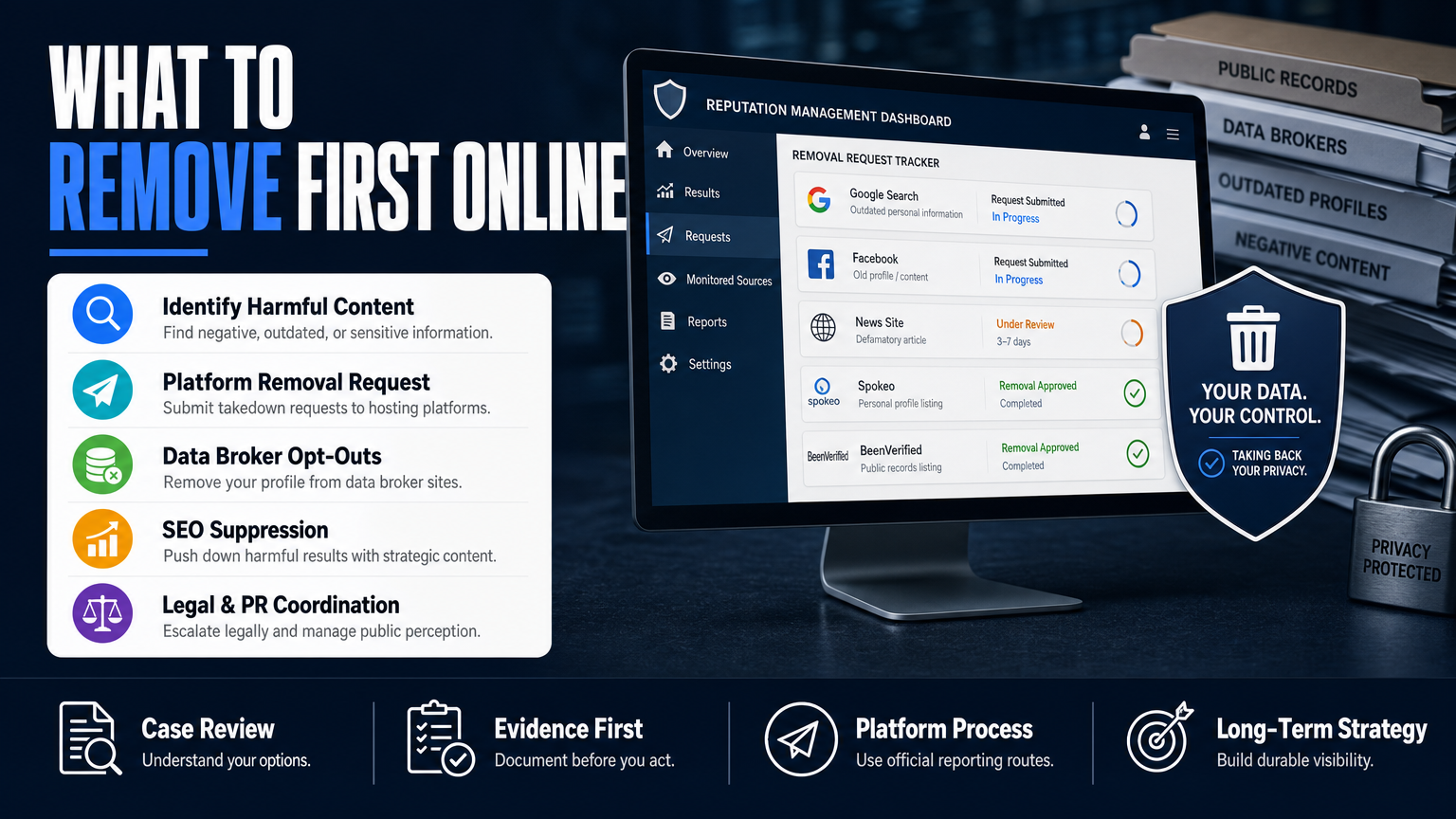
- Takedowns: remove copies on the surface web (blogs, paste sites, result pages).
- Opt‑outs: remove personal entries from people‑search sites and data brokers.
- Suppression: build authoritative pages and SEO to push harmful links off page one.
- Containment: lock accounts, freeze credit, and notify banks.
Takedowns vs. suppression — a quick decision guide
If the content is on a surface site you control or have a policy claim against, a takedown is worth pursuing. If it’s only on Tor or immutable peer‑to‑peer systems, prioritize containment and suppression.
We develop SEO reputation strategies intended to improve the visibility of relevant and credible information; search results may change because algorithms, competitors, publishers, and user behavior are outside our control.
- Takedown effective when publisher is contactable and platforms enforce policies.
- Suppression is the realistic long‑term play when direct removal is impossible.
Remove surface copies and data broker listings
Many dark‑web leaks are reposted onto the surface web or aggregated by data brokers. Remove or opt out of those copies first — it reduces search‑engine visibility and stops casual discovery.
For stepwise help on taking down or suppressing surface results like addresses, see When Your Address Becomes the First Result on Google.
- Submit opt‑out requests to major people‑search sites (Whitepages, BeenVerified, Spokeo, PeopleFinder).
- Use site‑specific abuse or DMCA processes where applicable.
What to do when removal is NOT available
If content can’t be removed from Tor or from uncooperative publishers, switch focus to reducing harm: containment, suppression, transparency planning, and legal escalation where appropriate.
This is a critical inflection point: you must accept that a deletion may not be possible and allocate resources to remediation that protects income, licensure, and hiring prospects.
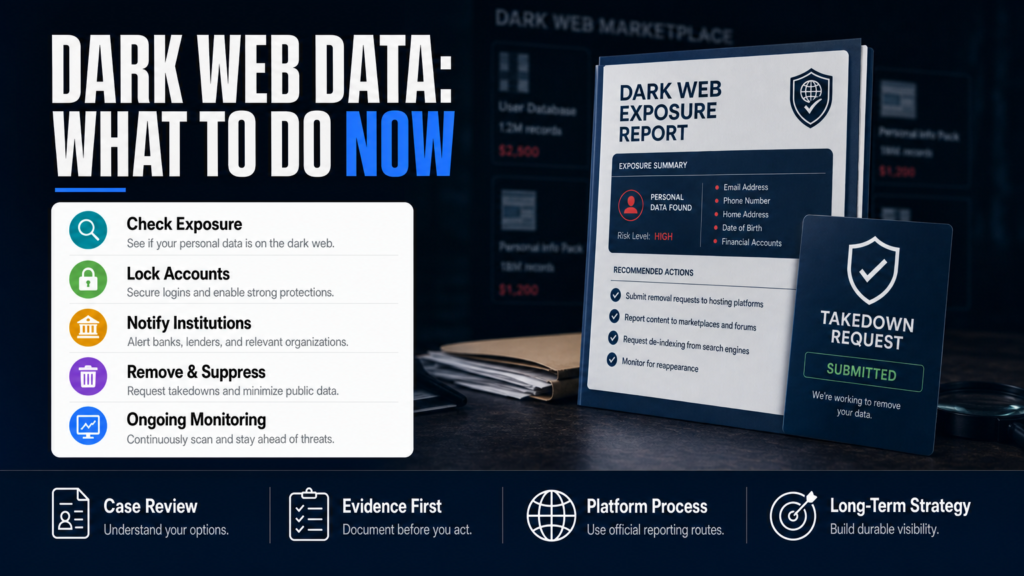
- Step 1 — Contain: freeze credit, change credentials, notify banks and payment processors.
- Step 2 — Suppress: create and promote positive, verifiable content that occupies search results.
- Step 3 — Monitor and document: continuous monitoring, incident logs, and evidence collection for possible future legal action.
- Freeze credit and add identity theft alerts with the three major bureaus.
- Lock or replace compromised accounts and enable strong multi‑factor authentication.
- Build authoritative content (company pages, LinkedIn, news releases) to push damaging links down in search results.
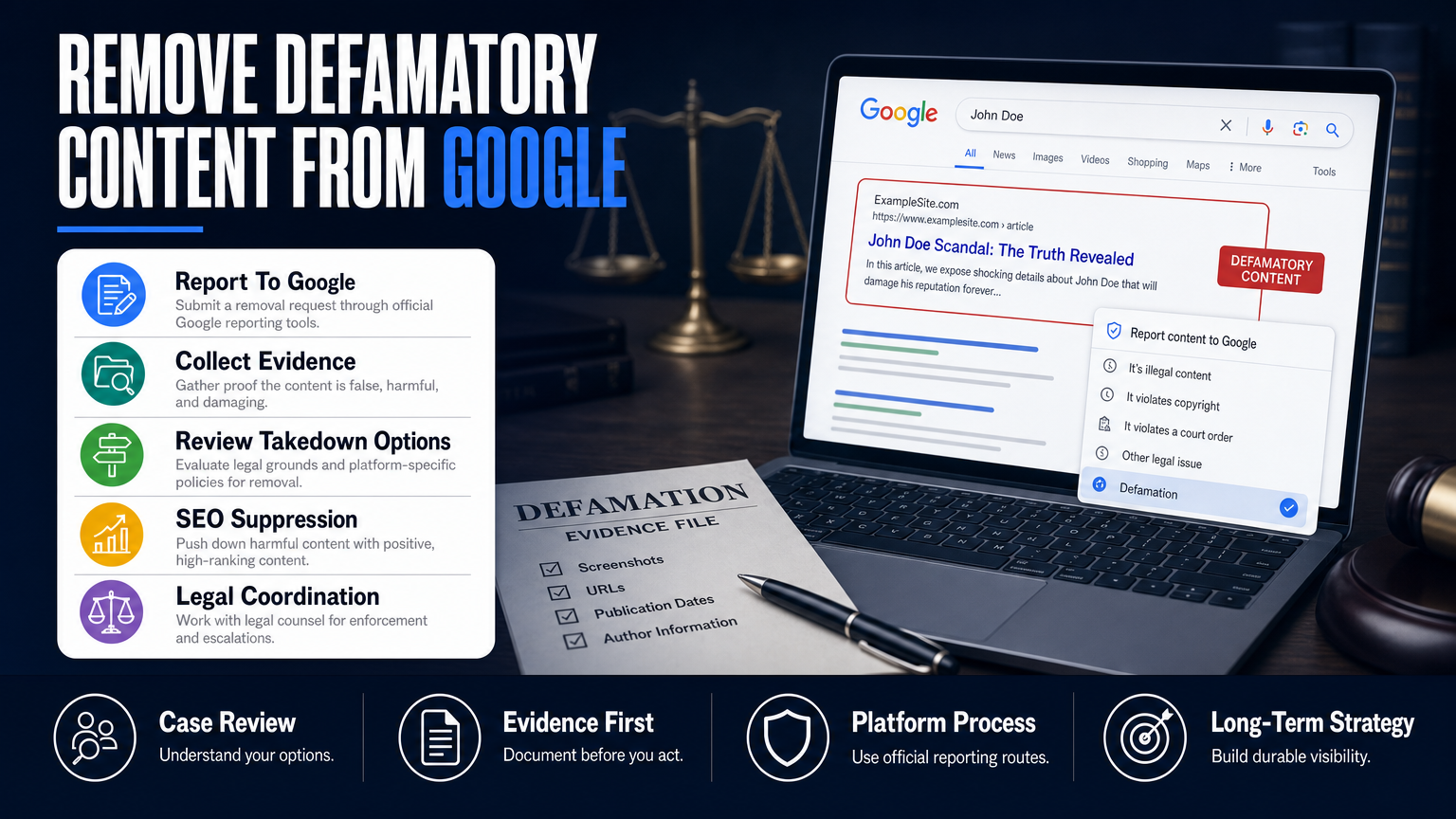
- Engage legal counsel to evaluate defamation, privacy, or takedown options if the data was stolen or published unlawfully.
How suppression works in practice
Suppression uses SEO, content creation, social profiles, and PR to push harmful items below the first page for key name queries. Results vary according to the strength of negative content and authority of competing sources.
An estimated timeline can be provided after an individual assessment; some cases may begin to show changes within weeks, while others require months of work.
- High‑quality news coverage and permanent profiles (LinkedIn, Crunchbase) rank strongly.
- Consistent publishing and link building accelerate visibility shifts.
When to involve law enforcement or regulators
If the exposure includes identity theft, extortion, or threats, file a police report and contact federal authorities such as the FBI’s IC3 for cyber‑crimes. If client or patient data was exposed, you may have regulatory notification obligations.
Coordinate with counsel before public statements; documenting steps taken to remediate can reduce regulatory friction.
- File an Identity Theft report with the FTC and use it with creditors.
- Notify licensing boards only after consulting counsel when professional data or allegations are involved.
How we prioritize actions in a rapid response
In rapid incidents we focus on three lanes: financial containment, visibility control, and evidence preservation. Triage decisions are driven by risk to revenue, licensure, and client trust.
Every case is different; timing depends on platform responsiveness, legal complexity, and how widely the data has spread.
- Step 1 — Triage call: document exposure and pick defensive list of accounts to harden.
- Step 2 — Evidence collection: capture URLs and preserve metadata for possible legal use.
- Step 3 — Ongoing monitoring: set up daily alerts for name variants, SSN fragments, and credential leaks.
- Immediate: freeze credit, change credentials, enable MFA, notify banks.
- Short term (days–weeks): remove surface reposts, opt out of data brokers, issue targeted takedown requests.
- Medium term (weeks–months): suppression SEO, PR to correct narrative, legal demands if warranted.
When social posts or threads amplify the leak
Surface reposts on Twitter/X, Reddit, Facebook, or review sites can be removed using platform policies if they violate privacy or impersonation rules. When a conversation on Reddit becomes a professional crisis, removal or suppression of the thread may be part of a response plan.
For an example of how a social thread can escalate and how to respond, read When a Reddit Thread Becomes a Professional Crisis.
- Collect URLs and user IDs before requesting removal.
- Use platform-specific abuse channels and, where appropriate, legal subpoenas.
DIY vs Agency: Which Route After Dark‑Web Exposure
A side‑by‑side look at what you can realistically do alone versus what a specialized firm can provide.
| DIY | Agency |
|---|---|
| Run basic surface searches | Comprehensive Tor + surface monitoring |
| Call banks & freeze credit yourself | Coordinate with banks, creditors and fraud teams |
| Submit opt‑out forms to data brokers | Mass opt‑outs and documented follow‑ups |
| Change passwords and enable MFA | Secure remediation plan plus credential management |
| File police/FTC reports alone | Assist with evidence packets and legal coordination |
| Attempt takedowns manually | Targeted takedowns, legal notices, and PR support |
Hypothetical Example: Dr. A’s SSN Appears in a Paste
Scenario: Dr. A receives an email from a colleague that includes a screenshot of a paste site showing her partially redacted SSN and a clinic client list. The paste is live on a public paste site and also appears referenced in a Tor marketplace post.
Process applied: triage, containment, takedown attempts, and suppression.
- 1) Triage call within 24 hours to list exposed assets and prioritize actions.
- 2) Submit takedown requests to the paste site and escalate via their abuse form; alert hosting provider if available.
- 3) Opt out of people‑search listings where the clinic address appeared using documented requests.
- 4) Begin suppression: publish a verified clinic statement, update LinkedIn/Crunchbase, and secure a local news correction where the leak implied malpractice.
- 5) Monitor daily for 30 days, then weekly; maintain evidence for potential legal action if the paste is reposted or used for fraud.
- Immediate actions: Dr. A freezes credit, updates all passwords, enables hardware MFA, and informs her malpractice carrier.
- Evidence: screenshots with timestamps and the paste URL were saved; a forensics vendor captured the Tor marketplace post securely.
Common Mistakes People Make After Dark‑Web Exposure
Below are frequent errors that increase harm or waste response time. Avoid these pitfalls and follow structured steps instead.
Mistake 1 — Ignoring early signs
Treat every verified data match as a potential breach. Waiting to act often increases financial and reputational damage because criminals use exposed data quickly.
- Action: implement immediate containment (passwords, freezes) while you investigate.
Mistake 2 — Chasing absolute deletion
Spending all time trying to delete items on Tor is rarely productive. Deletion is often impossible; resources are better spent on removal of surface copies and suppression.
- Action: balance takedown attempts with SEO and monitoring to reduce discovery.
Mistake 3 — Self‑investigating on Tor without experience
Attempting to access marketplaces or forums yourself risks exposure, malware, and inadvertent identification. It can also tamper with evidence needed for law enforcement or legal use.
- Action: use professional monitoring or an incident response partner for dark‑web collection.
Mistake 4 — Over‑sharing publicly
Posting public complaints or defensive statements without counsel can amplify reputational harm or create legal risk. Keep public messaging controlled and factual.
- Action: prepare a short, factual statement and coordinate with PR/legal as needed.
Mistake 5 — Not documenting steps taken
Failing to keep incident logs and evidence makes future legal or regulatory action harder. Documentation strengthens insurance and enforcement outcomes.
- Action: timestamp and store screenshots, URLs, and correspondence securely.
Best Practices For Reducing Damage And Recovering Reputation
Adopt a repeatable process so you and your team can act quickly and consistently when exposure occurs.
Practice 1 — Rapid containment checklist
Have a prebuilt checklist: freeze credit, reset critical passwords, revoke OAuth tokens, enable MFA, and alert banks. Time matters; do these within 24–72 hours of confirmed exposure.
- Notify your insurer, compliance officer, and counsel as appropriate.
- Use a password manager and rotate important credentials.
Practice 2 — Combine monitoring with proactive removals
Pair dark‑web monitoring with surface‑web takedowns and opt‑outs. Data brokers and paste sites are often easier to remove and removing those copies reduces search‑engine exposure.
- Schedule weekly scans for the first 90 days, then monthly.
- Keep records of opt‑out confirmations and takedown receipts.
Practice 3 — Build authority content for suppression
Create professional pages, press mentions, and authoritative bios that rank for your name. Consistent content and linking accelerate suppression of harmful links.
We develop SEO reputation strategies intended to improve the visibility of relevant and credible information; results vary by domain authority and competition.
- Claim and verify Google Business Profile, LinkedIn, professional directories.
- Publish factual descriptions of your practice and services on durable domains.
Practice 4 — Coordinate legal and PR actions
When exposure implicates client data, defamation, or extortion, coordinate counsel and PR early. Legal options depend on jurisdiction and evidence; a qualified attorney can determine whether a legal claim may be available.
Do not make public accusations without verified facts and legal review.
- Prepare a holding statement for clients and regulators.
- Work with counsel to collect evidence usable in subpoenas or court orders.
Practice 5 — Educate staff and limit data exposure
Minimize the amount of sensitive data stored in easily accessible formats. Train staff on phishing and secure file handling — most breaches start with human error.
Regularly review vendor security and data‑retention policies.
- Use encryption for backups and restrict access to sensitive files.
- Audit third‑party access and change credentials when vendors change.
Expert Tips
- If you get a dark‑web alert, assume credential compromise and change passwords before investigating the alert in depth.
- Freeze credit with Equifax, Experian, and TransUnion to stop new accounts rather than waiting for fraud.
- Use a privacy‑first email alias for public registrations and reserve your main email for clients and banks.
- Don’t download files from Tor. If you need files for evidence, have a professional collect them.
- Document every step you take — timestamps and evidence matter for insurers and law enforcement.
- If the exposure affects clients, notify them promptly with a clear remediation plan to preserve trust.
- Prioritize removing or suppressing surface copies — they drive most reputation damage.
- Maintain a small crisis kit: a prewritten holding statement, contact list for banks and counsel, and a monitoring subscription.
Conclusion
Can you remove personal information from the dark web? The honest answer is: sometimes, but often not entirely. Direct deletion on Tor and similar services is frequently impossible; effective recovery combines immediate containment, surface takedowns, and long‑term suppression strategies.
For professionals and SMEs the goal is to stop immediate financial harm, preserve licensure and client trust, and reduce future discovery. A coordinated plan — containment, documented takedowns, SEO suppression, PR, and legal review — is the responsible path forward.
Why Businesses Choose Your Reputation Agency
Managing your reputation takes more than monitoring reviews or publishing the occasional blog post. It takes a strategy built around your situation, your industry, and what is actually showing up in search.
Your Reputation Agency works with businesses, executives, healthcare professionals, attorneys and growing brands. Our services include:
- Remove defamatory content and false posts (news, blogs, listings)
- Remove or challenge negative reviews (Google, Yelp, TripAdvisor, industry sites)
- Mugshot and arrest record removal
- Remove videos, images, and other multimedia that damage reputation
- Remove personal data from people‑search and data‑broker sites (opt‑outs)
- Search result suppression (SEO to bury negative links)
- Social media takedowns and impersonation removal
- Rapid online crisis management and incident response
- Ongoing monitoring and alerting of reputation signals
- Coordination with legal counsel and use of legal tactics when required
Frequently Asked Questions
1. How do I see if my SSN is on the dark web?
Verify the alert by requesting the source (URL or screenshot) and run both surface searches and a dark‑web scan from a reputable monitoring service. Preserve evidence, then act to contain financial risk (freeze credit, change passwords). No single tool can guarantee full visibility — treat monitoring as ongoing.
2. What happens if your personal information is on the dark web?
Depending on the data, risks include identity theft, account takeover, targeted phishing, and reputational harm if documents are reposted to surface sites. Immediate containment (credit freezes, password changes) and monitoring are critical to limit damage.
3. Should I worry when Google says my info has been found on the dark web?
Treat it as a prompt to investigate, not definitive proof. Confirm the evidence, then follow containment steps: change passwords, enable MFA, and run a targeted scan. Alerts can indicate older breaches or aggregated lists and should trigger verification.
4. Can someone track me if I access the dark web?
Yes — misconfiguration, downloads, or logging into accounts can deanonymize you. Law enforcement and sophisticated actors may correlate activity. Use a professional vendor rather than browsing Tor yourself for investigative purposes.
5. Can my PII be removed if it’s found on Tor marketplaces?
Direct removal from Tor is often impractical. Focus first on removing surface copies, opt‑outs from data brokers, and suppression through SEO. We evaluate whether content may qualify for removal or review and pursue applicable platform, technical, and legal options.
6. Are dark‑web removal services legitimate?
Some legitimate firms provide monitoring, evidence collection, and surface‑web takedowns. Be cautious of any vendor promising guaranteed deletion from Tor or absolute anonymity. Ask about scope, legal controls, and data‑security practices before contracting.
7. What immediate steps should a business take after detection?
Freeze credit, rotate credentials, enable MFA, notify banks and insurers, preserve evidence, and begin surface takedowns and opt‑outs. For breaches involving clients, coordinate with counsel and regulators about notification obligations.
8. How long does suppression (burying negative links) take?
Timelines vary widely: some improvements can show in weeks, but meaningful suppression often takes months. Search visibility depends on the authority of new content, the strength of the negative item, and ongoing competitor activity; an estimated timeline can be provided after assessment.
9. Does identity theft protection remove my info from the dark web?
Identity‑protection services can monitor and alert to exposures and assist with recovery (fraud resolution, credit disputes). They do not typically remove content from Tor; removal depends on where the data is posted and whether platforms will cooperate.
This content provides general information and does not constitute legal advice. The available options and likely outcomes depend on the facts, evidence, platform policies, applicable law, jurisdiction, and public-interest considerations.
Past examples do not guarantee future results. Removal, correction, deindexing, and search-position changes depend on third parties and circumstances outside Your Reputation Agency’s control.