You just found a negative article, viral social post, or a string of fake reviews that surfaces when clients search your name or business in the UK. For US-based professionals and small businesses, this is not a hypothetical: London-focused incidents can threaten revenue, licensure, and future hires.
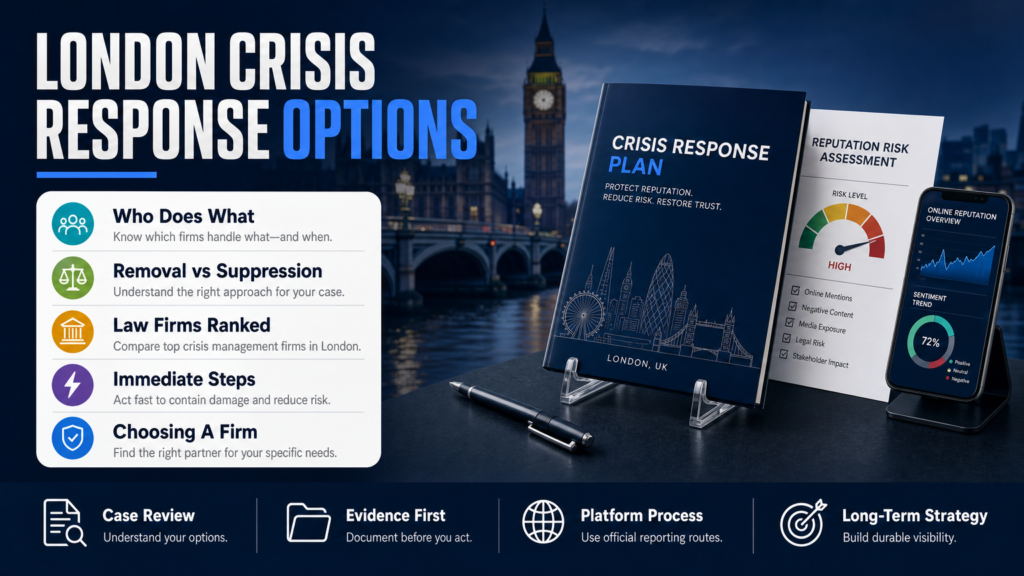
This article explains what crisis management firms London offer, who the typical providers are (and what they actually do), and the practical first steps to take right now. It uses the primary keyword naturally to help you find relevant services without promising specific outcomes.
You’ll get a clear triage path: immediate actions to limit spread, how to evaluate whether removal is realistic, mitigation and suppression tactics, and how to choose a firm or team in London that fits your risk profile.
Read on for step-by-step routines, a side-by-side comparison of removal vs suppression, top UK law-firm context you’ll encounter, and a hypothetical case that shows the process end-to-end.
Table of Contents
- What Is Crisis Management — and How It Applies to London Incidents
- Which Firms Handle Crises in London? Who Does What
- What Are The Big 5 Law Firms In London?
- Who Is The Most Feared Law Firm In The UK?
- What Are The Top Human Rights Firms In The UK?
- When Removal Is Not Available: Suppression, Correction and Mitigation
- Comparison: Removal vs Suppression
- How To Choose A Crisis Management Firm In London
- Emergency First Steps For An Online Reputation Crisis
- When To Involve Legal Counsel And How Agencies Coordinate
- Removal vs Suppression: Quick Comparison
- Hypothetical Example: A London Clinic With A Viral Complaint
- Common Mistakes Teams Make During a London-Focused Crisis
- Best Practices For Working With Crisis Management Firms In London
- Expert Tips
- Conclusion
- Why Businesses Choose Your Reputation Agency
- Frequently Asked Questions
What Is Crisis Management — and How It Applies to London Incidents
Crisis management is the coordinated set of actions an organization or individual takes to limit harm from an unfolding event that threatens reputation, revenue, or legal standing. For online incidents the response blends digital-takedown work, search-engine management, public messaging, and often legal coordination.
Crisis management firms London can include specialists in PR, digital-forensics, reputation SEO, legal liaison, and security. The exact team depends on the incident: a dataset leak needs different experts than a defamatory news article or a coordinated review-bomb.
If you want a grounded primer, start with our longer explainer on What Is Crisis Reputation Management? Complete Business Guide, which covers roles, timelines, and common platform processes in more depth.
- Triage the incident: identify the platform, publisher, and scope of exposure.
- Preserve evidence: capture screenshots, timestamps, and URLs before content is removed or altered.
- Assess legal and platform options: what policy or law might apply, and which teams should act first.
- Scope: containment, legal assessment, takedown attempts, suppression, PR messaging, monitoring
- Typical trigger events: defamatory articles, fake reviews, doxxing, leaked files, viral videos
- Outcome framing: reduce immediate exposure, correct the record where possible, rebuild trust
Triage Checklist (first 1–48 hours)
Work fast but methodically—rush decisions create unnecessary legal risk and can make matters worse.
- Record: screenshot mobile and desktop, note share counts and comments.
- Map: list where the link appears (news site, Facebook, X/Twitter, YouTube, Trustpilot, Google My Business).
- Owner: identify the account or publisher and whether it’s a private individual, anonymous forum, or established outlet.
Which Firms Handle Crises in London? Who Does What
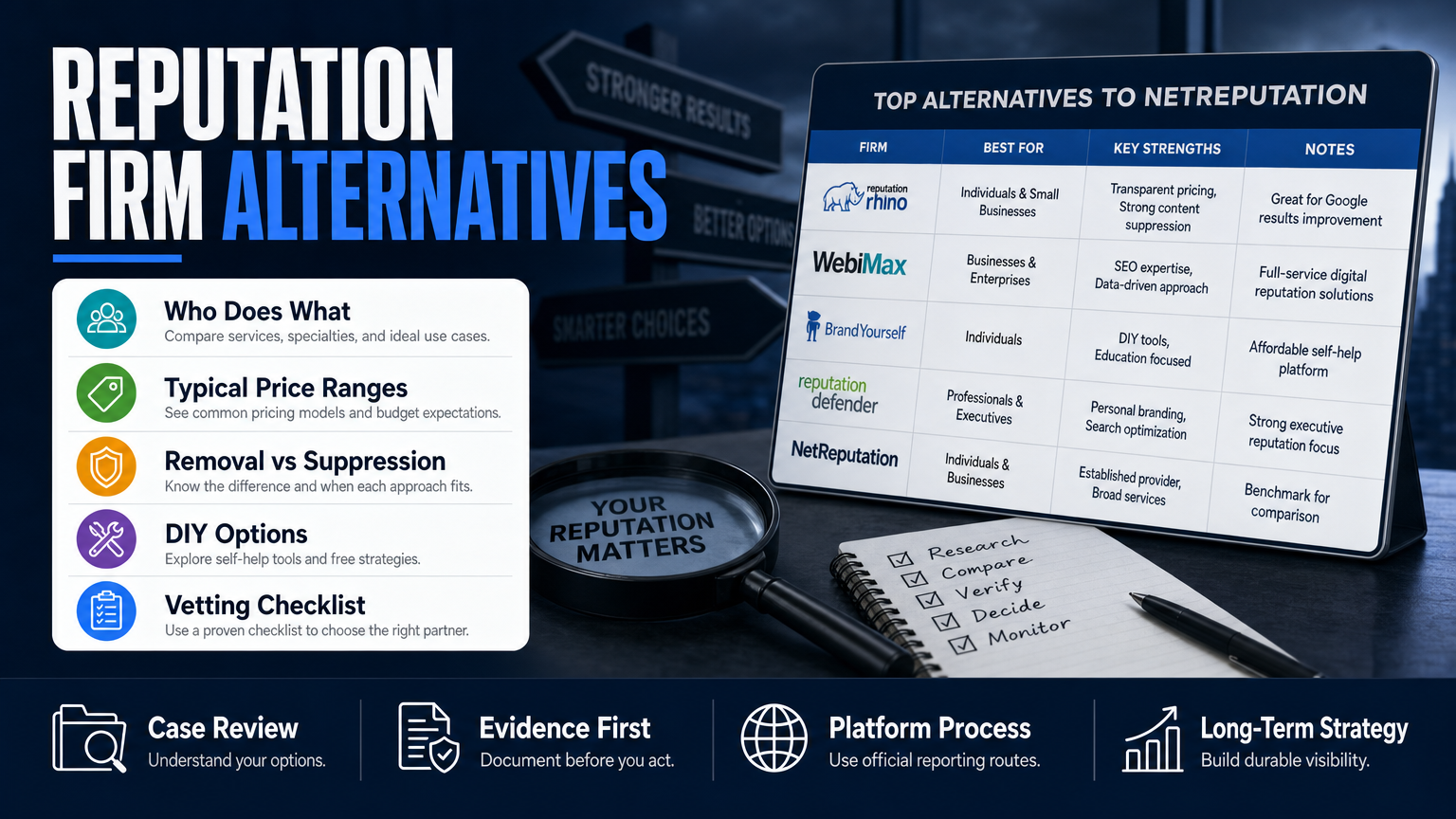
In London you’ll encounter four broad provider types: crisis PR firms, litigation-focused law firms, digital reputation specialists, and full-service security/resilience consultancies. Each brings different strengths and limitations.
Crisis PR firms focus on messaging, media outreach, and stakeholder communication. Law firms provide legal assessment and can issue notices or pursue takedown letters where appropriate. Digital reputation firms execute search-engine suppression, content-tracing, and platform takedown workflows.
If you need a combined approach, most complex incidents require coordination across these disciplines rather than a single-party solution.
- Identify the immediate need: legal protection, media control, or digital mitigation.
- Choose a lead coordinator—often the PR firm or the party with the most urgent deadline (e.g., regulatory or licensure risk).
- Align roles and communication lines: who speaks to media, who authorises legal letters, and who controls monitoring.
- Crisis PR: message strategy, press handling, stakeholder briefings
- Commercial law firms: defamation, privacy, injunctions, claimant defence
- Reputation/SEO firms: suppression, new content creation, backlink strategies
- Digital forensics & security: data intrusions, doxxing, evidence preservation
How a Typical London Team Is Structured
A practical crisis team has one lead client contact and named leads from PR, legal (or legal liaison), and digital response, plus an operations manager handling evidence and timelines.
- Lead client liaison: single point of contact
- PR lead: external messaging and journalist management
- Legal liaison: assesses defamation/privacy and issues formal notices
- Digital lead: takedown requests, SEO suppression, monitoring
What Are The Big 5 Law Firms In London?
The phrase ‘Big 5’ is used variously in the market to describe the largest or most influential City firms. The exact list can differ by practice area, but commonly cited elite UK firms include Linklaters, Freshfields Bruckhaus Deringer, Allen & Overy, Clifford Chance, and Slaughter and May.
These firms are full-service global players with deep litigation, corporate, and regulatory practices. They often act for major corporations and have high hourly rates; they’re not the default choice for every reputational issue, especially smaller, time-sensitive online takedown work.
- If a reputational incident risks regulatory sanction or complex cross-border litigation, consider top-tier firms for legal strategy.
- For fast online mitigation, pair a Big 5 or City firm’s legal advice with a specialist digital response team.
- Commonly named Big 5: Linklaters, Freshfields, Allen & Overy, Clifford Chance, Slaughter and May
- Strengths: cross-border litigation, regulatory work, high-stakes corporate matters
- Limitations: less nimble for fast platform takedowns, higher costs
When You Might Need a Big-Firm Partner
Cases involving multi-jurisdictional claims, major corporate clients, or potential criminal exposure often justify the cost and depth of a Big 5 firm.
- Cross-border discovery or injunctions
- Complex corporate reputation hits that implicate regulators
- High-value defamation or misuse-of-data litigation
Who Is The Most Feared Law Firm In The UK?
“Most feared” is a market perception rather than a formal designation. Historically, firms with the strongest litigation and media practices—sometimes including Harbottle & Lewis for media and reputation work, and a few City firms for aggressive commercial litigation—are described this way by in-house counsel.
Fear often reflects reputation for pursuing pre-action letters, swift injunction proceedings, or rigorous discovery. But a feared profile doesn’t automatically make a firm right for every case; tone and tactical fit matter more than bravado.
- Ask any prospective law firm for examples of similar matters and a plain-language description of likely next steps.
- Assess appetite for public litigation vs private negotiation—either can be appropriate depending on risk tolerance.
- Perception driven by track record in quick injunctive relief and vigorous defence of clients
- Media- and reputation-focused firms (e.g., Harbottle & Lewis) are often sought for urgent reputation work
- Match temperament to case: aggressive legal action can escalate publicity
Practical Consideration: When Aggressive Legal Posture Backfires
Demand letters and litigation can draw new attention to a complaint, especially if the underlying allegation has some public-interest component. Use legal escalation as a targeted tool, not a reflex.
- Weigh publicity risk before issuing threats or lawsuits
- Consider whether correction or negotiation would be less reputationally costly
What Are The Top Human Rights Firms In The UK?
Human-rights work in the UK is typically led by specialist firms and chambers with expertise in public law, civil liberties, and international human-rights frameworks. Names commonly referenced for stronger human-rights practices include Doughty Street Chambers, Leigh Day, and Public Law Project—though the list varies by subject matter.
For reputation incidents involving freedom-of-expression claims, press freedom, or asylum and privacy crossovers, these firms can advise on legal thresholds and public-interest defences.
- If the incident implicates press freedom, public-interest reporting, or state action, consult a human-rights specialist to assess defences.
- Coordinate human-rights counsel with digital and PR teams to avoid conflicting strategies.
- Commonly cited organisations: Doughty Street Chambers, Leigh Day (for some practices), and specialised public-interest groups
- Strengths: public law, civil liberties, press freedom issues
- Limitations: not typically used for standard commercial reputation suppression or takedowns
When Human-Rights Counsel Matters
Human-rights lawyers are important when the case raises fundamental freedoms or where challenging state actors; they are less frequently the right fit for a takedown of a small defamatory blog.
- Use for public-interest or state-related disputes
- Not a substitute for fast platform-based mitigation
When Removal Is Not Available: Suppression, Correction and Mitigation
Not all harmful content qualifies for removal. Removal depends on platform policies, publisher cooperation, jurisdiction, and whether the content is opinion, truthful public record, or alleged defamation. When removal is unavailable, the primary options are correction, search-engine suppression, and reputational repair.
Suppression and mitigation are tactical responses that aim to reduce the visibility and impact of damaging links rather than erase them. See our strategic advice on messaging and exposure management in Navigating PR Crises: Effective Online Reputation Management Strategies.
- Confirm whether the content violates platform policy or law—if not, treat it as permanent public information.
- Develop a content-suppression plan: identify target keywords and priority links to bury.
- Publish higher-authority content (press release, expert bios, client case studies) and use SEO to promote them.
- Correction: request factual updates or publish rebuttals where applicable
- Suppression: create authoritative, positive content to outrank negative items
- Mitigation: direct outreach to journalists/customers, reviews strategy, and monitoring
Tactical Suppression (90–180 day plan, illustrative)
A suppression campaign typically includes new content creation, digital PR placements, YouTube or LinkedIn articles, and SEO work aimed at pushing negative links off page one for targeted queries. Results vary and are not guaranteed.
- Create 6–12 authoritative assets: news releases, contributed articles, profile pages
- Build a measured backlink plan and social signals to support new assets
- Monitor rankings weekly and adapt targets based on algorithm and competitor activity
Comparison: Removal vs Suppression
Use this quick comparison when deciding whether to pursue removal (platform/legal) or suppression (SEO/PR). Both approaches can be used together, but expectations and timelines differ.
- Assess viability of a removal claim first; if weak, budget for suppression.
- Combine both where possible—pursue takedown requests while building authoritative replacement content.
- Removal aims to make the content inaccessible; suppression aims to reduce visibility.
- Removal depends on platform policy or legal leverage; suppression depends on content creation and SEO performance.
How To Decide Quickly
If the publisher is anonymous or a small forum with no legal protections, removal attempts may succeed; if the content is on a reputable news site or is a truthful public record, suppression is often the primary practical route.
- Ask: Is the publisher cooperative? Is the content demonstrably false? Does a legal claim exist?
- If uncertainty exists, prioritize preservation of evidence and a suppression plan.
How To Choose A Crisis Management Firm In London
Choosing the right provider means matching the firm’s strengths to your incident and risk tolerance. Price is important, but fit and demonstrated process matter more for time-sensitive cases.
Ask targeted questions about structure, reporting cadence, measurable milestones (not promised outcomes), and their experience with the specific platform or publisher involved.
- Request a written plan with roles, estimated ranges for timelines, and success metrics framed as inputs (e.g., number of takedown requests filed), not guaranteed outputs.
- Verify references from comparable clients where permissible and review vendor SLAs for monitoring and reporting.
- Ask for a named team and similar matter experience, not generic firm brochures
- Confirm whether they will coordinate with your legal counsel or suggest local counsel
- Check monitoring and escalation procedures and how they protect client confidentiality
Due Diligence Checklist
Before contracting, validate the firm’s technical capabilities, UK presence (or UK partners), and capacity for 24/7 response if the incident is escalating.
- Confirm UK contact or partner relationships
- Review sample reports and monitoring dashboards
- Ensure contractual confidentiality and IP protections are explicit
Emergency First Steps For An Online Reputation Crisis
Speed matters in the opening hours. Use a disciplined checklist to avoid public missteps and to preserve legal options.
Below is a concise playbook you can follow while you contact specialists.
- 1) Preserve evidence: screenshots, URL archives (Wayback/Archive.today), and metadata where possible.
- 2) Triage the channel: determine whether the priority is platform removal, PR containment, or legal action.
- 3) Notify key stakeholders: in-house counsel, senior leadership, and your chosen response provider.
- Don’t delete everything: preserve evidence before content disappears
- Limit public comments to factual acknowledgements if immediate response is needed
- Start transparent internal briefings so everyone on your team gives consistent statements
Sample 24-Hour Checklist
Use this to organize urgent tasks while you assemble external help.
- Collect evidence and make an incident log
- Temporarily pause public responses unless required; prepare a holding statement
- Flag regulatory or licensure deadlines and inform counsel
When To Involve Legal Counsel And How Agencies Coordinate
Legal involvement is appropriate when the content may be defamatory, a privacy violation, a breach of confidence, or when platform processes have been exhausted. A qualified attorney can assess whether a legal claim exists and what remedies are realistic.
Your reputation agency should operate as a coordinator: preserving evidence, filing platform complaints, and handing legal escalations to counsel. We coordinate with qualified legal professionals when a matter requires legal analysis and avoid giving legal advice ourselves.
- Notify counsel early enough to preserve privilege and meet any statutory deadlines.
- Coordinate statements: legal and PR leads should pre-clear public messaging to avoid admissions or legal exposure.
- Legal counsel evaluates claims, drafts formal notices, and may pursue injunctions or litigation
- Agencies run platform workflows, SEO suppression, and monitoring in parallel
- Decisions to escalate legally should include consideration of publicity risk and costs
What Agencies Need From Your Lawyer
To act efficiently, agencies often require a named counsel contact and written authorisation to liaise on takedown requests or to accept legal letters on your behalf.
- Consent to share selected materials under confidentiality
- Clear instructions on what constitutes privileged material
- Timely approval of any public statements that may have legal implications
Removal vs Suppression: Quick Comparison
Use this to decide whether to prioritise removal attempts or a suppression campaign.
| Removal | Suppression |
|---|---|
| Goal | Reduce visibility |
| Method | Create authoritative content and SEO |
| Dependence | Dependent on algorithms and new content |
| Speed | Slower; measurable over weeks–months |
| Control | Less platform-dependent control |
| Legal Need | Usually none |
| Typical Cost Profile | Moderate to high (ongoing) |
Hypothetical Example: A London Clinic With A Viral Complaint
Scenario: A US-based specialist runs a small clinic with patients in the UK. A single former patient posts a long allegation on a UK health forum and a local blogger republishes it. The post gains shares and appears on page one for the clinic name.
Process (anonymised and hypothetical): We triage, preserve evidence, assess removal options, attempt platform complaints, and run a suppression campaign while coordinating with UK counsel about possible defamation notices.
- Day 1–2: Evidence captured and immediate holding statement prepared for staff. Platform complaints filed.
- Day 3–14: Outreach to the blogger for correction or removal; monitoring and targeted SEO content creation begin.
- Weeks 3–12: New authoritative content (doctor profile, local press correction, patient-safety statement) are published and amplified; rankings monitored and adjusted.
- Triage and preserve: screenshots, Wayback snapshots, export of comments and shares
- Platform complaints: submitted to the forum and Blogger with documented policy violations where present
- Legal assessment: counsel reviews whether statements are false and whether a notice would be appropriate
Common Mistakes Teams Make During a London-Focused Crisis
Avoid common errors that turn manageable incidents into long-term reputation problems.
1. Reacting Publicly Without a Plan
Immediate, unvetted statements often contradict later legal or PR positions and can lock you into a narrative. Pause, preserve, and prepare a concise, factual holding statement when spokespeople are not ready.
2. Treating All Platforms The Same
Each platform has different policies and escalation paths. A takedown that works on Instagram won’t translate to an established news outlet, which may require correction requests or legal approaches.
3. Ignoring Jurisdictional Differences
UK defamation law differs from US law. Misreading jurisdictional tests leads to wasted legal spend. Engage counsel familiar with UK press and privacy law early.
Read about practical failures and how leaders can avoid them in 5 Critical Crisis Management Failures: Lessons for Modern Leaders.
4. Over-Promising Outcomes Internally
Vendors or internal leaders who promise content removal or guaranteed rankings set unrealistic expectations and risk damaging trust when platforms or search engines don’t comply.
5. Not Preserving Evidence
Failing to capture timely screenshots, URLs, and metadata destroys options for legal action or platform disputes later.
Best Practices For Working With Crisis Management Firms In London
Follow durable procedures that reduce legal risk and improve the chance of a prompt, practical outcome.
1. Establish A Single Incident Lead
A single point of contact prevents mixed messages and speeds decision-making. That person should have authority to approve statements and allocate budget.
2. Preserve Privilege And Evidence
Share sensitive materials with counsel under privilege where appropriate, and preserve copies of public posts, comments, and metadata immediately.
3. Use Platform Policies First, Legal Escalation Second
Start with the platform’s reporting channels for breaches of policy; escalate to counsel when the platform refuses or when law is implicated. We evaluate whether the content may qualify for removal or review before recommending legal steps.
4. Combine PR, Legal, And Technical Tactics
A coordinated campaign—simultaneous monitoring, takedown requests, reputational SEO and targeted PR—produces better outcomes than siloed efforts.
5. Plan For Long-Term Monitoring
Crises don’t always end when a single post disappears. Set up ongoing monitoring and alerts for months after an event to catch recurrences or new related content.
Expert Tips
- Preserve evidence immediately—screenshots and archived URLs are essential for legal and platform processes.
- Don’t promise removal or rankings to stakeholders; promise a documented process and regular updates instead.
- If you must respond publicly, keep statements factual, brief, and pre-cleared by legal counsel.
- Prioritise platform actions (reporting, copyright/defamation notices) in the first 72 hours while suppression assets are prepared.
- Ask prospective firms for a named team and similar-matter examples rather than marketing collateral.
- Budget both for immediate response and a 3–6 month suppression/monitoring plan when removal is unlikely.
- Match tone: aggressive legal action can escalate publicity; consider negotiation and correction where proportionate.
- Use reputable UK counsel when the incident affects UK searches or regulators; laws and remedies differ materially from the US.
Conclusion
A London incident that surfaces against a US professional is solvable in many respects, but there are no universal guarantees. The proper approach combines quick evidence preservation, a realistic assessment of removal options, and parallel mitigation through PR and SEO.
Choose providers who can clearly explain processes (not promises), coordinate across legal and communications teams, and commit to monitoring after the immediate crisis. If you’re unsure where to start, prioritize evidence collection and a brief holding statement while you assemble a response team.
Why Businesses Choose Your Reputation Agency
Managing your reputation takes more than monitoring reviews or publishing the occasional blog post. It takes a strategy built around your situation, your industry, and what is actually showing up in search.
Your Reputation Agency works with businesses, executives, healthcare professionals, attorneys and growing brands. Our services include:
- Remove defamatory content and false posts (news, blogs, listings)
- Remove or challenge negative reviews (Google, Yelp, TripAdvisor, industry sites)
- Mugshot and arrest record removal
- Remove videos, images, and other multimedia that damage reputation
- Remove personal data from people‑search and data‑broker sites (opt‑outs)
- Search result suppression (SEO to bury negative links)
- Social media takedowns and impersonation removal
- Rapid online crisis management and incident response
- Ongoing monitoring and alerting of reputation signals
- Coordination with legal counsel and use of legal tactics when required
Frequently Asked Questions
1. What are the big 5 law firms in London?
Lists vary by source, but the firms commonly cited as elite City practices are Linklaters, Freshfields Bruckhaus Deringer, Allen & Overy, Clifford Chance, and Slaughter and May. They handle complex cross-border litigation and regulatory matters but are not always the right fit for fast online takedowns.
2. Who is the most feared law firm in the UK?
“Most feared” is a market label reflecting litigation prowess—firms known for aggressive litigation or quick injunctive relief (including specialist media firms like Harbottle & Lewis) are often described this way. Fear is about reputation; choose temperament that matches your case rather than reputation alone.
3. What are the top human rights firms in the UK?
Human-rights and public-law work is typically led by specialist chambers and firms—examples include Doughty Street Chambers and select public-law practitioners. These firms are relevant when cases implicate press freedom, state action, or civil liberties rather than standard commercial reputation issues.
4. What is crisis management?
Crisis management is the coordinated set of actions taken to limit harm from an event that threatens reputation, operations, or legal standing. For online incidents it combines platform takedowns, legal assessment, PR messaging, technical remediation, and ongoing monitoring.
5. How long does it take to resolve an online reputation issue in the UK?
Timing varies greatly. Platform-review takedowns can sometimes occur in days but often take weeks or fail; suppression campaigns typically measure progress over weeks to months. We can provide estimated ranges after an assessment, but no universal timeframe applies.
6. Can a US business hire a London crisis management firm?
Yes. Many London firms and specialists work with international clients. Make sure the provider has UK-specific experience for London-focused searches and understands cross-border legal considerations.
7. Will a crisis management firm guarantee removal of negative content?
No reputable firm can guarantee removal. We evaluate whether content may qualify for removal or review and pursue available legal, technical, and platform options, but outcomes depend on platform policy, evidence, publisher cooperation, and jurisdiction.
8. Should I involve a lawyer immediately?
Involve a lawyer when the content appears defamatory, breaches privacy/confidentiality, raises regulatory risk, or when platform processes have been exhausted. Early legal consultation helps preserve privilege and ensures coordinated messaging between legal and PR teams.
9. What should I do first if a harmful post goes viral?
Preserve evidence (screenshots, archived URLs), limit public responses to a short factual holding statement, notify internal stakeholders, and assemble a response team for triage. Fast preservation keeps your legal options open and prevents sloppy public messaging.
This content provides general information and does not constitute legal advice. The available options and likely outcomes depend on the facts, evidence, platform policies, applicable law, jurisdiction, and public-interest considerations.
Past examples do not guarantee future results. Removal, correction, deindexing, and search-position changes depend on third parties and circumstances outside Your Reputation Agency’s control.