You opened this because a negative review, a mugshot site, or a viral complaint is sitting on the first page of Google for your property. That one item is already costing direct bookings, group RFPs, or a key corporate account — and you need practical options, fast.
This article explains hotel reputation management services: what agencies and software do, how much work like this typically costs, the 15-5 rule hotels use to triage guest issues, and concrete next steps you can take whether the content is removable or not. We use the phrase hotel reputation management services so you can see what works for hotels specifically.
You’ll get a clear comparison of removal vs suppression, timelines with caveats, a hypothetical end-to-end example, and a checklist of what to do when removal isn’t available. Read fast, act faster — reputation problems for hotels are time-sensitive and have measurable revenue consequences.
This is written for U.S.-based hotel owners, GMs, revenue managers, and small independent groups who need solutions that respect platform policy, evidence limits, and legal realities.
Table of Contents
- What are hotel reputation management services?
- How much do reputation management services typically cost?
- How much does an ORM typically cost?
- What is the 15-5 rule in hotels?
- How do hotels remove or challenge negative reviews and other content?
- Search-result suppression, SEO and what to do when removal is not available
- Crisis response, monitoring, and what to do after a viral incident
- Choosing between hotel reputation management software, DIY, and agencies
- Removal vs Suppression — A Practical Comparison
- Hypothetical: How a Boutique Hotel Responded to a Viral Complaint
- Common Mistakes Hotels Make Handling Reputation Problems
- Best Practices For Hotel Reputation Management
- Expert Tips
- Conclusion
- Why Businesses Choose Your Reputation Agency
- Frequently Asked Questions
What are hotel reputation management services?
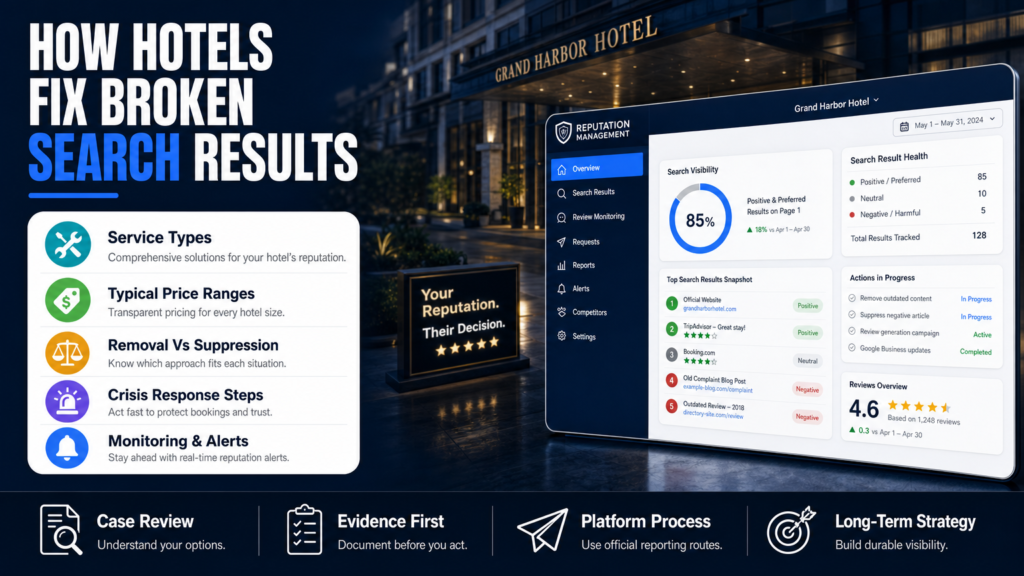
Hotel reputation management services are the set of technical, legal, SEO, PR, and customer-experience actions aimed at reducing the visibility and business impact of damaging online content about a property or manager.
Services range from pursuing removal under platform policies (for harassment, privacy violations, or defamation) to SEO-based suppression (creating and promoting authoritative pages that outrank the negative asset), to crisis response and ongoing monitoring.
We evaluate whether the content may qualify for removal or review, and we pursue the legal, technical, platform-based, and reputational options available. Platform decisions remain under the platform’s control, and outcomes depend on publisher, policy, evidence, and jurisdiction.
- Takedowns and reporting on Google, Yelp, Facebook, TripAdvisor, industry sites
- Challenging defamatory posts and coordinating with counsel when needed
- Mugshot and arrest-record removals and opt-outs from people-search sites
- Search-engine suppression using SEO to push negative links below page one
- Crisis PR and messaging to rebuild trust after a viral incident
- Monitoring, alerts, and digital-security remediation
How much do reputation management services typically cost?
Price depends on scope. For hotels, a small targeted matter (a handful of reviews or a single defamatory post) can be addressed with a short campaign; broader, multi-site suppression or ongoing monitoring is priced higher.
Typical ranges in the U.S.: one-off cleanups often start around $1,500–$5,000; focused monthly retainers for ongoing monitoring and review management commonly run $500–$2,500/month; full-service crisis and suppression campaigns for mid-size properties or brands can be $5,000–$50,000+ depending on scale and urgency.
These are industry ranges, not promises. Timing depends on the platform, publisher, evidence, legal complexity, and search-engine behavior. An estimated timeline can be provided after an individual assessment.
- Inventory the problem: number of offending URLs, platforms, and content type.
- Classify actions: removal viable, suppression required, or PR + SEO.
- Get a scoped proposal that ties deliverables to costs and reporting cadence.
- Small one-off takedown or opt-out: $1,500–$5,000
- Monthly ORM/monitoring retainer for single property: $500–$2,500/month
- Multi-property or enterprise campaigns: $5,000–$50,000+ (project basis)
- Emergency crisis response and PR: often higher short-term fees plus retainers
How much does an ORM typically cost?
ORM (online reputation management) pricing overlaps with the ranges above, but the label ORM often implies ongoing services: review solicitation, review response workflows, continuous monitoring, and monthly SEO.
Expect a baseline monthly ORM package for a single hotel to be $500–$2,000 depending on included services and whether the vendor handles review response on your behalf. Software-only solutions (SaaS) will be cheaper but require staff time; full-service agencies add management and escalation for higher fees.
- Compare software vs agency costs and what’s included (response writing, monitoring, escalation).
- Ask for case examples of hotel clients and sample reports.
- Confirm escalation rules, SLAs, and whether legal coordination is included or billed separately.
- SaaS-only review management tools: $50–$500/month per property
- Full-service ORM agencies (monthly): $500–$2,500+/month per property
- Emergency ORM + PR: custom pricing, often with an additional setup or rush fee
What is the 15-5 rule in hotels?
The 15-5 rule is a simple triage used by many hotels to prioritize guest recovery: resolve complaints within 15 minutes where possible, and if not, follow up within 5 hours with a recovery action.
Applied to online review damage, the principle becomes: address visible guest complaints quickly (acknowledge within 15 minutes on platforms where speed matters) and deliver a meaningful recovery or escalation within 5 hours or the same business day.
Speed demonstrates care and often prevents escalation into a viral complaint. That said, publicly acknowledging an allegation must be handled carefully — avoid admitting fault in public posts and move the conversation offline for detailed resolution.
- Train front-desk and social teams to flag complaints for immediate public acknowledgement.
- Use scripted but customizable messages that invite offline follow-up.
- Log the incident in a CRM or incident tracker for escalation if needed.
- 15 minutes: public acknowledgement or quick reply where platform norms expect fast responses (e.g., Twitter, Facebook Messenger)
- 5 hours: meaningful next steps — manager outreach, internal incident report, or offering a recovery
- Always escalate high-severity issues (safety, harassment, privacy breach) to legal/GM immediately
How do hotels remove or challenge negative reviews and other content?
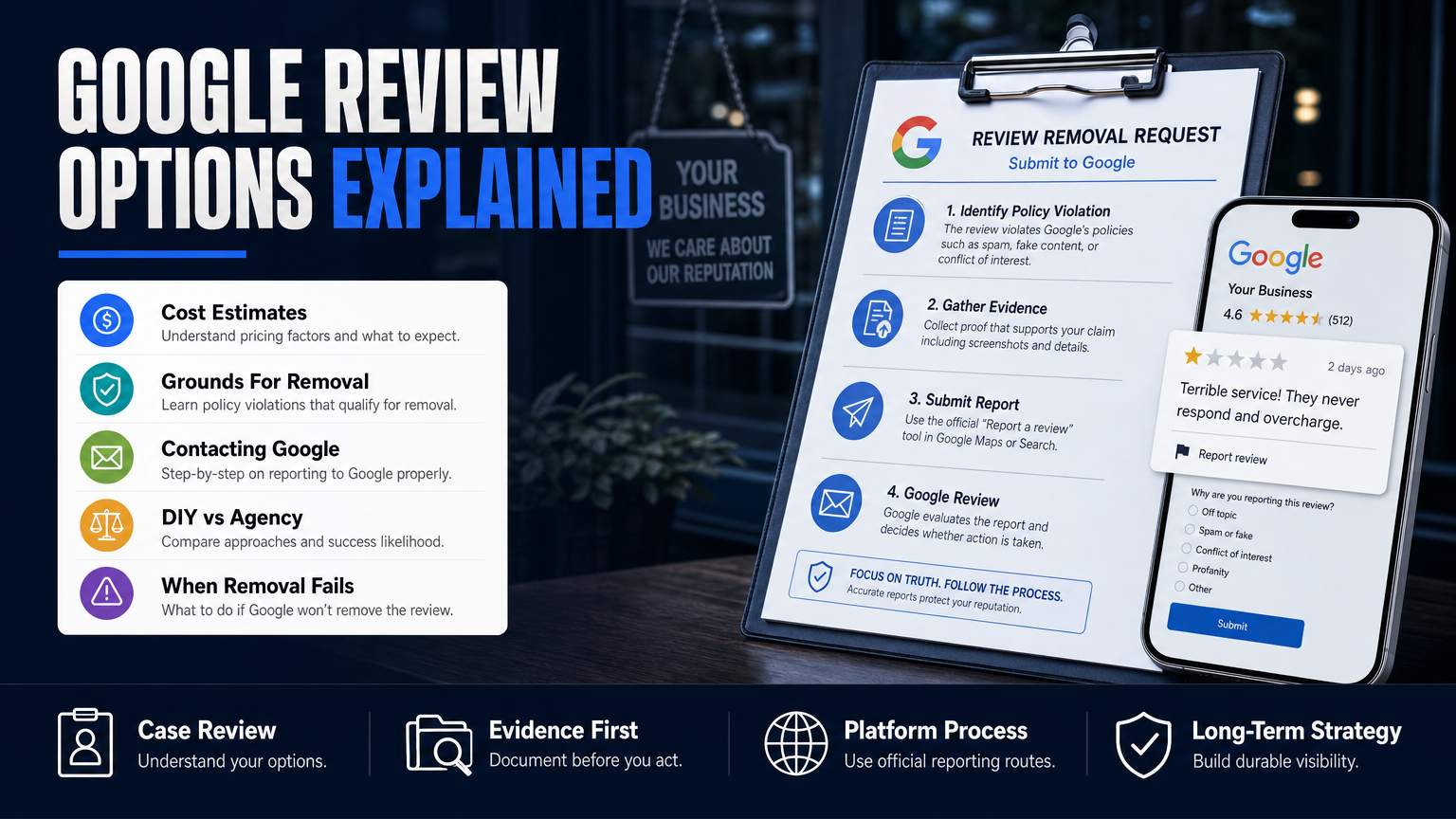
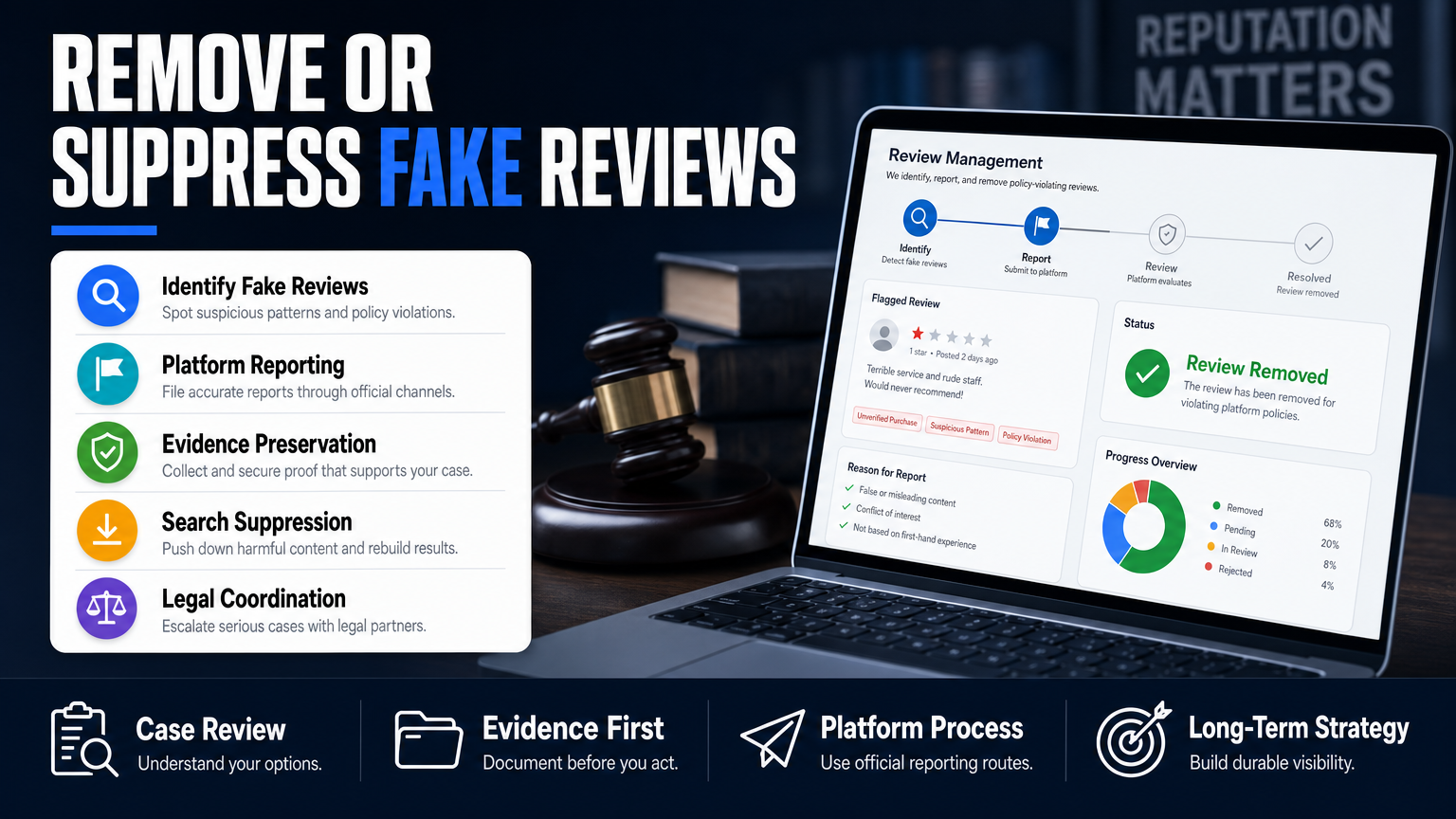
Removing content depends on platform policy, evidence, and whether the content violates rules (hate speech, defamation, privacy, impersonation). For Google, Yelp, Facebook, TripAdvisor and OTAs you must use the official reporting mechanisms and provide clear evidence when the claim is false or violates policy.
We evaluate whether the content may qualify for removal or review and pursue the legal, technical, platform-based, and reputational options available. Platform decisions remain under the platform’s control, and persistence plus documentation matter.
For a guide on how reviews can escalate to a major brand issue and when to escalate to paid support or legal counsel, see our analysis in When Google Reviews Become a Brand’s Biggest Crisis.
- Step 1: Collect host evidence (bookings, CCTV if relevant, staff logs).
- Step 2: File a platform report citing the specific policy violation and attach evidence.
- Step 3: If the platform denies the report, escalate to human review or request publisher correction.
- Step 4: If legal risk exists (defamation, privacy), coordinate with counsel; we coordinate with qualified legal professionals when a matter requires legal analysis.
- Document everything: reservation details, guest communications, photos, IP addresses if available.
- Use platform reporting forms with precise evidence and timestamps.
- Request removals for policy violations; request corrections for factual errors.
- Coordinate with the publisher (blog or local news) for corrections where appropriate.
When to involve legal counsel
Legal review is appropriate when a post alleges criminal conduct or clear falsehoods that materially harm the business and when other remedies fail.
A qualified attorney can determine whether a legal claim may be available. We coordinate with qualified legal professionals when a matter requires legal analysis.
Search-result suppression, SEO and what to do when removal is not available
When removal is unavailable—because the content is an opinion, a truthful public record, or hosted on a publisher that refuses to take it down—the usual next step is suppression: create and promote authoritative pages that push the negative item lower in search results.
Search result suppression is neither instant nor guaranteed. We develop SEO reputation strategies intended to improve the visibility of relevant and credible information, but search results may change because algorithms, competitors, publishers, and user behavior are outside our control.
For more on why the first page of search is functionally your external brand page and how to treat it, see The First Page of Google Is Your Real Homepage.
- Audit the first two pages of search for the brand and key staff names.
- Select 5–10 pages you can realistically create or influence (hotel site pages, local news, TripAdvisor listing, YouTube).
- Create and optimize those pages, then promote them with targeted outreach and backlinks.
- Monitor rankings and adjust the plan; timelines vary from weeks to months, sometimes longer.
- Targeted content: press releases, authoritative landing pages, staff bios, and curated social profiles.
- Leverage high-authority platforms: LinkedIn, YouTube, official brand pages, industry directories.
- Technical SEO: schema markup, page speed, backlinks from partners and franchise pages.
- Content diversification: videos and images can occupy valuable real estate and dilute a single negative URL.
When suppression is the right call
Suppression is the right option when content does not violate platform policy or when legal/removal options are impractical or disproportionate.
This is the most common outcome for truthful but damaging content, and for legacy news or review content that publishers refuse to change.
Crisis response, monitoring, and what to do after a viral incident
Rapid response matters. A 24–72 hour window after an incident is when narratives form and journalists, reviewers, and social accounts amplify content. Hotels should have playbooks that combine immediate acknowledgement, offline recovery, legal triage, and public messaging where appropriate.
Online monitoring and alerts are essential: set up keyword alerts for property name, GM name, and property social handles. Ongoing monitoring lets you detect review-bombing, impersonation, and spikes in traffic to negative assets.
If you plan a public message or an apology video, read our recommendations on platform risks and why certain formats can make a crisis worse in Why An Apology Video On TikTok Often Makes Crises Worse.
- Activate a crisis team (GM, legal, PR/communications, IT).
- Issue short public acknowledgement if required, then avoid detailed public dispute — move to private channels.
- Simultaneously start takedown/reporting, SEO suppression, and targeted PR to control narrative.
- Immediate steps: acknowledge, move conversation offline, log incident, and begin evidence collection.
- Monitoring: daily alerts for spikes, weekly reputation score checks, and monthly executive briefs.
- Security: change credentials, audit access, and apply doxxing mitigation if personal data was exposed.
Choosing between hotel reputation management software, DIY, and agencies
Hotel reputation management software (Revinate, TrustYou, Medallia and others) is valuable for ongoing review aggregation and guest feedback automation, but software alone cannot force removals, handle complex legal takedowns, or run an emergency suppression campaign.
DIY may work for small, routine review responses and simple opt-outs from data-broker sites, but complex removals, multi-platform suppression, and legal coordination typically require an experienced agency or counsel.
Before signing up with any vendor, ask for clear deliverables, escalation paths, and whether legal coordination is covered or billed separately.
- List what you can do in-house (responses, monitoring) and what you cannot (complex takedowns, legal escalation).
- Request trial access to software and evaluate agent responsiveness for agencies.
- Compare SLA terms, onboarding timelines, and reporting formats before committing.
- Software: good for scale and automation, cheaper, requires internal resources.
- DIY: lowest cost, highest time investment and risk of procedural errors.
- Agency: higher cost, offers human escalation, takedown experience, and coordinated PR/legal options.
Removal vs Suppression — A Practical Comparison
When you face a damaging asset, decide whether to pursue removal or suppression. Below is a concise comparison.
| Removal (Takedown) | Suppression (SEO & PR) |
|---|---|
| Goal | Goal |
| Eliminate the offending content from a platform | Push the offending content lower in search results |
| Requires policy violation or publisher cooperation | Works when content is lawful or the publisher refuses removal |
| Faster if platform/publisher agrees but not guaranteed | Slower — weeks to many months, variable |
| May involve legal letters or DMCA, privacy claims | Requires SEO, content creation, backlinks, PR |
| Higher chance of visibility disappearing for specific URL | Broader brand control across search results |
Hypothetical: How a Boutique Hotel Responded to a Viral Complaint
Scenario: A guest posts a video on YouTube and TikTok alleging poor sanitation; it gets shared on local Facebook groups and ranks on page one for the hotel’s name. The hotel’s direct bookings drop for four weeks.
Process we follow in this scenario (anonymized and hypothetical): we first collect reservation records, housekeeping logs, CCTV timestamps (if lawful), staff statements, and identify where the video appears in search results and local social shares.
Parallel tracks are opened: platform reporting for policy violations (harassment/false factual claim if evidence supports it), SEO suppression to create authoritative content, and a limited PR outreach to local press offering the hotel’s side and corrective actions.
- Day 1–2: Triage, acknowledge publicly without admitting liability, move complainant offline, collect evidence.
- Day 3–10: File platform reports, begin SEO content creation (staff bios, hotel improvements, press release), start outreach to partners for backlinks.
- Week 2–8: Monitor rankings and social traction, adjust content and outreach, consider paid amplification of positive assets.
- Month 2+: Re-evaluate remaining visible negative assets; if removal failed and suppression slow, plan ongoing content and review solicitation.
- Evidence collection before public responses to avoid admitting fault.
- Use platform reporting forms on YouTube, TikTok, Facebook, and Google with precise timestamps and attachments.
- Create positive, authoritative content: an official statement on the hotel’s site, a manager’s Q&A, and a professional video describing corrective steps.
Common Mistakes Hotels Make Handling Reputation Problems
These mistakes cost time, money, and often make the situation worse. Avoid them.
1. Publicly arguing details in a review thread
Engaging line-by-line in a public argument escalates visibility and trains algorithms and users to view the thread as active. It rarely resolves the issue and often increases shares.
Instead: acknowledge briefly, offer an offline channel, and document the incident.
2. Assuming negative content is removable because it’s false
Platform policies often protect opinions and truthful public records even when damaging. Removal depends on policy and evidence, not just on truth in the everyday sense.
Document evidence and evaluate alternative strategies like suppression when removal is not feasible.
3. Waiting too long to act
Delay allows content to propagate, be indexed, and referenced by aggregators. The longer a negative asset sits on page one, the more costly suppression becomes.
Apply the 15-5 principle for immediate triage and start evidence collection right away.
4. Using deceptive or retaliatory tactics
Creating fake positive reviews, censoring legitimate critics, or doxxing a reviewer is illegal or policy-violating and will backfire.
Use legitimate review solicitation, transparent corrections, and professional escalation instead.
5. Relying only on software without human escalation
SaaS systems flag and aggregate but cannot negotiate a publisher takedown or draft a legal demand letter. Complex issues need experienced human handling.
Plan for human escalation in your vendor selection.
Best Practices For Hotel Reputation Management
Durable practices reduce the chance of reputational crises and make remediation more effective when problems arise.
Document Everything Immediately
From the moment a complaint appears, gather reservation records, staff notes, CCTV (if lawful), timestamps, and any guest communications. Evidence is required for many platform reports and for legal escalation.
Have a Ready Crisis Playbook
Define roles (GM, PR, legal contact, social lead), response templates, and escalation triggers. Practice the playbook quarterly.
A playbook reduces time-to-response and avoids ad-hoc mistakes under pressure.
Use a Mixed Strategy: Removal, Suppression, PR
Apply removal efforts where policy violations are clear, suppression where content is lawful but damaging, and PR when the story has local or industry attention.
Coordinate all three tracks so messaging and evidence are consistent.
Invest in Ongoing Monitoring and Review Management
Set up daily alerts for brand mentions and weekly summary reports. Encourage legitimate positive reviews via post-stay emails and simple, reasoned response templates for managers.
Monitoring helps you spot coordinated attacks early and measure the effectiveness of suppression work.
Coordinate With Counsel For High-Stakes Claims
If allegations involve alleged criminal conduct, severe privacy breaches, or repeated defamatory claims, involve legal counsel early to preserve rights and evidence.
We coordinate with qualified legal professionals when a matter requires legal analysis — agencies are not law firms and cannot offer legal representation.
Expert Tips
- Always keep an offline trail: emails, timestamps, and screenshots with UTC stamps help in platform disputes.
- Prioritize guest remediation when revenue and licensure are at risk — a satisfied guest will sometimes retract or clarify public complaints.
- For suppression, target authoritative pages you control first: hotel site, franchise pages, executive bios, and LinkedIn.
- Avoid public technical rebuttals with excessive detail; they can be used against you in litigation and in social narratives.
- If a mugshot or arrest record surfaces, evaluate whether it falls under platform privacy rules or if it’s public record that needs suppression instead.
- Test responses on a single platform before rolling them out across all review sites to avoid repeating a messaging error.
- Include legal counsel in your vendor selection if you anticipate frequent high-stakes disputes.
- Measure ROI: track direct booking changes, conversion rate on branded searches, and review sentiment before and after remediation efforts.
Conclusion
Hotels face a uniquely visible reputation risk: guests post with multimedia, platforms amplify quickly, and negative items cost direct revenue in measurable ways. The right response mixes triage, documented evidence, platform reporting, and SEO suppression when removal is not feasible.
Hotel reputation management services offer technical and human resources that most properties cannot sustain in-house, but they are not magic. You should expect a professional process, clear reporting, and coordination with counsel when the matter exceeds platform remedies. Start with a fast inventory, document aggressively, and choose a targeted mix of removal attempts, suppression content, and crisis communications.
Why Businesses Choose Your Reputation Agency
Managing your reputation takes more than monitoring reviews or publishing the occasional blog post. It takes a strategy built around your situation, your industry, and what is actually showing up in search.
Your Reputation Agency works with businesses, executives, healthcare professionals, attorneys and growing brands. Our services include:
- Remove defamatory content and false posts (news, blogs, listings)
- Remove or challenge negative reviews (Google, Yelp, TripAdvisor, industry sites)
- Mugshot and arrest record removal
- Remove videos, images, and other multimedia that damage reputation
- Remove personal data from people‑search and data‑broker sites (opt‑outs)
- Search result suppression (SEO to bury negative links)
- Social media takedowns and impersonation removal
- Rapid online crisis management and incident response
- Ongoing monitoring and alerting of reputation signals
- Coordination with legal counsel and use of legal tactics when required
Frequently Asked Questions
1. How much do reputation management services typically cost?
Costs vary by scope. One-off cleanups commonly start at $1,500–$5,000; ongoing monthly services for a single property typically run $500–$2,500/month; large suppression or crisis campaigns can be $5,000–$50,000+. These are ranges, not guarantees — an accurate estimate follows an assessment.
2. What is the 15-5 rule in hotels?
The 15-5 rule triages guest issues: acknowledge urgent complaints within 15 minutes when platform norms demand speed, and take measurable recovery steps within 5 hours. Applied to online problems, act fast to prevent escalation, document the incident, then move the conversation offline.
3. How much does an ORM typically cost?
ORM (online reputation management) pricing overlaps with general reputation services. Expect SaaS tools at $50–$500/month, full-service monthly ORM at $500–$2,500+/month for a single property, and higher fees for emergency PR or legal coordination. Pricing depends on services included and escalation options.
4. What are reputation management services?
Reputation management services include takedowns and platform reporting, review-response workflows, SEO suppression to push harmful items down in search, monitoring and alerts, PR for narrative control, and coordination with legal counsel as needed. We evaluate whether content may qualify for removal or review and pursue the available options.
5. Are hotel reputation management services legit?
Yes — many reputable firms provide legitimate services like monitoring, review-response, takedown requests under platform policies, and SEO suppression. However, avoid vendors who promise guaranteed removals, guaranteed rankings, or ask you to post fake reviews; those approaches violate platforms and often legal standards.
6. How long does suppression take?
There is no universal timeframe. Suppression can take weeks to many months depending on search competition, the authority of new content, and algorithm changes. Timing depends on the platform, publisher, and search-engine behavior — an estimated timeline can be provided after assessment.
7. What should I do first if a negative video or article goes viral?
Immediately document evidence, acknowledge publicly in a short professional message where appropriate, move detailed discussions offline, and start parallel tracks: platform reporting, SEO suppression, and PR/crisis response. If allegations are potentially defamatory or involve safety, involve legal counsel early.
8. Can you remove mugshot or arrest records?
Some mugshot and arrest-record sites allow opt-outs or removals under specific conditions, and other cases may require legal review. We pursue the legal, technical, and platform options available, but removal depends on publisher policies and applicable law.
9. Should I use software or hire an agency for hotels?
Use software for scale and automation (aggregation, alerts), but plan for human escalation. Software alone cannot negotiate complex takedowns or run a full suppression campaign. For high-risk or high-impact cases, an agency that coordinates legal, PR, and SEO is usually appropriate.
This content provides general information and does not constitute legal advice. The available options and likely outcomes depend on the facts, evidence, platform policies, applicable law, jurisdiction, and public-interest considerations.
Past examples do not guarantee future results. Removal, correction, deindexing, and search-position changes depend on third parties and circumstances outside Your Reputation Agency’s control.