Digital Archeology: How Scammers Use Your 2012 Posts to Destroy Your 2026 Reputation
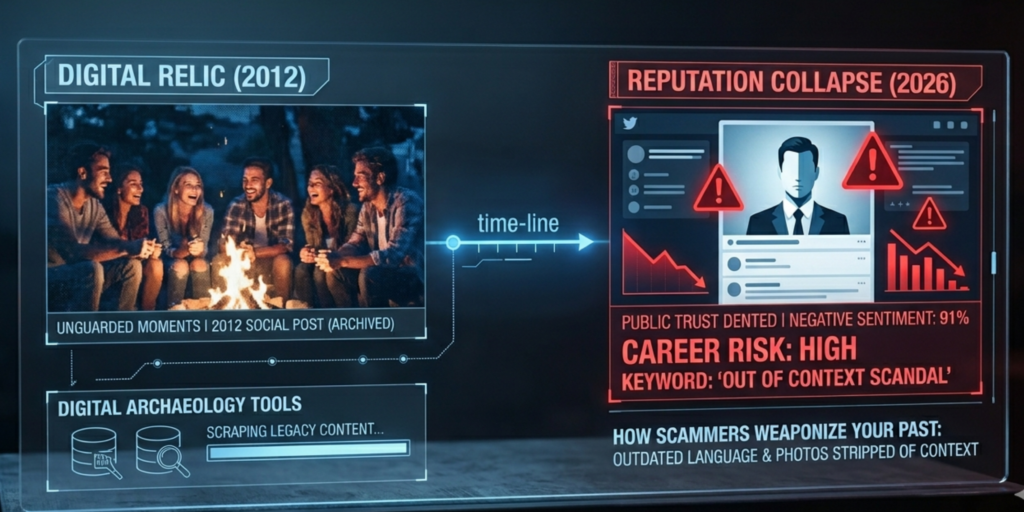
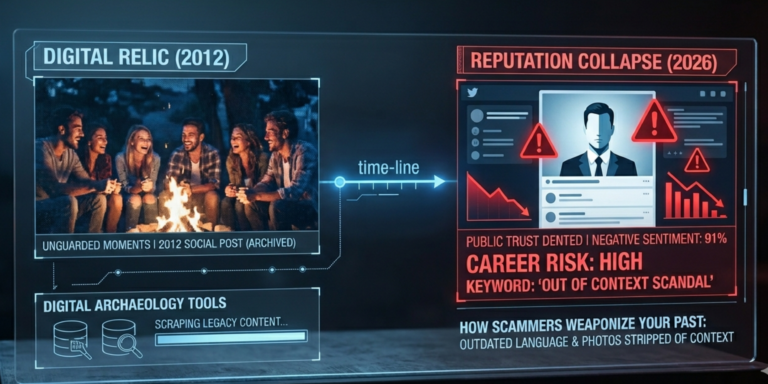
The internet never forgets, but it does lose context. What seemed like a harmless joke, a heated debate, or a personal opinion shared in 2012 can be unearthed and weaponized today. This practice, known as Digital Archeology, is being used by scammers and professional detractors to launch coordinated reputation attacks. By stripping old content of its original timeframe, they create a “false present” that can derail careers and bankrupt brands.
1. The Context Collapse
In 2012, social media was often treated as a private diary or an informal gathering. Today, those platforms are professional archives. Scammers look for “relics”—outdated language, old affiliations, or moments of personal struggle—and present them as if they happened yesterday. This “context collapse” forces the victim to defend who they were over a decade ago against the standards of the current year. For a high-level executive or a public official, a single unearthed post can trigger an immediate loss of stakeholder trust.
2. Why "Manual Removal" is a Losing Game
Many individuals attempt to use the “Opt-Out” forms provided by sites like Whitepages or Spokeo. However, this is a reactive and temporary fix. These platforms are designed to re-populate their databases within weeks by scraping new public records, a practice frequently monitored by privacy advocates at the Electronic Frontier Foundation. As we’ve analyzed in our look at Data Broker Risks, the speed at which information replicates means that manual removal is like trying to empty the ocean with a spoon.
3. Scrubbing vs. Strategic Overwriting
Many professionals respond to this threat by trying to delete their entire digital history. However, mass deletion often acts as a “red flag” to algorithms and investigative journalists. A more effective defense involves Strategic Overwriting. This means:
Deep-Audit Monitoring: Using professional tools to identify “high-risk” legacy content before an attacker does.
De-indexing Archives: Working with search engines to remove outdated personal information and cached pages that no longer reflect your current status.
Narrative Displacement: Creating a dominant, modern digital footprint that makes “archeological” finds appear irrelevant or clearly outdated.
FAQ
Can a post from 10+ years ago really get me fired? Yes. Many corporate morality clauses do not have an expiration date. If an old post surfaces and causes a PR crisis, boards often choose the path of least resistance: termination.
Is it illegal for someone to share my old public posts? Generally, no. If you posted it publicly, it is public domain. However, if the posts are used for extortion (demanding money to keep them quiet), it becomes a criminal matter.
How does Your Reputation protect my past? We perform a “Digital Deep Dive” to find what an attacker would find. We then use technical suppression and SEO strategies to ensure that your current achievements outshine and bury your digital relics.
Your past shouldn’t have the power to sabotage your future. But in an age of professional digital archeology, a “set it and forget it” attitude toward social media is a liability. At Your Reputation, we act as your digital curators, ensuring that your online history reflects the leader you are today, not the person you were a decade ago.
Is your digital past a ticking time bomb? Don’t wait for a scammer to find your old “receipts.” Clean your history and protect your future with a professional audit.