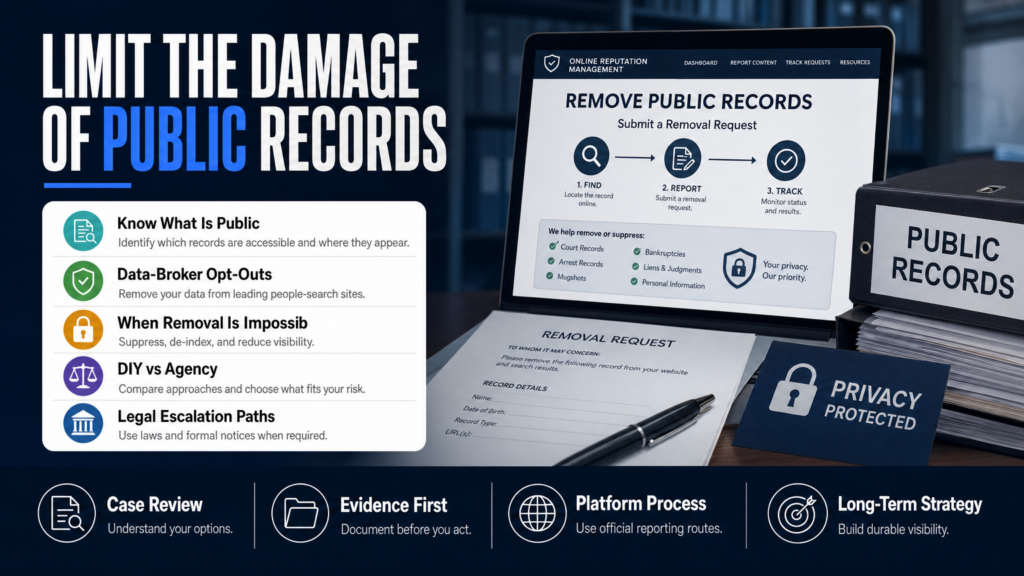
If a court docket, arrest record, property filing, or a people-search profile is the first thing people see when they Google you, you’re not alone — and there are concrete steps you can take. How do I remove my public records from the internet? The short answer: sometimes they can be taken down, often they can only be mitigated, and the right path depends on the source, platform, and jurisdiction.
This article walks through the practical options available to U.S. residents and professionals: how removal requests work on different platforms, what data brokers do (and how to opt out), when legal remedies may be required, realistic cost ranges, and exactly what to do when removal isn’t available.
Read on for step-by-step checklists, a comparative table of DIY vs. professional help, a hypothetical end-to-end example, common mistakes to avoid, and the short list of actions that typically produce the fastest reduction in visibility.
Table of Contents
- How do I delete my public records account?
- How much does it cost to remove your personal information from the internet?
- How do I remove my name from being googled?
- Can someone see your internet history even if you delete it?
- How to remove addresses, phone numbers and people-search listings
- What to do when removal is NOT available
- When a court judgment won’t leave your public record
- DIY vs. hiring an agency: a comparison
- DIY vs. Professional Agency
- Hypothetical: How a Single Arrest Record Was Managed
- Common Mistakes People Make When Trying To Remove Public Records
- Best Practices For Managing Public Records Online
- Expert Tips
- Conclusion
- Why Businesses Choose Your Reputation Agency
- Frequently Asked Questions
How do I delete my public records account?
There isn’t a single “public records account” to delete — public records are published across courthouses, news sites, people-search companies, and specialized public-record aggregators. Start by identifying where the record actually lives.
We evaluate whether the content may qualify for removal or review, but removal depends on the publisher, platform policy, and the nature of the record (e.g., a government docket vs. a private background-check profile).
- Step 1: Compile a spreadsheet with the exact URLs, the date found, and whether the site offers an opt-out or removal form.
- Step 2: Check site policies — many people-search sites have an opt-out link in the footer or a privacy page.
- Step 3: For court or government pages, record the docket number and the agency hosting the record (county clerk, state repository).
- Search your full name in quotes plus known locations (“John D. Smith” “Denver”)
- Note URLs, publisher names, and screenshots (date-stamped) for records you want removed
- Categorize sources: government/court, news, data-broker/people-search, review site, social media
How to use publisher and platform processes
Private sites (people-search, some aggregators) often provide opt-out and ID-verification processes. Follow them precisely: missing fields cause denials.
Major platforms like Google have a takedown request process for certain privacy violations, but they generally won’t remove lawful public records just because they’re embarrassing or unwanted.
- People-search opt-outs: expect email verification and identity upload on some sites
- Platform reports (Google, Bing): use their formal forms when content violates policies (doxxing, sensitive personal data)
- For news articles, request corrections or retractions from the publisher when factual errors exist — Google will not remove accurate, lawful news.
How much does it cost to remove your personal information from the internet?
The cost depends on the route: DIY opt-outs are often free but time-consuming; automated removal services and agencies charge fees; legal escalation is the most expensive. We pursue the legal, technical, platform-based, and reputational options available — but we can’t promise removal.
Typical ranges in the U.S. (illustrative, not a guarantee):
- Estimate time: expect multiple hours per site for DIY opt-outs, and repeated monitoring for reappearances.
- Ask providers for written service scopes and what they will attempt — note they should never promise guaranteed removal.
- If cost is the main constraint, prioritize the most visible URLs (first page Google results and major aggregator profiles).
- DIY: $0–$500 (time is the main cost; some sites require notarized IDs for opt-out)
- Automated or subscription removal services: $100–$600/year depending on coverage and updates
- Reputation-management agencies (comprehensive suppression + monitoring): $1,500–$10,000 initial, $200–$1,000/month ongoing depending on scope
- Legal action (injunction, defamation suits, or discovery): $5,000–$100,000+ depending on counsel and complexity
Cost drivers to watch
Legal complexity (factual disputes, jurisdictional issues) quickly raises cost.
High-authority publishers (national news sites, government databases) are harder to suppress and therefore require more SEO and PR work.
Recurring exposure: mugshot sites and some data brokers reappear quickly without ongoing monitoring and repeat opt-outs.
- Number of distinct domains hosting the record
- Whether the publisher is a private data broker vs. a government source
- Whether identity verification or notarization is required for opt-outs
When to consider paid help
Consider a paid agency if the negative content is causing measurable business or career harm, appears on page-one search results, or reappears after DIY attempts.
For professionals with licensure or high incomes, the brand and career risk often justify the expense of a managed program.
- Page-one visibility affecting clients or referrals
- High-volume reappearance of mugshots or data-broker listings
- A viral incident or coordinated review attack
How do I remove my name from being googled?
You cannot ‘un-Google’ yourself universally. Google indexes what publishers make available. Your goal is therefore twofold: remove content at the source where possible, and suppress or outrank it where removal isn’t available.
We develop SEO reputation strategies intended to improve the visibility of relevant and credible information — but search results may change due to algorithms and outside factors, so results vary.
- Step 1: Prioritize the exact URLs showing on page one of Google for your name.
- Step 2: Submit source takedown or correction requests where applicable (news corrections, data-broker opt-outs).
- Step 3: Create or strengthen high-authority pages in your name (LinkedIn, About page, professional directories).
- Step 4: Use ongoing monitoring so resurfacing content is quickly addressed.
- Source removal: request takedowns, opt-outs, or corrections from the site hosting the content.
- Suppression: publish and promote authoritative profiles and content (LinkedIn, professional bio pages, legal bios, press mentions) to push negative results down.
- Google-specific steps: use the ‘Remove Outdated Content’ tool for removed pages, and use URL removal only when content was actually removed at source.
Tactical content to build and promote
Useful items for suppression: a strong LinkedIn profile, a personal domain with an About page, professional bios on employer sites, author pages for published articles, and targeted press that uses structured name metadata.
A strategic SEO plan balances on-site content, backlinks, and content promotion; agencies often combine these with paid promotion to accelerate visibility changes.
- Claim and optimize author and staff pages on your firm’s domain
- Publish positive coverage or thought leadership on credible sites
- Use schema and accurate name+location metadata to help search engines associate content with you
Can someone see your internet history even if you delete it?
Deleting browser history or clearing local caches removes evidence from your device, but it does not erase server logs, ISPs’ records, or third-party data collected earlier. In most circumstances, other parties cannot access your private browsing history simply because you deleted it locally.
If you worry about forensic recovery or legal disclosure, consult a qualified attorney or digital-forensics professional. Deletion on your device is not the same as removing records on remote servers.
- Step 1: For privacy on devices, clear browsing history, caches, and log out of accounts; use private browsing for sensitive searches.
- Step 2: When legal exposure is a concern, preserve or secure evidence and get legal counsel before deleting anything that might be relevant to litigation.
- Step 3: Consider digital security measures (VPNs, endpoint controls) for ongoing protection, remembering these don’t retroactively remove server-side records.
- Local deletion: removes history from that device and browser profile only
- Server-side logs: websites and ISPs may retain logs independently
- Third-party trackers: ad networks and analytics can retain behavior data
When deletion can be misleading
People sometimes delete local history to hide activity from employers or partners; that may raise legal or ethical issues if used to conceal wrongdoing. If there’s any possibility of legal discovery, get counsel first.
For reputation work, focus on public content and visible URLs rather than private local history — public records and published pages are the ones people will find by searching your name.
How to remove addresses, phone numbers and people-search listings
People-search sites and data brokers are where your address and phone records most often appear. You can usually request an opt-out, but the process varies and often requires identity verification.
For location-specific problems (for example, your address appearing as the main Google result for your name), see our guidance on suppression and published corrections at When Your Address Becomes the First Result on Google.
- Step 1: List all instances of your address/phone across data-broker sites.
- Step 2: Follow each site’s opt-out process and keep confirmation receipts or screenshots.
- Step 3: Add these sites to a monitoring watchlist and re-check every 30–90 days for reinsertions.
- Identify the major aggregators (Whitepages, Spokeo, Intelius, PeopleFinders, BeenVerified) and use their opt-out pages.
- Prepare identity verification if requested — some sites accept a photo ID or notarized form; follow instructions exactly.
- Expect re-appearances; many data brokers refresh their databases and re-ingest public records.
When opt-outs aren’t enough
If your address appears on a property-record page hosted by a government site, you cannot remove accurate public records. Instead, consider mitigation: request a human-review where allowable, and push authoritative pages that list your professional address or P.O. box if appropriate.
If your address exposure is causing a safety risk, consider contacting local law enforcement and consulting a privacy attorney.
What to do when removal is NOT available
Sometimes removal is impossible: government-held records, truthful news coverage, and court dockets are commonly non-removable. When that’s the case, mitigation and reputational repair are your realistic options.
We pursue measures such as correcting factual errors, publishing stronger positive content, targeted SEO suppression, and coordinated PR to control the narrative — all options depend on the publisher and platform.
- Step 1: Audit the search results and prioritize URLs to suppress (focus on first-page links).
- Step 2: Build and promote 6–12 high-authority pages you control or can consistently influence.
- Step 3: Use ongoing monitoring and occasional paid amplification for key pages until the negative URLs move down.
- Request corrections from publishers when the record contains factual errors.
- Create authoritative alternative content (professional bios, articles, client testimonials) to outrank the problematic result.
- Use structured data, backlinks, and domain authority to accelerate suppression of negative links.
When legal review is required
If the content is false and injurious, the content may warrant legal review. A qualified attorney can determine whether a legal claim (defamation, privacy tort, or other remedies) may be viable. We coordinate with qualified legal professionals when a matter requires legal analysis.
Legal remedies vary by jurisdiction and can include cease-and-desist letters, retraction demands, or lawsuits — none are guaranteed and they carry cost and risk.
When a court judgment won’t leave your public record
Court judgments and filings are typically public records and not removable simply because they’re inconvenient. For guidance when these records keep resurfacing, see When a Court Judgment Won’t Leave Your Public Record.
Options include checking for factual or procedural errors that could justify a motion to seal or vacate (which requires legal counsel), and pursuing mitigation instead of removal when sealing isn’t possible.
- Step 1: Consult a qualified attorney to determine if relief like expungement, sealing, or vacatur is available in your jurisdiction.
- Step 2: If legal sealing is not an option, implement a suppression campaign focusing on the most prominent search results.
- Step 3: Use targeted PR to correct public misconceptions while respecting legal constraints and court records.
- Court sealing or expungement: available in limited circumstances and under specific legal standards — consult an attorney.
- Ask the court clerk whether redaction or sealing is available for sensitive identifiers (SSNs, minors’ names).
- If the judgment is accurate and public, prioritize suppression through SEO and authoritative content.
DIY vs. hiring an agency: a comparison
Deciding between doing this yourself and hiring a specialist depends on your time, risk tolerance, and how critical the reputation risk is to income or licensure. Below is a side-by-side comparison to help you choose.
DIY vs. Professional Agency
A realistic comparison of what you can expect from do-it-yourself opt-outs versus hiring a reputation agency.
| DIY (Self-Help) | Professional Agency |
|---|---|
| Cost | Lower upfront; time cost. Possible subscriptions. |
| Time to implement | Faster execution for large teams; continuous management |
| Technical breadth | Access to SEO, outreach, legal coordination, and escalation |
| Success on complex cases | Better for repeated re-insertions and high-authority suppression |
| Transparency | Professional reporting but check scope and guarantees |
| Ongoing monitoring | Usually included in packages |
Hypothetical: How a Single Arrest Record Was Managed
Situation: A mid-career physician discovered a county arrest docket and a mugshot site listing on the first page for searches of their name. The physician was not convicted; the docket was publicly accessible and a local newspaper had briefly covered the arrest.
Objective: Reduce first-page visibility, correct factual errors where possible, and minimize the risk to referrals and hospital privileges.
- Monitor search results weekly and re-submit opt-outs for sites that re-ingest data.
- If the court record could be sealed under local law, consult a specialist attorney — otherwise prioritize suppression and correction.
- Maintain an incident log for credentialing inquiries showing steps taken to address the record and communications with publishers.
- Step 1: Inventory URLs (court site, mugshot aggregator, local news article).
- Step 2: Submit opt-out requests to data brokers and take down requests to the mugshot aggregator if platform policy allowed (no guarantee of success).
- Step 3: Request correction or clarification from the local newspaper about factual errors in the coverage; request removal only if the article contained demonstrable falsehoods.
- Step 4: Publish a professional statement and update authoritative bios (hospital profile, medical licensing board with accurate status).
- Step 5: Launch an SEO suppression plan to build out LinkedIn, the physician’s hospital bio, several authored articles on reputable medical sites, and a press release highlighting recent professional work.
Common Mistakes People Make When Trying To Remove Public Records
Below are frequent errors that slow down resolution or make problems worse.
Mistake 1: Treating all sites the same
Not all publishers behave the same — government sites, reputable news outlets, and data brokers have different policies and legal obligations. Attempting the same approach for all of them wastes time.
Mistake 2: Using incomplete or sloppy opt-outs
Missing fields, incorrect URLs, or poor ID scans lead to denials. Follow each site’s instructions exactly and keep confirmations.
Mistake 3: Expecting permanent removal without legal basis
Assuming platforms will remove accurate public records because they’re embarrassing is unrealistic and sets wrong expectations. Prepare mitigation strategies when removal isn’t an option.
Mistake 4: Publicly calling out publishers or creating more content that references the issue
Over-sharing or blogging about the negative content can create new searchable pages that reference the issue, perpetuating the exposure instead of containing it.
Mistake 5: Failing to monitor for reappearance
Data brokers and scraper sites repopulate listings frequently. Without ongoing monitoring, your work can be undone within weeks.
Best Practices For Managing Public Records Online
Adopt a process that mixes source takedown attempts, SEO suppression, legal assessment, and continuous monitoring.
1. Map and prioritize
Start with a clear inventory and rank items by visibility and impact. Page-one results and high-authority domains deserve top priority.
2. Use exact evidence and forms
When submitting opt-outs or corrections, include exact URLs, screenshots, and concise explanations. Keep records of every communication.
3. Build authoritative replacement content
Strengthen pages you control (firm site, professional directories) and publish credible third-party content where possible to outrank negatives.
4. Monitor and re-submit
Set a routine to re-check every 30–90 days and prepare to re-submit opt-outs. Consider automated monitoring for high-risk people.
5. Involve counsel when appropriate
When records are inaccurate, injurious, or when court records might be sealed, coordinate with qualified legal counsel rather than relying on DIY legal threats.
Expert Tips
- Search in private mode to see unbiased public results without personalized ranking.
- Prioritize fixing factual errors on news stories — corrections can sometimes reduce downstream republication.
- Use a personal domain (yourname.com) as a canonical authoritative page for your name.
- Keep a dated log of every opt-out and publisher communication for escalation or legal use.
- When you must upload ID for opt-out, mask unrelated details on the document if the site allows.
- If a mugshot site demands payment, don’t pay; document the demand and escalate via reporting channels and legal counsel.
- Consider a P.O. box or registered business address for public-facing listings to separate home addresses from online records.
- Automate alerts (Google Alerts, monitoring tools) for name variants and common misspellings.
Conclusion
Removing public records from the internet is rarely a single technical action — it’s a program that blends removal requests where possible, legal review where necessary, and suppression and monitoring when removal can’t be achieved. We evaluate whether the content may qualify for removal or review and then pursue the legal, technical, platform-based, and reputational options available.
Act deliberately: inventory what you can control, prioritize first-page threats, document every step, and get specialist help when the content affects income, licensure, or personal safety. If removal isn’t available, mitigation and reputation repair are practical, measurable ways to reduce the harm and restore your professional standing.
Why Businesses Choose Your Reputation Agency
Managing your reputation takes more than monitoring reviews or publishing the occasional blog post. It takes a strategy built around your situation, your industry, and what is actually showing up in search.
Your Reputation Agency works with businesses, executives, healthcare professionals, attorneys and growing brands. Our services include:
- Remove or suppress negative Google search results and news articles
- Take down or mitigate negative reviews (Google, Yelp, Trustpilot, industry sites)
- Remove defamatory content, false posts and impersonation accounts
- Remove personal data from people-search and data-broker sites (opt-outs)
- Mugshot and arrest-record removal or suppression
- YouTube and negative video removal / demotion
- Rapid crisis response for viral incidents and online smear campaigns
- Social media impersonation and fake account removal
- Reputation monitoring, alerts and ongoing surveillance
- Search engine reputation repair (SEO to bury negative results)
Frequently Asked Questions
1. How do I delete my public records account?
There’s no universal ‘public records account’ to delete. Identify the specific websites publishing the record, follow each site’s opt-out or takedown procedure, and document every submission. For government or court-hosted records, removal is often not possible without a legal sealing or expungement order.
2. How much does it cost to remove your personal information from the internet?
Costs vary widely. DIY opt-outs are usually free but time-consuming. Paid services range from modest yearly subscriptions to multi-thousand-dollar agency programs. Legal action can be significantly more expensive. Ask providers for written scopes; no provider should promise guaranteed removal.
3. How do I remove my name from being googled?
You can’t make your name disappear from search engines. The practical approach is to remove content at the source when possible and to publish authoritative, high-quality pages that push the unwanted results lower on search pages. This involves SEO, content creation, and ongoing monitoring.
4. Can someone see your internet history even if you delete it?
Deleting local browser history removes it only from that device. Websites, ISPs, and servers may still retain logs. If legal discovery or forensic examination is a concern, consult counsel — deletion doesn’t erase server-side records.
5. Can I force Google to remove a court record or news article?
Google generally will not remove accurate, lawful public records or factual news reporting just because content is embarrassing. Removal requests succeed when content violates specific policies (doxxing, sensitive personal data) or when a publisher removes the content at source. We use Google’s official reporting processes but platform decisions remain under their control.
6. What if my address or phone number keeps reappearing on people-search sites?
Data brokers often re-ingest public sources. Re-submit opt-outs promptly, use monitoring to catch reinsertions, and consider using a business address or P.O. box for public listings. If the issue creates safety risks, consult local authorities and privacy counsel.
7. When should I consult an attorney about a public record?
Consult an attorney when the record appears to be false and injurious, when you believe a sealing or expungement may be possible, or when publishers refuse valid correction requests. A qualified attorney can assess legal options, but they cannot guarantee outcomes.
8. Are there reliable services that will permanently delete my records?
No reputable service can legally guarantee permanent deletion of every online record. Reputable providers will describe the actions they will take, the likely limitations, and the monitoring required to manage reappearances. Permanent deletion depends on the publisher and the nature of the record.
This content provides general information and does not constitute legal advice. The available options and likely outcomes depend on the facts, evidence, platform policies, applicable law, jurisdiction, and public-interest considerations.
Past examples do not guarantee future results. Removal, correction, deindexing, and search-position changes depend on third parties and circumstances outside Your Reputation Agency’s control.