You just found a one-star Google review that’s inaccurate, threatening to cost you clients, or written by a former employee — and the question on your mind is: Can you delete Google reviews as a company?
Short answer: you cannot directly delete a customer’s Google review. This article explains exactly what a business can and cannot do, how to pursue removal when the review meets Google’s policies, and pragmatic fallback plans when removal isn’t available.
I’ll give step-by-step reporting and escalation actions, response templates you can adapt, and mitigation strategies (SEO, PR, and monitoring) that respect platform rules and legal constraints.
If you’re responsible for hiring, patient intake, or revenue, follow the checklist sections below — they prioritize fast containment, documented evidence, and options that preserve your legal position.
Table of Contents
- Can a company delete Google reviews?
- Can I recover deleted Google reviews?
- How do you respond to negative reviews?
- Is it illegal to hide negative reviews?
- Dealing with review-bombing and coordinated attacks
- How do I leave multiple Google reviews?
- Monitoring, escalation, and when to involve counsel or PR
- DIY vs Agency: Quick Comparison
- Hypothetical: Doctor Facing a False One-Star Review
- Common Mistakes Businesses Make
- Best Practices For Handling Problematic Reviews
- Expert Tips
- Conclusion
- Why Businesses Choose Your Reputation Agency
- Frequently Asked Questions
Can a company delete Google reviews?
No. A business cannot directly delete a review a third party left on Google. Only the person who posted the review (the reviewer) or Google can remove it. What a company can do is flag the review to Google for policy violations, request removal from the publisher if it appears on a third-party page, or pursue legal or reputational remedies where applicable.
Removal depends on whether the review violates Google’s policies (harassment, hate, sexual content, impersonation, spam, conflicts of interest, etc.), whether it’s demonstrably fake, or whether it contains private information. Even then, the decision to remove rests with Google and is influenced by the evidence you provide.
- Step 1 — Gather evidence: take screenshots, note dates, collect transaction IDs or correspondence that refutes the review.
- Step 2 — Check Google policy: identify which policy (if any) the review appears to violate.
- Step 3 — Flag the review: use the Business Profile manager or the review’s menu on Google Maps to report it and include clear evidence.
- Step 4 — If flagged and denied, escalate: use the Google Business Profile support channel and provide a concise evidence packet.
- Businesses cannot edit or erase reviewer content from Google Maps/Business Profile.
- You can respond publicly and request edits from the reviewer (see Response section).
- You can flag reviews for policy violations through Google’s official process and provide documentation.
- If a review appears on another site (blog, forum), removal requests must go to that publisher.
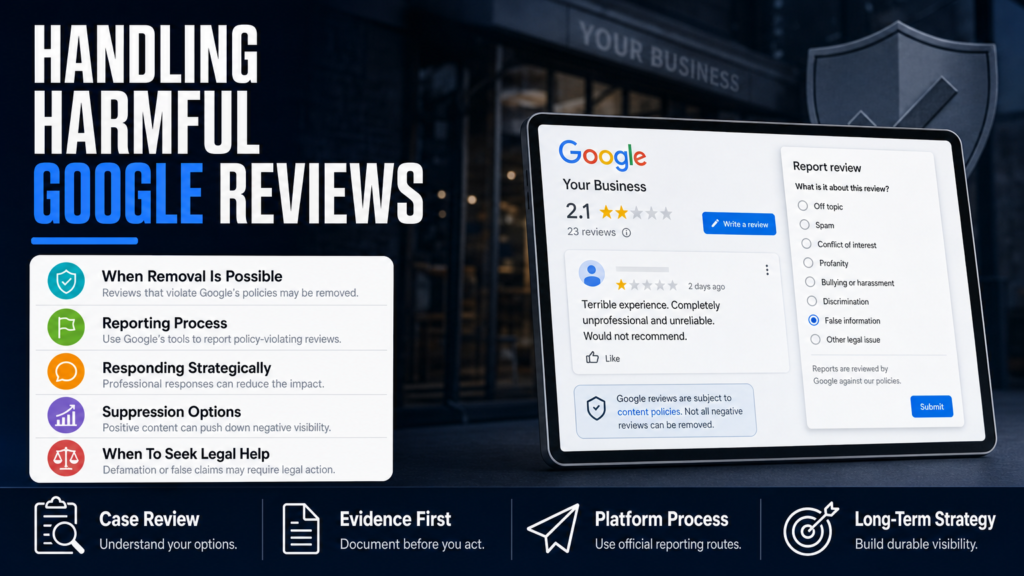
How to flag a Google review (step-by-step)
Use the Business Profile manager or Google Maps on desktop/mobile. Click the three-dot menu next to the review and choose “Report review.” Provide a clear reason and attach evidence where possible.
- Log into the account that manages your Business Profile.
- Find the review on Maps or the Business Profile dashboard.
- Choose Report and select the most accurate policy violation.
- Document the report: record the time, the reason chosen, and any case or ticket number.
What to expect after you flag a review
Google reviews flagged for policy breaches are reviewed by moderators. There is no guaranteed outcome or timeline; some reports are resolved within days, others take weeks, and many are declined.
Maintain a documented record of every escalation and any correspondence with Google support. If you later need legal or PR channels, clear documentation is essential.
Can I recover deleted Google reviews?
If an author deletes their own review, the business cannot restore it. Google retains backend logs but does not offer a public recovery tool for businesses. A reviewer who deleted their review can usually repost it from their account, but whether prior content is recoverable depends on Google’s retention policy and is not under business control.
If Google removes a review after you flagged it, there is no public appeals reversal path for the original reviewer other than contacting Google support and providing additional context — that process is not guaranteed.
- If you need a deleted review for documentation: 1) check and export your Business Profile activity; 2) pull server logs or booking records that corroborate or refute the claim; 3) consult legal counsel about subpoenas or preservation letters.
- A reviewer can repost or edit their review from their Google account; businesses cannot force reposts.
- If you need to preserve evidence, take screenshots and export your Business Profile data before a review is removed or changed.
- For legal disputes where evidence is critical, consult counsel about preservation and subpoenas; preservation is jurisdiction- and court-dependent.
How do you respond to negative reviews?
Responding well is often the fastest way to reduce reputational damage. A calm, factual public reply reassures prospective customers and demonstrates professional conflict resolution.
Never threaten the reviewer or offer incentives to remove negative feedback — both can violate platform rules and state consumer-protection laws.
- Step 1 — Acknowledge: “Thank you for your feedback. We take this seriously.”
- Step 2 — Offer a fix or investigation: “Please contact us at [business email/phone] so we can review your account and make this right.”
- Step 3 — Follow up offline and update the public reply if the situation is resolved (e.g., “We resolved this on [date]. Thank you.”).
- Acknowledge the experience, express a commitment to resolve, and invite offline contact (phone or email) for details.
- Keep replies short, factual, and free of accusatory language.
- If the review is false, provide the correct facts succinctly and offer to investigate. Avoid long legal arguments in a public reply.
Response templates
Adapt these to your tone. Keep them short and track which template you used.
- If service error: “We’re sorry you had this experience. Please DM or call [line] with your reservation/order number so we can investigate.”
- If false claim: “We don’t have a record of this incident. Please contact [email] so we can review and correct any errors.”
- If abusive: “We won’t tolerate abusive language. We invite you to contact us if you wish to resolve this constructively.”
Is it illegal to hide negative reviews?
‘Hiding’ negative reviews is a loaded term. Removing or suppressing reviews by deceptive means — creating fake positive reviews, paying to bury truthful critiques without disclosure, or using fake reviewer accounts — can violate platform rules and, in some cases, state consumer-protection statutes.
It is not per se illegal for a business to pursue legitimate moderation or to ask a reviewer to revise a factual error. However, intentionally manipulating reviews (astroturfing) or engaging in deceptive trade practices can trigger enforcement, fines, or civil claims in some jurisdictions.
- If you suspect illegal or fraudulent activity: 1) document the activity; 2) preserve evidence; 3) consult counsel to evaluate potential claims or regulatory referrals.
- Asking a real customer to update an honest review after resolving an issue is acceptable if no incentive or deception is offered.
- Paying for fake positive reviews or using networks to remove negative reviews deceptively can breach Google policy and consumer protection laws.
- Documented moderation, flagging for genuine policy reasons, and truthful public corrections are lawful steps; deceptive suppression is not.
Special case — reviews by former employees
Reviews from former employees can be particularly tricky: they may be protected speech, contain factual claims, or be demonstrably false. Each case requires evidence-based assessment.
If a former employee’s review is false or violates policy (e.g., discloses private data), you can flag it. For targeted campaigns by ex-staff, a coordinated mitigation and legal plan may be needed.
- Assess whether the review contains confidential information or defamation.
- Keep communication records with the former employee and document any relevant HR issues.
Dealing with review-bombing and coordinated attacks
When multiple bad reviews arrive quickly — a review-bomb — Google may take additional time to evaluate, and removal decisions hinge on whether the reviews violate policy (coordinated spam, impersonation, or fabricated accounts).
A coordinated response combines platform reporting, public communications, and an SEO suppression plan to limit visibility while you pursue other remedies.
- Step 1 — Triage: identify which reviews are likely policy violations vs. genuine complaints.
- Step 2 — Report pattern to Google with evidence and request review for spam/coordinated activity.
- Step 3 — Implement suppression tactics (SEO + fresh authoritative content) while monitoring.
- Collect timestamps, account profiles, and any linking evidence that suggests coordination.
- Report the pattern to Google with a consolidated evidence packet rather than individual reports for each review.
- Prepare a public statement if the attack is newsworthy, and implement monitoring to detect further waves.
When to involve outside specialists
If attacks are ongoing, large-scale, or accompanied by doxxing or impersonation, consider engaging reputation specialists and legal counsel to coordinate evidence collection and escalation.
For a technical walkthrough of coordinated attacks, see our analysis of review-bombing patterns and platform options.
- Specialists can help with documentation, SEO suppression strategies, and PR messaging.
- A targeted legal review may identify claims against perpetrators if jurisdiction and evidence permit.
How do I leave multiple Google reviews?
Google permits one review per user account per business listing. Posting multiple reviews from the same account for the same place is not allowed. A reviewer may edit an existing review or update a rating, but creating repeat reviews to manipulate scores breaches Google policy.
For businesses, it’s important not to solicit multiple reviews from the same customer or to incentivize repeat reviews — that creates compliance risk and may lead to penalties.
- If you need more legitimate reviews: 1) follow up with satisfied customers once after service; 2) provide clear instructions and links to leave a review; 3) do not offer incentives or ask for multiple submissions.
- A reviewer who wants to change feedback should edit their original review rather than posting another.
- Businesses should request honest feedback once and make it easy for customers to update reviews after a resolution.
- Encouraging genuine reviews across a range of platforms (Google, Yelp, industry sites) is better than trying to game a single listing.
Monitoring, escalation, and when to involve counsel or PR
Not every negative review needs legal action. Prioritize monitoring, quick public response, and evidence collection. Escalate to legal counsel or PR when reviews assert false factual claims that cause measurable harm, accompany harassment, or form part of a broader campaign.
A coordinated approach — combining documented reporting to Google, a measured public reply, an SEO suppression plan, and legal/PR coordination when appropriate — is usually the most effective.
- Step 1 — Monitor: set alerts for new reviews and brand mentions.
- Step 2 — Document: save screenshots and metadata for each disputed item.
- Step 3 — Escalate: consult PR for messaging and counsel for legal assessment when harm crosses a threshold.
- Maintain logs of every review, your public responses, and the dates and outcomes of any flagging or support tickets.
- Use reputation-monitoring tools to track mentions and alerts across search and social.
- Contact qualified counsel for potential defamation, harassment, or privacy claims; counsel can advise on subpoenas and evidence preservation.
Tools and services that help
There are monitoring platforms and managed services that combine flagging, templated responses, and suppression SEO. Evaluate them by transparent reporting, legal-compliance safeguards, and documented processes — not by promises of guaranteed removal.
- Look for services that emphasize documentation and ethical platform use.
- Avoid firms that claim special access to Google or guaranteed deletions.
DIY vs Agency: Quick Comparison
Choose the path that fits your risk tolerance, time, and resources.
| DIY | Agency / Specialist |
|---|---|
| Cost | Higher upfront fees, ongoing retainers possible |
| Control | Hands-off; provider handles workflow |
| Time | Frees internal time but requires coordination |
| Technical SEO | Professional SEO and content strategy |
| Legal Support | Coordinates with counsel, evidence handling |
| Documentation | Centralized records, ticketing, reporting |
Hypothetical: Doctor Facing a False One-Star Review
Scenario: A clinic receives a one-star Google review claiming negligent care. The clinic believes the review is false and that no such patient interaction occurred. This is a hypothetical walkthrough to illustrate actions a business can take.
Action plan below balances reporting, public response, mitigation (SEO and reputation), and legal steps if evidence supports it. This example is illustrative, not a promise of outcome.
- Step A — Triage within 24–48 hours: capture screenshots, export logs, and create a case file.
- Step B — Report to Google with evidence; open a support ticket and keep records.
- Step C — Publish a public reply that offers to resolve and requests offline contact.
- Step D — Implement suppression content: update the clinic’s site, publish authoritative content, and encourage verified patient reviews.
- Step E — Reassess after 2–4 weeks, and consult counsel about next steps if harm persists.
- 1) Evidence: Clinic exports appointment logs showing no matching patient on the date cited and screenshots of the review.
- 2) Flag: Clinic flags the review for impersonation or fabricated content and submits evidence to Google.
- 3) Respond: Clinic posts a brief public reply: a calm acknowledgement and an invitation to contact the clinic offline.
- 4) Monitor and escalate: If Google declines removal, clinic pursues mitigation: fresh authoritative content, patient testimonials, and targeted local SEO.
- 5) Legal check: Counsel reviews whether the claim is defamatory and advises on preservation or potential legal steps.
Common Mistakes Businesses Make
Avoid these frequent errors — they slow resolution, risk penalties, or escalate disputes.
Mistake: Threatening or suing immediately
Responding to a negative reviewer with threats or immediate legal action often escalates the situation and can draw more attention. Document, investigate, and consult counsel before taking legal steps.
Mistake: Buying fake positive reviews
Artificially inflating your rating violates platform rules and consumer-protection laws in many jurisdictions. It can result in listing penalties and damage credibility.
Mistake: Ignoring poor reviews
Not responding leaves the narrative uncontrolled. A professional reply often reassures readers and reduces churn.
Mistake: Inadequate documentation
Failing to save evidence (screenshots, timestamps, account details) makes escalations and legal steps harder to pursue.
Mistake: Using questionable removal services
Some providers promise guaranteed removals or imply special platform access. Choose partners that explain processes, limitations, and compliance measures.
Best Practices For Handling Problematic Reviews
Implement these durable practices to reduce risk and improve outcomes.
Proactive Monitoring
Set alerts for new reviews and brand mentions. Early detection lets you respond before issues propagate.
- Use Google Alerts, a Business Profile dashboard, or a reputation monitoring service.
Document Everything
Maintain a case file for each disputed review with screenshots, correspondence, and ticket numbers.
- Preserved evidence supports platform reports and any legal review.
Standardize Responses
Create templated, legally-reviewed responses for common complaint types and train staff on tone and escalation triggers.
- Keep replies short, factual, and offer offline resolution.
Invest in Suppression SEO
When removal is unlikely, build authoritative content — your site, profiles, press coverage, and directories — to push harmful items down search results.
- Diversify credible links and encourage verified positive reviews from real customers.
Coordinate With Counsel and PR
Have a relationship with legal and PR counsel who understand digital evidence and can quickly advise or draft preservation letters when necessary.
- Legal/PR readiness decreases reaction time in high-risk disputes.
Expert Tips
- Never delete your own business profile to ‘remove’ reviews — that destroys historical data and complicates recovery.
- Keep all public replies concise; long defenses rarely persuade readers and can make you look defensive.
- When flagging, attach clear, objective evidence rather than opinionated commentary.
- If a review cites a transaction, reference the transaction ID in private follow-up rather than in the public reply.
- Track the lifecycle of each reported case: date flagged, ticket ID, outcome, and follow-up action.
- If you suspect fake accounts, collect profile URLs, timestamps, and pattern evidence before reporting.
- Encourage satisfied customers to leave honest reviews regularly so one complaint has less relative impact.
- Avoid pay-for-removal offers; they often create regulatory and credibility risks.
Conclusion
Can you delete Google reviews as a company? Not directly — but you have a range of legitimate tools: reporting through Google’s policy process, responding publicly in a professional way, documenting evidence, and pursuing mitigation strategies when removal isn’t achievable.
If removal is possible, it depends on policy violations, evidence, and Google’s discretionary review; no service can promise outcomes. When removal isn’t available, suppression, authoritative content, monitoring, and coordinated PR and legal steps can protect hiring, revenue, and brand trust. Start with a documented triage and escalate thoughtfully.
Why Businesses Choose Your Reputation Agency
Managing your reputation takes more than monitoring reviews or publishing the occasional blog post. It takes a strategy built around your situation, your industry, and what is actually showing up in search.
Your Reputation Agency works with businesses, executives, healthcare professionals, attorneys and growing brands. Our services include:
- Remove or suppress negative search results and news articles from Google
- Review removal and remediation (Google, Yelp, Facebook, Trustpilot, industry sites)
- Data broker and people-search opt-outs to remove personal information
- Mugshot and arrest-record removal or suppression
- Takedowns of defamatory, false, or malicious posts (social, blogs, forums)
- Online crisis management and rapid-response reputation repair
- Impersonation and fake account removal on social platforms
- Reputation monitoring, alerts, and ongoing surveillance
- First-page SEO and suppression strategies to bury negative content
- Digital security audits and privacy hardening to prevent future exposure
Frequently Asked Questions
1. Can I recover deleted Google reviews?
If a reviewer deletes their own Google review, businesses cannot restore it. The reviewer may be able to repost or edit from their account. If preservation of evidence is essential, export screenshots and Business Profile data before changes occur and consult counsel about preservation options.
2. How do you respond to negative reviews?
Respond promptly with a calm, factual acknowledgement, offer to resolve offline (give a contact path), and avoid accusatory or threatening language. Document the interaction, and update the public reply if the issue is resolved.
3. Is it illegal to hide negative reviews?
Removing or suppressing reviews by deceptive tactics (fake reviews, undisclosed payments, or using sham accounts) can violate platform policies and, in some cases, consumer-protection laws. Legitimate reporting for policy violations, correction of factual errors, and documented resolution are lawful.
4. How do I leave multiple Google reviews?
Google allows one review per account per business listing. To change feedback, edit your original review rather than posting multiple entries. Businesses should not solicit multiple submissions from the same customer.
5. How long does Google take to remove a flagged review?
There is no guaranteed timeline. Some reports are resolved in days; others take weeks or are declined. Timing depends on workload, the strength of evidence, and whether the report implicates complex policy questions.
6. Can I sue someone for a fake review?
Potential legal claims (defamation, tortious interference) depend on the specific statements, evidence, and jurisdiction. Consult qualified counsel to evaluate whether a review meets the legal standards for a claim — do not initiate legal action without documented evidence and legal advice.
7. What does a removal service cost?
Costs vary widely based on scope, evidence gathering, and whether legal or SEO work is required. Evaluate providers by transparency, documented process, and realistic disclaimers — avoid anyone promising guaranteed deletions.
8. What if multiple negative reviews arrive at once?
Treat it as a potential coordinated attack: document timestamps and account details, report the pattern to Google with consolidated evidence, prepare a public statement if needed, and implement suppression and monitoring strategies while you escalate.
9. Where can I read about reviews from ex-employees or review-bomb attacks?
For practical guidance on reviews from former staff, see our walkthrough on employee-related reviews: When a Former Employee Becomes a Brand’s Biggest Search Result. For coordinated attacks, our analysis covers review-bomb patterns and platform options: The Anatomy of a Review-Bombing Attack on Google Maps.
This content provides general information and does not constitute legal advice. The available options and likely outcomes depend on the facts, evidence, platform policies, applicable law, jurisdiction, and public-interest considerations.
Past examples do not guarantee future results. Removal, correction, deindexing, and search-position changes depend on third parties and circumstances outside Your Reputation Agency’s control.