You just found an old article, a mugshot site listing, or a one-star review that appears at the top of Google when a hiring manager searches your name. It’s urgent, it’s visible, and you need a clear path forward. This article explains how Kalicube-style online reputation management for individuals approaches that exact situation and how it differs from other options.
If you’re evaluating Kalicube online reputation management for individuals, you’ll want to know three things: what the method focuses on (Brand SERP and structured data), how that fits with removal or suppression tactics, and when you should attempt DIY versus hiring external help. I’ll walk through practical steps, realistic cost ranges, platform-specific constraints, and what to do when removal isn’t an option.
The guidance below is tactical and platform-aware: it names real processes, gives step sequences you can follow, and explains where outcomes depend on publisher policy, jurisdiction, or evidence. Read the sections that match your immediate need—removal, mitigation, monitoring, or SEO—and use the checklists to act quickly and professionally.
Table of Contents
- Which reputation management companies are best for individuals?
- How much does online reputation management cost?
- How can you manage your online reputation?
- What is the best software for reputation management?
- What to do when removal is not available
- How Kalicube-style methods differ for individuals
- When to DIY and when to hire an agency
- Removal vs Suppression: Quick Comparison
- Hypothetical Case: A Doctor With an Old Arrest Record
- Common Mistakes People Make
- Best Practices for Individuals
- Expert Tips
- Conclusion
- Why Businesses Choose Your Reputation Agency
- Frequently Asked Questions
Which reputation management companies are best for individuals?
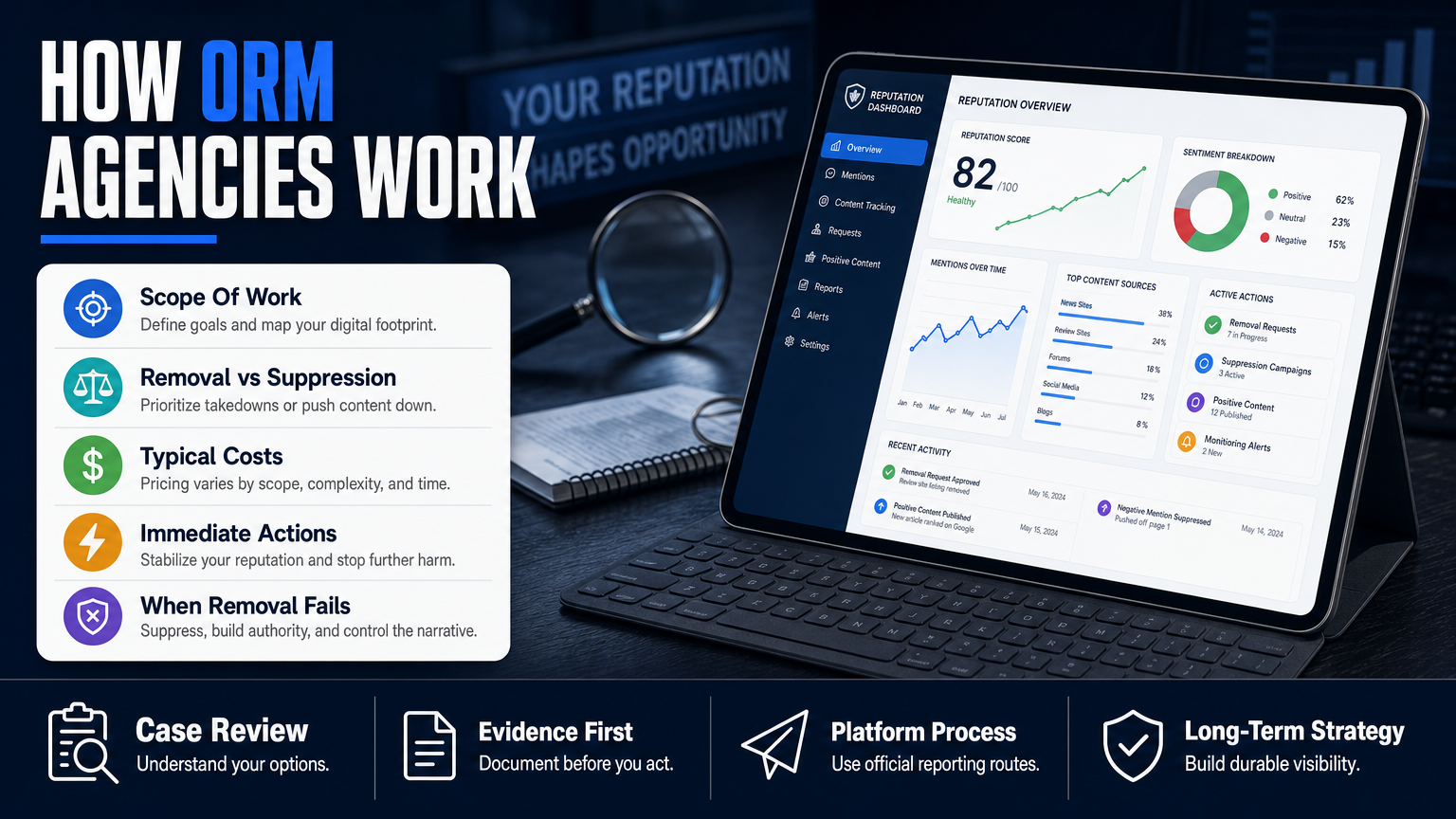
There isn’t a single ‘best’ company that fits every individual; the right choice depends on the problem type (mugshots, defamatory articles, review problems, doxxing), budget, desired speed, and whether legal action may be required. Firms fall into three useful categories: technical SEO-focused agencies, removal-first specialists, and hybrid full-service vendors.
When you compare providers, evaluate them on: documented processes (not promises), a clear scope of platform work, experience with your industry, and whether they coordinate legal/PR counsel when needed.
- 1) Define the primary problem (search result, review platform, social post, public record).
- 2) Ask potential providers for a process map for your exact content type (what they would attempt first, evidence they need, and expected escalation paths).
- 3) Request sample timelines framed as ranges and platform-dependent caveats—not guaranteed dates.
- 4) Confirm confidentiality controls and what documentation they require.
- SEO/Brand SERP specialists: focus on pushing down negative results via new, authoritative content, metadata, and schema.
- Removal specialists: pursue takedowns, data-broker opt-outs, and platform policy removals.
- Full-service firms: combined monitoring, takedown, legal referrals, and crisis PR.
How to vet companies quickly
Ask for references in your industry, written process descriptions, and sample work (screenshots of pre/post searches are helpful if made available). Avoid vendors that promise removal guarantees or fixed outcomes.
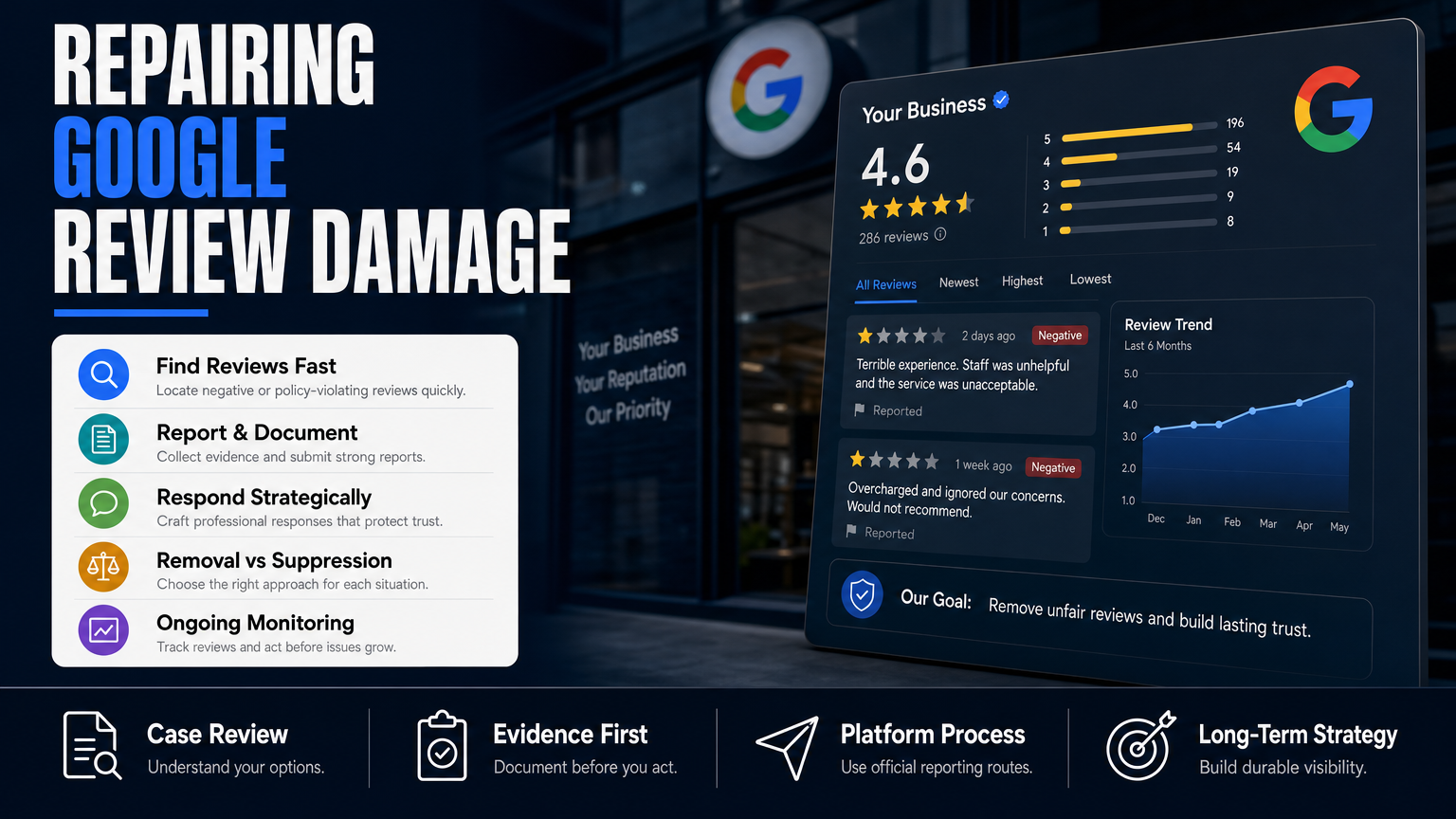
If the issue centers on reviews, our article When Google Reviews Become a Brand’s Biggest Crisis explains common escalation steps and when you need a specialist that understands Google’s review policies.
- Verify they do not claim legal representation unless they are a law firm.
- Check that they use platform reporting routes and legal escalation where appropriate.
- Confirm they clearly separate removal attempts from SEO suppression strategies.
How much does online reputation management cost?
Cost varies by scope: a single-platform review remediation will cost less than a multi-source suppression campaign combined with legal coordination. Pricing models include flat project fees, monthly retainers, and per-action fees (for opt-outs, form-filling, or takedown attempts).
Expect price ranges and the reasons behind them rather than a single figure: complexity, the number of targeted URLs, publisher type, and whether legal work is likely to be required all influence cost.
- 1) Get a scoped assessment listing the exact URLs and platforms involved.
- 2) Request a written estimate that separates removal attempts, monitoring, and SEO work.
- 3) Ask about phased engagement: initial triage, removal attempts, then suppression/SEO.
- 4) Confirm reporting cadence and what success indicators the vendor will track.
- Simple data-broker opt-out packages: $300–$1,200 (one-off or with limited follow-up).
- Single-URL takedown or removal attempt via platform reporting: $500–$3,000 depending on complexity and appeals.
- Brand SERP/SEO suppression campaigns: $1,000–$6,000+ per month depending on content creation needs and the number of sites to outrank.
- Full crisis response with legal and PR coordination: $5,000–$25,000+ depending on urgency and legal referrals.
What drives higher costs
Large publishers and news sites often require legal work and outreach, which increases cost. Ongoing monitoring and monthly SEO content production also add to retainer fees.
Keep in mind that fast, manual outreach for urgent cases typically raises fees due to the time-sensitive labor involved.
- High-authority publishers (newsrooms, major blogs) increase outreach time.
- Court filings, subpoenas, or legal referrals add legal fees outside ORM scope.
- Repeat or layered problems (mugshot + review bombing + doxxing) compound costs.
How can you manage your online reputation?
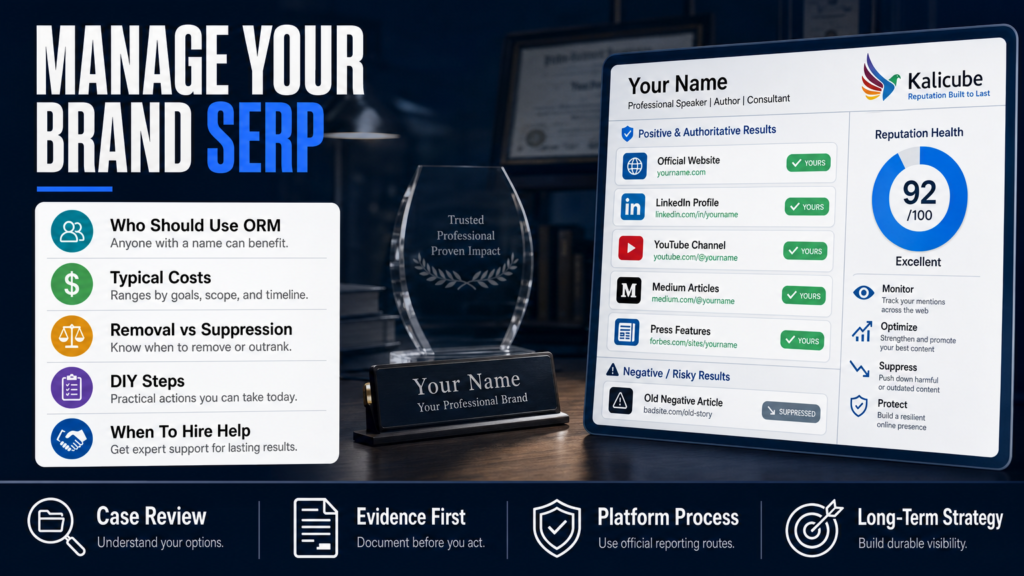
Managing reputation combines defensive actions (removal attempts and privacy opt-outs), offensive actions (creating and promoting authoritative content), and monitoring. Kalicube-style approaches emphasize controlling the Brand SERP via structured content and authoritative profile pages, but combining tactics produces the best practical results.
You can do immediate triage yourself and then decide whether to escalate to an agency. A straightforward triage produces the evidence a vendor will need and preserves options if legal action becomes necessary.
- 1) Create an evidence folder with screenshots, URLs, and context for each item.
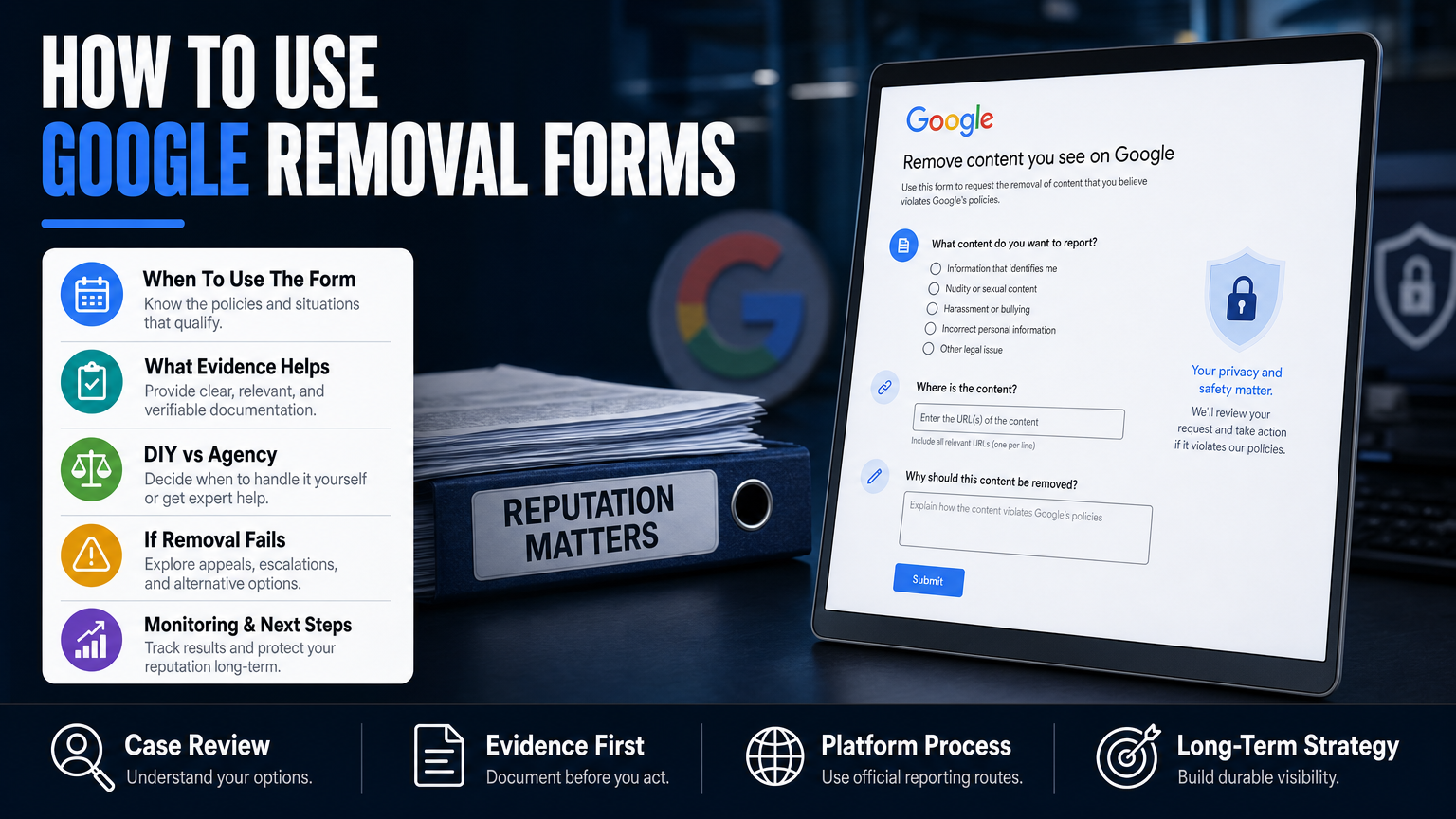
- 2) Check platform-specific removal routes and file reports where policy violations exist.
- 3) Run a Brand SERP audit (search your name in private mode and note the exact top 10 results).
- 4) Publish or update authoritative profiles (personal website, LinkedIn, about pages) with clear schema and consistent naming.
- 5) Monitor changes and log responses; escalate to an agency or legal counsel if removal attempts fail or the publisher refuses correction.
- Immediate steps: archive the content (use timestamps and screenshots), document URLs, note dates and any communications, and assess whether the content violates platform policy.
- Short-term actions: request platform removals, file data-broker opt-outs, and contact publishers for corrections.
- Medium-term actions: deploy authoritative pages (personal site, LinkedIn, interviews, profiles) and optimize them for your name queries.
How structured data and Brand SERP work together
Kalicube-style methods use structured data (schema.org markup) and consistent entity signals to help search engines present accurate knowledge about a person. These tactics don’t remove content — they aim to replace or re-rank entries in the Brand SERP with more authoritative, controlled assets.
If you’re pursuing this route, align the content you publish (personal site, interviews, directory listings) so search engines have consistent biographical data points to use.
- Use schema for Person, sameName, jobTitle, and sameAs links (official profiles).
- Ensure NAP (name, address, phone) and professional titles are consistent across profiles.
- Prioritize high-authority domains (personal domain, LinkedIn, institutional pages).
Further reading on controlling your homepage in search
If your concern is the first page of Google for your name, this section explains why that page functions as your public homepage and how SEO actions change what appears. For a strategic view of Brand SERP as your public front page, see The First Page of Google Is Your Real Homepage.
What is the best software for reputation management?
There is no single ‘best’ software for every use case. Monitoring tools, review-management platforms, Brand SERP tools, and legal takedown trackers each serve different needs. Combine specialized tools rather than expecting one product to solve everything.
Kalicube uses Brand SERP and knowledge-graph-oriented signals; other tools focus on review aggregation, social listening, or people-search opt-outs.
- 1) Match tools to need: monitoring vs. review remediation vs. SERP improvement.
- 2) Use a cheap or free monitoring tool initially to catch urgent mentions.
- 3) Layer in paid tools when you need historical tracking, multi-platform reporting, or automation.
- Brand SERP & entity tools: BrandYourself, Kalicube Pro, and Search Pilot (for SERP diagnostics and structured data).
- Review & reputation platforms: Birdeye, Podium, Reputation.com for multi-location businesses and review funnels.
- Monitoring & alerts: Google Alerts, Mention, Awario, and SentiOne for social and web monitoring.
- Data-broker management: Abine DeleteMe, OneRep for automated opt-outs (note: manual checks still needed).
How to choose software for an individual
For most individuals, start with free monitoring, a single review-management solution if reviews are the issue, and a Brand SERP diagnostic tool if search visibility is the problem. Avoid paying for enterprise bundles that assume you are a large multi-location business.
- Prioritize alert speed and coverage for mentions of your exact name.
- Confirm the tool lets you export evidence (screenshots, timestamps) for legal or outreach uses.
- Keep an eye on false positives—tools can misattribute mentions to the wrong person with common names.
What to do when removal is not available
Removal isn’t always possible: truthful public records, court filings, or publisher refusals can make takedowns unlikely. When removal is not available, the practical path is mitigation: suppression, context, corrections, and legal review where appropriate.
Mitigation is multi‑layered: improve the visibility of authoritative assets, add context where allowed (responses, corrections), and where applicable, pursue legal or publisher corrections based on errors or defamation if supported by evidence.
- 1) Prioritize which URLs must be demoted from the first page.
- 2) Create or optimize high-authority pages you control with consistent schema and keywords (your full name, profession, and location).
- 3) Build reputable links to those pages (institutional citations, guest posts, professional directories).
- 4) Monitor the Brand SERP and adapt the content strategy based on which pages are rising or falling.
- Suppress: publish and promote credible pages (personal site, guest articles, institutional directories) to push negative items lower in search.
- Correct: ask publishers for corrections or context if the article contains factual errors.
- Respond: on review platforms, use professional responses to show readers the contested nature of the claim (avoid emotional or retaliatory language).
- Legal review: consult counsel if the content is false and harmful—legal remedies depend on jurisdiction and evidence.
How suppression campaigns typically work
Suppression uses new content, SEO, and targeted link-building to increase the rank of positive or neutral assets. It is a strategic, ongoing effort—algorithms and competitor activity can change results over time.
Remember: suppression aims to reduce visibility, not erase history. Be wary of any provider who calls suppression a guarantee of permanent removal.
- Start with your personal domain and LinkedIn profile as the anchor assets.
- Add targeted content: bio pages, profiles on professional associations, and reputable interviews or op-eds.
- Maintain monitoring—suppression requires periodic content updates and link maintenance.
How Kalicube-style methods differ for individuals
Kalicube’s approach is entity-centric: it treats a person as an entity to be described consistently across the web using structured data and knowledge panel signals. For individuals, this means focusing on Brand SERP hygiene: a clean personal site, correct schema, consistent links (sameAs), and authoritative references.
That approach complements removal and suppression tactics but does not replace them. Use entity optimization when you can’t remove content or when you want to reduce the chance that future content will dominate your searches.
- 1) Build or refine a personal homepage with clear Person schema and a canonical URL.
- 2) Claim and complete high-authority profiles (LinkedIn, institutional pages, professional directories) with consistent metadata.
- 3) Create targeted content (articles, podcasts, profiles) that reinforce the same factual entity signals.
- Entity-first setup: personal site with Person schema and sameAs links to verified profiles.
- Knowledge panel work: supply accurate sources and structured data that search engines can trust.
- Consistent naming: use the same form of your name across high-authority sources.
When reviews and Brand SERP intersect
Reviews often appear in the Brand SERP and can dominate perceptions. Understanding the cost and effect of reviews helps prioritize work: for analysis of the true business impact of a review problem, see What a One-Star Google Review Really Costs Your Business.
When to DIY and when to hire an agency
DIY is reasonable for initial triage, single-platform review responses, basic monitoring, and publishing a personal site with schema. Hire an agency when the problem spans multiple publishers, involves legal risk, or requires fast, coordinated outreach and SEO suppression at scale.
Your decision should be based on time, technical skill, and risk tolerance. If a search result is costing you job interviews or clients, the cost of professional help may be justified by the speed and comprehensiveness of the response.
- 1) Triage: do the DIY steps below to gather evidence and reduce immediate harm.
- 2) If DIY fails or the case is complex, get a scoped assessment from a reputable agency.
- 3) Ensure the agency provides a written process, platform-specific tactics, and clear reporting.
- DIY: evidence collection, screenshots, initial reports to platforms, building your personal site and LinkedIn, and monitoring.
- Hire agency: coordinated takedowns across publishers, PR outreach to newsrooms, multi-month SEO suppression, and integration with legal counsel.
A quick DIY triage checklist
Start with a short triage that preserves options and prepares you for escalation.
- Screenshot the negative content and capture the URL and timestamps.
- Check whether the content violates platform policy and file the appropriate report.
- List all related URLs and note whether they are on review sites, news sites, social media, or data brokers.
- Publish or update your personal domain and key profiles to create authoritative alternatives.
Removal vs Suppression: Quick Comparison
When you’re deciding how to proceed, removal and suppression have different strengths. Use this table to pick the right focus.
| Removal | Suppression |
|---|---|
| Goal | Goal |
| Eliminate a specific piece of content from a platform | Reduce visibility by outranking negative content |
| Depends on publisher or platform policy | Depends on consistent SEO and content production |
| Often faster if policy violation is clear | Takes weeks to months and ongoing work |
| May require legal action for stubborn publishers | Requires editorial resources and link-building |
| Binary outcome if successful (content removed) | Gradual, reversible changes in search visibility |
Hypothetical Case: A Doctor With an Old Arrest Record
Situation: A healthcare provider discovers an old public-record arrest and a mirror article on a mugshot website dominating their Brand SERP. The listing is causing patient calls to fall and interfering with credentialing conversations.
Process: The individual performs a DIY triage (screenshots, note of URLs, initial platform reports). They then hire an agency for a combined approach: data-broker opt-outs, outreach to the mugshot site for removal or pay-to-remove options, and a Brand SERP suppression campaign focused on authoritative medical directories and a refreshed personal website.
Outcome: Within months the mugshot listing remains on some aggregator sites (public record caveat), but authoritative pages (institutional profile, updated personal site, and guest article on a medical association site) occupy more of the first page, reducing the mugshot site’s prominence. Parallel legal review is conducted to evaluate defamation or privacy-based claims; no guarantee of legal remedy is assumed.
- 1) Preserve evidence and document the problem.
- 2) Attempt data-broker opt-outs and report to platforms where policy applies.
- 3) Commission authoritative content (institutional profile, clinician bio) and optimize with schema.
- 4) Monitor Brand SERP and adjust content priorities based on SERP movement.
- 5) Consult counsel if publisher refuses correction and the content is demonstrably false.
- Triage: evidence captured and initial platform reports filed within 48 hours.
- Removal attempts: data-broker opt-outs and publisher outreach documented.
- Suppression: new authoritative pages published and promoted; schema added to personal site.
- Monitoring: daily alerts for the first two months, then weekly surveillance.
Common Mistakes People Make
Avoid these frequent errors that slow recovery or make the situation worse.
Mistake 1 — Chasing guarantees
Some vendors advertise guaranteed removals or fixed timelines. Legitimate processes rely on platform policies, publisher cooperation, and sometimes legal avenues. Ask for process detail, not promises.
Mistake 2 — Publicly arguing with reviewers or publishers
Emotional or confrontational public replies to reviews or posts can worsen perception and be used against you. Use calm, factual responses or escalate privately through official channels.
Mistake 3 — Over-relying on automated tools
Monitoring tools are valuable but can misattribute mentions or miss context. Always review automated alerts before acting and preserve manual evidence for legal or outreach work.
Mistake 4 — Treating suppression as a one-off
SEO suppression is ongoing. Failing to maintain authoritative pages or links lets negative content resurface higher over time. Plan for maintenance.
Mistake 5 — Skipping legal review when content is potentially defamatory
If content is false and damaging, consult qualified counsel. Don’t assume removal will happen without legal evaluation when allegations are serious.
Best Practices for Individuals
Use these durable actions to stabilize and improve your online presence.
Establish authoritative anchors
Own a personal domain and maintain a well-structured professional homepage. Use clear Person schema, canonical URLs, and sameAs links to verified profiles (LinkedIn, institutional bio).
- Keep the site updated with a clear professional bio and media mentions.
- Use HTTPS, fast hosting, and accessible contact information.
Document everything from the start
Screenshots, timestamps, and saved URLs matter. Collect them before you contact platforms or publishers to ensure evidence is accurate and preserved.
- Save HTML snapshots or screenshots with visible timestamps.
- Log every communication with publishers and platforms.
Use platform policy where it applies
Different platforms have different removal criteria. Use policy-based reporting for hate speech, threats, doxxing, or explicit privacy violations, and follow the platform’s official process.
- Familiarize yourself with Google’s content removal policies, Facebook’s community standards, and review-site rules.
- Escalate appeals only after initial reports are denied and you have documented the process.
Coordinate SEO and PR
If suppression is the plan, combine SEO content with PR placements on reputable sites. PR placements earn authoritative links and citations that help boost the positive pages you control.
- Prioritize reputable domains over low-quality mass guest-post sites.
- Maintain a cadence of fresh content tied to your professional role.
Monitor continuously
Reputation is dynamic. Set up alerts, review search results regularly, and have a plan for rapid response if something new appears.
- Set up Google Alerts and a paid monitoring tool if budget allows.
- Review Brand SERP weekly for at least the first three months after a remediation effort.
Expert Tips
- Use your personal domain as the central hub for authoritative information about you.
- When filing platform reports, be concise and include exact policy citations and evidence.
- Respond to negative reviews professionally and offer offline resolution—don’t argue publicly.
- Prioritize high-authority citations (institutional pages, professional associations) over dozens of low-quality backlinks.
- Preserve pre-removal evidence; once content disappears you may need proof of prior publication.
- If you have a common name, add a profession and location to your primary page to disambiguate search results.
- Document every outreach attempt to publishers—this creates a paper trail if legal steps later become necessary.
- Avoid any deceptive tactics (fake reviews, false takedown claims); they create additional risk.
Conclusion
Kalicube-style entity and Brand SERP work is a practical and powerful piece of an individual’s reputation toolkit, but it is not a silver bullet. Combine structured data and authoritative content with targeted removal attempts, careful monitoring, and legal review when necessary.
Start with disciplined triage: document the problem, use platform policy where available, and decide whether a suppression campaign or professional intervention fits your risk and time profile. An informed, measured approach preserves options and increases the chance of a durable, professional outcome.
Why Businesses Choose Your Reputation Agency
Managing your reputation takes more than monitoring reviews or publishing the occasional blog post. It takes a strategy built around your situation, your industry, and what is actually showing up in search.
Your Reputation Agency works with businesses, executives, healthcare professionals, attorneys and growing brands. Our services include:
- Remove or suppress negative search results and news articles from Google
- Review removal and remediation (Google, Yelp, Facebook, Trustpilot, industry sites)
- Data broker and people-search opt-outs to remove personal information
- Mugshot and arrest-record removal or suppression
- Takedowns of defamatory, false, or malicious posts (social, blogs, forums)
- Online crisis management and rapid-response reputation repair
- Impersonation and fake account removal on social platforms
- Reputation monitoring, alerts, and ongoing surveillance
- First-page SEO and suppression strategies to bury negative content
- Digital security audits and privacy hardening to prevent future exposure
Frequently Asked Questions
1. What are the best reputation management companies for individuals?
Best-fit companies depend on your issue. Choose a provider that shows a clear process for your content type (reviews, mugshots, news), uses platform reporting and SEO suppression appropriately, and provides legal coordination if needed. Ask for process descriptions and avoid promises of guaranteed removal.
2. How much does online reputation management cost?
Costs vary widely: simple data-broker opt-out work can run a few hundred to a few thousand dollars, single-URL removal attempts may cost $500–$3,000, and ongoing Brand SERP or crisis response retainers can range from $1,000 to $6,000+ per month depending on complexity. Get written estimates broken out by task.
3. How can you manage your online reputation?
Manage reputation through a three-part approach: triage (evidence and platform reports), mitigation (removals and corrections where possible), and reputation-building (personal site, profiles, content and SEO to suppress unwanted results). Monitoring and iterative adjustments are essential.
4. What is the best software for reputation management?
No single tool fits all. Combine monitoring (Google Alerts, Mention), review-management platforms (Birdeye, Podium) if reviews are central, and Brand SERP tools (Kalicube Pro, BrandYourself) for entity work. Choose tools matched to your problem and budget.
5. Can Kalicube methods remove defamatory content?
Kalicube-style entity optimization focuses on visibility and Brand SERP control, not removal. Removal depends on publisher policy, evidence, and sometimes legal action. Use entity methods to reduce visibility while pursuing removal through platform or legal routes when appropriate.
6. What should I do first if I discover damaging content about me online?
Immediately capture evidence (screenshots with timestamps), list URLs, check whether the content violates platform policy, file policy reports where applicable, and publish or update authoritative profiles. That collection of evidence will be essential for any professional or legal escalation.
7. How long do suppression campaigns take to affect search results?
Timelines depend on the strength of the negative content and the authority of the assets you create. Some movement can appear in weeks, but meaningful, stable suppression often takes months and ongoing maintenance. No vendor can ethically promise a fixed timeline.
8. When should I consult an attorney?
Consult counsel when content is demonstrably false, defamatory, or when a publisher refuses correction and the material causes measurable harm (lost clients, credentialing issues). A lawyer can advise on jurisdictional issues and whether legal claims are realistic given the evidence.
9. Is DIY reputation management worth trying?
Yes for initial triage, evidence collection, basic profile updates, and limited platform reports. DIY builds the foundation and may resolve simple issues. Hire professionals when the problem is multi‑publisher, legally complex, or when you need faster, coordinated suppression and outreach.
This content provides general information and does not constitute legal advice. The available options and likely outcomes depend on the facts, evidence, platform policies, applicable law, jurisdiction, and public-interest considerations.
Past examples do not guarantee future results. Removal, correction, deindexing, and search-position changes depend on third parties and circumstances outside Your Reputation Agency’s control.