You opened this because a negative search result — a Google review, a news story, or an angry blog post — is affecting calls, bookings, or investor confidence. You need concrete next steps, not platitudes. This article lays out how to approach internet reputation management with clear options, realistic timelines, and a decision framework for when to act yourself and when to hire experts.
Internet reputation management begins with a precise inventory: what appears in search, who published it, and whether it violates a platform policy or the law. We evaluate whether the content may qualify for removal or review, and we pursue the legal, technical, platform-based, and reputational options available. Removal depends on the content, publisher, platform policies, evidence, jurisdiction, and circumstances.
Below you’ll find six practical sections: definitions and why this matters, step-by-step strategies for removal or suppression, what to do when removal isn’t available, how to respond to review attacks and viral incidents, tools and the DIY vs agency choice, and how to measure progress. The advice is US-focused and written for business owners, healthcare and legal professionals, and reputation-conscious executives.
Table of Contents
- What ‘Reputation’ Means in Management
- Why Online Reputation Management Matters
- Effective Strategies for Managing Your Online Reputation
- When Removal Isn’t Available: Mitigation and Suppression
- Responding to a Viral Incident or Review Attack
- Tools and Services: DIY Versus Hiring an Agency
- Measuring Success and Setting Expectations
- Removal vs Suppression: Which Approach Fits?
- Hypothetical Example: A Local Surgeon and a Viral Article
- Common Mistakes People Make
- Best Practices For Durable Reputation Work
- Expert Tips
- Conclusion
- Why Businesses Choose Your Reputation Agency
- Frequently Asked Questions
What ‘Reputation’ Means in Management
In management terms, reputation is the aggregate of public perceptions, signals, and search-visible facts that influence decisions by customers, partners, regulators, and investors. It includes reviews, news articles, social posts, directory listings, and search results — especially the first page of Google.
Reputation in management is not just PR; it’s a measurable asset and a risk. Teams track conversion rates, hireability, referral volume, and legal exposure tied to public-facing content. A single piece of widely visible content can change those metrics quickly.
- Map every public mention that affects searches for your name, brand, or location.
- Classify mentions as opinion, allegation, privacy violation, impersonation, or public record.
- Score each item by visibility (search rank), severity, and removability.
- Components: reviews, search results, social posts, news, directories, images, videos.
- Stakeholders: customers, employees, regulators, media, investors.
- Outcomes: conversion, trust, regulatory scrutiny, hiring and retention.
Why Online Reputation Management Matters
Reputation influences revenue and opportunity. For many SMBs and professionals, the first page of Google is the homepage prospective clients use to decide. Poor visibility or damaging content reduces leads, increases friction in onboarding, and raises the cost of customer acquisition.
Beyond lost business, certain content carries compliance or licensing risk for regulated professions. This makes internet reputation management an operational priority, not just marketing.
Search visibility and platform decisions change over time. We develop SEO reputation strategies intended to improve the visibility of relevant and credible information, but search results may change because algorithms, competitors, publishers, and user behavior are outside our control.
- Quantify the business impact (calls, bookings, conversion drop).
- Prioritize items that are high-visibility and high-impact.
- Create a combined removal + suppression plan tied to measurable KPIs.
- Conversions drop when negative items are prominent.
- Regulated professionals face added career and compliance risk.
- Long-term damage compounds if left unaddressed.
Effective Strategies for Managing Your Online Reputation
There’s no single fix. Effective internet reputation management uses parallel tracks: platform reporting and takedown requests where applicable; legal review for defamation, impersonation, or privacy breaches; tactical SEO to push down unwanted results; content creation to replace them; and targeted outreach to publishers or reviewers.
We recommend starting with a documented inventory and evidence package. That simplifies platform reports, legal letters, and publisher outreach. Remember: platform decisions remain under the platform’s control.
- Step 1 — Document: Save URLs, screenshots, dates, and any supporting evidence.
- Step 2 — Classify: Is this opinion, alleged fact, private data, or impersonation?
- Step 3 — Report: Use platform forms and publisher contacts; escalate with legal notices if warranted.
- Step 4 — Create: Publish authoritative content (profiles, articles, videos) that can rank.
- Step 5 — Monitor: Set alerts and weekly checks for new mentions.
- Platform takedowns (Google, Facebook, Twitter/X, YouTube, Yelp) using official reporting channels.
- Direct publisher outreach to request corrections or retractions.
- Legal options for defamation or privacy breaches when supported by evidence.
- SEO and content publishing to suppress negative entries with high-quality alternatives.
- Paid remediation for urgent suppression when organic options are too slow.
Platform Reporting: Practical Tips
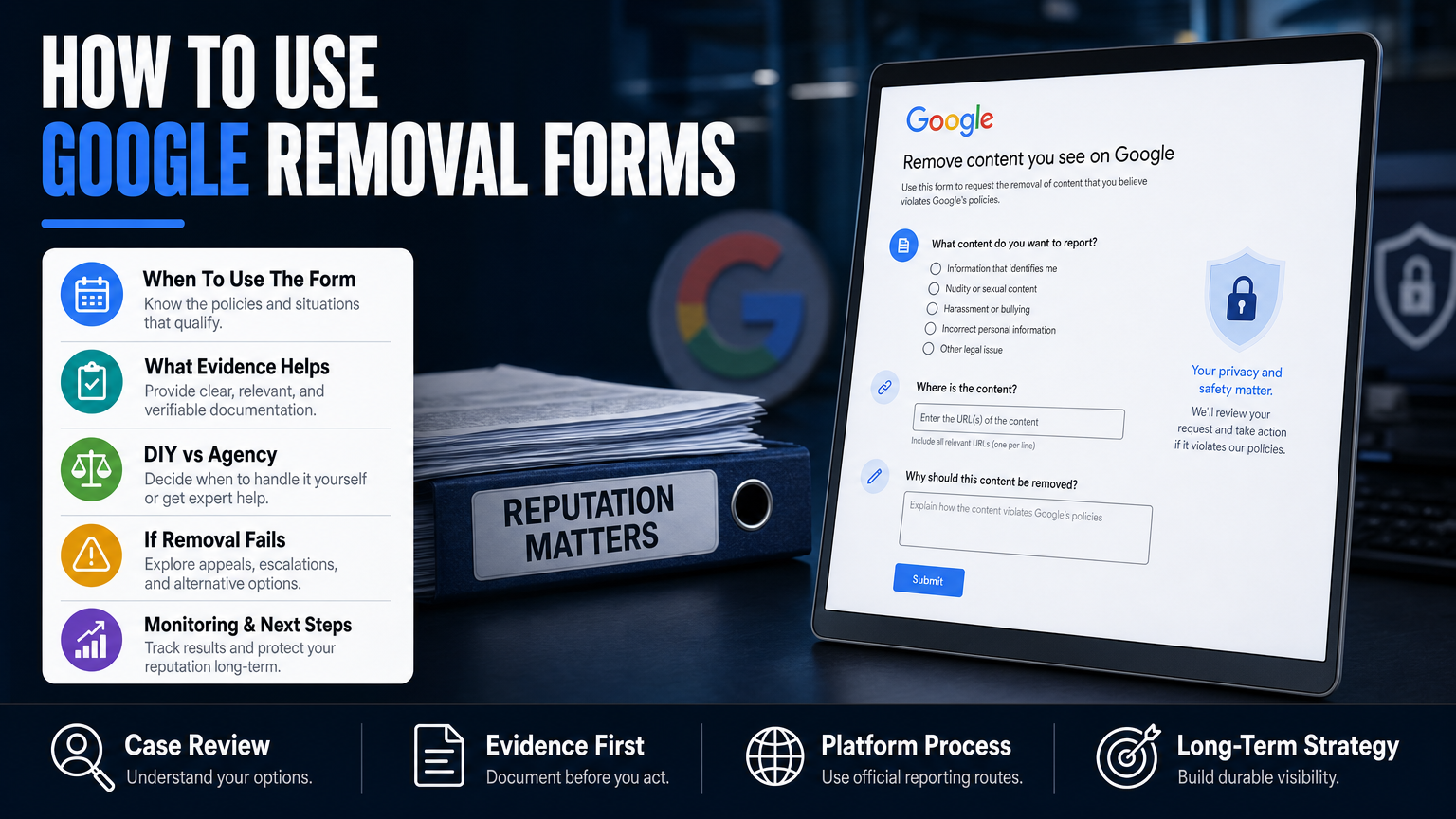
Follow the platform’s official forms precisely. Attach evidence and identify the specific policy (privacy, impersonation, harassment, defamation) you believe is violated. We use the official reporting and review processes made available by platforms.
Keep copies of all correspondence and confirmation IDs. Timing depends on the platform, publisher, evidence, legal complexity, and search-engine behavior.
- For Google, use Search Console removals for personal data and Google’s legal forms for doxxing.
- For Yelp and Trustpilot, follow their verified-complaint and business-response processes.
- For YouTube, use copyright or privacy reporting, and consider counter-notes only with legal counsel.
SEO Suppression: Tactical Steps
When removal is unlikely or slow, suppression is the primary durable tactic: create and optimize credible pages (site pages, LinkedIn, press releases, published interviews, high-authority directories) to occupy the first page.
We develop SEO reputation strategies intended to improve the visibility of relevant and credible information. Results vary according to the strength of the negative content and the authority of competing sources.
- Prioritize owned assets (your website, press page, LinkedIn, YouTube channel).
- Publish evergreen content targeting the same name and keywords as the negative item.
- Acquire authoritative links to the positive pages to help them outrank negatives.
When Removal Isn’t Available: Mitigation and Suppression
Removal is often the best outcome, but it’s not always available. Some content is lawful, opinion-based, or on sites that refuse takedowns. When removal is unavailable, we may recommend mitigation, correction, or reduced visibility.
Mitigation combines SEO suppression, correction requests, contextual responses, and targeted advertising to redirect searchers to accurate, controlled information.
- Step 1 — Accept which items cannot be removed after assessment.
- Step 2 — Build a suppression content plan with prioritized pages to outrank the negative items.
- Step 3 — Execute link-building, on-page SEO, and social seeding.
- Step 4 — Use monitoring and alerts to catch reappearing content.
- Create authoritative replacement content (about page, staff bios, FAQs).
- Issue clarifying public statements on owned channels if appropriate.
- Use targeted ads to capture searchers for critical branded queries.
- Request contextual labels or updates from publishers where factual errors exist.
Paid Options When Speed Matters
Paid search ads or sponsored content can buy visibility quickly for high-stakes queries, but they are temporary and should be coupled with organic suppression work.
An estimated timeline can be provided after an individual assessment; some cases may begin to show changes within a general estimated range, but no universal timeframe applies.
- Use targeted Google Ads for branded searches (short-term).
- Commission high-authority guest articles for faster indexing.
- Consider reputation PR to publish corrective narratives.
Responding to a Viral Incident or Review Attack
A coordinated review attack or a viral post needs both immediate containment and longer-term repair. Immediate measures limit further spread and preserve evidence; later steps handle visibility and narrative repair.
If the issue raises legal or safety concerns, the content may warrant legal review. A qualified attorney can determine whether a legal claim may be available.
- Step 1 — Evidence: Screenshot posts, record timestamps, collect IP-blockable material if available.
- Step 2 — Platform Reports: Report coordinated reviews or fake accounts citing the platform policy.
- Step 3 — Public Response: If you respond publicly, keep it factual, concise, and invite offline resolution.
- Step 4 — Audit: Identify the root cause (ex-employee, competitor, genuine customers) before broader remediation.
- Contain: lock accounts, turn off comments where appropriate, and preserve evidence.
- Report: use platform abuse forms for coordinated inauthentic behavior and impersonation.
- Respond: craft a short, factual public response where appropriate; avoid knee-jerk defensive messaging.
- Recover: follow removal/suppression steps and issue targeted PR to correct the record.
How To Handle Fake Reviews
Fake reviews on Google, Yelp, or industry sites can often be reported for policy violations. Follow each platform’s procedures carefully and provide evidence of inauthentic behavior.
For reputation guidance about review crises and escalation, see When Google Reviews Become a Brand’s Biggest Crisis.
- Flag clearly fake reviews with documentation (order records, lack of interaction).
- Respond publicly to legitimate reviews with empathy and an offer to resolve offline.
- Escalate repeated or coordinated attacks to platform trust & safety teams.
If The Crisis Began With One Review
A single prominent review can dominate search visibility and local pack listings. Assess its visibility and whether it’s truthful, defamatory, or a policy breach before crafting a response.
Immediate steps and messaging depend on whether the review is demonstrably false or an expression of opinion. For practical next steps on small-business review fallout, see Can One Google Review Destroy a Small Business — What To Do Next.
- Do not offer incentives to remove reviews — that violates many platforms’ terms.
- If the review mixes fact and opinion, politely state your perspective and invite offline resolution.
Tools and Services: DIY Versus Hiring an Agency
Many business owners start with internet reputation management tools and escalate to an agency when issues are complex or time-sensitive. Reputation management software can handle monitoring, alerts, and review responses, but it won’t replace manual publisher outreach, legal letters, or high-skill SEO.
If you want to evaluate the real first page risk of your brand and learn whether suppression or removal is the priority, consider a professional audit. For a deeper look at how the first page functions as your public homepage, see The First Page of Google Is Your Real Homepage.
- Step 1 — Use monitoring tools to set alerts for branded queries and high-risk terms.
- Step 2 — For simple review responses and basic suppression, use an ORM tool plus content calendar.
- Step 3 — Hire an agency when you need coordinated takedowns, legal escalation, or crisis PR.
- DIY tools: monitoring, review aggregation, and basic response workflows.
- Agency work: forensic audits, publisher outreach, legal coordination, and complex SEO suppression.
- Software helps scale processes but requires strategy and expert judgment for high-stakes items.
Choosing Software
Look for platforms that integrate search monitoring, review management, and backlink tracking. Search for ‘reputation management software’ and ‘online reputation management tools’ in product reviews.
Remember: the best software reduces manual work but does not replace strategic decisions and legal coordination.
- Prioritize tools with alerting and exportable evidence for platform disputes.
- Check integrations with Google My Business (Business Profile), social channels, and industry review sites.
- Budget: entry-level tools can manage small brands; enterprise tools or agencies handle scale.
Measuring Success and Setting Expectations
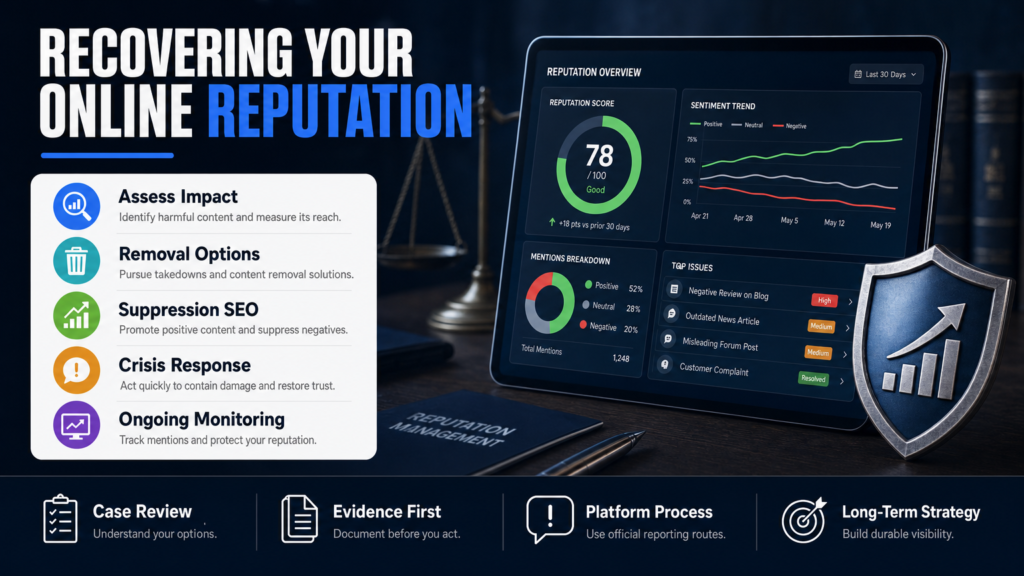
Measure success with both visibility metrics (search rank for target queries, Share of Voice on page one) and business metrics (calls, bookings, conversion rate). We develop SEO reputation strategies intended to improve the visibility of relevant and credible information, but avoid promising fixed timelines.
A clear scorecard helps stakeholders judge whether suppression is working or whether legal/publisher escalation is still needed.
- Step 1 — Baseline current search positions and traffic for branded queries.
- Step 2 — Set short-term (30–90 day) and medium-term (3–9 month) KPIs.
- Step 3 — Review monthly and adjust suppression, content, and outreach tactics.
- Visibility: position of negative items on page one and page two of search.
- Engagement: click-through rate and time on replacement pages.
- Business outcomes: leads, bookings, or customer churn tied to reputation incidents.
Removal vs Suppression: Which Approach Fits?
Both strategies are valid; choose based on removability, speed needs, and long-term goals.
| Removal | Suppression |
|---|---|
| Goal | Goal |
| Eliminate the item from the publisher or platform | Push the item out of top search results with alternate content |
| When effective | When removal is impossible, slow, or legally unsupported |
| Tactics | Tactics |
| Platform reports, publisher retraction, legal notices | SEO, content publishing, social profiles, paid ads |
| Speed | Speed |
| Unpredictable; depends on platform/publisher response | Gradual; measurable with rank and traffic changes |
| Cost | Cost |
| Potentially higher if legal action is required | Predictable ongoing marketing and content costs |
Hypothetical Example: A Local Surgeon and a Viral Article
Scenario: A local cosmetic surgeon finds a negative investigative article and several hostile social posts showing up on the first page of search for their name. The article alleges poor outcomes; the surgeon disputes accuracy. This is a hypothetical, anonymized scenario meant to illustrate process, not a reported case.
Process overview: Inventory and evidence collection; classify content (allegation vs opinion vs medical record); platform reporting for privacy breaches or impersonation; publisher outreach requesting correction; legal review for possible defamation; SEO suppression for the article and social posts; monitoring and periodic reporting.
- Step 1 — 0–7 days: Emergency containment — capture evidence, lock company accounts, and set monitoring.
- Step 2 — 7–30 days: Begin publisher outreach with a factual correction request and supply evidence. Submit platform reports for policy breaches if present.
- Step 3 — 1–3 months: If removal is denied, execute suppression: create physician profile pages, patient education content, and local press pieces to target branded queries.
- Step 4 — 3–9 months: Monitor search positions and traffic; continue outreach and adjust SEO to improve the position of authoritative pages.
- Notes — Timing depends on publisher cooperation, legal complexity, and search-engine response; an estimated timeline can be provided after assessment.
- Inventory: Save URLs, snapshots, and patient-release records if relevant.
- Assessment: Determine whether the article contains demonstrably false factual claims.
- Platform/legal: Use platform reports where policies apply; consult counsel for legal options.
Common Mistakes People Make
Avoid these frequent errors that make remediation slower, more expensive, or ethically problematic.
Mistake: Reacting Without Evidence
Many business owners publicly deny or attack commenters before collecting evidence. That wastes opportunities to use documented timelines and can make legal or platform escalation harder.
Collect and preserve evidence first: screenshots with timestamps, order numbers, and related communications.
Mistake: Treating All Negative Content the Same
A negative opinion differs from a factual falsehood and from doxxing. The right response depends on classification: platform report for privacy violations, publisher correction requests for factual errors, or SEO for opinions.
Distinguish opinion (protected speech) from false factual claims before pursuing legal action.
Mistake: Paying For Fake Removal Promises
Avoid services that guarantee deletion from Google or permanent suppression. Platform decisions remain under the platform’s control and no vendor can promise permanent removal.
We evaluate whether the content may qualify for removal or review and pursue the legal, technical, platform-based, and reputational options available.
Mistake: Offering Incentives For Reviews
Providing discounts or refunds in exchange for review removal or positive reviews can violate many platforms’ terms and backfire. Use transparent, policy-compliant customer recovery instead.
Handle legitimate complaints through a documented customer-service process and invite review updates without incentives.
Mistake: Ignoring Monitoring
Reputation is dynamic. Without monitoring, small issues can grow unnoticed. Set alerts for branded queries and key phrases so you can act quickly.
Simple alerting tools or a low-cost monitoring plan prevents surprises and reduces emergency costs.
Best Practices For Durable Reputation Work
Adopt processes that reduce risk and improve the chances of successful remediation while staying within platform rules and legal boundaries.
Practice: Systematic Evidence Collection
From the first sign of trouble, capture screenshots with timestamps and archive URLs. That evidence streamlines platform disputes and legal review.
Store evidence securely and limit access. Specific confidentiality obligations can be defined in a service agreement.
Practice: Prioritize Based on Impact
Not every bad mention requires the same response. Prioritize items by visibility and business impact (loss of revenue, regulatory exposure).
Use a triage system: High (page-one, high-traffic), Medium (page-two or low-traffic), Low (rarely seen).
Practice: Use Owned Channels First
Strengthen and optimize owned assets — your website, staff pages, LinkedIn profiles, and YouTube channel — so they rank for key branded queries.
We develop SEO reputation strategies intended to improve the visibility of relevant and credible information; owned assets are the fastest path to durable control.
Practice: Transparent, Measured Responses
When public replies are needed, be concise, factual, and invite offline resolution. Avoid emotional language or threats.
Keep a template library for common situations that legal or PR teams approve in advance.
Practice: Continuous Monitoring and Testing
Set up weekly checks, alerting, and quarterly audits of the first page for core brand queries. Track both search results and local pack listings.
Adjust tactics based on what works: sometimes paid content plus earned media is the fastest path to suppression.
Expert Tips
- Always capture full-page screenshots and the page’s HTML header before doing anything else.
- Treat legal threats as a last resort after publisher outreach and platform reporting; legal action requires clear evidence.
- For local businesses, optimize Google Business Profile fields and category accuracy to regain the local pack.
- Don’t leave negative replies unanswered — respond calmly and offer an offline resolution path.
- Use LinkedIn and professional directories aggressively for executives and licensed professionals.
- Place monitoring alerts on exact-match brand and name queries plus common misspellings.
- If a single review drives substantial damage, a targeted ad buy for branded terms can buy time while suppression works.
- Ask your agency for an indexable content plan that targets the exact phrases the negative items rank for.
Conclusion
Internet reputation management is a blend of triage, platform work, legal judgment, SEO, and measured messaging. There are no guaranteed shortcuts, but a methodical approach — inventory, classify, pursue removal where eligible, and suppress with high-quality content where removal isn’t possible — produces the best outcomes.
If the situation is high-stakes (licensing risk, safety, or viral spread), coordinate with qualified legal counsel and consider professional agencies that specialize in rapid containment and integrated SEO. A focused audit will identify whether removal, suppression, or a mix is the right strategy and provide an estimated timeline tailored to the platforms and publishers involved.
Why Businesses Choose Your Reputation Agency
Managing your reputation takes more than monitoring reviews or publishing the occasional blog post. It takes a strategy built around your situation, your industry, and what is actually showing up in search.
Your Reputation Agency works with businesses, executives, healthcare professionals, attorneys and growing brands. Our services include:
- Remove or suppress negative Google search results and news articles
- Take down or mitigate negative reviews (Google, Yelp, Trustpilot, industry sites)
- Remove defamatory content, false posts and impersonation accounts
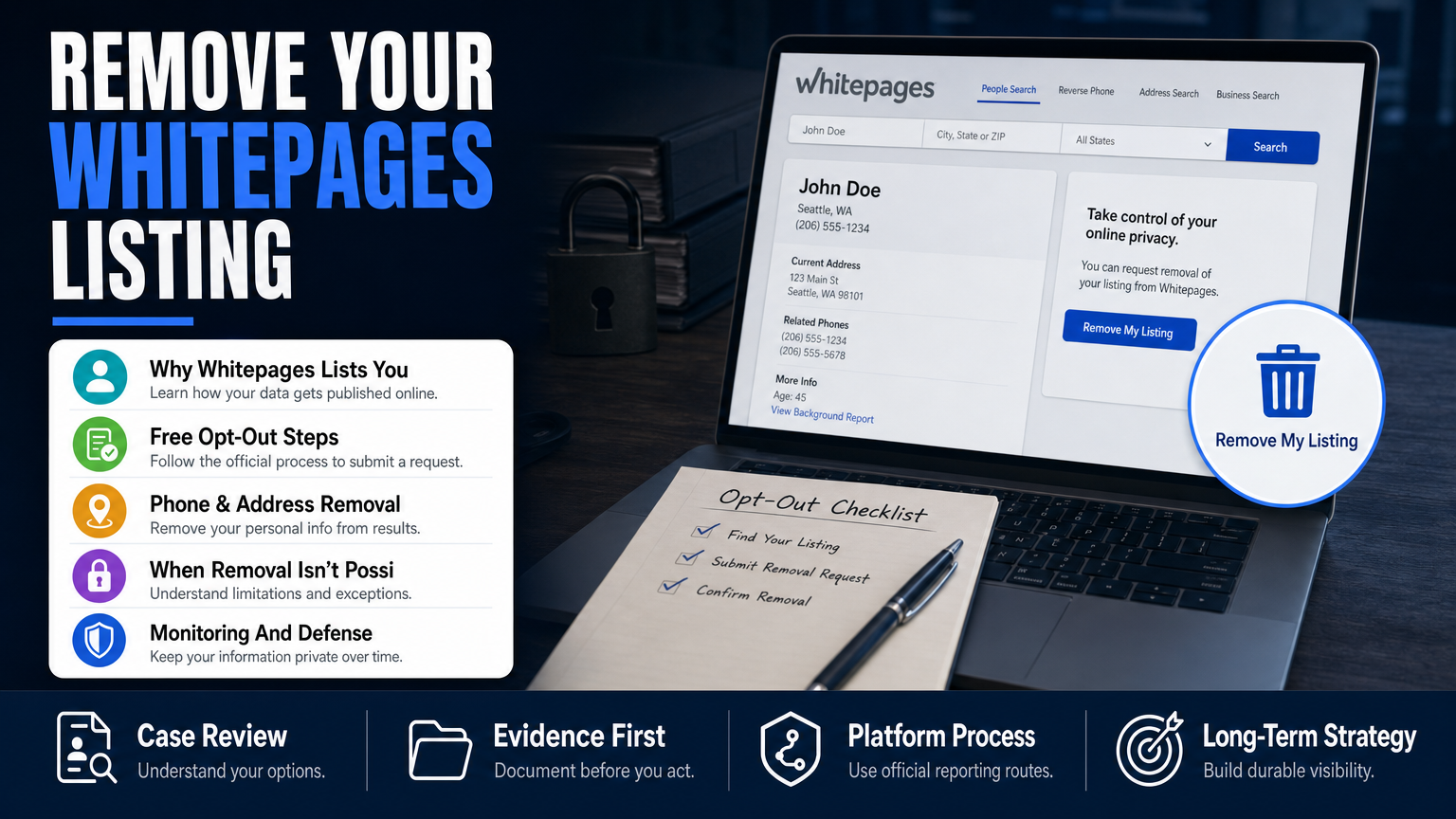
- Remove personal data from people-search and data-broker sites (opt-outs)
- Mugshot and arrest-record removal or suppression
- YouTube and negative video removal / demotion
- Rapid crisis response for viral incidents and online smear campaigns
- Social media impersonation and fake account removal
- Reputation monitoring, alerts and ongoing surveillance
- Search engine reputation repair (SEO to bury negative results)
Frequently Asked Questions
1. What is reputation in management?
In management, reputation is the collection of public signals — reviews, search results, news items, social posts, and directory listings — that affect stakeholder decisions. It’s managed like any other business asset because it influences revenue, hiring, and regulatory exposure.
2. Why is online reputation management important?
Online reputation management matters because visible content often determines whether prospects contact you. It affects conversion, referrals, and professional credibility. For regulated professionals and small businesses, visible allegations or privacy breaches can carry career and legal risk, so proactive management reduces long-term cost.
3. What are some effective strategies for managing online reputation?
Effective strategies include documenting and classifying negative items, using platform reporting and publisher outreach for removal where eligible, conducting legal review for defamation or privacy breaches, and executing SEO and content publishing to suppress unavoidable items. Monitoring and measured public responses complete the approach.
4. Who is the best digital reputation management company?
There is no universally ‘best’ firm — the right company depends on the scale of your problem, industry, and whether you need legal coordination or crisis PR. Look for firms that offer transparent processes, documented escalation paths, and experience with the platforms relevant to your case. For comparisons of review-crisis approaches, see When Google Reviews Become a Brand’s Biggest Crisis.
5. How long does reputation remediation take?
Timing varies widely. Some platform removals can happen in days if policy violations are clear; others require months of publisher negotiation or SEO work that takes 3–9 months to materially change first-page results. An estimated timeline can be provided after an individual assessment.
6. Can I remove any negative review or article?
No. Removal depends on platform policies, publisher cooperation, the nature of the content, and applicable law. We evaluate whether the content may qualify for removal or review and pursue the available options. When removal is unavailable, mitigation and suppression become the primary strategies.
7. Should I respond to negative reviews publicly?
Yes, but do so strategically. Respond calmly, acknowledge any verifiable issue, and offer to resolve offline. Avoid arguments or promises that violate platform policies. For sustained attacks, pair public responses with escalation to platform trust teams.
8. Do reputation management tools replace agencies?
Tools help with monitoring, alerts, and routine review responses, but they don’t replace the manual outreach, legal coordination, and high-skill SEO that complex cases require. Use software for scale; hire specialists for high-visibility or legally sensitive issues.
9. What does a professional audit include?
A professional audit inventories search results, classifies each item by type and removability, recommends platform, legal, and SEO actions, and provides an estimated plan with KPIs. It identifies whether removal, suppression, or a combination is the recommended path.
This content provides general information and does not constitute legal advice. The available options and likely outcomes depend on the facts, evidence, platform policies, applicable law, jurisdiction, and public-interest considerations.
Past examples do not guarantee future results. Removal, correction, deindexing, and search-position changes depend on third parties and circumstances outside Your Reputation Agency’s control.