You found an unwanted profile, arrest record, or people‑search listing that’s visible to clients and employers — and you need it gone or buried. You’re asking, “What’s better than DeleteMe?” because you want the fastest, clearest path that matches your case, budget, and legal exposure.
This article compares subscription data‑removal services like DeleteMe and Incogni, explains what those companies actually do, lays out free DIY options, and shows when an agency is the better choice. It will give concrete timeframes, likely outcomes, and the tradeoffs of cost, evidence needs, and permanence.
If your problem involves defamatory text, impersonation, or a viral smear there are legal and PR routes as well as takedown or suppression tactics — and the best approach usually mixes them. Below you’ll get a decision framework and step‑by‑step actions to take next.
Table of Contents
- Is DeleteMe a good product?
- What is a DeleteMe company — and how do these services actually work?
- How much does Incogni cost?
- Is there a free alternative to DeleteMe?
- When removal is NOT available: mitigation and suppression tactics that work
- DIY vs Subscription Service vs Hiring an Agency: make the decision
- What to expect after you sign up or start action
- Special cases: mugshots, medical records, and industry review sites
- Subscription Service vs Reputation Agency
- Hypothetical scenario: A surgeon’s old mugshot and a negative news mention
- Common mistakes people make when trying to replace or remove online data
- Best practices for choosing and using a data‑removal solution
- Expert Tips
- Conclusion
- Why Businesses Choose Your Reputation Agency
- Frequently Asked Questions
Is DeleteMe a good product?
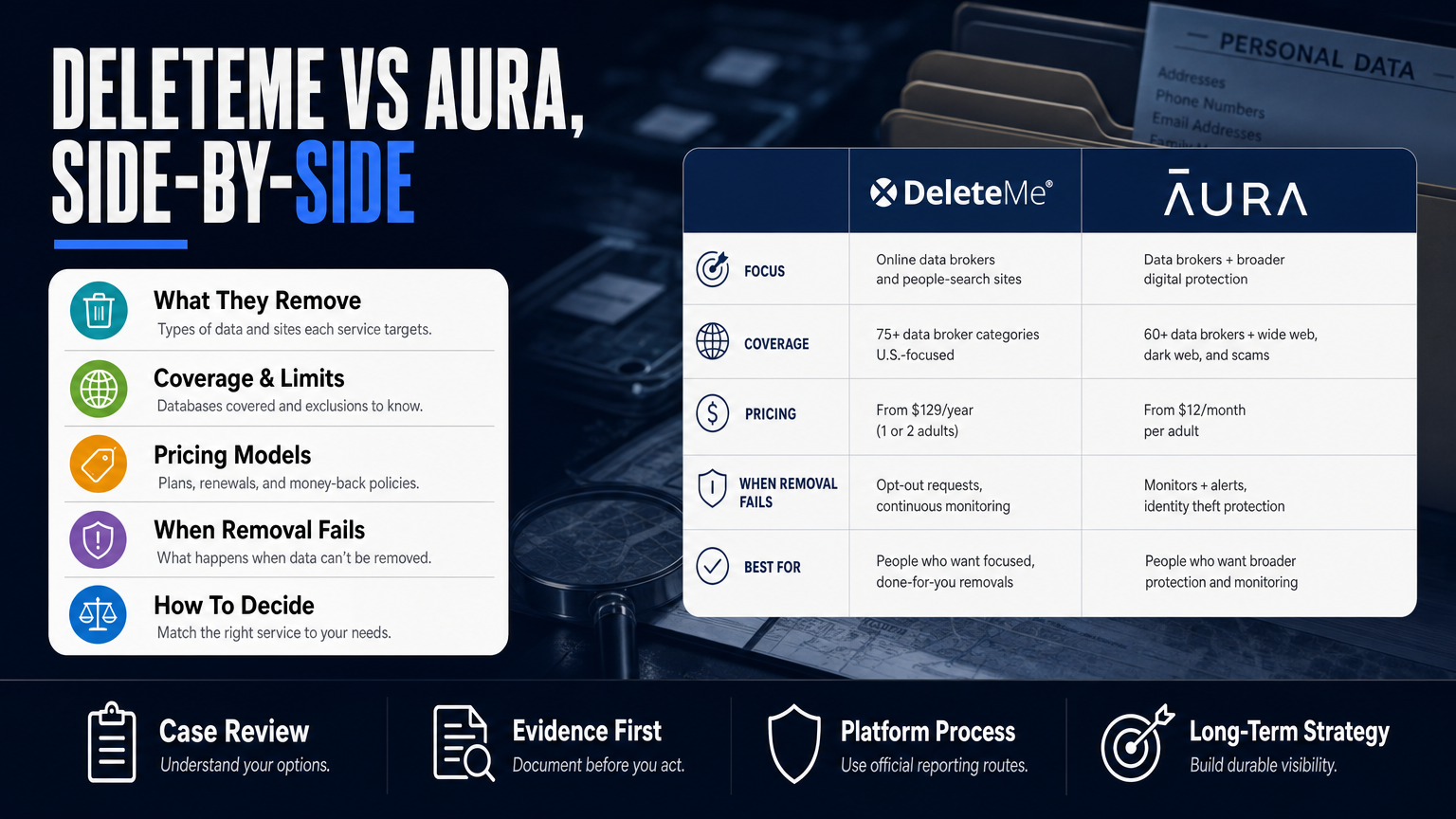
DeleteMe is a well‑known commercial subscription that automates opt‑out requests to people‑search and data‑broker sites. It is useful for individuals who want a low‑touch option to reduce exposure on dozens of common broker sites.
Whether DeleteMe is ‘good’ depends on your goals: if your priority is broad, ongoing removal from aggregator sites and you accept periodic reappearances (a common broker behavior), it can be cost‑effective. If you need removal of defamation, news articles, or fast crisis response for a viral incident, DeleteMe is not designed for that level of intervention.
- Identify which broker sites host your data.
- Decide if a subscription is worth automating opt‑outs versus DIY.
- If the listing involves false allegations or impersonation, escalate beyond subscription services.
- Strengths: Automates many opt‑outs, low effort for the user, predictable subscription pricing.
- Limitations: Limited or no reach into publishers, news outlets, or editorial sites; cannot promise permanent removal; not a substitute for legal action when content is defamatory.
Who should consider DeleteMe
People with many basic people‑search listings, non‑sensitive exposures (addresses, age), or those who want a hands‑off starting point often consider DeleteMe a sensible first step.
Professionals who face reputational harm from specialized sites (medical license databases, niche industry review sites) should not rely on DeleteMe alone.
- Prospective clients who want an automated cleanup.
- Busy executives wanting a maintenance service rather than case‑by‑case legal action.
What is a DeleteMe company — and how do these services actually work?
Companies in DeleteMe’s category provide subscription opt‑out workflows. They crawl the web and submit opt‑out requests to data brokers, and they periodically rescan to catch reappearing listings.
They are not law firms and do not litigate; platform decisions and publisher responses remain under the control of the website or platform. They rely on platform terms and data‑broker processes rather than court orders.
- Service finds your records using name/aliases and known addresses.
- Service files an opt‑out or privacy request where allowed.
- If denied, some services attempt manual escalation; others log the denial and monitor.
- Typical actions: identify listings, file opt‑outs, follow up on denials, and rescan at intervals.
- They publish no guarantees: removal depends on site policy and verification steps done by the broker.
What these services do not do
They typically do not contact publishers, newsrooms, or social platforms to remove defamatory content. They rarely perform targeted SEO suppression for negative press or coordinate crisis PR.
If your priority is removal of a specific harmful article, an agency or attorney may be necessary.
- No litigation or formal legal representation.
- Limited reach to site owners and no guaranteed outcomes.
How much does Incogni cost?
Incogni (a prominent competitor to DeleteMe) typically offers subscription pricing that can be lower than DeleteMe’s published packages, but prices vary with promotions and plan length. Incogni focuses on automated contact with data brokers to request removals.
Publicly listed prices change over time; you should check the service’s site for current rates and read their scope of work carefully to confirm what is and isn’t included.
- Compare current pricing on vendor sites before buying.
- Confirm exactly which broker sites are covered in the plan.
- Ask about manual escalation handling and refund/credit policies for denials.
- Common pricing model: monthly or annual subscription with discounts for longer terms.
- Watch for add‑ons: some services charge extra for manual escalation, special publisher requests, or monitoring of very large data sets.
How to compare cost vs value
Don’t compare price alone: compare the number of sites covered, frequency of rescans, transparency of reporting, and whether the service offers manual follow‑up for rejected opt‑outs.
If your case includes sensitive legal harm, cheaper subscriptions can delay the faster, more targeted interventions you may need.
- Check the provider’s site list and rescan frequency.
- Ask for an example report so you know what results look like.
Is there a free alternative to DeleteMe?
Yes. You can run DIY opt‑outs at no monetary cost, but they require time, persistence, and careful record‑keeping. Free alternatives work for many people, especially those with a limited number of broker listings.
The tradeoff is labor: DIY opt‑outs are manual, sometimes require supplying identity verification, and brokers often re‑index data, requiring repeated follow‑up.
- Create a tracking spreadsheet of sites, dates submitted, forms used, and confirmation emails.
- Use browser automation only with caution; never provide sensitive documents to unknown sites without verifying legitimacy.
- Set calendar reminders for 30, 90, and 180 days to rescan and repeat requests.
- DIY steps: locate the listing, follow the site’s opt‑out instructions, submit required IDs if requested, and document the request.
- Limitations: manual workload, risk of missed sites, and no automated rescan unless you set calendar reminders or use a monitoring tool.
Helpful free tools and when to use them
Use Google search operators (site:peoplesearch.com “Your Name”) to find listings. Free monitoring tools or saved Google Alerts can flag reappearances.
For a deeper read on when a viral complaint requires urgent intervention, see When a Viral Complaint Becomes a Career Emergency.
- Google Alerts for name variations.
- Manual use of site search and opt‑out pages.
When removal is NOT available: mitigation and suppression tactics that work
Sometimes content cannot be removed: public records, truthful news coverage, or platforms that decline takedowns for policy reasons. When removal is unavailable we pursue mitigation: correction, contextual content, and targeted SEO to reduce visibility of the harmful result.
Mitigation is a layered approach: build credible, authoritative content that outranks or displaces the negative result; file corrections or right‑to‑reply pieces with publishers where appropriate; and use ongoing monitoring to catch re‑emergence.
- Audit the first two pages of Google for your name or brand to identify targets for suppression.
- Prioritize assets you control (company site, LinkedIn, industry profiles, press releases).
- Develop a 3–6 month content and backlink plan to improve authority and visibility of positive content.
- Create fresh authoritative pages (site, LinkedIn, professional profiles).
- Publish factual clarifications or responses where platform policies allow.
- Use SEO strategies to boost desired pages and push down negatives.
When to involve PR and legal counsel
If the content is false, defamatory, or causing measurable business harm, coordinate with communications and a qualified attorney to evaluate cease‑and‑desist letters, corrections, or litigation options. These are evidence‑dependent decisions.
Our agency often coordinates technical suppression with PR messaging to control the narrative while legal options are explored.
- Attorney review for defamation or privacy law claims.
- PR outreach to request corrections or publish responses.
DIY vs Subscription Service vs Hiring an Agency: make the decision
Choosing between DIY, a subscription like DeleteMe/Incogni, or a full agency engagement depends on complexity, time sensitivity, and the type of content you need addressed. Small, low‑risk broker listings suit DIY or a subscription; targeted defamatory posts, removal of news, or a viral smear usually requires an agency and possibly legal counsel.
If you want metrics and incident response beyond opt‑outs — for example, coordinated review attacks, YouTube videos, or impersonation across platforms — an agency provides cross‑platform escalation, PR coordination, and SEO suppression.
- List every harmful item (broker entry, review, article, video) and score them by visibility and business impact.
- If one or two high‑visibility items exist (news article, viral video), prioritize an agency or attorney consult.
- If dozens of low‑impact listings exist, consider a subscription or DIY program.
- DIY: low cost, high time investment, good for a few broker sites.
- Subscription services: moderate cost, automated opt‑outs, suitable for broad broker cleanup.
- Agency: higher cost, multidisciplinary team, appropriate for complex or time‑sensitive crises.
How we evaluate a case (sample framework)
We score items on visibility (search rank, platform), content type (public record, opinion, false allegation), and urgency (hiring cycle, contract deadline, upcoming litigation). This scoring drives whether to recommend DIY, subscription, or agency.
For a deeper look at choosing a service when personal data affects hiring or business, see When Your Data Hurts Business: Which Service Helps?.
- Visibility: rank on page one vs buried.
- Content type: broker listing vs defamation vs public record.
- Urgency: immediate threat to job or business.
What to expect after you sign up or start action
Expect incremental progress, not instant eradication. Opt‑outs can succeed within days or take months; publishers and brokers may reindex content. Agencies will typically provide a plan, regular reports, and an estimated timeline range based on platform behaviors.
Documentation and evidence are crucial: keep copies of offending content (screenshots, URLs), record dates, and preserve any communications. If the case may require legal escalation, those records will be needed.
- Collect screenshots, URLs, and any communications related to the harmful content.
- Request a written plan and reporting cadence from the provider you choose.
- Set realistic checkpoints (30, 90, 180 days) and reassign priorities as results come in.
- Initial audit and prioritized action plan within 3–10 business days for agencies.
- Subscription services usually provide a dashboard and periodic reports.
- DIY results will vary; expect to repeat requests as listings reappear.
Reporting you should insist on
Ask for actionable reporting: what was requested, what the platform responded, and whether a listing was removed, suppressed, or denied. Vague summaries are not helpful.
For legal cases, request exportable logs and copies of any correspondence with publishers or platforms.
- Itemized list of targets attempted and their current status.
- A copy of any correspondence used to support takedown or correction requests.
Special cases: mugshots, medical records, and industry review sites
Certain categories—mugshots, sensitive medical data, or negative posts on specialty review sites—require tailored workflows. Mugshot sites often operate on a pay‑to‑remove model; medical boards and licensing bodies have their own correction processes.
Specialized sites or regulated data sometimes need a combination of legal, platform, and SEO tactics; a general subscription service often lacks the authority or process knowledge to handle them effectively.
- Identify the regulating body for licensing or medical records and follow their correction process.
- Document inaccuracies thoroughly before contacting specialty sites.
- Consider an agency if the issue involves recurring reposts across many niche sites.
- Mugshot sites: many will remove content on payment or proof of record errors; these sites also frequently republish data, requiring monitoring.
- Medical and licensing issues: correct public records through the issuing body; coordinate with counsel when allegations are contested.
- Industry review sites: respond professionally and request removals for policy violations; escalate to platform support when necessary.
Impersonation on social platforms
Impersonation requires swift platform reporting and, often, corroborating ID. Platforms have different policies and varying response times. An agency can coordinate multi‑platform escalation while preserving evidence for potential legal action.
If you face immediate business or safety risk, elevate to a specialist for rapid response.
- Follow each platform’s impersonation reporting flow and preserve confirmation IDs.
- Use verified accounts and two‑factor authentication to protect official profiles.
Subscription Service vs Reputation Agency
A concise side‑by‑side of core differences to help pick the right route.
| Subscription Service | Reputation Agency |
|---|---|
| Typical cost | Higher retainer or per‑project fee |
| Best for | Best for |
| Automated opt‑outs and monitoring | Custom takedowns, PR, and SEO |
| Speed on complex removals | Faster escalation for news, defamation, and viral crises |
| Legal coordination | Works with counsel and manages evidence |
| Transparency | Detailed strategy and reporting |
| Good when | Good when |
Hypothetical scenario: A surgeon’s old mugshot and a negative news mention
A surgeon discovers a mugshot listing and a regional news write‑up that appears in the first page of Google for their name three days before a high‑stakes hospital credential review. The mugshot is on a broker that republishes public records; the news article reports on an old, resolved investigation.
The person has two urgent problems: a high‑visibility news result (page one) and repeated broker republication of the mugshot.
- Day 1–3: Audit and evidence collection; agency recommends immediate PR and legal consult for the article.
- Week 1–4: PR outreach and correction requests; broker opt‑outs processed; monitoring set up for reappearance.
- Month 1–3: SEO suppression campaign begins to lower news article ranking; continued monitoring and follow‑ups on broker denials.
- Outcome expectation: improvements may appear in 4–12 weeks but depend on publisher cooperation and search algorithm responses; removal is not guaranteed and may require legal action if the article contains demonstrably false statements.
- Step 1: Triage — collect screenshots, URLs, and dates; prioritize the news article as the highest visibility risk.
- Step 2: Rapid response — agency files journalist correction requests and prepares a factual statement; concurrently, opt‑outs are submitted to the broker and payment‑based removal options are evaluated.
- Step 3: Mitigation — publish authoritative professional profiles and a clarifying statement on controlled channels; begin SEO suppression targeting the article’s keywords.
Common mistakes people make when trying to replace or remove online data
These mistakes slow progress, waste money, and can worsen outcomes if they lead to public escalation without evidence or proper strategy.
Mistake 1 — Chasing guarantees
Believing any vendor can guarantee removal or permanent suppression is a trap. Platform policies, publisher judgment, and search algorithms are outside any vendor’s direct control.
Instead demand transparent process descriptions and conditional timelines.
- Ask for scope of work, not promises.
- Insist on itemized reporting of attempts and responses.
Mistake 2 — Treating public records like removable content
Public records and truthful news seldom qualify for removal. Attempting to force deletion without correction or legal basis wastes time.
Focus on mitigation strategies like contextual content and SEO suppression when records are accurate.
- Verify whether content is public record before paying for removal attempts.
- Document corrections or expungements at the issuing body for use in remedial requests.
Mistake 3 — Relying on one tactic
Using only a subscription, or only SEO, rarely solves complex reputation problems. Effective recovery usually combines takedowns, corrections, content creation, and monitoring.
Plan a layered approach: technical, legal, and reputational actions together.
- Map out a combined timeline for takedown attempts and content creation.
- Coordinate PR messaging with platform escalations to avoid making the issue more visible.
Mistake 4 — Poor evidence collection
Failing to preserve screenshots, URLs, and dates makes legal or escalation routes difficult or impossible.
Always snapshot offending content and maintain secure backups if you may need counsel later.
- Use timestamped screenshots and an evidence log.
- Save copies of any responses from platforms or publishers.
Mistake 5 — Ignoring monitoring after removal
Many sites re‑publish removed content; without ongoing surveillance you’ll be surprised by reappearances.
Set automated alerts and periodic rescans to catch reposts early.
- Use Google Alerts and scheduled manual scans.
- Consider a subscription or agency monitoring if re‑publication risk is high.
Best practices for choosing and using a data‑removal solution
These durable actions reduce risk and create a defensible record if legal or PR escalation becomes necessary.
Inventory everything first
Create a complete list of every harmful item, its URL, screenshots, and a simple impact score. Decisions follow evidence.
This inventory is the basis for DIY requests, subscription onboarding, or an agency scope of work.
- Capture full URLs and search snippets.
- Note discovery date and audience (hiring managers, patients, customers).
Pick the right tool for the problem
Use DIY or subscription services for broad aggregator exposure; use agencies for news, defamation, impersonation, or review‑bombing incidents.
Be realistic about timelines: plan for rescans and follow‑ups, not instant fixes.
- Match cost to impact; don’t overspend on subscription services for a single high‑impact item.
- Get a written scope and reporting cadence from any paid provider.
Preserve evidence and avoid public escalation
Collect and store all evidence before you comment publicly. A rushed public response can increase visibility and harm.
Coordinate with counsel and PR when planning a public reply to ensure it does not create further legal exposure or amplify the story.
- Preserve original pages and metadata where possible.
- Limit public posts until you have a coordinated plan.
Insist on transparency
When you hire a provider, ask for itemized logs of targets, methods, responses, and metrics of success. Vague reports hide poor performance.
Contracts should state confidentiality terms, reporting frequency, and termination rights.
- Request exportable logs for any legal needs.
- Confirm confidentiality clauses before sharing sensitive evidence.
Plan for monitoring after action
Recovery is ongoing. Set monitoring for the first 6–12 months at higher frequency, then adjust as needed.
Automated alerts and quarterly manual audits catch reposts early and protect hiring or business cycles.
- Schedule rescans at 30, 90, and 180 days after removal attempts.
- Keep a rapid escalation path for reappearing or new high‑impact items.
Expert Tips
- Start with an inventory and impact score before spending on any service.
- If a listing is accurate public record, plan suppression and context rather than futile removal attempts.
- Ask providers for exportable logs and copies of correspondence with platforms.
- For impersonation, report on every platform simultaneously and preserve response IDs.
- Use authoritative profiles (LinkedIn, company site, published bios) as suppression targets.
- Be wary of any vendor promising guaranteed removal or fixed timelines.
- If a negative item risks employment, escalate immediately to PR and legal consultation.
- Document everything — screenshots and timestamps are essential if legal action becomes necessary.
Conclusion
Choosing “what’s better than DeleteMe” depends on the problem type: for broad people‑search exposure, a subscription can be a pragmatic, low‑touch start. For high‑visibility items — news articles, defamatory posts, videos, or impersonation — a coordinated agency and legal/PR approach is usually more effective.
Decide by inventory and impact: map each harmful item, score for visibility and urgency, then choose DIY, a subscription, or an agency to match that score. If you’re unsure, a focused audit from a qualified reputation team will identify the fastest path and estimate a realistic timeline and cost range.
Why Businesses Choose Your Reputation Agency
Managing your reputation takes more than monitoring reviews or publishing the occasional blog post. It takes a strategy built around your situation, your industry, and what is actually showing up in search.
Your Reputation Agency works with businesses, executives, healthcare professionals, attorneys and growing brands. Our services include:
- Remove or suppress negative Google search results and news articles
- Take down or mitigate negative reviews (Google, Yelp, Trustpilot, industry sites)
- Remove defamatory content, false posts and impersonation accounts
- Remove personal data from people-search and data-broker sites (opt-outs)
- Mugshot and arrest-record removal or suppression
- YouTube and negative video removal / demotion
- Rapid crisis response for viral incidents and online smear campaigns
- Social media impersonation and fake account removal
- Reputation monitoring, alerts and ongoing surveillance
- Search engine reputation repair (SEO to bury negative results)
Frequently Asked Questions
1. Is DeleteMe a good product?
DeleteMe is a solid option for automated opt‑outs from common people‑search brokers; it’s useful if you want a low‑touch subscription. It is not a one‑size‑fits‑all solution and is limited on publisher, news, or defamation issues.
2. What is a DeleteMe company?
A DeleteMe company is a subscription data‑removal service that scans for personal records on broker sites and submits opt‑out requests. They automate processes but do not provide legal representation or guarantee removals.
3. How much does Incogni cost?
Incogni typically charges on a subscription basis, with monthly and annual options; pricing fluctuates with promotions and plan duration. Check the vendor’s site for current rates and verify what sites and services are included.
4. Is there a free alternative to DeleteMe?
Yes — manual DIY opt‑outs and monitoring are free but time‑consuming. DIY requires you to find listings, submit opt‑outs, handle identity verification, and rescan regularly; it’s effective for those with the time and patience.
5. What do I do if content can’t be removed?
When removal isn’t available, focus on mitigation: publish authoritative content you control, request corrections where applicable, and run an SEO suppression campaign. Consider PR and legal options if the content is false or defamatory.
6. When should I hire an agency instead of using a subscription?
Hire an agency when you face high‑visibility items (page‑one news, viral video), legal exposure, impersonation, or a coordinated review attack. Agencies coordinate cross‑platform escalation, PR, and SEO suppression in ways subscription services do not.
7. Will a data removal service stop reappearances?
No service can promise permanent absence. Brokers and scrapers can republish data; effective plans include monitoring, repeat opt‑outs, and mitigation strategies. Expect ongoing maintenance in many cases.
8. Can I handle high‑risk incidents myself?
You can begin triage — collect evidence, snapshot pages, and file initial reports — but high‑risk incidents (threats to employment, safety, or licensure) usually need coordinated PR, legal review, and technical escalation that an experienced team provides.
9. How long before I see results?
Timelines vary by platform and content: some opt‑outs take days, many take weeks, and complex publisher corrections or SEO suppression can take months. Avoid vendors who promise fixed deadlines; ask instead for range‑based estimates after a full audit.
This content provides general information and does not constitute legal advice. The available options and likely outcomes depend on the facts, evidence, platform policies, applicable law, jurisdiction, and public-interest considerations.
Past examples do not guarantee future results. Removal, correction, deindexing, and search-position changes depend on third parties and circumstances outside Your Reputation Agency’s control.