You found a people‑search profile, mugshot site listing, or an old complaint showing up first when someone Googles you — and you’re asking: How much do data removal services cost? That’s the right question to start with because price varies widely depending on the problem.
This article gives a clear, platform‑by‑platform view of pricing models, realistic cost ranges, what affects the bill, and a decision framework so you can decide whether to pay for help. We also answer the common followups: Is a data removal service worth it? How long does data removal take? Is there a free option?
We cover removal, suppression, and monitoring; what vendors actually do; and concrete next steps you can take this week. The goal is to make costs and tradeoffs visible so you can choose the fastest, most defensible route for a doctor, lawyer, clinic, or small business.
Table of Contents
- Is a data removal service worth it?
- How long does data removal take?
- Is there a free data removal service available?
- What’s the best data removal company?
- How much do data removal services cost — pricing models and sample ranges
- Removal vs suppression: when removal isn’t available
- How to pick a vendor and what to request in a quote
- Digital security and monitoring costs you should budget
- Removal vs Suppression — Quick Comparison
- Hypothetical: A Doctor, A Mugshot, And A Budget Decision
- Common Mistakes That Drive Up Costs
- Best Practices When Budgeting for Data Removal
- Expert Tips
- Conclusion
- Why Businesses Choose Your Reputation Agency
- Frequently Asked Questions
Is a data removal service worth it?
Short answer: sometimes. Whether a paid service is worth it depends on the harm, the visibility of the content, the platforms involved, and how much time or risk you can absorb.
Paid services speed up the process, reduce the administrative burden, and bring expertise on platform policies and mass opt‑outs. They do not guarantee removal. They evaluate whether the content may qualify for removal or review and pursue the legal, technical, platform‑based, and reputational options available.
For busy professionals — physicians, lawyers, executives — the primary value is managing time and risk. If a listing or profile threatens licensure, contracts, or recruiting, paying for expert handling is often justified.
- Assess visibility: Is it on page one of Google for your name or business?
- Estimate impact: Does it cost you clients, interviews, or referrals?
- Get a written scope and evidence checklist before hiring anyone.
- Worth it if the content is false, defamatory, or violates platform policy and causing measurable harm.
- Worth it if you lack time, or the publisher is difficult to contact.
- Less worth it if the item is a factual public record (some mugshots, certain court documents) — removal is harder and may require counsel.
When to hire a professional
Hire when the content is widespread (data‑broker networks, multiple duplicates), when platform appeals are likely to be rejected, or when rapid mitigation is critical to revenue or licensure.
If you’re unsure how to quantify impact, a short paid audit from a reputable firm can clarify options and an estimated budget.
- Multiple people‑search listings or broker profiles
- Mugshots or arrest aggregators showing on page one
- Coordinated fake reviews or impersonation
How long does data removal take?
There is no universal timetable. Timing depends on the platform, publisher responsiveness, legal complexity, and whether the removal depends on third parties (publishers, registrars, search engines).
Some platform‑based removals (privacy flagging on Google, opt‑outs on certain brokers) can begin to show changes in days to a few weeks; removals from stubborn publishers or legal takedowns can take months. SEO suppression to push content off page one often requires several months of sustained work.
An estimated timeline can be provided after an individual assessment — and good providers will give ranges with caveats rather than promises.
- Get a written estimate with best/worst case ranges.
- Prioritize items by visibility and risk.
- Combine immediate platform reports with longer‑term SEO suppression.
- Simple opt‑out from a broker: days to a few weeks (varies by broker backlog).
- Social platform removal for harassment or impersonation: days to weeks if policy violations are clear.
- Publisher takedown or legal notices: weeks to months.
- SEO suppression: months to a year depending on content authority.
Why some cases take longer
Large data brokers and aggregators process thousands of opt‑outs and may place manual holds or require identity verification.
Persistent republication (copy sites, mirrors) multiplies work; each host or CDN may need separate notices.
Legal escalation requires evidence collection and coordination with counsel, which adds time but may be necessary for certain false or defamatory content.
- Mirror sites and syndicated content
- Jurisdictional issues across states or countries
- Publishers that monetize the content
Is there a free data removal service available?
There are free options and DIY routes. Many data brokers provide public opt‑out forms, and platforms have built‑in reporting mechanisms for harassment, impersonation, or privacy breaches.
Free routes are sensible for single low‑impact items, or when you have time to manage dozens of opt‑outs. They are less reliable for large or commercialized scraping operations, and they require sustained follow‑up.
When you use a free method, keep records (screenshots, ticket numbers, dates). If the item reappears, those records become evidence for escalation.
- Search for the item across three search engines (Google, Bing, DuckDuckGo).
- Use the platform’s official removal or abuse report form and save confirmation.
- Schedule follow‑ups in 2–4 weeks; expect reappearance and be prepared to refile.
- Free: platform reporting tools (Google, Facebook, Twitter/X, YouTube).
- Free: broker opt‑out forms and manual removal requests.
- Paid value: consolidation, repeat requests, and dealing with bad‑faith publishers.
Where free commonly fails
Some brokers deliberately complicate opt‑outs (CAPTCHAs, identity checks) or respawn listings. Commercial sites often ignore manual requests or require payment.
Free tools rarely include ongoing monitoring — so even if a removal succeeds, you may not know when a listing reappears.
- Sites that re‑publish scraped public records
- High‑authority publishers that value ad revenue above takedown appeals
- Paywalls or registration walls that block appeals
What’s the best data removal company?
There is no single ‘best’ company for every case. The right vendor depends on the problem type (people‑search brokers vs. defamation vs. mugshots), evidence, and how aggressive you need to be.
Good providers publish transparent pricing models, examples of the types of platforms they work with, and how they escalate matters to counsel when appropriate. Avoid firms that promise guaranteed removal or immediate takedowns.
Look for a company that explains the process clearly, provides written milestones, and coordinates with legal counsel and PR when incidents affect licensure or revenue.
- Ask for an itemized quote with sample timelines and a scope of work.
- Request references or case examples describing types of platforms (not named clients).
- Confirm how they escalate legal issues and whether they coordinate with outside counsel.
- Match expertise to problem type: brokers, mugshots, reviews, or publishers.
- Verify responsiveness and document sharing procedures.
- Choose a provider that offers monitoring and repeat attempts.
How to compare companies
Compare pricing models (one‑time vs subscription vs per‑item), success metrics, and the extent of monitoring included. Transparent providers will explain which outcomes are probable versus possible.
Beware low‑cost ‘one‑time’ packages that omit monitoring; data often returns unless monitored and re‑submitted.
- Transparent scope and exclusions
- Written ticketing and documentation
- Proactive monitoring options
How much do data removal services cost — pricing models and sample ranges
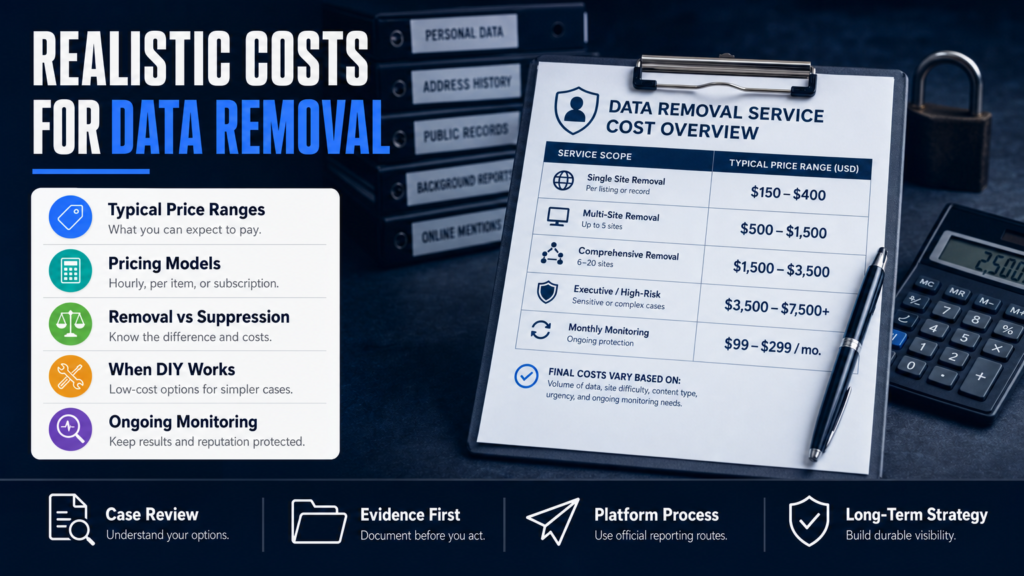
Providers usually use one of these pricing models: per‑item/one‑time fee, subscription (monthly/annual), tiered packages (X items included), or hourly consulting for legal escalations. Costs vary by content type and platform authority.
Below are sample US pricing ranges you can expect as rough market guidance. These are illustrative ranges, not guarantees; actual quotes depend on the item and publisher.
- List each harmful item and group duplicates or syndications.
- Ask providers to quote by group (e.g., all broker profiles, all mugshot sites) to compare apples to apples.
- Include expected monitoring duration when comparing subscription quotes.
- Per‑item opt‑out from a mid‑tier broker: $25–$150 per listing if handled professionally.
- Mugshot removal from aggregators: $200–$1,500 per listing depending on publisher resistance and whether verification is required.
- Publisher takedown requests or manual outreach: $300–$2,000+ per story for complex publishers.
- SEO suppression packages to push content off page one: $1,000–$5,000 per month for sustained campaigns; expect multiple months.
- Comprehensive subscription services (ongoing broker removal + monitoring): $30–$250/month depending on scope.
Factors that push costs higher
High‑authority publishers (news outlets), syndicated content, and content behind paywalls or registrars in other jurisdictions raise costs. Legal escalation, court involvement, or complex identity verification also increases fees.
If multiple mirror sites or international hosts are involved, expect the scope and cost to grow accordingly.
- Syndication and mirror networks
- Need for notarized identity verification
- Coordination with legal counsel
Removal vs suppression: when removal isn’t available
Removal depends on the content, publisher, platform policies, and jurisdiction. When removal is unavailable, mitigation and suppression become the primary strategies: correction, contextualization, and SEO work to lower visibility.
Suppression is an active, ongoing process: creating authoritative pages, publishing corrections, building links, and using social profiles to occupy the first page. This is where firms often earn recurring fees.
For many professionals, the safest approach is a hybrid: pursue removal where justified and use SEO suppression and PR for everything else.
- Map the first page of Google for your name or brand and identify targets for replacement.
- Develop a content plan focused on authoritative pages you control.
- Monitor search results and adjust the content mix over time.
- When removal fails, prioritize high‑visibility items for suppression.
- Create and claim authoritative properties (your clinic site, LinkedIn, professional directories).
- Use press releases, guest articles, and controlled content to outrank harmful items.
Why suppression often costs more over the long term
Suppression requires ongoing content production and link building; algorithms and competitors change, so suppression is maintenance work rather than a one‑time fix.
Transparency about recurring costs should be part of any quote you accept.
- SEO is not permanent; visibility can rebound without monitoring
- Recurring monitoring detects republication early
- PR can change the narrative but requires budget
How to pick a vendor and what to request in a quote
Ask vendors to itemize work: which platforms they will contact, what documentation they need, how many follow‑ups are included, and how long monitoring lasts. Get the scope in writing and compare what happens if content reappears.
Request a ticketing or dashboard view so you can see submissions and responses. Confirm confidentiality terms and whether the vendor coordinates with legal counsel when needed.
Be explicit about exclusions (news archives, public court records) and how the vendor defines ‘removal’ versus ‘suppression’.
- Collect three proposals with the same sample items for apples‑to‑apples comparison.
- Ask for references who faced similar platforms (not named clients).
- Compare total cost over 6–12 months, not just upfront fees.
- Itemized per‑platform pricing
- Monitoring duration and re‑submission policy
- Escalation path to legal review
Red flags in vendor proposals
Vendors promising guaranteed removal or claiming special insider access are red flags. Also be cautious of very low one‑time prices that exclude monitoring.
A professional vendor will be candid about uncertainty and offer documented processes.
- Guaranteed removal claims
- No documentation of process
- High upfront fees with no monitoring
Digital security and monitoring costs you should budget
Removal is only one part of the cost. Add monitoring, alerts, brand protection domains, and digital security measures (two‑factor authentication, incident response retainer) to your budget.
Monitoring tools or subscription services can range from $15 to $300 per month depending on frequency and coverage. Incident response retainers or dedicated crisis management support are additional and vary by provider.
Keeping a small ongoing budget for monitoring reduces future removal costs by catching republications quickly.
- Decide acceptable alert frequency (daily, weekly, monthly).
- Combine automated monitoring with quarterly manual reviews.
- Budget for at least six months of monitoring after initial remediation.
- Basic monitoring: $15–$75/month
- Comprehensive monitoring + alerts: $100–$300/month
- Crisis response retainer: varies widely; request a ballpark on inquiry
Insurance and cost recovery considerations
Some professional liability or cyber insurance policies cover reputation‑management expenses — review your policies before paying large sums. If the content is defamatory and you pursue legal action, consult counsel about fee recovery possibilities.
Document everything: invoices, screenshots, and correspondence could be important for insurance claims or legal actions.
- Check cyber or professional liability coverage
- Keep receipts and detailed logs
- Talk to counsel about cost recovery options
Removal vs Suppression — Quick Comparison
Compare the two core approaches so you can decide where to spend your budget.
| Removal | Suppression |
|---|---|
| Goal: Make content disappear | Goal: Reduce visibility |
| Works best for clear policy/legal violations | Works when content is lawful or factual |
| Often one‑time effort (but may require follow‑ups) | Requires ongoing SEO/PR investment |
| Possibly higher per‑item legal cost | Higher ongoing monthly cost |
| Outcome depends on publisher/platform decision | Outcome depends on content quality and SEO effort |
| Documentation and evidence important | Content creation and link building required |
Hypothetical: A Doctor, A Mugshot, And A Budget Decision
Scenario: A physician finds a mugshot and related article showing high on page one for their name after a dismissed arrest. The mugshot appears on three aggregator sites and in search snippets. The physician is worried about losing referrals.
Process: First, a vendor or the physician collects screenshots, URLs, and the dismissal paperwork. The team evaluates each host: some are people‑search brokers, others are news‑syndication mirrors.
Tactics: The team files opt‑outs with broker forms for two sites (cost: low per item but time consuming), requests removal from smaller mirrors (moderate outreach fee), and prepares an SEO suppression campaign (create authoritative profiles and publish a corrective statement on the physician’s clinic site). Legal escalation is considered only after providers reject reasonable requests, and counsel is consulted about the feasibility of a defamation claim given the dismissal paperwork.
- Collect documentation (court disposition, IDs) and take dated screenshots.
- Prioritize takedown requests for the highest‑visibility hosts.
- Start SEO suppression immediately while opt‑outs process.
- Monitor results and prepare escalation if needed.
- Initial audit and evidence collection: 1–3 business days
- Broker opt‑out filings (handled by vendor): a few days to a few weeks to process
- SEO suppression to restore page one: several months of work
- Legal escalation only if simple routes fail and counsel advises it
Common Mistakes That Drive Up Costs
Avoidable errors often inflate fees or prolong problems. Below are frequent mistakes we see and how to avoid them.
Mistake 1: Chasing every single mirror without strategy
Treating each republication as equal wastes budget. Instead, prioritize high‑authority hosts and search visibility. A focused suppression strategy often delivers better ROI than chasing dozens of low‑traffic mirrors.
- Use search analytics to find which URLs actually drive impressions
- Archive or screenshot low‑priority mirrors for evidence but do not spend major budget on them
Mistake 2: Hiring the cheapest vendor for a one‑time cleanup
Low upfront price that excludes monitoring often means the content returns and you pay again. Evaluate total cost of ownership over 6–12 months rather than just the initial bill.
- Ask about re‑submission policies
- Compare recurring monitoring costs
Mistake 3: Expecting guaranteed permanent removal
No reputable provider will promise permanent removal or fixed timelines. Anyone who does is making an impossible guarantee.
Plan with ranges and contingencies, not certainties.
- Get documented processes, not promises
- Prepare for follow‑ups and recurring checks
Mistake 4: Not preserving evidence early
Failing to capture screenshots, URLs, and timestamps makes later legal or platform appeals harder. Preserve evidence at the first sign of trouble.
Record ticket numbers and correspondence when you submit opt‑outs or reports.
- Use archive.org snapshots and local screenshots
- Log all submissions with dates and confirmations
Mistake 5: Overlooking monitoring after a ‘successful’ removal
Content frequently resurfaces. Without monitoring, reappearances go unnoticed and problems compound. Budget for at least six months of monitoring after remediation.
- Automate alerts and schedule manual checks
- Include re‑submission terms in your contract
Best Practices When Budgeting for Data Removal
Adopt these durable practices to control cost and improve outcomes when dealing with harmful online content.
Document everything from day one
Screenshots, URLs, and correspondence matter. If you later involve counsel or insurance, having a complete record saves time and money.
- Record ticket IDs and dates
- Keep copies of legal documents and court dispositions
Bundle similar items when requesting quotes
Group broker listings, duplicate URLs, and syndicated copies when asking for quotes to get realistic pricing and avoid per‑item sticker shock.
- Ask vendors to quote by group
- Prioritize by visibility
Include monitoring in your contract
A short monitoring window invites reappearance. Define monitoring duration and re‑submission terms in writing so the vendor remains accountable.
- Specify alert frequencies
- Agree on re‑submission attempts and additional fees
Combine legal, technical, and PR approaches when needed
Complex incidents often require coordinated action: policy reports, legal notices, and reputation content to correct the narrative. Good vendors coordinate with outside counsel and PR advisors.
- Plan escalation paths in advance
- Allocate budget for counsel if defamation or legal rights are implicated
Check insurance and contracts for coverage
Some policies cover reputation management or crisis communications. Review policies early to see if costs may be reimbursable.
- Document expenses for claims
- Ask your vendor for invoices suitable for reimbursement
Expert Tips
- Start with an audit: a two‑page report clarifies visibility and stops overpaying.
- Prioritize page‑one results — items off page one rarely cost as much to suppress.
- Bundle broker opt‑outs: vendors give better per‑item rates for groups.
- Document and timestamp everything before you contact a vendor or publisher.
- Ask vendors for an escalation path to outside counsel and PR if the issue escalates.
- Avoid vendors that promise guaranteed removal or fixed timelines.
- Budget for six months of monitoring after remediation.
- If you’re a licensed professional, involve your risk/credentialing team early.
Conclusion
How much data removal services cost depends on the content, platforms, required tactics, and whether you need ongoing monitoring. Expect a spectrum of pricing models — from low per‑item opt‑outs to multi‑month SEO campaigns and legal escalations — and evaluate total cost over time, not just the initial invoice.
If visibility or licensure is at stake, paying for skilled help is often worth the investment because it reduces administrative burden and provides a documented escalation path. Whether you DIY or hire, use a prioritized plan: audit visibility, collect evidence, test free opt‑outs, and reserve paid escalation for the highest‑risk items. For a sense of broker economics and how they affect professionals, see What a Data Broker Profile Really Costs a Professional.
Why Businesses Choose Your Reputation Agency
Managing your reputation takes more than monitoring reviews or publishing the occasional blog post. It takes a strategy built around your situation, your industry, and what is actually showing up in search.
Your Reputation Agency works with businesses, executives, healthcare professionals, attorneys and growing brands. Our services include:
- Remove defamatory content and false posts (news, blogs, listings)
- Remove or challenge negative reviews (Google, Yelp, TripAdvisor, industry sites)
- Mugshot and arrest record removal
- Remove videos, images, and other multimedia that damage reputation
- Remove personal data from people‑search and data‑broker sites (opt‑outs)
- Search result suppression (SEO to bury negative links)
- Social media takedowns and impersonation removal
- Rapid online crisis management and incident response
- Ongoing monitoring and alerting of reputation signals
- Coordination with legal counsel and use of legal tactics when required
Frequently Asked Questions
1. Is a data removal service worth it?
It depends. Paid services are worth it when the content causes measurable harm, is widespread, or you lack the time to manage repeated opt‑outs. They provide expertise, documentation, and monitoring but cannot guarantee removal. Evaluate by prioritizing items by visibility and impact.
2. How long does data removal take?
There is no universal timeline. Simple platform removals or broker opt‑outs can begin to show changes within days to weeks; publisher takedowns, legal notices, or SEO suppression can take months. Providers should offer estimated ranges after assessing your case.
3. Is there a free data removal service available?
Yes — many brokers and platforms offer free opt‑outs and reporting tools. Free routes work for single, low‑impact items or when you have time, but they often lack monitoring and may be less effective against commercialized scraping operations.
4. What’s the best data removal company?
There’s no single best company for every situation. Choose a vendor experienced with the specific problem (mugshots, brokers, reviews, publisher content), transparent about pricing, and clear on monitoring and escalation. Avoid anyone promising guaranteed outcomes.
5. How much should I budget for monitoring?
Basic monitoring can cost $15–$75/month; comprehensive monitoring $100–$300/month. Budget at least six months after remediation to detect reappearances. The right amount depends on your risk tolerance and how public your role is.
6. Can insurance cover data removal costs?
Some cyber or professional liability policies cover reputation remediation or crisis response. Review your policy and retain invoices and documentation for claims. Consult your broker or legal counsel about coverage specifics.
7. What if the publisher refuses to remove false information?
If a publisher refuses, options include escalation to the platform (if a policy is violated), SEO suppression, or seeking legal advice. A qualified attorney can determine whether a legal claim may be available; Your Reputation Agency coordinates with counsel when cases warrant legal analysis.
8. How do I compare vendor quotes?
Compare itemized scopes, monitoring duration, per‑platform pricing, re‑submission policies, and escalation to legal counsel. Ask for three comparable proposals and evaluate total cost over 6–12 months, not just the upfront fee.
9. Can I remove my information from data brokers myself?
Yes — many brokers provide opt‑out forms and identity verification steps. DIY is time‑consuming but feasible for a small number of listings. If brokers respawn listings or you find many duplicates, professional services that include monitoring may be more efficient.
This content provides general information and does not constitute legal advice. The available options and likely outcomes depend on the facts, evidence, platform policies, applicable law, jurisdiction, and public-interest considerations.
Past examples do not guarantee future results. Removal, correction, deindexing, and search-position changes depend on third parties and circumstances outside Your Reputation Agency’s control.