You just found a false accusation or defamatory article that ranks on page one for your name or business. That single result is costing calls, interviews, bookings, or even professional referrals.
This article explains when and how to use a Google legal removal request for defamation, what evidence Google and courts look for, who should be involved, and realistic alternatives when removal is unlikely. The primary keyword — Google legal removal request defamation — is used below to connect you to the specific Google processes discussed.
We’ll give clear, actionable steps you can take immediately, explain likely outcomes and timelines, and show when litigation, a platform complaint, or a reputational suppression strategy is the better option.
If you prefer immediate help rather than DIY, the sections include the signals that typically justify contacting counsel or a specialized agency.
Table of Contents
- Can you sue Google for defamation?
- Do Google removal requests work for defamation?
- How to submit a legal removal request to Google for defamation
- How to get an unfair Google review removed
- How much does it cost to get a negative Google review removed?
- When removal is NOT available: suppression and mitigation
- Evidence, timing, and coordination with counsel and PR
- Next steps: an immediate checklist you can follow
- Removal Request vs Search Suppression
- Hypothetical: A surgeon, a false blog post, and mixed options
- Common mistakes people make when seeking defamation removal
- Best practices when pursuing a Google legal removal request for defamation
- Expert Tips
- Conclusion
- Why Businesses Choose Your Reputation Agency
- Frequently Asked Questions
Can you sue Google for defamation?
Short answer: usually no. Suing Google directly for defamation is rarely effective because, in the United States, platforms like Google are generally protected as intermediaries under Section 230 of the Communications Decency Act. That law shields internet services from liability for third-party content in many (but not all) cases.
That said, there are narrow situations where legal action is appropriate: suing the author or publisher of the defamatory content, pursuing a subpoena to identify an anonymous poster, or bringing claims against a publisher that falls outside Section 230 protections. A qualified attorney can advise whether a specific factual record supports a legal claim and the jurisdictional questions involved.
- Document the defamatory content (screenshots, archive links, dates, URLs).
- Collect evidence that the statements are false (records, witness statements).
- Consult a defamation attorney to review jurisdiction, statute of limitations, and potential defendants.
- Consider sending a cease-and-desist or defamation demand letter as a first step through counsel.
- Section 230 often protects Google from direct defamation claims about third-party posts.
- You can sue the author/publisher of the post if you have evidence the statements are false and defamatory.
- You can pursue subpoenas, pre-litigation demands, or other discovery to identify anonymous posters.
- Courts, jurisdiction, and the nature of the content determine whether legal remedies are available.
When a claim should go to a lawyer
If the content accuses you of criminal conduct you did not commit, threatens your professional licensure, or is coordinated and fraudulent (fake reviews, impersonation), consult counsel sooner rather than later.
A lawyer can issue preservation letters, draft defamation demands, seek subpoenas to identify anonymous posters, and advise whether a direct suit is worth pursuing.
- Harms to licence, employment, or clear business losses justify early legal involvement.
- Anonymous posters can sometimes be unmasked through subpoenas served on platforms or hosts.
Do Google removal requests work for defamation?
Google has several formal ways to report content: policy-based reporting (harassment, impersonation), privacy requests (personal data), DMCA for copyright, and a legal removal request form that covers things like court orders or content violating specific laws. A ‘Google legal removal request defamation’ is usually not a one-click fix — Google evaluates reports against policies and applicable law.
Platform removal can succeed when the content violates Google’s policies (privacy, doxxing, revenge porn, impersonation) or when there’s a valid court order. For plain defamatory statements, Google often defers to publishers and the public record unless the post also breaks platform rules or a court has ordered removal.
- Identify whether the post violates Google policy (harassment, doxxing, sexual content, personal data exposure).
- If so, use Google’s standard policy-reporting forms for the specific violation.
- If you have a court order, submit it through Google’s legal removal request channels with the order attached.
- Google can remove search results or delist content when presented with a valid court order or when content violates a specific Google policy.
- Defamation alone is not always sufficient for Google to remove a result; platform policy, publisher cooperation, and jurisdiction matter.
- If the publisher removes the content, Google will stop indexing it — that’s often the fastest path.
Where Google typically steps in
Google is more likely to remove or delist content that involves privacy violations (exposed SSNs, financial data), explicit images shared without consent, or content that impersonates another person.
For defamation that is purely false statements of fact without a policy violation, Google will usually expect the publisher to remove or for a court order to require removal.
- Privacy violations and doxxing — higher chance of action.
- Impersonation and account takeovers — report via Google account forms.
- Allegations of criminality — may require court action for delisting.
How to submit a legal removal request to Google for defamation
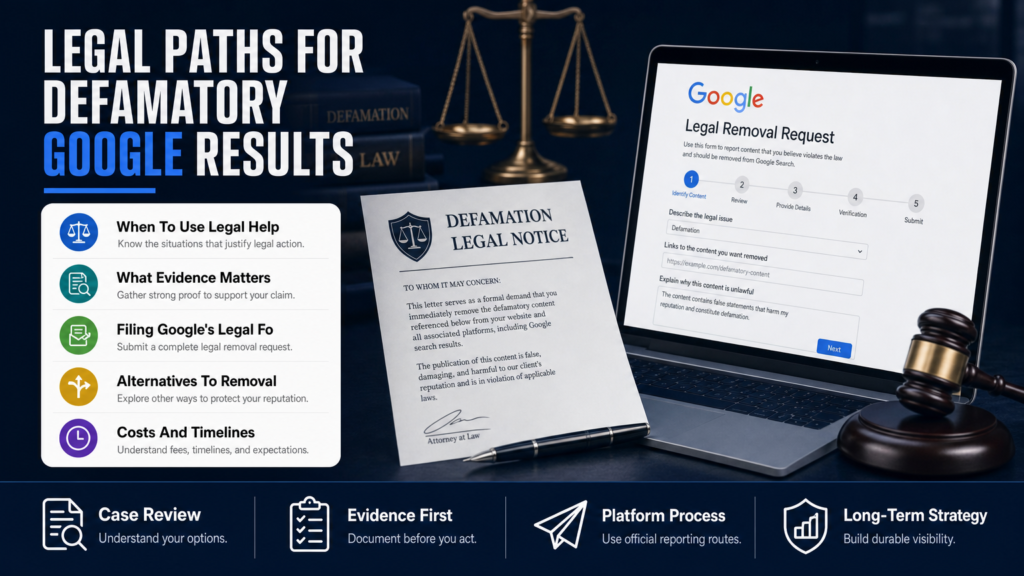
Google’s legal removal channels are the formal path for requests backed by law: court orders, statutory claims, or formal legal process. A thorough ‘Google legal removal request defamation’ packet increases your chance of review. Remember that Google evaluates legal documents and will not act as a judge on the merits of a defamation claim absent a court order.
Below are practical steps to prepare and file a legal removal request, with what to expect after submission.
- 1) Archive and document the content: take time-stamped screenshots, copy the URL, and capture the page’s HTML or use the Wayback Machine.
- 2) Obtain legal documentation if available: court orders, takedown notices, defamation judgments, or subpoenas.
- 3) Use Google’s legal removal forms at Google’s Legal Help pages and choose the correct category (e.g., ‘Request removal for legal reasons’).
- 4) Upload supporting evidence and the legal order (PDF).
- 5) Track the request and be prepared to provide further authentication if Google asks.
- Prepare a precise description of the content and the URL(s).
- Attach authenticated court orders or legal documents if you have them.
- Explain jurisdiction and why the legal order applies to Google’s services.
Filing tips and practical details
Use precise URLs (not a search-results link) and include the full path to the offending content. Note the date and time you first discovered the content.
If you have a court order, include the order’s relevant pages and a certified translation if it’s not in English.
- Do not conflate unrelated URLs; submit one legal request per URL for clarity.
- Keep original evidence (emails, DMs, records) in case Google or a court asks for verification.
How to get an unfair Google review removed
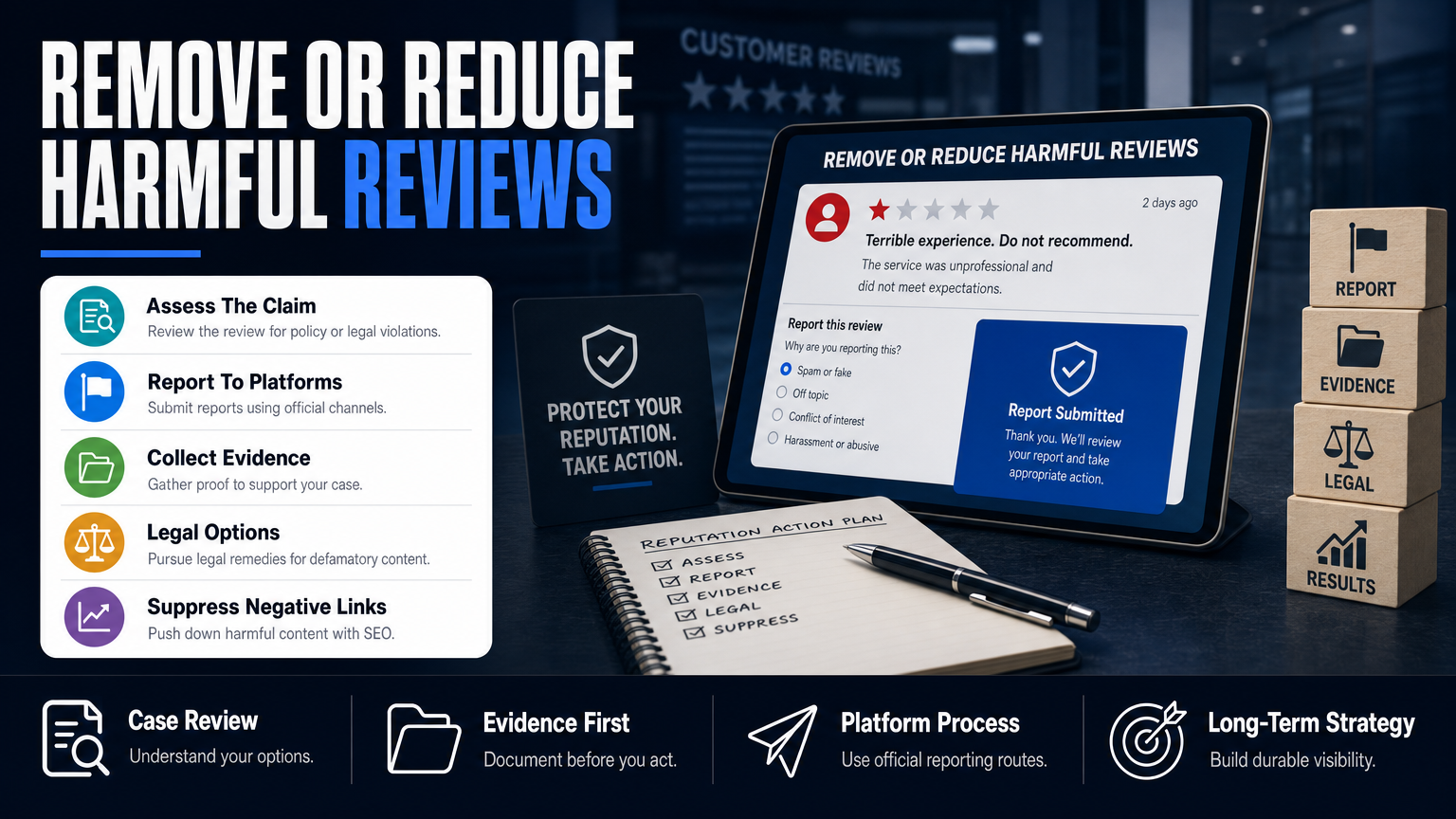
Unfair Google reviews are one of the most common reputation problems. If a review violates Google’s review policies — it’s fake, contains harassment, or is a conflict of interest — you can request removal through Google. For other cases (truthful negative feedback), removal is unlikely and mitigation or response strategies are better.
If the review impacts a regulated professional (doctor, lawyer), you may have additional remedies if the content is demonstrably false or violates licensing rules. For medical practices, “What One-Star on Google Can Cost a Medical Practice” explains the stakes of a single negative review and when to escalate beyond platform reporting.
- 1) Flag the review inside Google Business Profile and choose the most accurate policy reason.
- 2) If flagging fails, use the Google Business Profile support channels and provide evidence (proof of non-customer relationship, screenshots showing coordination).
- 3) Consider a formal demand to the reviewer through counsel if identity is known or can be discovered.
- 4) If a review contains factual falsehoods that harm licensure or safety, involve your professional regulatory body.
- Google removes reviews that are spam, fake, contain hate speech, or violate sexual or privacy policies.
- Reviews that are merely negative or critical typically stay; you can reply to them publicly instead.
- For repeat fake reviews or coordinated attacks, collect evidence and consider legal or administrative remedies.
When to escalate beyond Google’s flagging tools
If multiple fake reviews appear over days, or a competitor orchestrates a review-bombing campaign, Google’s automated systems may miss the pattern. Escalate through Google Business Profile support and document the pattern.
For medical practices and other high-risk professions, consider regulatory complaints where appropriate.
- Track reviewer accounts and timestamps to show coordination.
- Present business records proving the reviewer was never a client where applicable.
How much does it cost to get a negative Google review removed?
Cost varies widely. Google does not charge to process standard complaints filed through its forms, but fees can appear if you hire a lawyer or an agency. Typical cost components are legal fees (if counsel is needed), agency fees for evidence collection and escalation, and potential subpoena or court costs if identity discovery is required.
Expect a range rather than a fixed price: trivial cases (flagging a single spam review) can be free or low-cost; complex cases involving subpoenas, discovery, or litigation will cost several thousand dollars or more depending on the law firm and urgency.
- 1) Start with the free Google flagging process.
- 2) If unsuccessful, get written cost estimates from specialized agencies or a defamation attorney.
- 3) Balance cost vs. damage: for high-revenue or licensure-risk cases, aggressive paid escalation is often justified.
- DIY: $0 to a few hundred dollars (time to document and flag).
- Agency-assisted escalations: often a few hundred to several thousand dollars depending on scope and speed.
- Legal action or subpoenas: typically several thousand dollars upward, depending on counsel and court costs.
What drives cost
Costs are driven by complexity: identity discovery (subpoenas), cross-jurisdictional legal work, and urgency. Fast-track services and immediate incident response commands higher fees.
Transparent providers will estimate likely ranges after a quick case review; beware firms that promise guaranteed removal for a fixed low price.
- Subpoenas and litigation materially increase costs.
- Coordination with PR or crisis communications adds expense but is often necessary to repair reputation.
When removal is NOT available: suppression and mitigation
Sometimes removal isn’t feasible: the publisher won’t cooperate, the content is a truthful public record, or the platform declines the request. In those cases, the right strategy is mitigation: SEO-driven suppression, correction, context, and reputation rebuilding.
Suppression and mitigation are technical and communications efforts intended to push negative results lower in search and populate the first page with accurate, authoritative content. For background on how a single result can damage a career, see When One Google Result Can End A Professional’s Career.
- 1) Audit the first two pages of search results for your name and core keywords.
- 2) Identify high-authority slots you can feasibly control (LinkedIn, professional associations).
- 3) Publish, optimize, and promote accurate content to push the negative link down.
- 4) Use paid search ads selectively to control the narrative on branded queries.
- Create authoritative pages (press releases, bios, professional profiles) to outrank the negative link.
- Use content amplification (social profiles, LinkedIn articles, directory listings) to fill search results with vetted information.
- Correct factual errors publicly where possible and use positively framed content to regain trust.
When suppression is preferable to legal action
Suppression may be faster, cheaper, and less risky when a legal victory is uncertain, when the publisher is overseas, or when the content is a lawful public record. Suppression also helps rebuild trust with potential clients and referrals.
However, suppression is not a removal; the negative link remains accessible to anyone who searches deeply or follows a direct link.
- Prefer suppression when the publisher won’t cooperate or legal costs outweigh likely benefits.
- Combine suppression with PR and corrections for best effect.
Evidence, timing, and coordination with counsel and PR
Evidence is the single biggest determinant of whether a legal route will work. Good evidence includes contemporaneous records, direct refutations, authenticated screenshots, server logs, and witness statements. Timing matters: act before links spread to aggregators, syndication services, or review sites.
Coordinate legal, technical, and PR teams. A well-timed legal step combined with a communications plan prevents missteps (for example, sending a heavy-handed demand that aggravates a publisher or creates a Streisand effect). If the matter affects patient safety or licensure, involve counsel immediately and prepare a public-facing statement with PR oversight. For issues with legacy press coverage about a medical professional, consider reading When an Old Article Threatens a Doctor’s Practice.
- 1) Preserve evidence using multiple methods (screenshots, HTML saves, Wayback Machine).
- 2) Get a case assessment from a defamation attorney and a reputation specialist.
- 3) Decide on a coordinated path (direct publisher request, Google legal notice, or SEO suppression plus PR).
- 4) Track and monitor the outcome and be ready to escalate if necessary.
- Collect and preserve evidence immediately (screenshots with timestamps, source URLs).
- Assess whether a court order or a publisher retraction is realistic before filing formal requests.
- Coordinate messages so legal demands and public statements do not contradict each other.
Practical monitoring and escalation
Set up alerts for mentions of your name, business, and core phrases. Early detection reduces the spread and cost of remediation.
If Google declines a removal request, preserve their communications and ask for a written explanation — that can be useful evidence if you later pursue court remedies.
- Use Google Alerts, brand-monitoring tools, and paid monitoring services for high-risk professionals.
- Request written denials or case numbers from Google when they refuse to act.
Next steps: an immediate checklist you can follow
If you’ve found defamatory content ranking for you or your business, follow a prioritized checklist to preserve options and limit damage. The steps below balance speed with preserving legal remedies.
If you want professional evaluation rather than DIY, collect the items below before you contact counsel or a reputation firm — it will speed any intake and clarify likely options.
- 1) Take time-stamped screenshots and save the URL in a document.
- 2) Use the Wayback Machine or similar archiving services to preserve a copy.
- 3) Flag the content to the hosting platform and Google using the appropriate forms.
- 4) If the content violates clear Google policy (privacy, images), submit a platform report immediately.
- 5) If the content is potentially actionable and causing material harm, consult a defamation attorney for next steps.
- Preserve the page (screenshot, HTML, archive link).
- Note the exact URL, timestamps, and how you first found the content.
- Collect corroborating evidence that statements are false (records, emails, contracts).
- Decide who should be on the response team (in-house counsel, outside counsel, PR).
Useful links and further reading
For more on how a single, visible result can upend a professional career and what to do about it, read When One Google Result Can End A Professional’s Career.
Removal Request vs Search Suppression
Quick comparison to decide whether to pursue removal or suppression as your first line of response.
| Removal Request | Search Suppression (SEO & PR) |
|---|---|
| Goal | Goal |
| Eliminate the specific piece of content | Push negative links lower in search results |
| Depends on platform/legal authority | Depends on content-production and SEO effort |
| Fast only with publisher cooperation or court order | Takes weeks to months, ongoing effort |
| May require legal fees or court costs | Typically agency or content creation costs |
| Removes the record (if successful) | Does not remove the record, reduces visibility |
| Good when content is illegal or policy-violating | Good when content is lawful but harmful |
Hypothetical: A surgeon, a false blog post, and mixed options
Scenario: A named surgeon finds an old local blog post that falsely accuses them of malpractice. The post ranks top for searches on the surgeon’s name and is shared on social media. The post’s author refuses to remove it and hosts it on a US-based platform.
Process below illustrates evidence collection, platform escalation, legal evaluation, and a suppression fallback.
- 1) Day 1–3: Collect and preserve evidence; flag the post to Google and the host. Begin monitoring for shares.
- 2) Day 4–10: Attorney sends a defamation demand to the blog author and the host requesting removal; host declines citing publisher rights.
- 3) Day 11–30: Attorney evaluates filing suit or seeking a temporary injunction; surgeon weighs cost versus harm. Meanwhile, the reputation team begins a suppression campaign: publishing authoritative bios, optimizing LinkedIn, and placing positive content on professional directories.
- 4) 1–3 months: If the publisher still refuses and the surgeon declines litigation, suppression begins to reduce visibility — within weeks the first page shows more authoritative profiles and articles, and the blog post drops to page two or three for many queries.
- 5) Ongoing: Monitor search results, respond to inquiries with a concise factual statement when contacted, and keep legal option open if new harms arise (license inquiry, job offer rescinded).
- Preserve evidence: screenshots, Wayback archive, email correspondence with the author.
- Flag policy violations: no explicit policy violation found — the blog claims to report news.
- Legal review: attorney finds statements that appear false and defamatory; jurisdiction is local to the surgeon.
Common mistakes people make when seeking defamation removal
Avoid predictable missteps — they waste time, increase costs, and can make the problem worse.
Mistake 1 — Acting without preserving evidence
People often try to fix the problem without capturing timestamps, URLs, or page copies. If the publisher edits or removes the content later, you may lose evidence needed for legal remedies.
- Always save screenshots, HTML, and archive links immediately.
Mistake 2 — Sending public takedown threats
Posting aggressive public demands or making legal threats on social media can trigger the Streisand effect — the content becomes more visible and spreads.
- Coordinate legal and PR messages before contacting publishers publicly.
Mistake 3 — Assuming Google will remove anything negative
Expecting Google to act just because content is embarrassing or false is unrealistic; removal usually requires a policy violation or a court order.
- Plan for suppression and alternative remedies if removal is denied.
Mistake 4 — Hiring low-cost removal promises
Some vendors promise guaranteed removal for a flat low fee — such promises are misleading. Legitimate providers will explain probabilities and dependencies.
Avoid vendors that recommend fake or deceptive tactics.
- Demand transparent processes and written scopes before paying.
Mistake 5 — Ignoring professional regulation risks
Professionals sometimes treat reputational hits as only a marketing problem, when they actually threaten licensure. Ignoring regulator notification obligations or failing to seek counsel early can worsen outcomes.
- If licensure or patient safety issues are implicated, involve counsel and compliance teams.
Best practices when pursuing a Google legal removal request for defamation
Follow these durable steps to preserve options, reduce risk, and improve chances of a favorable outcome.
Preserve everything and document chain of discovery
Immediate preservation is essential. Use multiple capture methods and keep originals. Preservation protects legal and administrative options.
- Screenshots, HTML saves, Wayback archives, and logs of communications with platforms.
Use the correct Google forms and legal channels
Submit reports through the specific Google reporting pathway that matches the problem: privacy, impersonation, legal removal. Generic flags are less effective than targeted forms.
- Attach court orders where applicable and include precise URLs.
Coordinate legal, technical, and PR responses
A unified strategy prevents contradictory messages and reduces the risk of escalation. Have counsel review any public statement before posting.
- Plan external communications only after legal options are identified.
Know when to invest in suppression
If removal looks unlikely, invest in producing authoritative content and SEO to push the harmful link down. This is often the pragmatic option for busy professionals.
- Build profiles on high-authority sites (LinkedIn, industry boards, publisher pages).
Keep monitoring and be ready to act if circumstances change
A decline letter from Google or a publisher’s re-posting can alter the situation. Maintain monitoring alerts and preserve all subsequent developments.
- Ask Google for written denial or case numbers if they refuse a legal request.
Expert Tips
- Archive the page immediately using the Wayback Machine or Webrecorder before contacting anyone.
- When flagging a review, include objective evidence (booking records, receipts) that demonstrates it’s fake.
- If you have a court order, submit only the relevant pages and a cover explaining how it applies to Google.
- Avoid public legal threats — they often trigger wider distribution of the content.
- Use a single coordinated contact to handle platform escalations to reduce confusion.
- Consider paid search ads on your name temporarily to control branded search results while pursuing longer-term fixes.
- Ask Google for a written explanation if they refuse a removal request — it can help later legal steps.
- For regulated professionals, loop in compliance counsel early; reputational fixes and regulatory responses must align.
Conclusion
A Google legal removal request for defamation is one tool among many. It can work when you have a legal basis or a platform policy violation, but it is not an automatic or guaranteed solution. Preservation, careful evidence collection, and the right mix of legal, technical, and communications actions determine whether removal or mitigation is realistic.
If removal is not immediately available, suppression and a targeted reputation-repair campaign are practical, evidence-driven ways to protect revenue and professional standing while you preserve legal options. Consider getting an early case assessment from a defamation attorney and a reputation specialist to map a prioritized, cost-aware plan.
Why Businesses Choose Your Reputation Agency
Managing your reputation takes more than monitoring reviews or publishing the occasional blog post. It takes a strategy built around your situation, your industry, and what is actually showing up in search.
Your Reputation Agency works with businesses, executives, healthcare professionals, attorneys and growing brands. Our services include:
- Remove defamatory content and false posts (news, blogs, listings)
- Remove or challenge negative reviews (Google, Yelp, TripAdvisor, industry sites)
- Mugshot and arrest record removal
- Remove videos, images, and other multimedia that damage reputation
- Remove personal data from people‑search and data‑broker sites (opt‑outs)
- Search result suppression (SEO to bury negative links)
- Social media takedowns and impersonation removal
- Rapid online crisis management and incident response
- Ongoing monitoring and alerting of reputation signals
- Coordination with legal counsel and use of legal tactics when required
Frequently Asked Questions
1. Can you sue Google for defamation?
Generally no — Section 230 protects platforms from liability for third-party content in many cases. You can often sue the author or publisher of the statement, or seek a subpoena to identify an anonymous poster; a qualified attorney should evaluate the specifics.
2. Do Google removal requests work?
They work when content violates Google policies, involves privacy or explicit images, or when accompanied by a valid court order. For purely defamatory statements, Google often defers to publishers unless a policy violation or legal order exists.
3. How to get an unfair Google review removed?
Flag the review in Google Business Profile with the correct policy reason and provide evidence. If flagging fails, escalate to Google Business Profile support, collect proof (no customer relationship, evidence of falsity), and consider legal steps if identity discovery is required. For high-stakes cases, a combined legal and reputation approach is often necessary. See also What One-Star on Google Can Cost a Medical Practice.
4. How much does it cost to get a negative Google review removed?
Costs range from free (DIY flagging) to several thousand dollars for legal action or expedited agency services. The price depends on whether identity discovery, subpoenas, or litigation are needed, and on how quickly you need results.
5. What if Google refuses to remove the content?
Preserve the refusal in writing, document why removal was requested, and then choose mitigation: SEO suppression, authoritative content, PR, or legal litigation against the publisher or author if warranted.
6. How long does a legal removal request to Google take?
Timing varies by complexity: simple policy removals can be days to weeks; legal reviews or court-order processing can take weeks or longer. No universal timeframe applies; timing depends on evidence, platform workload, and whether court involvement is needed.
7. Should I contact the publisher first or file a request with Google?
It’s usually best to contact the publisher first to request removal; if they refuse or do not respond, escalate to Google with documentation. Contacting the publisher first preserves cooperative remedies and is often faster.
8. When should I involve a lawyer?
Involve counsel when the content threatens licensure, causes measurable business loss, involves criminal accusations, or when you need subpoenas to identify anonymous posters. A lawyer can draft demands, evaluate jurisdiction, and coordinate legal and reputational responses.
9. Will removing a review or article fix my reputation permanently?
Not always. Removal or delisting helps, but reputation is rebuilt through consistent, authoritative content and relationship repair. When removal isn’t possible, suppression, accurate information, and strong customer communications are essential long-term strategies.
This content provides general information and does not constitute legal advice. The available options and likely outcomes depend on the facts, evidence, platform policies, applicable law, jurisdiction, and public-interest considerations.
Past examples do not guarantee future results. Removal, correction, deindexing, and search-position changes depend on third parties and circumstances outside Your Reputation Agency’s control.