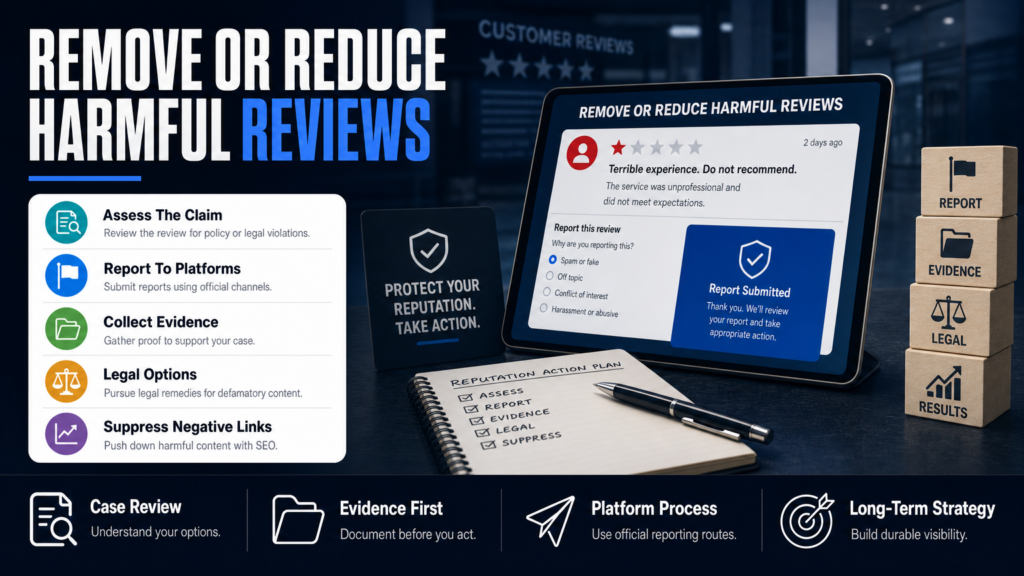
You searched for “How do I get bad reviews removed?” because a negative review is costing calls, clients or credibility. That question is exactly where every reputation response must start: with careful evidence and the correct channel for the platform where the review lives.
This article walks through the practical steps platforms expect, the legal options that exist in the U.S., when paying anyone is illegal or futile, and what to do when removal isn’t available. You’ll find checklist-style steps, a comparison of DIY vs agency help, and concrete next actions.
We do not promise removal—platform decisions and legal results vary with evidence, publisher control, and jurisdiction—but we will give you realistic options you can start implementing today.
If you need an estimated timeline or individualized assessment, those depend on the specific review, the platform, and whether additional legal evidence is required.
Table of Contents
- Can I pay to have bad Google reviews removed?
- Is it illegal to delete bad reviews?
- Can I get sued for leaving a bad review?
- How to get wrong Google reviews removed
- What platforms consider removable versus protected speech
- When removal is not available: suppression, correction and rebuilding
- Choosing Between DIY And Agency Help
- DIY vs Agency: Quick Comparison
- Hypothetical Case: Doctor’s One-Star Review That Mentions Medical Error
- Common Mistakes That Make Review Problems Worse
- Best Practices For Getting Bad Reviews Removed Or Mitigated
- Expert Tips
- Conclusion
- Why Businesses Choose Your Reputation Agency
- Frequently Asked Questions
Can I pay to have bad Google reviews removed?
Short answer: You cannot legitimately pay Google to remove reviews. Google does not offer a paid service that removes negative reviews from business profiles. Any third party claiming they can remove a review from Google for a prepayment is misrepresenting Google’s process or relying on unreliable, risky tactics.
That said, there are paid services that help you pursue legitimate removal paths: they audit the review, collect evidence showing it violates Google’s policies (for example, spam, off-topic content, conflicts of interest, or clear defamatory statements), prepare your report, and escalate through the platform’s official channels. Those services charge for expertise, not for a guaranteed deletion.
If your concern is the business impact of reviews, calculate the likely revenue effects and compare them to professional help costs. For a primer on the revenue stakes and cost-benefit framing, see What a One-Star Google Review Actually Costs You.
- Audit the review: date, content, reviewer profile, screenshots, and any internal records that contradict or verify the claim.
- Submit a platform report: use Google Business Profile’s official ‘flag as inappropriate’ flow or business owner support.
- If the platform declines, escalate to formal business support channels and consider legal review if the review contains false factual claims.
- Never pay an individual to delete or edit a review (that can be fraud or pay-for-play).
- Use paid services that follow platform reporting, evidence collection, legal escalation and SEO suppression—these are legitimate business services.
- Ask any vendor for a written scope: what they will do, how they escalate, and what is not guaranteed.
Is it illegal to delete bad reviews?
Deleting a review is only illegal in certain contexts — for example, if an employee or agent of the business removes or alters reviews by deceptively impersonating the reviewer, that may violate computer-fraud or consumer-protection laws and platform terms. You should not use fake accounts, misrepresent your identity, or coerce reviewers to delete.
Platforms provide procedures for removing content that breaks their rules. Those procedures are lawful. What is illegal is deceptive deletion (e.g., the business creates fake accounts to remove others’ reviews) or paying a reviewer under false pretenses to remove truthful complaints.
If you’re considering asking an employee to remove a review, consult counsel or your professional policies first. When in doubt, use platform reporting, documented dispute channels, or a neutral third-party mediation approach.
- Do not attempt to access another person’s account or use false identities.
- If you want a review removed, follow the platform’s reporting path and consider a mediated outreach to the reviewer with an offer to make the issue right (refund, correction).
- If you suspect criminal conduct (hacking, doxxing), escalate to law enforcement and legal counsel.
- Allowed: Reporting reviews that violate platform rules and following the platform’s official processes.
- Risky/illegal: Creating fake accounts, impersonating reviewers, bribing reviewers to change or remove honest complaints, or hacking accounts.
- Document every request and use written communications if you attempt a direct resolution with a reviewer.
Can I get sued for leaving a bad review?
Yes, reviewers can be sued for defamation in some cases — but not every negative review is defamation. In the U.S., most truthful statements and most opinions are protected. Defamation requires a false factual statement presented as fact that harms reputation and, in some cases, is made with negligence or actual malice.
Before leaving a review, avoid false statements of fact (fabricated claims about criminality, licensure, or illegal conduct). Saying “I had a terrible experience” or “In my opinion, service was unprofessional” is generally protected as opinion.
If you receive a threat of suit for a review, consult an attorney. Many threats are SLAPP-style intimidation; several states have anti-SLAPP protections and procedural defenses worth discussing with counsel.
- If you plan to respond to a review, stick to verifiable facts (dates, transaction reference) and offer to move the conversation offline.
- If threatened with litigation, preserve evidence, save copies of the review thread, and seek legal advice quickly.
- Consider mediation or public correction rather than escalation if the reviewer’s claim has any plausible basis.
- Opinion vs fact: Opinions are generally protected; false factual claims can be actionable.
- Reviewers can be liable for making knowingly false or reckless factual statements.
- Most businesses rarely recover large damages from honest reviewers; courts balance free speech and reputation harms.
How to get wrong Google reviews removed
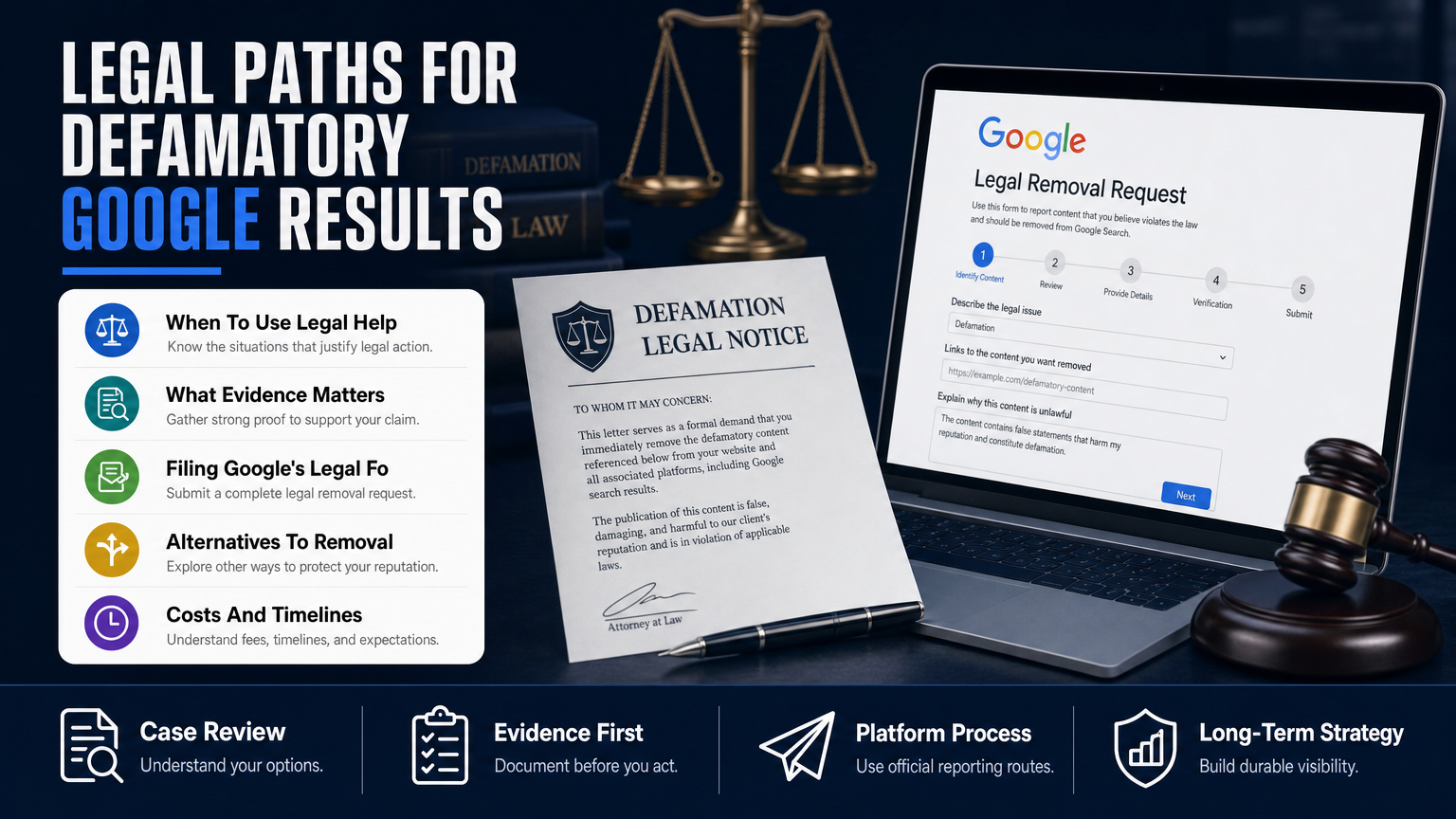
When a Google review contains demonstrably false facts, harassment, or violates Google’s content policies, there is a path to removal. That path is evidence-driven and procedural: Google expects you to show why a review violates specific policy items.
Start with documentation and a calm, professional process. You can resolve many disputes by contacting the reviewer privately; when that’s not possible or ineffective, use Google’s business reporting flow and escalate with supporting evidence.
For a practical walkthrough of when reviews threaten your business and how professional remediation works, review When One‑Star Google Reviews Threaten Your Practice.
- 1) Capture evidence: screenshot the review, reviewer profile, timestamps, and any internal records (receipts, communication logs).
- 2) Attempt reconciliation: politely contact the reviewer, offer remedy, and request an edit or removal — keep communications professional and documented.
- 3) Report to Google: use the ‘Flag as inappropriate’ button or Google Business Profile support and include the evidence and a clear explanation which policy the review breaks.
- 4) Escalate: if initial flags fail, use Business Profile support channels, Google Maps help forum, or paid-firm escalation that compiles a policy-based appeal.
- 5) If the review makes demonstrably false factual claims that seriously harm you, consult an attorney about legal notices or subpoenas that can compel the platform to reveal reviewer identity where lawful.
- Common removable reasons: spam, impersonation, hate speech, explicit doxxing (private info), unrelated content, or clearly falsified facts.
- Google will not remove legitimate opinions or truthful customer complaints.
- Screenshots, order numbers, timestamps, and internal records increase the chance of a successful policy-based challenge.
Reporting template (copy and adapt)
Use a short, factual template when you report: identify the review URL, quote the offending text, cite the exact Google policy violated (link it), and attach supporting documents (screenshots, order receipts).
- Do not include inflammatory language — keep it objective.
- Attach evidence in chronological order.
- State the remedy you seek (removal or redaction of private info).
When to consider legal escalation
Legal routes are appropriate if the review contains demonstrable lies that cause material business harm or if it reveals private data (doxxing) or criminal acts not in public record. An attorney can advise whether a subpoena, publisher notice, or demand letter is appropriate.
- Legal action is often slower, costlier, and jurisdiction-dependent.
- Platforms may require formal court orders to unmask anonymous reviewers.
What platforms consider removable versus protected speech
Different platforms enforce different rules. Google, Yelp, Facebook, TripAdvisor and industry-specific sites (healthcare boards, legal directories) each have content policies that differentiate opinion from disallowed content.
Protected speech typically includes expressions of opinion and fair reporting of experiences. Removable content is often spam, impersonation, private data exposure, threats, or false factual claims documented with evidence.
When you evaluate a review, classify it first: Opinion, Factual Claim, Spam/Commercial, Harassment/Doxxing, or Impersonation. That classification determines the reporting pathway and likely outcome.
- Identify the platform and look up its review policy.
- Match the review to policy categories and select the correct reporting flow.
- Prepare evidence and use platform-specific escalation if initial reports fail.
- Google: removes spam, hate speech, doxxing, impersonation, and reviews that aren’t about a real experience.
- Yelp: prominently protects consumer opinion but removes attempts at extortion, fake accounts and doxxing.
- Industry sites: medical boards or licensing sites may treat factual complaints differently and can be more resistant to takedowns due to public-interest considerations.
When removal is not available: suppression, correction and rebuilding
Sometimes removal is not an option: the review is protected speech, the publisher is unresponsive, or the content is a public record. In those cases, you pursue mitigation — lowering visibility, correcting the record, and rebuilding trust.
Mitigation strategies include search-engine suppression (SEO to push negative links down), creating authoritative content that outranks the bad item, soliciting legitimate positive reviews to dilute the negative signal, and public relations to contextualize or correct misinformation.
If you want cost/benefit clarity for mitigation vs removal, or are evaluating vendor proposals, see our analysis What a One-Star Google Review Really Costs a Practice to help set priorities.
- 1) Assess the review’s search visibility: which pages link to it, which queries surface it.
- 2) Build a content plan: targeted pages, local listings, and high-authority placements (press, professional sites).
- 3) Execute ongoing monitoring and solicitation of legitimate positive reviews to change the star-average and search signals.
- Suppression via SEO: create pages, press releases, and profiles that are likely to rank above the negative item.
- Correction: ask publishers for a correction, or publish a factual response on your own channels.
- Rebuild: pursue proactive review solicitation, improved customer experience, and public communications.
Choosing Between DIY And Agency Help
You can pursue removal and mitigation yourself for straightforward cases (a spam review, a clear policy violation), but complex cases—legal claims, review-bombing, doxxing, or high-impact items on page one of Google—often benefit from an experienced agency or counsel.
An agency offers process, documentation workflows, platform experience, SEO suppression skills, and coordination with counsel and PR when required. DIY is less costly initially but may prolong visibility problems and risk procedural mistakes.
To compare options, review the tradeoffs in the table below and factor in time, internal capability, risk appetite, and the potential business impact of the review. For more on when negative reviews threaten operations and licensure, see When One‑Star Google Reviews Threaten Your Practice.
- 1) Triage: assess impact (referrals lost, licensure risk, revenue impact).
- 2) Choose route: DIY for simple policy flags; agency for complex mitigation and legal coordination.
- 3) Define success metrics: removal attempts made, visibility reduction, or a positive-review velocity target.
- DIY is appropriate when: the violation is obvious, you have internal records, and you can document and follow platform processes.
- Hire experts when: the review is high-impact, requires legal options, involves doxxing, or when you lack time to manage escalations and SEO suppression.
- Ask agencies about their escalation protocol, costs, and whether they coordinate with legal counsel.
DIY vs Agency: Quick Comparison
When deciding who should handle a problematic review, consider these practical differences.
| DIY | Agency |
|---|---|
| Cost | Higher upfront fees, ongoing management options |
| Speed | Faster escalation and multiple channels |
| Expertise | Specialized platform, legal coordination, SEO skills |
| Risk of errors | Lower (documented processes, legal review available) |
| Control | Hands-off; agency handles communications |
| Best for | Small, clear policy violations |
| Best for (agency) | Complex, high-stakes, or systemic issues |
Hypothetical Case: Doctor’s One-Star Review That Mentions Medical Error
A mid-size clinic finds a one-star Google review alleging a medical error. The review names a specific date and procedure but provides no medical record. The clinic must act quickly because referrals and a specialist referral network are sensitive to such allegations.
Step-by-step process the clinic follows (anonymized, hypothetical):
- 1) Preserve evidence and limit public comment to a neutral offer to resolve offline (avoid medical specifics).
- 2) Document all outreach and responses carefully.
- 3) Report the review to Google with attached evidence and cite the policy sections it allegedly violates.
- 4) If Google declines, evaluate legal options for identifying an anonymous reviewer or seek a correction from a publisher if the review appeared on a news site.
- 5) Implement a suppression plan: publish authoritative content, ask satisfied patients to post verified reviews, and monitor results.
- Immediate triage: record screenshots, copy the review URL, preserve internal appointment logs for the date cited.
- Patient outreach: a respectful, HIPAA‑safe message requesting to discuss the concern offline and clarifying the reviewer’s details, offering to correct any administrative error.
- Policy reporting: flagged to Google for potential false factual claim and request for redaction of private medical details.
- Legal review: counsel assessed whether the claim amounted to a false factual public accusation and whether a subpoena of Google would be warranted if the reviewer was anonymous.
- Mitigation: simultaneously launched SEO content about the clinic’s safety protocols and patient satisfaction data to reduce the review’s visibility.
Common Mistakes That Make Review Problems Worse
Avoid these predictable errors that escalate rather than resolve review issues.
1) Responding Emotionally On The Platform
A defensive, angry response usually cements the negative impression and can trigger copycats. Keep public replies factual, empathetic, and invite offline resolution. Document the exchange and avoid admitting fault in public comments.
- Do not disclose private patient or client information in replies.
- Use brief, neutral language and an offer to continue offline.
2) Using Fake Accounts Or Paying For Deletions
Creating false reviewer accounts or paying individuals to remove reviews is unethical and may violate platform terms and laws. It can lead to account suspensions and reputational damage when exposed.
- Never impersonate another user or misrepresent your identity.
- Document legitimate resolution efforts instead.
3) Failing To Preserve Evidence
Platforms and courts rely on preserved evidence. Screenshots, timestamps, transaction IDs, and communications are crucial. If you delete or overwrite records you may lose the chance to make a strong challenge.
- Take multiple screenshots and save HTML copies where possible.
- Log internal records that corroborate your position.
4) Ignoring Search-Engine Effects
Even if a review is low-visibility on the platform, it might rank highly for your business name. Ignoring the SEO dimension leaves the problem in front of prospective clients and hiring managers.
- Assess where the review appears in search results for branded queries.
- Consider suppression and content creation when needed.
5) Overusing Legal Threats Publicly
Publicly threatening legal action in reply to a reviewer often backfires, escalating the situation and provoking public pushback. Reserve legal notices for private counsel communications.
- Use private, documented legal channels if necessary.
- Consider professional mediation before threats.
Best Practices For Getting Bad Reviews Removed Or Mitigated
Follow these durable actions whether you handle the work in-house or with outside help.
1) Triage And Document
Classify the review by type, preserve evidence immediately, and quantify the impact (lost calls, referral risk). This decision matrix guides whether to flag, reconcile, or escalate.
- Collect screenshots, profile links, timestamps, and supporting internal documents.
- Assign an internal owner to track escalation status.
2) Attempt A Professional Reconciliation
A polite, solution-oriented private outreach often resolves misunderstandings and leads to an edited or removed review. Offer a documented remedy where appropriate and never condition remediation on deletion in a coercive manner.
- Keep messages concise and HIPAA/privilege-safe for healthcare contexts.
- Document all offers and responses.
3) Use Platform Reporting Correctly
Match the review to the exact policy violation when filing a report. Provide evidence and a clear request. Vague flags are less likely to be successful.
- Cite the policy section you believe the review violates.
- Attach chronological evidence supporting your claim.
4) Have A Mitigation Plan Ready
If removal fails, implement suppression and trust rebuilding: SEO, authoritative content, positive-review solicitation, and PR where needed. Measure outcomes (search rankings, sentiment, review velocity).
- Create authoritative pages that answer common concerns.
- Implement ongoing monitoring for new reviews and search mentions.
5) Coordinate With Legal And PR
Serious allegations, doxxing, or coordinated smear campaigns benefit from simultaneous legal and public-relations strategies. Legal can advise on subpoenas or defamation claims; PR can shape the public narrative while legal processes run.
- Align messaging between counsel, PR and whoever manages platform responses.
- Avoid public statements that interfere with potential legal actions.
Expert Tips
- Always capture time-stamped evidence the moment you see a harmful review — screenshots, URLs, and internal records.
- If a reviewer offers to remove a review after you fixed the issue, document the fix but avoid payments tied to deletion.
- Use neutral, empathetic public replies and shift the conversation offline quickly.
- For search suppression, prioritize high-authority pages (press, industry bodies, professional profiles).
- Ask satisfied clients for reviews on the same platform rather than multiple platforms—consistency helps SEO.
- If a review names private data, report it as a privacy/doxxing violation immediately.
- Keep a running log of every escalation attempt — platforms respond better to documented, repeated appeals.
- Measure outcomes: track star-average, organic impressions, and branded search click-throughs after remediation steps.
Conclusion
Getting bad reviews removed starts with a disciplined, evidence-first approach: preserve proof, choose the right reporting channel, and avoid shortcuts that could create legal or ethical problems. Removal is sometimes possible, but it is never guaranteed—platforms control enforcement and what counts as removable varies.
When removal isn’t achievable, your next best strategy is targeted mitigation: suppress the negative item through authoritative content and SEO, correct factual errors publicly where appropriate, and rebuild trust with genuine, verifiable customer experiences. A careful combination of documentation, platform reporting, legal coordination, and reputation-focused SEO will give you the best chance of reducing the review’s real-world harm.
Why Businesses Choose Your Reputation Agency
Managing your reputation takes more than monitoring reviews or publishing the occasional blog post. It takes a strategy built around your situation, your industry, and what is actually showing up in search.
Your Reputation Agency works with businesses, executives, healthcare professionals, attorneys and growing brands. Our services include:
- Remove defamatory content and false posts (news, blogs, listings)
- Remove or challenge negative reviews (Google, Yelp, TripAdvisor, industry sites)
- Mugshot and arrest record removal
- Remove videos, images, and other multimedia that damage reputation
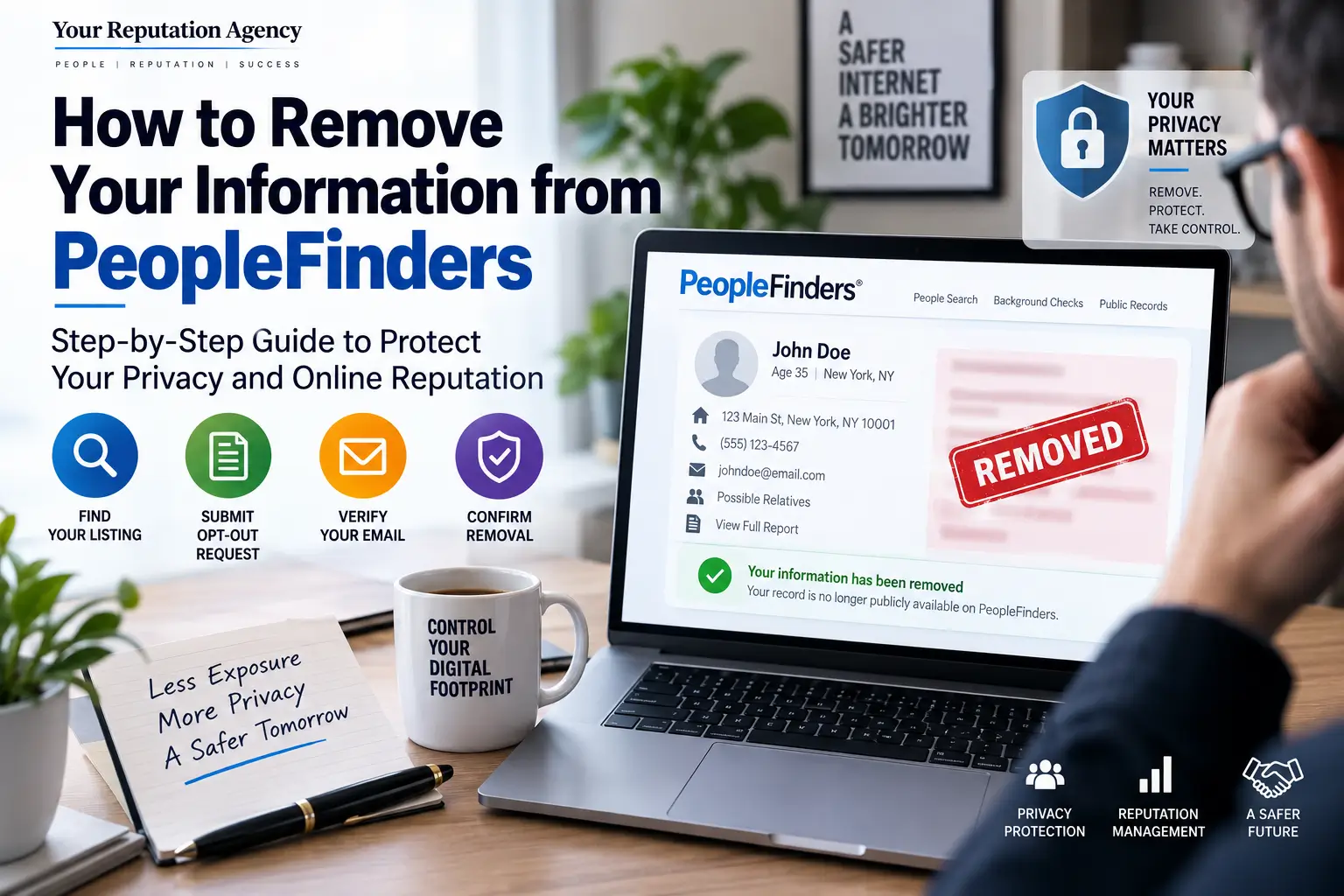
- Remove personal data from people‑search and data‑broker sites (opt‑outs)
- Search result suppression (SEO to bury negative links)
- Social media takedowns and impersonation removal
- Rapid online crisis management and incident response
- Ongoing monitoring and alerting of reputation signals
- Coordination with legal counsel and use of legal tactics when required
Frequently Asked Questions
1. Can I pay to have bad Google reviews removed?
No, you cannot pay Google to remove reviews. Some vendors charge for professional services that compile evidence and pursue official review/appeal channels, but any promise to buy deletions or pay a platform for removal is false. Use paid vendors who document processes and work inside platform policies.
2. Is it illegal to delete bad reviews?
Deleting reviews through official platform tools and owner dispute channels is legal. It is illegal or unlawful to remove reviews by impersonating someone else, hacking accounts, or paying for deceptive deletions. Those actions can violate platform terms and, in some cases, state or federal laws.
3. Can I get sued for leaving a bad review?
Yes, but only when the review states false factual claims presented as facts that harm reputation. Opinions and truthful statements are generally protected. If you receive a lawsuit or a threat, preserve all evidence and consult an attorney; some jurisdictions have anti-SLAPP protections for critics.
4. How to get wrong Google reviews removed?
Document the review, collect supporting evidence (screenshots, transaction records), try polite offline resolution with the reviewer, then report the review to Google citing the specific policy violation. If that fails and the matter involves false factual claims or doxxing, consult counsel about escalation or subpoenas.
5. How fast can a review be removed?
Timing varies. If a review clearly violates platform policy and the platform acts quickly, removal can happen in days. Other cases require multiple appeals, legal process, or publisher cooperation and may take weeks or months. No universal timeline applies.
6. What if a review is technically accurate but unfair or misleading?
If a review is factually accurate but misleading, removal is unlikely. Focus on mitigation: publish corrective content, request clarifying comments from the reviewer if appropriate, and solicit legitimate positive reviews to change average ratings and search visibility.
7. Can companies remove reviews left by competitors?
If a competitor leaves fake reviews in a coordinated manner, report them as fraudulent and compile evidence linking the accounts. Platforms investigate review fraud, but you should also consider legal counsel because proving coordination often requires advanced discovery or subpoenas.
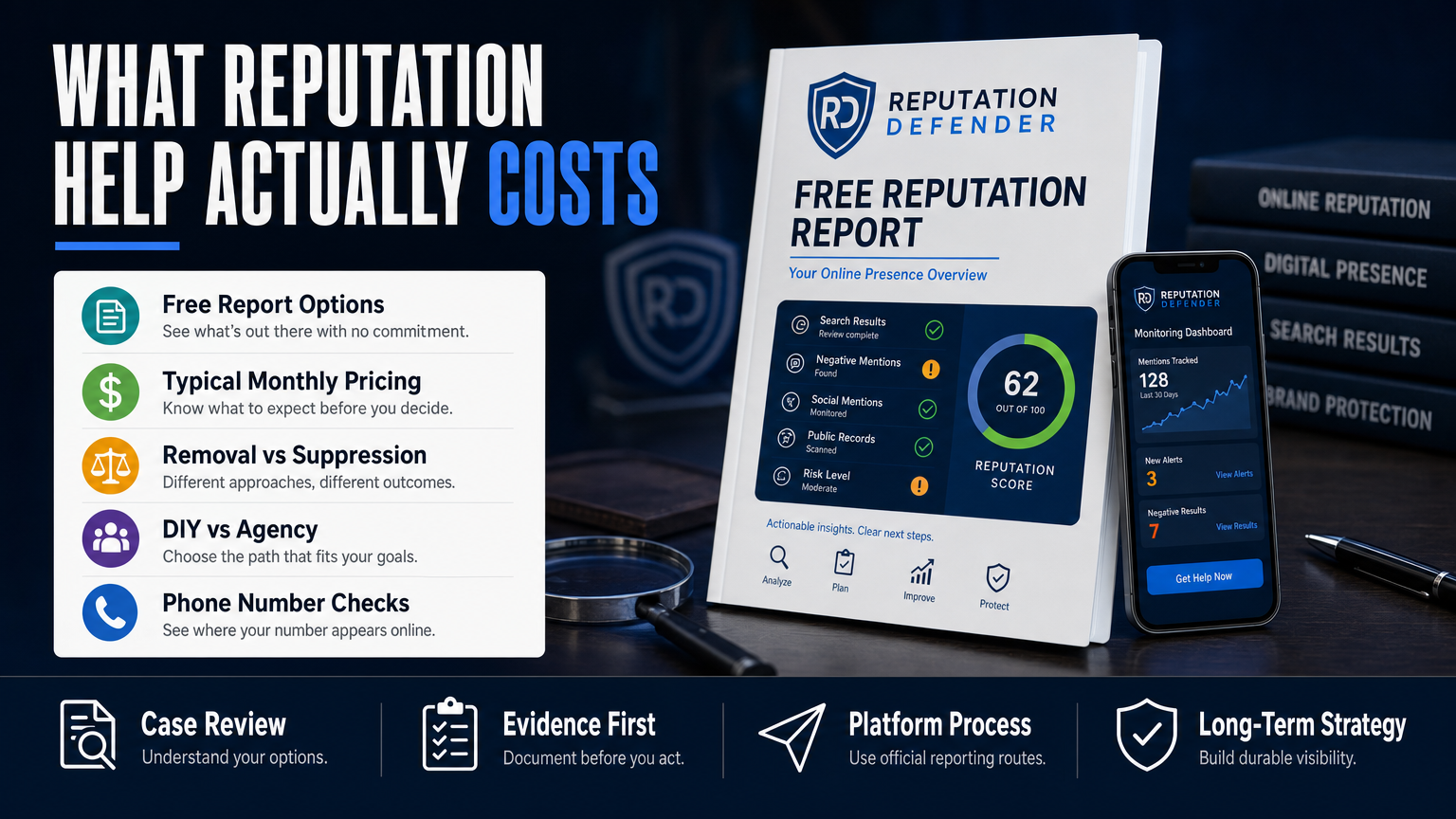
8. How much do reputable review-removal services cost?
Costs vary widely with complexity. Simple policy-flagging services are relatively inexpensive; cases requiring legal coordination, subpoenas, or SEO suppression are costlier. Get a written scope from any vendor and ask for milestone-based deliverables rather than guarantees of removal.
This content provides general information and does not constitute legal advice. The available options and likely outcomes depend on the facts, evidence, platform policies, applicable law, jurisdiction, and public-interest considerations.
Past examples do not guarantee future results. Removal, correction, deindexing, and search-position changes depend on third parties and circumstances outside Your Reputation Agency’s control.