You’ve found a damaging article, mugshot, or string of one-star reviews that are showing up when people search your name or business. You need to know: how much will it cost to fix this, and how quickly can you act?
This article lays out realistic price ranges and the factors that control them so you can budget and choose an approach. It answers the specific question of the cost of repairing online reputation in US contexts and gives concrete, stage-by-stage options.
We cover removal vs. suppression, what a website redo costs and why that sometimes matters, what consumers and small firms pay for managed services, and a clear workflow you can follow now.
No promises are made about outcomes or timelines — instead you’ll get practical, defensible estimates and a plan you can present to counsel, leadership, or a vendor.
Table of Contents
- How much does online reputation management cost?
- What drives the price: 7 cost levers you should budget for
- How much to charge to redo a website (and when it’s worth it)
- How much does ReputationDefender typically cost?
- How to repair your online reputation: a step‑by‑step playbook
- What to do when removal is NOT available
- Ongoing costs: monitoring, retainers, and review defense
- DIY vs hiring an agency: practical comparison
- DIY vs Agency — quick tradeoffs
- Hypothetical scenario: a physician facing a viral complaint
- Common mistakes that increase cost and slow recovery
- Best practices to control cost and improve outcomes
- Expert Tips
- Conclusion
- Why Businesses Choose Your Reputation Agency
- Frequently Asked Questions
How much does online reputation management cost?
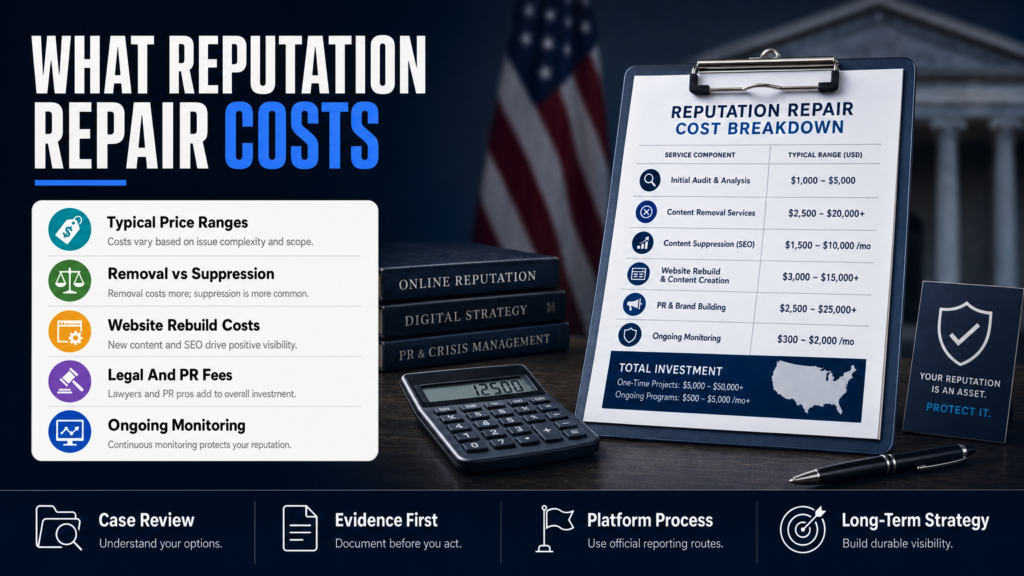
Short answer: prices vary widely because ‘reputation management’ is a bundle of distinct services — takedown requests, legal work, SEO suppression, review responses, data‑broker opt‑outs and crisis PR. Expect anything from one‑time fees of a few hundred dollars to multi‑month retainers in the low five‑figures.
Below are typical US ranges and what they usually cover. These are industry ranges, not guarantees; your matter’s price depends on publisher, evidence, jurisdiction, scope, and speed required.
If you want a side‑by‑side industry reference and deeper pricing examples, see our Cost of Professional Reputation Repair – Real 2025 Guide.
- 1) Start with an audit to identify the top 10–30 search results for your name or brand (often $250–$1,000).
- 2) Triage items into categories (privacy, defamation, review, accurate public record, opinion/complaint).
- 3) Estimate removal probability and decide which items to pursue for removal and which to suppress.
- 4) Request a written estimate that separates discrete fees (removal attempts, legal letters, monthly SEO).
- Single-content takedown (news article, defamatory blog): $300–$2,500+ per item depending on publisher authority and legal complexity.
- Mugshot/arrest removal packages: $500–$3,000 per record when platforms accept opt‑out or removal; higher if litigation or publisher negotiation is needed.
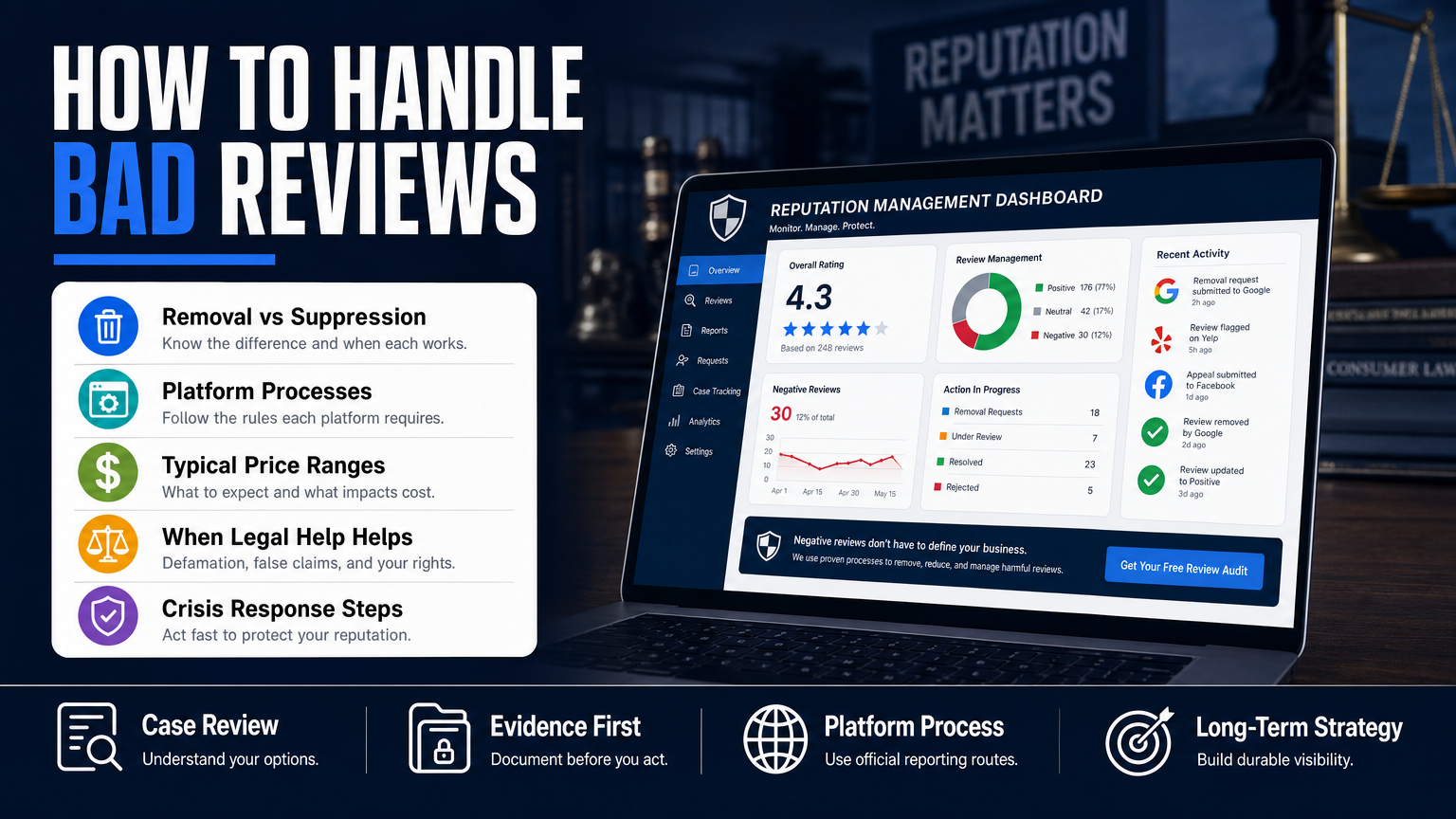
- Negative review remediation: $200–$1,500 per review for disputes and platform escalation; higher if legal demand letters are required.
- Search-result suppression / SEO to bury links: $1,000–$10,000 per month for an agency plan with sustained content and link work; single‑campaign projects often $3,000–$15,000 total.
- Rapid incident response / crisis retainer: $2,000–$15,000+ up front for a short retainer depending on team size, PR, and legal coordination.
- Data broker opt‑outs and privacy cleanups: $300–$3,000+ depending on number of listings and whether automation or manual removal is needed.
- Website rebuild / major content creation (see next section): $2,000–$25,000+ depending on scope and SEO integration.
How vendors estimate price
Agencies typically price by scope and risk: number of problematic items, authority of the sites involved (local blog vs. national media), whether the publisher is cooperative, and whether legal action is likely.
Time sensitivity increases cost — same-day or 24–48 hour response work brings higher fees because teams must be pulled from other work and third‑party vendors may be engaged.
- Publisher authority: top‑tier news sites cost more to influence than small blogs.
- Jurisdiction and privacy law: some states require extra legal checks for subpoenas or court filings.
- Evidence and legal risk: actionable defamation requires documentation and counsel, which raises fees.
What drives the price: 7 cost levers you should budget for
Understanding the main drivers helps you forecast. Two similar pieces of content can have entirely different price tags depending on where they live and what they claim.
Below are the common drivers and what to expect.
- 1) Identify whether the content is governed by platform policy (harassment, doxxing, impersonation) or is a legal claim like defamation.
- 2) Gather evidence (screenshots, cached pages, timestamps) and preserve it.
- 3) Decide whether to attempt platform reporting, publisher outreach, or legal escalation first.
- Platform and publisher authority (Google, Yelp, national media vs. local forum).
- Type of content (defamatory allegation, opinion, truthful public record, private data).
- Legal complexity — whether a lawyer or subpoenas are needed.
- Volume — single items cost less per item than dozens of listings or reviews.
- Speed — urgent crises incur premium fees and additional staffing.
- Geography and jurisdictional issues — cross‑border cases cost more.
- Desired outcome (complete removal, delisting, suppression, correction, or public response).
Why platform matters
Platforms each have different reporting processes and thresholds: Google, Facebook, Yelp, YouTube, and industry review sites evaluate complaints differently. A takedown on a small forum is often quicker and cheaper than persuading a major publisher or earning a Google News correction.
- Yelp and Google Reviews: often handled through dispute processes and policy flags, sometimes requiring direct customer interaction.
- News publishers: may require correction requests, editor engagement, or legal letters.
- Data brokers: many have automated opt‑out procedures that scale well; others are manual and time‑consuming.
How much to charge to redo a website (and when it’s worth it)
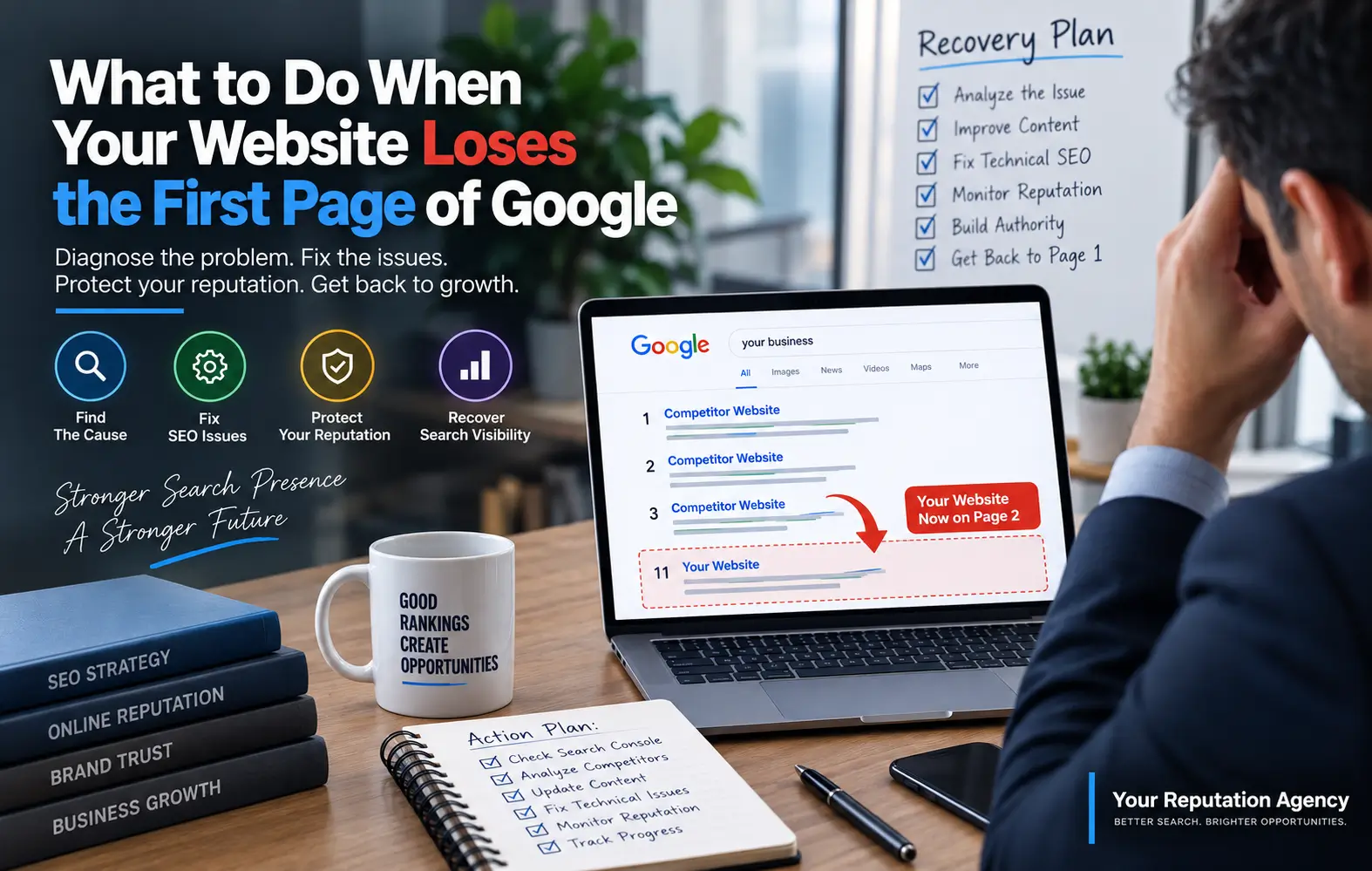
A website rebuild is sometimes the fastest way to improve search visibility for branded queries — by providing authoritative pages to outrank negative results — but it’s not always required.
Typical US costs reflect scope and technical needs, and you should include SEO content work in the estimate rather than viewing design alone.
- 1) Audit existing site rankings and map which search queries show negative content.
- 2) Decide on new content targets: author pages, press room, service pages, and long‑form articles.
- 3) Budget for migration, redirects, technical SEO, and ongoing content publishing for suppression campaigns.
- Small brochure site redesign (5–10 pages, modern template): $2,000–$8,000.
- Custom business site (content strategy, SEO, CMS, basic integrations): $8,000–$25,000.
- Large site or e‑commerce with technical SEO and migration: $25,000–$75,000+.
- Monthly SEO/content plan to support suppression: $1,000–$7,500/month depending on content volume and link building.
When a rebuild makes sense for reputation work
If your brand has no authoritative pages for your primary query, a rebuilt site with strong content and schema can be one of the most cost‑effective long‑term ways to push down negative results.
If negative content is from a powerful publisher, rebuilding alone is unlikely to be sufficient—pair it with outreach, corrections, or legal steps where appropriate.
- Good candidate: little branded content, outdated site, and manageable negative links.
- Poor candidate: a national exposé or court filing that will continue to be indexed unless legally corrected or mitigated.
How much does ReputationDefender typically cost?
ReputationDefender is a consumer and professional reputation brand whose pricing varies by package type. Publicly advertised offerings typically split into basic monitoring/protection and managed remediation packages.
Industry reporting and vendor comparisons place basic monitoring plans in the lower‑hundreds per year and comprehensive, managed reputation services in the several‑hundreds to thousands per month range, depending on scope. For precise, up‑to‑date pricing check the vendor directly.
- 1) Compare the vendor’s monitoring features vs. active remediation services.
- 2) Request a scope of work and a breakdown of one‑time vs. recurring costs.
- 3) Consider matchups: some providers are stronger on consumer privacy; others on SEO and content creation.
- Monitoring/identity protection packages: often start at a few hundred dollars per year.
- Managed remediation and SEO suppression: commonly priced in the hundreds to thousands per month for business or high-profile personal plans.
- Custom legal or crisis response options add separately and are quoted per‑case.
How to compare vendors
When you evaluate any vendor, ask for a detailed scope that lists discrete deliverables (e.g., number of removal requests, pages created, links built, monthly reports). Avoid vague promises.
Look for clear escalation paths and whether the vendor coordinates with outside counsel, which affects cost.
- Ask for examples of procedures (not results) and reporting cadence.
- Confirm whether third‑party costs (paid listings, legal filings) are included or billed separately.
How to repair your online reputation: a step‑by‑step playbook
Repair is a multi‑disciplinary process. Below is a practical workflow you can follow immediately. Timelines and costs vary by case; this is a process map, not a guarantee of outcome.
If you want fast remediation that pairs SEO with legal escalation when warranted, see our piece on Repair Online Damage Fast with SEO and Legal Tactics.
- 1) Immediate preservation: take screenshots, note URLs, collect witness statements or documentation.
- 2) Quick wins: flag policy violations (doxxing, impersonation, explicit images) and submit platform reports.
- 3) Publisher outreach: send polite correction requests; escalate to legal counsel if warranted by defamation risk.
- 4) SEO suppression campaign: publish optimized content on high‑authority domains (LinkedIn, professional directories, press releases, guest articles).
- 5) Review strategy: for review sites, follow dispute processes and invite verified customers to leave replacement reviews.
- 6) Ongoing monitoring: set up alerts and weekly checks; adjust tactics based on search result movement.
- Triage: identify top search results, screenshots, and classify items.
- Attempt platform removal if policy violation exists (impersonation, doxxing, explicit content).
- Contact publishers for corrections or retractions if the content is demonstrably false.
- Launch suppression SEO: build authoritative content and web properties.
- Deploy PR and messaging to address reputational harm publicly when appropriate.
- Monitor and iterate with alerts and monthly reporting.
Evidence and legal coordination
If content crosses into probable defamation, data breach, or other actionable areas, coordinate with a qualified attorney. We coordinate with counsel when matters require legal analysis, but an attorney determines available claims.
Maintain careful evidence logs; many publishers respond when presented with clear, time‑stamped documentation.
- Preserve original pages and server headers where possible.
- Request a retraction or correction in writing before escalating.
- Only authorized counsel should make legal threats; vendors should not represent themselves as law firms.
What to do when removal is NOT available
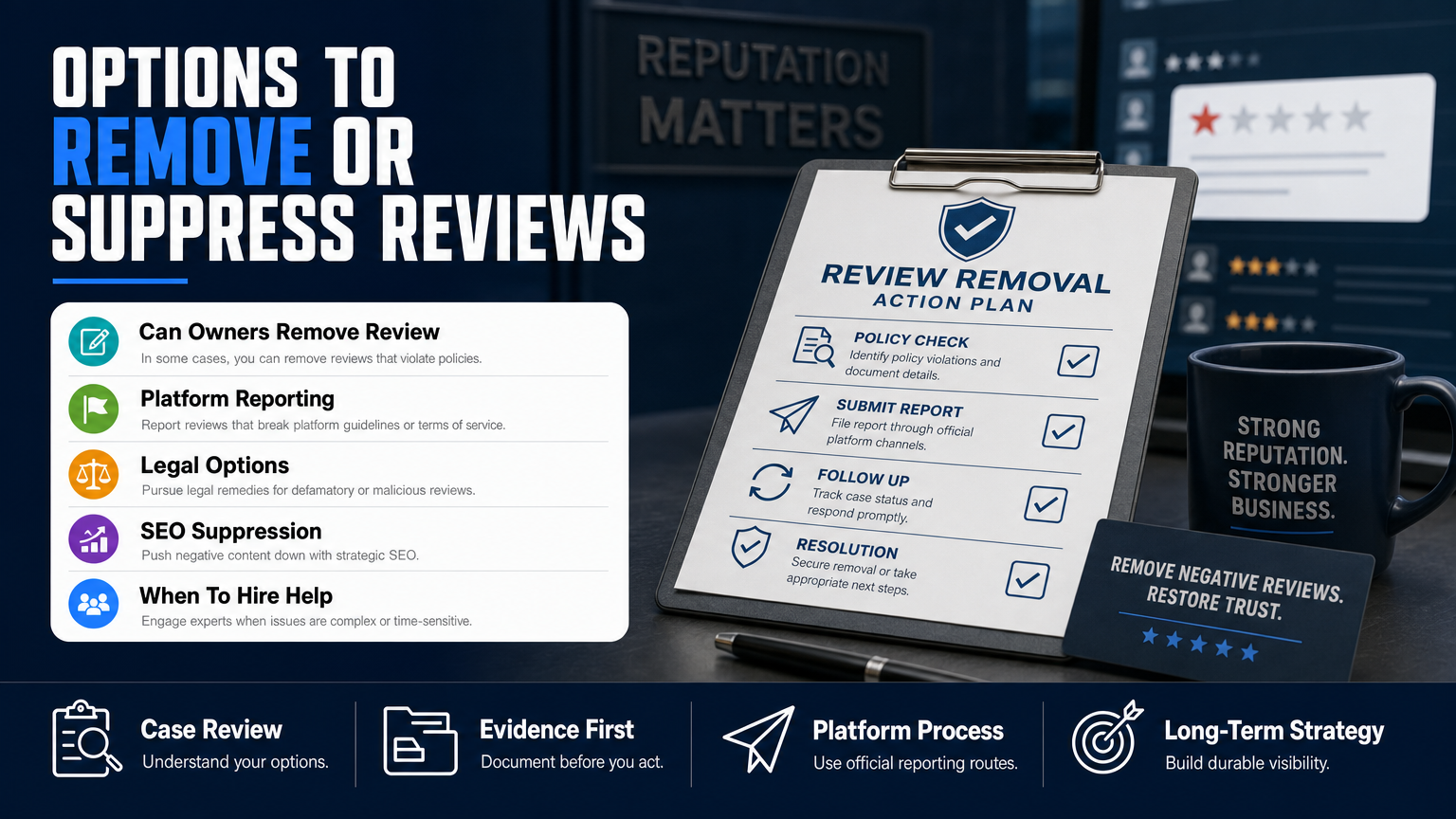
Often removal is not possible: truthful public records, opinion pieces, or content on sites that refuse to take down material are common limits. When removal isn’t on the table, mitigation and suppression become the focus.
Mitigation aims to change the narrative and reduce visibility; suppression aims to push negative links off the first page of search results.
- 1) Prioritize which negative URLs are most visible and which can realistically be outranked.
- 2) Build targeted pages and content optimized for those exact queries.
- 3) Acquire legitimately earned citations and backlinks to strengthen owned pages.
- 4) Monitor movement and keep stakeholders informed with periodic reports.
- Create authoritative assets: updated company site, staff bios, professional profiles, and high‑quality blog posts.
- Leverage owned channels: press releases, LinkedIn articles, and YouTube content that you control.
- Earn third‑party coverage that frames the issue neutrally or corrects inaccuracies.
- Use review acquisition to dilute negative feedback with verified positive reviews (never fake or incentivized).
- Pursue alternative remedies: corrections, clarifying statements, or court orders only when counsel advises.
When to use PR vs SEO
Use PR to change the narrative quickly — statements, interviews, and press releases can reduce immediate reputational damage and create new, newsworthy links.
Use SEO for a longer‑term, durable suppression strategy: pages and links take time but often provide more stable control over branded search results.
- PR is fast but may be short‑lived; SEO is slower but more durable.
- Combine both where possible: a press release can create a high‑authority page to support SEO suppression.
Ongoing costs: monitoring, retainers, and review defense
Reputation work rarely ends. After initial repair work, most clients budget for monitoring, periodic content refreshes, and a small retainer for rapid incident response.
If reviews are a primary risk for your business, you should factor in review defense and response as an ongoing cost. For deeper reading on review crises, consult When Google Reviews Become a Brand’s Biggest Crisis.
- 1) Set an alert baseline for the top 30 branded search queries.
- 2) Define response SLAs internally: who approves statements, who engages counsel.
- 3) Keep a contingency fund for urgent paid amplification or a legal filing if needed.
- Monitoring tools and alerts: $20–$300/month depending on coverage and API access.
- Monthly maintenance retainer for content and SEO: $500–$5,000/month.
- Crisis retainer for rapid response (PR + legal coordination): typically $2,000–$15,000 upfront or a monthly subscription.
- Quarterly audits and reputation score tracking: $500–$2,000 per audit.
Budgeting rule of thumb
Small businesses can often manage with a one‑time remediation budget plus a modest monthly monitoring fee ($1,500–$3,500 first three months, then $200–$1,000/mo). Larger or higher‑risk professionals (doctors, lawyers, executives) commonly reserve $5,000–$25,000 for high‑priority incidents and $1,000–$10,000/mo for ongoing management.
Tailor budgets to the worst plausible scenario: a viral article that affects revenue or licensure will cost more than isolated negative reviews.
- Low risk/small impact: $1,000–$5,000 initial, $100–$500/mo monitoring.
- Medium risk/known inaccuracies: $5,000–$20,000 initial, $500–$2,500/mo maintenance.
- High risk/viral or legal exposure: $20,000+ initial and flexible monthly budgets depending on legal activity.
DIY vs hiring an agency: practical comparison
Some organizations will try to handle issues internally to save money. Others retain specialists because of platform relationships, legal coordination needs, and the time cost to staff.
Below is a compact comparison to help you decide — more detail appears in the comparison table.
- 1) Attempt low‑risk, low‑cost fixes (data broker opt‑outs, responding to benign reviews) yourself first.
- 2) For items that require publisher negotiation or legal letters, seek a vendor or counsel.
- 3) Use an agency for sustained SEO suppression campaigns or when you need continuous monitoring and reporting.
- DIY can be low cost for simple opt‑outs and review responses but demands time and familiarity with platform policies.
- Agencies bring process, scale, and contacts but add ongoing fees and require clear scopes to avoid surprises.
- Hybrid approach: do immediate fixes internally and hire experts for complex or high‑visibility items.
When to delegate immediately
Delegate if you lack time, the issue risks licensure or revenue, or if sensitive legal questions arise. Agencies can coordinate technical, PR and legal work simultaneously, which is important in fast‑moving crises.
If the matter involves threatened litigation, sensitive personal data, or a major media outlet, bring in counsel and a professional reputation team.
- Red flags to delegate: viral social posts, high‑authority news pieces, doxxing, or legal threats.
- Tasks suitable for DIY: data broker opt‑outs with automated forms, asking customers to leave reviews, or basic site updates.
DIY vs Agency — quick tradeoffs
A two-column comparison of typical strengths and weaknesses to help decide which approach matches your budget and risk tolerance.
| DIY | Agency |
|---|---|
| Cost | Higher upfront, lower monthly; transparent quotes |
| Control | Hand off to specialists; less day‑to‑day control |
| Speed (simple tasks) | Faster for complex, multichannel responses |
| Platform knowledge | Access to tried processes and escalation playbooks |
| Legal coordination | Often coordinates with counsel and manages vendors |
| Scalability | Easier to scale suppression campaigns and content creation |
| Reporting | Professional reporting and measurement |
Hypothetical scenario: a physician facing a viral complaint
Dr. A (hypothetical) sees an unverified blog post and a viral Facebook thread accusing them of negligence, appearing on the first page for their name. Patients call, and appointment bookings drop. Dr. A wants to know cost and steps to recover.
This anonymized example shows a typical pathway and the kinds of fees a US professional might face.
- 1) Immediate triage: document posts, preserve evidence, and set alerts.
- 2) Quick platform removals: flag Facebook pages and request review for harassment/defamation per platform policy.
- 3) Publisher outreach: request correction; if unsuccessful, coordinate with counsel to evaluate legal merits.
- 4) Launch suppression: publish authoritative profiles (clinic site, state licensing board page, LinkedIn) and three long‑form SEO articles to target the branded queries.
- 5) PR and patient communication: prepare a factual clinic statement, update front‑desk scripts, and run a modest press outreach effort to earn neutral coverage.
- 6) Monitor and report monthly, adjust content and outreach based on ranking movement.
- Initial audit and evidence preservation: $500 (one‑time).
- Platform takedown attempts for doxxing or policy violations: $500–$2,000.
- Publisher outreach for correction or retraction: $1,000–$5,000 in counsel/negotiation costs if legal letters are needed.
- Suppression campaign (content creation + link building) for 3–6 months: $6,000–$25,000 total.
- Crisis PR support and message drafting: $2,000–$10,000 depending on scope.
- Ongoing monitoring and maintenance: $200–$1,500/month.
Common mistakes that increase cost and slow recovery
Avoid predictable errors that make matters more expensive. Each mistake below costs time and money.
Mistake 1 — Treating every negative item the same
Not all negative content should be chased for removal. Spending legal fees on a truthful public record is costly and unlikely to succeed; suppression or contextualization is usually better.
- Classify items before budgeting removal efforts.
- Reserve legal spends for content that is demonstrably false and injurious.
Mistake 2 — Starting public counterattacks
Posting defensive rants or threatening commenters makes matters worse and creates more searchable content. Calm, documented responses or private outreach are better first steps.
- Avoid emotional public posts.
- Use controlled statements reviewed by counsel for sensitive matters.
Mistake 3 — Ignoring evidence preservation
Failing to take screenshots, capture headers, or note timestamps can permanently weaken both platform reports and legal options.
- Preserve content immediately.
- Keep a simple log with date, URL, and why it matters.
Mistake 4 — Overpaying for vague promises
Vendors who promise removals or guaranteed rankings are red flags. Ask for a clear scope with deliverables and avoid open‑ended retainers without milestones.
- Get itemized quotes and service level descriptions.
- Ask how vendors measure success and how they bill for third‑party costs.
Mistake 5 — Underbudgeting ongoing defense
Many clients treat remediation as a one‑time project and are surprised when negative items reappear or new ones surface. Plan for monitoring and refreshes.
- Include monthly monitoring and periodic content refresh in your budget.
- Build an incident reserve for sudden crises.
Best practices to control cost and improve outcomes
These are durable tactics used by professionals to get efficient, defensible results without overspending.
Practice 1 — Start with a focused audit
A targeted audit of 10–30 search results is typically sufficient to produce a remediation plan. That keeps initial costs in check and identifies the priority items.
- Map which results affect revenue or licensure first.
- Classify each URL by likelihood of removal vs. suppression.
Practice 2 — Separate one‑time vs. recurring needs
Ask vendors to separate one‑time remediation fees (removal attempts, legal letters) from recurring SEO or monitoring fees so you understand the levers you can turn off later.
- Negotiate trial periods for monthly services when possible.
- Require written scopes for one‑time projects.
Practice 3 — Preserve evidence and be precise
Provide clear documentation to any vendor or attorney. The stronger your records, the cheaper and faster a response usually is.
- Screenshots, cached links, and witness statements matter.
- Timestamp and store evidence offsite.
Practice 4 — Use owned channels aggressively
Invest in authoritative content you control: an updated site, staff bios, and profiles on high‑authority sites provide reliable pages to push down negatives.
- Optimize for your exact branded queries.
- Publish regular, factual updates rather than reactive posts.
Practice 5 — Measure and pivot
Set measurable goals (e.g., reduce negative results on page one from 4 to 1 within X months) and review progress monthly, adjusting tactics if movement stalls.
- Use rank trackers and share concise monthly reports.
- If a tactic stalls after reasonable time, reallocate budget to alternatives.
Expert Tips
- Preserve evidence immediately: screenshots and cached URLs are the currency of both platforms and lawyers.
- Prioritize the first page of Google for your brand queries — shift resources to whatever affects that first page most.
- Ask vendors for itemized quotes that separate one‑time and recurring fees before engaging.
- Use authoritative third‑party sites (LinkedIn, state licensing boards) as durable pages in suppression campaigns.
- Never buy fake reviews or engage in retaliatory posting — those tactics create legal and platform risk.
- If revenue or licensure is at stake, bring counsel early and keep PR messaging tightly controlled.
- Measure success by reduced visibility and sentiment improvement, not promises of removal.
- Build a modest crisis reserve (1–3 months of operating revenue) for sudden, high‑cost incidents.
Conclusion
Repairing an online reputation in the U.S. is rarely a single line item. Expect a mix of one‑time remediation costs, possible legal fees, and ongoing investment in content and monitoring. The total depends on publisher authority, legal complexity, and how quickly you act.
A pragmatic approach is to start with a focused audit, preserve evidence, and then allocate budget according to priority items: quick platform fixes and data‑broker opt‑outs first, publisher outreach and legal review where warranted, and SEO/PR suppression for durable results. That sequence controls cost while creating options.
If you need a realistic estimate tailored to your situation, prepare a prioritized list of the top 10 searchable items and request an itemized proposal that separates one‑time work from ongoing fees.
Why Businesses Choose Your Reputation Agency
Managing your reputation takes more than monitoring reviews or publishing the occasional blog post. It takes a strategy built around your situation, your industry, and what is actually showing up in search.
Your Reputation Agency works with businesses, executives, healthcare professionals, attorneys and growing brands. Our services include:
- Remove defamatory content and false posts (news, blogs, listings)
- Remove or challenge negative reviews (Google, Yelp, TripAdvisor, industry sites)
- Mugshot and arrest record removal
- Remove videos, images, and other multimedia that damage reputation
- Remove personal data from people‑search and data‑broker sites (opt‑outs)
- Search result suppression (SEO to bury negative links)
- Social media takedowns and impersonation removal
- Rapid online crisis management and incident response
- Ongoing monitoring and alerting of reputation signals
- Coordination with legal counsel and use of legal tactics when required
Frequently Asked Questions
1. How much does online reputation management cost?
Costs range widely: single‑item removals often cost $300–$2,500+, SEO suppression and content campaigns run $1,000–$10,000+/month, and crisis retainers commonly start at a few thousand dollars. Exact pricing depends on publisher authority, legal need, and urgency.
2. How much to charge to redo a website?
A basic redesign can be $2,000–$8,000; a custom business site with SEO is typically $8,000–$25,000; large e‑commerce or complex migrations may exceed $25,000. Include content and technical SEO in the scope for reputation projects.
3. How much does ReputationDefender typically cost?
Public offerings generally split into monitoring packages (often a few hundred dollars per year) and managed remediation services that can run several hundred to thousands of dollars per month. Pricing varies by scope—check the vendor for current plans and detailed quotes.
4. How to repair your online reputation?
Follow a process: audit and preserve evidence, triage items by removal probability, attempt platform or publisher remedies, coordinate with counsel for legal claims, launch SEO/PR suppression campaigns, and set up monitoring. Tailor actions to the type and severity of content.
5. What if removal isn’t possible?
When removal isn’t available, focus on mitigation and suppression: create authoritative content you control, use PR to change the narrative, earn neutral or positive third‑party coverage, and acquire legitimate reviews to dilute negatives. These tactics reduce visibility and impact over time.
6. Can I do this myself to save money?
You can handle some tasks—data broker opt‑outs, simple review responses, and basic site updates—but complex publisher negotiations, legal claims, and large‑scale SEO suppression are usually more efficient when handled by experienced vendors or counsel. A hybrid approach often works.
7. How long does reputation repair take?
Timing depends on platform responses, search‑engine behavior, and whether legal steps are required. Some platform removals occur in days; SEO suppression and durable reputation work can take 3–12 months. No timeline can be guaranteed.
8. Will an agency guarantee removal or a top search ranking?
No reputable agency can guarantee removal or specific search‑engine rankings. They can evaluate removal likelihood, pursue available legal and platform options, and develop SEO strategies intended to improve visibility, but outcomes vary by many factors outside anyone’s control.
9. How do I choose a vendor?
Request detailed scopes separating one‑time and recurring fees, ask how they measure success, confirm whether they coordinate with counsel, and look for clear communication about risks and timelines. Avoid vendors promising guaranteed removals or rankings.
This content provides general information and does not constitute legal advice. The available options and likely outcomes depend on the facts, evidence, platform policies, applicable law, jurisdiction, and public-interest considerations.
Past examples do not guarantee future results. Removal, correction, deindexing, and search-position changes depend on third parties and circumstances outside Your Reputation Agency’s control.