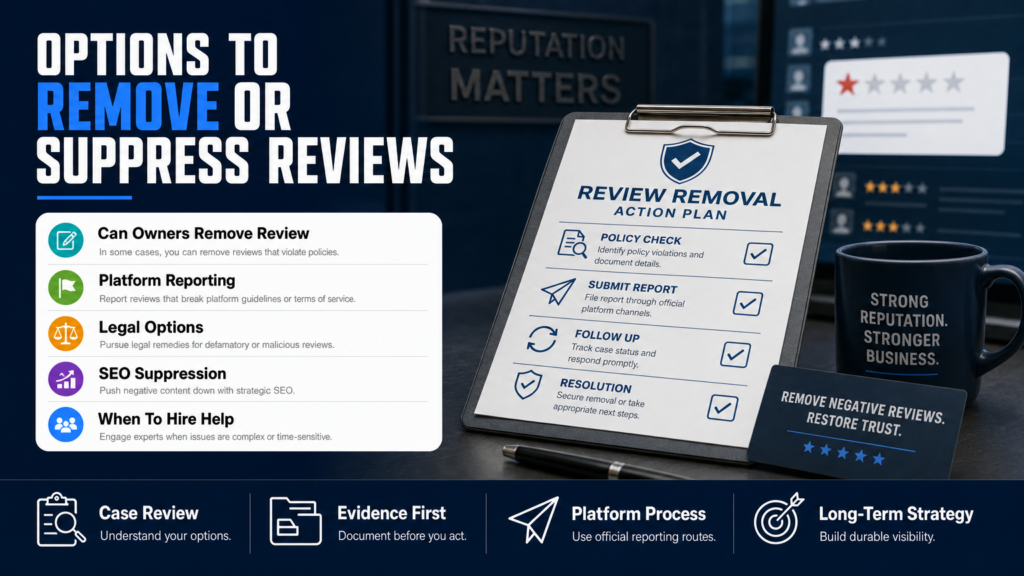
You found a damaging review on Google, Yelp, or an industry site and you’re asking: can I remove this myself, or should I hire a company that handles remove bad reviews llc? This article walks through the real options — reporting rules, legal pathways, SEO mitigation, and when professional help matters.
We’ll answer the common questions owners ask (Can a business owner remove bad reviews? Which companies can help? Is deleting reviews illegal?) and give practical, platform-specific steps you can start today. The primary keyword appears because many readers are searching for agencies that say they can remove bad reviews — we’ll explain what’s realistic.
You’ll get: how to evaluate if a review qualifies for removal, exact reporting routes on Google/Yelp/industry sites, when to escalate to counsel, and an honest guide to costs and timelines. If removal isn’t available, we’ll show mitigation strategies that reduce visibility and restore trust.
Table of Contents
- Can a business owner remove bad reviews?
- Which company can remove bad reviews from my business?
- Is it illegal for a company to delete bad reviews?
- How can I remove fake reviews from my business?
- When removal is not available: suppression and mitigation
- Step-by-step: How we evaluate a review-removal case
- Timeframes, costs, and what to expect
- Ongoing monitoring and prevention
- Removal vs Suppression: Which Path Fits Your Case?
- Hypothetical: Nurse Practitioner’s Fake Negative Review
- Common Mistakes Owners Make
- Best Practices For Handling Harmful Reviews
- Expert Tips
- Conclusion
- Why Businesses Choose Your Reputation Agency
- Frequently Asked Questions
Can a business owner remove bad reviews?
Short answer: sometimes. A business owner can request removal or flag content under each platform’s policies, but platform teams make the decision. You can also respond publicly to correct inaccuracies, request mediation on some sites, or pursue legal options if the review is defamatory or violates specific laws.
Whether a review can be removed depends on whether it violates platform policy (hate speech, threats, explicit privacy violations, paid review manipulation, impersonation), whether it’s demonstrably false and defamatory, or whether you can show it’s a product of fraud or a policy breach.
- Document the review (screenshot, URL, reviewer profile, date).
- Flag the review through the platform’s official reporting process.
- Post a calm public response noting facts and offering to resolve offline.
- If the review contains false factual claims causing harm, consult an attorney for a legal assessment.
- Owner actions you can take right away: flag the review, respond professionally, collect evidence, and ask the reviewer for clarification or a correction.
- Platform removal is not automatic; each site applies policy criteria and evidence standards internally.
- Legal options exist for defamation, but they require counsel and do not guarantee removal; courts do not remove content directly from third-party platforms in most cases.
Platform reporting vs. owner deletion
Only the platform (Google, Yelp, Facebook, industry site) can remove user-generated content. Owners cannot ‘delete’ a reviewer’s post unless the reviewer removes it or the platform takes action.
Platforms provide specific report forms (e.g., Google My Business dispute flows, Yelp’s report review link) — use those first because they are the official path and produce a record.
- Keep a copy of your report submission ID or confirmation email.
- If you have a support rep (for larger accounts), escalate through that channel after the initial report.
Which company can remove bad reviews from my business?
No legitimate company can promise to remove every bad review. Reputable reputation firms evaluate whether the content may qualify for removal or review and pursue the legal, technical, platform-based, and reputational options available.
If you’re vetting firms, look for clear processes, written estimates with ranges, and explicit statements that removals depend on platform policies, evidence, and lawful authority.
- Ask each company for a written evaluation of one representative review before you sign.
- Require an itemised scope: platform reports, legal review, SEO suppression, PR, and monitoring.
- Verify security and confidentiality clauses in the engagement agreement.
- Red flags: companies that promise guaranteed removal, ask for bulk access to your accounts without clear security practices, or pressure you to pay up-front for a ‘magic’ takedown.
- Good signs: documented workflows, willingness to coordinate with your lawyer, clear reporting of outcomes, and references from similar clients (without fabricated testimonials).
When to consider hiring a specialist
Hire a professional when the review threatens licensure, substantial revenue, loan covenants, or when review attacks are coordinated (review-bombing). Specialists manage complex takedowns, legal escalation, and suppression strategies.
If you want a real-world primer on how a single review can harm a practice and what to do next, read When One Trustpilot Review Costs Your Practice — And What To Do Next.
- Complexity that justifies a hire: multiple negative listings, cross-platform impersonation, doxxing, or defamation claims.
- Smaller issues (one-off honest complaint) are often best handled internally with a response and remediation.
Is it illegal for a company to delete bad reviews?
Deleting reviews is not illegal when done by the platform or the reviewer. It becomes illegal if a company uses deceptive or fraudulent means to remove reviews — for example, by forging reviewer accounts, paying people to remove truthful reviews without transparency, or producing fake positive reviews to bury negatives.
There are also consumer-protection laws and platform terms that prohibit review manipulation; violating them can trigger civil penalties or platform sanctions.
- Do not share account credentials unnecessarily; use proper delegations and audit logs.
- Refuse offers that require fabricated content or coercion of reviewers.
- If a vendor suggests aggressive or opaque tactics, get a second opinion from counsel.
- Legitimate removals follow platform policy or legal process; illegitimate removals include hacking, bribery, or impersonation.
- Companies offering ‘pay-to-delete’ services or promising to generate fake positive reviews are engaging in risky, potentially illegal conduct.
How platforms enforce against manipulation
Platforms detect review manipulation via patterns: unusual review velocity, duplicate IPs, paid-review networks, and profile anomalies. When detected, platforms may remove reviews, suspend accounts, or take legal action.
Reporting manipulation to the platform is an appropriate first step; you may also document the pattern for future legal use if needed.
- Keep records of any outreach from third parties offering to ‘clear’ reviews.
- If you suspect fraud, preserve logs and communications for investigators or counsel.
How can I remove fake reviews from my business?
Fake reviews fall into several types: fake customers, competitors posting as customers, former employees, or bots. Each type has a different evidentiary standard for platforms and different practical remedies.
Start with the platform reporting flow and build your case with evidence: transaction records, IP metadata if available, reviewer history, and any communications that show the account is not a legitimate customer.
- 1) Document the review and collect factual evidence.
- 2) Submit a formal report to the platform with the evidence.
- 3) Publicly respond with a factual, non-defensive message offering to resolve the issue offline.
- 4) If platform response is insufficient and the review is clearly fraudulent, escalate to legal review or hire an experienced reputation firm.
- Evidence to collect: screenshots, order numbers that disprove purchase, timestamps, reviewer profiles showing no purchase history, and records of similar reviews across businesses (pattern evidence).
- If a review makes false factual claims that cause reputational or regulatory harm, a legal review may be appropriate — an attorney can advise whether a defamation claim is available.
Platform-specific notes
Google: use the ‘Report a review’ link in Google Business Profile and supply proof that the reviewer was not a customer or that the content violates policy. Decisions are ultimately at Google’s discretion.
Yelp: Yelp has a well-documented ‘filtered reviews’ process and a business support center for suspicious reviews; persistent abuse can be escalated through Yelp for Business Support.
Industry sites (medical boards, Trustpilot): each site has its own verification rules — for an example of platform-specific risk, see When One Trustpilot Review Costs Your Practice — And What To Do Next.
- Keep your reporting focused on policy violations rather than arguing the reviewer’s opinion.
- If a reviewer responds to your public reply with more claims, preserve those interactions for evidence.
When removal is not available: suppression and mitigation
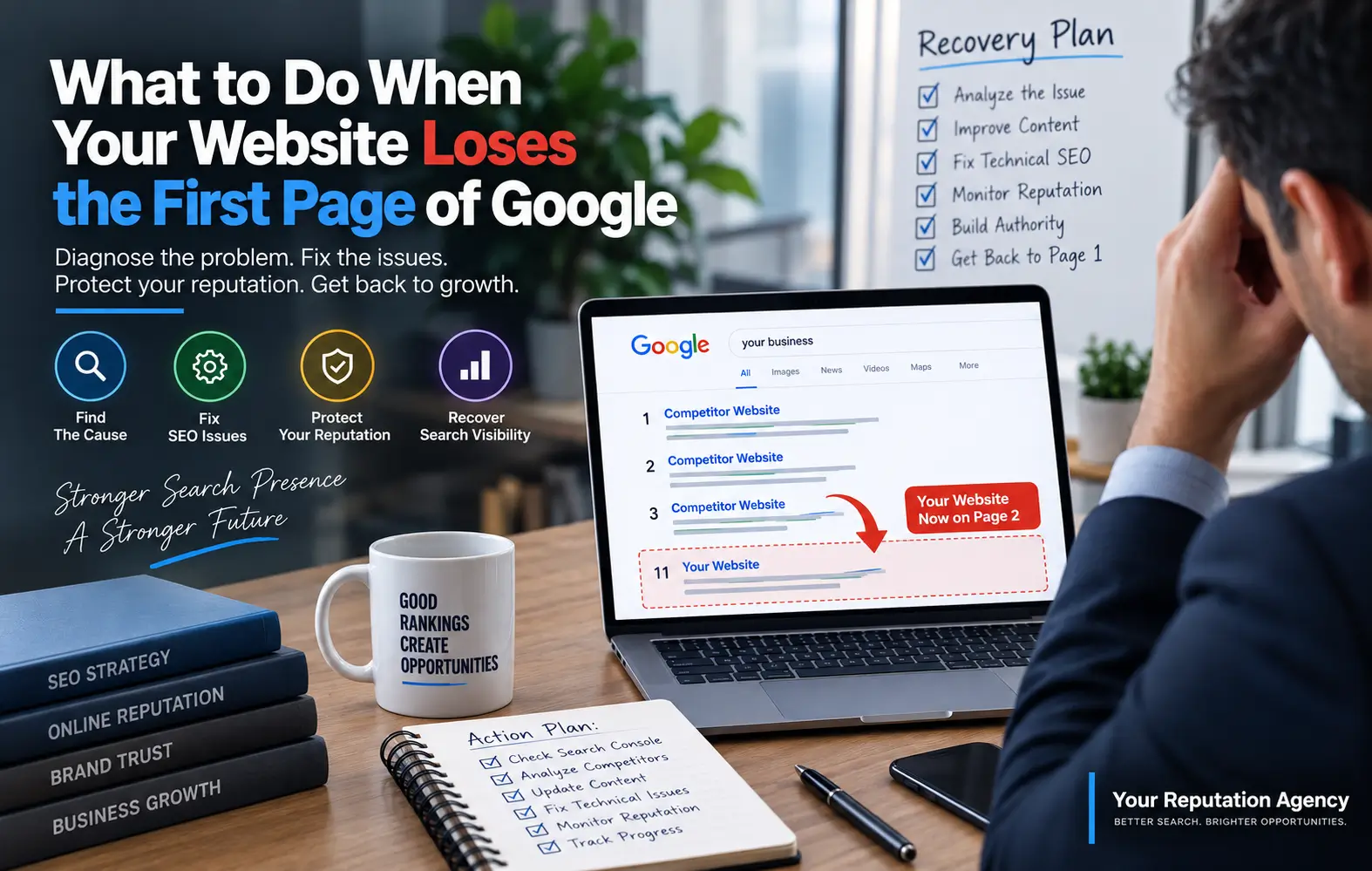
Removal is not always achievable. When platforms decline to remove content, the next responsible step is mitigation: decrease the content’s visibility and rebuild trust with fresh, authoritative content.
Suppression is an SEO and content strategy intended to improve the presence of positive or neutral pages so negative links appear lower in search results. We develop SEO reputation strategies intended to improve the visibility of relevant and credible information.
- Audit current search results for your business name and core pages.
- Create a prioritized list of assets to build or optimize (profiles, articles, press, video).
- Deploy a measured content and link strategy to raise the ranking of the trustworthy assets.
- Mitigation tactics: optimized landing pages, authoritative press or blog posts, social profiles, structured citations, and targeted SEO to promote positive content.
- Also use direct remedies: correct underlying operational problems, invite genuine customers to leave reviews, and improve on-site reputation signals (FAQ, credentials).
When a social or forum thread fuels the problem
Sometimes the harm comes from a viral discussion rather than a single review. If that’s the case, targeted PR outreach and authoritative content are needed to address claims and restore context. For a deeper look at Reddit-driven reputation harm, read When a Reddit Thread Quietly Sinks Your Google Ratings.
- Do not engage in heated public arguments; document the thread and respond through calm, factual channels.
- A structured media or PR response can reduce the thread’s influence and signal to search engines that authoritative sources exist to correct the record.
Step-by-step: How we evaluate a review-removal case
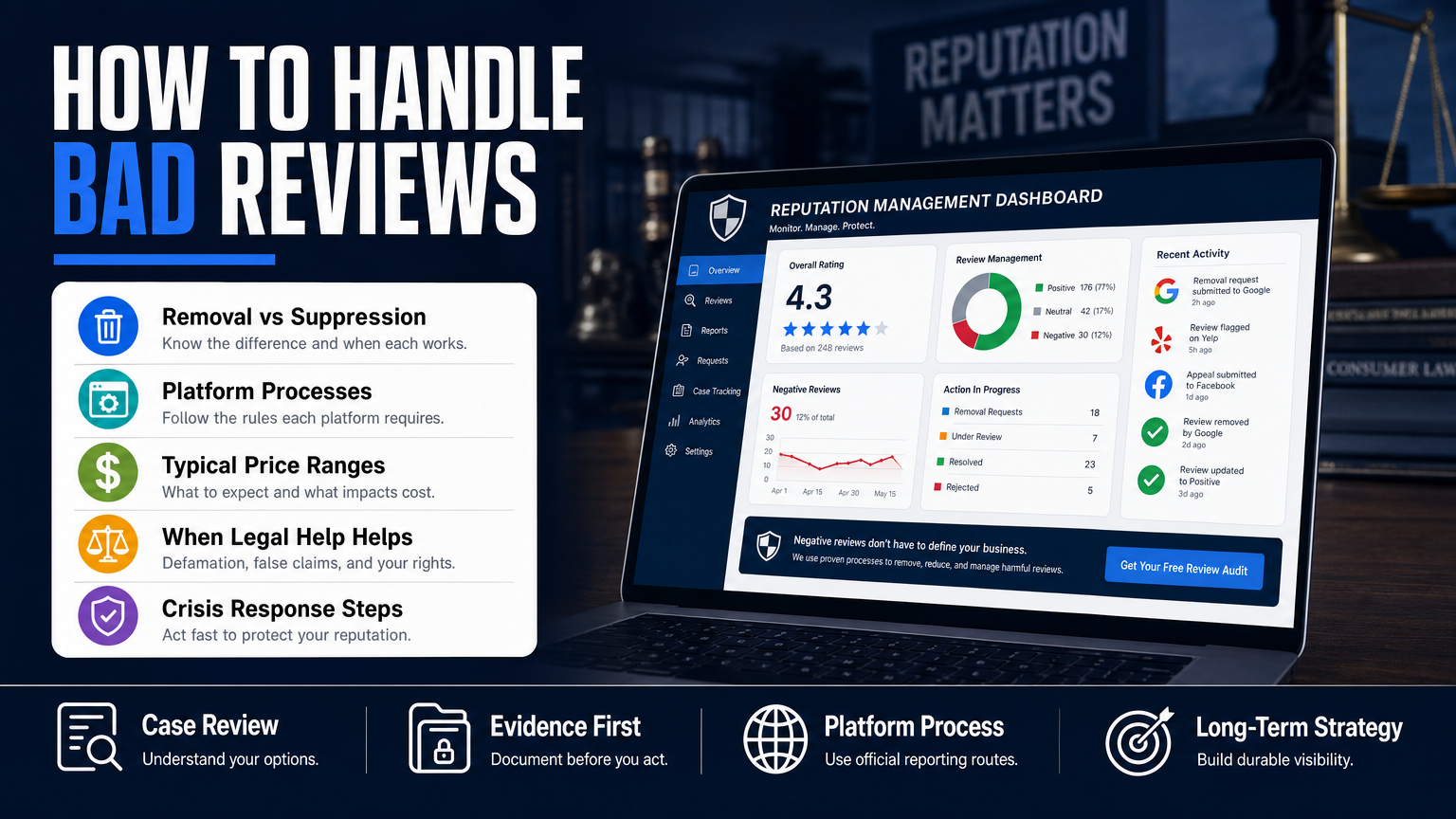
A professional approach follows a clear sequence: intake, evidence collection, platform reporting, legal assessment (if warranted), and mitigation. Below is a practical checklist you can use for any negative-review incident.
- 1) Intake call or form: capture who, when, where, and the claimed harm.
- 2) Evidence pack: assemble screenshots, order logs, communications, and reviewer history.
- 3) Platform reports: file targeted reports with attachments where allowed.
- 4) Legal review: if the content appears defamatory or contains private data, coordinate with counsel.
- 5) Mitigation: implement SEO and PR steps to reduce the harmful item’s visibility.
- Intake: collect the raw URL, screenshots, reviewer profile, and any transactional evidence.
- Assessment: classify the content as opinion, factual allegation, privacy violation, impersonation, or harassment.
- Action plan: map out platform reports, evidence to submit, and SEO mitigation priorities.
What we look for in evidence
Strong evidence: purchase or appointment records proving the reviewer was not a customer, IP or metadata showing repeated abuse, or communications that show an intent to harm. Weak evidence: unsupported assertions, hearsay, or emotional responses without corroboration.
We evaluate whether the content may qualify for removal or review and pursue the legal, technical, platform-based, and reputational options available.
- Preserve everything — screenshots with timestamps are crucial.
- If records involve protected health information or sensitive client data, follow privacy laws and involve counsel before sharing.
Timeframes, costs, and what to expect
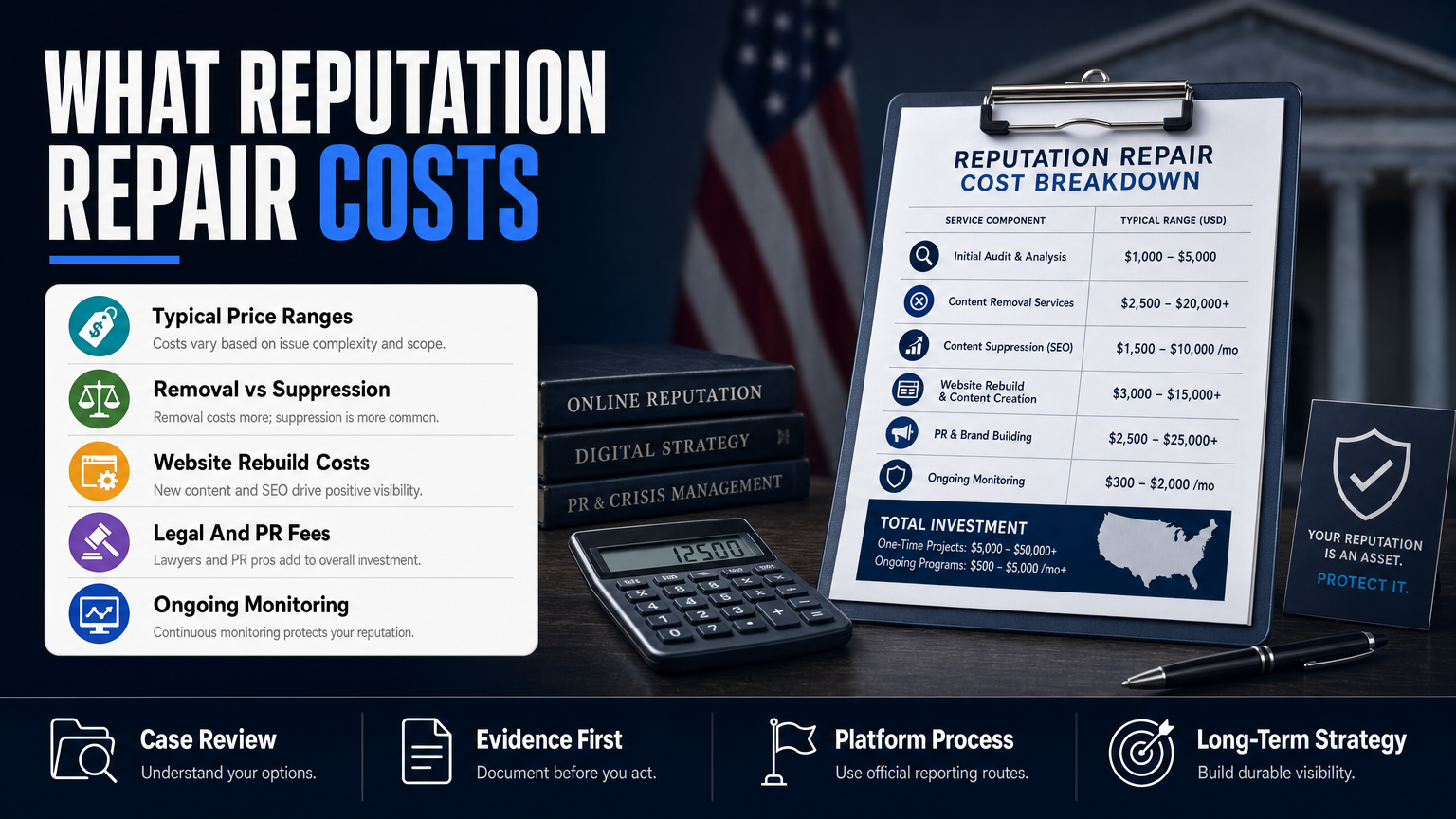
Time and cost vary widely. Platform responses can take 48 hours to several weeks. Legal routes (cease-and-desist, civil claims) may take months and incur counsel fees. Mitigation via SEO is gradual and may take 3–12+ months to materially change first-page results.
A professional firm usually offers tiered services: single-review takedown attempts, multi-platform campaigns, legal coordination, and long-term suppression and monitoring. Costs reflect complexity and risk.
- Request an assessment to get a realistic timeline and an itemized scope. An estimated timeline can be provided after an individual assessment.
- Typical time ranges: platform report resolution 2–30 days; legal steps weeks to months; SEO suppression 3–12 months.
- Typical cost ranges (very approximate): single-review response $200–$1,000; comprehensive campaigns with legal and SEO components $3,000–$30,000+ depending on scope.
Pricing models you’ll encounter
Fixed-fee: for specific tasks like filing platform reports or drafting legal letters. Contingency (no-win, no-fee) models are sometimes offered for removals but read the fine print — removal depends on platform policies and is not guaranteed.
Retainer or monthly subscription: used for ongoing monitoring, suppression, and crisis response; appropriate when you want continuous coverage.
- Avoid vendors who demand large upfront payments for unspecified outcomes.
- Ask how reporting and success are documented — you should receive clear status reports.
Ongoing monitoring and prevention
Prevention reduces crisis risk. Ongoing monitoring alerts you to new reviews, brand mentions, and potential review-bombing patterns so you can react early. We handle matters confidentially and apply appropriate privacy and security controls during monitoring.
Prevention also includes improving customer experience, asking satisfied clients for reviews, and training staff on review-response protocols.
- Set up monitoring for business name, key people, and primary locations.
- Create a playbook: who responds, who escalates to legal, and how to preserve evidence.
- Monitoring tools: Google Alerts, platform dashboards, and paid monitoring services that track mentions, sentiment, and spikes.
- Internal policies: review-response templates, escalation rules for threatening or false claims, and a central evidence repository.
When to notify counsel or PR
Notify counsel when a review contains demonstrably false statements that may be defamatory, when it includes private personal data, or when demands for payment or extortion appear. Notify PR when the issue is public-facing and likely to attract media or community attention.
We coordinate with qualified legal professionals when a matter requires legal analysis, and we develop PR messaging to rebuild trust where appropriate.
- Legal and PR coordination is standard for high-risk incidents (licensure threats, regulatory exposure, or coordinated attacks).
- Keep response messages factual; avoid admitting fault in public posts without counsel.
Removal vs Suppression: Which Path Fits Your Case?
A quick comparison to decide whether to pursue removal or suppression as your primary strategy.
| Removal | Suppression |
|---|---|
| Goal | Lower visibility by promoting other content |
| Best for | When content violates policy or is demonstrably false or private data is exposed |
| Who decides | Platform teams or courts |
| Typical time | Days to months (platform/legal variability) |
| Cost profile | Generally lower for single removals; legal routes cost more |
| Risk | Possible platform denial; legal action may escalate visibility |
| When to pick | Clear policy breach or falsity; or privacy violation |
Hypothetical: Nurse Practitioner’s Fake Negative Review
Scenario: A nurse practitioner (anonymized) finds a one-star review on Google claiming malpractice and saying the reviewer paid for a procedure that never occurred. The profile has no appointment history and left similar reviews for several unrelated clinics.
Process: The business documents the review, pulls appointment logs showing no matching patient, screenshots the reviewer’s profile and cross-references similar reviews, submits a Google report with supporting evidence, posts a professional public response offering to investigate, and engages a reputation firm to handle escalation and suppression.
- 1) Document everything (screenshots, logs).
- 2) File a formal report with the platform attaching evidence.
- 3) Respond publicly to state facts and invite offline resolution.
- 4) If Google declines to remove, start suppression with authoritative content and monitor results.
- 5) If the false claim persists and causes measurable harm, consult an attorney for next steps.
- Evidence collected: appointment logs, screenshots of repeated-review patterns, reviewer profile, and copies of platform report confirmations.
- Actions taken: platform report, public factual reply, legal evaluation for defamation, and an SEO suppression campaign to promote authoritative bios and educational content.
Common Mistakes Owners Make
Avoiding these errors reduces the risk of making a bad situation worse.
Mistake 1 — Emotional public replies
Responding angrily multiplies visibility and gives the reviewer more to post about. Keep public replies factual and professional; offer a private channel to resolve the issue.
- Tip: Use a template that acknowledges the complaint, states a corrective action, and provides contact details.
Mistake 2 — Paying for ‘magic’ removal services
Vendors promising guaranteed removals or employing opaque tactics are risky. They can expose you to fraud, platform sanctions, or legal trouble.
- Tip: Require written processes and refuse vendors that demand unethical actions.
Mistake 3 — Not preserving evidence
Platforms change content over time. If you don’t capture screenshots, report IDs, and logs immediately, you may lose critical proof for later escalation.
- Tip: Use timestamped screenshots and store them in a secure, access-controlled folder.
Mistake 4 — Over-relying on legal threats
Sending a cease-and-desist without a clear legal basis can escalate the situation and prompt a public backlash. Legal steps should follow an evidence-based assessment by counsel.
- Tip: Coordinate counsel and PR before sending strong legal language.
Mistake 5 — Ignoring prevention
Failing to solicit genuine reviews and improve operations leaves you vulnerable to a single negative review disproportionately affecting your reputation.
Tip: Implement regular review-generation processes that encourage satisfied clients to post feedback.
Best Practices For Handling Harmful Reviews
These durable steps reduce risk and improve outcomes whether you pursue removal or mitigation.
1 — Act quickly, but calmly
Preserve evidence immediately, then plan your response. Time matters for both platform reports and legal options, but emotional haste hurts more than it helps.
- Capture screenshots, URLs, and reviewer profile details within 24 hours.
2 — Use platform tools correctly
File reports using the platform’s official forms and include focused evidence. Generic complaints without specifics are less likely to succeed.
- Attach transaction IDs, dates, and copies of communications when allowed.
3 — Build authoritative content
Create verifiable, trustworthy pages (staff bios, press releases, case studies) to push negative items lower in search results. We develop SEO reputation strategies intended to improve the visibility of relevant and credible information.
- Prioritise pages with clear ownership and verification (.gov, .edu, or recognized industry publications when possible).
4 — Coordinate legal and PR responses
If a review is potentially defamatory or part of a coordinated attack, coordinate legal review and PR messaging. Legal action may be appropriate, but it should be weighed against potential publicity risks.
- Use counsel to vet the evidence and draft any legal correspondence.
5 — Monitor and institutionalize the process
Set up monitoring, documentation, and an escalation playbook so future incidents are handled promptly and consistently.
We handle matters confidentially and apply appropriate privacy and security controls during monitoring and incident response.
- Designate a single point of contact for review incidents to avoid mixed messages.
Expert Tips
- Screenshot everything immediately and store it in a secure folder with timestamps.
- Answer public reviews quickly with a calm, factual reply that invites offline resolution.
- Use order numbers or appointment logs as evidence to challenge fake reviewers.
- Avoid public threats or aggressive legal language without counsel’s input.
- If a vendor promises guaranteed removals, ask for a detailed written process and references.
- Promote genuine positive reviews to dilute the impact of a single negative item.
- Monitor mentions of key staff names as well as the business name.
- Preserve and log all communications if you plan to escalate legally.
Conclusion
Removing bad reviews is rarely a single, clean action; it’s a sequence of documentation, platform reporting, possible legal evaluation, and—in many cases—reputation rebuilding through SEO and PR. We evaluate whether the content may qualify for removal or review, and pursue the platform, legal, technical, and reputational options available.
If you’re deciding between DIY and hiring help, prioritize clear evidence, a written scope from any vendor, and alignment with legal counsel when the content includes false allegations or private data. When removal is unavailable, focused suppression and a steady stream of authoritative content are practical, measurable ways to regain control of your search results and business reputation.
Why Businesses Choose Your Reputation Agency
Managing your reputation takes more than monitoring reviews or publishing the occasional blog post. It takes a strategy built around your situation, your industry, and what is actually showing up in search.
Your Reputation Agency works with businesses, executives, healthcare professionals, attorneys and growing brands. Our services include:
- Remove defamatory content and false posts (news, blogs, listings)
- Remove or challenge negative reviews (Google, Yelp, TripAdvisor, industry sites)
- Mugshot and arrest record removal
- Remove videos, images, and other multimedia that damage reputation
- Remove personal data from people‑search and data‑broker sites (opt‑outs)
- Search result suppression (SEO to bury negative links)
- Social media takedowns and impersonation removal
- Rapid online crisis management and incident response
- Ongoing monitoring and alerting of reputation signals
- Coordination with legal counsel and use of legal tactics when required
Frequently Asked Questions
1. Can a business owner remove bad reviews?
A business owner can request removal by flagging reviews and using the platform’s official reporting tools, but only the platform can remove content. Owners should document the review, file a clear report with evidence, and respond publicly in a professional manner. Legal options are available in some cases but require counsel and are not guaranteed.
2. Which company can remove bad reviews from my business?
Reputable reputation firms evaluate whether content may qualify for removal or other remedies and then pursue platform, legal, and SEO options. Look for documented processes, willingness to coordinate with your lawyer, and realistic, evidence-based assessments. For a specific example of Google-focused risk, see When One‑Star Google Reviews Threaten Your Practice.
3. Is it illegal for a company to delete bad reviews?
It is not illegal for platforms or reviewers to delete reviews, but companies that use fraudulent or deceptive methods to remove or alter reviews (hacking, bribery, fake accounts) may violate laws and platform terms. Always use official reporting channels and avoid tactics that could expose you to legal or platform penalties.
4. How can I remove fake reviews from my business?
Collect evidence (transaction logs, screenshots, reviewer patterns), file a targeted report with the platform, and publicly reply with facts. If the platform declines to remove the review and it’s clearly fraudulent, consider legal review. For platform-specific tactics, consult the site’s reporting flows and specialist guidance like When One Trustpilot Review Costs Your Practice — And What To Do Next.
5. How long does review removal take?
Platform responses can range from 48 hours to several weeks. Legal processes may take months. SEO suppression can take 3–12 months or longer. Timing depends on platform policy, evidence strength, legal complexity, and search-engine behavior.
6. How much does review removal cost?
Costs vary by scope. Simple platform reports and management can be a few hundred dollars; multi-platform, legal, and SEO campaigns can range from a few thousand to tens of thousands. Ask for itemized scopes and realistic ranges during the initial assessment.
7. Should I send a cease-and-desist to a reviewer?
Only after counsel reviews the evidence. A cease-and-desist can be appropriate for clear defamatory falsehoods, threats, or extortion, but poorly founded legal threats can inflame the situation and cause negative publicity. Coordinate legal and PR strategy before sending strong legal notices.
8. What if the review is on a third-party forum or Reddit?
Public forums require a different approach: document the thread, avoid escalating publicly, and use measured PR and authoritative content to provide context. If the thread is driving search results, mitigation and suppression are often more effective than takedown attempts; see When a Reddit Thread Quietly Sinks Your Google Ratings.
This content provides general information and does not constitute legal advice. The available options and likely outcomes depend on the facts, evidence, platform policies, applicable law, jurisdiction, and public-interest considerations.
Past examples do not guarantee future results. Removal, correction, deindexing, and search-position changes depend on third parties and circumstances outside Your Reputation Agency’s control.