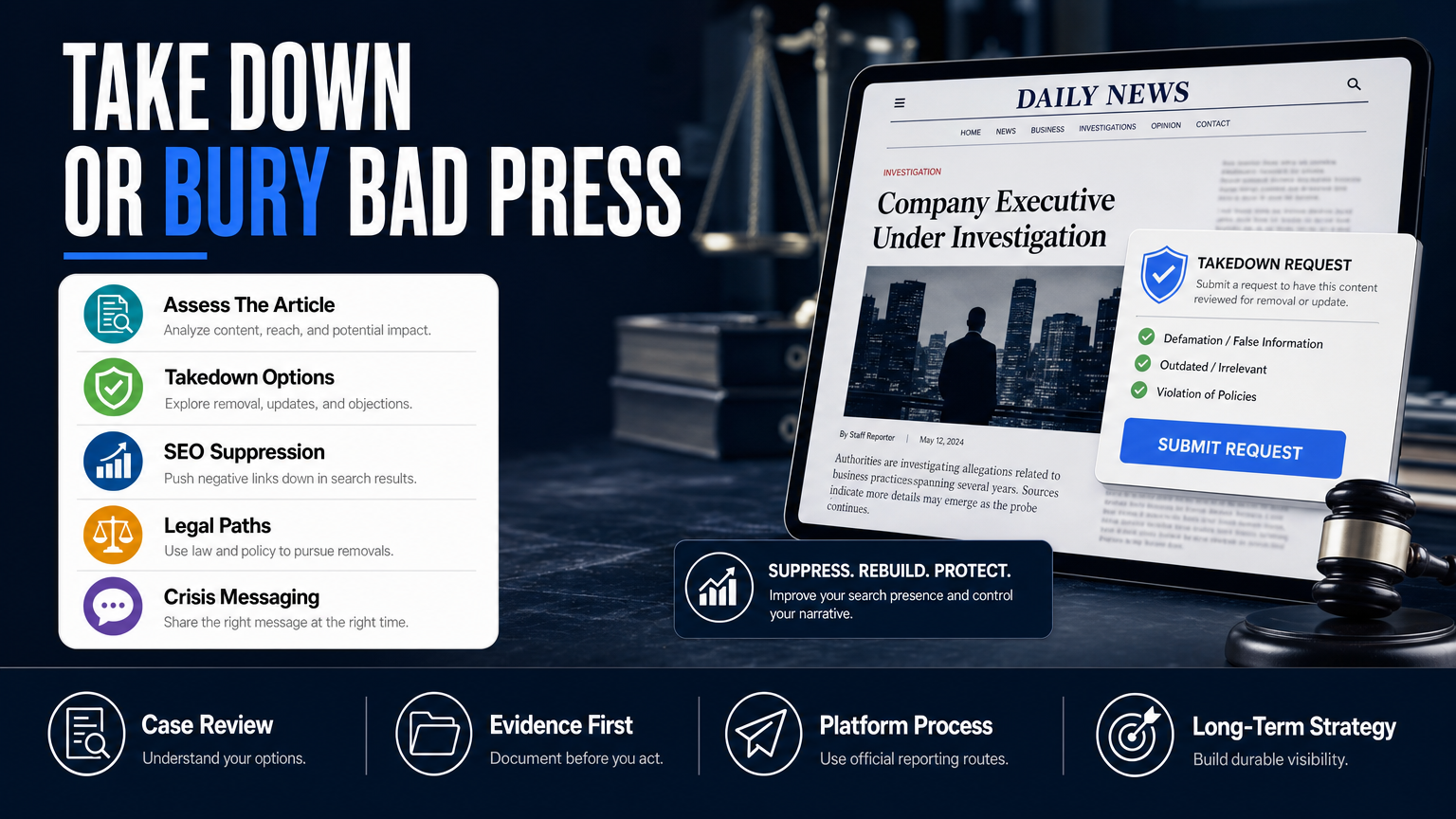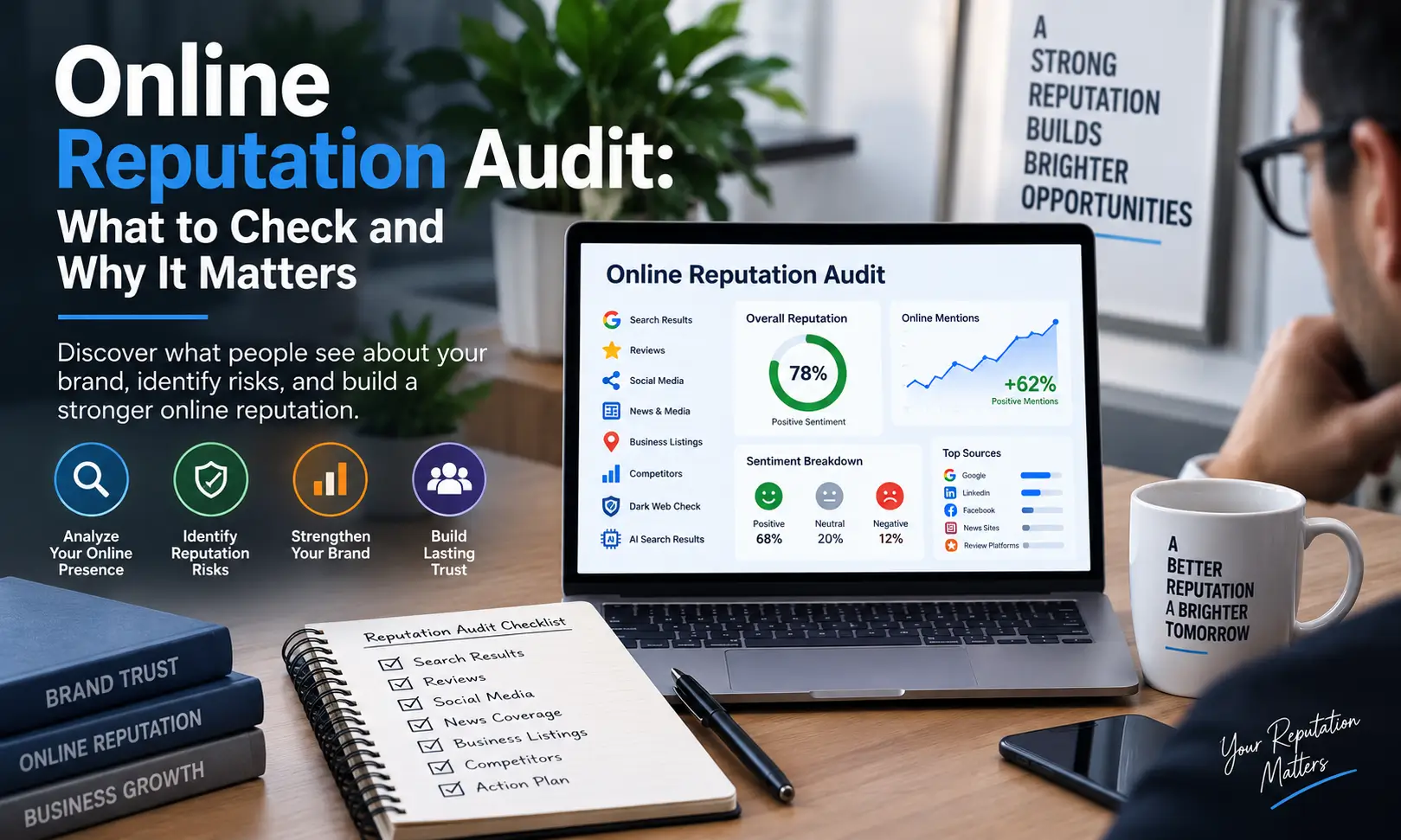
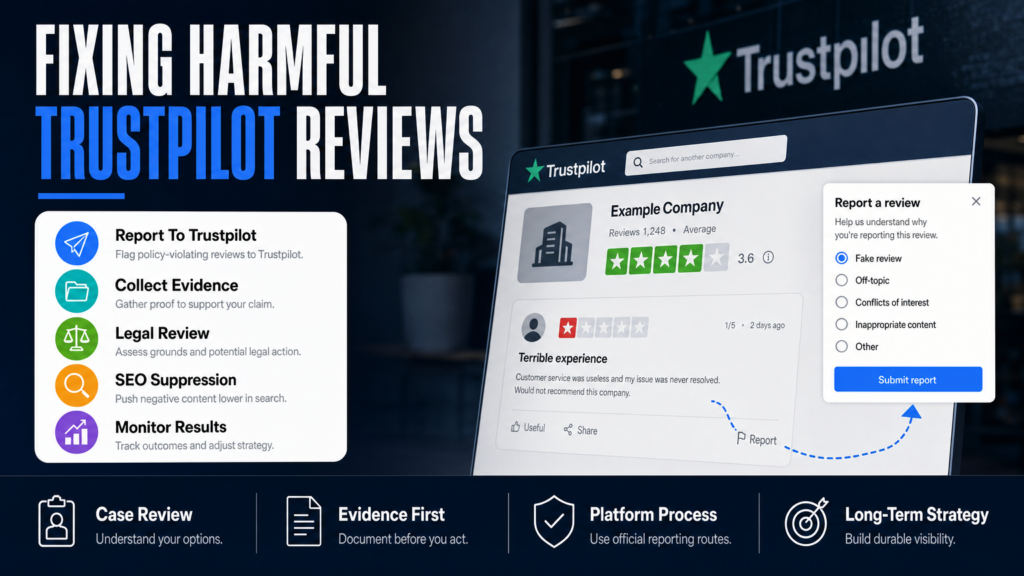
You found one or more damaging Trustpilot reviews that show up in Google searches for your name or business. They’re costing calls, interviews, or bookings — and you need to know whether you can remove bad reviews from Trustpilot and how fast you can act.
This article walks through the realistic options: when Trustpilot will remove or hide a review, how to prepare evidence, how to escalate platform and legal channels, and what to do if removal isn’t available. We’ll use specific steps you can take today and explain tradeoffs between takedown attempts and search-result suppression.
If you’re time-sensitive (licensure, a live PR issue, a hiring freeze, or lost revenue), the sections that follow give a prioritized checklist, sample wording for reports and escalations, and a hypothetical case that shows the process end-to-end.
Table of Contents
- Can you delete negative reviews on Trustpilot?
- How do I get bad reviews removed?
- Can companies really remove bad reviews?
- Can I pay to remove reviews on Trustpilot?
- Step-by-step: Escalating a review that won’t be removed
- DIY vs hiring a reputation agency
- What to do when removal is not available
- Removal vs Suppression: Which Path Fits Your Risk
- Hypothetical example: A surgeon facing a false Trustpilot review
- Common mistakes that make Trustpilot problems worse
- Best practices to handle Trustpilot complaints effectively
- Expert Tips
- Conclusion
- Why Businesses Choose Your Reputation Agency
- Frequently Asked Questions
Can you delete negative reviews on Trustpilot?
Short answer: sometimes, but not automatically. Trustpilot can remove reviews that violate its content guidelines (fraud, hate speech, personal data, impersonation, conflicts of interest, or unlawful content). Trustpilot generally will not remove truthful negative opinions or legitimate customer complaints simply because they’re unpleasant.
We evaluate whether the content may qualify for removal or review based on Trustpilot’s published guidelines and the specific facts of a case. Platform decisions remain under the platform’s control and outcomes vary by evidence and context.
- Capture evidence: save the review as a screenshot, note the URL, reviewer handle, and date/time.
- Check Trustpilot’s guidelines and map each claim to a policy breach (for example: is the reviewer claiming your name or revealing private data?).
- Report using Trustpilot’s ‘Report a review’ tool and attach or reference evidence.
- Trustpilot removes reviews for: impersonation, fabricated reviews, review-bots, doxxing/personal data exposure, threats, and unlawful content.
- Trustpilot does not remove: truthful negative experiences, opinions, or editorial coverage unless it violates policy.
How to build the initial report
A good report reduces back-and-forth and speeds the platform review. State exactly which policy the review violates and attach supporting evidence (screenshots, transaction records, IP logs if available through your systems, or a communication thread).
If the reviewer mentions private medical or financial data, quote the offending lines (don’t repost extra private data) and indicate why those lines are sensitive under Trustpilot’s rules.
- Quote the offending text verbatim and add a screenshot.
- If the reviewer is a competitor, show a pattern of coordinated reviews if possible.
- If it’s an impersonation, provide proof of the real account and official company pages.
How do I get bad reviews removed?
Removal requires either a platform policy breach, a successful legal claim, or cooperation by the reviewer or publisher. Your first route is to follow Trustpilot’s reporting flow and provide clear, corroborating evidence. If the reviewer is contactable, a retraction or update from them is the fastest outcome.
If the review looks false, requires verification, or is likely from a competitor, follow escalation steps and document everything. For tactics focused specifically on false or fabricated content, see our walkthrough at Trustpilot Fake Reviews: 6 Tactics to Challenge False Reviews on Trustpilot.
- Attempt direct contact: ask the reviewer to correct or remove the review, offering to resolve the underlying complaint if appropriate.
- File an internal Trustpilot report with policy citations and attached evidence.
- If denied, gather counsel and consider a legal takedown or subpoena if the content is defamatory or violates privacy laws.
- Report to Trustpilot with evidence.
- Request reviewer removal or correction directly (polite, factual outreach).
- Escalate with legal notice if review contains defamation or private data (coordination with counsel required).
When to offer to resolve the underlying complaint
If the review describes a genuine customer service incident, resolving the problem and asking for an updated review is often the fastest, lowest-cost fix. Track communications in writing, and avoid offering incentives for review removal — that can violate Trustpilot rules and professional ethics in some fields.
If the complaint is fraudulent or from a non-customer, do not offer concessions — document the fraud and escalate to Trustpilot as such.
- Record dates, order numbers, and names before contacting the reviewer.
- Keep outreach professional and offer a clear path to resolution.
Can companies really remove bad reviews?
Companies can remove reviews when the review breaches platform rules, the reviewer agrees to remove it, or a court orders removal. There is no universal ability for businesses to delete legitimate critical reviews on Trustpilot simply because they dislike them.
For a detailed look at competitor tactics and evidence of coordinated attacks, our analysis covers how adversaries can manipulate Trustpilot and what to watch for: How Competitors Are Quietly Destroying Businesses on Trustpilot.
- Document the falsehood or policy breach.
- Make a formal report to the platform.
- If necessary, consult a lawyer about defamation or privacy claims; legal options depend on the facts and local law.
- Platforms enforce their own rules; businesses may have limited direct control.
- Legal remedies are available but depend on jurisdiction, the nature of the statement, and the available evidence.
- Agreed removals (reviewer retracts) are the simplest legal path but require consent.
What legal routes actually do
A lawyer can send a demand letter or apply for a court order to compel removal. Courts may order a publisher to take down defamatory content, but success depends on evidence, the speaker’s rights (e.g., opinion vs false statement of fact), and jurisdiction.
Legal steps can be costly and slow; legal review is most appropriate for clear cases of false factual claims, privacy violations, or coordinated false-review campaigns.
- Defamation claims require proving a false factual statement and harm in many jurisdictions.
- Privacy or data-exposure claims can sometimes be faster if private data is posted.
- Subpoenas can compel platform logs in litigation but require formal legal proceedings.
Can I pay to remove reviews on Trustpilot?
Short answer: No. Trustpilot does not allow businesses to pay for the removal of specific negative reviews. Paying for removals would violate platform integrity and could lead to penalties.
That said, companies can invest in services that attempt lawful and policy-based removals, or in reputation-building strategies such as SEO and PR to suppress negative content in search results. We develop SEO reputation strategies intended to improve the visibility of relevant and credible information, but search engines and platforms ultimately control outcomes.
- If approached about paid removals, request proof of compliance and credentials; decline any tactic involving fake content.
- Consider reputable reputation services that coordinate policy reports, legal review, and SEO work transparently.
- Direct payment to Trustpilot for removals is not a supported or legitimate option.
- Paid services can include evidence collection, legal notices, PR outreach, and SEO suppression campaigns.
- Avoid any service that asks you to buy fake positive reviews or to post fake removals — those violate Trustpilot policy and can worsen exposure.
Ethical and platform risks of paid tactics
Buying removal or fake positive reviews risks suspension from Trustpilot and can create legal exposure. Platforms have detection systems for review manipulation and coordinated inauthentic behavior.
We never recommend deceptive tactics. Instead, pursue policy-compliant reporting, legal remedies where applicable, and search-result suppression when removal isn’t possible.
- Fake review posting is detectable and reversible.
- Deceptive practices can produce platform sanctions and reputational blowback.
Step-by-step: Escalating a review that won’t be removed
When Trustpilot declines to remove a review, you still have multiple paths: appeal, documented outreach to the reviewer, targeted SEO suppression, PR correction, or legal escalation where appropriate.
We use the official reporting and review processes made available by platforms while also pursuing external remedies as needed.
- 1) Re-check the policy mapping and prepare supplemental evidence or witness statements.
- 2) Submit an appeal or escalate via Trustpilot’s business support channels.
- 3) If the reviewer is reachable and the issue is legitimate, offer to resolve and request an updated review.
- 4) If removal is not possible, start a suppression plan: publish factual, authoritative content (press release, blog post, staff profiles), optimize site pages, and target low-authority negative pages for correction or removal.
- 5) Set up ongoing monitoring to detect copycat posts or new negative signals.
- Appeal to Trustpilot with more evidence.
- Contact the reviewer with documented resolution offers or requests for clarification.
- Deploy SEO and content strategies to push negative results down in searches.
How suppression works in practice
Suppression uses SEO to improve the ranking of credible, factual pages so that the negative review is less visible. We develop SEO reputation strategies intended to improve the visibility of relevant and credible information, but remember search results change for many reasons.
Suppression is not deletion; it reduces visibility. Results vary by the strength of the negative content and the authority of competing sources.
- Create and optimize authoritative pages (About, Services, Staff bios).
- Use guest posts, local citations, and industry directories to build alternate signals.
- Request corrections or de-indexing from search engines for content that violates policies.
DIY vs hiring a reputation agency
You can pursue Trustpilot reports and direct reviewer outreach yourself — many businesses do — but complex cases (coordinated attacks, legal issues, or high-stakes professional risk) often benefit from experienced coordination. A professional firm manages evidence collection, escalations, and a coordinated suppression strategy.
If you want a walkthrough of what an agency does day-by-day and the costs and tradeoffs, our breakdown explains how vendors operate and when to bring counsel: What One Fake Review Actually Costs Your Practice.
- If DIY: follow the reporting and evidence steps above, attempt resolution with reviewer, and set a suppression plan.
- If hiring an agency: demand a clear scope, written processes for evidence, and a plan for monitoring and escalation.
- DIY is lower cost and good for single, simple disputes.
- Agencies bring process, evidence workflows, legal coordination, and SEO expertise.
- Choose an agency that documents process, sets realistic expectations, and coordinates with counsel.
Red flags when selecting a vendor
Avoid any vendor that guarantees removal, promises fixed timelines, or recommends deceptive practices. Ask for a clear escalation matrix, sample report formats, and references that confirm process — not outcomes.
A good vendor will evaluate whether the content may qualify for removal or review and will coordinate legal and PR actions where appropriate.
- Guarantees of removal or ranking are a red flag.
- Demand written confidentiality and defined limits to liability.
- Prefer teams that coordinate with qualified legal counsel.
What to do when removal is not available
If Trustpilot refuses removal and legal claims aren’t viable, shift to mitigation: correct factual errors publicly, produce authoritative content, and use search-result suppression. Treat the review as a communications problem as much as a platform problem.
Mitigation plans combine customer resolution, targeted content, citation building, and monitoring. These strategies aim to reduce the review’s business impact rather than erase it.
- 1) Post a professional, limited response on Trustpilot addressing the issue and offering resolution steps.
- 2) Publish a corrective or explanatory page on your site and optimize it for the same keywords that trigger the negative review.
- 3) Use local citations, staff bios, and press placements to create alternative, authoritative results.
- 4) Monitor for new content and set alerts for brand mentions.
- Respond publicly on Trustpilot where allowed — keep tone factual and non-inflammatory.
- Publish a clear corrective statement on your website and distribute it via PR channels if the matter is newsworthy.
- Use targeted SEO and content to outrank the negative review in relevant searches.
When a public response is the right move
Public responses are appropriate when the facts can be clarified and a resolution offered. Keep responses brief, avoid admitting liability, and invite the reviewer to continue the conversation privately to resolve the issue.
A measured public reply can reassure prospective customers and demonstrate professionalism.
- Acknowledge the issue without repeating inflammatory accusations.
- Offer contact information and a concrete next step (e.g., “Please email ops@yourdomain.com with your order number”).
Removal vs Suppression: Which Path Fits Your Risk
Quick side-by-side of the two main approaches when facing a Trustpilot review you can’t simply delete.
| Removal (Takedown) | Suppression (SEO & PR) |
|---|---|
| Goal | Goal |
| Erase or block the content from the platform | Push the content lower in search results |
| Requires policy breach or legal order | Requires sustained content and SEO effort |
| Potentially fast if platform agrees or court orders it | Typically slower (weeks to months) but less risky |
| Can be costly (legal fees) and uncertain | Costs scale with SEO/PR spend; outcomes vary |
| Removes the original exposure when successful | Does not remove the original; reduces visibility |
Hypothetical example: A surgeon facing a false Trustpilot review
Scenario: An anonymous Trustpilot review falsely claims malpractice and cites no verifiable facts. The review appears on the first page of Google and has begun affecting new patient inquiries.
Process (anonymized): the surgeon’s office collected evidence, attempted contact, reported to Trustpilot, escalated to counsel for a defamation assessment, and simultaneously launched a suppression campaign to reduce visibility.
- Collect and preserve evidence (screenshots, URL, internal logs).
- Report to Trustpilot and map the review to a policy violation.
- If Trustpilot declines removal, coordinate legal review for defamation and begin SEO suppression simultaneously.
- Monitor and adapt: if the reviewer replies, keep the record of outreach; if additional negative content appears, repeat escalation and suppression steps.
- Step 1: Save screenshots and record the review URL and timestamps.
- Step 2: Search internal records for any patient with the claimed incident; confirm there is no matching record.
- Step 3: Attempt direct outreach via Trustpilot message to ask for clarification; keep communication factual.
- Step 4: File a Trustpilot report citing impersonation or false factual claims, attaching the internal records demonstrating no matching patient (protecting patient privacy).
- Step 5: Prepare for suppression: publish an official statement, update staff profiles with optimized content, and commission guest posts in local health directories.
Common mistakes that make Trustpilot problems worse
Avoid these frequent errors — they either violate platform rules or expose you to legal and reputational risk.
1) Reacting emotionally with public attacks
Answering a negative review with a defensive or insulting reply often amplifies the issue and looks worse to potential customers. Keep public responses short, factual, and offer to continue the discussion privately.
- Do not repeat unverified accusations in your reply.
- Avoid naming or accusing a reviewer publicly.
2) Buying fake positive reviews
Purchasing fake reviews or engaging in reciprocal review schemes violates Trustpilot’s policies and can lead to suspension and greater reputational damage if exposed.
- Do not purchase reviews or incentivize customers to post untrue content.
- Focus on legitimate review collection programs instead.
3) Missing basic evidence collection
Failing to save early screenshots, URLs, and records can make platform appeals and legal options much harder. Tools exist to automate monitoring; start with simple manual captures if nothing else.
- Always capture full-page screenshots with timestamps.
- Record internal logs that show no matching transaction if the claim is false.
4) Over-relying on legal threats
Sending aggressive legal demands without solid evidence can backfire and appear like bullying. Legal steps should be coordinated and reserved for clear cases of defamation or privacy violation.
- Use counsel to vet any demand letter before sending.
- Document all earlier attempts at resolution to show good faith.
5) Ignoring monitoring after resolution
Even after a takedown or suppression, bad actors may repost or copy the content. Implement ongoing monitoring and alerts for brand mentions to catch regressions early.
- Set Google Alerts and monitoring tools for brand variants.
- Keep a log of removed content and follow up if it reappears elsewhere.
Best practices to handle Trustpilot complaints effectively
Adopt a measured, evidence-driven approach combining platform reports, customer service, and suppression when necessary.
Document everything immediately
Preserve screenshots, URLs, internal records, and any communications with the reviewer. Early preservation strengthens both platform appeals and legal options.
- Use a timestamped archive (local and cloud copy).
- Keep an evidence index for each disputed review.
Map the review to an exact policy breach
Identify the precise Trustpilot policy you believe the review violates. Reports that explicitly cite a matching policy and include evidence are more likely to be escalated and reviewed.
- Quote the policy and the offending lines in your report.
- Include corroborating documents (order numbers, messages).
Use professional, non-confrontational public replies
A calm, factual public reply demonstrates professionalism and can reassure prospective customers even if the review remains visible.
- Acknowledge, offer resolution, and move details offline.
- Avoid legal threats in public replies.
Combine legal, platform, and SEO tactics
Coordinate the right mix: platform reporting for clear policy breaches, legal steps for defamation or privacy violations, and SEO/PR to mitigate residual damage when removal fails.
- Coordinate actions to avoid contradictory public statements.
- Track time and cost for each path to decide when to escalate.
Set up monitoring and a response playbook
Create a short, rehearsed playbook: who collects evidence, who files reports, template messages for reviewers, and when to escalate to counsel or an agency. Speed matters in live incidents.
- Assign a single point of contact for reviews.
- Use alerts and periodic audits of review sites.
Expert Tips
- Save a full-page screenshot immediately and record the review URL and reviewer handle.
- Map each problematic sentence to a specific Trustpilot policy before filing a report.
- If the review references private data, flag it specifically as a privacy violation in your report.
- Never offer payment for removal or post fake positive reviews — it creates greater risk.
- Consider simultaneous SEO suppression while pursuing removal; the two are complementary.
- Keep public replies factual, brief, and focused on resolution, never on assigning blame.
- Document all outreach attempts to the reviewer — they strengthen appeals and legal steps.
- Use a reputable vendor that coordinates evidence, legal review, and SEO rather than promising fixed outcomes.
Conclusion
Removing bad reviews from Trustpilot is possible in many cases, but not guaranteed. Platform removal depends on Trustpilot’s policies, the strength of your evidence, the availability of legal remedies, and whether the reviewer cooperates.
If removal isn’t available, your practical options are clear: document, escalate, and mitigate through professional responses and search-result suppression. A coordinated, evidence-driven approach reduces risk and restores trust more reliably than ad-hoc reactions or deceptive shortcuts.
Why Businesses Choose Your Reputation Agency
Managing your reputation takes more than monitoring reviews or publishing the occasional blog post. It takes a strategy built around your situation, your industry, and what is actually showing up in search.
Your Reputation Agency works with businesses, executives, healthcare professionals, attorneys and growing brands. Our services include:
- Remove defamatory content and false posts (news, blogs, listings)
- Remove or challenge negative reviews (Google, Yelp, TripAdvisor, industry sites)
- Mugshot and arrest record removal
- Remove videos, images, and other multimedia that damage reputation
- Remove personal data from people‑search and data‑broker sites (opt‑outs)
- Search result suppression (SEO to bury negative links)
- Social media takedowns and impersonation removal
- Rapid online crisis management and incident response
- Ongoing monitoring and alerting of reputation signals
- Coordination with legal counsel and use of legal tactics when required
Frequently Asked Questions
1. Can you delete negative reviews on Trustpilot?
Trustpilot can delete reviews that violate its policies (impersonation, fabricated reviews, hate speech, privacy violations, illegal content). Trustpilot generally will not delete truthful negative opinions. We evaluate whether the content may qualify for removal or review and report with evidence when appropriate.
2. How do I get bad reviews removed?
Start by documenting the review (screenshot, URL, timestamps), map it to a specific Trustpilot policy, and file a formal report with evidence. If the reviewer is reachable, request revision or removal. If the content is defamatory or exposes private data, consult counsel about legal options.
3. Can companies really remove bad reviews?
Companies can sometimes secure removals when reviews breach platform rules, when reviewers retract, or when a court orders removal. They cannot simply remove legitimate criticism. Platform decisions remain under the platform’s control, and legal remedies depend on jurisdiction and evidence.
4. Can I pay to remove reviews on Trustpilot?
No. Trustpilot does not permit businesses to pay for removal of specific negative reviews. Paying for removals or using fake reviews risks platform penalties and reputational harm. Instead, invest in lawful reporting, legal options, and SEO/PR mitigation.
5. How long does a Trustpilot takedown take?
Timing varies: some platform removals happen in days, others take weeks or longer depending on evidence and internal review. Legal processes can be months. No fixed timelines can be guaranteed — timing depends on platform processes, legal complexity, and the specifics of the case.
6. Should I respond publicly to a negative Trustpilot review?
Often yes, but keep the reply short, factual, and focused on resolution. Avoid argumentative language and invite the reviewer to continue privately. A professional public response can reassure potential customers even if the review remains visible.
7. What if Trustpilot refuses to remove a clearly false review?
If Trustpilot declines, collect additional evidence, appeal with more documentation, consult legal counsel about defamation or privacy claims, and start a suppression plan to reduce the review’s visibility while continuing to monitor for additional developments.
8. Can an agency guarantee removal of Trustpilot reviews?
No reputable agency should guarantee removal. A responsible agency will evaluate whether the content may qualify for removal or review, pursue available legal and platform options, and develop mitigation strategies. Guarantees of removal or ranking are a red flag.
9. How do I prevent future fake or malicious reviews?
Implement verification processes for reviewers where possible, monitor review sites regularly, encourage legitimate customers to leave honest feedback, and document an escalation playbook for rapid response. If you suspect coordinated attacks, preserve evidence and consult experts.
This content provides general information and does not constitute legal advice. The available options and likely outcomes depend on the facts, evidence, platform policies, applicable law, jurisdiction, and public-interest considerations.
Past examples do not guarantee future results. Removal, correction, deindexing, and search-position changes depend on third parties and circumstances outside Your Reputation Agency’s control.