You checked your practice’s Google listing and saw a one-star review that looks manufactured: no details, vague complaints, and a username that never interacted with your business. You need to know whether a website that removes fake reviews can help — and what realistic steps to expect.
This article explains how to get fake reviews removed, what options exist for Google and other platforms, what to do when removal isn’t available, and how to rebuild visibility and trust afterwards. We use clear, platform-specific actions and show which moves typically require evidence, which need legal coordination, and which are handled via SEO suppression.
We evaluate removal as one tool among several: reporting to platforms, documenting the incident, using reputation SEO to suppress harmful content, coordinating with counsel when warranted, and running a targeted PR response to protect revenue and licensure.
If you need step-by-step next actions, each section includes concrete tasks you or your team can start today; you’ll also find a comparison of DIY vs. agency approaches and a hypothetical end-to-end example.
Table of Contents
- How to get fake reviews removed
- Is there a way to remove fake Google reviews?
- Social platforms and other review sites (Facebook, Yelp, Amazon, industry directories)
- Can you go to jail for fake reviews?
- Which company is the best for removing negative reviews?
- When removal is not available: suppression, correction, and PR
- How to spot fake reviews and preserve evidence
- Rebuilding trust after a review attack: SEO, PR, and ongoing monitoring
- DIY vs. Agency: Quick Comparison
- Hypothetical: A Clinic Hit by a Fake Reviewer — End-to-End
- Common Mistakes Organizations Make
- Best Practices to Reduce Risk and Recover Faster
- Expert Tips
- Conclusion
- Why Businesses Choose Your Reputation Agency
- Frequently Asked Questions
How to get fake reviews removed
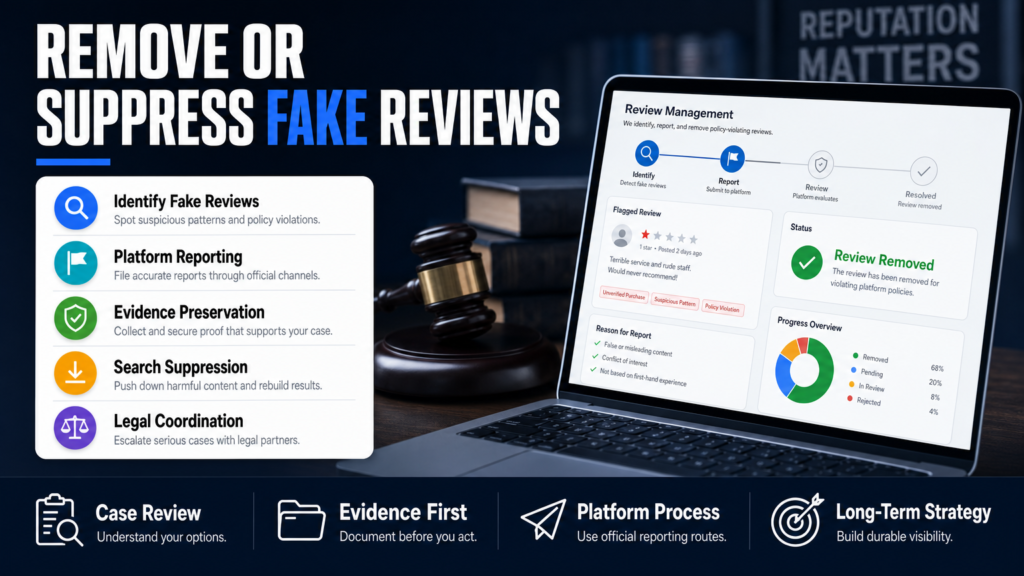
Removing a fake review typically follows three parallel tracks: platform reporting, evidence collection, and escalation (technical, legal, or PR). A website that removes fake reviews will evaluate which tracks apply and pursue the most promising combination.
Start by determining whether the review is a policy violation (e.g., spam, impersonation, hate speech) or a false factual allegation that may be defamatory. We evaluate whether the content may qualify for removal or review, but removal depends on the platform’s rules, the evidence you can provide, and the publisher’s response.
- Step 1 — Preserve evidence: Take screenshots, save review URLs, note reviewer profile and IP-related information if available in platform logs.
- Step 2 — Report through the platform: Use the official dispute/report function and attach documentary evidence when the platform allows it.
- Step 3 — Request escalation: If the platform response is insufficient, request a manual review or use an escalation process offered by the platform.
- Step 4 — Assess legal options: If the review contains false statements of fact or identifiable libel, consult a qualified attorney about possible next steps.
- Step 5 — Monitor results and prepare mitigation: Track the status and begin mitigation (SEO, corrected content, and PR) while the dispute progresses.
- Immediate: Document the review (screenshot, URL, date/time, reviewer profile).
- Short-term: Use platform reporting paths (Google, Yelp, Facebook, industry sites).
- Medium-term: Deploy reputation SEO and alternate authoritative content to reduce visibility.
- When warranted: Coordinate with counsel for cease-and-desist letters or litigation options.
Where to start now
If you need a checklist right away: 1) screenshot the listing, 2) note the business page URL and reviewer handle, 3) export any email notifications, and 4) gather any records that contradict the reviewer’s claim.
For a deeper primer on identifying which reviews are likely fake and how to prioritize takedown requests, see Identifying and Removing Fake Reviews to Protect Your Business Integrity.
Is there a way to remove fake Google reviews?
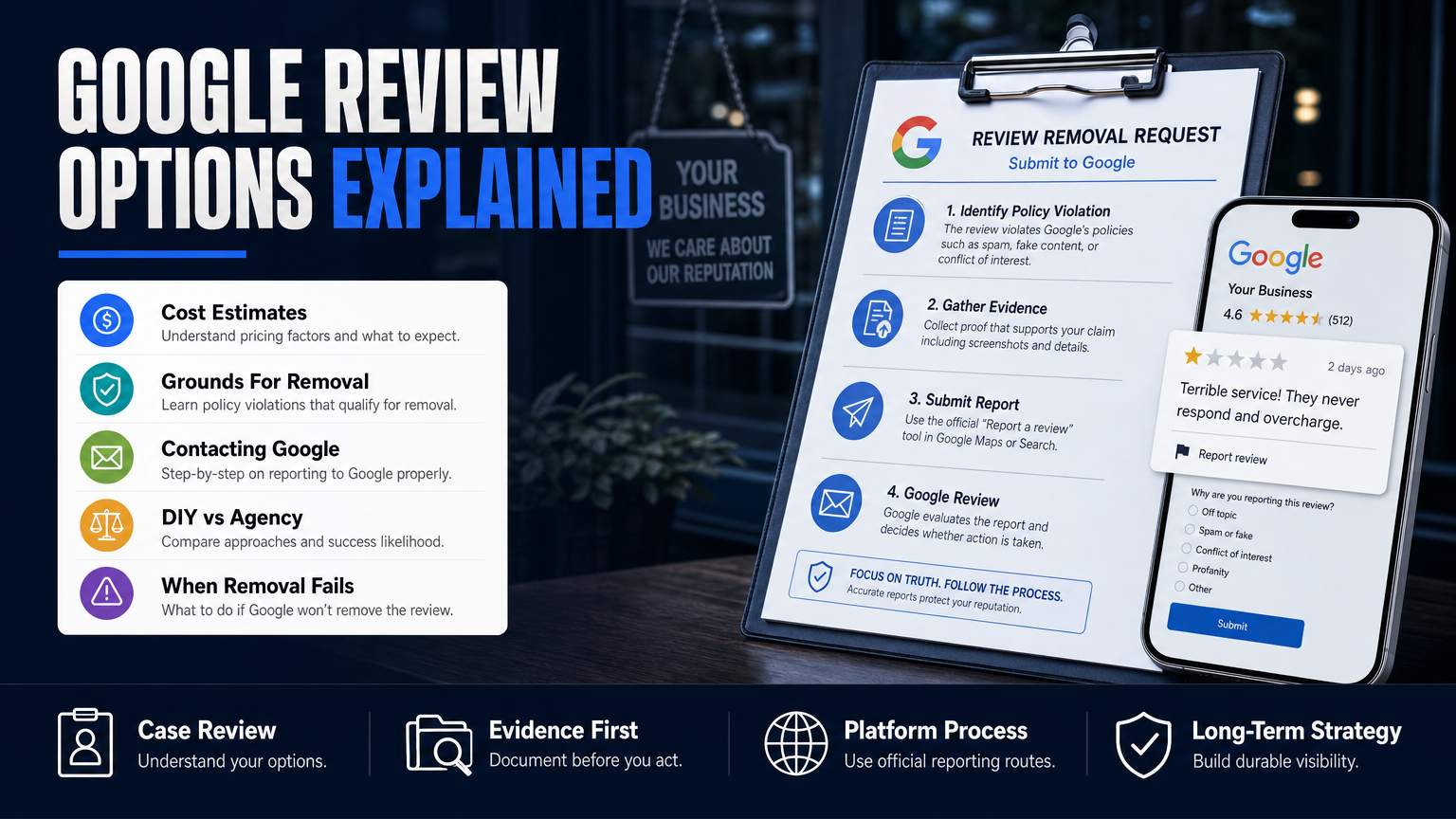
Google has a formal process for flagging reviews that violate its policies (spam, impersonation, off-topic content, conflict of interest). There is a path to removal, but platform decisions remain under the platform’s control and outcomes vary.
A website that removes fake reviews will use Google’s Business Profile dispute flows, submit documentation where allowed, and, when necessary, escalate with legal notices or additional evidence. Timing depends on Google’s review queue, the strength of evidence, and whether the review clearly matches a policy violation.
- Step 1 — Flag the review in Google Maps or Google Business Profile.
- Step 2 — If available, use the “Request Review” option in your Google Business Profile and attach facts (appointment logs, transaction records) if Google asks.
- Step 3 — If the flag is denied, escalate using Google Business Profile support or a legal escalation if the content is demonstrably false or defamatory.
- Step 4 — Simultaneously start mitigation: publish factual content, solicit verified positive reviews, and use SEO tactics to push negative content lower.
- Google will remove reviews that are outright spam or violate content policies.
- Google rarely removes reviews simply because they are negative or because a business dislikes them.
- You can request review removal via Google Business Profile (formerly Google My Business) or the support line; provide evidence when available.
When to involve counsel or outside providers
If a review makes a provably false factual claim that threatens licensure, or contains private health information or other protected data, the content may warrant legal review. A qualified attorney can determine whether a legal claim may be available.
Legal notices can persuade Google to re-review content in some cases, but there is no universal outcome and no automatic right to removal in the United States.
Social platforms and other review sites (Facebook, Yelp, Amazon, industry directories)
Different platforms have different rules and tools. Facebook and Yelp respond to different indicators; Amazon has anti-fraud enforcement for product reviews; industry directories often have their own support teams and verification requirements.
For Facebook-specific steps, see Remove Fake Facebook Reviews: 5 Steps to Remove Defamatory Reviews from Facebook.
- Step 1 — Identify the platform policy that the review violates.
- Step 2 — Use the platform’s reporting UI and include concise evidence.
- Step 3 — If the platform allows, request a human review or provide transaction logs to show the reviewer never interacted with your business.
- Step 4 — If removal is denied, begin mitigation: SEO, content correction, and targeted outreach to customers for verified reviews.
- Facebook: report via the business page’s review management tools and use Page support for escalation.
- Yelp: use the Yelp for Business Owners support form; Yelp has an internal review team that will remove reviews violating policy.
- Amazon: use the ‘Report abuse’ link on product reviews and escalate to Seller Support with purchase records where relevant.
- Industry sites: follow the site’s dispute process and prepare formal evidence of a false claim.
Industry-specific sites (medical boards, legal directories, TripAdvisor)
Sites with professional directories or licensing may have additional obligations or public-interest exceptions. Claims that implicate public health or safety can be harder to remove if they reflect a legitimate complaint.
Coordinate with legal counsel or a reputational specialist when complaints threaten licensure; the content may warrant different handling than consumer-review spam.
Can you go to jail for fake reviews?
Short answer: It’s unlikely for most individual fake-review incidents, but criminal exposure exists in narrow circumstances. Laws vary by state and case facts matter.
Criminal charges related to fake reviews are usually reserved for cases involving coordinated fraud, identity theft, extortion, or where fake reviews are tied to broader criminal schemes. Civil remedies (defamation claims, business torts) are far more common.
- Step 1 — Preserve evidence of the fake review and any related financial transactions or communications.
- Step 2 — If you suspect a criminal scheme, report to local law enforcement and federal consumer-protection agencies (FTS, state attorney general) and provide collected evidence.
- Step 3 — Consult an attorney to evaluate whether civil action (defamation, business interference) is more appropriate than criminal referral.
- Criminal liability may attach if the fake reviews are part of a scheme to defraud consumers, involve false statements made under oath, or involve identity theft.
- Several jurisdictions have prosecuted companies or organized networks that sold fake reviews and engaged in broad consumer fraud.
- For individual actors leaving a single fake review, the typical legal risk is civil exposure rather than jail time.
When to report to law enforcement
Report to law enforcement when a fake review is part of an extortion demand (pay to remove), linked to identity theft, or tied to a larger fraud network. Law enforcement resources vary and may prioritize large-scale schemes over individual disputes.
We coordinate with qualified legal professionals when a matter requires legal analysis or criminal referral.
Which company is the best for removing negative reviews?
No single agency is objectively the “best” in every case. Choose a provider by matching their documented processes to your problem: platform expertise, legal coordination capability, evidence-handling, and crisis PR. Your Reputation Agency focuses on US professionals and coordinates takedowns, SEO suppression, legal escalation, and PR — but we never guarantee removal.
When evaluating vendors, look for case-appropriate experience (healthcare, law, hospitality), transparent pricing, documented escalation paths, and clear communication about realistic outcomes.
- Step 1 — Request a written scope and sample process for accounts similar to yours.
- Step 2 — Validate their escalation paths: which platforms they handle in-house versus via partners, and whether they coordinate with licensed counsel.
- Step 3 — Ask for references (industry-appropriate) and confirm they don’t use deceptive or fake-review buying practices.
- Step 4 — Choose a provider that offers monitoring and a remediation plan if removal is denied.
- Criteria to compare: platform experience, legal coordination, SEO suppression skill, monitoring and SLA for incident response.
- Beware vendors that promise guaranteed removal or permanent suppression — platform decisions and search algorithms remain outside any vendor’s control.
- Ask for a written process that explains escalation steps, timelines as estimates, and how evidence is handled.
DIY vs. agency: a short comparison
Small, one-off issues can often be handled internally. Persistent campaigns, high-stakes threats to revenue or licensure, or cross-platform attacks typically justify an agency with legal and PR coordination.
A useful two-column comparison of DIY vs. agency follows below to help you decide.
When removal is not available: suppression, correction, and PR
Sometimes platforms decline to remove content because it is an opinion, a truthful complaint, or a public record. When removal is unavailable, the practical response is mitigation: SEO suppression, factual corrections, context, and a proactive communications plan.
Mitigation is not a guarantee of permanent invisibility. We develop SEO reputation strategies intended to improve the visibility of relevant and credible information and to push harmful results lower on search pages.
- Step 1 — Map the search results that matter (first two pages) and identify targets for suppression.
- Step 2 — Create or optimize authoritative pages (staff bios, press releases, case studies) to compete for those keywords.
- Step 3 — Build a steady pipeline of verified positive content and reviews to dilute the impact of negative entries.
- Step 4 — If the issue originated or spread on Reddit or other forums, use targeted engagement, corrective posts, and platform reporting as appropriate; see When a Reddit Thread Becomes a Professional Crisis for tactics on Reddit-specific incidents.
- Tactics include publishing authoritative pages, getting coverage on local press, creating positive review momentum, and technical SEO.
- Correct false factual claims with public statements or FAQs when appropriate; never use deceptive takedowns or fake reviews.
- Use monitoring and alerting to detect new attacks early and respond before they amplify.
When to choose suppression over legal escalation
Choose suppression when the content is an opinion or truthful complaint, when legal remedies are unlikely or cost-prohibitive, or when a low-cost SEO approach can materially reduce visibility faster than litigation.
Coordinate PR messaging and factual corrections to rebuild trust with clients while suppression takes effect.
How to spot fake reviews and preserve evidence
Spotting fake reviews saves time and strengthens takedown requests. Common signals include no purchase history, generic language, rapid clusters of reviews, reviewer handles created the same day, and reviewer activity limited to a single competitor.
Preserving evidence properly is essential if you later escalate to platform support or counsel.
- Step 1 — Capture a timestamped screenshot and export the business page URL.
- Step 2 — Pull internal records that disprove the reviewer’s factual claims (appointment logs, invoices).
- Step 3 — Preserve metadata when possible and note any suspicious communications that accompanied the review.
- Step 4 — Log subsequent interactions and keep a chain of custody for documents if legal action may follow.
- Red flags: identical phrasing, reviewer profiles with zero friends or activity, reviews posted in unnatural patterns (time/date clusters).
- Hard evidence: screenshots, saved URLs, transaction records, CCTV or appointment logs that contradict the reviewer.
- Soft evidence: patterns across multiple platforms, third-party reports, and internal logs showing no record of service.
Using platform analytics and owner tools
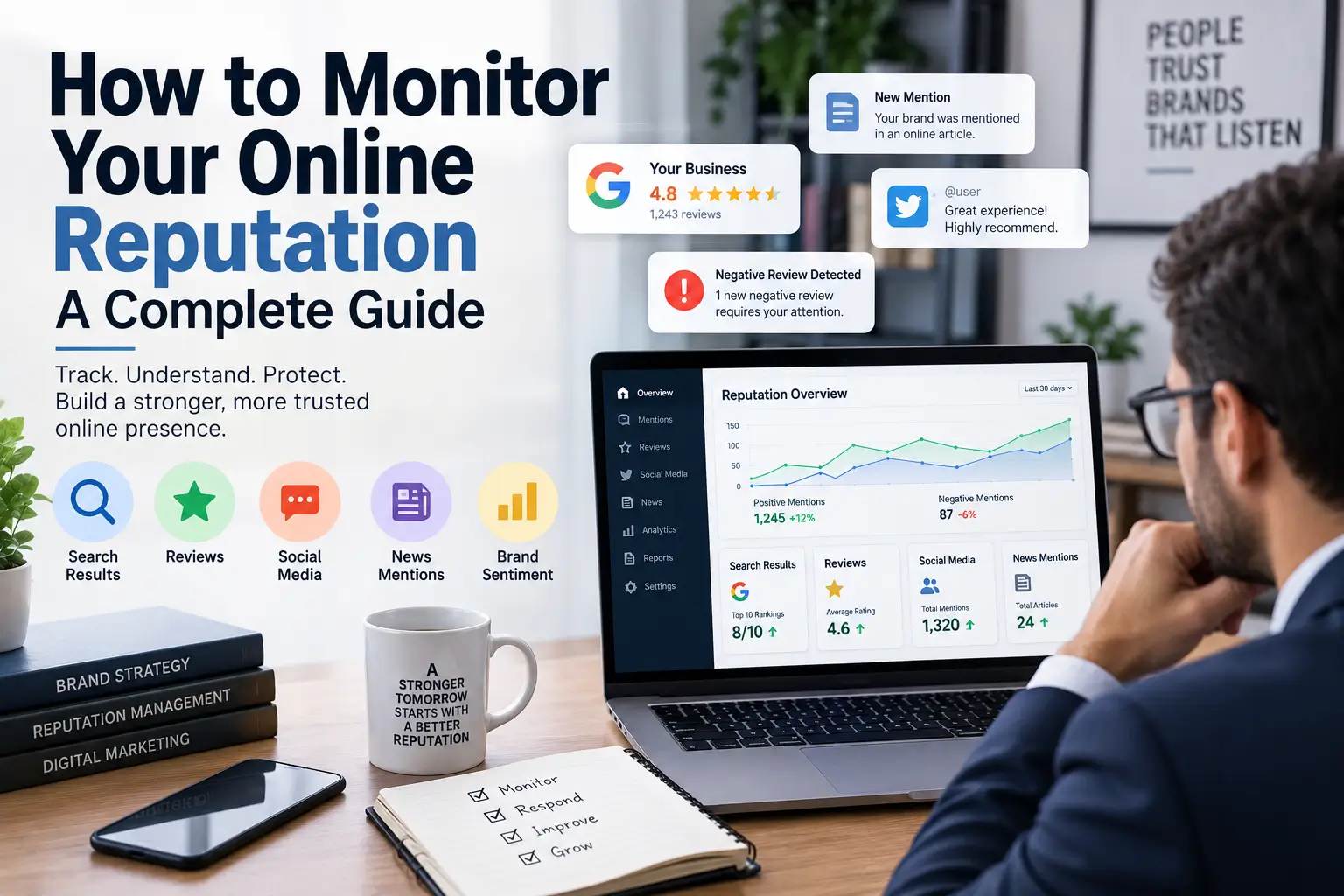
Owner tools often show limited reviewer metadata, but third-party analytics and review-monitoring services can reveal patterns across platforms. Use monitoring to catch campaigns early and prevent escalation.
Ongoing monitoring and alerting of reputation signals helps you respond promptly to new fake-review waves.
Rebuilding trust after a review attack: SEO, PR, and ongoing monitoring
Removal is rarely the whole answer. Even when a fake review is removed, screenshots and copies can persist elsewhere. Rebuilding trust requires coordinated PR messaging, improved customer-facing processes, and a search-engine plan to favor accurate, positive information.
We apply a mix of technical SEO, content creation, verified review solicitation, local listings optimization, and proactive communications to restore standing with clients and referral sources.
- Step 1 — Prepare a concise public response template that acknowledges concerns, offers offline resolution, and avoids legal admissions.
- Step 2 — Clean up listing data across directories (consistent NAP) and push accurate, positive content.
- Step 3 — Launch a verified-review campaign (email + in-office prompts) to replace noise with credible experiences.
- Step 4 — Maintain ongoing monitoring and a quarterly audit of branded search results.
- Publish an FAQ or response that addresses legitimate concerns without amplifying baseless claims.
- Solicit verified reviews from satisfied clients and make it easy for them to leave feedback.
- Use press releases or local coverage to create high-authority pages around your practice or product.
- Set up monitoring and alerts to detect regressions and respond quicker next time.
Measuring progress and setting expectations
Search visibility changes over weeks to months depending on domain authority and the competitive landscape. We develop SEO reputation strategies intended to improve the visibility of relevant and credible information, but search algorithms, competitors, and publishers remain outside our control.
An estimated timeline can be provided after an individual assessment; some cases may begin to show change within weeks while others take months.
DIY vs. Agency: Quick Comparison
Choose based on scale, urgency, and the platforms involved.
| DIY | Agency |
|---|---|
| Cost | Higher upfront; managed service |
| Speed for complex cases | Faster escalation and multi‑channel coordination |
| Platform escalation expertise | Dedicated contacts and process knowledge |
| Legal coordination | Often includes counsel coordination |
| SEO suppression | Professional content & link strategies |
| Best for | Single reviews and small disputes |
| Scales to | Coordinated campaigns and crises |
Hypothetical: A Clinic Hit by a Fake Reviewer — End-to-End
Scenario: A midsize dermatology clinic finds three one-star reviews in a 48-hour window alleging a missed appointment and poor behavior from staff. Internal records show no such appointments, and reviewer profiles are new. The clinic wants to remove the reviews and limit fallout to bookings.
Actions taken: the clinic preserves evidence, reports to the platforms, escalates where needed, and runs parallel mitigation to rebuild visibility and reassure patients.
- Step 1 — Evidence: screenshots, saved page URLs, appointment logs, staff statements.
- Step 2 — Platform reporting: use each site’s dispute form and provide concise, factual documentation.
- Step 3 — Escalation: if policy removals fail and the review contains false statements of fact, coordinate with counsel to prepare a legal escalation.
- Step 4 — Mitigation: publish accurate content, solicit verified reviews, and run a targeted PR message to local referrers.
- Day 0: Capture screenshots, export business URLs, and collect appointment logs showing no matches.
- Day 1–3: Flag reviews on Google, Yelp, and Facebook; attach evidence where possible and request human review.
- Day 4–14: If platforms decline, agency escalates with counsel to send a formal notice where reviews contain provably false factual claims.
- Week 2–8: Launch SEO suppression via new staff bios, local press stories, and targeted Google Ads on branded terms while soliciting verified patient reviews.
- Ongoing: Monitor for copycat posts and set alerts; refine processes to verify appointments and follow up proactively.
Common Mistakes Organizations Make
Avoid these frequent errors — each one slows down resolution and can make negative content stickier.
Retaliating publicly
Posting angry replies, threatening reviewers publicly, or implying you’ll sue usually escalates attention and creates new content that platforms or search engines index. A calm, professional response or an offer to take the conversation offline is usually better.
Relying solely on platform flags
Flagging is necessary but often insufficient. Platforms receive massive volumes of reports; supplement flags with preserved evidence, follow-up escalations, and mitigation strategies.
Buying fake positive reviews
Buying reviews is unethical, violates platform policies, and can lead to penalties or further visibility problems. Never recommend or use deceptive tactics to bury negative content.
Waiting too long to document
Delays lose evidence. Screenshots disappear, profiles change, and internal logs may be purged. Preserve everything immediately.
Treating all reviews the same
A hostile but truthful complaint needs a different response than a fabricated spam review. Distinguish opinion from false factual allegations before deciding escalation paths.
Best Practices to Reduce Risk and Recover Faster
Adopt durable processes that minimize the chance of harm and make effective remediation easier when incidents occur.
Document everything immediately
Create a simple incident checklist for staff: screenshot, URL, reviewer handle, internal records, and a timeline of events. Keep a secure folder for these materials and assign ownership.
Use the platform’s official routes first
Report through the platform’s UI and include supporting evidence. Platforms will often act faster when the complaint matches policy language and is accompanied by proof.
Combine removal attempts with suppression
Even when pursuing takedowns, start suppression and PR immediately. Publish accurate pages, get local press, and build verified review momentum to reduce the impact of remaining negative entries.
Coordinate with counsel when needed
When reviews contain false statements of fact that materially harm the business, legal review is appropriate. A qualified attorney can advise on the viability of civil claims and criminal referrals.
Monitor continuously
Set up alerts for new reviews and branded search changes. Rapid detection reduces spread and helps you respond before damage compounds.
Expert Tips
- Preserve a timestamped screenshot before interacting with the review — responses change the page and sometimes remove metadata.
- Always respond with an offer to take the conversation offline; public, calm replies help readers and reduce escalation.
- If you suspect a competitor is behind reviews, document connections and patterns before alleging anything publicly.
- Use targeted, high-authority content (local press, professional directories) to outrank persistent negative pages.
- Avoid asking for bulk reviews in a way that violates platform rules; encourage satisfied clients to leave verified feedback naturally.
- Keep a log of all platform support interactions — ticket numbers, timestamps, and agent names where possible.
- When a platform denies removal, ask for the written rationale and preserve that as part of your evidence chain.
- Treat each platform differently — what succeeds on Yelp may fail on Amazon or a specialized industry directory.
Conclusion
A website that removes fake reviews can be a useful partner, but removal is one tool among many. Effective remediation combines timely evidence collection, platform reporting, escalation when warranted, SEO suppression, and a communications plan to restore trust.
Decide your approach by the stakes involved: small single incidents can often be handled internally; coordinated attacks, threats to licensure, or cases involving identifiable false statements usually need professional coordination and legal review. Prepare to act fast, document thoroughly, and use a layered strategy rather than expecting a single fix.
Why Businesses Choose Your Reputation Agency
Managing your reputation takes more than monitoring reviews or publishing the occasional blog post. It takes a strategy built around your situation, your industry, and what is actually showing up in search.
Your Reputation Agency works with businesses, executives, healthcare professionals, attorneys and growing brands. Our services include:
- Remove defamatory content and false posts (news, blogs, listings)
- Remove or challenge negative reviews (Google, Yelp, TripAdvisor, industry sites)
- Mugshot and arrest record removal
- Remove videos, images, and other multimedia that damage reputation
- Remove personal data from people‑search and data‑broker sites (opt‑outs)
- Search result suppression (SEO to bury negative links)
- Social media takedowns and impersonation removal
- Rapid online crisis management and incident response
- Ongoing monitoring and alerting of reputation signals
- Coordination with legal counsel and use of legal tactics when required
Frequently Asked Questions
1. How to get fake reviews removed?
Start by preserving evidence (screenshots, URLs, internal records), then report via the platform’s official dispute or flagging tools. If the platform declines removal and the review contains provable false statements, consider escalation with a qualified attorney and begin mitigation (SEO and PR) while disputes proceed.
2. Is there a way to remove fake Google reviews?
Yes — Google provides flagging and Business Profile dispute flows for spam, impersonation, and policy violations. Outcomes depend on the evidence and whether the content violates Google’s policies; platform decisions remain under Google’s control and timing varies.
3. Can you go to jail for fake reviews?
Criminal prosecution for fake reviews is rare and typically limited to organized fraud, extortion, identity theft, or schemes that cross criminal thresholds. Most disputes result in civil claims or platform enforcement rather than criminal charges.
4. Which company is the best for removing negative reviews?
There is no universally best company. Choose a vendor that matches your industry experience, platform expertise, legal coordination capability, and transparency about realistic outcomes. Avoid anyone promising guaranteed removal.
5. What should I do if a platform refuses to remove a fake review?
When removal is denied, shift focus to mitigation: collect more evidence, consider legal options if the review contains false factual claims, publish authoritative content to suppress the result, and run a verified-review campaign to dilute the impact.
6. How long does removal or suppression take?
Timing varies by platform and the complexity of the case. Some platform flags are resolved in days; escalations and SEO suppression can take weeks to months. No universal timeline applies; an estimated timeline can be provided after an individual assessment.
7. Can a website delete fake reviews from all platforms?
No vendor can unilaterally delete content across all platforms. Reputable providers combine platform reporting, counsel coordination, and remediation strategies. Platform decisions and search algorithms are outside any vendor’s control.
8. How do I prove a review is fake?
Look for patterns (identical text, account age, activity patterns), and gather hard evidence like absence of transaction records or appointment logs. Preserve a clear chain of evidence and document platform responses to support escalations.
9. Is paying for removal ever necessary?
Platforms do not charge for removal. Paid services are for professional remediation (agency work, legal support, or SEO). Avoid paying third parties who promise to fabricate removals or buy fake positive reviews; those tactics violate platform policies and create further risk.
This content provides general information and does not constitute legal advice. The available options and likely outcomes depend on the facts, evidence, platform policies, applicable law, jurisdiction, and public-interest considerations.
Past examples do not guarantee future results. Removal, correction, deindexing, and search-position changes depend on third parties and circumstances outside Your Reputation Agency’s control.