Why a TikTok apology video can worsen a crisis
A TikTok apology video crisis often grows when the response centers the creator, minimizes harm, blames the audience, or introduces new contradictions. Short-form video also encourages clips and reaction content that can outlive the original post.
Seven response principles
- Verify the facts and affected groups before recording.
- State clearly what happened without euphemisms.
- Acknowledge specific impact rather than demanding forgiveness.
- Avoid excuses, legal speculation, or attacking critics.
- Explain concrete corrective action and who owns it.
- Use the right channel; video is not always the best format.
- Provide follow-up evidence after promised changes occur.
A credible apology is part of operational repair, not a substitute for it. Monitor questions and misinformation, but do not flood feeds with repeated defensive responses.
You just found a damaging post, mugshot, or viral video making the rounds and your phone won’t stop buzzing. For celebrities and other public figures, small incidents amplify quickly; what was once a single thread can become the top search result for your name.
This article explains realistic options and tradeoffs when hiring celebrity reputation management services: what removal might require, when search‑engine suppression is the practical path, how PR and legal options fit together, and what to expect for cost and timing.
We’ll answer the specific questions public figures ask most — how much these services typically cost, how to contact other celebrities or their teams safely, whether established companies like Reputation are appropriate partners, and what a celebrity PR team actually does.
Read on for step‑by‑step actions you can start today, a comparison to help choose a path, and a hypothetical end‑to‑end scenario that shows how decisions play out in the real world.
Table of Contents
- How Much Do Celebrity Reputation Management Services Cost?
- How Can You Contact a Celebrity Safely During a Crisis?
- Is ‘Reputation’ A Good Company For Public Figures?
- What Does a Celebrity PR Team Do?
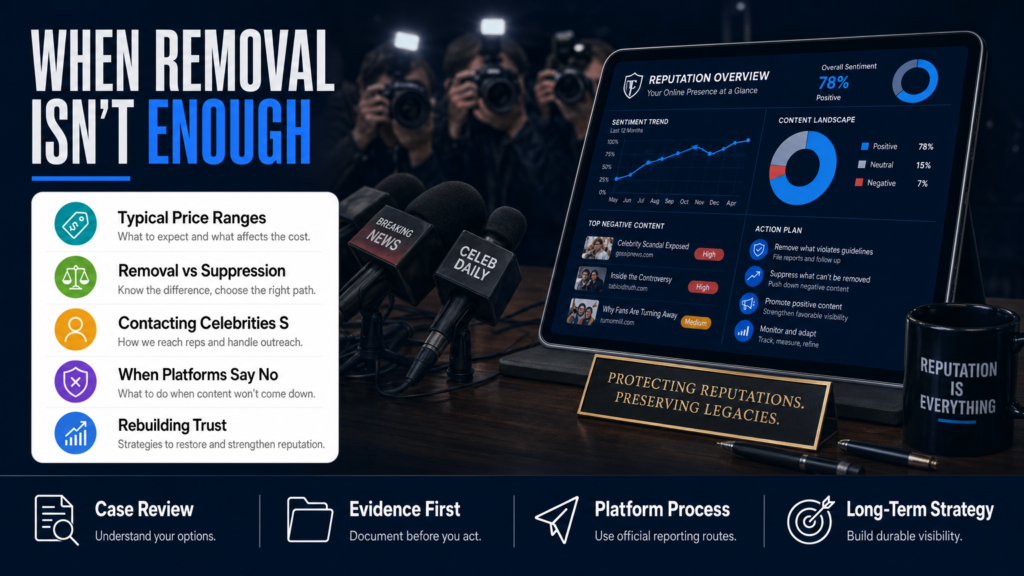
- When Removal Is Not Available: What To Do Instead
- Removal vs Suppression: Which Path Should You Choose?
- Monitoring, Security, and Long‑Term Reputation Rebuilding
- How Reputation Management Services Handle Reviews and Former Employees
- Removal vs Suppression: Quick Comparison
- Hypothetical: The Actor, The Viral Video, And The Two‑Track Response
- Common Mistakes Celebrities Make During Digital Crises
- Best Practices For Celebrity Reputation Work
- Expert Tips
- Conclusion
- Why Businesses Choose Your Reputation Agency
- Frequently Asked Questions
How Much Do Celebrity Reputation Management Services Cost?
Price is almost always the first practical question. Celebrity reputation management services range widely because work scope differs: emergency takedowns, complex legal work, sustained search‑engine suppression, and ongoing PR all carry different price profiles.
We evaluate whether the content may qualify for removal or review and then scope the recommended mix of takedown requests, SEO suppression, legal coordination, and PR. Below are common price bands and what they typically buy.
- 1) Get a free assessment to identify whether content is defamatory, private data, impersonation, or an opinion; this determines likely tactics.
- 2) Request a scoped estimate that distinguishes platform work, legal work (if any), and ongoing SEO/PR retainers.
- 3) Ask for a proposed timeline range and milestones but understand no vendor can promise fixed results or guaranteed removal.
- Emergency incident response (one‑time): $3,000–$15,000 — rapid platform escalations, targeted takedown requests, immediate monitoring. Timing depends on platform responsiveness and evidence.
- Takedown‑focused campaigns: $5,000–$25,000+ — persistent publisher outreach, legal notice drafting (coordination costs), DMCA and privacy opt‑outs; removal depends on content type, publisher willingness, and jurisdiction.
- Search suppression/SEO programs: $2,500–$15,000/month — creation of authoritative pages, link‑building, content optimization to bury negative links. Results vary by authority of negative content.
- Ongoing reputation retainer: $2,000–$10,000+/month — monitoring, social takedowns, PR coordination, rapid incident triage, and monthly reporting.
- Full crisis program with PR/legal coordination: $15,000–$100,000+ depending on media buy, legal complexity, and scale of outreach.
How to Budget for Uncertainty
Plan for a three‑phase spend: immediate containment (week 0–2), legal or publisher escalation (weeks 2–8), and reputation rebuilding/suppression (months 2–12). Each phase may be stopped or scaled depending on results.
Document the business impact you’re trying to prevent (lost deals, licensure risk, bookings cancelled) — that makes it easier to justify higher upfront spends when speed matters.
- Emergency containment budget for 72 hours: reserve funds for paid platform escalations and PR placements.
- Separate legal spend: coordinate with counsel rather than assuming the reputation firm will cover legal fees.
How Can You Contact a Celebrity Safely During a Crisis?
‘How do I get in contact with any celebrity?’ is a two‑part problem: finding the correct channel, and doing so in a way that protects you legally and reputationally. Cold DMs or public tagging rarely work and can make matters worse.
If you are a public figure trying to contact another public figure (for example, to request a correction, clarification, or joint statement), use official channels: talent agent, publicist, manager, or the legal representative listed on filings or official websites.
- 1) Identify the correct representative (publicist, manager, talent agency).
- 2) Draft a short, factual outreach explaining the issue and the remedy you seek (takenown, correction, joint statement).
- 3) Offer a secure channel for follow‑up (secured email or via counsel) and avoid public pressure tactics that invite escalation.
- Search public filings, official websites, IMDBPro, and professional directories for agent/manager contact details.
- If contact info isn’t public, approach the celebrity’s representation via email rather than social media DMs — keep the message factual, concise, and non‑accusatory.
- When a crisis involves alleged wrongdoing, coordinate with counsel before contacting the other party to avoid creating evidence problems or admissions.
When You’re a Brand Reaching a Celebrity
If you’re a brand or business seeking a celebrity partner post‑crisis, work through their booking agency or manager. Proposals should be professional, time‑bound, and routed through the business contacts listed on official pages.
Cold social outreach for partnerships is common but low‑yield; a tracked professional approach via email or phone is preferable.
- Include one‑page terms and clear deliverables.
- Be ready to demonstrate brand safety measures and crisis response plans.
Is ‘Reputation’ A Good Company For Public Figures?
If you mean the firm Reputation (often stylized with a capital R), they are one of several large, enterprise‑focused reputation platforms that offer review management, monitoring, and some remediation tools. Whether they are the right fit depends on your needs.
Public figures and celebrities looking at firms should compare capability sets: do you need enterprise review response and presence management, or fast legal takedowns and PR coordination? The two are different services and different vendors excel at each.
- 1) Match the firm’s documented services to your problem (reviews vs defamation vs doxxing).
- 2) Request references or anonymized examples of similar engagements.
- 3) Ensure the contract clearly separates monitoring, technical takedowns, legal coordination, and PR deliverables.
- Reputation is well‑known for review monitoring and customer experience platforms; for complex takedowns and legal escalation, boutique reputation firms or specialized agencies may be a better match.
- Look for case experience with high‑profile clients, privacy opt‑outs, multimedia removals, and media relations — these are the capabilities most celebrities need.
What To Ask Any Large Reputation Platform
Ask whether they coordinate with outside counsel, whether they have rapid escalation channels with major platforms, and whether their teams include former journalists, platform‑policy specialists, and SEO experts.
Check that they will give you a written scope of work describing what is and is not included and that they do not imply guaranteed removals or fixed timelines.
- Request a sample incident response plan.
- Confirm data security and confidentiality controls spelled out in the agreement.
What Does a Celebrity PR Team Do?
A celebrity PR team manages messaging, media outreach, and public positioning. In a reputation crisis they help craft statements, arrange interviews, and work with legal counsel to coordinate timing and content.
PR is not the same as legal action or platform takedowns; instead it mitigates reputational harm by controlling the narrative and restoring trust with journalists, fans, and commercial partners.
- 1) PR and counsel agree on a messaging framework and any public statement.
- 2) PR schedules controlled interviews and prepares the talent with media training.
- 3) Post‑incident, PR runs reputation rebuilding campaigns (humanitarian work, positive coverage, authored articles).
- Message drafting and approval workflows with legal review.
- Targeted media outreach and embargoed briefings for select reporters.
- Social media strategy: whether to respond, apologize, or stay silent; production of controlled content (video statements, Q&A documents).
- Coordination with talent agencies, managers, and corporate partners to manage contractual fallout.
When PR Should Defer to Legal
If allegations involve potential criminal conduct, ongoing litigation, or significant contractual disputes, PR should follow legal counsel’s lead to avoid obstructing discovery or creating admissions.
Always coordinate statements with a lawyer in those circumstances; PR’s role becomes message control inside legal boundaries.
- Get counsel approval for any public apology that might be construed as admitting liability.
- Use narrow, verifiable facts in early statements rather than broad defenses.
When Removal Is Not Available: What To Do Instead
Platforms and publishers will not always remove content. Private sites, credible news reports, and court records are examples that are difficult or impossible to remove entirely. In those cases we pursue mitigation, correction, and visibility strategies.
We pursue the legal, technical, platform‑based, and reputational options available, and when removal is unavailable, we recommend mitigation steps that reduce visibility and contextualize the record.
- 1) Assess whether content is fact, opinion, private data, or public record.
- 2) Pursue corrections or retractions with publishers when there are provable errors.
- 3) Launch a suppression campaign: create high‑authority pages (official site, major interviews, profiles) and optimize them to outrank the harmful content.
- 4) Combine SEO with public relations placements to accelerate visibility shifts.
- File corrections or right‑of‑reply requests with the publisher when the content is factually inaccurate.
- Use SEO and content creation to push harmful links off the first page of Google.
- Obtain court judgments or sealed records where applicable (only through legal process).
- Strengthen verified social profiles, publish authoritative bios, and secure profiles on IMDB, Wikipedia (with neutral sourcing), and major outlets to occupy search real estate.
Tactics That Help When You Can’t Remove Content
Suppression is not guaranteed; search results may change because algorithms, competitors, publishers, and user behavior are outside our control. Still, structured content and authoritative placements commonly reduce the visibility of offending results.
We develop SEO reputation strategies intended to improve the visibility of relevant and credible information about the client, while continuing to evaluate new removal avenues.
- Create or refresh an official domain and biography pages.
- Secure and verify social accounts (Twitter/X Blue, Instagram verified, YouTube channel) to occupy top slots.
- Place long‑form interviews on high‑authority sites to outrank negative content.
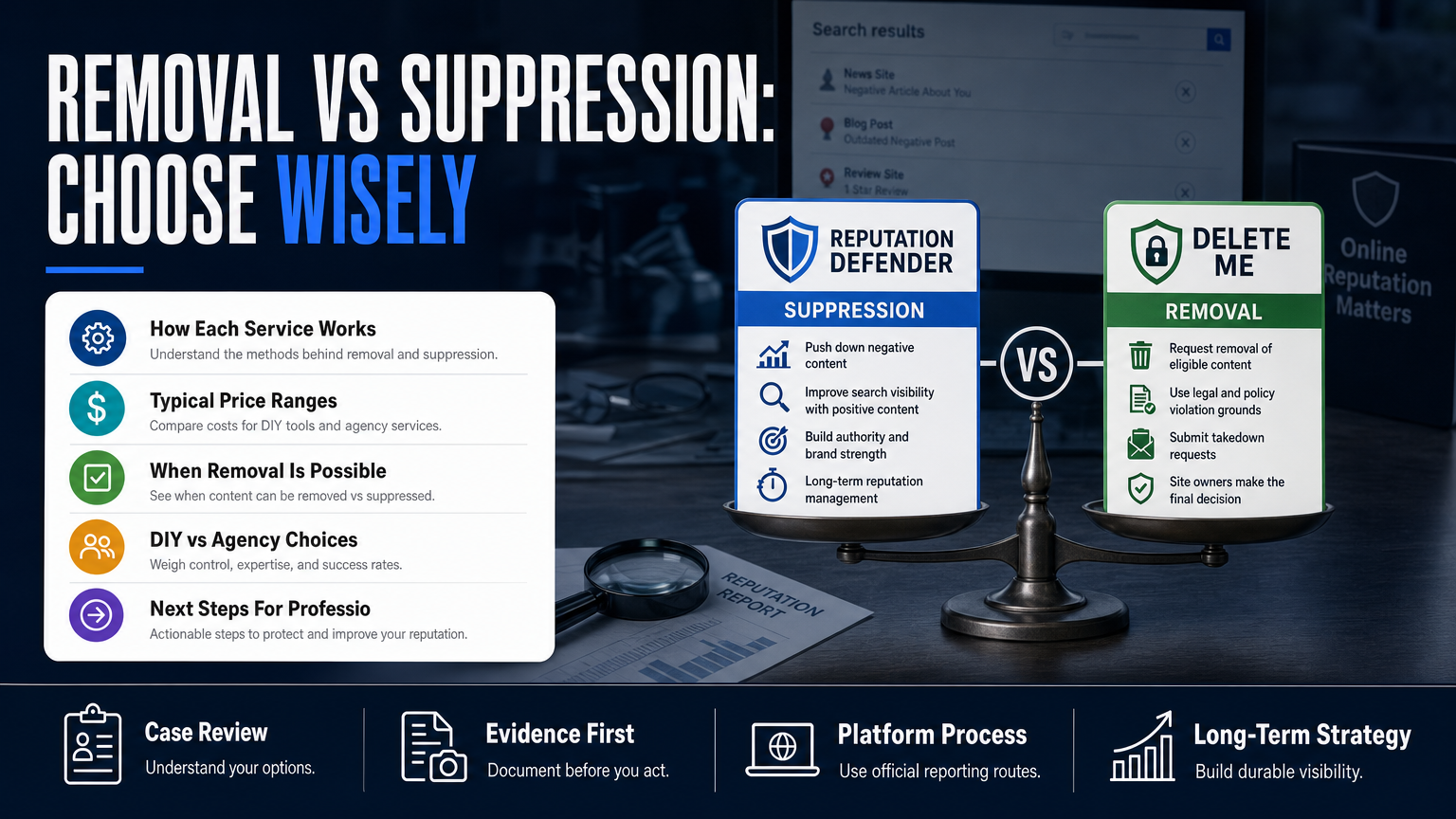
Removal vs Suppression: Which Path Should You Choose?
Removal and suppression are complementary but distinct approaches. Removal tries to delete or block content; suppression accepts the content may remain and focuses on burying it in search and controlling the narrative.
Choice depends on content type, publishing platform, legal leverage, and how damaging the content is to your commercial or personal life.
- 1) Triage content by type and platform.
- 2) Attempt platform reports and publisher outreach for removals where policy or law supports removal.
- 3) Simultaneously begin suppression campaigns for content that remains live.
- Removal is preferable for private data leaks, impersonation, clear defamation, or content violating platform policy.
- Suppression is often the realistic option for accurate news reports, public records, or widely mirrored content.
- Most effective programs use a mix: seek removal where defensible, suppress the remainder with authoritative content and PR.
A Practical Decision Framework
Ask four questions: Is it false? Is it private? Does it violate platform policy? Can legal counsel support a claim? If multiple answers are no, suppression is usually the practical path.
This framework helps prioritize spend and manage expectations with stakeholders like agents, managers, and commercial partners.
- False + private = high removal priority.
- True + public record = suppression priority.
Monitoring, Security, and Long‑Term Reputation Rebuilding
A crisis is rarely a single event. Ongoing monitoring and security hardening reduce the risk of future incidents and provide early warning when new content appears.
Public figures benefit from continuous alerting, social listening, and periodic reputation audits to catch recurring problems before they escalate.
- 1) Implement monitoring across search engines, social platforms, and dark web sources if doxxing is a concern.
- 2) Pair technical containment with PR calendar planning to keep positive content flowing.
- 3) Reassess the suppression strategy every 3–6 months; search landscapes and algorithms shift.
- Set real‑time alerts for name variants, mispellings, and branded keywords across Google, Twitter/X, TikTok, YouTube, forums, and data‑broker sites.
- Harden accounts: enforce 2FA, use enterprise password managers, and audit third‑party app access.
- Schedule quarterly reputation reviews and an annual content inventory for new removal or suppression opportunities.
When to Involve Counsel
The content may warrant legal review if it is demonstrably false and harmful, if private data was exposed, or if impersonation is ongoing. A qualified attorney can determine whether a legal claim may be available.
We coordinate with qualified legal professionals when a matter requires legal analysis and will not provide legal representation ourselves.
- Coordinate takedown requests with counsel to ensure notices are legally accurate.
- Reserve public statements until counsel has reviewed potential legal exposures.
How Reputation Management Services Handle Reviews and Former Employees
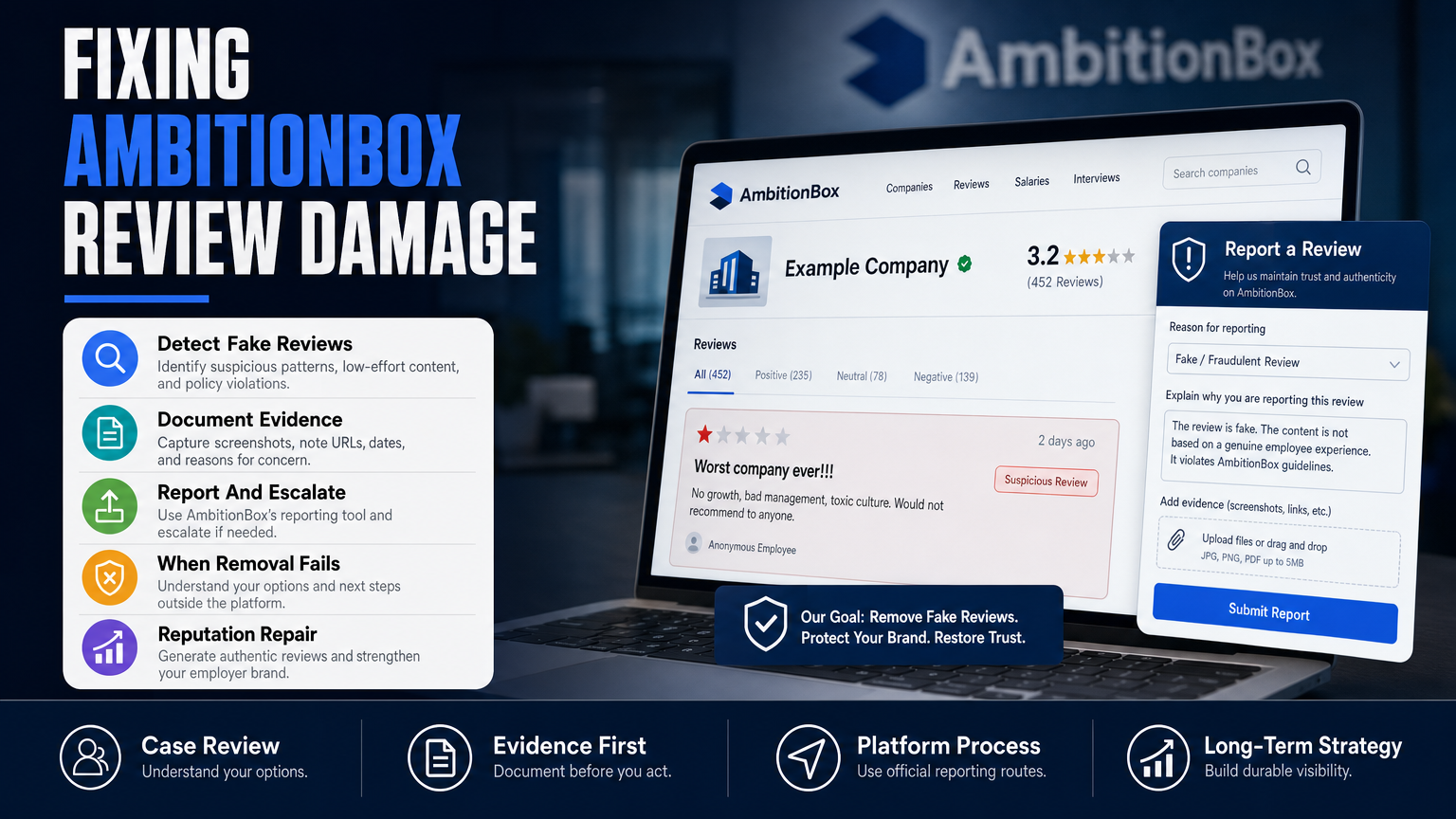
Negative reviews and former‑employee posts are frequent triggers for reputational damage. Handling them requires platform knowledge and, often, coordinated messaging rather than aggressive removal attempts.
If your issue started with reviews or an ex‑employee surfacing damaging claims, read our analysis of review crises and internal departures for more context.
- 1) Document the review or post and gather any evidence that contradicts false statements.
- 2) Use platform dispute mechanisms and prepare a professional response if permitted.
- 3) If removal is not an option, support the brand with positive customer stories and authoritative content.
- Review remediation combines factual responses, dispute filing where policies were violated, and reputation building to dilute negative content.
- Posts from former employees may be opinion or protected speech; determine whether content is false, defamatory, or a policy violation before pursuing removal.
Resources
For more on review crises see When Google Reviews Become a Brand’s Biggest Crisis. For issues that began with an ex‑employee consult When a Former Employee Becomes a Brand’s Biggest Search Result. To understand the priority of search results, read The First Page of Google Is Your Real Homepage.
- Each link gives examples and longer tactics for specific scenarios.
Removal vs Suppression: Quick Comparison
Side‑by‑side tradeoffs to help decide immediate priorities.
| Removal | Suppression |
|---|---|
| Goal | Goal |
| Delete content from the source or platform | Reduce visibility; outrank negative links |
| Best when content is private, violates policy, or is false | Best when content is accurate, public record, or mirrored widely |
| Often needs publisher/platform cooperation or legal action | Uses SEO, content creation, and PR to change search results |
| Can be faster if platform cooperates | Takes months; depends on investment and competitor activity |
| Does not address copies or archives automatically | Does not remove the content; reduces exposure over time |
Hypothetical: The Actor, The Viral Video, And The Two‑Track Response
Scenario: An anonymized mid‑tier actor (we’ll call them ‘A’) is featured in a 90‑second clip posted to TikTok that alleges misconduct. The clip is shared across X, Instagram Reels, and a gossip blog within 24 hours. A’s bookings are threatened and a sponsor pauses a campaign.
Step‑by‑step approach below shows how a combined takedown, legal, PR, and suppression program might proceed. This is illustrative, not a promise of outcome.
- 1) Immediate: Assemble the team — agent, PR lead, counsel, and reputation specialists. Triage claims: is the clip false, edited, or private? Collect original files and witness statements.
- 2) Platform actions: File takedown requests on TikTok, Instagram, YouTube and escalation tickets with platforms using account verification. Request removal for manipulated footage or policy violations.
- 3) Publisher outreach: Contact the gossip blog to request correction or retraction if the clip is misleading; offer verified facts and supporting evidence.
- 4) Legal review: Counsel assesses defamation options and whether a cease‑and‑desist or subpoena is appropriate. Legal notices are sent where justified.
- 5) PR and messaging: Prepare a concise public statement approved by counsel, do targeted interviews with trusted outlets, and publish an in‑depth video on the actor’s verified channels to provide context.
- 6) SEO suppression: Launch authoritative content (long‑form interview, official site bio, philanthropic coverage) and optimize for the actor’s name to push the viral clip lower in search.
- 7) Monitoring and follow‑up: Track results, continue publisher outreach for copies, and reassess suppression strategy every 90 days.
- Day 0–3: Emergency containment and monitoring
- Day 3–14: Publisher outreach, platform reports, legal evaluation
- Week 2–12: PR messaging, interviews with vetted outlets, parallel SEO suppression
- Month 3–12: Ongoing monitoring, new authoritative placements, periodic legal follow‑up
Common Mistakes Celebrities Make During Digital Crises
Avoid these frequent errors — each one tends to make a crisis last longer or become costlier.
Mistake 1 — Reacting Publicly Without Counsel
Immediate, emotional posts or videos can create legal exposure and be used against you. Have a short holding statement and involve counsel before any substantive public response.
- A holding statement provides facts and signals action without admissions.
- Delay detailed comments until legal and PR align.
Mistake 2 — Chasing Deletion Only
Focusing exclusively on getting a post removed wastes time if the content is widely mirrored or a public record. Pair removal attempts with suppression for durable results.
- Simultaneous SEO work prevents a single failure from becoming permanent.
Mistake 3 — Publicly Shaming Platforms or Publishers
Calling out platforms or publishers on social media rarely speeds removal and creates adversarial dynamics that can block cooperation. Use private escalation channels and formal notices when possible.
- Escalate inside official platform appeal systems and provide evidence via secure channels.
Mistake 4 — Ignoring Security and Doxxing Risks
A reputational incident often triggers doxxing attempts. Not hardening accounts and contacts increases the chance of repeat breaches and further damaging leaks.
Apply immediate security measures and treat doxxing as a separate technical and legal risk.
- Enable 2FA, change compromised passwords, and audit third‑party access.
Mistake 5 — Expecting Instant SEO Wins
SEO suppression takes time; expecting lightning results leads to disappointment and misallocated budgets. Plan for months and measure progress with specific KPIs.
- Track ranking changes, referral traffic, and share of search for your name.
Best Practices For Celebrity Reputation Work
Follow these durable practices to reduce risk and respond professionally when incidents occur.
Maintain a Response Playbook
Have a written incident response plan that lists roles (agent, PR, counsel, reputation manager), contact info, and pre‑approved holding language. Practice the plan with quarterly drills.
- Include escalation thresholds tied to commercial risk (sponsor at risk, legal exposure, booking cancellations).
Prioritize Evidence Collection
Preserve original materials: screenshots with timestamps, links to archives, and witness statements. Evidence supports takedowns and any legal claims.
Use secure channels to collect and store evidence and avoid posting it publicly.
- Document when and where the content first appeared and any downstream mirrors.
Create Authoritative, Search‑Ready Content
Build or refresh your official website, secure verified social profiles, and publish long‑form interviews on reputable outlets. These authoritative assets help suppression campaigns.
Ensure all content is optimized for your common name variants and controlled biographical details.
- Use structured data (schema) on your official site to help search engines understand the authoritative profile.
Coordinate PR, Legal, And Technical Work
Siloed responses fail. Ensure PR messaging is reviewed by counsel and technical takedowns or platform requests are logged and tracked.
Use project management tools and weekly status calls during active incidents.
- Assign a single point of contact for media and one for legal to reduce mixed messages.
Invest in Ongoing Monitoring
Set up continuous alerts for your name, common misspellings, branded keywords, and any known aliases to detect issues early and act quickly.
Monitoring should cover Google, YouTube, TikTok, X, Reddit, data‑broker sites, and niche industry forums.
- Review monitoring output daily in the first two weeks of a crisis, then weekly as things stabilize.
Expert Tips
- Keep a short, calm holding statement ready to post within the first hour of a crisis.
- Treat takedown and suppression as parallel tracks; start suppression immediately after triage.
- Verify and secure all accounts before running a public statement to prevent hijacked posts.
- Document everything: timestamps, URLs, screenshots, and communications with publishers or platforms.
- Use earned media (interviews, profiles) to create high‑quality pages that search engines favor.
- Ask your rep to collect sponsor concerns early; managing commercial relationships saves deals.
- Budget for both technical and PR work — one without the other usually fails.
- If a regulator or licensing body is likely to be involved, loop in counsel before public communication.
Conclusion
For celebrities and public figures, reputation incidents are fast, messy, and expensive when not handled by experienced teams. Celebrity reputation management services provide multiple tools — platform reports, legal coordination, content suppression, and PR — but no vendor can guarantee removal or fixed timelines.
Decide your plan by triaging the content type, documenting harm, and running parallel tactics. When removal is unlikely, invest in authoritative content and measured PR to change what people see first. If you need an immediate assessment, start with an evidence collection checklist and an incident playbook so your team can act quickly and coherently.
Why Businesses Choose Your Reputation Agency
Managing your reputation takes more than monitoring reviews or publishing the occasional blog post. It takes a strategy built around your situation, your industry, and what is actually showing up in search.
Your Reputation Agency works with businesses, executives, healthcare professionals, attorneys and growing brands. Our services include:
- Remove defamatory content and false posts (news, blogs, listings)
- Remove or challenge negative reviews (Google, Yelp, TripAdvisor, industry sites)
- Mugshot and arrest record removal
- Remove videos, images, and other multimedia that damage reputation
- Remove personal data from people‑search and data‑broker sites (opt‑outs)
- Search result suppression (SEO to bury negative links)
- Social media takedowns and impersonation removal
- Rapid online crisis management and incident response
- Ongoing monitoring and alerting of reputation signals
- Coordination with legal counsel and use of legal tactics when required
Frequently Asked Questions
1. How much do reputation management services typically cost?
Costs vary by scope: emergency incident response often runs $3,000–$15,000; takedown campaigns $5,000–$25,000+; SEO suppression $2,500–$15,000/month; and full crisis programs with PR/legal coordination can exceed $15,000. Exact estimates require an assessment because platform, legal complexity, and desired speed affect price.
2. How do I get in contact with any celebrity?
Use official channels: talent agents, managers, publicists, or the contact information on verified websites and IMDBPro. For crisis contact, approach representation by secure email and avoid public tags or DMs. Coordinate outreach with counsel if the matter involves potential legal claims.
3. Is Reputation a good company?
Reputation is a known enterprise platform focused on reviews and customer experience. Whether they’re a good fit depends on your needs; they excel at monitoring and presence management, while complex takedowns, legal escalation, or bespoke PR crises sometimes call for specialist firms or a mixed team. Assess capabilities against your specific problem.
4. What is the PR team of celebrity?
A celebrity PR team crafts messaging, prepares the talent for interviews, handles media outreach, and coordinates with legal counsel and managers to protect and restore public perception. In crises, PR focuses on controlling the narrative and placing authoritative content rather than pursuing legal removal.
5. How long does it take to remove or suppress damaging content?
Timing depends on platform policies, publisher cooperation, legal complexity, and search‑engine behavior. Some platform removals happen in days; suppression via SEO typically takes months. No vendor can guarantee a fixed timeline; expect results to be conditional on many external factors.
6. Can a reputation firm act as my lawyer?
No. Reputation firms coordinate with qualified attorneys but are not law firms and do not provide legal representation. If legal action is possible, a qualified attorney must evaluate and pursue those options.
7. What should I do first when a story goes viral?
Triage immediately: collect evidence (screenshots, links, timestamps), assemble your response team (agent, PR, counsel, reputation specialist), post a short holding statement if necessary, and enable heightened monitoring to track spread. Prioritize safety and legal counsel when allegations involve potential criminal conduct.
8. Will paying for search suppression make the negative content disappear?
Paid suppression cannot make content disappear; it aims to reduce visibility by promoting authoritative content. Search results may change because algorithms, competitors, publishers, and user behavior are outside our control. A thoughtful mix of SEO and PR is the usual approach.
9. What if the content is on a small foreign site?
Small foreign sites present jurisdictional and enforcement challenges. We evaluate legal options, publisher outreach, and technical remedies such as hosting complaints or DNS reporting where appropriate, and often pair those efforts with suppression strategies targeted at domestic audiences.
This content provides general information and does not constitute legal advice. The available options and likely outcomes depend on the facts, evidence, platform policies, applicable law, jurisdiction, and public-interest considerations.
Past examples do not guarantee future results. Removal, correction, deindexing, and search-position changes depend on third parties and circumstances outside Your Reputation Agency’s control.