When a data broker becomes your first impression
A data broker first impression can reveal addresses, ages, relatives, phone numbers, and possible associates before someone finds your official profile. The information may also be outdated or linked to the wrong person.
Seven privacy steps
- Search your name, locations, phone numbers, and common variations.
- Record every profile URL and the data that is inaccurate or sensitive.
- Use each broker’s official opt-out or correction process.
- Complete verification without sending unnecessary information.
- Request search-result refreshes after profiles change.
- Reduce exposed details in public and professional profiles.
- Recheck regularly because profiles can be rebuilt.
Keep a removal log with request dates and confirmations. No service can guarantee permanent deletion from every lawful public record or future data source.
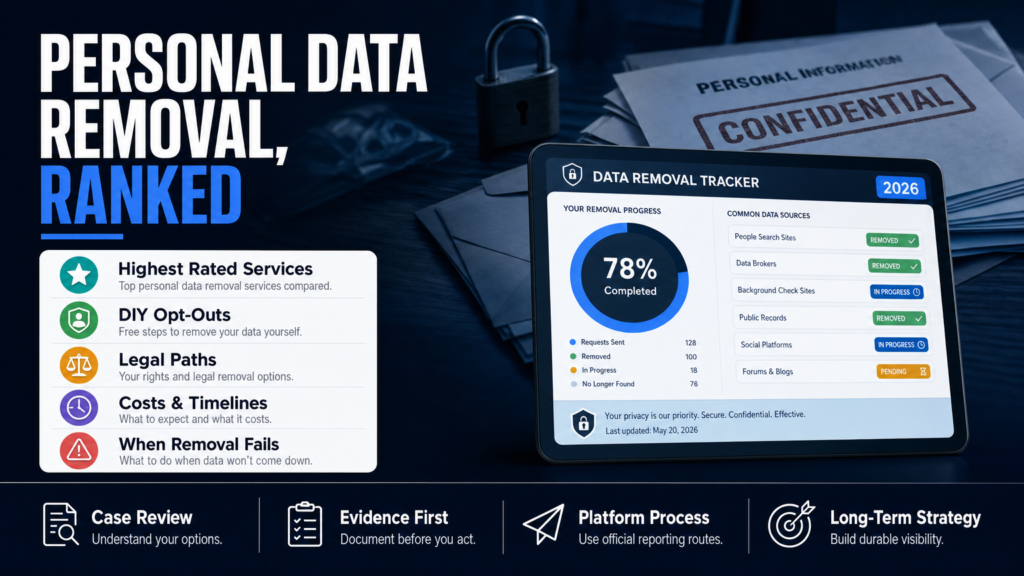
Best personal data removal service in 2026: The best personal data removal service in 2026 is the one that matches your actual exposure and handles your identity data responsibly. No single provider is best for every person, and no service can guarantee removal from every public record, publisher, or search result.
Best Personal Data Removal Service in 2026: Selection Criteria
- Inventory the data brokers and profiles involved.
- Compare covered sites and removal methods.
- Review privacy, security, and data-retention practices.
- Check whether removals are monitored and repeated.
- Evaluate progress reports and customer support.
- Understand public-record and publisher limitations.
- Compare pricing, renewals, and cancellation terms.
Before choosing a provider, confirm the written scope, evidence requirements, privacy practices, exclusions, and who controls the final decision. Platform, publisher, and search-engine outcomes cannot be guaranteed.
You typed a name into Google and found an onslaught of people-search profiles, old listings, or a mugshot site that prospects and regulators can see before they meet you. That single first page is already doing measurable damage to appointments, hiring, and credibility.
What is the best personal data removal service in 2026? This article walks through the options that matter for US professionals and small businesses — which services are designed for broad broker opt-outs, which combine monitoring and identity protection, and when an agency-led approach is the sensible investment.
You’ll get an evidence-driven checklist for choosing between DeleteMe, Incogni, Aura, Cloaked-style offerings and white-glove agencies; a clear explanation of what removal actually means in practice; and concrete next steps if removal isn’t available or fails to stick.
Table of Contents
- Which service currently has the highest ratings — and how to read those ratings
- Which is better, Cloaked or DeleteMe?
- Is a personal data removal service worth it?
- What is better, DeleteMe or Aura?
- How to choose the right service for your profile
- Costs, timelines and realistic expectations
- When removal is not available: mitigation and suppression strategies
- Monitoring, recurrence and long-term hygiene
- DIY Opt‑Outs vs Paid Removal Services
- Hypothetical: A physician, a mugshot site, and a press deadline
- Common mistakes people make when hiring a removal service
- Best practices for personal data removal and ongoing reputation hygiene
- Expert Tips
- Conclusion
- Why Businesses Choose Your Reputation Agency
- Frequently Asked Questions
Which service currently has the highest ratings — and how to read those ratings
There is no single, objective “highest rated” service across every use case. Ratings you see on aggregators or the App Store measure different things: ease of signup, customer support, perceived effectiveness, or included extras like monitoring and insurance. Look past a single star score and read what the score is measuring.
Reputable indicators to weigh: transparency about targets (which brokers/sites they cover), whether they publish a takedown workflow, refund or cancellation terms, and independent audits or third-party attestations. For example, some services publish audits of their processes; that can be useful but is one data point, not proof of long-term success.
- List the specific sites you want removed (PeopleFinders, Whitepages, Spokeo, etc.).
- Map those sites to vendor coverage in their documentation or FAQ.
- Confirm whether the service performs repeat follow-ups or only a one‑time sweep.
- Factor in litigation support or coordination with counsel if the profile is a republication or a defamatory claim.
- Check scope: How many broker sites does the vendor actively pursue?
- Evidence: Do they publish sample removal letters, processes, or audit reports?
- Service model: Manual opt-outs, automated legal requests, or a hybrid?
- Support: Is there an assigned case manager or only automated email?
- Ongoing monitoring: Does the price include recurring scans and follow-ups?
Quick checklist to verify a vendor’s claims
Ask for a sample removal report and a typical timeline range for broker opt-outs; ask how they handle sites that reappear after republishing or scraping.
Request written explanation of escalation: when do they push for manual/legal action versus repeating automated opt-outs?
- Sample report or dashboard access
- Escalation policy for reappearing listings
- Customer support SLA (response time window)
Which is better, Cloaked or DeleteMe?
Compare these two using neutral, verifiable criteria: coverage, process, price model, and whether they combine removal with monitoring or identity protection. Cloaked-style services often emphasize automated coverage and streamlined interfaces; DeleteMe (Abine) is known for periodic manual opt-outs and a multi-year subscription model.
Neither is categorically “better” for every problem. For a busy professional with steady reappearances across 30+ brokers, a service that provides repeated automated follow-ups plus monitoring may be more convenient. For someone with a handful of stubborn listings that require manual intervention, a vendor that documents manual removal attempts and escalation steps may be preferable.
- Identify the five worst links you want removed.
- Ask each vendor how they would approach those specific links and what evidence they need.
- Compare written scopes and follow-up cadence before you sign.
- Cloaked-style: typically automated, rapid sweep, good for broad coverage
- DeleteMe: subscription with human review, regular repeat opt-outs
- Ask both vendors about handling of scraped copies and publisher refusals
Questions to ask sales that reveal real differences
Ask whether the vendor files data‑subject requests only or whether they can coordinate legal takedowns, and whether their price includes ongoing monitoring and repeat opt-outs.
- Is monitoring included or an add-on?
- What is your policy when a site refuses to remove a listing?
- Do you provide written records suitable for counsel or licensure boards?
Is a personal data removal service worth it?
Short answer: sometimes. The value depends on the business or professional damage at stake, how many listings exist, and how much time you are willing to spend doing opt-outs yourself. For high-risk profiles (physicians, lawyers, CEOs) where a single listing can affect licensing or revenue, paying for speed, documentation, and escalation can be worth the cost.
Consider the alternatives: DIY opt-outs take hours to research, involve repetitive forms, CAPTCHA, and frequent follow-ups; an agency or paid service compresses that time into an ongoing, documented process. That said, if you only have one or two low‑traffic listings, DIY may be sufficient.
- Estimate the weekly hours you’d spend on opt-outs.
- Calculate vendor price vs. your hourly rate (and risk exposure).
- Decide if you need monitoring and legal documentation for future disputes.
- Worth it when risk is financial, licensure-related, or affects hiring
- Worth it for repeated republishing or high-volume broker exposure
- Less necessary for isolated, low-traffic listings
When to hire a specialist or an agency
Hire a specialist when there is an active crisis (viral incident, mugshot spread, or false allegations), when listings republish daily, or when you need coordinated legal/PR support. Agencies can combine takedowns, SEO suppression, monitoring, and PR in a single plan.
- Active crisis or reputation incident
- Recurring reappearance across new domains
- Need for evidence package for counsel or regulators
What is better, DeleteMe or Aura?
DeleteMe and Aura target overlapping but distinct needs. DeleteMe focuses on removing listings from people-search and broker sites via a subscription model; Aura is a broader identity security suite that bundles dark-web monitoring, credit/identity theft protection, and sometimes data removal as part of a larger package.
If your primary concern is visibility of your name and contact information in broker databases, a focused removal service may be more cost-effective. If your overall risk includes fraud, account takeover, or identity theft, a bundled service like Aura may provide additional protections that removal-only offerings do not.
- List the harms you want to prevent (misinformation vs. fraud).
- Map each vendor’s features to those harms (monitoring, insurance, removal).
- Decide if you need an integrated platform or a targeted removal service.
- DeleteMe: focused opt-outs and repeated sweeps
- Aura: identity protection plus monitoring and insurance
- Choose based on whether visibility or identity-fraud risk is the primary problem
How bundling affects price and expectations
Bundled products often look cheaper when you value monitoring and insurance, but they may de-emphasize manual, human-led takedowns. If you need repeated manual escalations, confirm those are included.
- Watch for limited removal attempts in bundled plans
- Confirm insurance amounts and covered events
- Check whether monitoring is continuous or periodic
How to choose the right service for your profile
Choosing well requires mapping your specific problem to vendor capabilities. Ask vendors for explicit answers about coverage, escalation, proof, and timelines in writing. Don’t accept vague promises about “removing everything.”
Use this short decision flow to categorize your needs and match them to a service type.
- Identify the five worst results for your name or business.
- Decide if these are people‑search listings, news articles, court records, or social posts (different strategies apply).
- Request a written scope from two vendors that includes which exact domains they will target and typical follow-up cadence.
- Category A: High‑risk professional with licensure or revenue at stake — consider agency + legal coordination
- Category B: Moderate recurring broker listings — consider subscription removal service with monitoring
- Category C: One-time, low-traffic listing — consider DIY opt-outs
Include these must‑ask items in vendor interviews
Get answers in writing about repeat removal cadence, data they require from you, monitoring frequency, cancellation/refund policy, and what documentation they provide for legal use.
- Repeat removal cadence
- Escalation pathways if a site refuses
- Documentation suitable for counsel or licensing boards
Costs, timelines and realistic expectations
Expect variable pricing: consumer removal subscriptions typically range from a few hundred dollars per year to higher-tier plans with insurance or monitoring; agency or legal coordination is often billed monthly or as retainers and can run from mid‑four to five figures depending on scope and urgency.
Timelines are not guarantees. Some broker opt-outs are completed in days; others require weeks or months and repeated follow-ups. Platform policy reviews (Google, social networks) can add weeks. Use the vendor’s published processes to form a rough range, but expect variation based on publisher responses and re‑scraping behavior.
- Ask vendors for typical ranges, not fixed timelines.
- Budget for monitoring and repeat work for at least 6–12 months if listings keep reappearing.
- Keep your own records of removal requests and vendor actions for future legal or compliance needs.
- Consumer subscriptions: $100–$500/year typical for single-person plans
- Agency/white-glove services: often $1,500+/month depending on scope
- Some individual removals may take days; repeated or legal escalations can take months
How platform differences affect timing
People‑search brokers and small directories often process opt-outs faster than large publishers or commercial aggregators. News outlets and court-record sites may resist removal on public‑interest grounds; those situations may require legal review.
- Small broker: faster opt-out, higher re‑appearance risk
- Major publisher: slower, may require correction or legal process
- Social networks: follow platform reporting and escalation paths
When removal is not available: mitigation and suppression strategies
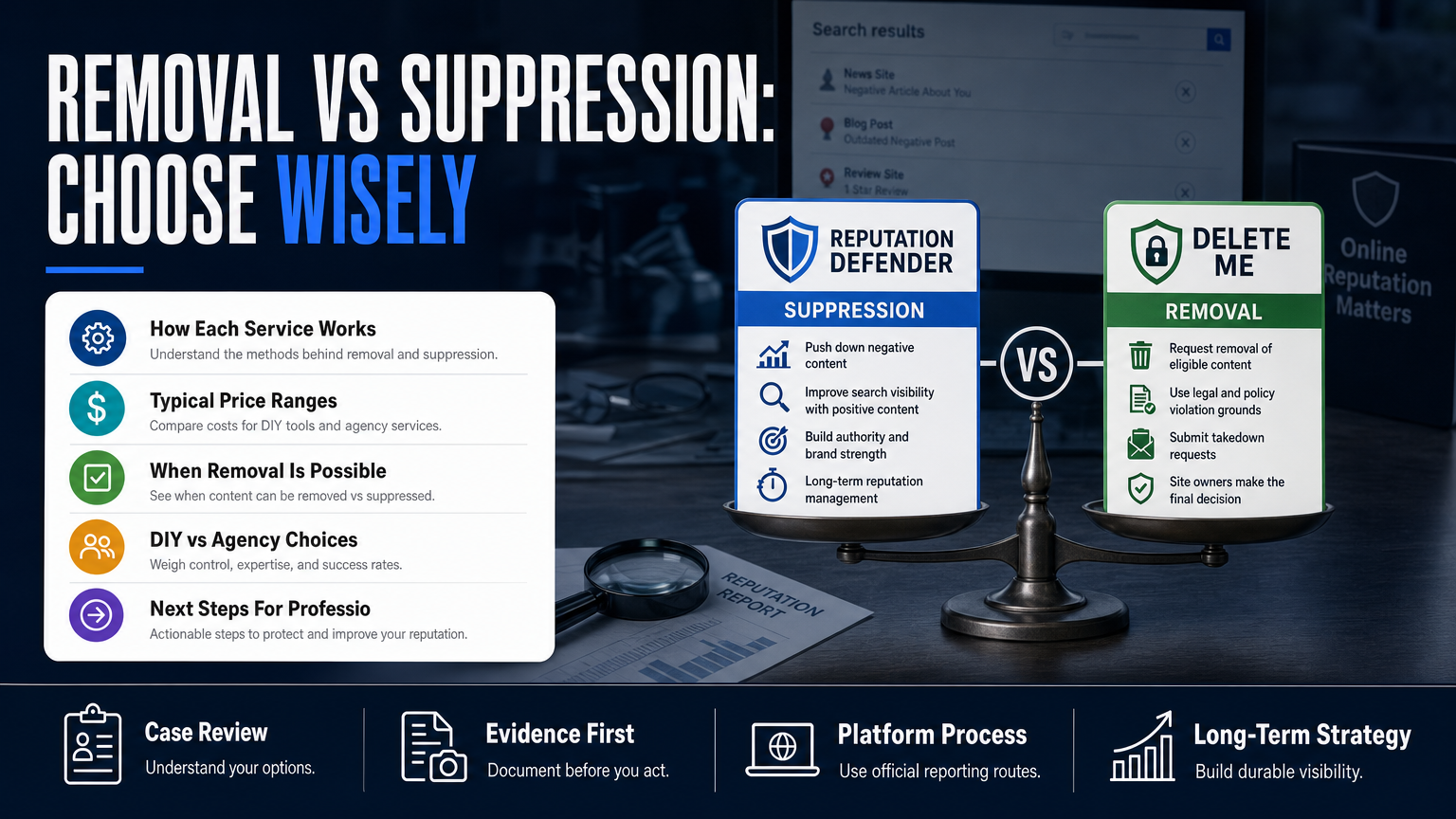
Sometimes removal is not available because the content is accurate, a public record, or the publisher refuses. That does not mean the problem is hopeless. When removal is unavailable, the two practical routes are mitigation (correction, contacting the publisher, or submitting contextual updates) and search-result suppression through SEO.
Suppression is an ongoing process: you develop credible, authoritative positive content (site bios, professional profiles, articles) and optimize it to outrank the harmful item. This is a strategic, technical SEO process, not an instant fix.
- If the publisher refuses removal, request a correction or contextual note.
- Create authoritative owned pages (site bio, LinkedIn, professional directories) optimized for your name.
- Implement a suppression plan: publish, interlink, build modest authority signals, and monitor rankings monthly.
- Mitigation: corrections, publisher responses, context pages
- Suppression: SEO pages, profiles, controlled content to push negative links down
- Monitoring: continual scanning for reappearance and new links
Example SEO suppression tactics
Use a mix of owned pages, site pages with your name, optimized press releases, and quality guest posts. Anchor text should be natural and your site should be technically sound (fast, mobile-friendly). Results take time and depend on the authority of the negative item.
- Publish an authoritative bio page
- Obtain a few high-quality backlinks to owned pages
- Use structured data and clear titles to help search engines associate those pages with your name
Monitoring, recurrence and long-term hygiene
Removal is rarely a one‑and‑done project. Brokers re-scan and republish; scraped copies appear; new sites may index old data. Ongoing monitoring is the only reliable way to catch recurrences early.
Decide whether monitoring will be DIY (Google Alerts, regular name searches) or part of a paid plan. Paid monitoring usually includes alerts, dashboard access, and automatic follow‑up. For professionals at high risk, combine monitoring with a retention of an agency or legal counsel for rapid escalations.
- Set up at least two monitoring feeds (Google Alerts and a commercial monitoring tool).
- Review top 20 results quarterly to detect new harms.
- If reappearance frequency is high, consider a paid repeat-removal subscription.
- Schedule monthly name+location scans at minimum
- Use a mix of automated alerts and manual named-entity checks
- Keep a documented log of all removals and reappearances
A note on confidentiality and records
We handle matters confidentially and apply appropriate privacy and security controls, but absolute confidentiality can’t be promised in public-facing processes. Maintain secure local records of removal requests and vendor actions you can share with counsel if needed.
- Secure records for legal or licensing needs
- Limit disclosure of case details to essential personnel
- Confirm vendor confidentiality terms in the service agreement
DIY Opt‑Outs vs Paid Removal Services
A quick side‑by‑side for professionals deciding whether to self-manage or hire a vendor.
| DIY Opt‑Outs | Paid Removal / Agency |
|---|---|
| Cost | Subscription or retainer fees |
| Time investment | Minimal for you; vendor handles work |
| Documentation for counsel | Usually provided |
| Repeat follow-ups | Included in many plans |
| Handling legal pushback | Vendor coordinates escalation; may involve counsel |
| Scalability (many names/locations) | Scales better with vendor tools |
Hypothetical: A physician, a mugshot site, and a press deadline
A physician finds an old arrest photo on a mugshot aggregator that appears on the first page for her name. Patients start calling, and a local paper asks for comment. Removal from the aggregator is unlikely without proof of inaccuracy or an expungement order; the site refuses. She needs a rapid, documented response and search-result mitigation.
Process the physician (anonymized) follows with a paid agency: the agency documents the publisher refusal, coordinates with counsel to explore any legal avenues (expungement paperwork or takedown letters), and simultaneously deploys an SEO suppression plan to push the mugshot off the first page. The agency also begins monitoring and prepares a press statement template the physician can use.
- 1) Triage: agency confirms what can and can’t be removed and documents publisher communication.
- 2) Parallel tracks: launch suppression SEO work and monitor search changes weekly.
- 3) Escalation: if legal grounds exist, counsel files the appropriate motion or demand.
- 4) Communication: provide templated responses to media and patients while work proceeds.
- Agency documents the refusal for future legal use
- SEO suppression targets owned bios, local profiles, and professional directories
- Monitoring set to daily for the first month, then weekly
Common mistakes people make when hiring a removal service
Avoid these predictable errors; they waste money and prolong exposure.
- When interviewing vendors, insist on written scopes and ask what happens if content reappears.
- Expecting guarantees — removal depends on publisher policy, evidence, and law.
- Focusing only on one site — information often lives on many mirrors and brokers.
- Neglecting monitoring after an initial sweep — reappearance is common.
- Confusing bundled identity protection with targeted removal services.
Mistake: Hiring solely on price
Cheaper services may limit follow‑ups or exclude harder targets. Verify what you get for the price — number of sites, cadence of repeat attempts, and whether escalation is included.
- Confirm repeat attempts are included
- Ask how many unique domains are covered
Mistake: Assuming all negative content is removable
Truthful public records and many news articles are protected; removal may be impossible without legal orders. Plan for mitigation and suppression in those cases.
- Identify if content is a public record or news
- Plan suppression if removal is denied
Mistake: Not verifying vendor processes
Vendors that cannot or will not explain their escalation and follow-up process in writing should be treated cautiously. You need a record of what was requested and when.
- Obtain a sample report
- Document vendor communications
Mistake: Ignoring SEO as a parallel strategy
Even when removal is possible, suppression via credible owned content reduces the risk of recurrences appearing at the top of search results.
- Build and optimize authoritative pages
- Use PR to secure high-authority placements
Best practices for personal data removal and ongoing reputation hygiene
Adopt these durable steps to protect your professional presence online.
- Create a secure, versioned spreadsheet logging URLs, dates, vendor actions, and outcomes.
- Schedule quarterly audits and monthly monitoring alerts.
- Keep minimal, consistent contact information on public profiles to reduce stale data spread.
- Start with a full search audit (top 50 results for your name + modifiers).
- Document every removal request and publisher response.
- Combine removal attempts with SEO suppression when necessary.
Hygiene: reduce new exposure
Limit the number of places where you publish personal contact details. Prefer institutional pages (medical group, firm bio) over publicly editable directories that republish to brokers.
- Use business contact pages instead of personal listings
- Regularly check third-party aggregators for scraped changes
Documentation for legal and licensing needs
If your reputation problem could intersect with licensure or legal action, keep documented removal attempts and vendor reports to share with counsel. This preserves options and demonstrates proactive remediation.
- Export vendor reports and keep local copies
- Maintain chronological correspondence logs
When using an agency
Define measurable goals in the engagement letter: target domains, reporting cadence, and acceptable KPIs (e.g., removal attempts logged, number of reappearances). Avoid vague “remove everything” language.
- Include reporting frequency
- Specify escalation processes
Expert Tips
- Start with a list of the ten worst links and treat those as your priority — vendors respond better to a focused scope.
- Ask vendors for a sample dashboard or report export before you commit.
- If a site refuses removal, always ask for the written reason — it’s useful for counsel and future requests.
- Don’t overlook Google’s removal options for privacy-sensitive info (financial, explicit images, doxxing).
- Combine a removal subscription with quarterly personal audits to catch recurrences early.
- If you face a viral incident, lock down social accounts and coordinate messaging before pursuing removals.
- Keep a secure record of old usernames and email addresses — they often appear in broker profiles.
- When in doubt about legal action, consult a qualified attorney; removal may require jurisdictional legal steps.
Conclusion
Choosing the best personal data removal service in 2026 depends less on a single vendor name and more on matching the service model to your problem: broad automated coverage, subscription-based manual opt-outs, bundled identity protection, or white-glove agency coordination with legal and PR. No vendor can guarantee removal or permanent suppression — outcomes depend on platform policies, publisher cooperation, evidence, and law.
Start with a practical audit: identify your worst results, decide whether the harm is visibility or identity-risk driven, and ask vendors for written, specific answers about scope, cadence, and escalation. If removal is unavailable, plan suppression and ongoing monitoring as a durable alternative.
Why Businesses Choose Your Reputation Agency
Managing your reputation takes more than monitoring reviews or publishing the occasional blog post. It takes a strategy built around your situation, your industry, and what is actually showing up in search.
Your Reputation Agency works with businesses, executives, healthcare professionals, attorneys and growing brands. Our services include:
- Remove defamatory content and false posts (news, blogs, listings)
- Remove or challenge negative reviews (Google, Yelp, TripAdvisor, industry sites)
- Mugshot and arrest record removal
- Remove videos, images, and other multimedia that damage reputation
- Remove personal data from people‑search and data‑broker sites (opt‑outs)
- Search result suppression (SEO to bury negative links)
- Social media takedowns and impersonation removal
- Rapid online crisis management and incident response
- Ongoing monitoring and alerting of reputation signals
- Coordination with legal counsel and use of legal tactics when required
Frequently Asked Questions
1. What is the highest rated data removal service?
There isn’t a single universal winner — ratings depend on criteria. Look for vendors that publish coverage lists, provide sample reports, and explain their escalation process. Independent audits or third-party attestations can be helpful context but are only one factor in evaluating quality.
2. Which is better, cloaked or DeleteMe?
It depends on needs. Cloaked-style tools often emphasize automation and breadth; DeleteMe uses subscription-based manual opt-outs and repeat sweeps. Choose based on whether you need rapid broad coverage or documented manual intervention and follow-ups.
3. Is a personal data removal service worth it?
Often yes for high‑risk professionals or active reputation crises; less so for a single, low-traffic listing. Consider the time you’d spend doing repetitive opt-outs and whether documented removal evidence or escalation capability is important for your situation.
4. What is better, DeleteMe or Aura?
DeleteMe focuses on broker opt-outs; Aura is a broader identity-protection suite with monitoring and insurance. If your primary risk is identity theft, a bundled platform may be preferable; if it’s visibility in brokers, a dedicated removal service may be more efficient.
5. How long does removal take?
Timing varies by publisher and process. Some opt-outs clear in days; others require weeks or months and repeated follow-ups. Platform reviews, legal steps, and republishing behavior affect timelines; ask vendors for ranges, not guarantees.
6. Can I remove accurate public records or news articles?
Accurate public records and most news articles are difficult to remove and may be lawfully published. Those situations often require mitigation (correction requests) and suppression via SEO, or legal steps if there are narrow statutory remedies.
7. What should I do if content keeps reappearing after removal?
Document each reappearance, request repeat removals, and consider escalating with legal counsel if the publisher is republishing content in bad faith. Combine repeat removals with suppression tactics so repeated copies are less likely to appear at the top of search results.
8. How do I know whether to DIY or hire an agency?
If you have many listings, recurring republishing, or reputational risk (licensure, revenue), hiring an agency or a subscription removal service saves time and provides documentation. For isolated entries, DIY opt-outs can be effective.
9. Where can I learn more about specific removal workflows and examples?
For vendor reviews and practical removal workflows, see our write-up on When a Reddit Thread Becomes a Professional Crisis. For step-by-step opt-out instructions, consult our practical manual How to Remove Your Personal Information from the Internet (2026 Guide). If Reddit content is your main problem, read When A Reddit Thread Becomes Your Primary Search Result.
This content provides general information and does not constitute legal advice. The available options and likely outcomes depend on the facts, evidence, platform policies, applicable law, jurisdiction, and public-interest considerations.
Past examples do not guarantee future results. Removal, correction, deindexing, and search-position changes depend on third parties and circumstances outside Your Reputation Agency’s control.