When an old news article affects doctor reputation
An old news article doctor reputation problem occurs when dated coverage ranks prominently without later context, a final outcome, or corrections. The best response depends on accuracy, newsworthiness, publisher policy, and applicable law.
Seven response steps
- Save the article, URL, publication date, headline, and search position.
- Verify every disputed fact against reliable records.
- Identify missing outcomes, corrections, dismissals, or later developments.
- Send the publisher a concise, evidence-backed update request.
- Use search-removal or legal tools only when the content qualifies.
- Publish accurate professional information and substantive updates.
- Monitor the result for headline, snippet, or ranking changes.
A request is stronger when it specifies the exact error or missing development and includes primary documentation. Avoid demanding removal merely because accurate reporting is unfavorable.
You just searched your name and found an article that could cost you patients, clients, or a license. The natural follow-up is: can you get an article removed from google?
This article lays out exactly how those requests work, what platforms and publishers control, and which steps professionals and small businesses can take right now. It explains removal vs suppression, the forms to file, when legal action may be useful, and realistic timelines.
We’ll show step-by-step actions for takedown requests, publisher outreach, Google and platform forms, and what to do when removal isn’t available so you can protect revenue and licensure.
Throughout, you’ll see practical language to use, typical timeframes and evidence you’ll need, and clear criteria for when to involve counsel or a reputation firm.
Table of Contents
- How do I get an article about me removed?
- Can you remove news articles from Google?
- Can you get news articles removed?
- How can I get something removed from Google?
- What to do when removal is not available
- Legal options: when to involve counsel
- Platform-specific processes and realistic timelines
- Monitoring, response, and rebuilding trust
- Removal vs Suppression: Which Route Fits Your Case?
- Hypothetical: A Surgeon and a Ten-Year-Old Article
- Common Mistakes We See
- Best Practices for Speed and Effectiveness
- Expert Tips
- Conclusion
- Why Businesses Choose Your Reputation Agency
- Frequently Asked Questions
How do I get an article about me removed?
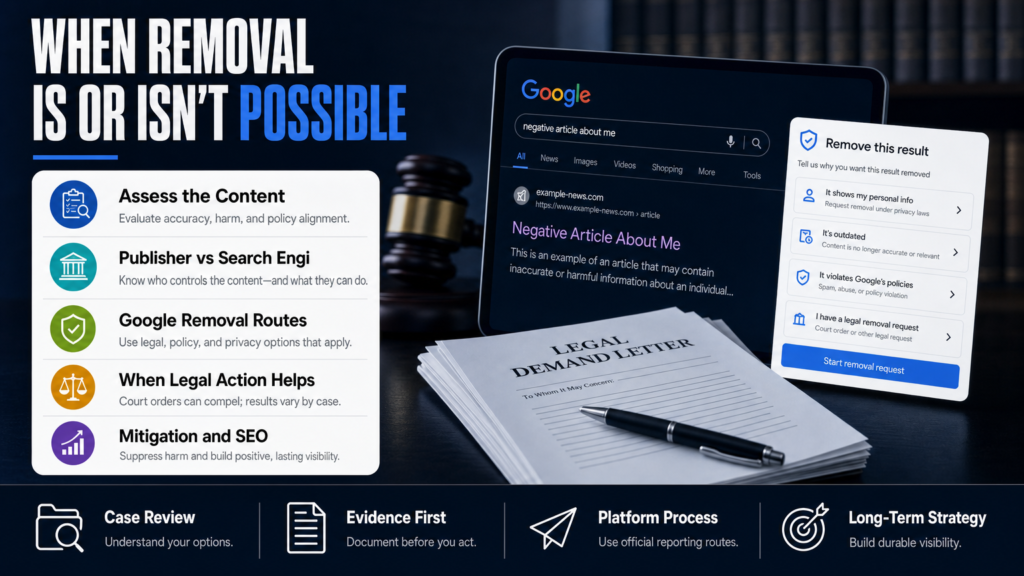
Start by separating three things: the publisher (the website that posted the article), the search engine (Google), and secondary sites that republish or archive the piece. Removing an article entirely usually requires action against the publisher or a valid legal basis; removing it from Google is a different process that depends on Google’s policies and whether the content violates law or privacy.
We evaluate whether the content may qualify for removal or review and pursue the legal, technical, platform-based, and reputational options available. Below are immediate actions you or your team can take.
- Step 1 — Record evidence: save the page, note the date, collect copies of anything that proves falsity or private data.
- Step 2 — Send a publisher takedown or correction request: include precise URL, what is inaccurate or private, and what remedy you seek (correction, retraction, removal).
- Step 3 — If the publisher refuses and you believe the content is unlawful, consult a qualified attorney to explore defamation, privacy, or other claims.
- Step 4 — File platform reports with Google and other sites once you’ve documented attempts and the basis for removal.
- Document the article: URL, screenshots (with timestamps), copies saved as PDF, and any comments or social shares that amplify it.
- Decide whether the content is factually false, defamatory, a privacy/data breach, harassment/impersonation, or protected public‑interest reporting.
- Contact the publisher first — a polite, evidence-based request often works on smaller sites or bloggers.
- Use platform reporting routes (Google, Facebook, Twitter/X, YouTube) after publisher contact or if the content violates platform policy.
- When the publisher won’t remove an unlawful or false article, consult counsel about legal options.
What to include in a publisher request
Keep the message professional and concise. Attach evidence showing inaccuracy or privacy invasion. If you’re asking for correction rather than removal, propose the exact language.
If the article contains personal data (SSN, medical records, private photos) or is demonstrably false, state that and attach supporting documents. Do not send confidential documents publicly—use secure channels.
- Exact URL(s) and screenshots
- Clear statement of the inaccuracy or privacy violation
- Proposed correction or removal action
- Contact info and a deadline for response (reasonable: 7–14 days)
Can you remove news articles from Google?
Short answer: sometimes. Google does not automatically remove news articles just because they are negative or embarrassing. Removal depends on policy, law, and whether the content violates privacy or other narrow categories.
If the article is published by a news outlet, the publisher controls the content. You can request the outlet to retract or correct; for additional context on news-specific removals see our walkthrough on How to Remove News Article from Google: What You Need to Know.
- Step 1 — Contact the news outlet asking for correction or retraction with supporting evidence.
- Step 2 — If personal data or privacy law applies, use Google’s legal removal forms (see the Google help page) or consult counsel.
- Step 3 — If removal isn’t possible, plan visibility reduction strategies (SEO and new positive content).
- Google may remove links under limited policies (e.g., doxxing, non-consensual intimate images, certain privacy laws for EU residents, or legal removals).
- Courts and legal orders can force removal from publishers or Google in narrow circumstances.
- Newsworthiness and public interest frequently weigh against removal in US contexts.
When news outlets will cooperate
Local papers and smaller digital outlets sometimes remove or archive articles for good reasons: demonstrable factual error, settlement, or when the story includes private data by mistake. Major national outlets are less likely unless there is legal pressure or an incontrovertible factual error.
- Correction request success is higher for demonstrable factual errors.
- Settlements, clarifications, or libel judgments can prompt publisher action.
- Publishers may offer an edited version, archive, or paywall instead of full removal.
Can you get news articles removed?
This question repeats a common concern: removing a news article entirely from the internet is often difficult because publishers control their own archives and because truthful reporting on matters of public interest is protected.
Removal is more likely when the article contains false statements of fact, private data published without consent, or content that violates specific laws. Otherwise, mitigation is the usual path.
- Step 1 — Evaluate whether the article contains demonstrably false factual statements.
- Step 2 — If false, gather evidence and ask for correction; if private data was published, collect proof and consult counsel.
- Step 3 — Use search-engine requests or archive takedown requests if legal grounds exist.
- Truthful reporting of a crime, lawsuit or regulatory matter is typically not removable simply because you dislike it.
- Private facts, highly sensitive data, or non-consensual intimate images have stronger grounds for removal.
- You may obtain correction, clarification, or a paid statement from the publisher, even when full removal isn’t possible.
Archives and third-party republishing
Even if the original publisher removes an article, copies may remain in caches, social shares, or news aggregators. You’ll often need to request removal or de-indexing from these secondary hosts, plus ask Google to update cached results.
- Request removal of cached pages via Google’s Remove Outdated Content tool.
- Contact aggregator sites and archive.org with a legal basis for removal if applicable.
- Plan for a period of follow-up; cache updates can take days to weeks.
How can I get something removed from Google?
Google maintains several removal pathways: legal removal requests, policy-based takedown reports (e.g., intimate images, doxxing), and the Remove Outdated Content tool for pages already changed or removed. It’s important to know which route fits your case.
If you’re trying to remove a negative article, our guide Negative article: How to Remove it from Google explains practical publisher outreach and how to use Google’s reporting options.
- Step 1 — Identify the best Google route: policy report, legal request, or outdated-content request.
- Step 2 — Prepare evidence and documentation showing policy or legal grounds.
- Step 3 — Submit the correct form and monitor the response; Google decisions are at its discretion.
- Use Google’s legal removal forms only when content violates law or specific Google policies.
- Use the Remove Outdated Content tool when the publisher has removed or changed the page but Google still shows a cached copy.
- Policy-based reports (like non-consensual imagery or personal data exposures) are evaluated by Google and may lead to de-indexing.
Common Google forms and when to use them
Google offers different forms: non-consensual explicit imagery, doxxing/personal data, legal removal requests, and outdated content. Choose the form that matches the problem—using the wrong one slows action.
Google’s public help pages explain each form and the supporting documents needed; platform decisions remain under Google’s control.
- Non-consensual imagery form — for private sexual content shared without consent
- Personal data form — for doxxing or exposed identity documents
- Copyright/DMCA form — for copyrighted text or media you own
- Outdated content tool — when the original page has changed or been removed
What to do when removal is not available
Removal is not always an option. When a publisher refuses and platforms decline to remove a link, the most reliable route is mitigation: suppressing harmful content in search results and rebuilding authoritative, accurate information.
We develop SEO reputation strategies intended to improve the visibility of relevant and credible information. These are practical, evidence-driven steps that reduce the prominence of the negative article without promising permanent suppression.
- Step 1 — Audit current search results and prioritize targets for suppression.
- Step 2 — Build or refresh high-authority pages (LinkedIn, company bio, trade profiles, local listings).
- Step 3 — Publish SEO-optimized content and backlinks to push negative links lower.
- Step 4 — Monitor progress; search results may change slowly and depend on many external factors.
- Create and optimize authoritative pages (professional site, profiles, press releases) to outrank the negative link.
- Use structured data and regular content updates to signal freshness and relevance to search engines.
- Encourage positive reviews and third-party coverage from reputable outlets.
When professional help is appropriate
Reputation teams coordinate technical SEO, outreach to publishers for corrections or updates, public relations to earn new coverage, and legal counsel if necessary. These combined efforts can change search visibility over months, but results vary by case.
If you want an in-depth look at what Google can and cannot remove, our explainer Can Google Remove Search Results? What You Need to Know provides practical distinctions between legal takedowns and mitigation strategies.
- Hire an SEO specialist with experience in reputation work for suppression campaigns.
- Use PR to generate authoritative content that addresses the issue directly and transparently when appropriate.
- Maintain monitoring and alerting to detect new copies or resurges of the article.
Legal options: when to involve counsel
Legal remedies can help in some cases—defamation suits, privacy claims, or DMCA takedowns—but each has limits and costs. A qualified attorney can determine whether a legal claim may be available and whether litigation or a legal demand letter is the right next step.
We coordinate with qualified legal professionals when a matter requires legal analysis; we do not provide legal representation. Below are the typical legal avenues and what they usually require.
- Step 1 — Collect documentation that supports your claim (corrections, contradicting evidence, financial harm).
- Step 2 — Have counsel evaluate jurisdictional issues and the likelihood of success.
- Step 3 — Consider a graduated approach: demand letter, publisher negotiation, and only then litigation when appropriate.
- Defamation: requires false statements of fact that cause demonstrable harm and, depending on the plaintiff’s public status, proof of actual malice.
- Privacy/statutory claims: some states have laws protecting certain private data; relief depends on the facts and jurisdiction.
- Copyright/DMCA: useful when copyrighted content you own appears without permission.
- Court orders and subpoenas: can compel publishers or platforms to remove or reveal identifying information in narrow situations.
Practical realities of legal action
Litigation is expensive, public, and slow. Even a successful judgment may not erase online copies, but it can force a publisher to retract, issue a correction, or remove content.
A court order against a publisher does not automatically remove links from search engines worldwide; additional steps with platforms and archives are often needed.
- Weigh financial cost and timeline against the real harm of the article.
- Use legal pressure strategically—sometimes a targeted legal notice motivates a publisher to negotiate.
Platform-specific processes and realistic timelines
Different platforms respond to removal requests on different timelines and for different reasons. Expect variability: some decisions happen in days, others take weeks, and legal routes can take months or years.
Document everything and use the right form for each platform. Below are platform-specific notes to help prioritize.
- Step 1 — Prioritize platforms by reach and search visibility (e.g., Google and large aggregators first).
- Step 2 — File specific reports with exact evidence for each platform—don’t use generic complaints.
- Step 3 — If denied, prepare an appeal or escalate through publisher or legal channels.
- Google: policy and legal forms; outdated content tool for caches. Decisions vary; de-indexing can happen in days to weeks when granted.
- Facebook/Instagram/Meta: reports for harassment, impersonation, or privacy violations; appeals possible if denied.
- Twitter/X: impersonation and safety reporting; timelines are variable and enforcement inconsistent.
- Yelp/Google Reviews/Industry sites: each has review dispute processes—prepare evidence and follow site-specific proof requirements.
- YouTube: copyright and privacy reports can remove videos; community guidelines cover harassment and doxxing.
Using the Google Remove Outdated Content tool
Use this when the publisher already removed or changed the page but Google still shows the old snippet or cached page. It’s a targeted, often fast route for clearing cached results.
If the publisher hasn’t removed the page, the outdated-content tool won’t work—start with publisher outreach or the correct Google legal/policy form.
- Only works after the live page is changed or removed
- Typical processing can be days to a couple of weeks
- Keep screenshots and timestamps of when the page changed
Monitoring, response, and rebuilding trust
Removal or suppression is only part of recovery. Ongoing monitoring, clear public messaging, and proactive reputation work reduce the long-term impact of negative articles.
We handle ongoing monitoring and alerting of reputation signals so you can react to new copies, social amplification, or related claims quickly.
- Step 1 — Deploy monitoring and establish escalation rules for new incidents.
- Step 2 — Prepare a short holding statement or FAQ for staff and stakeholders.
- Step 3 — Implement a content plan that prioritizes authoritative, SEO-optimized pages to regain control of search results.
- Set up alerts (Google Alerts, platform monitoring, and paid monitoring tools) for names, business names, and key terms.
- Develop transparent messaging for patients, clients, or stakeholders if the article affects licensure or service delivery.
- Use earned media and authoritative content to replace the narrative over time.
When to involve PR and compliance
If the article threatens revenue, licensure, or regulatory compliance, coordinate a response that includes legal counsel, a communications lead, and operations. Carefully worded statements and proactive outreach to stakeholders can stop rumors and stabilize business relationships.
Transparency and speed matter—handled properly, slow public relations can make the problem worse.
- Alert regulators and insurers early when required by law or policy
- Use limited, factual statements to avoid amplifying false claims
- Prepare for follow-up inquiries and have a designated spokesperson
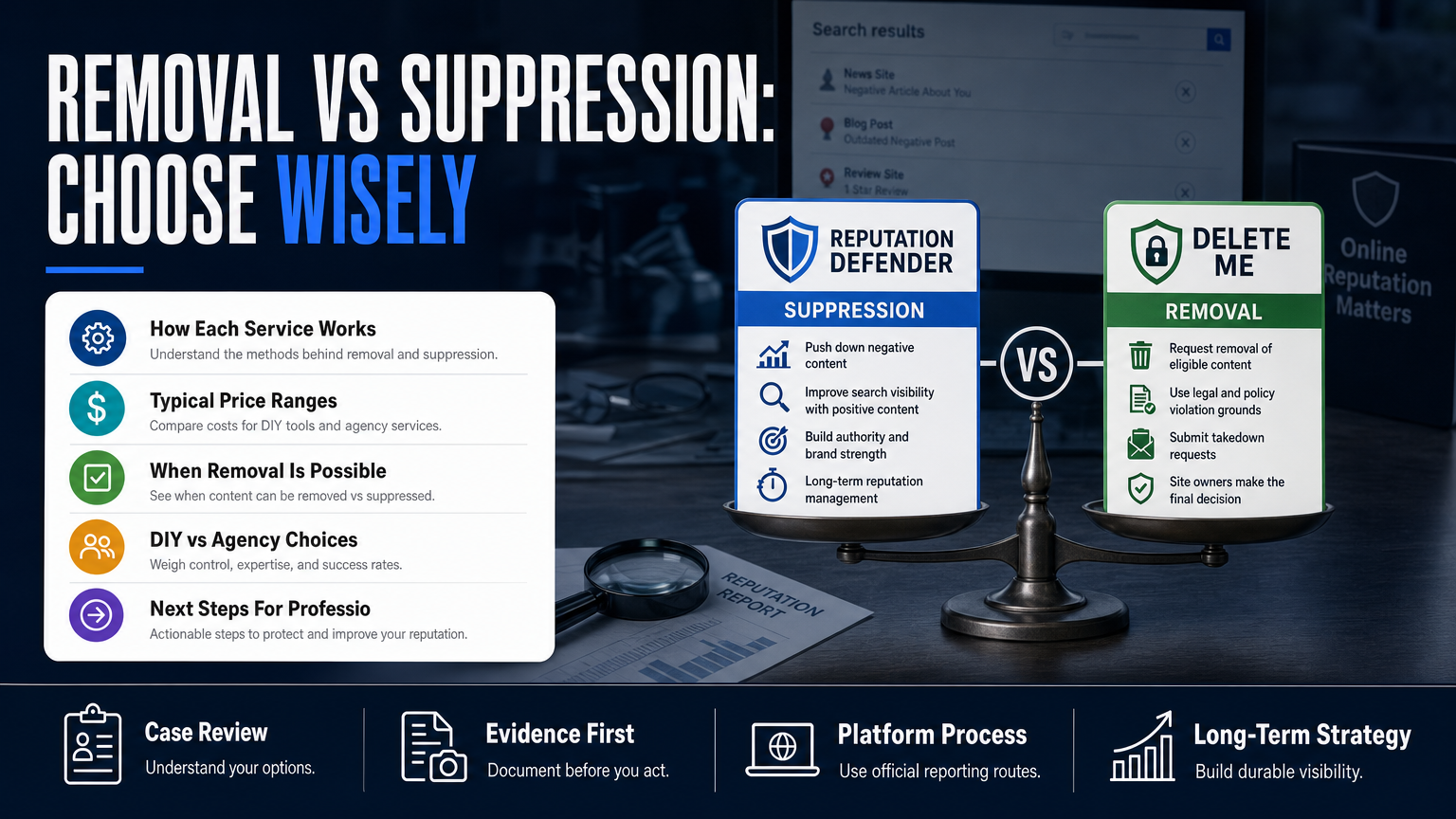
Removal vs Suppression: Which Route Fits Your Case?
Quick side-by-side to decide whether to pursue removal or mitigation.
| Removal | Suppression |
|---|---|
| Who controls it | Publisher or platform decides |
| Typical timeline | Weeks to months for results |
| Cost | Potentially high (legal fees) |
| Success factors | Quality SEO and authority |
| When to choose | Unlawful content or clear policy breach |
| Visibility after action | May still exist in archives or mirrors |
| Long-term risk | Requires ongoing monitoring and content work |
Hypothetical: A Surgeon and a Ten-Year-Old Article
A private-practice surgeon finds a decade-old local news article about a malpractice allegation ranking #3 for their name. The article is accurate in reporting an early claim that was later dismissed, and the publisher declines to remove it.
The surgeon wants to reduce referral loss without costly litigation. Here’s a pragmatic sequence of actions that illustrates removal and mitigation together.
- Step 1 — Collect documentation proving the dismissal and prepare a short summary for publisher outreach.
- Step 2 — Request correction from the publisher, offering a linked public record and proposed wording.
- Step 3 — While waiting, implement suppression: update and optimize the surgeon’s professional profiles, publish a robust bio page, and author two expert articles on clinical practice linked from reputable sites.
- Step 4 — Set up monitoring and request removal of cached or mirrored copies via Google’s outdated-content tool if the publisher edits or archives the page.
- Documented evidence: dismissal order and court records saved as PDFs.
- Publisher outreach: polite correction request with court documents attached.
- Google action: filed an outdated-content check after publisher confirmed archive status.
Common Mistakes We See
These missteps cost time and reduce the likelihood of a good outcome. Avoid them.
- None
- None
Mistake 1: Treating Google Like the Publisher
People often think removing a link from Google solves the problem. Google only removes links for narrow policy or legal reasons; the publisher still controls the underlying content.
- Always contact the publisher first when possible
- Use Google requests only for policy or legal grounds
Mistake 2: Using Generic, Emotional Messages
Angry or vague takedown requests to publishers cause defensiveness. A concise, evidence-based request is more likely to produce cooperation.
- Include specific URLs, facts, and a proposed remedy
- Avoid threats unless counsel has advised and drafted the message
Mistake 3: Skipping Documentation
Failure to save pages, timestamps, and evidence makes legal or platform claims weaker. Assume you will need proof later.
- Save PDFs, take full-page screenshots, and store source links
- Record where and when copies appear
Mistake 4: Expecting Immediate Results
Some forms and outreach yield changes quickly; many do not. Expect follow-up and a multi-stage strategy involving publisher outreach, platform forms, and suppression.
- Plan for weeks to months, not hours
- Maintain monitoring and follow-up
Mistake 5: Using Retaliatory or Deceptive Tactics
Do not use fake accounts, bogus copyright claims, or other deceptive tactics to remove content. These can backfire legally and reputationally.
- Stick to lawful, documented processes
- Coordinate with counsel when considering legal pressure
Best Practices for Speed and Effectiveness
Adopt a disciplined, evidence-first approach and coordinate the technical, legal, and communications elements.
- None
- None
Practice 1: Prepare Evidence Before You Reach Out
Gather court records, medical licenses, or other public documents that contradict false claims. Attach them when appropriate to publisher or platform requests—this increases credibility and the chance of action.
- Include dated PDFs and links to official records
- Keep a secure folder for case documents
Practice 2: Use the Right Platform Form
Match your complaint to the platform policy or legal form. Misdirected requests delay resolution.
- Review Google’s available forms before submitting
- Follow evidence instructions exactly
Practice 3: Don’t Over‑Promote in Public Responses
If a public comment or social reply is necessary, keep it factual and minimal. Overly defensive statements can amplify the story.
- Designate one spokesperson
- Stick to short factual corrections
Practice 4: Combine SEO With PR
Parallel SEO and PR work—publishing timely, authoritative content and securing earned media—gives you the best chance to reduce the visibility of the negative article over months.
- Publish long-form bios, case studies, and community work
- Reach out to industry press for balanced coverage
Practice 5: Monitor Continuously
Set up alerts and regular audits of your first two SERP pages. React quickly to copying, new aggregations, or renewed social attention.
- Use free tools (Google Alerts) and paid monitoring when stakes are high
- Log all takedown attempts and responses
Expert Tips
- If a publisher offers an edited article instead of removal, ask for a timestamped correction and a linked statement to your documentation.
- When sending evidence to a publisher, include a neutral third-party document (court record, regulator notice) rather than private correspondence.
- Avoid mentioning the article on your public channels unless you have a carefully crafted message—doing so can boost its search prominence.
- Use robots.txt and noindex on pages you control to prevent further indexing by Google.
- Consider a controlled press release that answers concerns and ranks for your name when the story is straightforward and you can provide documents.
- If the content includes images or videos, identify the original host and use the platform’s multimedia takedown process rather than a generic complaint.
- For review sites, focus on the site’s dispute process and documented evidence rather than public arguments in comments.
- Keep an incident log with dates, contacts, and outcomes—this helps counsel and reputation teams act quickly.
Conclusion
Can you get an article removed from Google? Sometimes—but rarely with a single action. Successful outcomes start with accurate categorization of the problem (policy violation, unlawful content, or damaging but lawful reporting), careful documentation, and the right mix of publisher outreach, platform reporting, legal review, and SEO suppression.
If removal is feasible, expect platform discretion, conditional timelines, and a need for supporting evidence. If removal is not feasible, suppression, monitoring, and reputation rebuilding are proven alternatives. Prepare for a process rather than a single fix, and coordinate legal, technical, and communications resources as needed.
Why Businesses Choose Your Reputation Agency
Managing your reputation takes more than monitoring reviews or publishing the occasional blog post. It takes a strategy built around your situation, your industry, and what is actually showing up in search.
Your Reputation Agency works with businesses, executives, healthcare professionals, attorneys and growing brands. Our services include:
- Remove defamatory content and false posts (news, blogs, listings)
- Remove or challenge negative reviews (Google, Yelp, TripAdvisor, industry sites)
- Mugshot and arrest record removal
- Remove videos, images, and other multimedia that damage reputation
- Remove personal data from people‑search and data‑broker sites (opt‑outs)
- Search result suppression (SEO to bury negative links)
- Social media takedowns and impersonation removal
- Rapid online crisis management and incident response
- Ongoing monitoring and alerting of reputation signals
- Coordination with legal counsel and use of legal tactics when required
Frequently Asked Questions
1. How do I get an article about me removed?
Begin by documenting the article and contacting the publisher with a clear, evidence-backed request for correction or removal. If that fails and the content violates applicable law or platform policy, use the correct platform reporting form and consult qualified counsel about legal options.
2. Can you remove news articles from Google?
Google will remove news links only in limited cases—policy violations, certain privacy issues, or valid legal orders. Truthful reporting on public-interest matters is usually not removed simply because it is negative.
3. Can you get news articles removed?
Removing a news article from the publisher’s site is usually the only way to fully eliminate it; that requires publisher cooperation or legal action. When removal isn’t possible, mitigation through SEO and new, authoritative content is the practical alternative.
4. How can I get something removed from Google?
Identify the correct Google path—policy report, legal request, or the Remove Outdated Content tool—and submit the required evidence. Use publisher outreach first when possible, and keep in mind that Google decisions rest with Google.
5. How long does removal or de-indexing take?
Timing varies. Platform policy removals may take days to weeks; legal proceedings can take months or longer. SEO suppression campaigns also take months. No universal timeframe applies—timing depends on the platform, publisher, evidence, and legal complexity.
6. Should I pursue a lawsuit for an article?
Legal action may be warranted for defamation or privacy violations, but litigation is costly, public, and uncertain. Consult a qualified attorney to assess the strength of claims, jurisdictional issues, and whether a demand letter or negotiation might be preferable.
7. Can I remove cached copies or archive.org versions?
Yes, in some cases. Use Google’s Remove Outdated Content tool for cached pages and contact archive.org or other archivers with a legal basis for removal. Even then, success is not guaranteed and may require court orders.
8. What if the article is factually true but harmful?
If the content is true and lawful, removal is unlikely. Focus on mitigation: create authoritative, up-to-date content, pursue corrections for factual errors, work with PR for balanced coverage, and monitor for copies or amplification.
9. Can a reputation firm guarantee removal?
No reputable firm can guarantee removal or specific search-engine rankings. Firms can evaluate options, pursue publisher and platform routes, coordinate with legal counsel, and implement suppression strategies intended to improve visibility.
This content provides general information and does not constitute legal advice. The available options and likely outcomes depend on the facts, evidence, platform policies, applicable law, jurisdiction, and public-interest considerations.
Past examples do not guarantee future results. Removal, correction, deindexing, and search-position changes depend on third parties and circumstances outside Your Reputation Agency’s control.