The cost of exposed personal information
The cost of exposed personal information can extend beyond fraud. For doctors and other professionals, an exposed home address, phone number, relatives, or identity data can create safety, licensing, employment, and patient-trust risks.
Seven potential consequences
- Identity theft and unauthorized account access.
- Harassment, stalking, or threats at home and work.
- Impersonation targeting patients, colleagues, or employers.
- Phishing based on accurate personal details.
- False profiles and mistaken-identity search results.
- Time and expense for credit, legal, and security recovery.
- Reduced professional trust when exposed data is misused.
Reduce exposure through data-broker opt-outs, multifactor authentication, credit freezes when appropriate, and careful profile settings. Use IdentityTheft.gov if identity information is misused.
How much does it cost to remove your personal information from the internet? Costs range from free manual opt-outs to recurring data-removal subscriptions and customized professional engagements. The right option depends on how many sources expose the data, whether it reappears, and whether the case also involves safety, impersonation, news, images, or legal issues.
You found your street address, phone number and an old arrest record on several data-broker sites and in Google results. You need to know how much it will cost to clean that up and what work actually moves the needle. This article answers the central question: how much does it cost to remove your personal information from the internet?
We break down realistic price ranges, which items can often be removed for free, when paid services are necessary, and the trade-offs between DIY and hiring an agency. You’ll get step-by-step actions, a clear comparison of options, and a plan for when removal is not available.
If you want a deeper technical process for scrub and suppression, see our procedural guide linked later in the DIY section. Along the way we’ll reference platform-specific realities: Google, data brokers, social networks, and review sites are all different.
Table of Contents
- Is there a free way to remove my information from the internet?
- Which is better, Cloaked or DeleteMe? (How to compare data-removal services)
- Is personal data removal worth it?
- What is the best company to remove personal information from the internet?
- DIY: How to remove personal information from Google and data brokers for free
- How we estimate cost: typical price ranges and what affects fees
- What to do when removal is not available
- Monitoring, follow-up, and timelines you should expect
- When to hire professionals and how to vet them
- Case resources and next steps
- DIY vs Agency: Choose Based on Complexity
- Hypothetical example: Dr. Smith’s mugshot and review storm
- Common Mistakes People Make
- Best Practices For Removing and Mitigating Personal Data
- Expert Tips
- Conclusion
- Why Businesses Choose Your Reputation Agency
- Frequently Asked Questions
Is there a free way to remove my information from the internet?
Yes — in many cases you can remove or reduce visibility of personal information at no monetary cost, but it depends on where the information lives and why it’s there.
Free options include using platform reporting tools, submitting opt-outs to data brokers, requesting takedowns for doxxing or private content, and correcting or deleting your own social posts. However, free routes often require time, repeated follow-ups, and careful documentation.
- Identify the URL and platform where the data appears; copy the exact text or screenshot evidence.
- Check the platform’s help center for the correct removal or privacy request process.
- Submit the request with required proof (redact where possible), record the ticket number, and set calendar reminders to follow up.
- If denied, escalate to platform appeals or consider a paid/ legal route.
- Delete or lock your original account (Twitter/X, Facebook, Instagram, LinkedIn) to remove information you control.
- Use official platform reporting for impersonation, private data (SSNs, bank account numbers), or intimate images.
- Submit opt-out forms to data brokers (Whitepages, Spokeo, PeopleFinders) — many provide free self-serve removals.
- File webhost or DMCA notices for copyrighted material you own (photos, writing).
- Report doxxing or threats to the platform’s safety team for prioritized review.
Where free removal commonly fails
Public records, many news articles, and court dockets generally cannot be removed for free because they are lawful public information. Sites that mirror public records (mugshot aggregators, arrest record sites) may ignore opt-outs or re-post using new URLs.
Some high-volume data brokers bury opt-outs behind complex verification or charge small fees; the process can be tedious without automation.
- News outlets will rarely remove accurate reporting without a legal judgment or editorial retraction.
- Court records and government filings are usually public and not removable except in narrow statutory circumstances.
- Aggregators often reappear in different forms after removal unless you monitor and follow up.
Which is better, Cloaked or DeleteMe? (How to compare data-removal services)
Comparing services like Cloaked, DeleteMe, or other data-removal companies requires clear evaluation criteria: coverage (which brokers they contact), frequency of rechecks, automated monitoring, transparency of reports, and refund or cancellation policies.
Neither brand is universally ‘better’ — suitability depends on your case complexity, appetite for DIY, and whether you need one-off scrub work or ongoing monitoring.
- List the sites where your info appears and ask a vendor to confirm coverage.
- Request a sample report and the cadence of monitoring.
- Compare contract terms for cancellation, refunds, and privacy protection.
- Check exact broker lists (some firms hit 20 brokers; others claim 100+ but with diminishing returns).
- Ask whether the service re-submits opt-outs regularly (many brokers repopulate listings).
- Confirm whether the company uses automated scripts (cost-effective) or manual verification (more reliable for complex cases).
- Compare pricing models: flat annual fee vs. per-entry pay-per-removal vs. subscription.
What to ask a vendor before signing
Request a written scope of work that lists which brokers and platforms will be targeted, how evidence is stored, and how success is measured. Vendors should not guarantee removal but must explain processes and limitations.
If tracking recurring repopulation is important to you, make sure the contract includes scheduled rechecks.
- Exact broker list and sample removal entries
- Monitoring frequency (monthly, quarterly)
- Escalation for re-posts or ignored opt-outs
Is personal data removal worth it?
Whether removal is worth the cost depends on the severity of the exposure, professional risk, and the alternatives available (suppression, correction, or legal action). For high-risk professionals — surgeons, lawyers, executives — the cost is often justified by the revenue and reputational stakes.
For lower-risk exposures, a pragmatic combination of selective paid removals and self-serve monitoring may be more cost-effective than full-service subscriptions.
- Inventory each exposed item and score risk (High/Medium/Low) based on audience, permanence, and impact.
- Prioritize high-risk items (mugshots, false allegations, doxxing, SSNs) for paid or legal intervention.
- Budget: expect to pay more for complex removals (lawyer involvement, court filings, international publishers).
- Assess direct harms: lost patients/clients, lost job opportunities, harassment, identity theft risk.
- Estimate downstream costs: hiring legal counsel, PR response, or lost business due to search results.
- Consider time costs: DIY removal can take dozens of hours across multiple platforms.
Simple ROI exercise
Estimate the annual revenue impact of losing one client or one referral source, and compare that to a vendor quote. If the potential revenue loss exceeds the removal cost, pursue paid remediation sooner rather than later.
- List average client value and conversion rate lost to negative search results
- Multiply to get estimated annual lost revenue
- Compare to vendor quotes and legal estimates
What is the best company to remove personal information from the internet?
There is no universally ‘best’ company; the right choice depends on your needs: one-off data-broker opt-outs, ongoing monitoring, aggressive takedown work (legal and technical), or reputation suppression via SEO.
Evaluate vendors on measurable criteria: documented processes, sample reports, data-broker coverage, legal coordination, and clear cancellation terms.
- Define whether you need: broker opt-outs, platform takedowns, legal escalation, suppression SEO, or monitoring.
- Request a written proposal that includes estimated timelines, price ranges, and an explanation of likely outcomes.
- Confirm the company’s data handling and confidentiality terms.
- Smaller boutique firms may handle complex, bespoke removals better than mass-market services.
- Large subscription services (DeleteMe et al.) can be cost-effective for broad, ongoing broker coverage.
- Agencies that combine legal tactics, SEO suppression, and PR are better suited for high-stakes professional cases.
How Your Reputation Agency fits into the mix
For complex, high-stakes matters where multiple pathways (platform reporting, legal requests, SEO suppression) must be combined, an agency that coordinates those disciplines can be more efficient than using separate vendors.
If you want to read a technical procedure for DIY removals and when to escalate to paid help, see our in-depth procedural guide.
- Coordinated legal, technical, and SEO tactics
- Ongoing monitoring and recheck schedules
- Case-specific evidence gathering and escalation
DIY: How to remove personal information from Google and data brokers for free
If your budget is zero, you can achieve substantial results by systematically addressing Google, data brokers, and social platforms yourself. This is time-consuming but doable for many people.
For step-by-step procedures and templates, consult our detailed procedural resource that covers platform-specific steps and scripts.
- Step 1 — Map the exposure: search your name in quotes, use site: searches, and collect URLs.
- Step 2 — Use platform tools: for Google results, use the official removal forms; for social networks, use impersonation and doxxing reports.
- Step 3 — Visit each data-broker opt-out page and follow their verification instructions (you may need to submit a photo ID in some cases — follow privacy best practices).
- Step 4 — Set a 30-day follow-up calendar to verify whether content reappears and resubmit as needed.
- Triage: prioritize URLs that appear on page one of search results for your name.
- Use platform tools: Google’s Remove Outdated Content, site-specific privacy/contact forms, and data-broker opt-outs.
- Document every request: save confirmation emails, screenshots, and ticket numbers.
Specific places to start
For Google removals you can use removal forms for personal information or outdated content, but remember Google does not remove lawful public records or accurate news reporting on demand; refer to platform guidance.
For a full procedural walkthrough and downloadable templates, see our guide: How to Remove Your Personal Information from the Internet (2026 Guide).
- Google Remove Outdated Content tool and privacy forms
- Data broker opt-out pages (Whitepages, Spokeo, Intelius, PeopleFinders)
- Social platforms’ impersonation and intimate-image takedown forms
How we estimate cost: typical price ranges and what affects fees
Costs vary wildly. Below are practical ballpark ranges and the factors that push a case toward the low or high end. These are illustrative ranges, not guarantees of outcome or timelines.
Always get a scoped quote that lists specific deliverables rather than a single number.
- Identify each item and categorize by difficulty: self-controlled, platform-controlled, publisher-controlled, public record.
- Estimate the likely pathway: self-service, vendor opt-out, legal notice, SEO suppression.
- Request separate line-item pricing for each pathway so you can prioritize.
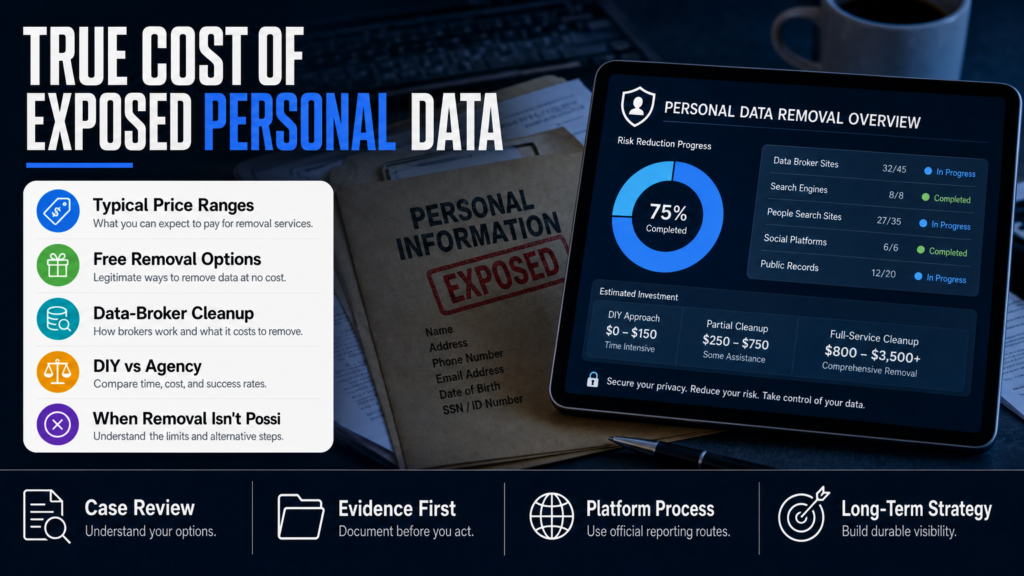
- Low-complexity DIY or single-item removal: $0–$200 (time cost only or small pay-for-automation tools).
- Data-broker cleanup subscriptions: $100–$500 per year for mainstream services (DeleteMe-style subscriptions).
- Targeted removals requiring legal letters or publisher negotiation: $500–$5,000 per item depending on publisher, jurisdiction, and complexity.
- High-complexity matters (mugshot networks, multiple defamation claims, cross-border publishers): $5,000–$50,000+ depending on legal needs and SEO suppression work.
- Ongoing monitoring and suppression SEO: $200–$2,000+ per month depending on scope and content volume.
Cost drivers explained
Publisher type: small blog vs. national news vs. government record — publishers have different incentives and costs for compliance.
Evidence and legal complexity: false allegations supported by malicious edits may need lawyer work; removing intimate images often moves faster via platform safety teams.
Repetition and republishing: aggregators that scrape content will re-list removed items unless you have ongoing monitoring and resubmission.
- Legal letters increase cost but can prompt publisher review.
- Court action is expensive and variable; it is rarely the first-line option.
- SEO suppression (creating positive authoritative content) is slow but often essential when removal isn’t possible.
What to do when removal is not available
When content cannot be removed (accurate news reporting, public records, or platforms that refuse to act), your practical options are mitigation and correction rather than deletion.
Mitigation combines reputation SEO, authoritative content creation, legal correction where possible, and targeted outreach to people whose opinions matter (clients, partners, credentialing bodies).
- Step 1 — Prioritize results to suppress (page-one links first).
- Step 2 — Create a suppression plan: new pages, guest posts, profiles, and SEO for targeted keywords.
- Step 3 — Combine monitoring with periodic refreshes of positive content and disavow strategies where appropriate.
- Suppress by building higher-quality pages (LinkedIn, professional bios, personal site) to outrank the harmful result.
- Request a correction or update from the publisher if the content is inaccurate — provide evidence; this does not guarantee a change but is a documented step.
- Use paid ads or promoted content strategically to alter what appears for branded searches during hiring or credentialing windows.
- Flag privacy violations (SSNs, intimate content) to platforms and regulators even if the main content stays up.
When to involve legal or PR help
Bring in counsel if the content is demonstrably false and causing measurable harm, or if a publisher refuses reasonable correction requests. Similarly, use PR to manage high-visibility incidents that attract local or national attention.
- False allegations with demonstrable factual errors
- Sustained, high-reach viral attacks
- Credentialing or licensing risks that require direct inquiry responses
Monitoring, follow-up, and timelines you should expect
There is no fixed universal timeline. Some removals are resolved in days, others take months; monitoring is ongoing because content can reappear or be reposted.
A reasonable operational expectation: simple platform removals 3–30 days, broker opt-outs 30–90 days to stabilize, and SEO suppression 3–12 months to change page-one results.
- Step 1 — Establish monitoring keywords and alerts (Google Alerts, paid monitoring). Step 2 — Recheck removed URLs at 30 and 90 days and resubmit opt-outs as needed. Step 3 — Evaluate suppression progress at 3-month intervals and adjust content strategy.
- Document every request and set automated reminders for follow-up.
- Use monitoring tools and manual checks for name+city searches, images, and phone numbers.
- Plan budgets for periodic rechecks — many agencies include quarterly monitoring in subscriptions.
Tools and resources
Set Google Alerts for name variations and use paid monitoring for high-risk individuals. For technical guidance on search engines and erasure options, see our analysis: Search Engines Privacy: Can You Erase Personal Information Online?.
- Google Alerts for basic monitoring
- Paid services for image and deep-web monitoring
- Spreadsheets or case-management tools to track takedown requests
When to hire professionals and how to vet them
Hire an agency when time is scarce, the case is high-stakes, or the problem spans publishers, platforms and search. Agencies should provide a clear scope, evidence handling standards, and an escalation roadmap that may include legal coordination.
Vetting questions should focus on processes and transparency; avoid vendors that promise guaranteed removals or permanent suppression.
- Step 1 — Get at least two written proposals with line-item pricing.
- Step 2 — Confirm monitoring frequency and recheck policies for re-posts.
- Step 3 — Insist on written confidentiality and defined operational controls.
- Ask for a sample scope of work, not just a price.
- Verify whether they coordinate with attorneys when legal options are necessary.
- Confirm data protection practices for sharing any identity documents or sensitive evidence.
Gatekeeper red flags
Red flags include guaranteed removals, vague scopes, pressure to sign multi-year contracts without exit clauses, or requests to use deceptive tactics. Ethical vendors will explain limits and alternatives honestly.
- Guarantees of deletion or permanent rankings control
- Requests to impersonate or misrepresent identity to platforms
- No written process for handling re-posts or refunds
Case resources and next steps
If you prefer a focused page about removing personal data, our service page explains typical workflows and what to expect during an engagement. See: Personal Information – Powerful Online Protection.
If you want to begin immediately, do a rapid inventory: list the three highest-priority URLs and collect screenshots and any relevant dates. This inventory is what vendors and lawyers will ask for first.
- Create a prioritized list of URLs and the harm they cause.
- Decide budget and whether to pursue free opt-outs first.
- If you hire help, request a scoped proposal tied to your top three items.
- Start with a small inventory: 3–10 priority items.
- Decide if this is a DIY project or escalation to paid help.
- Keep a digital folder with screenshots and request receipts for every action taken.
If you are under immediate threat
If the exposure includes threats, doxxing with location data, or intimate images, contact platform safety teams, law enforcement if there is a threat to physical safety, and consider an agency that can do rapid escalation and evidence preservation.
- Preserve evidence with screenshots and timestamped exports
- Use platform emergency takedown procedures
- Notify your employer or licensing body if professional risk is imminent
DIY vs Agency: Choose Based on Complexity
A quick two-column comparison to help decide between handling removals yourself or hiring professionals.
| DIY | Agency |
|---|---|
| Cost | Higher upfront, recurring fees |
| Time | Saves your time; faster escalation |
| Effectiveness | Often limited for complex publishers |
| Control | Vendor-managed, requires trust |
| Ideal for | Low-risk, few URLs |
| Scales for | High-stakes cases and legal coordination |
Hypothetical example: Dr. Smith’s mugshot and review storm
Situation: An anonymized physician, ‘Dr. Smith’, discovers a decades-old arrest photo in Google results and several fake negative reviews on Healthgrades and Yelp. The mugshot originates from a county arrest archive and has been copied to a mugshot aggregator; the reviews appear to be coordinated and include factual inaccuracies.
Process: Step one is triage — identify top three search URLs (mugshot aggregator URL, Healthgrades review page, Yelp review). Step two is evidence collection: screenshots, links, and dates. Step three is pathway selection: mugshot aggregators sometimes remove for a fee or via publisher outreach; review sites have platform policies for fake reviews and allow reporting.
- 1) Inventory and evidence: collect URLs and screenshots (Day 1–3).
- 2) Rapid platform reports for fake reviews and doxxing (Day 1–7).
- 3) Publisher outreach and possible paid removal negotiation for aggregator (2–8 weeks).
- 4) Suppression SEO: create authoritative content and backlinks (3–12 months).
- 5) Ongoing monitoring and quarterly rechecks for republished content.
- Initial DIY work: submit review disputes on Healthgrades and Yelp, request Google removal for personal image where applicable, and file opt-out requests with mainstream brokers.
- Paid steps: negotiate takedown with the mugshot aggregator (publisher outreach), prepare an evidence packet for review sites, and invest in suppression SEO for the physician’s professional site and profiles.
- Monitoring: schedule monthly checks and a resubmission plan for any reappearing mugshot URLs.
Common Mistakes People Make
Avoid these recurring errors — they waste time and money.
Assuming everything can be deleted
Mistake: Believing accurate news, public records, and lawful court dockets can be removed on demand. Reality: Many such items are legitimate public-interest content and require mitigation rather than deletion.
- Consequence: Wasting budget on hopeless legal pushes.
- Fix: Prioritize suppression and correction instead of pursuing impossible deletions.
Paying for vague guarantees
Mistake: Signing with vendors that promise deletions or permanent rankings changes.
Fix: Demand a written scope, line-item pricing, and documented processes. Avoid language that guarantees outcomes.
- Consequence: No real recourse if the vendor fails.
- Fix: Keep contracts short-term with clear exit clauses.
Not documenting requests
Mistake: Making removal requests without saving ticket numbers, screenshots, or dates.
Fix: Use a case-tracking spreadsheet and archive every email and confirmation — this is critical for escalations and legal evidence.
- Consequence: Inability to prove prior submissions when a publisher denies action.
- Fix: Use timestamps, PDFs of pages, and archived emails.
Using shady tactics
Mistake: Asking someone to impersonate you, submit false identity attestations, or pay a publisher under the table.
Fix: Never use deceptive or fraudulent tactics; they can create legal exposure and platform bans.
- Consequence: Platform bans, legal risk, and reputational damage.
- Fix: Use legitimate, documented processes and escalate through legal channels when appropriate.
Ignoring recurring repopulation
Mistake: Assuming one removal finishes the job; many aggregators re-list content.
Fix: Budget for monitoring and scheduled re-submissions or a vendor who includes rechecks.
- Consequence: Removed content reappears and wastes previous effort.
- Fix: Schedule 30/90/180-day rechecks and automated alerts.
Best Practices For Removing and Mitigating Personal Data
Follow these durable steps whether you DIY or hire help.
Start with a prioritized inventory
List the worst URLs first: page-one search results and legally sensitive items (SSNs, bank details, intimate images). A short, prioritized list focuses resources where they matter.
- Score each entry by visibility and harm
- Target page-one links and high-impact platforms first
Document everything
Keep a case log with screenshots, ticket numbers, emails, and dates. This record is essential for appeals, vendor handoffs, and any potential legal review.
- Save PDFs of pages with timestamps
- Archive confirmation emails and correspondence
Use combined tactics
Combine platform reporting, publisher outreach, legal review, and SEO suppression. Deletion rarely happens via a single vector when content is entrenched.
- Platform reports for policy violations
- Publisher outreach for editorial corrections
- SEO and content creation for suppression
Plan for monitoring
Set up recurring checks and alerts; build monitoring costs into your budget. Many removals are temporary without follow-up.
- Automate Google Alerts and use paid monitoring for images
- Schedule quarterly manual rechecks for priority URLs
Vet vendors carefully
Insist on written scopes, sample reports, and clear privacy handling. A solid vendor explains limits and alternative strategies rather than promising absolute results.
- Request line-item quotes
- Confirm recheck and republish policies
Expert Tips
- Document and timestamp every removal attempt — screenshots matter in appeals and legal escalations.
- Start with the three most visible URLs; removing those often reduces immediate harm.
- Use a mix of corrective content and authoritative profiles (LinkedIn, institutional bio) to push negative results down.
- Don’t pay to remove accurate public records; instead, focus on suppression and clarification.
- Ask vendors for the exact broker list they will target and how often they re-submit opt-outs.
- If intimate images or safety threats are involved, prioritize platform emergency takedowns and law enforcement where necessary.
- Budget for monitoring — repopulation is common, and ongoing checks catch new appearances early.
- Avoid vendors that promise guaranteed deletions or permanent search control.
Conclusion
How much it costs to remove your personal information from the internet depends on the type of content, the publisher, and whether you handle it yourself or hire specialists. Small, self-managed removals can be free but time-consuming; complex, commercial, or legally sensitive items commonly require paid services and may entail substantial fees.
Create a prioritized plan: inventory your top URLs, try the free path for routine broker opt-outs and platform reports, and escalate to an agency or lawyer for high-stakes or repeat problems. With realistic expectations and documented processes, you can make cost-effective decisions and reduce the practical harms even when deletion isn’t available.
Why Businesses Choose Your Reputation Agency
Managing your reputation takes more than monitoring reviews or publishing the occasional blog post. It takes a strategy built around your situation, your industry, and what is actually showing up in search.
Your Reputation Agency works with businesses, executives, healthcare professionals, attorneys and growing brands. Our services include:
- Remove or challenge defamatory content and false posts across news sites, blogs and social platforms
- Remove negative reviews from Google, Yelp, Facebook, Trustpilot, Glassdoor and industry review sites (e.g., Healthgrades, RateMDs, RealSelf, Vitals, Angi)
- Mugshot and arrest-record removal and remediation
- Remove or takedown negative videos, YouTube content, TikTok clips and other harmful multimedia
- Remove or suppress negative search results and implement search-engine suppression strategies (SEO to bury bad results)
- Remove personal information and opt-out from people-search and data-broker sites (address, phone, phone number removal)
- Social media impersonation and fake account takedown (reporting and removal on Facebook, Instagram, Twitter/X, LinkedIn, TikTok)
- Reddit and community forum post/comment removal and visibility reduction
- Online crisis management and reputation PR to respond to viral incidents
- Monitoring and alerting for negative content, fake reviews and emerging reputation threats
Frequently Asked Questions
1. Is there a free way to remove my information from the internet?
Yes. Many platform reporting tools and data-broker opt-outs are free; you can also delete your own content. Free routes work best for information you control or where platforms have clear policies (impersonation, intimate images, explicit doxxing). Public records and accurate news reporting typically cannot be removed for free.
2. Which is better, Cloaked or DeleteMe?
Neither is universally better — compare on coverage, monitoring frequency, transparency, and contract terms. Some services offer broader broker lists or more frequent rechecks; others are cheaper. Ask for a line-item broker list and recheck policy before deciding.
3. Is personal data removal worth it?
It depends on the risk and potential harm. For professionals facing reputational or revenue risks, paid removal and monitoring are often cost-effective. For low-risk exposures, selective DIY work plus periodic monitoring may be sufficient.
4. What is the best company to remove personal information from the internet?
There’s no single ‘best’ company; choose based on your needs. For broad broker cleanup, subscription services can be cost-effective. For complex or high-stakes cases, an agency that combines legal, technical, and SEO tactics is often preferable. Vet vendors for scope, reporting, and escalation processes.
5. How long does removal typically take?
Timelines vary. Simple platform removals can occur in days; broker opt-outs often stabilize in 30–90 days; SEO suppression may take 3–12 months. There is no guaranteed timeline because platforms, publishers, and search algorithms are outside your control.
6. Can I remove my personal information from Google for free?
You can request removals using Google’s tools for outdated content, personal data, and certain privacy violations. Google will not remove lawful public records or accurate news just because they are embarrassing; for those, suppression and correction are the practical strategies.
7. What should I do if removal is denied?
If a platform or publisher denies removal, document the denial, consider an appeal, and shift to mitigation: request corrections, build authoritative content to suppress the item, and, if warranted, consult legal counsel to evaluate potential remedies.
8. How much should I budget for ongoing monitoring?
Budget depends on risk level. For most individuals, $200–$600 per year for a reputable monitoring service is a reasonable starting point; high-risk professionals may budget $1,000+ per year for more active monitoring and quarterly rechecks.
9. Are there shady services I should avoid?
Avoid anyone promising guaranteed deletions, requiring deceptive tactics, or asking you to impersonate or misrepresent identity. Ethical vendors explain limits, provide written scopes, and do not promise specific legal outcomes.
This content provides general information and does not constitute legal advice. The available options and likely outcomes depend on the facts, evidence, platform policies, applicable law, jurisdiction, and public-interest considerations.
Past examples do not guarantee future results. Removal, correction, deindexing, and search-position changes depend on third parties and circumstances outside Your Reputation Agency’s control.
How Much Does It Cost to Remove Personal Information?
Manual data-broker opt-outs may cost nothing beyond your time. Subscription services typically charge recurring fees to monitor and resubmit removals. Complex reputation matters cost more because they can require source research, publisher outreach, platform appeals, monitoring, legal coordination, and search-result mitigation. No provider can ethically guarantee deletion from every source.
Seven Factors That Affect the Cost
- The number of exposed profiles and URLs.
- Whether the information comes from data brokers or public records.
- The need for repeated monitoring and opt-outs.
- Whether factual corrections require supporting documents.
- Safety, stalking, identity-theft, or impersonation concerns.
- Legal review or court processes.
- Search suppression when source removal is unavailable.
The Federal Trade Commission’s privacy guidance describes steps consumers can take directly. Before paying, request a written scope that lists covered sites, reporting frequency, exclusions, cancellation terms, and how the provider handles submitted personal data.