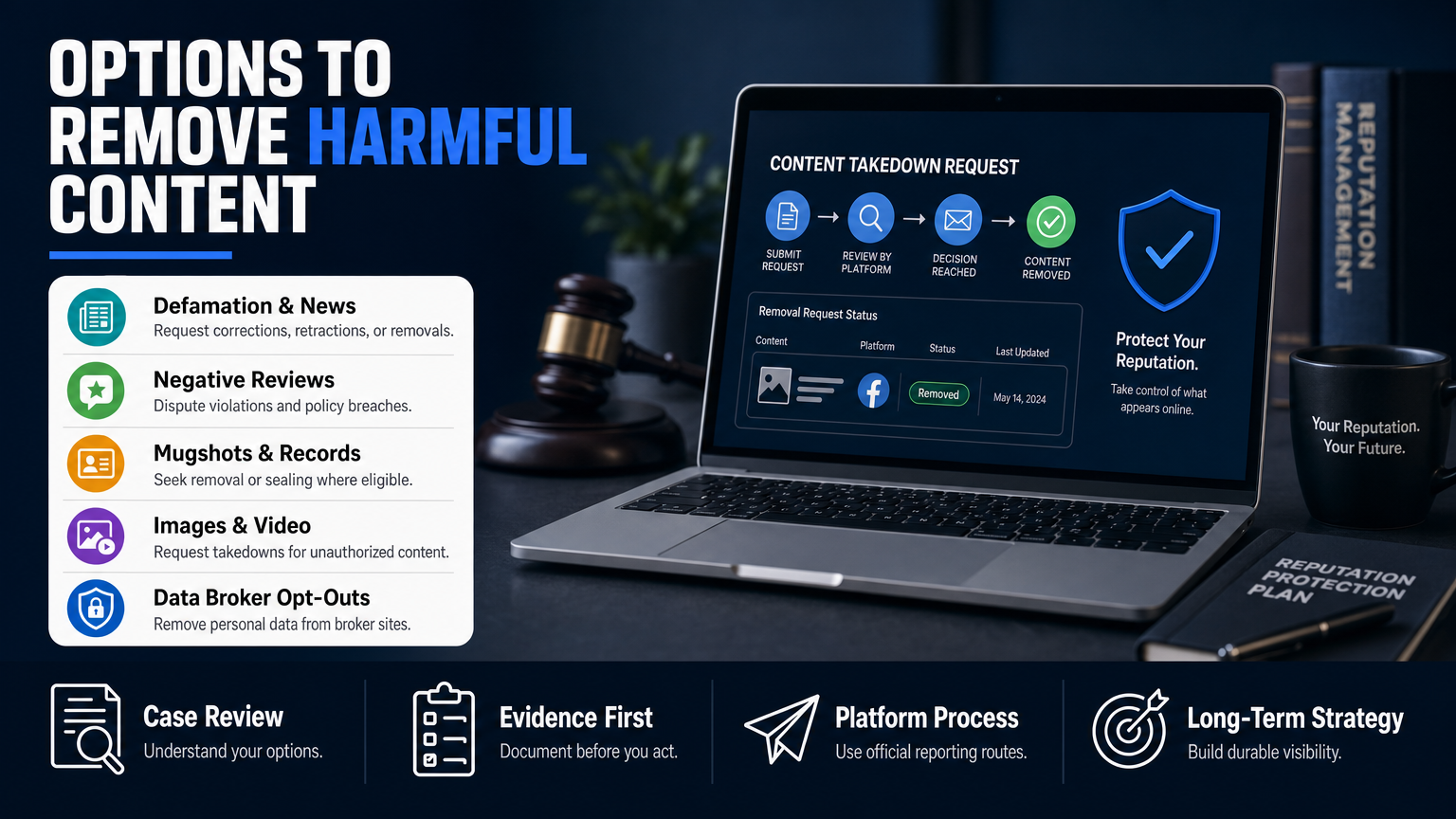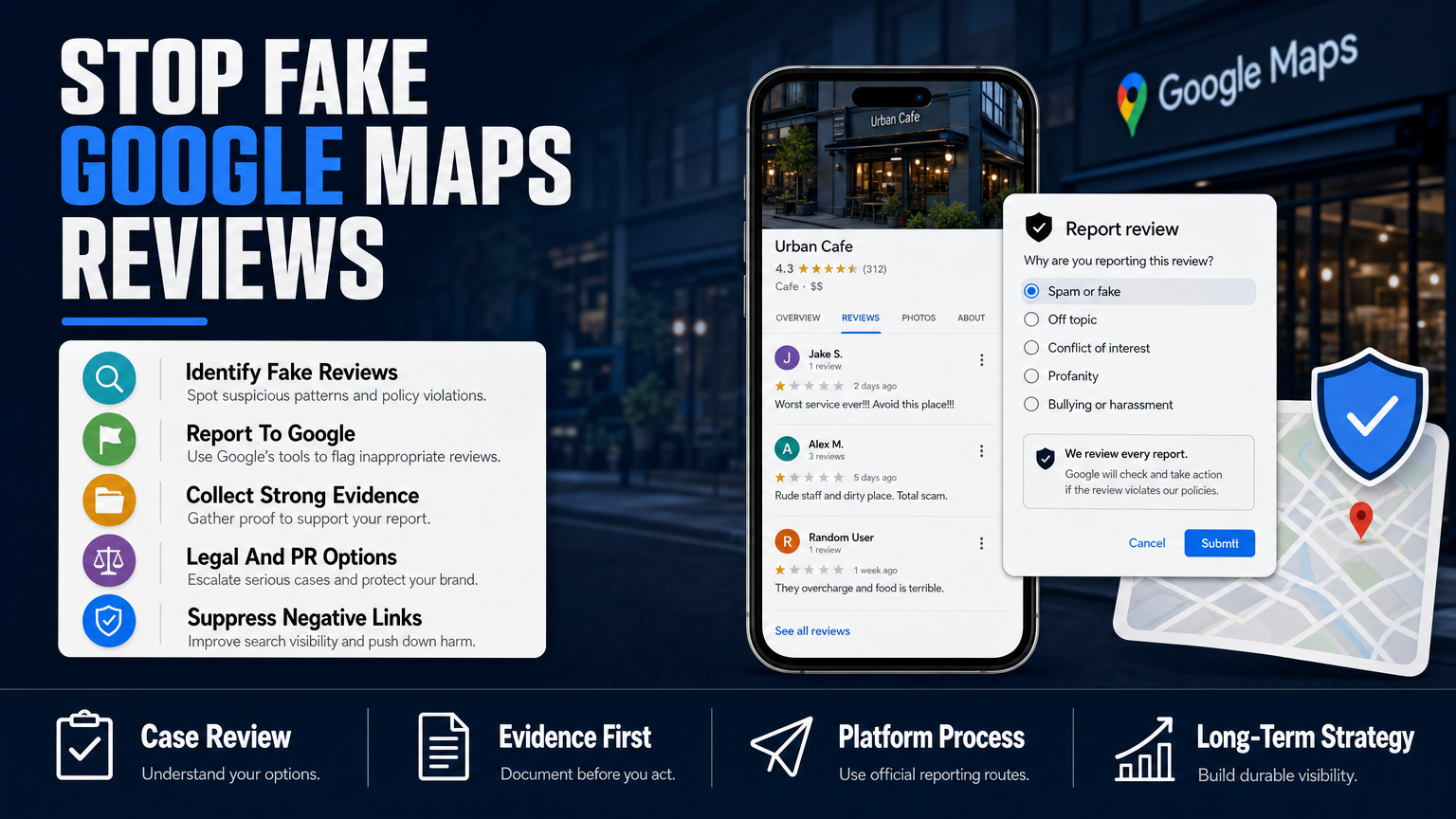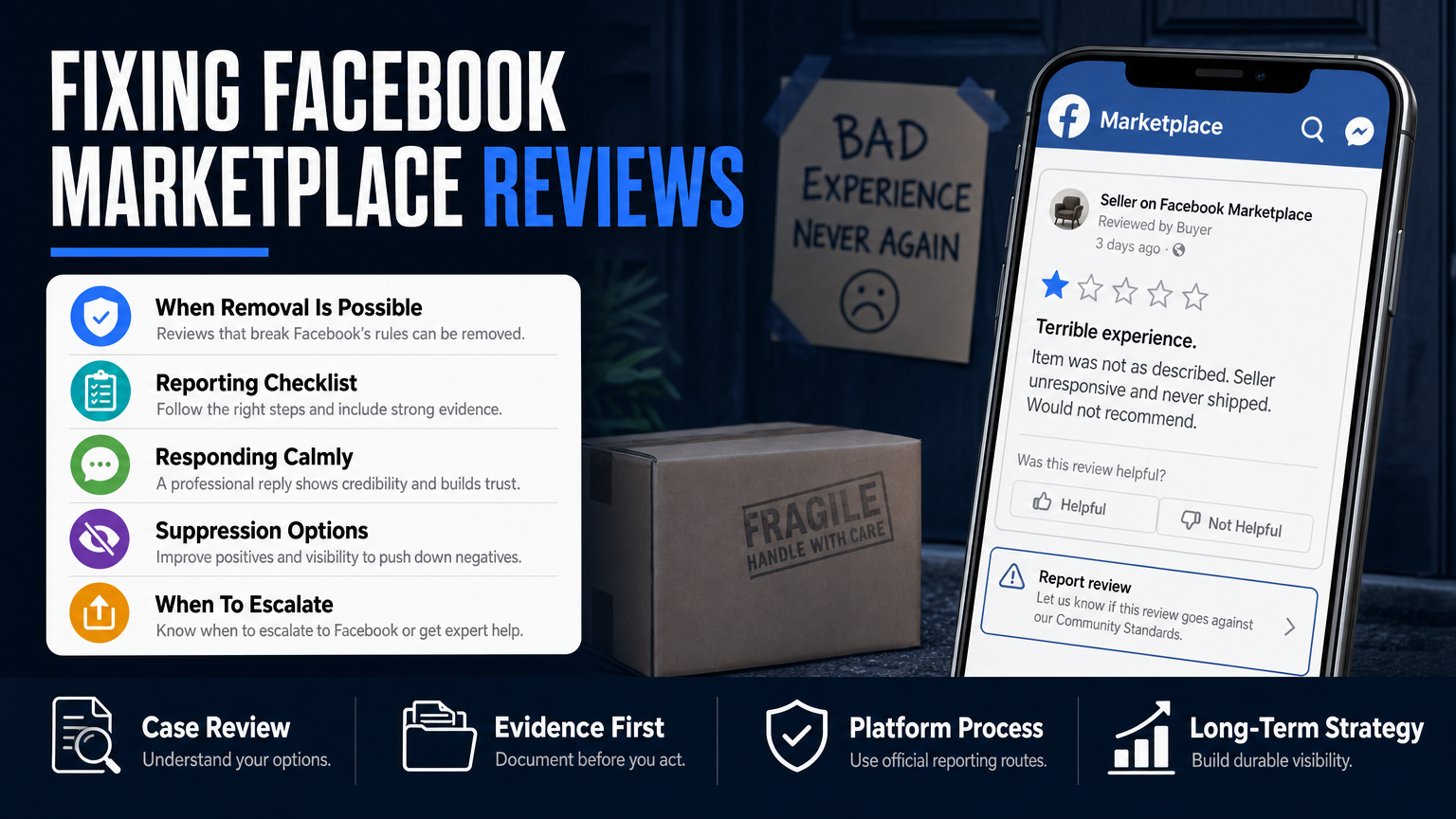
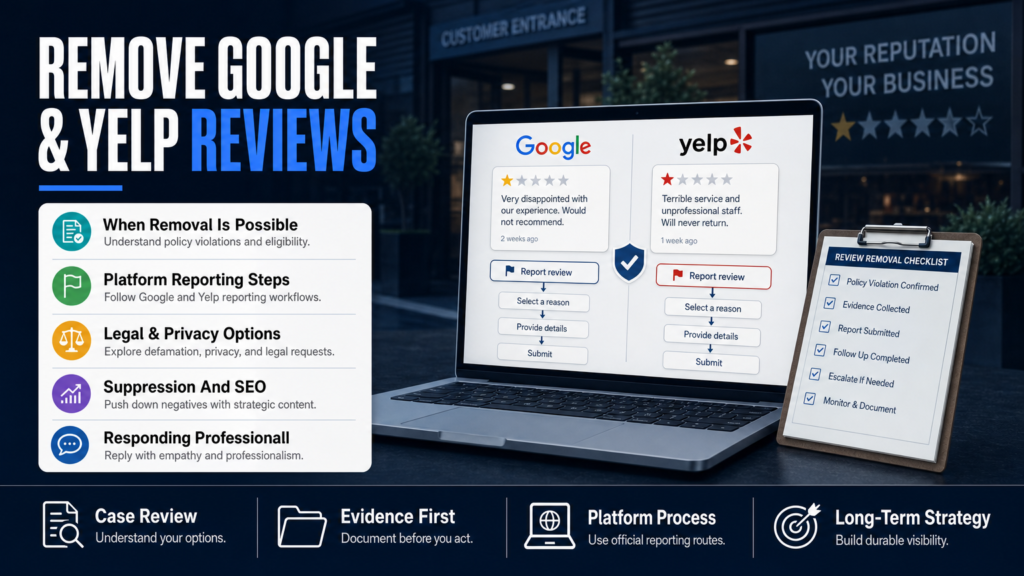
If you’re reading this, you’re dealing with a harmful or unfair review on Google or Yelp and need clear, usable steps for how to remove negative Google and Yelp reviews. This guide walks through the platform processes, legal paths, costs you can expect, and mitigation plans when removal isn’t realistic.
We cover what constitutes a grounds for removal on each platform, precise reporting flows and evidence to collect, realistic timeframes, and what professional help can — and cannot — do. The advice here is practical and cautious: platform decisions and legal outcomes vary by evidence, policy, and jurisdiction.
Read the sections that match your situation: immediate removals (privacy, personal info, impersonation), content that may need legal review (defamation), and negative-but-accurate reviews where suppression and reputation repair are the right moves.
Table of Contents
- Is it possible to get negative Google reviews removed?
- Can you remove a negative Yelp review?
- How to remove negative Google and Yelp reviews: step-by-step process
- How much does it cost to get a bad Google review removed?
- Can you hire someone to remove bad Google reviews?
- What to do when removal is NOT available
- Monitoring, prevention, and next steps
- Quick checklist and realistic timelines
- Removal vs. Suppression (SEO) — Quick Comparison
- Hypothetical example: A clinic fighting a bogus review
- Common mistakes that make situations worse
- Best practices for handling negative reviews
- Expert Tips
- Conclusion
- Why Businesses Choose Your Reputation Agency
- Frequently Asked Questions
Is it possible to get negative Google reviews removed?
Yes — sometimes. Google will remove reviews that violate its policies (spam, fake content, hate speech, privacy violations, impersonation, or conflicts of interest), but it will not remove reviews that are simply negative or truthful opinion. Removal depends on the review content, evidence, platform policy, and Google’s review process.
Start by documenting the review (screenshots, timestamps, reviewer profile URL) and deciding which Google policy the review may violate. For a step-by-step approach and how we evaluate cases, see our service overview at Remove Negative Google Reviews – Legally & Effectively.
- Document the review: capture URL, date/time, and reviewer profile.
- Attempt to identify the reviewer (without harassment): compare with customer lists and correspondence.
- Use the official reporting flow in Google Business Profile (“Flag as inappropriate”) and supply supporting evidence where the form allows.
- Removable examples: spam, explicit threats, doxxing (exposed sensitive info), impersonation, or reviewer admission of a conflict of interest.
- Not removable: truthful negative experiences, expressions of opinion, or complaints about price/service unless they cross policy lines.
- Evidence matters: screenshots, internal records (appointment logs, customer correspondence), and matching timestamps improve chances of review action.
How to flag a review in Google Business Profile (quick)
Open your Business Profile on Google (via search or Google Maps), find the review, click the three vertical dots, and select “Flag as inappropriate.”
If you manage the profile in Google Business Profile (formerly Google My Business), use the support/contact option to escalate and attach any evidence showing policy violation.
- Use the “Report a policy violation” option when available.
- If the reviewer has posted the same text across multiple locations, note that as evidence of spam.
Can you remove a negative Yelp review?
Yelp will remove reviews that violate its content guidelines (hate speech, discrimination, doxxing, extortion, personal information, or clear evidence of fabrication), but, like Google, Yelp does not remove reviews simply because they are negative.
Use Yelp’s “Report review” link or the Yelp for Business Owners interface to flag a review, and gather supporting evidence: screenshots, account details, and any proof tying the post to a policy violation.
- Sign into Yelp for Business Owners and locate the review.
- Click the ‘..’ or flag icon and submit a report citing the specific Yelp guideline violated.
- If flagged reviews are not removed, use the Contact Yelp Business Support form and include concise evidence.
- Yelp policies focus on authenticity and relevance — personal attacks or unrelated content are candidates for removal.
- Yelp sometimes places a consumer alert on businesses that appear to be soliciting fake reviews; if you suspect manipulation, document it carefully.
When to escalate to Yelp support
If the review contains personal data, threats, or is clearly fabricated (e.g., reviewer admits to no transaction), escalate using the Yelp business support contact form and include timestamps and supporting documents.
If Yelp declines removal, consider responding publicly with a calm factual reply and follow the mitigation steps below.
- Escalations: threats, doxxing, illegal content, or sustained fake-review networks.
- Keep your escalation concise and evidence-based; emotional appeals rarely help.
How to remove negative Google and Yelp reviews: step-by-step process
Below are practical steps you can take immediately to pursue removal or reduction of visibility. Work methodically: evidence collection, reporting, escalation, legal review (if warranted), and mitigation.
Different platforms require slightly different evidence and forms. Follow each platform’s instructions precisely and save copies of every submission.
- 1) Capture evidence: screenshot the review, copy the URL, save any relevant messages, and record transaction data that contradicts the reviewer if available.
- 2) Match the review to a policy: spam, impersonation, privacy violation, extortion, illegal content, or conflict of interest.
- 3) Submit a report through the platform (Google Business Profile → flag/report; Yelp → report review or Business Support).
- 4) If the platform refuses removal and content appears defamatory or unlawful, consult a qualified attorney for legal options such as cease-and-desist, retraction demand, or court action.
- 5) While legal remedies are considered, implement reputation mitigation (responses, additional positive reviews, SEO suppression).
- Collect evidence before contacting platforms.
- Use the platform’s official reporting mechanism first — this is required in most disputes.
- Escalate with additional documentation if the initial report is denied.
Google-specific steps
Use the ‘flag as inappropriate’ option for basic policy violations. Business-profile managers can use the help center to contact support and attach evidence. If the review includes personal data (SSN, bank info) or threats, report to law enforcement and to Google for removal.
If the issue is a clear fake review coming from a competitor or a conflict of interest, provide transaction logs, IDs, or proof of no prior relationship when contacting support.
- Google’s forms accept specific categories: spam, off-topic, conflict of interest, restricted content, and illegal content.
- If a review violates privacy, attach a redacted copy of the exposed sensitive data as evidence in your support ticket.
Yelp-specific steps
Flag the review on the platform, then use the Yelp for Business Owners help center to escalate. For doxxing or extortion, provide direct evidence and consider a DMCA or other legal routing when content includes copyrighted or legally protected material.
If the reviewer admits to not being a customer or to being paid for reviews, include that proof in your escalation.
- Yelp uses algorithmic filtering as well — encourage legitimate customers to post honest reviews to balance flagged content where removal is not possible.
- Avoid asking reviewers to remove their review in exchange for anything — that can look like review manipulation.
How much does it cost to get a bad Google review removed?
Costs vary widely depending on your route: DIY reporting is free, platform escalations are free, paid agency assistance and legal routes add fees. There is no universal price for removal because outcomes are uncertain and services vary by scope.
Below are common market ranges and what you can expect to pay as of typical industry practice — these are illustrative ranges, not promises of results.
- 1) Start with free platform reports.
- 2) If escalation requires forensic evidence or coordinated action (multiple reviews, organized attack), budget for agency or legal fees.
- 3) Ask any vendor for a written scope of work and an honest risk assessment of likely outcomes before paying.
- DIY reporting: free — your time and internal resource costs only.
- Reputation-management agencies: single-review removal attempts commonly range from $250 to $2,000+ depending on complexity and documentation needed; monthly retainers are common for ongoing monitoring.
- Law firms: hourly rates vary by jurisdiction; some firms work on demand letters or contingency for larger defamatory cases — legal fees may run into thousands or more.
What drives cost
Complexity (impostor accounts, repeated attacks), evidence collection needs, legal involvement, cross-platform work, and the need for SEO suppression all increase cost.
Some vendors advertise quick timelines; ask for a clear explanation of methods and understand that no one can guarantee removal.
- One-off vs. ongoing protection (monitoring and review generation) changes cost structure.
- Legal action is typically the most expensive and time-consuming option.
Can you hire someone to remove bad Google reviews?
Yes — you can hire professional reputation managers and attorneys to pursue review removal, but hiring someone does not guarantee removal. Professionals can provide evidence-gathering, formal reporting, legal letters, and suppression/SEO strategies to reduce visibility when removal is unavailable.
When evaluating vendors, ask for a written process, examples of similar issues handled (anonymized), fee structure, and how they escalate when a platform denies removal. For one example of a service page that describes a removal-focused offering, review Remove Google Reviews: Our 30-Day Guarantee to Reclaim Your Reputation, and clarify timelines and success metrics in writing before engaging.
- 1) Ask for a written evaluation and estimated plan.
- 2) Request clear deliverables and communication frequency.
- 3) Confirm the provider’s data-security measures for handling sensitive information.
- Reputable firms follow platform rules and legal methods — avoid anyone who suggests fake takedown tactics, false identities, or review-bombing.
- Expect a diagnostic phase where the provider evaluates whether the content qualifies for removal or needs mitigation.
When to hire an attorney instead of an agency
If a review includes false factual statements that are demonstrably defamatory, extortion, or criminal threats, a lawyer can advise on legal notices and litigation — agencies do not provide legal representation.
Coordinate agency work with counsel when pursuing legal remedies so evidence collection conforms to legal standards.
- Legal routes can compel retraction or removal in some cases but are time-consuming and costly.
- Always get an upfront assessment from counsel about likely outcomes and jurisdictional issues.
What to do when removal is NOT available
Many negative reviews are opinions or truthful customer accounts and will not be removed. When removal is unavailable, shift to mitigation: well-crafted public responses, SEO and content strategies to push negative results lower, and building a stream of positive, verified reviews.
Mitigation should be proactive and transparent. Avoid asking reviewers to remove legitimate negative feedback in exchange for incentives — that can violate platform rules and backfire.
- 1) Publish a calm, corrective public response to the review addressing factual points and offering contact info for resolution.
- 2) Launch an SEO reputation campaign: optimized landing pages, YouTube videos, articles, and profiles that target your name plus relevant terms.
- 3) Use monitoring tools to track if mitigations reduce visibility and set up alerts for new negative content.
- Respond promptly and professionally: acknowledge, offer to take the conversation offline, and show commitment to resolving the issue.
- SEO suppression: create authoritative, keyword-optimized pages (company site, profiles, press releases) that can outrank the negative result over time.
- Solicit honest reviews from real customers to increase the ratio of positive feedback and engage on social channels.
Practical response template
Keep replies short, factual, and customer-focused. Example: “We’re sorry you had this experience. We take this seriously — please call our office at [phone] or email [address] so we can review your account and resolve this.”
Avoid admitting liability or making promises; instead, show willingness to investigate and correct where appropriate.
- Do not post long rebuttals that escalate the issue publicly.
- If the reviewer responds, move to private channels quickly to resolve.
Monitoring, prevention, and next steps
After initial remediation, set up monitoring and internal processes to reduce future risks: automatic alerts for new reviews, a review-collection workflow for real customers, and staff training on customer escalation.
Consider a balance of defensive tactics (privacy controls, removing personal data from people-search sites) and proactive reputation work (SEO, thought leadership, verified review channels). For assistance with ongoing negation and monitoring strategies, see our service page at Remove Negative Reviews Fast – Guaranteed in 30 Days, and evaluate the scope before committing.
- 1) Set up an alerting system for your business name, owner names, and key staff.
- 2) Implement a verified-review solicitation program (post-service emails with review links).
- 3) Quarterly audit: check major review sites, people-search sites, and social platforms for risky content.
- Use Google Alerts, Brand24, or other monitoring tools for immediate notification of new mentions.
- Train staff to capture service details so you can verify or refute reviews with evidence if needed.
- Establish a documented response policy with approved language for public replies.
A note on review generation
Encourage honest reviews from real customers through post-service emails and in-person asks. Do not offer incentives for positive reviews or coordinate fake-review schemes — these violate platform rules and can lead to penalties.
Use verified channels (receipt links, in-app prompts) to increase credibility of new reviews.
- Avoid review gating (pre-screening customers and only sending positive reviewers to public sites).
- If you implement a review request flow, keep it consistent for all customers.
Quick checklist and realistic timelines
Below is a practical checklist and typical timeframe ranges to help plan your response; these are broad estimates, not promises.
Platform reviews can be actioned within days to weeks; legal remedies may take months. Mitigation/SEO can take several weeks to many months to shift search visibility.
- Create an evidence packet (day 0).
- Submit platform reports (day 1–3).
- Escalate to platform support and legal counsel if refused (week 1–4).
- Start SEO/content suppression and review generation (week 1 onwards).
- Immediate (same day): capture screenshots, reply publicly with a brief professional message, flag review via platform form.
- Short term (3–30 days): platform review outcomes often occur in this window for clear policy violations; follow up with support if needed.
- Medium term (1–6 months): SEO suppression and content-generation strategies begin to show movement in search results.
- Long term (6+ months): sustained reputation repair and legal action (if taken) may conclude or result in further steps.
When to involve outside help
Consider professional help when you face multiple coordinated fake reviews, doxxing, extortion, or a reviewer is spreading demonstrably false facts that damage your business. Also consider help when the internal time or expertise to pursue removal and mitigation is not available.
Get a written scope and risk assessment before signing any contract; make sure responsibilities and reporting are defined.
- Immediate legal involvement: threats, extortion, doxxing, or potential criminal conduct.
- Agency involvement: SEO suppression, cross-platform removals, or ongoing monitoring.
Removal vs. Suppression (SEO) — Quick Comparison
Use this table to decide whether to pursue removal or suppression.
| Removal (Platform / Legal) | Suppression (SEO / Content) |
|---|---|
| Goal | Reduce visibility by outranking |
| When to use | Content violates policy or is unlawful |
| Speed | Potentially fast for clear policy violations |
| Cost | Varies — can be low (DIY) or high (legal) |
| Guarantee | No guarantee — platform controls outcome |
| Typical timeframe | Days to months for platform decisions |
| Best role | Safety/legal cleanup |
Hypothetical example: A clinic fighting a bogus review
Clinic X receives a one-star review claiming medical malpractice and uses the following approach:
This example is hypothetical and anonymized to show the process; it does not represent a real client engagement or promised outcome.
- Step 1 — Evidence: Save the review URL, screenshot, and internal records showing no matching appointment.
- Step 2 — Platform report: Use Google’s flagging tool and attach a concise statement of the discrepancy.
- Step 3 — Escalation: If removal is denied and the claim is demonstrably false, consult a lawyer to evaluate a retraction demand.
- Step 4 — Mitigation: Publish authoritative content and encourage verified reviews to lower the visibility of the disputed review.
- Day 0: Staff capture screenshots of the review and match the review date to clinic appointment logs — no appointment found.
- Day 1: Clinic flags the review in Google, submits evidence showing no record of the patient, and reports impersonation/conflict of interest.
- Day 3–10: If Google declines removal, clinic consults counsel to prepare a retraction demand letter for false factual assertions.
- Meanwhile: Clinic posts a public, calm reply offering a way to resolve concerns offline and begins soliciting verified reviews from recent patients to restore ratings.
Common mistakes that make situations worse
Avoid these frequent missteps — each one reduces your chance of a satisfactory outcome or risks platform penalties.
Mistake 1 — Emotional public rebuttals
Responding angrily on the review thread escalates visibility and looks unprofessional. Keep public replies short, factual, and invite private resolution.
- Don’t attack the reviewer or make legal threats in public replies.
- Move the conversation offline quickly if corrective action is needed.
Mistake 2 — Paying for fake removals or fake reviews
Buying takedown promises or fake positive reviews violates platform rules and can lead to penalties. Use legitimate reputation-building channels instead.
- Beware vendors offering guaranteed removals — no legitimate provider can guarantee outcomes.
- Insist on documented processes before paying an agency.
Mistake 3 — Failing to document evidence
Without timestamps, transaction logs, or communication records, platform or legal escalations are weaker. Collect and preserve evidence before it disappears.
Maintain a secure folder for case materials and limit access to necessary staff.
- Screenshots alone can be challenged — where possible, include URLs and metadata.
- Record chain-of-custody for evidence if legal action may follow.
Mistake 4 — Ignoring legitimate negative feedback
Not responding to negative-but-accurate reviews misses an opportunity to demonstrate service recovery. A corrective response can turn some dissatisfied customers into retained clients.
- A calm response with an offer to resolve shows future readers you care.
- Use feedback to fix recurring operational issues.
Mistake 5 — Inconsistent review solicitation
Only asking happy customers for reviews or gating requests can lead to biased reviews and platform penalties. Use a fair, consistent review request process.
- Implement a post-service review request for all customers.
- Keep the process the same across channels to avoid claims of manipulation.
Best practices for handling negative reviews
Adopt these proven practices to protect and rebuild your online reputation while staying within platform policies and legal boundaries.
Document everything immediately
Capture screenshots, URLs, reviewer profiles, and any internal records that relate to the incident. Time-stamped evidence improves the strength of platform reports and legal options.
- Store evidence in a secure, access-controlled folder.
- Log dates and staff who handled the matter.
Respond publicly with a short, constructive message
A well-crafted reply shows readers you take complaints seriously. Offer to investigate and resolve offline and avoid admissions or detailed rebuttals in public.
- Example reply: “We’re sorry to hear this. Please contact us at [email/phone] so we can review your situation and find a resolution.”
- Keep replies under 2–3 sentences and avoid technical language.
Use platform processes first, then escalate
Always start with the platform’s official reporting mechanism. If that fails, escalate to support or consider legal counsel if the content is unlawful.
- Document every submission and response from the platform.
- Follow up methodically and avoid repeated duplicate reports without new evidence.
Build positive content and verified reviews
Create authoritative pages (staff bios, FAQs, service pages) and encourage satisfied customers to post reviews. Over time, this dilutes the impact of a single negative review.
- Use your website, press releases, and social profiles to occupy search engine real estate.
- Request reviews consistently and transparently from all customers.
Protect personal data and privacy proactively
Remove unnecessary personal data from public-facing pages and opt out of data-broker sites to lower risk of doxxing or privacy-based review issues.
- Audit staff and executive profiles for overshared personal data.
- Set up alerts for name mentions and people-search listings.
Expert Tips
- Always capture the review URL and a full-page screenshot before attempting any action.
- Keep public replies short, polite, and focused on resolution rather than debate.
- If multiple fake reviews appear, document patterns — similar wording, timing, or IP may indicate a coordinated attack.
- Use the business owner support channels (Google Business Profile support, Yelp for Business) to escalate — attach concise evidence.
- Avoid asking for removal in exchange for refunds or incentives in public posts.
- When in doubt about defamation, get a jurisdiction-specific legal opinion before sending demand letters.
- Start SEO suppression early — it takes time for new content to rank.
- Vet vendors for documented processes and require a written scope before paying for services.
Conclusion
Removing negative Google and Yelp reviews is often possible when the content violates platform policies or the law, but many negative posts are opinions and will remain. The most effective response combines careful documentation, precise platform reporting, measured public replies, and a mitigation plan that includes SEO and honest review generation.
If you face threats, doxxing, extortion, or demonstrably false statements of fact, consult counsel and consider professional reputation support. Whatever path you choose, insist on a clear written plan, documented evidence handling, and realistic expectations about timelines and outcomes.
Why Businesses Choose Your Reputation Agency
Managing your reputation takes more than monitoring reviews or publishing the occasional blog post. It takes a strategy built around your situation, your industry, and what is actually showing up in search.
Your Reputation Agency works with businesses, executives, healthcare professionals, attorneys and growing brands. Our services include:
- Remove or challenge defamatory content and false posts across news sites, blogs and social platforms
- Remove negative reviews from Google, Yelp, Facebook, Trustpilot, Glassdoor and industry review sites (e.g., Healthgrades, RateMDs, RealSelf, Vitals, Angi)
- Mugshot and arrest-record removal and remediation
- Remove or takedown negative videos, YouTube content, TikTok clips and other harmful multimedia
- Remove or suppress negative search results and implement search-engine suppression strategies (SEO to bury bad results)
- Remove personal information and opt-out from people-search and data-broker sites (address, phone, phone number removal)
- Social media impersonation and fake account takedown (reporting and removal on Facebook, Instagram, Twitter/X, LinkedIn, TikTok)
- Reddit and community forum post/comment removal and visibility reduction
- Online crisis management and reputation PR to respond to viral incidents
- Monitoring and alerting for negative content, fake reviews and emerging reputation threats
Frequently Asked Questions
1. Is it possible to get negative Google reviews removed?
Yes, when the review violates Google’s policies (spam, impersonation, privacy violations, threats, or conflicts of interest). However, Google will not remove reviews simply because they are negative or truthful opinions; each case depends on evidence and policy.
2. Can you remove a negative Yelp review?
Yelp will remove reviews that breach its content guidelines (hate speech, doxxing, extortion, clear fabrication), but will not remove legitimate negative feedback. Use Yelp’s ‘Report review’ or Business Support and provide clear evidence when asking for removal.
3. How much does it cost to get a bad Google review removed?
DIY reporting is free. Paid agency efforts typically range broadly (hundreds to a few thousand dollars per difficult case) and legal action can be significantly more expensive. Costs vary by complexity, evidence needs, and whether cross-platform work or litigation is required.
4. Can you hire someone to remove bad Google reviews?
Yes — you can hire professional reputation firms and attorneys to pursue removal, evidence collection, and mitigation. Professionals cannot guarantee removal; they provide processes and expertise to pursue the available platform and legal options.
5. How long does it take for platforms to act on review reports?
Platform response times vary: straightforward policy violations may be removed in days to a few weeks, while more complex escalations or legal requests can take weeks to months. Timing depends on the platform, the clarity of the violation, and the evidence supplied.
6. What should I do if the review is true but unfair?
Respond professionally, offer to resolve the issue offline, and use the incident to improve operations. If removal isn’t available, focus on generating authentic positive reviews and using SEO to reduce the review’s visibility over time.
7. What evidence helps the most when requesting removal?
Transaction logs, appointment records, messages showing no relationship, screenshots showing doxxing or threats, and proof that the reviewer has a conflict of interest strengthen removal requests. Keep a secure, timestamped record of evidence.
8. Can deleting reviews affect SEO or search listings?
Removing a review affects the profile’s visible rating and may change how results display, but search rankings are influenced by many factors. If a review stays public, SEO mitigation (new authoritative content, profiles, and verified reviews) is the usual method to reduce its visibility.
9. Are there risks to responding to negative reviews?
Yes — unprofessional or legally risky responses can escalate harm. Avoid admissions of liability, personal attacks, and offering incentives publicly. Use brief, factual replies and move detailed discussions offline.
This content provides general information and does not constitute legal advice. The available options and likely outcomes depend on the facts, evidence, platform policies, applicable law, jurisdiction, and public-interest considerations.
Past examples do not guarantee future results. Removal, correction, deindexing, and search-position changes depend on third parties and circumstances outside Your Reputation Agency’s control.