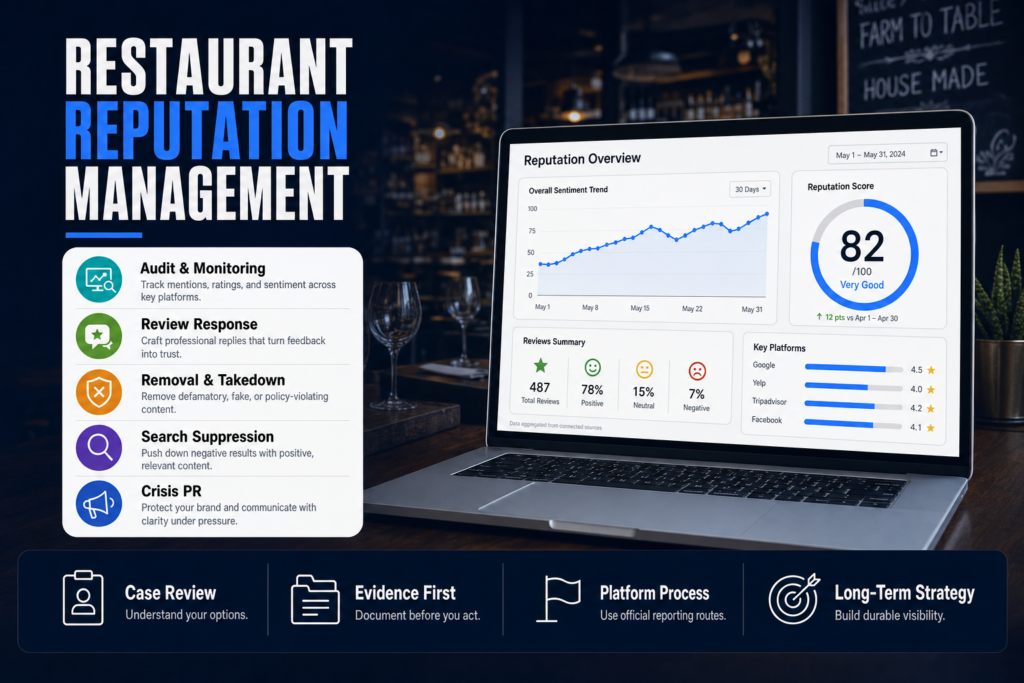
You run a restaurant and you just found a review, social post, or search result that’s costing you tables. This guide walks through exactly what to do, what you can reasonably expect, and when you’ll need outside help.
This article focuses on online reputation management for restaurants: how to audit current risks, use platform processes (Google Business Profile, Yelp, TripAdvisor, OpenTable, Facebook/Instagram, review sites), and combine legal, technical, and PR options to restore trust.
You’ll get concrete checklists, platform‑specific actions, realistic timeframes, and a crisis playbook so your team can act fast without making the problem worse.
If you want a full operational workflow for day‑to‑day reputation work, see our complete how‑to guide for businesses for a fuller programmatic view.
Table of Contents
- Start with an audit: what to check first
- How much does reputation actually affect a restaurant?
- Responding to reviews: how to write replies that reduce damage
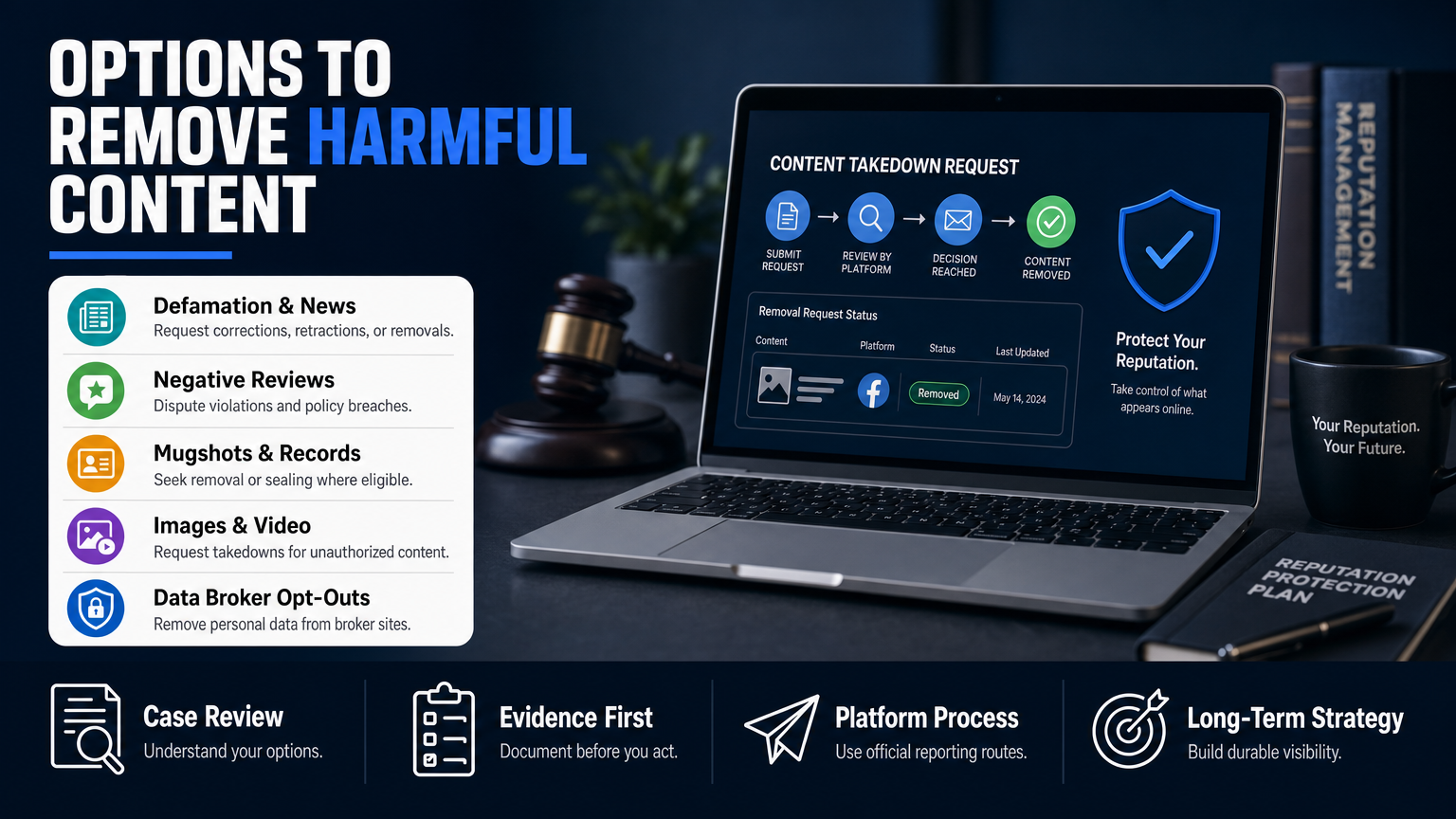
- Removal and takedown: platform processes and legal options
- When removal is NOT available: mitigation and suppression
- Crisis response: viral incidents, food safety allegations, and PR
- Tools, monitoring and whether to hire an agency
- Removal vs Suppression — which path to choose?
- Hypothetical example: ‘Chef’s Table Bistro’ viral complaint
- Common mistakes restaurants make
- Best practices for long‑term reputation health
- Expert Tips
- Conclusion
- Why Businesses Choose Your Reputation Agency
- Frequently Asked Questions
Start with an audit: what to check first
Begin with a rapid evidence audit so your next moves match the problem. An audit separates issues you can escalate for removal from problems better handled by response, correction, or suppression.
For a step‑by‑step operational model and templates you can deploy across multiple locations, consult our longer program guide: How to Do Online Reputation Management: The Complete Guide for Businesses.
- Step 1 — 0–24 hours: Capture screenshots and save the URL. Log metadata (author, time, device if available).
- Step 2 — 0–72 hours: Search exact text snippets and images to find duplicates or mirror pages.
- Step 3 — 72 hours: Prioritize action items: remove, report, respond, or suppress.
- Identify the content: URL, platform, author handle, screenshots, timestamps.
- Classify the issue: false factual claim, opinion, privacy leak/doxxing, mugshot/arrest page, fake review, impersonation, multimedia (video/image).
- Check ownership: is the content on a forum, a news site, aggregator (mugshot sites), or a major review site?
- Record impacts: lost bookings, refund requests, staff safety concerns, regulatory or licensing exposure.
How much does reputation actually affect a restaurant?
Reputation directly influences discovery, reservation conversions, and repeat business. Negative reviews and viral social posts can reduce conversion on Google Business Profile, TripAdvisor, OpenTable, and your own website.
For a short primer on why reputation matters to businesses and professionals, including reputational risk to licensure and referrals, see Why Online Reputation Management Is Important for Businesses and Professionals.
- Search listings and review stars are visible in search and Maps and often appear above your website.
- OpenTable and reservation partners display reviews that influence booking decisions.
- Platforms feed into third‑party aggregators and local directories, amplifying negative items.
Responding to reviews: how to write replies that reduce damage
When a review is on a platform (Google, Yelp, TripAdvisor, Facebook), the fastest, lowest‑risk step is a public business response. That both signals to future customers that you care and may persuade the reviewer or platform to remove or update the review.
Never post a defensive or accusatory reply — that usually makes the situation worse and can be used as evidence of poor conduct.
- Template reply — 15–30 minutes: Thank the reviewer, acknowledge specifics, offer to resolve privately, provide contact.
- Follow‑up — 24–72 hours: If the reviewer replies or reaches out, move the conversation offline and keep detailed records.
- If resolution occurs, politely request an updated review (platform policies vary — never offer payment or incentives).
- Acknowledge the experience and express a desire to make it right.
- Offer offline resolution (phone number or manager’s email) rather than negotiating details in public.
- If the claim is factually incorrect, calmly state corrected facts and invite the reviewer to update their post after resolution.
- If the post alleges illegal conduct or health violations, advise the reviewer to contact you directly and document any regulatory interactions.
Removal and takedown: platform processes and legal options
Removal depends on platform policy, the nature of the content, the evidence you can produce, and the publisher’s willingness to act. We evaluate whether content may qualify for removal or review before escalating.
Below are practical, platform‑specific actions; timelines depend on the platform and the strength of your evidence.
- Evidence collection — immediate: screenshots, server logs, reservation records, CCTV timestamps to prove or disprove a claim.
- Reporting — 24–72 hours: Submit platform reports with supporting evidence. Track ticket IDs and escalation pathways.
- Escalation — 7–30+ days: If platforms refuse or ignore a takedown, evaluate legal options (defamation notice, subpoena for identity of anonymous poster, injunctions) with counsel. The content may warrant legal review.
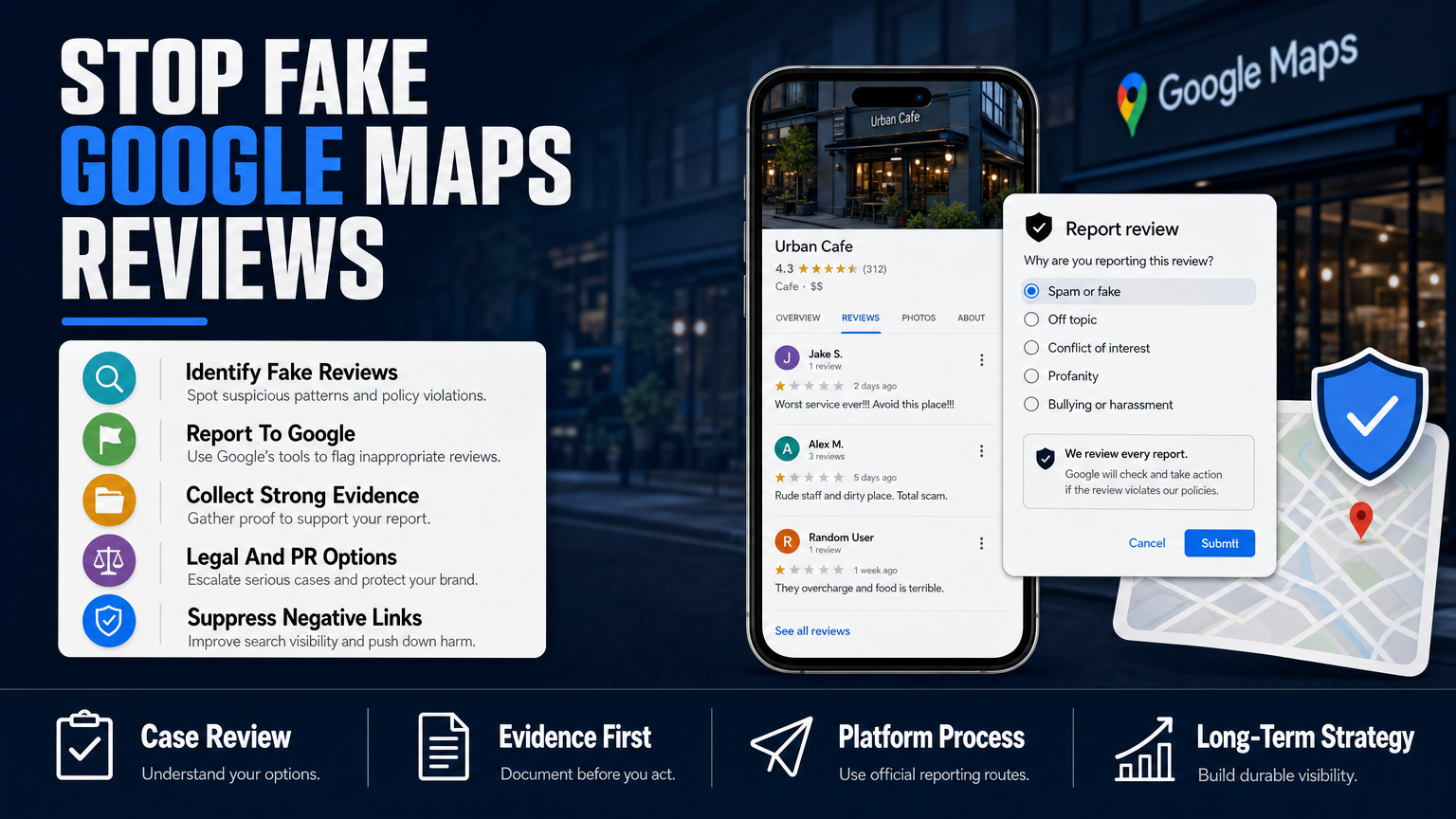
- Google Business Profile: Flag inappropriate reviews via the Business Profile dashboard and use the legal removal form for libel/defamation or privacy breaches; expect a response window of days to weeks, sometimes longer.
- Yelp: Use the ‘Report Review’ flow and supply business records if the reviewer was never a customer; Yelp rarely removes reviews that are opinion‑based.
- TripAdvisor/OpenTable: Use property‑owner portals to report policy violations; OpenTable also displays third‑party reviews depending on configuration.
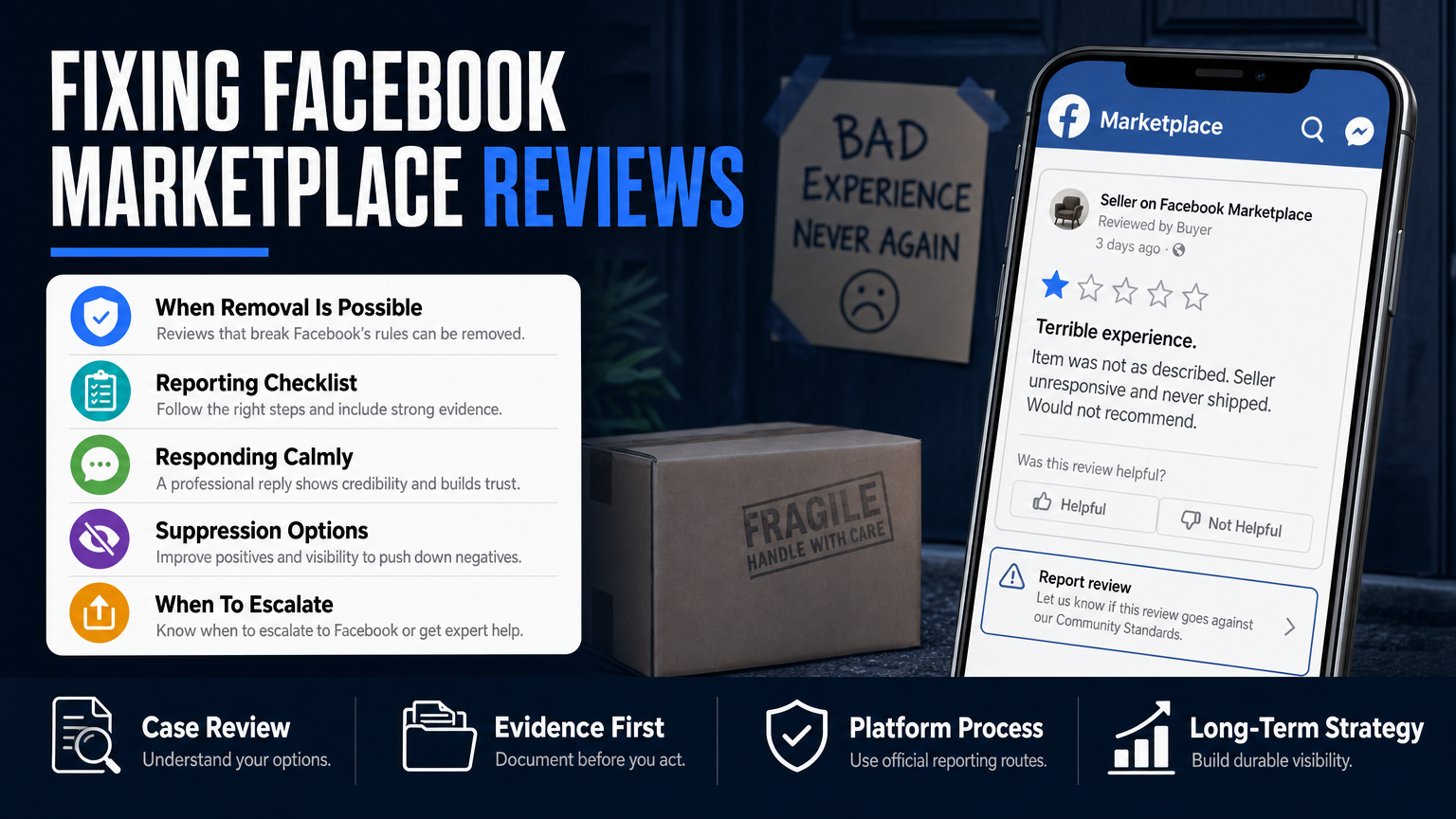
- Facebook/Instagram/TikTok: Use platform report flows and escalate through business support; responses vary by volume and region.
- Mugshot/aggregator sites: Many have opt‑out forms or paid removal offers — treat these skeptically and document communications.
When a review is fake or from a competitor
If you have solid evidence that a review came from a competitor or a fabricated account (IP correlation, repeated handles, impossible timestamps), include that evidence in your report.
Some platforms (Google, Yelp, Facebook) will act on clear evidence; others will decline without a court order.
- Preserve everything. Do not publicly accuse a person by name.
- Consider a legal demand for identity only after counsel assesses cost vs benefit.
Removing videos and social posts
Videos on YouTube, TikTok or Instagram can be reported for privacy violations, harassment, or copyrighted material. YouTube has a complaint center and privacy complaint forms; TikTok and Instagram use in‑app reporting.
If a video contains medical misinformation or unsafe conduct, platforms may have policy grounds for removal — but this is fact‑specific.
- Use platform copyright forms (DMCA) only when you have a genuine copyright claim.
- For doxxing (exposed address or phone), use platform privacy report forms and request expedited removal.
When removal is NOT available: mitigation and suppression
Sometimes content cannot be removed: it’s truthful, published by a news outlet, or on a platform that won’t act. In those cases we pursue mitigation: correction, context, and search‑engine suppression.
We develop SEO reputation strategies intended to improve the visibility of relevant and credible information, and to push harmful items lower in results over time.
- SEO suppression — weeks to months: Publish targeted pages and blog posts, acquire local backlinks, optimize title tags and meta descriptions for desired phrases.
- Social proof — immediate to 30 days: Encourage satisfied diners to leave recent Google, Yelp, and OpenTable reviews — volume and recency matter.
- Profiles and directories — 1–3 months: Build and claim profiles on industry sites (OpenTable, Zomato, Foursquare) to crowd out negative links.
- Create authoritative pages: updated About, press statements, staff bios, menu pages, and high‑quality local content.
- Use structured data and Google Business Profile optimization to own the ‘knowledge’ cards and map pack real estate.
- Publish third‑party coverage: respond with corrective statements sent to local news editors and food bloggers when appropriate.
- Use YouTube and long‑form content strategically — high‑quality video often ranks well for brand queries.
Crisis response: viral incidents, food safety allegations, and PR
A viral post alleging food safety problems or a publicized complaint is a reputational emergency that requires coordinated action: operations, communications, legal, and customer care.
Rapid, coordinated responses reduce ambiguity and limit speculation. Do not ignore public posts or lock them behind privacy settings; that often fuels distrust.
- Hour 0–6: Assemble incident team, capture evidence, and draft initial holding statement.
- Day 1: Publish a factual statement on your site and on Google Business Profile posts; use social channels to amplify corrective messaging.
- Day 2–7: Undertake operational fixes if needed (deep cleaning, retraining), document them, and publish a remediation report.
- Immediate triage (first 24 hours): Confirm facts with staff, preserve evidence (CCTV, logs), and prepare a short factual public statement.
- Designate a single spokesperson and route all external communications through them.
- Notify insurance and, if applicable, regulatory bodies; follow reporting requirements rather than hiding incidents.
- Prepare an internal FAQ for staff so front‑line teams deliver consistent messages.
Working with PR and legal
Reputation PR should focus on facts, remedy, and empathy. Legal coordination is necessary when allegations are false, defamatory, or when you need to subpoena an anonymous user’s identity.
A qualified attorney can determine whether a legal claim may be available; we coordinate with counsel when a matter requires legal analysis.
- PR drafts should be reviewed by counsel if they touch on admissions or sensitive regulatory issues.
- Avoid promising compensation or making statements that could affect insurance or litigation.
Tools, monitoring and whether to hire an agency
Small restaurants often start with DIY tools and move to managed services when volume or stakes rise. For multi‑location groups, centralized monitoring saves time and prevents inconsistent responses.
If you’re evaluating options for hands‑on work or software, compare the scope and the escalation pathways carefully. For an SMB perspective and managed options, review our guide to Online Reputation Management for Small Businesses.
- DIY setup — 1–7 days: Claim all profiles, enable notifications, set up Google Alerts, and create a simple response template library.
- Managed setup — 2–4 weeks: Integrate booking systems (OpenTable, Resy) with reputation software, set escalation rules, and train staff on response protocols.
- Free tools: Google Alerts, Social Mention, and native platform notifications (Google Business Profile, Yelp Biz, TripAdvisor Owners).
- Paid monitoring: ReviewTrackers, Birdeye, Podium — they centralize reviews and automate response workflows.
- Security and doxxing: Use data‑broker opt‑out services and set monitoring for exposed addresses/phones.
- Crisis escalation: Have contacts for platform rep escalation, a PR firm, and a local attorney.
Removal vs Suppression — which path to choose?
A quick comparison to decide whether to pursue removal or focus on suppression and reputation building.
| Removal | Suppression |
|---|---|
| Goal | Goal |
| Take down the specific item | Reduce visibility of the item in search |
| Best when content violates platform policy or is defamatory | Best when content is truthful, newsworthy, or hosted by resistant publishers |
| Depends on platform decisions or legal process | Depends on SEO, content production, and backlinks |
| Can be faster if platform agrees (days–weeks) | Takes longer (weeks–months) and requires ongoing work |
| May require legal counsel for subpoenas or takedown demands | Requires content strategy and distribution (blogs, YouTube, local citations) |
Hypothetical example: ‘Chef’s Table Bistro’ viral complaint
Scenario: A single Instagram video claims a patron became ill after dining at Chef’s Table Bistro and the video gets 200k views in 24 hours. The video mentions the restaurant by name and is reshared on Twitter and a local news site picks it up.
Process (high level): triage, evidence collection, platform reporting, public response, operational remediation, and search suppression. Timelines and outcomes depend on the evidence and platform policies.
- Hour 0–24: Capture evidence, notify staff, post a neutral holding statement, and enable extra monitoring on social channels.
- Day 1–3: Contact the poster privately requesting details; preserve logs that show no corroborating complaints during that time window; submit platform reports with supporting evidence.
- Day 3–14: If a news outlet published, request a correction or clarification with documented evidence. Meanwhile, publish authoritative content (staff statement, inspection report if available) and optimize that content for brand searches.
- Week 2–8: Monitor search results and continue suppression strategy; if the poster’s claim is clearly false and harmful, consult counsel about defamation options and subpoenas for identity.
- Immediate actions: preserve the post (screenshot, archive.org), assign an incident lead, gather CCTV and reservation logs for the date/time claimed.
- Platform actions: report the video for harassment/privacy if it exposes private data; report false health claims to platforms if they violate policies.
- Communications: issue a short factual holding statement on Google Business Profile and your website, encourage customers with positive recent experiences to leave reviews, and prepare a more detailed press statement if a news outlet has published.
Common mistakes restaurants make
Avoid these frequent errors — each one can magnify reputational damage or create legal exposure.
Mistake: Ignoring early warning signs
Small negative items compound. Not monitoring mentions on third‑party sites and social platforms allows issues to grow into crises.
Set automated alerts and review dashboards so you don’t miss a problem until it’s viral.
Mistake: Publicly attacking reviewers
Calling out or threatening reviewers almost always backfires and can be used as evidence of bad behavior.
Keep responses professional, brief, and focused on resolution.
Mistake: Using fake reviews or incentivized praise
Posting or buying fake positive reviews violates platform policies and can lead to penalties or delisting. Never offer payment for positive reviews.
Instead, implement legitimate review‑generation tactics for satisfied customers (receipts with review links, table signage, post‑visit emails).
Mistake: Overreliance on a single platform
If one platform (e.g., OpenTable or Yelp) becomes a single point of failure, you’ll be vulnerable. Diversify presence across Google, Facebook, TripAdvisor, and reservation partners.
Claim and optimize all profiles and maintain consistent NAP (name, address, phone) data.
Mistake: Not documenting evidence
When you later need to challenge a claim or pursue legal options, poor documentation weakens your position. Preserve logs, CCTV, transaction records, and correspondence.
Documentation also supports internal training and operational fixes.
Best practices for long‑term reputation health
These durable actions reduce crisis frequency and increase the chance you’ll weather negative incidents with minimal revenue impact.
Claim and optimize all listings
Claim Google Business Profile, Yelp for Business, TripAdvisor Owners, Facebook Page, OpenTable/Resy profiles and keep menus, hours, and photos current.
Use accurate categories and add high‑quality images — these small signals improve conversion and reduce confusion.
- Verify ownership where possible and enable multi‑manager access for backups.
- Use a consistent business description and NAP across platforms.
Implement a review response playbook
Create templates for common review types (complaint, food temperature, service speed) but personalize each reply. Set SLAs: acknowledge within 24 hours, resolve within 72.
Train managers and front‑of‑house staff on the process.
- Never ask for removal publicly; always move to private channels if resolution is possible.
- Log outcomes so you can track whether responses improve review ratings over time.
Monitor proactively and automate alerts
Use a mix of free and paid tools for monitoring. For single locations, native notifications and Google Alerts may suffice. For multi‑location groups consider ReviewTrackers, Birdeye, or Podium.
Set escalation thresholds for high‑risk mentions (illness, safety, impersonation).
- Monitor reservation partner feedback (OpenTable covers certain complaints).
- Include mention of staff names to spot targeted attacks early.
Plan for crises and run tabletop exercises
Run tabletop drills for a viral post or a food safety claim. Define roles, contact lists, and how and when to involve counsel or PR.
A tested plan prevents confusion and inconsistent public messaging.
- Include legal, operations, and a communications lead in exercises.
- Maintain an up‑to‑date incident binder with templates and vendor contacts.
Leverage ongoing SEO and content
Publish timely, customer‑focused content: seasonal menus, events, staff spotlights, health inspection explanations, and video tours. This generates positive signals search engines can rank.
Encourage organic backlinks from local partners, food bloggers, and press.
- Optimize page titles and meta descriptions with brand + location keywords.
- Use schema markup for menu, opening hours, and reservations where available.
Expert Tips
- Enable two‑factor authentication on all social and reservation accounts to prevent account takeover.
- Keep a log of removed or modified posts and the reasons — it helps defend future disputes.
- When asking for updated reviews after resolving an issue, never offer money or discounts as an incentive.
- Use reservation and POS timestamps to quickly corroborate or disprove timing claims in complaints.
- If a reviewer asks for a refund publicly, handle the refund privately and then politely ask for an update to the review.
- Train staff to escalate safety or health complaints immediately instead of trying to resolve them informally.
- For multi‑location groups, centralize review oversight but allow local managers to personalize responses.
- Keep an updated contact list for platform business support so you can escalate quickly when needed.
Conclusion
Restaurants face unique reputational risks: high volume of customer interactions, tight margins, and strong influence of single negative items on bookings. A structured approach — audit, respond, document, escalate, and when needed, suppress — turns reactive firefighting into a controllable process.
You won’t always get every piece of content removed, and timing varies by platform and legal complexity. The objective is to reduce harm, restore trust with factual and empathetic responses, and rebuild search visibility with authoritative content.
Why Businesses Choose Your Reputation Agency
Managing your reputation takes more than monitoring reviews or publishing the occasional blog post. It takes a strategy built around your situation, your industry, and what is actually showing up in search.
Your Reputation Agency works with businesses, executives, healthcare professionals, attorneys and growing brands. Our services include:
- Remove or challenge defamatory content and false posts across news sites, blogs and social platforms
- Remove negative reviews from Google, Yelp, Facebook, Trustpilot, Glassdoor and industry review sites (e.g., Healthgrades, RateMDs, RealSelf, Vitals, Angi)
- Mugshot and arrest-record removal and remediation
- Remove or takedown negative videos, YouTube content, TikTok clips and other harmful multimedia
- Remove or suppress negative search results and implement search-engine suppression strategies (SEO to bury bad results)
- Remove personal information and opt-out from people-search and data-broker sites (address, phone, phone number removal)
- Social media impersonation and fake account takedown (reporting and removal on Facebook, Instagram, Twitter/X, LinkedIn, TikTok)
- Reddit and community forum post/comment removal and visibility reduction
- Online crisis management and reputation PR to respond to viral incidents
- Monitoring and alerting for negative content, fake reviews and emerging reputation threats
Frequently Asked Questions
1. How do I get a negative Google review removed?
Start by flagging the review in your Google Business Profile and provide clear evidence if the review violates policy (spam, impersonation, or off‑topic). If the review alleges privacy breaches or false statements of fact, use Google’s legal removal forms. Timing varies — platform review responses can take days to weeks, and removal depends on policy and evidence.
2. Can OpenTable or Yelp remove a bad review if I prove it’s false?
Both platforms have processes to report policy violations. Yelp tends to be strict about opinions and removes only when posts violate their content rules. OpenTable handles certain third‑party reviews through owner portals. Whether a review is removed depends on the platform’s evaluation, the evidence you supply, and their internal policies.
3. What should I do if someone posts that they got sick after eating at my restaurant?
Triage immediately: preserve evidence (screenshots, video), check reservation and CCTV logs, and open an internal investigation. Publish a short factual holding statement and direct inquiries to a single contact. If health safety is implicated, notify insurers and follow local health department reporting requirements; coordinate public communications with counsel as needed.
4. How long does it take to bury negative search results with SEO?
Search suppression timelines vary. Some changes show in weeks for low‑authority results; suppression of high‑authority pages (news, big blogs) can take months. Search results may change because algorithms, competitors, publishers, and user behavior are outside your control. An estimated timeline can be provided after assessment.
5. Should I hire an agency or handle reputation management in‑house?
If you’re a single small location with light volume, in‑house monitoring and a clear playbook may be sufficient. For multi‑location operations, frequent incidents, or high‑stakes crises, a managed service or agency that coordinates platform escalation, SEO, and PR will likely be more efficient. Compare escalation pathways, SLAs, and evidence handling when choosing a vendor.
6. Can I sue a reviewer for defamation?
Possibly, but defamation claims depend on jurisdiction, whether the statement is false and presented as fact, and the available evidence. Suits are costly and can backfire (the Streisand effect). A qualified attorney can determine whether a legal claim may be available and advise on subpoenas to identify anonymous posters.
7. What if removal isn’t possible because the content is truthful?
When removal is unavailable, pursue mitigation: correct the record publicly where appropriate, publish authoritative content, optimize your Google Business Profile, and use an SEO suppression strategy to push unwanted results lower in search. We develop strategies intended to improve the visibility of credible information, but results vary.
8. How can I protect my staff from doxxing or impersonation?
Limit public exposure of personal staff data, train employees on privacy practices, enable strong account security (unique passwords, two‑factor authentication), and monitor people‑search sites for exposed contact details. If doxxing occurs, use platform privacy complaint forms and consult digital security specialists for remediation.
9. Are there quick wins restaurants can implement today?
Yes. Claim and verify your Google Business Profile, enable review notifications, respond to recent reviews within 24 hours, add recent photos and updated menus, and set up Google Alerts for brand mentions. These steps improve customer conversion and give you early warning of reputation issues.
This content provides general information and does not constitute legal advice. The available options and likely outcomes depend on the facts, evidence, platform policies, applicable law, jurisdiction, and public-interest considerations.
Past examples do not guarantee future results. Removal, correction, deindexing, and search-position changes depend on third parties and circumstances outside Your Reputation Agency’s control.