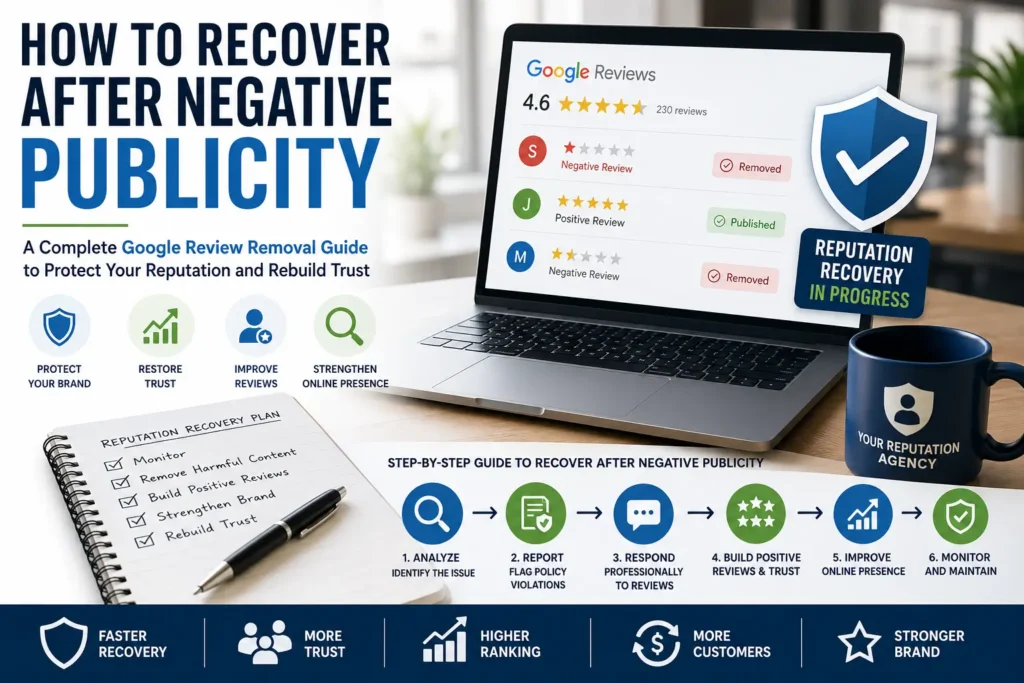
Negative publicity can spread faster than ever before. A single negative Google review, viral social media post, misleading news article, or online complaint can influence how customers, investors, and potential partners view your business.
If you’re searching for a reliable Google Review Removal Guide, you’re likely facing a reputation challenge that needs immediate attention. The good news is that negative publicity doesn’t have to define your business forever. With the right strategy, you can reduce its impact, restore customer confidence, and strengthen your online reputation for the future.
In this guide, you’ll learn how to recover after negative publicity, when Google reviews can be removed, and what practical steps businesses should take to rebuild trust and credibility.
Table of Contents
- Understanding Negative Publicity
- Why Google Reviews Matter More Than Ever
- First Steps After Negative Publicity
- How to Identify Reviews That May Qualify for Removal
- Step-by-Step Google Review Removal Guide
- How to Rebuild Customer Trust
- Real Business Example
- Common Reputation Recovery Mistakes
- Best Practices for Long-Term Reputation Management
- Expert Tips for Business Owners
- Frequently Asked Questions
- Conclusion
- Contact Your Reputation Agency
Why Negative Publicity Can Damage Your Business
Negative publicity affects far more than your online image. Today’s consumers research businesses before making purchasing decisions, and search results often shape first impressions within seconds.
A few highly visible negative reviews or damaging online discussions can reduce customer confidence, lower conversion rates, and even influence employee recruitment. Business owners may also notice declining website traffic, fewer inquiries, and reduced referral opportunities.
The impact becomes even greater when negative content appears across multiple platforms such as Google Business Profile, review websites, social media, blogs, or news publications.
Because online information spreads quickly, responding strategically is far more effective than reacting emotionally.
Why Google Reviews Matter More Than Ever
Google Reviews have become one of the strongest trust signals for local businesses and professional service providers.
Potential customers frequently compare ratings before deciding which company to contact. Even a few misleading or policy-violating reviews can influence purchasing decisions, especially when they appear prominently in Google Search and Google Maps.
Google also considers review quality, recency, and customer engagement as part of the overall local search experience. While reviews alone do not determine rankings, they significantly influence user trust and click-through rates.
This is why businesses should actively monitor their Google Business Profile and respond professionally to legitimate customer feedback.
Not Every Negative Review Should Be Removed
One of the biggest misconceptions is believing every negative review qualifies for removal.
In reality, Google generally allows honest customer experiences—even when they are critical—to remain visible. However, reviews that violate Google’s policies may qualify for removal.
Examples include:
- Fake reviews
- Spam or promotional content
- Reviews from competitors
- Impersonation
- Hate speech or harassment
- Offensive language
- Reviews unrelated to an actual customer experience
- Conflicts of interest
Understanding this distinction is essential before beginning the removal process.
Attempting to remove legitimate customer feedback instead of addressing the underlying issue can reduce credibility and create additional reputational challenges.
First Steps After Negative Publicity
When negative publicity appears online, your first reaction matters.
Rather than responding emotionally, take a structured approach.
Step 1: Stay Calm
Avoid public arguments or defensive responses. Emotional reactions often attract more attention and can make the situation worse.
Step 2: Assess the Situation
Determine where the negative publicity originated.
Ask yourself:
- Is it a Google Review?
- A news article?
- A social media post?
- A forum discussion?
- A blog article?
Each platform requires a different response strategy.
Step 3: Gather Evidence
Document everything before taking action.
Collect:
- Screenshots
- URLs
- Review dates
- Usernames
- Supporting documentation
- Customer communication records
Having organized evidence makes it easier to evaluate whether removal requests are appropriate.
How to Determine If a Google Review Violates Policy
Before requesting removal, compare the review against Google’s published review policies.
Questions to ask include:
- Does the reviewer appear to be a real customer?
- Is the review misleading or fabricated?
- Does it contain offensive or abusive language?
- Is it promotional spam?
- Does it reveal confidential personal information?
- Does it come from a competitor or someone with a conflict of interest?
If the answer to any of these questions is “yes,” the review may qualify for Google’s review moderation process.
However, every request is evaluated individually, and removal is never guaranteed.
Reputation Recovery Requires More Than Review Removal
Even when a review cannot be removed, businesses still have many opportunities to improve their online reputation.
A successful recovery strategy often includes:
- Publishing helpful, authoritative content
- Encouraging genuine customer reviews
- Improving customer service
- Responding professionally to feedback
- Strengthening branded search results
- Building trust through transparency
- Monitoring online mentions regularly
These long-term strategies help create a stronger digital presence that is less vulnerable to future reputation challenges.
Step-by-Step Google Review Removal Guide
If you believe a review violates Google’s policies, following the correct process gives you the best chance of resolving the issue. While Google does not remove reviews simply because they are negative, it does review reports involving spam, fake content, conflicts of interest, or policy violations.
Here’s a practical Google Review Removal Guide you can follow.
Step 1: Review Google’s Policies Carefully
Before submitting a report, compare the review against Google’s official prohibited content guidelines.
Reviews may qualify for removal if they involve:
- Fake or fabricated experiences
- Spam or promotional content
- Impersonation
- Harassment or hate speech
- Conflicts of interest
- Illegal content
- Personal or confidential information
Understanding these policies helps you avoid submitting requests that are unlikely to succeed.
Step 2: Flag the Review
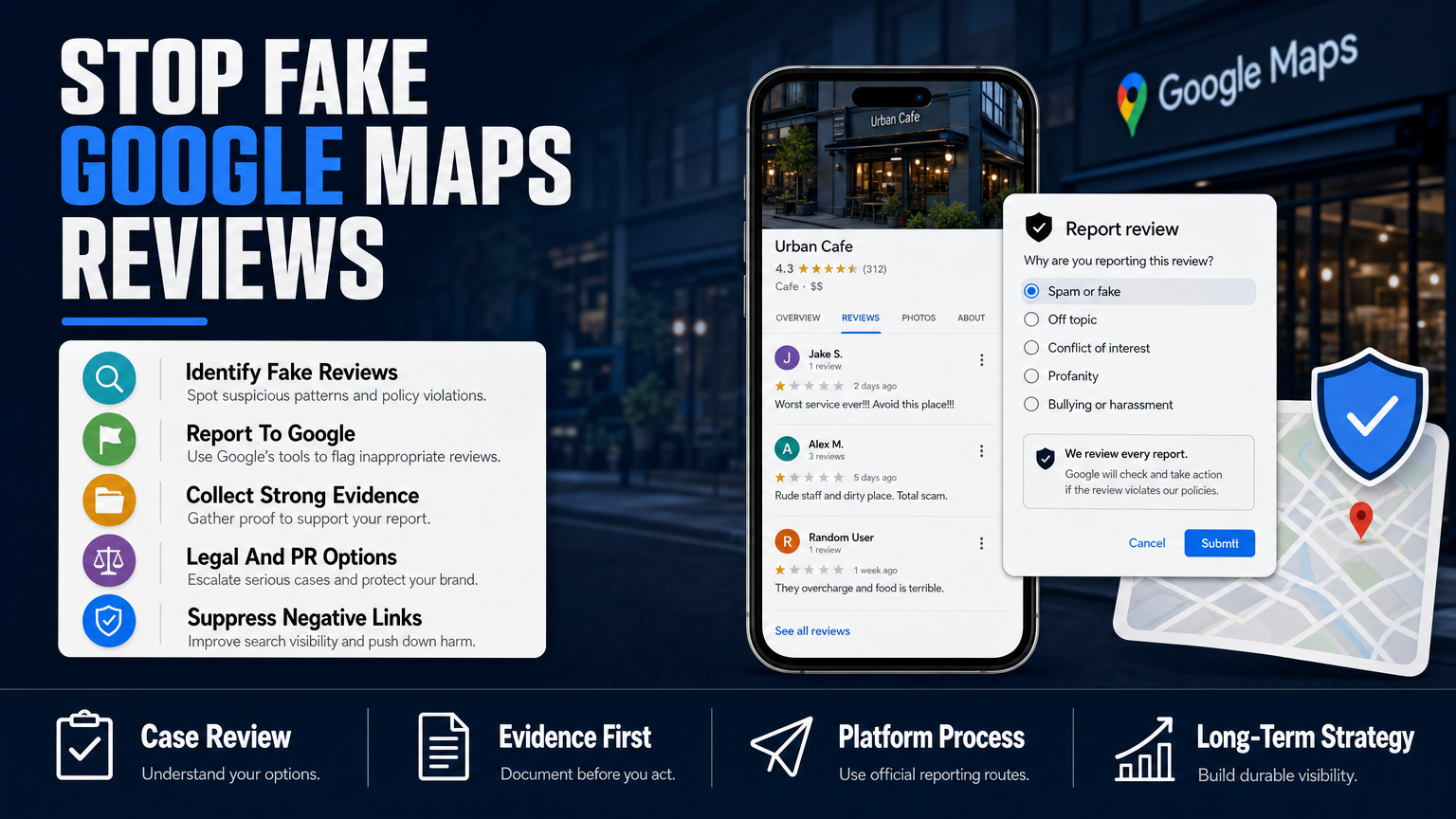
If the review appears to violate Google’s policies:
- Open your Google Business Profile.
- Locate the review.
- Click Report Review.
- Select the most appropriate policy violation.
- Submit your request.
Google’s moderation team will evaluate the report individually.
Keep in mind that reporting the same review repeatedly does not increase the likelihood of removal.
Step 3: Respond Professionally
While waiting for Google’s review, publish a calm, professional response.
A thoughtful response demonstrates transparency and shows potential customers that your business values feedback.
For example:
“We’re sorry to hear about your experience. Unfortunately, we’re unable to identify your visit based on the information provided. We’d appreciate the opportunity to discuss this matter directly and work toward a resolution.”
Avoid:
- Arguing publicly
- Accusing the reviewer
- Sharing private customer information
- Using emotional language
Often, your response influences future customers more than the review itself.
Step 4: Continue Building Positive Reviews
One negative review rarely defines an entire business.
Encourage satisfied customers to leave honest feedback after positive experiences.
Authentic reviews help:
- Improve customer trust
- Strengthen your Google Business Profile
- Balance occasional negative reviews
- Increase local search credibility
Never purchase reviews or offer incentives that violate Google’s policies.
Recovering After Negative Publicity
Removing a review is only one part of reputation recovery.
Long-term reputation management focuses on improving the overall perception of your business rather than chasing every individual comment.
Successful recovery often includes:
- Publishing educational content
- Improving customer communication
- Monitoring online mentions
- Increasing positive media exposure
- Strengthening branded search results
- Responding consistently to customer feedback
This broader strategy helps protect your business against future reputation challenges.
Real Business Example
Imagine a local law firm receives several one-star Google reviews following a misunderstanding that gains attention on social media.
Instead of responding emotionally, the firm takes a structured approach.
First, they investigate each review and identify two that violate Google’s policies because they were posted by individuals who had never been clients.
Next, they submit policy-based review reports while responding professionally to legitimate feedback.
At the same time, they encourage satisfied clients to leave honest reviews, publish informative legal resources, update their Google Business Profile, and strengthen their website content.
Within several months, positive reviews significantly outweigh the negative ones, branded search results improve, and customer inquiries begin increasing again.
This example illustrates that reputation recovery rarely depends on a single action—it requires consistency and a long-term strategy.
When Professional Help Makes Sense
Some reputation challenges involve far more than Google reviews.
You may also be dealing with:
- Negative news articles
- Search engine visibility issues
- Fake online content
- Defamatory blog posts
- Executive reputation concerns
- Review attacks across multiple platforms
In these situations, a comprehensive online reputation strategy often produces better results than addressing each issue individually.
At Your Reputation Agency, we help businesses and professionals develop customized strategies based on their specific reputation challenges.
If your concern involves policy-violating reviews, learn more about our Google Review Removal Service.
If negative media coverage is affecting your brand, our News Articles Removal Service explains additional recovery options:
For complex reputation challenges involving multiple search results, our Reputation Management Agency develops long-term strategies designed to strengthen your digital credibility.
Best Practices for Rebuilding Customer Trust
Trust cannot be restored overnight, but consistent actions make a significant difference.
Businesses that recover successfully often focus on:
- Delivering excellent customer experiences
- Responding quickly to concerns
- Encouraging genuine customer feedback
- Publishing helpful educational content
- Maintaining accurate business information
- Monitoring reviews regularly
- Building authority through expertise
- Being transparent during difficult situations
Customers are generally willing to forgive mistakes when businesses demonstrate accountability and professionalism.
Common Reputation Recovery Mistakes
Many organizations unintentionally make negative publicity worse.
Avoid these common mistakes:
- Ignoring negative reviews
- Responding emotionally
- Buying fake positive reviews
- Threatening customers publicly
- Publishing low-quality content simply to bury criticism
- Failing to monitor online mentions
- Waiting too long before taking action
The most effective reputation strategies are proactive rather than reactive.
Expert Tips for Protecting Your Online Reputation
Recovering from negative publicity is only part of the journey. The most successful businesses invest in ongoing reputation management to prevent future issues before they escalate.
Here are several practical strategies that can strengthen your online reputation over time:
- Monitor your Google Business Profile regularly.
- Respond to customer reviews within 24–48 hours.
- Publish high-quality educational content that demonstrates expertise.
- Keep your business information accurate across all online platforms.
- Encourage genuine customer reviews after positive experiences.
- Track brand mentions using reputation monitoring tools.
- Address customer concerns privately whenever possible.
- Continuously improve your products and customer service.
Small, consistent actions often produce better long-term results than reacting only during a crisis.
Comparison: Reactive vs. Proactive Reputation Management
| Reactive Reputation Management | Proactive Reputation Management |
|---|---|
| Responds after damage occurs | Prevents reputation issues before they grow |
| Focuses on individual reviews | Builds long-term digital authority |
| Often stressful and time-sensitive | Planned and strategic |
| May require crisis management | Maintains consistent brand trust |
| Higher recovery costs | Lower long-term reputation risk |
| Short-term solutions | Sustainable online credibility |
Businesses that invest in proactive reputation management are generally better positioned to maintain customer confidence and recover more quickly if negative publicity occurs.
Why Businesses Trust Your Reputation Agency
Your Reputation Agency, we understand that reputation is one of your most valuable business assets.
Our team helps businesses, executives, healthcare professionals, attorneys, entrepreneurs, and public figures develop customized online reputation strategies designed to strengthen trust and improve long-term visibility.
Our services include:
- Google Review Management
- Reputation Monitoring
- Search Result Suppression
- News Article Management
- Executive Reputation Management
- Corporate Reputation Protection
- Digital Brand Strategy
- Online Crisis Management
Many prospective clients first explore our Google Business Profile and Trustpilot reviews before contacting us. We believe transparency and consistent client satisfaction are essential parts of building trust.
If you’re ready to take control of your online reputation, we’re here to help.
For personalized guidance, visit our Contact Us page.
Conclusion
Negative publicity doesn’t have to define your business. While one harmful review or online discussion can influence public perception, a thoughtful and ethical strategy can restore confidence over time.
This Google Review Removal Guide demonstrates that reputation recovery is about much more than removing individual reviews. Success comes from combining professional responses, high-quality customer service, trustworthy content, consistent reputation monitoring, and long-term digital authority.
Businesses that act quickly, communicate transparently, and focus on continuous improvement are often the ones that recover most successfully.
Whether you’re dealing with fake reviews, misleading online content, or a broader reputation challenge, taking action today helps protect your reputation tomorrow.
Frequently Asked Questions
1. What is a Google Review Removal Guide?
A Google Review Removal Guide explains how businesses can identify reviews that violate Google’s policies, report inappropriate reviews, and strengthen their overall online reputation through ethical reputation management strategies.
2. Can Google remove every negative review?
No. Google generally removes reviews only when they violate its review policies. Honest customer opinions usually remain visible, even if they are critical.
3. How long does Google review a reported review?
The review process varies depending on the situation. Some reports may be evaluated within several days, while more complex cases may require additional time.
4. What types of reviews may qualify for removal?
Examples include:
- Fake reviews
- Spam
- Impersonation
- Hate speech
- Harassment
- Promotional content
- Conflicts of interest
- Reviews unrelated to an actual customer experience
5. Should I respond to negative Google reviews?
Yes. Professional, respectful responses demonstrate accountability and often improve customer confidence, even when the review remains visible.
6. Can online reputation management improve search results?
Yes. Ethical reputation management focuses on strengthening positive digital assets, improving branded search visibility, and building long-term online authority.
7. When should I hire a reputation management agency?
Professional support may be helpful if your business is experiencing ongoing negative publicity, fake reviews, damaging search results, or broader reputation challenges across multiple platforms.
8. How can businesses prevent future reputation issues?
Regular monitoring, excellent customer service, transparent communication, and consistent reputation management significantly reduce long-term reputation risks.
Reputation Recovery Checklist
Use this checklist after experiencing negative publicity or harmful online reviews.
Immediate Actions
- Audit your Google search results
- Review your Google Business Profile
- Document harmful reviews or content
- Respond professionally to legitimate feedback
- Report reviews that violate Google’s policies
- Monitor social media mentions
- Notify your internal team
Short-Term Actions
- Publish helpful, authoritative content
- Request honest reviews from satisfied customers
- Update your website with fresh information
- Improve customer communication
- Strengthen branded search results
Long-Term Actions
- Monitor your online reputation regularly
- Continue publishing valuable content
- Improve customer experience
- Build media mentions and authority
- Review your reputation strategy every quarter
Signs You Should Contact a Reputation Management Professional
Some situations require more than responding to reviews yourself.
Consider seeking professional help if:
- Fake reviews continue appearing
- Negative articles rank on Google’s first page
- Customers mention misleading online information
- Your business receives coordinated review attacks
- Search results affect sales or lead generation
- Your executive reputation is being targeted
- Your brand is facing a public relations crisis
Early action often makes reputation recovery faster and more effective.
Why Ethical Reputation Management Matters
Quick fixes and misleading promises may seem attractive, but they often create bigger problems later.
Ethical reputation management focuses on:
- Transparency
- Honest communication
- Search engine best practices
- Long-term trust
- Sustainable SEO
- Genuine customer relationships
Businesses that prioritize ethical practices build stronger credibility with both customers and search engines.
What Success Looks Like
Successful reputation management isn’t simply about removing negative reviews.
A successful campaign should achieve:
| Before Reputation Management | After Reputation Management |
|---|---|
| Negative search visibility | Strong branded search presence |
| Low customer confidence | Higher trust and credibility |
| Inconsistent online information | Accurate business information |
| Poor review management | Consistent customer engagement |
| Weak digital authority | Strong online reputation |
Continue Learning
If you’d like to learn more about protecting your reputation, these resources may help:
Learn how search suppression works
What Is Search Result Suppression? | Complete Guide
Understand content removal strategies
Search Suppression vs Content Removal | Key Differences
Protect executive leadership
CEO Reputation Management Guide
Your reputation is one of your most valuable business assets. Whether you’re responding to negative reviews, recovering from unwanted publicity, or proactively protecting your brand, taking the right steps today can make a lasting difference.
At Your Reputation Agency, we help businesses, executives, entrepreneurs, doctors, lawyers, and professionals build stronger online reputations through ethical, customized reputation management strategies.
If you’re ready to protect your reputation, improve customer trust, and strengthen your online presence, our team is here to help.