You just found a post or thread accusing you of something untrue — and it’s already being shared. Your immediate questions are practical: how do you stop the spread, protect clients or employers, and preserve evidence that proves the post is false?
This article outlines exactly what to do if someone is spreading lies about you on social media, with step-by-step actions for the first 24–72 hours, what evidence you need if you pursue legal routes, how platforms handle takedown requests, and alternatives when removal isn’t available.
We balance urgency with realism: some posts can be removed quickly, some require legal review, and some you will need to suppress rather than delete. Wherever possible we give precise timelines and caveats about platform control and jurisdiction.
Table of Contents
- Can I sue someone for posting lies about me on social media?
- How do you stop someone from slandering you on social media immediately?
- Is it illegal for someone to spread lies about you?
- What to do if someone is slandering you on social media: a practical, prioritized plan
- When removal is not available: suppression and reputational repair
- Monitor, prevent, and harden your digital presence
- How businesses and professionals should respond to coordinated smear campaigns
- Removal vs Suppression: Which to pursue first?
- Hypothetical example: A false accusation on a neighborhood Facebook group
- Common mistakes people make when responding to online lies
- Best practices to manage and recover from false social posts
- Expert Tips
- Conclusion
- Why Businesses Choose Your Reputation Agency
- Frequently Asked Questions
Can I sue someone for posting lies about me on social media?
Short answer: possibly — but it depends on whether the post meets your state’s legal elements for defamation, whether you can identify the speaker, and whether the false statement is treated as a fact rather than opinion. Civil claims for defamation (commonly called libel for written statements) are available in many jurisdictions, but they require proof of specific elements.
To evaluate whether a lawsuit is realistic, a qualified attorney will look for: a false factual statement presented as true; publication to a third party; fault (negligence or actual malice depending on who you are and the subject); and damages (financial loss, lost clients, reputational harm). Public figures face higher proof standards.
If you’re a professional whose practice or employment is at risk, consult counsel quickly — the complaint may need to be timely to preserve evidence and meet statute-of-limitations deadlines. For a practical introduction to legal routes and corporate risk, see our article on When an Online Rumor Threatens Your Job or Business.
- 1. Preserve all evidence (screenshots with timestamps, links, export options).
- 2. Ask an attorney to review the content and evaluate whether defamation claim elements are present.
- 3. If identity is unknown, counsel can advise on subpoenas to platforms for metadata — timing matters.
- 4. Consider a demand letter or cease-and-desist only after legal review; do not post threats or retaliation publicly.
- Defamation elements: falsity, publication, fault, damages (varies by state).
- Public vs private person: public figures must usually prove actual malice.
- Suing requires identifying the poster; anonymous accounts may need subpoenas.
- Cost-benefit: litigation can be costly and slow; weigh immediate containment needs.
What evidence matters for a legal claim
Strong, well-documented evidence improves the viability of civil claims. Collect original URLs, full-page screenshots (desktop and mobile views), archive copies (Wayback Machine), witness statements from people who saw the post, and records of any lost business or job opportunities tied to the content.
Preserve metadata where possible: if you have copies of emails, DMs, or direct messages related to the post, keep them in secure storage. Do not alter screenshots or images; retain originals and note how and when you captured them.
- Full-page screenshots (with timestamps visible).
- Exported comments and replies when the platform allows.
- Records of lost business, declined interviews, or terminated opportunities tied to the post.
- Any private messages or threats that corroborate motive or malice.
How do you stop someone from slandering you on social media immediately?
Stopping the spread quickly requires both technical steps and communications strategy. Early containment reduces shares and preserves your options later.
Start by isolating and documenting the content, then use platform reporting tools and direct outreach where appropriate. Do not try to litigate publicly on social feeds — that often backfires and can amplify the post.
- 1. Capture full-page screenshots (desktop and mobile) and save the post URL. Use a secondary method (screen recorder or print-to-PDF) to back up.
- 2. Use the platform’s report tool (Facebook/Meta, X, Instagram, TikTok, LinkedIn, Reddit) and select the closest policy: falsified content, harassment, impersonation, or privacy violation. Platform decisions are under their control.
- 3. If the post violates privacy laws (sharing your SSN, medical records, adult images), use the platform’s privacy or legal removal channels.
- 4. If anonymous, gather comment history and note usernames; do not attempt doxxing or retaliatory action.
- Preserve evidence before it’s deleted.
- Report the content to the platform using the most specific policy violation (harassment, defamation, impersonation, privacy breach).
- If the post is harassing or violent, escalate to platform safety lines and, where immediate danger exists, local law enforcement.
Platform-specific reporting notes
Platforms have different workflows and turnaround times. For example, Facebook and Instagram allow reports for false information and impersonation; X (Twitter) has policies against targeted harassment and private information; TikTok reviews community guidelines but may not remove content simply for being false.
Expect varying outcomes: some posts will be removed quickly, others will stay and only be labeled, and some will remain because they don’t violate platform policy even if false.
- Facebook/Instagram: report under ‘False Information’ or ‘Harassment/Bullying’.
- X: use ‘Abusive behavior’ and report private information separately.
- TikTok: report under ‘Harassment’ or ‘Privacy’ and include context.
- Reddit: report to moderators first; for doxxing use official trust & safety routes.
Is it illegal for someone to spread lies about you?
Spreading false statements can give rise to civil liability (defamation) and, in some narrow circumstances, criminal charges — but most false speech on social media is handled as a civil matter or a platform policy issue rather than a criminal one.
Some jurisdictions criminalize specific acts (threats, stalking, identity theft, or intentionally false reporting to authorities). Criminal charges are fact-specific and will depend on local statutes; in most typical reputation cases you will be pursuing civil remedies or platform takedowns.
- 1. If the post includes threats or credible danger, contact local law enforcement immediately.
- 2. For non-criminal but defamatory posts, collect evidence and seek legal review for possible civil action.
- 3. Use platform safety tools to report harassment or doxxing, which platforms may treat as severe violations.
- Civil defamation is the common remedy for false damaging statements.
- Criminal charges are rare and usually tied to threats, harassment, stalking, or identity-based crimes.
- Platform rules often offer faster relief than courts but do not create criminal liability.
When to involve law enforcement
Contact law enforcement if the content includes imminent threats, stalking behavior, or if the post reveals your private financial or medical information in a way that places you at risk. Law enforcement procedures and responsiveness vary by jurisdiction.
Document your interactions with police and any case numbers you receive; that information can also help when asking platforms for expedited review.
- Imminent threats or explicit violence — call emergency services.
- Doxxing with actionable data such as home address or bank details — consider a police report.
- If unsure, an attorney can advise whether to file a law-enforcement report.
What to do if someone is slandering you on social media: a practical, prioritized plan
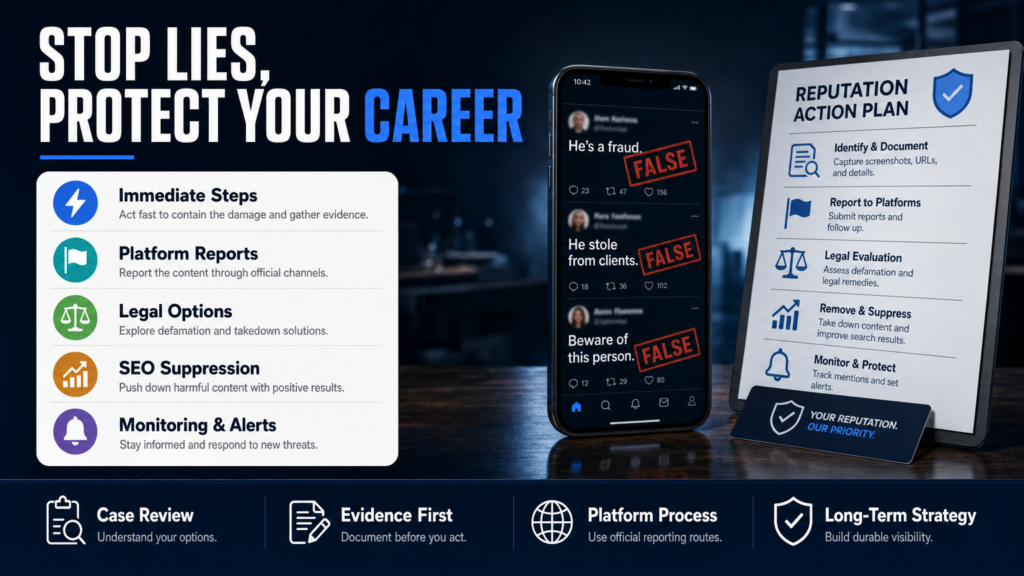
Use a staged response: immediate containment, platform pathways, legal review, and reputation remediation. Each stage can run in parallel while preserving future legal options.
If you are dealing with a post that mentions your employer, clients, or licensing board, act faster: those audiences can make immediate decisions that affect your livelihood.
- 1. Preserve evidence (see earlier) immediately.
- 2. Notify key stakeholders privately — employer, clients, or platform if it affects safety or contracts.
- 3. Report the content to the platform and request review; escalate with a business/legal report if you represent an organization.
- 4. Get a legal assessment to see if defamation, harassment, or privacy claims may be feasible.
- 5. If removal fails or is slow, begin suppression tactics: publish accurate, authoritative content that outranks the false item.
- Contain (0–72 hours): document, report, alert stakeholders privately.
- Assess (3–7 days): legal review and risk assessment, decide whether to send a demand letter.
- Remediate (1–12 weeks): removal attempts, mitigation, or suppression through SEO and content creation.
How to communicate with followers, clients, or employers
Keep external communications factual and concise. A carefully worded private message to affected clients or an internal brief to your employer is usually better than a public back-and-forth that draws more attention to the claim.
If you must address the public, avoid emotional attacks. State the facts, note that the statement is false, and that you are pursuing appropriate channels to correct it.
- Draft a short internal notification for stakeholders with key facts and next steps.
- Use neutral language in a public statement if necessary; avoid giving the lie free publicity.
- Coordinate with any legal counsel or PR advisor before releasing a public statement.
When to use our practical resource
If you want a step-by-step checklist for initial actions and templates (evidence log, sample reporting note), see our walkthrough at What to Do When Someone Posts Lies About You Online. That resource focuses on immediate containment and documentation.
When removal is not available: suppression and reputational repair
Many false posts don’t qualify for platform removal because they fall into opinion, commentary, or insufficiently targeted harassment. In those cases we evaluate suppression (reducing visibility) and reputational repair as realistic alternatives.
Suppression uses search-engine optimization (SEO) and content publishing to push damaging content off the first page of search results. This is a strategic, ongoing process rather than a guaranteed fix.
- 1. Audit the search results for your name and key phrases to identify which pages must be outranked.
- 2. Create or strengthen authoritative pages (LinkedIn, personal website, institutional profiles).
- 3. Publish high-quality content (articles, press releases, expert commentary) that targets the same keywords as the harmful post.
- 4. Use backlink building and social signals to accelerate indexing and ranking of positive content.
- 5. Continue monitoring and refreshing content to maintain improved visibility.
- Suppression does not remove the content — it aims to outrank it with authoritative material.
- Tactics include publishing site pages, press releases, professional profiles, and positive third-party coverage.
- Timing varies: some cases show improvement in weeks; others require months and continued effort.
Tactics if legal or platform removal is unsuccessful
When removal is unavailable, mitigation and correction are often the practical path. That can include requesting corrections from publishers, issuing a short factual statement on your site, and engaging in SEO work designed to make the false post less visible to searchers.
For a deep dive into content permanence and screenshot propagation, read The Screenshot Effect: How One Post Can Ruin a Career.
- Request corrections from publishers (if a news article repeated a false claim).
- Use authoritative profiles and content to occupy the first page of Google.
- Consider paid media placements or local news corrections if appropriate and factual.
Monitor, prevent, and harden your digital presence
After the immediate crisis, set up systems to detect new mentions quickly and reduce future risk. Ongoing monitoring lets you respond before a post goes viral.
Combine technical measures (privacy settings, two-factor authentication) with monitoring tools and a response playbook.
- 1. Enroll in a monitoring service or use alerts for name variants and branded terms.
- 2. Regularly audit privacy settings on major platforms: Facebook, Instagram, X, TikTok, LinkedIn, YouTube.
- 3. Implement digital hygiene: unique passwords, password manager, 2FA, and contact info protection with data brokers.
- 4. Maintain a relationship with counsel and a PR advisor for faster escalation if a new incident arises.
- Set up Google Alerts and reputation-monitoring tools for your name, company, and common misspellings.
- Lock down account security: change passwords, enable 2FA, review third-party app access.
- Have a pre-approved internal notification and public-response template to speed accurate communications.
Data-broker opt-outs and privacy
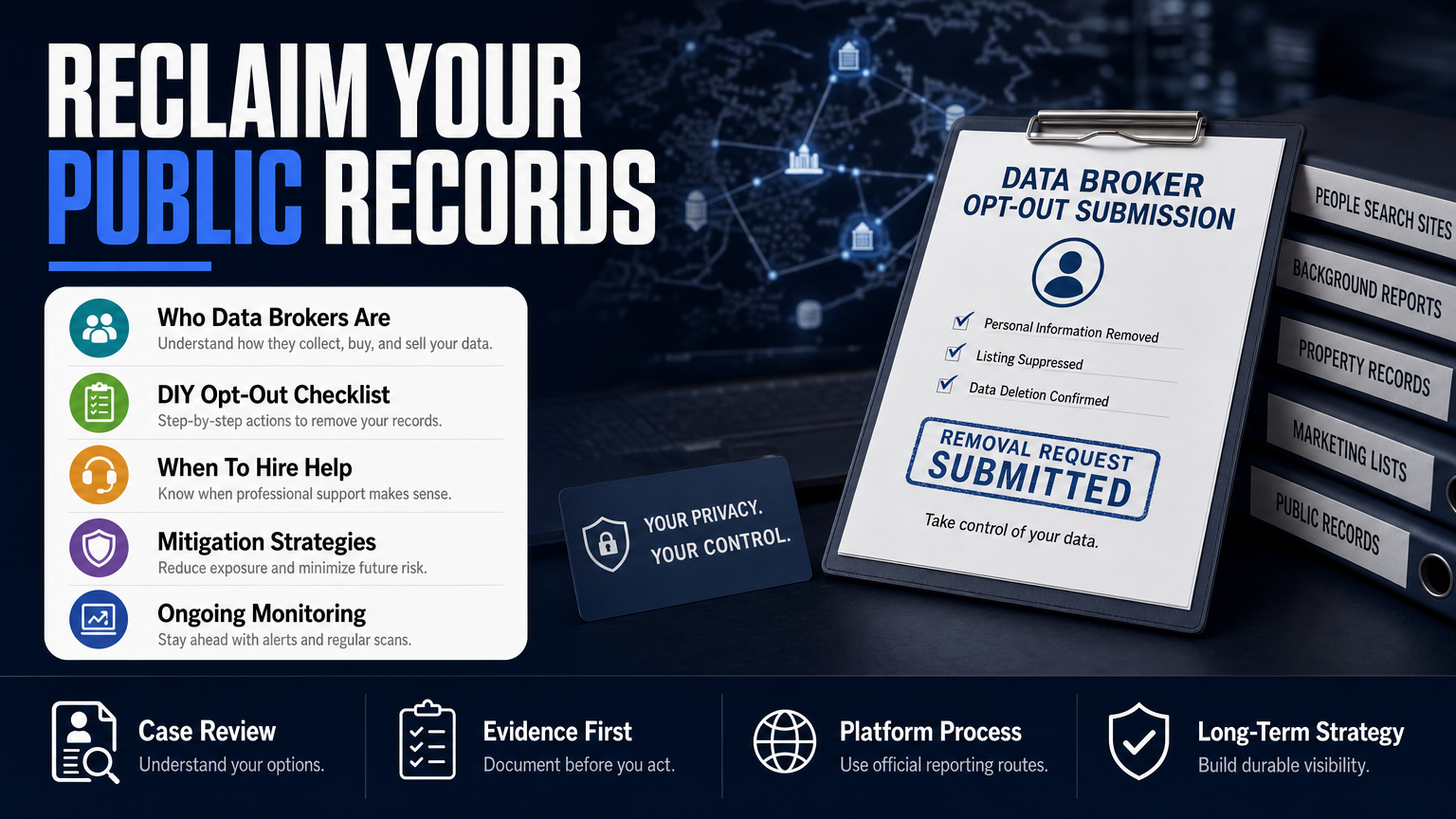
People-search sites and data brokers often amplify doxxing and reputational harm. Removing or opting out of these services reduces the amount of private data available to opportunistic attackers.
Opt-outs are time-consuming and may not be permanent; many people use a combination of manual requests and paid services to keep their data limited.
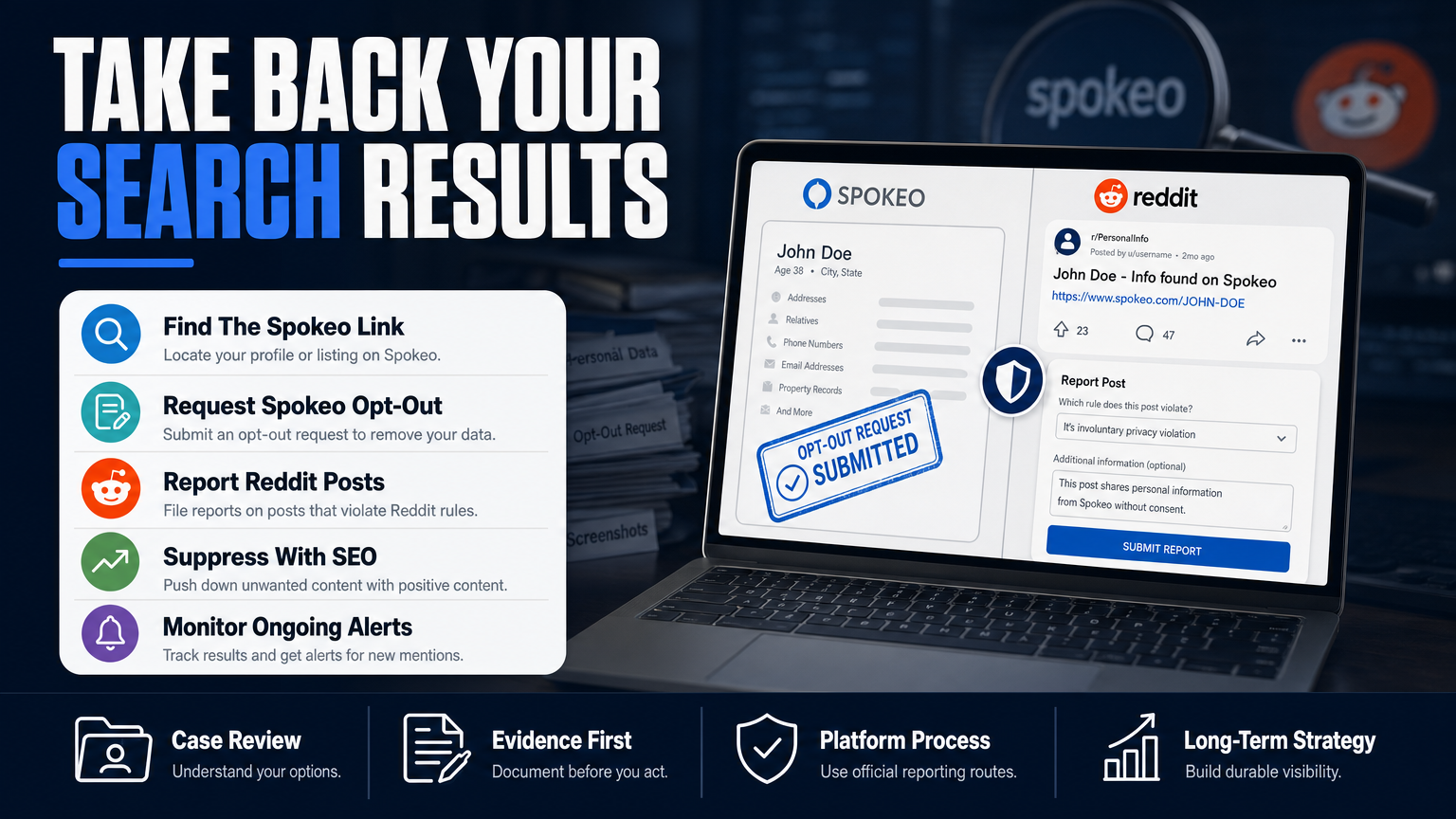
- Identify key brokers (Spokeo, Whitepages, Intelius, BeenVerified) and file opt-out requests.
- Monitor for re-listings; set a schedule to check major brokers quarterly.
- Consider professional help for large-scale data removal and privacy hardening.
How businesses and professionals should respond to coordinated smear campaigns
When a brand or professional faces coordinated attacks (review-bombing, organized posts across platforms), the response should be coordinated across legal, PR, and technical teams. Rapid, consistent messaging and decisive mitigation matter more than reactive emotional posts.
Businesses must protect customers and employees while preserving evidence and engaging platform escalation paths for coordinated abuse.
- 1. Triage: identify platforms and the scale of spread.
- 2. Notify affected customers or partners privately with facts and reassurance.
- 3. Engage platform abuse teams and request coordinated takedowns for impersonation or repeat-offender accounts.
- 4. Begin SEO suppression for campaign keywords and negative search results.
- Segregate duties: legal handles subpoenas, PR crafts responses, operations support evidence collection.
- Use platform business channels and trust-and-safety escalations to request expedited review.
- Document financial impact and customer churn as part of any legal or insurance claim.
When to involve outside specialists
Large-scale campaigns often require outside specialists for technical takedowns, forensic tracing of coordinated accounts, and SEO suppression. Your Reputation Agency evaluates whether the content may qualify for removal or review and pursues the legal, technical, platform-based, and reputational options available.
Professional help is especially useful when the attack targets customers, harms revenue, or risks licensure or regulatory complaints.
- Consider a reputation management firm when multiple platforms are involved.
- Coordinate with counsel for subpoenas or cease-and-desist letters.
- Document costs and lost revenue for potential recovery or insurance claims.
Removal vs Suppression: Which to pursue first?
A realistic comparison to help decide whether to focus on getting content taken down or on reducing its visibility.
| Removal (Take Down) | Suppression (Reduce Visibility) |
|---|---|
| Goal | Goal |
| Have the content removed from the platform or publisher | Push harmful content lower in search results with positive content |
| Depends on platform policy, publisher cooperation, or legal order | Depends on SEO, content authority, and ongoing maintenance |
| Best for clear policy violations or illegal content | Best when content is false but not removable or is a public record |
| May be faster if platform acts quickly | Often slower but more durable across search engines |
| Doesn’t address copies or screenshots already shared | Can reduce visibility of both original and copies over time |
Hypothetical example: A false accusation on a neighborhood Facebook group
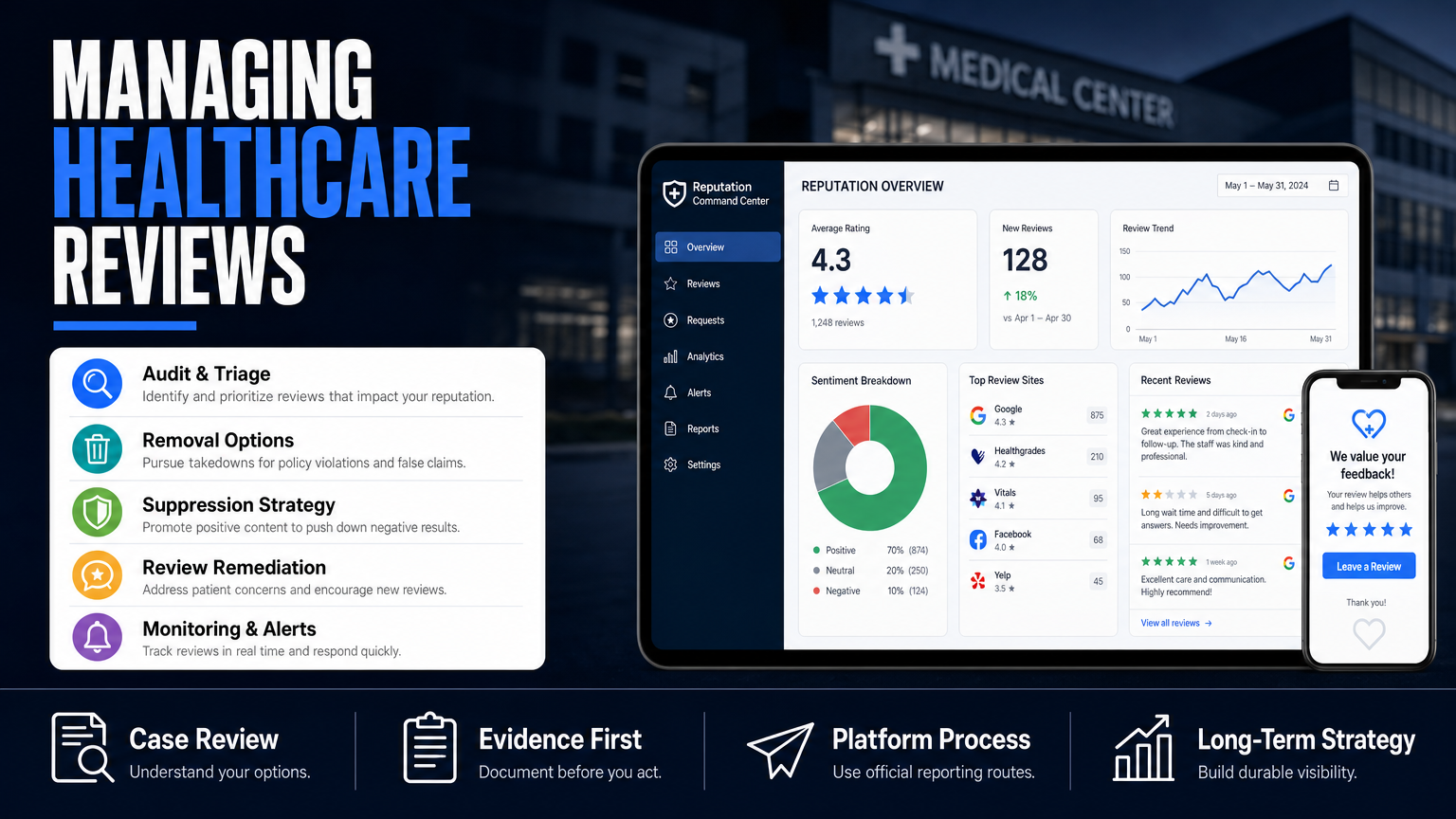
A physician (anonymous scenario) is falsely accused in a local Facebook group of misconduct after a disgruntled patient posts an unverified claim. The post gets shared to other local groups and appears in searches for the physician’s name.
The physician follows a staged response: preserve screenshots, privately message the poster asking for correction (with caution), report to Facebook for harassment and privacy violation, notify the hospital’s risk team, and contact an attorney for review.
Facebook does not immediately remove the post because it’s framed as an anecdote rather than a clear policy violation. The physician then pursues suppression: updates their professional website, posts a factual statement on their clinic page, requests local news to correct misstatements, and publishes authoritative content that targets the physician’s name in search results.
- 1. Capture and archive all instances of the post, including shares and comments.
- 2. Use platform report channels and request expedited review from Facebook’s business trust-and-safety team.
- 3. Notify employer and licensing board if required by policy; coordinate public statements.
- 4. Implement SEO suppression and monitor for re-posting; set alerts for new mentions.
- Immediate evidence capture and stakeholder notification reduced panic and preserved options.
- Platform review did not remove the post; suppression and factual correction limited long-term damage.
- Legal review determined a defamation suit was possible but expensive given the poster’s jurisdiction and limited damages, so the team prioritized mitigation and monitoring.
Common mistakes people make when responding to online lies
These are frequent errors that worsen exposure or damage legal options. Avoid them deliberately.
Mistake: Responding angrily or publicly to the accuser
A defensive, emotional public reply can increase shares and create a record that looks unprofessional. It often causes the post to trend further. Keep public responses factual and minimal; handle disputes privately when possible.
Mistake: Relying only on platform reporting without preservation
Platforms allow deletion at any time. If you don’t capture evidence first, a later legal claim may be impossible to prove. Always document before you report.
Mistake: Threatening legal action without counsel
Cold cease-and-desist messages from non-lawyers can escalate conflict and provide the poster with publicity. Consult qualified counsel before sending formal legal demands.
Mistake: Trying to remove truthful public records
Truthful reporting, arrest records, or public court filings are often not removable; attempting to forcibly delete them can waste resources and may attract more attention. Focus on correction, context, or suppression instead.
Mistake: Using deceptive or retaliatory tactics
Do not try to fabricate counterclaims, pay for fake reviews, or impersonate accounts to retaliate. These actions are unethical and can expose you to legal penalties.
Best practices to manage and recover from false social posts
Adopt these durable habits whether you face a single false post or an organized campaign.
Act quickly, but collect evidence first
Immediate action is important, but never report or delete before you document. Use multiple backups (screenshots, PDFs, archives) and log the time and method of capture.
Use the most specific platform violation when reporting
Choose the policy category that fits best (impersonation, harassment, privacy, false information). Generic reports are slower and less effective.
Coordinate legal, PR, and technical responses
A coordinated approach reduces errors. Legal preserves options, PR manages messaging, and technical/SEO work mitigates long-term visibility.
Plan for long-term suppression and monitoring
Plan for ongoing work: suppression requires high-quality content and maintenance. Set monitoring alerts and a refresh schedule for your positive content.
Protect account security and personal data
Harden all accounts with 2FA and a password manager, and regularly review data-broker listings to limit doxxing risk.
Expert Tips
- Preserve everything before reporting — a deleted post can still be used as evidence if you archived it.
- Use a calm, short private message to request a correction from the poster only after documenting the post.
- If anonymous accounts are involved, consult counsel about subpoenas; timing and jurisdiction matter.
- Don’t assume platform removal is the only route; build suppression content in parallel.
- Avoid public legal threats; they often backfire and draw more attention to the claim.
- Track the chain of reposts — sometimes the original is down but copies are what drive visibility.
- Use professional profiles (LinkedIn, institutional pages) as SEO anchors for your name.
- Regularly check data broker sites and file opt-outs to limit the data attackers use to personalize attacks.
Conclusion
False statements on social media are distressing and can have real career and business consequences. The right response blends immediate containment, careful evidence preservation, measured legal evaluation, and long-term reputation work. Removal may be possible in some cases; where it isn’t, suppression and correction become the practical path.
Act deliberately: document first, then report, then consult counsel if the content is materially damaging. If your situation involves potential licensing, employment, or legal jeopardy, prioritize legal review and stakeholder communication to limit immediate harm.
Why Businesses Choose Your Reputation Agency
Managing your reputation takes more than monitoring reviews or publishing the occasional blog post. It takes a strategy built around your situation, your industry, and what is actually showing up in search.
Your Reputation Agency works with businesses, executives, healthcare professionals, attorneys and growing brands. Our services include:
- Remove or suppress negative search results and news articles from Google
- Review removal and remediation (Google, Yelp, Facebook, Trustpilot, industry sites)
- Data broker and people-search opt-outs to remove personal information
- Mugshot and arrest-record removal or suppression
- Takedowns of defamatory, false, or malicious posts (social, blogs, forums)
- Online crisis management and rapid-response reputation repair
- Impersonation and fake account removal on social platforms
- Reputation monitoring, alerts, and ongoing surveillance
- First-page SEO and suppression strategies to bury negative content
- Digital security audits and privacy hardening to prevent future exposure
Frequently Asked Questions
1. Can I sue someone for posting lies about me on social media?
Possibly. A defamation suit can be viable if you can prove the statement is false, was presented as fact, was published to third parties, and caused damages. Public figures face a higher standard (actual malice). Consult a qualified attorney to assess evidence and jurisdictional rules.
2. How do you stop someone from slandering you on social media?
Start by preserving evidence, report the post using the most relevant platform policy, and consider private outreach or legal review. If removal isn’t achieved, pursue suppression, factual corrections, and monitoring. Avoid public retaliation which can amplify the claim.
3. Is it illegal for someone to spread lies about you?
Spreading false statements is usually a civil matter (defamation). Criminal charges are rare and typically limited to threats, stalking, identity theft, or other statutory crimes. Platform policy enforcement is separate from criminal or civil law.
4. What do I do if someone is slandering me on social media?
Preserve screenshots and URLs, report to the platform, notify any affected stakeholders privately, and get a legal assessment if the content risks your job or business. If removal isn’t available, build suppression strategies and monitor for recurrences.
5. How long does it take to get harmful content removed?
Timing varies by platform, the content’s nature, and whether legal processes are needed. Some platform reviews take hours or days; subpoenas and court orders take weeks to months. We evaluate whether the content may qualify for removal or review and pursue the legal, technical, platform-based, and reputational options available.
6. Can social media platforms be forced to remove posts?
Platforms generally remove content under their policies or in response to valid legal orders. Courts can sometimes order removal, but jurisdictional complexity and the presence of copies and screenshots make court-driven deletion a partial solution rather than a guaranteed one.
7. Should I contact the person who posted the lie?
You can attempt a brief, non-threatening private message requesting correction, but only after documentation. If the poster is hostile or anonymous, or if there are legal risks, consult an attorney before contacting them.
8. What evidence should I collect to support a complaint or lawsuit?
Collect full-page screenshots (desktop and mobile), URLs, timestamps, archived copies, records of reposts, witness statements, and documentation of any financial or professional harm tied to the post. Preserve originals and record how you captured them.
9. What if the post is technically true but presented to mislead?
If a statement is literally true but misleading or taken out of context, legal remedies are more limited. You may pursue correction, context, or mitigation strategies, and consider demanding a clarification from publishers or using suppression tactics to provide fuller context in search results.
This content provides general information and does not constitute legal advice. The available options and likely outcomes depend on the facts, evidence, platform policies, applicable law, jurisdiction, and public-interest considerations.
Past examples do not guarantee future results. Removal, correction, deindexing, and search-position changes depend on third parties and circumstances outside Your Reputation Agency’s control.