If a quick Google of your name returns contact details, addresses, or a profile you didn’t create, you’re looking at data broker inventory — and you’re not alone. This guide explains how to remove data from data brokers and what realistic outcomes you can expect.
You’ll get a step-by-step DIY checklist, a comparison of doing this yourself vs hiring an agency, timelines with caveats, and concrete mitigation tactics when deletion isn’t available.
Throughout, I’ll point out platform-specific quirks, legal options that may apply in some U.S. states, and the exact follow-up you need to stop the same data showing up again.
Table of Contents
- Who Are Data Brokers and What Do They Sell?
- How Do Data Brokers Collect and Build Profiles?
- Can You Remove Data From Data Broker Sites?
- DIY Opt-Out: A Practical Checklist
- DIY Versus Hiring a Reputation Agency
- When Removal Isn’t Available: Suppression, Correction, and Legal Options
- Monitoring, Follow‑Up, and Hygiene to Prevent Recurrence
- How Long Does Removal Take? Realistic Timelines
- DIY vs Agency: Which Route Fits Your Case?
- Hypothetical Example: A Local Physician’s Removal and Suppression
- Common Mistakes People Make When Trying To Remove Broker Data
- Best Practices to Reduce Future Exposure
- Expert Tips
- Conclusion
- Why Businesses Choose Your Reputation Agency
- Frequently Asked Questions
Who Are Data Brokers and What Do They Sell?
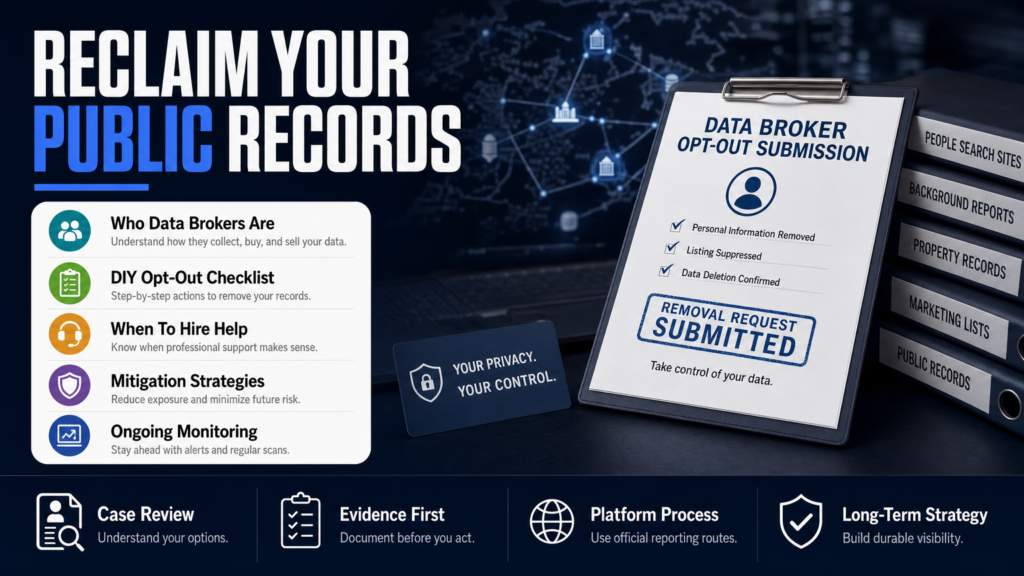
Data brokers are companies that collect, aggregate, and resell personal information — contact details, addresses, employment history, property records, and inferred attributes like household income or interests. For a plain-English overview, see What Are Data Brokers and How Do They Work?.
Their product is convenience for businesses: marketing lists, lead files, background-aggregation services, or people-search interfaces. That same convenience is what makes brokers a privacy headache for individuals.
- Typical data sold: name, phone, email, current and past addresses, relatives, property records, professional history.
- Common broker sites: Whitepages, Spokeo, Intelius, PeopleFinders, BeenVerified, TruthFinder, MyLife, Instant Checkmate, Radaris, PeopleLooker, PeekYou.
- Brokers acquire data from public records, commercial sources, subscriptions, scraping, and other brokers.
How Do Data Brokers Collect and Build Profiles?
Understanding the sources matters because it determines which channel to use for removal. Brokers combine multiple sources to create a profile; removing one source may not remove the broker’s copy.
Sources include public records (property, court filings), social profiles, online directories, marketing lists, purchased data from other brokers, and scraped content from websites and social networks.
- Public records: deeds, professional licenses, and some court documents are routinely harvested.
- Commercial lists: retailers, loyalty programs, and data-exchange networks feed brokers.
- Scraped content: public social media posts, sites, and news articles can be captured and indexed.
Sensitive data and the dark web
Brokers generally do not sell active stolen credentials, though some data brokers trade in lists that later get abused; if you find your Social Security number or bank details hosted or advertised, treat it as a separate, high-priority incident.
If you suspect sensitive personal data is exposed beyond broker profiles, consult security and legal resources; for guidance on finding and responding to SSNs or similar leaks see When Your Social Security Number Turns Up on the Dark Web.
Can You Remove Data From Data Broker Sites?
Short answer: sometimes. Whether you can remove data from data brokers depends on the broker’s policies, the source of the data, proof of identity, state privacy laws, and whether the information is a public record.
We evaluate whether the content may qualify for removal or review. Removal is never guaranteed and will vary by publisher, platform policy, and jurisdiction.
- If the broker displays an opt‑out form and accepts proof of identity, you often can remove or suppress your listing.
- If the broker’s data is derived from public records (property, certain court documents), removal is harder because the underlying record is public.
- Some brokers allow suppression for a fee; paid suppression is not an assurance of permanence.
DIY Opt-Out: A Practical Checklist
You can remove a surprising amount of exposure yourself. Below is a prioritized, repeatable process you can run through for each broker site.
Keep a log of requests, screenshots, and the exact email addresses or forms you used — that record is essential if you later escalate or coordinate with a paid service.
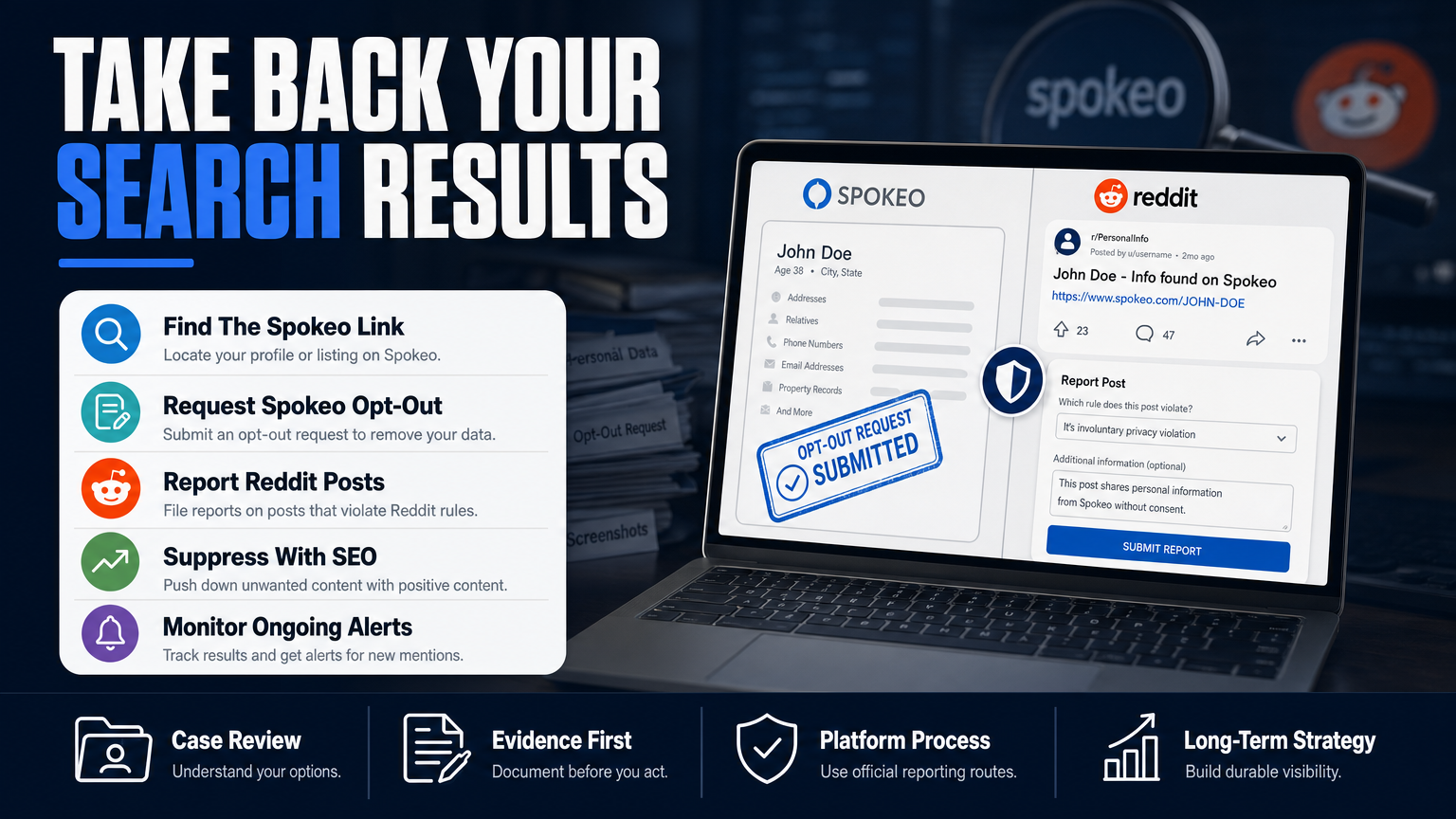
- 1) Create an inventory: list every broker result for your name and the exact URL of the listing.
- 2) Check the broker’s opt-out or privacy page for a removal method — many have dedicated forms or email addresses.
- 3) Prepare identity documents only where the site explicitly requires them; never email sensitive documents unencrypted. Redact SSNs when possible and only provide the minimum the form asks for.
- 4) Submit opt-out requests using the broker’s form or the publisher email. Save confirmation numbers or screenshots.
- 5) Follow up after 7–14 days. Some brokers take several weeks; timing depends on their processes.
- 6) Repeat every 60–90 days: data can reappear if brokers reacquire from third-party feeds.
- Start with the largest aggregators (Whitepages, Spokeo, BeenVerified, MyLife, Intelius).
- Work from authoritative sources outward: if a broker copies from MySpace or LinkedIn, correct or limit the original source if possible.
What to include in an opt-out request
Provide the exact URL, the name exactly as shown, and the minimum ID the broker requires. Keep your message factual: cite the broker’s privacy policy section or opt‑out form if available.
Do not invent legal claims in a first contact. If a broker refuses to remove inaccurate information, you can escalate to a lawyer or a consumer protection agency for review.
- Exact listing URL
- Name and former names as shown
- Proof of current address (if required) — utility or lease (redact account numbers)
- Copy of the broker’s opt-out confirmation or reference number
Automated tools vs manual opt-outs
There are removal tools and services that automate opt‑outs for you. They can save time but read their terms: many operate by repeatedly submitting opt-outs and may charge recurring fees.
If you use a freemium tool, confirm whether it actually files opt-outs or just shows links you still must use yourself.
- Pros of tools: saves time, manages many brokers at scale.
- Cons: recurring fees, potential for incomplete coverage, and limited power over public records.
DIY Versus Hiring a Reputation Agency
For busy professionals, agencies coordinate opt-outs, suppression campaigns, monitoring, and legal referrals. That said, DIY removal remains an appropriate option for many people — the choice depends on scale, sensitivity, and how much time you can commit.
Below is a practical comparison to help you decide.
- DIY suits singletons with limited exposure and moderate time to manage follow-ups.
- Agencies are appropriate for high-volume listings, ongoing threats (doxxing, smear campaigns), or when you need coordination with PR and legal counsel.
When Removal Isn’t Available: Suppression, Correction, and Legal Options
Not every listing can be deleted. Public records, aggregated court filings, and some news articles may be beyond the broker’s authority to remove. In those cases we pursue mitigation: suppression, correction, and escalation.
Suppression strategies aim to reduce visibility in search results rather than to delete the original record. These strategies include building authoritative content, issuing corrections, and working with publishers when content is inaccurate.
- Create positive, authoritative pages you control (personal website, LinkedIn, professional profiles) that can outrank broker listings.
- Request corrections directly with the original publisher (example: a newspaper or a county clerk) when data is inaccurate.
- If data is defamatory or violates platform policies, coordinate with qualified legal counsel and document the evidence.
Why screenshots and copies matter
Brokers and publishers sometimes change content or deny prior versions. Keep dated screenshots and your correspondence records. For guidance on the danger of assuming deletions erase the problem, see The Screenshot Effect: Why Deleted Posts Still Hurt.
When to consider legal escalation
If a broker refuses to remove demonstrably false information, or you face harassment or identity theft tied to broker listings, a legal review may be warranted. A qualified attorney can evaluate whether a claim like defamation, invasion of privacy, or a statutory privacy right might apply.
Any legal option depends on jurisdiction, evidence, and the nature of the content — there is no universal legal remedy.
Monitoring, Follow‑Up, and Hygiene to Prevent Recurrence
Removal is not a one-time task. Brokers re-ingest public records and third-party feeds constantly. Implementing monitoring and privacy hygiene prevents—or at least reduces—recurring exposure.
Set up alerts and schedule quarterly reviews; many agencies offer continuous surveillance but individuals can do effective monitoring with a few tools.
- Set Google Alerts for your name and common variants (include city/profession).
- Use people-search monitoring services or a reputation-monitoring dashboard to track reappearances.
- Periodically re-run opt-outs and check the biggest aggregators every 60–90 days.
How Long Does Removal Take? Realistic Timelines
Timing varies dramatically. Some opt-outs are processed in days; others may take weeks. Public-record corrections or legal escalations can take months. Never accept a single, fixed timeline as a promise.
We provide estimated ranges only after assessing the case: platform processing times, the number of brokers involved, and whether the data is a public record all affect timing.
- Simple opt-out: often 7–30 days (some brokers complete within 48–72 hours).
- Complex cases with publisher corrections or legal notices: weeks to several months.
- Suppression campaigns (SEO, content creation): months to build ranking improvements; no guaranteed outcome.
DIY vs Agency: Which Route Fits Your Case?
A concise contrast to help you choose based on scale, cost, and objectives.
| DIY | Agency |
|---|---|
| Cost | Upfront low cost; time investment high |
| Time to start | Immediate by you; onboarding for agency takes days |
| Coverage | Manual, limited to what you find |
| Scalability | Hard to scale for dozens of listings |
| Legal coordination | You must find counsel separately |
| Monitoring | DIY alerts; manual checks |
| Complex incidents | Agencies coordinate PR, takedowns, and legal referrals |
Hypothetical Example: A Local Physician’s Removal and Suppression
A family doctor found multiple broker listings showing her old addresses, a past practice, and a data-broker profile that included phone and email scraped from a now‑deleted online roster. She needed faster results because new patients were calling the old practice.
The process combined DIY opt-outs, direct publisher correction, and a suppression campaign aimed at pushing broker results lower in search.
- 1) Inventory and prioritize listings that cause the most patient confusion.
- 2) Submit opt-outs to major brokers and save confirmation evidence.
- 3) Fix or remove the original content source (the roster) to prevent re-scraping.
- 4) Launch suppression with authoritative profiles and a news item to push negative listings down.
- 5) Set monitoring and plan quarterly re-checks; repeat opt-outs as needed.
- Step 1: Inventory — 18 broker URLs and two scraped pages identified.
- Step 2: Immediate opt-outs on top 5 brokers; screenshots and confirmation emails saved.
- Step 3: Contacted original publisher to correct scraped email and remove an outdated roster entry.
- Step 4: Built authoritative pages (updated clinic site, LinkedIn, clinician directory) and a targeted press release about the move.
Common Mistakes People Make When Trying To Remove Broker Data
These errors waste time and can worsen your exposure if you’re not careful. Avoid them.
1. Skipping the source
Many people only target brokers and forget to correct or remove the original source. If a broker re‑ingests a corrected source, the listing can disappear from the broker in time; leave the source unaddressed and reappearances are likely.
2. Uploading unnecessary sensitive documents
Some opt-out forms request identity verification; you should provide only the minimum required and avoid sending unencrypted sensitive documents like SSNs unless absolutely necessary and only via secure channels.
3. Expecting permanent deletion
Assuming that one successful opt‑out is permanent is a mistake. Brokers re‑aggregate data; periodic checks and maintenance are required.
4. Using only automated tools
Automated tools can miss edge cases: unique aliases, court-records aggregators, or industry-specific sites. Manual review is still important for comprehensive cleanup.
5. Ignoring state privacy options
Failing to check whether a state privacy law applies (for example, California’s consumer privacy regulations) can mean missing a statutory opt-out or deletion avenue in applicable jurisdictions.
Best Practices to Reduce Future Exposure
Adopt a proactive approach that combines technical, administrative, and behavioral changes.
Inventory and prioritize
Create a centralized spreadsheet of all broker listings with URLs, contact forms, and last-check dates. Prioritize listings where contact details or address errors cause real harm (clients calling an old office, identity theft risks).
Limit public sharing
Minimize exposure by not posting personal phone numbers, home addresses, or unredacted IDs on public pages. Use business contact points when you can.
Use secure identity verification
When a broker requires an ID to process an opt-out, provide the least sensitive accepted document and transmit it only via secure forms or encrypted email if offered.
Schedule recurring reviews
Repeat checks every 60–90 days for the first year, then quarterly thereafter. Automated alerts plus a manual quarterly sweep catch reappearances fast.
Document everything
Keep screenshots, confirmation emails, and form entries. Your documentation is critical if you later need legal help or escalate to a regulatory agency.
Expert Tips
- Target the largest aggregators first—removing one authoritative source often reduces distribution downstream.
- If a broker requests identity proof, redact any SSN before submission and use a government-issued ID image only over secure forms.
- Set a recurring calendar reminder to re‑check the top 10 broker URLs every 60 days for the first six months.
- When a listing is inaccurate, correct the original publisher before chasing every broker copy.
- Use your professional directory listings (state board, hospital profile) to create authoritative pages that outrank brokers.
- If there’s harassment or doxxing, document everything and seek immediate legal and security help—this is different from a routine opt-out.
- Free removal tools can save time but verify what they file on your behalf; keep copies of all submissions they make.
- Consider a suppression campaign (SEO + authoritative content) when deletion isn’t an option.
Conclusion
Removing data from data brokers is practical but rarely final: it’s an ongoing program of opt-outs, source corrections, monitoring, and sometimes suppression. Expect a mix of quick wins and longer projects, and plan for recurring maintenance.
If your exposure is large, time-sensitive, or tied to identity theft or harassment, coordinate removal efforts with security professionals, legal counsel, and (if needed) a reputation team that can manage scale and escalation. A disciplined, documented process reduces both visibility and the chance of repeated reappearance.
Why Businesses Choose Your Reputation Agency
Managing your reputation takes more than monitoring reviews or publishing the occasional blog post. It takes a strategy built around your situation, your industry, and what is actually showing up in search.
Your Reputation Agency works with businesses, executives, healthcare professionals, attorneys and growing brands. Our services include:
- Remove or suppress negative search results and news articles from Google
- Review removal and remediation (Google, Yelp, Facebook, Trustpilot, industry sites)
- Data broker and people-search opt-outs to remove personal information
- Mugshot and arrest-record removal or suppression
- Takedowns of defamatory, false, or malicious posts (social, blogs, forums)
- Online crisis management and rapid-response reputation repair
- Impersonation and fake account removal on social platforms
- Reputation monitoring, alerts, and ongoing surveillance
- First-page SEO and suppression strategies to bury negative content
- Digital security audits and privacy hardening to prevent future exposure
Frequently Asked Questions
1. How do you remove your info from data broker sites?
Start with an inventory of broker listings and use each broker’s opt-out form or email. Provide the exact listing URL and the minimum proof of identity required. Save confirmation screenshots and follow up after 7–14 days. Removal depends on the broker, the data source, and whether the information is a public record.
2. Are data broker removal tools free and do they work?
Some tools offer free searches and partial automation, but many useful services charge for recurring management. Free tools can point you to opt-out links, but they often do not replace the manual verification and follow-up that ensures removal requests are actually processed.
3. How long does a broker opt-out take?
Simple opt-outs may be processed in 7–30 days, while more complex removals or publisher corrections can take weeks to months. Timing depends on the broker’s process, whether the data is pulled from public records, and the need for legal escalation.
4. Can data brokers sell my Social Security number?
Reputable brokers should not sell SSNs as a feature; however, lists shared or sold in other channels can include sensitive data. If you find an exposed SSN or financial data, treat it as a security incident, limit further exposure, and seek identity-theft remediation and legal advice.
5. Does California law force brokers to delete my data?
State privacy laws (for example, California’s CCPA/CPRA) create consumer rights such as opt-outs for sale of personal information in some circumstances. These statutes are complex and jurisdiction-specific; a lawyer can advise whether you qualify under applicable state law.
6. What do I do if a broker refuses to remove false information?
Document the inaccuracy, save screenshots, and request correction from the original publisher. If the broker still refuses, consult qualified legal counsel to evaluate whether a statutory or common-law claim exists. A qualified attorney can determine whether legal remedies are available in your jurisdiction.
7. How can I stop brokers from reappearing after removal?
Fix or remove the data at the original source, maintain periodic opt-outs (every 60–90 days initially), set up monitoring alerts, and create authoritative content to push broker results lower in search. There is no single permanent fix; maintenance is necessary.
8. Should I hire an agency to handle broker removals?
If you have dozens of listings, an ongoing campaign, or an urgent reputational or safety risk, an agency can coordinate opt-outs, suppression, monitoring, and legal/PR referrals efficiently. For limited exposure and time to manage requests, DIY is often sufficient.
9. Can I sell my data to data brokers instead of removing it?
You can often control commercial sharing through privacy settings with specific companies, and some services allow opting out of sale. ‘Selling’ personal data directly to brokers is uncommon for individuals; be wary of any service that asks you to list or sell sensitive information — it can create new exposure.
This content provides general information and does not constitute legal advice. The available options and likely outcomes depend on the facts, evidence, platform policies, applicable law, jurisdiction, and public-interest considerations.
Past examples do not guarantee future results. Removal, correction, deindexing, and search-position changes depend on third parties and circumstances outside Your Reputation Agency’s control.