You found a damaging Yelp review that’s costing you customers and sleep. You’re asking the obvious question: can you pay to remove Yelp reviews and is that legal or effective?
This article explains exactly what Yelp allows, what it doesn’t, where paid removal offers fit in (and why they’re risky), and the realistic paths you can take: platform reporting, legal options, or suppression through first-page SEO.
You’ll get clear, step-by-step actions you can take today, plus what to prepare if you hire a professional. We evaluate options honestly — including when removal may be unavailable and how to limit damage instead.
If you want to dive deeper on practical removal tactics, this guide links to detailed resources and explains what to expect at each stage.
Table of Contents
- Can Yelp Reviews Be Removed?
- Can You Pay To Remove Yelp Reviews?
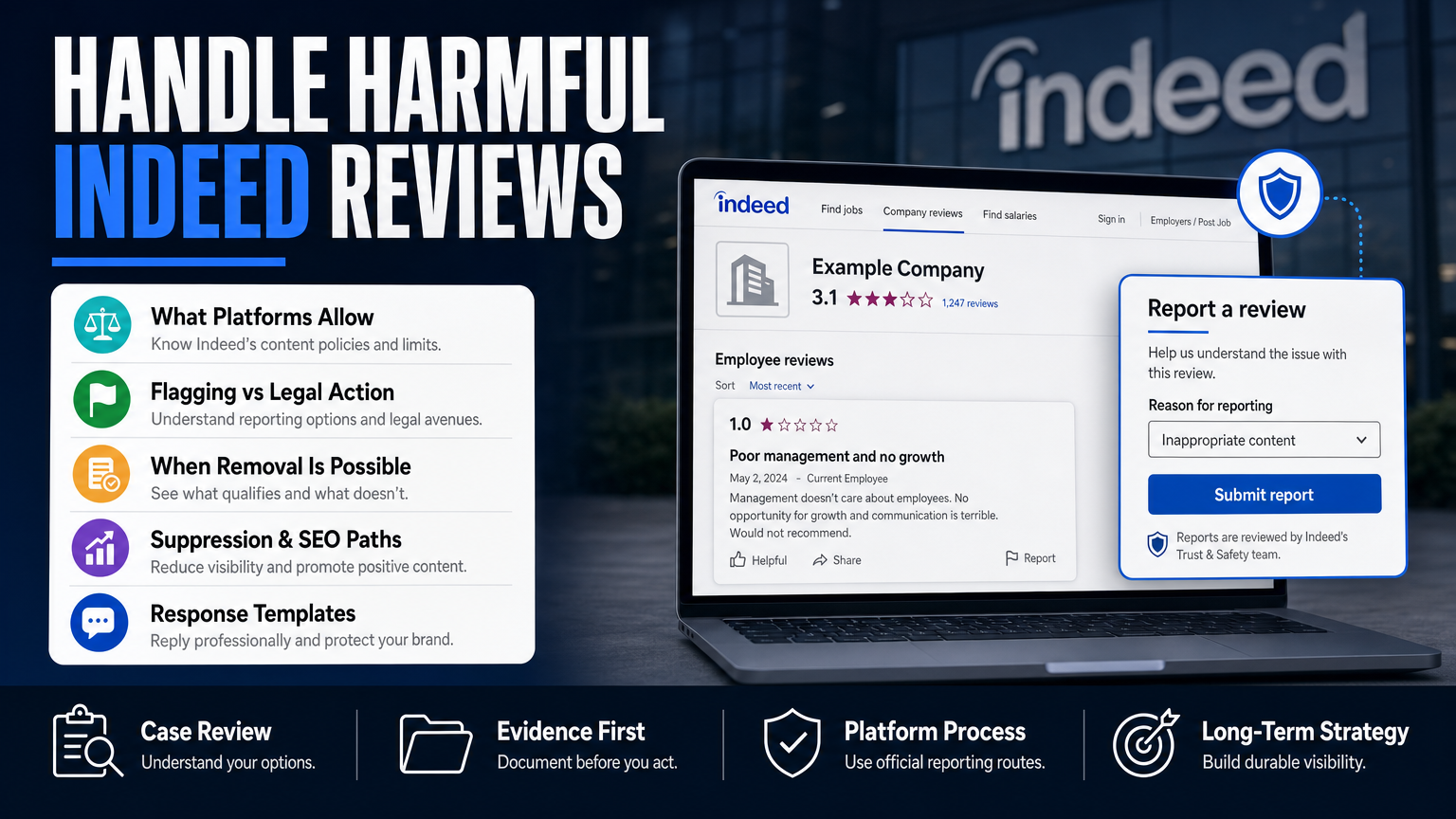
- How To Report Or Ask Yelp To Remove A Review
- Does Yelp Pay You To Do Reviews?
- Can I Request To Have A Google Review Removed?
- Why Are My Reviews Getting Deleted?
- When Removal Isn’t Available: Suppression, Correction, And Damage Control
- Escalation: Legal Options, Evidence, And When To Hire Professionals
- Monitoring And Prevention: Stop Problems Before They Spread
- DIY vs Professional Agency
- Hypothetical Example: One Fake Review, A Three‑Pronged Response
- Common Mistakes Businesses Make With Yelp Reviews
- Best Practices For Handling Problematic Yelp Reviews
- Expert Tips
- Conclusion
- Why Businesses Choose Your Reputation Agency
- Frequently Asked Questions
Can Yelp Reviews Be Removed?
Yes — Yelp can remove reviews, but removal depends on Yelp’s content policy, whether the review violates their terms, and the evidence you provide. Yelp explicitly removes reviews that are fraudulent, contain hate speech, reveal private information, or are clearly off-topic.
We evaluate whether the content may qualify for removal or review. Platform decisions remain under the platform’s control; Yelp’s moderation is not guaranteed and depends on their investigation.
- Collect evidence: screenshots, timestamps, order numbers, IP indicators if available.
- Use Yelp’s official report flow from the review (flag) and include concise evidence.
- If Yelp declines, escalate with a business owner support request and attach the same evidence.
- Yelp removes reviews for fraud, solicitation, harassment, or personal data exposure.
- Yelp generally does not remove truthful negative opinions or neutral-business disputes.
- If a review is from an identified competitor or fake account, document the indicators before reporting.
What Yelp Considers ‘Off-Topic’ or ‘Fake’
Off-topic reviews (not about the customer experience) and obviously fake reviews (no details, pattern of one-star posts from new accounts) are within Yelp’s removal scope.
You should distinguish between a legitimate complaint (which Yelp will often keep) and a policy violation (which they may remove).
- Off-topic example: a political rant posted on a restaurant’s page.
- Fake-review indicators: new account, generic one-liners across multiple businesses, matching language.
Can You Pay To Remove Yelp Reviews?
You cannot legitimately pay Yelp to remove reviews. Yelp does not offer a paid service to take down negative reviews, and any claim that a company can pay Yelp for removal is false.
There are third‑party vendors who advertise ‘Yelp removal’ for a fee. Some rely on legitimate escalation and documentation; others use deceptive or risky tactics. We don’t recommend paying for services that promise guaranteed removal.
- If an agency asks for payment up front and promises guaranteed removal, do not proceed.
- Request their exact process in writing and ask for references that demonstrate compliance with platform policies.
- Prefer agencies that outline evidence-based reporting, public-response strategy, and mitigation (SEO) rather than promises.
- No official Yelp-paid removal program exists.
- Paid services vary: legitimate agencies use documentation and escalation; unscrupulous operators may suggest fake account reporting or other prohibited tactics.
- Paid removal offers that guarantee outcomes or ask you to create fake accounts are red flags.
Why Paid ‘Guarantees’ Are Dangerous
Guarantees imply special access or unlawful tactics. Yelp’s decisions remain under Yelp’s control; no vendor can lawfully force removal.
Using deceptive tactics (fake accounts, coerced reviewers, payroll schemes) risks platform bans or further public exposure.
- Platform penalties: account suspension, removal of other legitimate content.
- Reputational risk: evidence of paying for removal may be used against you publicly.
How To Report Or Ask Yelp To Remove A Review
Follow Yelp’s official reporting channels and prepare tidy documentation. Small mistakes slow or derail requests.
If you want practical, stepwise instructions for multiple approaches (flag, business owner support, escalation), follow these steps. For a detailed set of tactics to remove or suppress Yelp reviews, see our guide: Delete Yelp Review: 7 Proven Ways to Remove Negative Reviews from Yelp.
- Step 1 — Document: Save URLs, screenshots, and any internal records relevant to the incident.
- Step 2 — Flag: Use Yelp’s flagging tool on the review and provide concise evidence in the text box.
- Step 3 — Business Owner Support: If flagging fails, use Yelp for Business support to submit a more detailed request.
- Step 4 — Public Response: Draft a calm, factual public reply that shows you take complaints seriously (don’t admit liability).
- Step 5 — Escalate If Necessary: If you have proof of fraud or impersonation, consider a legal notice and coordinate with counsel.
- Always preserve the original review page URL and a dated screenshot.
- Keep a customer file (order numbers, receipts, reservation logs) that either corroborates or disproves the reviewer’s claims.
- Respond publicly before or after flagging — a measured reply can reduce immediate damage.
How to Write an Effective Flag
Yelp moderators read hundreds of flags; a short, evidence-focused report is more effective than emotional pleas.
Cite specific policy violations (e.g., ‘This review contains private medical details, in violation of Yelp policy’) and attach supporting documents if the form allows.
- Keep it short: state the policy breach, include one or two concrete facts, attach proof.
- Avoid asking for removal solely because the review is negative — that won’t convince moderators.
Does Yelp Pay You To Do Reviews?
No, Yelp does not pay people to write reviews. Yelp has programs for local advertising, but paying reviewers or buying reviews violates Yelp’s rules and most platform policies.
If you see an offer that claims Yelp pays reviewers or pays to delete reviews, treat it as misinformation or a scam.
- If a contractor suggests paying people for positive Yelp reviews, refuse and document the suggestion.
- If you suspect someone is selling reviews, report the activity to Yelp with evidence of solicitation.
- Yelp’s business model is ad-based; it does not compensate reviewers.
- Businesses offering payment for positive reviews are engaging in review solicitation, which is prohibited and risky.
- Incentivized reviews are often removed by platforms, and participating can harm credibility.
Why Buying Reviews Backfires
Bought reviews are often low-quality, easily detected, and can trigger network-wide moderation or account suspensions.
Platforms use behavioral signals (sudden bursts of positive reviews, accounts with no other activity) to find purchased reviews.
- Loss of trust if customers recognize paid language.
- Potential removal of legitimate positive reviews if platform enforcement sweeps the page.
Can I Request To Have A Google Review Removed?
Yes—you can request removal of a Google review, but Google and Yelp are separate platforms with separate policies. Removal depends on whether the review violates Google’s policies (spam, impersonation, hate speech, privacy violations).
If a Yelp review is mirrored on Google (for example, a review syndicated to Google Maps), you may need to report it to both platforms. For background on the business impact of reviews on search and hiring, see What a One‑Star Google Review Actually Costs You.
- Step 1 — Flag the review in Google Maps or Google Business Profile.
- Step 2 — If the review remains, collect evidence and consider a legal takedown through counsel if the content meets legal standards.
- Step 3 — Parallel response: craft a professional public reply and pursue SEO suppression if removal is unlikely.
- Use Google’s ‘flag as inappropriate’ flow for the review and choose the correct category.
- Google may retain reviews that are harsh but truthful opinion.
- If the review includes personal data or defamation, a legal route may be an option.
When a Review Appears on Multiple Platforms
Coordinated negative posts across Yelp, Google, and other directories may indicate review-bombing or an organized attack.
We evaluate whether the content may qualify for removal or review on each platform and pursue the technical and reputational options available.
- Report on every platform where the content appears.
- Collect patterns (timestamps, account similarities) to show coordination.
Why Are My Reviews Getting Deleted?
Reviews get deleted for several common reasons: they violate platform policies, they’re detected as fake, the reviewer deletes them, or the platform’s algorithm re-evaluates and filters them out.
You should not assume deletion means victory — sometimes legitimate reviews are filtered accidentally or as collateral damage from algorithmic moderation.
- If a negative review disappears, document the change (screenshot the reviewer’s profile if available) in case it reappears.
- If you rely on review counts for reputation reports, track both visible reviews and flagged/filtered statuses.
- Deleted by the reviewer: they removed their account or withdrew the post.
- Filtered by platform algorithm: flagged as suspicious or spam.
- Removed for policy violation: harassment, hate speech, or personal data exposure.
What To Do If Legitimate Positive Reviews Vanish
If legitimate positive reviews are removed, this can be due to overly aggressive filters catching thin or old accounts.
Contact the platform’s business support and provide context proving authenticity (booking or transaction records).
- Proof of purchase or transaction is often the decisive evidence for restoring a review.
- Keep a record of customer communications to show authenticity.
When Removal Isn’t Available: Suppression, Correction, And Damage Control
Removal is not always possible. When platform policies or free speech protections block removal, pursue mitigation: correction, contextualization, and first-page SEO strategies to reduce the negative review’s visibility.
We develop SEO reputation strategies intended to improve the visibility of relevant and credible information. Search results may change because algorithms, competitors, publishers, and user behavior are outside our control.
- Step 1 — Respond Publicly: A concise, non-defensive reply that offers offline resolution shows readers you care.
- Step 2 — Publish Positive Content: Add location pages, new service pages, and local citations optimized for your business name.
- Step 3 — Monitor Search and Adjust: Track the result pages and tweak content until the balance improves.
- Public responses that demonstrate professionalism can limit damage.
- Create authoritative, keyword-targeted content (blogs, staff bios, press releases) to push negative items down in search.
- Use review-generation programs to encourage legitimate reviews and dilute the impact of a few negatives.
When To Consider Paid Reputation Support
An agency can help with sustained SEO, content creation, and coordinated monitoring; they do not control platform decisions but may accelerate mitigation.
Ask agencies for a clear scope: what they will attempt, how they document actions, and what reporting you’ll receive.
- Typical timelines for SEO mitigation vary widely and depend on the authority of competing sources.
- An estimated timeline can be provided after an individual assessment.
Escalation: Legal Options, Evidence, And When To Hire Professionals
If a review contains false factual allegations, threats, or private data, the content may warrant legal review. A qualified attorney can determine whether a legal claim may be available.
We coordinate with qualified legal professionals when a matter requires legal analysis. Platform removal still depends on platform policy and the publisher’s response to legal notices.
- Step 1 — Preserve Evidence: Save every relevant page, including cached and archived copies.
- Step 2 — Get Counsel: If content is clearly false or revealing private information, consult a local attorney experienced in online defamation or privacy.
- Step 3 — Coordinate: Let legal counsel draft a targeted takedown or cease-and-desist if appropriate, and provide their letter to the platform.
- Defamation claims require proof the statement is false and caused damage — consult counsel.
- Privacy violations (medical records, Social Security numbers) can often be removed more quickly if you show evidence.
- Evidence collection should be methodical: timestamps, screenshots, backups of logs, and any direct communications.
How Coordination With Legal Counsel Works
Legal referral does not guarantee removal. A legal demand may persuade a publisher to remove content, but each platform has its own process and legal thresholds.
We handle matters confidentially and apply appropriate privacy and security controls while coordinating with counsel.
- Legal steps are typically more effective when you have clear evidence that content is false or contains private data.
- Ask your attorney about jurisdictional issues — where a publisher is located can affect enforceability.
Monitoring And Prevention: Stop Problems Before They Spread
Ongoing surveillance and a fast-response workflow reduce the chance that a negative review becomes a reputational crisis. Reputation monitoring catches spikes, patterns, and coordinated attacks early.
If you want to understand how a social thread can affect your search profile, read When a Reddit Thread Quietly Sinks Your Google Ratings for a clear example of cross-platform spillover and what to monitor.
- Step 1 — Implement Alerts: Use monitoring tools that notify you of new reviews and social mentions.
- Step 2 — Create Triage Protocols: Decide who responds, who documents, and when counsel is consulted.
- Step 3 — Build a Legitimate Review Program: Encourage real customers to leave reviews to offset sporadic negatives.
- Set automatic alerts for brand mentions, review activity, and sudden traffic spikes.
- Train staff on how to escalate credible complaints and collect evidence.
- Harden privacy and security to avoid doxxing or credential leaks that can spark public complaints.
Tools & Signals To Monitor
Prioritize monitoring on Yelp, Google Business Profile, Facebook, industry-specific review sites, and major social networks.
Watch for sudden increases in one-star reviews or multiple negative posts within a short window — these are signs of coordinated attacks.
- Set alerts for brand + ‘Yelp’ or brand + ‘review’ on social listening tools.
- Track reviewer account ages and cross-post patterns to identify possible fake accounts.
DIY vs Professional Agency
Compare the typical tradeoffs between handling review issues yourself and hiring a reputation agency.
| DIY | Professional Agency |
|---|---|
| Cost | Upfront low cost; potential hidden time cost |
| Expertise | Requires learning platform rules; variable results |
| Time To Act | Immediate but limited bandwidth for sustained campaigns |
| Methods | Flagging, public replies, basic SEO |
| Risk | Higher if you try aggressive or prohibited tactics |
| Likelihood Of Progress | Moderate for simple cases; low for complex smear campaigns |
Hypothetical Example: One Fake Review, A Three‑Pronged Response
A small dental practice receives a one-star Yelp review alleging a billing scam. The reviewer has no appointment record and the account is newly created. The practice cannot pay Yelp and needs a lawful, pragmatic response.
Here’s a step-by-step approach the practice used (hypothetical) to address the problem without promising removal.
- Step 1 — Document sharply: Save the review URL and create a folder with supporting records.
- Step 2 — Flag on Yelp with evidence and request review per policy.
- Step 3 — Draft a professional public reply addressing the issue and providing next steps to resolve.
- Step 4 — If Yelp declines removal, start suppression: create positive content and encourage real patients to leave reviews via your legitimate program.
- Step 5 — If the review worsens into an organized smear (multiple fake accounts), consult counsel about legal remedies and evidence collection.
- Collected evidence: patient logs, screenshots, and support chats showing no matching appointment.
- Flagged the review via Yelp with a short explanation: ‘No record of visit; account appears fake — see attached transaction logs.’
- Posted a measured public reply offering to resolve offline and requesting the reviewer contact the practice.
- Published two new blog posts and a patient testimonial page to improve first-page search results for the practice name.
Common Mistakes Businesses Make With Yelp Reviews
Avoid these frequent errors — they often make a bad situation worse or block effective remedies.
Mistake: Offering Payment For Removal
Attempting to pay a reviewer or a third party to delete a review invites more exposure and violates platform rules. It also creates a paper trail that can be used against you.
- Don’t negotiate privately in public threads.
- If approached by a vendor offering guaranteed paid removal, demand a transparent process and refuse guarantees.
Mistake: Public Arguments With Reviewers
Arguing with a reviewer in the public reply escalates attention and looks unprofessional to potential customers.
A calm, solution-focused response is almost always better.
- Avoid profanity, threats, or admission of liability.
- Offer offline escalation rather than public back-and-forth.
Mistake: Creating Fake Positive Reviews
Posting fake positive reviews exposes you to penalties and harms long-term trust. It can also trigger platform sweeps that remove legitimate content.
- Do not ask employees or friends to post reviews pretending to be customers.
- Focus on building a repeatable, authentic review-gathering process.
Mistake: Ignoring Evidence Collection
Weak or absent documentation undermines your ability to convince Yelp or counsel that a review violates policy.
Always capture screenshots and keep internal logs of the incident.
- Document order numbers, reservation details, and communications.
- Save cached copies and use web-archiving if you expect a takedown later.
Mistake: Relying Solely On One Tactic
Flagging once and doing nothing else is often insufficient. A combination of reporting, response, monitoring, and SEO is more effective.
Plan for parallel mitigation if removal fails.
- Combine platform reporting with a public reply and suppression tactics.
- Monitor results and be prepared to escalate to legal counsel if needed.
Best Practices For Handling Problematic Yelp Reviews
Follow durable processes that protect your reputation without crossing ethical or legal lines.
Practice: Fast Documentation
Capture the review URL, reviewer profile, and a timestamped screenshot immediately. Quick documentation preserves evidence if the reviewer deletes the post or the account is removed.
- Store evidence in a secure folder with restricted access.
- Record any internal action you take in response (calls, refunds, messages).
Practice: Measured Public Responses
Respond publicly with a brief, non-confrontational message that acknowledges the concern and offers to resolve it offline. This helps future readers see you attempt remediation.
- Avoid promising refunds or admission of wrongdoing in public replies.
- Use phrasing like ‘We take these concerns seriously; please contact our office at [phone/email].’
Practice: Legitimate Review Generation
Encourage satisfied customers to leave reviews through your normal communications (receipts, follow-up emails). An active, genuine review profile reduces the impact of a single negative post.
- Ask neutrally: ‘If you had a positive experience, please consider leaving feedback on Yelp.’
- Avoid incentives tied to review sentiment.
Practice: Multi-Channel Mitigation
Don’t rely only on the platform. Build content and listings on other properties (Google Business Profile, your site, industry directories) so negative items occupy less of the first page of search results.
- Publish authoritative pages optimized for your business name.
- Use structured data and local listings to strengthen positive signals.
Practice: Pre-Plan Escalation Paths
Have a protocol that defines when to escalate to in-house legal counsel or an external reputation specialist. Define evidence thresholds and roles so there’s no delay in urgent situations.
- Decide who will collect evidence, who will contact the platform, and who will contact counsel.
- Schedule periodic reviews of the plan and update contact lists.
Expert Tips
- Always assume a deleted review can be archived elsewhere; keep your own screenshots and timestamps.
- A calm, helpful public reply often reduces the chance a reader will convert to a lost customer.
- If an agency guarantees removal, ask for their exact written process and decline if it involves prohibited tactics.
- Set alerts for sudden surges in reviews — a burst of negatives is often coordinated and requires faster escalation.
- Document everything before you speak to the reviewer or the platform; unsystematic responses weaken your position.
- When a review contains private information, prioritize legal options and platform reporting with clear evidence.
- Use content creation to push negative items lower in search rather than relying only on removal.
- If you suspect an organized smear, collect patterns across platforms and consult counsel early.
Conclusion
You cannot legitimately pay Yelp to remove a review; Yelp’s moderation is governed by policy and platform controls. Paid promises of guaranteed removal should be treated with skepticism and caution.
When removal is possible, use evidence-led reporting and measured public replies. When removal is not possible, mitigation through SEO, content, and legitimate review generation is the practical path. If false allegations or privacy violations are involved, consult qualified counsel and preserve your evidence.
A methodical, documented approach that combines platform reporting, public professionalism, and mitigation is the most reliable way to restore your reputation over time.
Why Businesses Choose Your Reputation Agency
Managing your reputation takes more than monitoring reviews or publishing the occasional blog post. It takes a strategy built around your situation, your industry, and what is actually showing up in search.
Your Reputation Agency works with businesses, executives, healthcare professionals, attorneys and growing brands. Our services include:
- Remove or suppress negative search results and news articles from Google
- Review removal and remediation (Google, Yelp, Facebook, Trustpilot, industry sites)
- Data broker and people-search opt-outs to remove personal information
- Mugshot and arrest-record removal or suppression
- Takedowns of defamatory, false, or malicious posts (social, blogs, forums)
- Online crisis management and rapid-response reputation repair
- Impersonation and fake account removal on social platforms
- Reputation monitoring, alerts, and ongoing surveillance
- First-page SEO and suppression strategies to bury negative content
- Digital security audits and privacy hardening to prevent future exposure
Frequently Asked Questions
1. Can Yelp reviews be removed?
Yes — Yelp can remove reviews that violate its content policies (spam, hate speech, privacy violations, impersonation). Removal depends on the nature of the content, the evidence you provide, and Yelp’s internal review.
2. Can you pay to remove Yelp reviews?
No legitimate avenue exists to pay Yelp to remove reviews. Some vendors charge fees to pursue removal using legitimate escalation and documentation; others promise unlawful guarantees — these promises should be treated as red flags.
3. Does Yelp pay you to do reviews?
No. Yelp does not compensate users for writing reviews. Any program offering payment for reviews is likely against platform rules and risks removal.
4. Can I request to have a Google review removed?
Yes — you can flag Google reviews that violate policy. Google will evaluate based on its rules. If removal is unavailable, mitigation and legal options may be considered; see related resources on the cost and impact of Google reviews.
5. Why are my reviews getting deleted?
Reviews can be deleted because the reviewer removed them, the platform’s algorithm flagged them as suspicious, or they violated policy. Sometimes legitimate content can be filtered accidentally; document changes and contact support if you believe a mistake occurred.
6. Is it legal to pay someone to remove a review?
Paying a private individual to remove their review is risky and can create additional legal exposure, especially if the payment is contingent on false statements or deception. Consult counsel before engaging in any payment arrangement related to online content.
7. What should I do if removal isn’t possible?
When removal isn’t possible, pursue suppression and correction: craft a professional public reply, publish authoritative content to outrank negative items, encourage legitimate reviews, and monitor search results for changes.
8. Can I sue someone for a fake Yelp review?
Potentially, if the review contains false factual assertions that caused harm, but defamation claims are fact-specific and jurisdiction-dependent. A qualified attorney can assess whether the content may warrant legal action.
9. How long does it take to remove or suppress a negative review?
Timing depends on the platform, evidence strength, legal complexity, and search-engine behavior. No universal timeframe applies; some platform actions can take days to weeks, while SEO suppression often takes months.
This content provides general information and does not constitute legal advice. The available options and likely outcomes depend on the facts, evidence, platform policies, applicable law, jurisdiction, and public-interest considerations.
Past examples do not guarantee future results. Removal, correction, deindexing, and search-position changes depend on third parties and circumstances outside Your Reputation Agency’s control.