You’re staring at an Indeed review that’s costing interviews, clients, or credibility—and you need to know: can you remove negative reviews on Indeed, and how fast?
This article delivers a realistic, actionable playbook: what Indeed will and won’t remove, how employers and individuals report reviews, the documentation platforms demand, legal options to consider, and clear mitigation steps if removal isn’t available.
We evaluate whether the content may qualify for removal or review and outline the technical, platform, and legal avenues you can pursue. No guarantees, no promised timelines—only the procedures and decisions you can control.
Read on for step-by-step forms you can copy, exactly where to escalate, sample response language, and a realistic timeline framework so you can act fast and prioritize the highest‑impact moves.
Table of Contents
- Can employers remove bad reviews on Indeed?
- How can I get a negative review removed?
- How to get a review removed from Indeed — step-by-step
- Is it illegal to delete negative reviews?
- When removal isn’t available: suppression and mitigation
- How long can you remove negative reviews on Indeed — timelines and expectations
- Can employers give you a bad review on Indeed and can employers respond?
- Removal vs Suppression: Which Path to Choose
- Hypothetical: Clinic Response and Mitigation Workflow
- Common Mistakes Employers and Professionals Make
- Best Practices For Managing Indeed Reviews
- Expert Tips
- Conclusion
- Why Businesses Choose Your Reputation Agency
- Frequently Asked Questions
Can employers remove bad reviews on Indeed?
Employers cannot unilaterally delete reviews on Indeed just because they’re negative. Indeed removes content only when it violates specific site policies (harassment, doxxing, impersonation, explicit false statements presented as fact with evidence, or other listed violations).
We use the official reporting and review processes made available by platforms; platform decisions remain under the platform’s control. That means your first route is platform reporting, not self‑deletion.
What employers can do immediately is: flag the review, respond publicly to provide context, and gather evidence to support a policy complaint or potential legal claim. Each action has different thresholds and timelines.
- Log in to your Indeed Employer account or create one and claim/verify the company profile.
- Locate the review and click the ‘Flag’ or ‘Report’ option (follow Indeed’s form prompts).
- Attach supporting documents if the complaint is about factual inaccuracy, harassment, or privacy violations.
- Use the Employer Help/Contact forms to escalate if initial flagging yields no response.
- Flag reviews that violate Indeed’s content policy (hate speech, threats, doxxing, impersonation).
- Respond on the review thread to correct facts and show professionalism—this does not remove the review but reduces its impact.
- Claim or verify your company profile on Indeed so you can respond and monitor activity.
When to escalate to legal or platform safety
Escalate when the review contains doxxing (personal data), threats, impersonation, or demonstrably false factual claims that cause demonstrable harm—these may meet Indeed’s removal criteria or justify legal review.
We coordinate with qualified legal professionals when a matter requires legal analysis; a qualified attorney can determine whether a legal claim may be available.
- Document the review (URL, screenshot, date/time).
- Record how the review has caused harm (lost contracts, interview cancellations).
- Ask counsel about subpoenas or cease-and-desist letters when identity or falsehoods are clear and harmful.
How can I get a negative review removed?
Getting a negative review removed depends on whether the content violates Indeed’s policies or applicable law. Honest negative feedback or an opinion almost never qualifies for removal by itself.
We evaluate whether the content may qualify for removal or review and pursue the legal, technical, platform-based, and reputational options available. Removal depends on the content, publisher, platform policies, evidence, jurisdiction, and circumstances.
- Step 1: Capture evidence—take full-page screenshots and copy the review URL.
- Step 2: Search Indeed’s Help Center for the closest matching violation category.
- Step 3: File a report with supporting evidence and a short, factual statement.
- Step 4: If the reviewer is identifiable and the claim is false, consult counsel about legal options.
- Identify the type of violation—privacy, impersonation, hate speech, harassment, or demonstrable falsehood.
- Collect screenshots, timestamps, and any linked evidence (emails, messages, attachments).
- Report through Indeed’s formal reporting flow with concise documentation and a clear request.
Sample report language to use in Indeed’s form
Keep the submission factual and evidence‑focused. Example: “This review includes the reviewer’s full home address and phone number—this is a privacy violation. Screenshot attached.”
Avoid emotional language and avoid demanding removal for being ‘unfair’—explain the exact policy violation and attach proof.
- State the policy term you believe was violated.
- Attach a screenshot and the review URL.
- Provide your contact information for platform follow‑up.
How to get a review removed from Indeed — step-by-step
Here is a practical sequence you can follow. Timing depends on the platform, publisher, evidence, legal complexity, and search‑engine behavior; an estimated timeline can be provided after an individual assessment.
If you prefer an outside view of how a single destructive review can affect marketplaces, see When One Marketplace Review Can Sink Your Business for broader context on prioritization and impact.
- 1. Capture evidence: full-page screenshots, metadata, and the review URL.
- 2. Claim and verify your company on Indeed so you can access employer tools and responses.
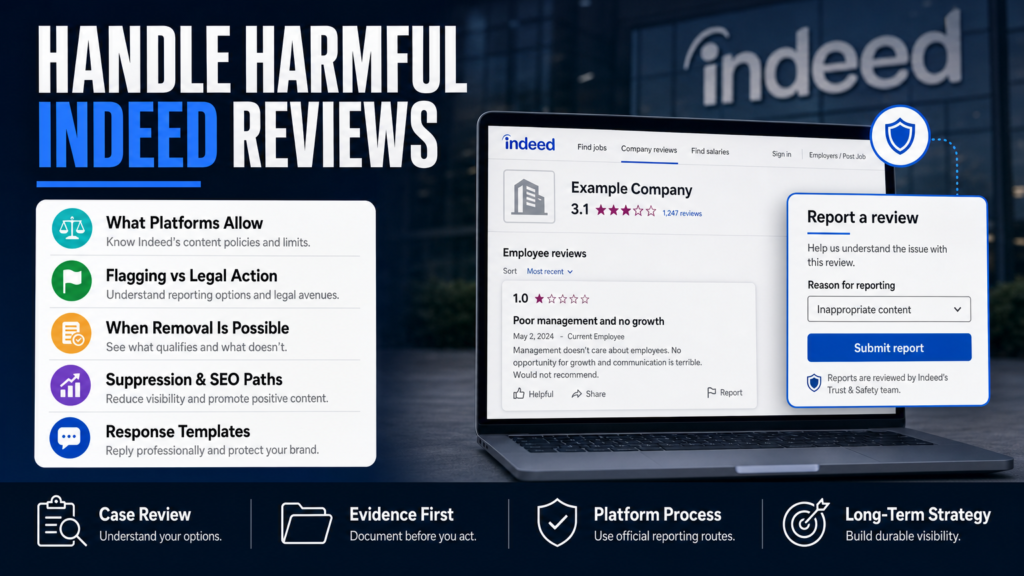
- 3. File a report through Indeed’s ‘Report a Review’ or Help Center, selecting the correct violation type.
- 4. If no action within a reasonable period, use the employer support contact or legal escalation channels.
- 5. Prepare a measured public response to the review to add context and show responsiveness.
- Document everything before you act.
- Use the platform’s reporting tools first—this is required for most successful removals.
- Escalate to legal counsel only with clear evidence of falsity, impersonation, or privacy invasion.
If the reviewer is anonymous but the statement is false
Indeed’s reviewers are often anonymous; that complicates direct contact. A subpoena can force platforms to disclose identity, but subpoenas require a legal process and a court order and are not guaranteed.
A qualified attorney can advise if the content may warrant legal review and whether a subpoena or defamation claim is appropriate given the evidence and jurisdiction.
- Subpoenas require counsel and a court process.
- Platforms may resist disclosure without clear legal basis.
- Consider the cost/benefit before pursuing identity subpoenas.
Is it illegal to delete negative reviews?
It is not illegal for a platform to remove content. Platforms routinely remove content that violates their terms of service. The legal issue arises when a business or an individual posts fake reviews or coordinate review manipulation—those practices may violate consumer protection and state laws.
We never recommend deceptive or retaliatory tactics. Removal depends on platform policy and legal standards, and the content may warrant legal review if it includes false factual statements presented as fact, impersonation, or privacy violations.
- If you suspect illegal activity (fake reviews, doxxing, extortion):
- 1. Document and preserve evidence.
- 2. Notify the platform using documented flows.
- 3. Consult a qualified attorney about potential civil or criminal remedies.
- Platforms can remove content under their terms; that’s their right.
- Posting fake positive reviews or paying for removals can trigger penalties or platform sanctions.
- Using threats or extortion to coerce a reviewer to remove a review can create criminal exposure.
When a review may be defamatory
Defamation claims require showing a false factual statement and demonstrable harm; opinions are generally protected. Whether a post is defamatory depends on the statement, the proof you have, and applicable law.
A qualified attorney can determine whether a legal claim may be available. We coordinate with qualified legal professionals when a matter requires legal analysis.
- Statements of opinion (e.g., “I dislike working there”) typically aren’t defamatory.
- Claims of criminal conduct or professional malpractice, if false, may be actionable.
When removal isn’t available: suppression and mitigation
When a removal request fails—because the review is an opinion or does not clearly violate policy—you still have effective options. We develop SEO reputation strategies intended to improve the visibility of relevant and credible information and reduce the prominence of a single negative item.
Suppression and mitigation usually combine public responses, SEO, fresh authoritative content, and monitoring to reduce visibility of the complaint over time.
- 1. Respond professionally and briefly to the review (acknowledge, invite offline resolution).
- 2. Produce authoritative content: client testimonials, staff profiles, news coverage.
- 3. Optimize and publish the new content on high‑authority domains (own website, LinkedIn, industry press).
- 4. Use reputation monitoring to detect and respond to future items quickly.
- Respond publicly with a short, factual reply to show hiring managers and clients you take concerns seriously.
- Create and promote positive, factual content (careers page, staff bios, Google Business Profile updates).
- Use first‑page SEO and content promotion to push negative items lower in search results.
When to use paid suppression tactics
Paid promotion of positive content (sponsored posts, targeted PR) can accelerate visibility gains, but search algorithms and user behavior remain outside our control.
For more on the cost/benefit of prioritizing a single damaging review, read What a One-Star Review Really Costs Your Practice.
- Paid tactics can help short-term visibility but are not permanent guarantees.
- Combining organic SEO with paid promotion typically produces better, more durable results.
How long can you remove negative reviews on Indeed — timelines and expectations
There is no universal timeline for removal. Timing depends on the platform, publisher, evidence, legal complexity, and search‑engine behavior. Some cases may begin to show changes within a general estimated range, but no universal timeframe applies.
Expect initial platform review responses to take from a few days up to several weeks; legal processes (subpoenas, court orders) take substantially longer and have unpredictable outcomes.
- 1. File the report quickly—delays reduce the chance of early action.
- 2. Escalate with documentation if there is no response in 7–14 days.
- 3. Pursue mitigation simultaneously; suppression workflows can start immediately and are often faster than legal paths.
- Simple policy removals (doxxing, explicit threats): days to a few weeks.
- Complex disputes or legal takedowns: weeks to months (or longer).
- Suppression via SEO: measurable change in weeks to months, with ongoing work required.
Balancing urgency and resources
Decide whether to prioritize immediate suppression (PR/SEO) or pursue a slower legal route based on the review’s tangible harm. For regulated professionals—doctors, lawyers—rapid mitigation often matters more than a lengthy legal case.
If you want a practical primer on how a single negative review can affect local businesses and what to do first, see When One‑Star Google Reviews Threaten Your Practice.
- Start monitoring and public response right away.
- Reserve legal escalation for clear-cut privacy, impersonation, or false factual claims backed by evidence.
Can employers give you a bad review on Indeed and can employers respond?
Indeed is primarily a site for employee reviews of employers, not for employers to rate individual employees. Employers do not have a public mechanism to post negative ‘reviews’ of applicants; they can post job ads and employer responses, but not employee ratings in the same way.
Employers can, however, respond to reviews left on their company page. Employer responses are public and should be used to show professionalism and to correct factual errors without violating privacy or making retaliatory statements.
- 1. Verify or claim your employer profile on Indeed so you can post responses.
- 2. Draft short responses: acknowledge, state steps taken, invite offline resolution.
- 3. Avoid repeating reviewer allegations or publishing confidential information.
- Employers cannot use company review pages to post negative reviews of job candidates.
- Employer responses to reviews are visible and should always be factual and measured.
- Retaliatory or harassing responses can create additional policy or legal issues.
Sample employer response formula
Use a three‑part structure: (1) thank the reviewer for the feedback, (2) correct or clarify facts succinctly, (3) provide an offline contact for resolution.
Example: “Thank you for sharing your experience. We take claims like this seriously—please contact HR at hr@company.com so we can investigate. We value feedback and are committed to improving.”
- Keep responses under 150 words.
- Do not admit liability or repeat accusations as facts.
Removal vs Suppression: Which Path to Choose
Quick comparison to help choose the right initial approach when faced with an Indeed review.
| Removal | Suppression / Mitigation |
|---|---|
| Goal | Goal |
| Eliminate the offending content from the platform | Reduce visibility and impact without deleting the content |
| Best when policy or law is clearly violated | Best when content is opinion or not removable |
| Requires evidence and platform or legal action | Requires SEO, content creation, and PR tactics |
| Potentially faster for clear policy violations | Usually faster to start; results accumulate over weeks/months |
| Outcome controlled by platform or court | Outcome influenced by content quality and promotion |
Hypothetical: Clinic Response and Mitigation Workflow
A mid‑sized clinic sees a one‑star Indeed review alleging negligence. The clinic cannot confirm the reviewer’s identity and the post includes no obvious policy violation. Here’s a realistic sequence the clinic follows.
We never present hypothetical examples as completed client engagements; this is an anonymized scenario to show decision points, documentation, and outcomes you can expect when removal is uncertain.
- 1. Day 0–2: Capture evidence, assign internal owner, draft public response inviting contact.
- 2. Day 3–14: File platform report and follow up with employer support if needed; monitor for platform action.
- 3. Week 1–12: Publish high‑quality content (patient safety policy, staff bios, Google updates), promote via social and local press to push negative review lower in searches.
- 4. Month 1–3: Monitor search results; consider limited paid promotion if visibility remains harmful. Legal review only if the review contains demonstrably false factual claims causing substantial harm.
- Document: screenshots, date/time, internal scheduling records showing no relevant appointment.
- Attempt platform route: flag for privacy/falsehood—no removal because it’s expressed as opinion and lacks clear false factual claim.
- Mitigate: respond on Indeed, publish a corrective FAQ on the clinic site, and boost authoritative content via targeted PR and SEO.
Common Mistakes Employers and Professionals Make
Avoid common, costly errors that slow resolution and sometimes worsen the situation. Each subsection names a mistake and explains how to fix it.
Public Shaming or Attacking the Reviewer
Emotional or retaliatory responses escalate the situation and can attract more attention. They also make your organization look defensive to third‑party readers.
- Fix: Use short, factual responses and invite offline resolution.
Demanding Removal Without Evidence
Asking a platform to remove a review because it’s ‘unfair’ rarely works. Platforms require policy or legal grounds.
Fix: Gather and present clear evidence tied to a stated policy violation.
- Fix: Document specifics (dates, communications) that show falsity or policy breach.
Posting Fake Positive Reviews
Buying or fabricating positive reviews can violate platform terms and consumer protection laws and worsen your reputation if discovered.
Fix: Encourage legitimate satisfied clients to leave reviews, and diversify the sources (Google, LinkedIn, industry sites).
- Fix: Use legitimate, opt‑in review collection processes and documented consent.
Ignoring the Issue
Failing to respond lets negative impressions calcify in hiring managers’ minds. A well-crafted response often mitigates damage.
Fix: Assign monitoring, respond promptly, and implement a suppression plan if removal fails.
- Fix: Use reputation monitoring and set alerting thresholds for new reviews.
Rushing to Legal Threats
Threatening legal action prematurely can backfire and may not be effective without evidence. Legal options are valid but require counsel and a cost/benefit assessment.
Fix: Consult qualified counsel, document harm, and pursue legal steps only when justified.
- Fix: Consider mediation or platform escalation before court filings.
Best Practices For Managing Indeed Reviews
These focus on durable, lawful, and practical actions that reduce harm and protect future reputation.
Document Everything Immediately
Before you do anything online, capture screenshots, URLs, dates, and internal records that contradict or contextualize the review. Preservation increases your options later (platform escalations or legal review).
- Save full-page screenshots and store them in an internal incident folder.
- Record business impacts (lost interviews, canceled contracts) with dates and contacts.
Use Platform Reporting Correctly
Select the correct policy violation, supply evidence, and keep your submission factual. Platforms act on policy matches, not on how ‘unfair’ something seems.
We use the official reporting and review processes made available by platforms and follow platform guidance for escalation.
- Attach screenshots and the review URL in reports.
- Follow up if you receive no response in the platform’s stated timeframe.
Respond Publicly, But Carefully
A short, professional public reply reassures prospective clients or hires that you take complaints seriously. Avoid technical legal language, admissions of liability, or revealing confidential details.
- Acknowledge, offer a private contact, and state you’re investigating.
- Keep replies concise (2–4 sentences).
Implement SEO Suppression
When removal isn’t available, prioritize publishing authoritative content (news, staff bios, client success stories) and optimizing your Google Business Profile and LinkedIn presence.
Results vary according to the strength of negative content and authority of competing sources; we develop SEO reputation strategies intended to improve the visibility of credible information.
- Publish pages with targeted keywords and promote them via social or earned media.
- Encourage real clients to review on multiple platforms to dilute a single negative item.
Monitor Continuously
Set up alerts for your company name, key staff, and critical search terms. Rapid detection shortens response time and reduces long‑term impact.
Combine automated alerts with monthly manual checks of major review sites.
- Use monitoring tools and set human review thresholds.
- Review metrics monthly and revisit strategy every quarter.
Expert Tips
- Always capture full‑page screenshots including the URL—platforms can remove or alter listings and you’ll need proof.
- Never threaten a reviewer publicly; legal escalation should be handled through counsel and private channels.
- Prioritize fixing real operational issues that cause negative reviews—systemic fixes reduce future incidents.
- Ask satisfied clients to leave reviews across multiple platforms to diversify your review footprint.
- Keep employer responses brief, factual, and invitational—invite the reviewer to continue offline.
- If identity disclosure is essential, consult an attorney about subpoenas before filing anything that presumes identity.
- Measure suppression efforts with rankings for the reviewer’s name and review URL, not only with overall traffic.
- When in doubt, document and mitigate first; legal action is a last resort and can be slow and expensive.
Conclusion
Can you remove negative reviews on Indeed? Sometimes—but not always. Platforms remove content that breaks their rules or where law supports removal; honest opinions and many complaints will remain. What you control are the process, evidence, and the strategic response.
Start with documentation and platform reporting, respond professionally, and run parallel mitigation (SEO, PR, monitoring). If the content includes privacy violations, impersonation, or provably false factual claims, engage counsel for evaluation. Every case is different—an estimated timeline and approach should follow an individual assessment.
Why Businesses Choose Your Reputation Agency
Managing your reputation takes more than monitoring reviews or publishing the occasional blog post. It takes a strategy built around your situation, your industry, and what is actually showing up in search.
Your Reputation Agency works with businesses, executives, healthcare professionals, attorneys and growing brands. Our services include:
- Remove or suppress negative search results and news articles from Google
- Review removal and remediation (Google, Yelp, Facebook, Trustpilot, industry sites)
- Data broker and people-search opt-outs to remove personal information
- Mugshot and arrest-record removal or suppression
- Takedowns of defamatory, false, or malicious posts (social, blogs, forums)
- Online crisis management and rapid-response reputation repair
- Impersonation and fake account removal on social platforms
- Reputation monitoring, alerts, and ongoing surveillance
- First-page SEO and suppression strategies to bury negative content
- Digital security audits and privacy hardening to prevent future exposure
Frequently Asked Questions
1. Can employers remove bad reviews on Indeed?
Employers can report reviews that violate Indeed’s policies and ask for removal, but they can’t delete reviews at will. If a review includes doxxing, threats, impersonation, or other policy breaches, provide clear evidence in your report. Otherwise, the realistic options are to respond publicly and pursue mitigation strategies.
2. How can I get a negative review removed?
You can request removal by reporting the review to Indeed with evidence showing a policy or legal violation—screenshots, URLs, and documentation. If the review is an opinion or lacks a clear policy breach, removal is unlikely and suppression/response strategies are the practical path.
3. How to get a review removed from Indeed?
Claim your employer profile, capture evidence, use Indeed’s ‘Report’ tool with precise policy citations, and follow up via employer support. If no action is taken, consider legal counsel for serious privacy or false‑statement cases; subpoenas or court orders are possible but not guaranteed.
4. Is it illegal to delete negative reviews?
It’s not illegal for platforms to remove reviews per their terms. What can be unlawful is posting fake reviews, coercing removals, or using threats to force a reviewer to delete a post. Always avoid deceptive or retaliatory tactics and consult counsel for legal questions.
5. Can employers give you a bad review on Indeed?
Indeed is designed for employees to review employers, not for employers to post ratings about job candidates. Employers don’t have a public mechanism to post negative ‘employee reviews’ on the company review pages; they can, however, publicly respond to reviews left about their company.
6. How long does Indeed take to remove a review?
There’s no fixed timeline. Simple policy removals (privacy violations, threats) can be handled in days to weeks; legal processes take much longer. Timing depends on the platform’s workload, the clarity of the violation, and whether legal steps are required.
7. What if Indeed refuses to remove a review?
If Indeed refuses, document the refusal, continue mitigation (public response, SEO, and PR), and consult an attorney if the review contains provably false statements, impersonation, or privacy violations that justify legal action.
8. Are Indeed reviews truly anonymous?
Reviewers often appear anonymous to the public, but platforms may retain identifying data. Disclosure of reviewer identity typically requires a legal process like a subpoena and is only available when justified under law and platform policy.
9. Can I hire a reputation agency to help?
Reputation firms can evaluate removal prospects, file and follow up on platform reports, craft responses, run suppression SEO campaigns, and coordinate with legal counsel. We evaluate whether the content may qualify for removal or review and pursue the legal, technical, platform, and reputational options available—never promising guaranteed removal or specific timelines.
This content provides general information and does not constitute legal advice. The available options and likely outcomes depend on the facts, evidence, platform policies, applicable law, jurisdiction, and public-interest considerations.
Past examples do not guarantee future results. Removal, correction, deindexing, and search-position changes depend on third parties and circumstances outside Your Reputation Agency’s control.